
Spaced repetition explained
Why the right review interval is what locks in mastery-level Hindi vocabulary instead of cramming
You have C1 Hindi. You read Hindi newspapers fluently, write a structured essay, switch between colloquial and formal registers, and follow a literary novel with effort. C2 is where the effort drops away. The mental work of monitoring your Hindi fades, you reach for the right तत्सम word in formal prose and the right Persianate word in lyric writing without thinking, and your Hindi stops reading as translated.
Hindi has no widely used C2 CEFR exam, but a mastery-level vocabulary still has a shape. This guide covers the 2,000+ items that close the gap between advanced and near-native Hindi: the Sanskritised शुद्ध हिन्दी register that dominates serious written Hindi, the literary lexis of Premchand, Mahadevi Verma, and Renu, the dense muhavare and lokoktiyan of editorial Hindi, the academic vocabulary of Hindi scholarship, the compound verb precision that signals native fluency, the political and media commentary vocabulary of Lok Sabha and Hindi journalism, and the Persianate ghazal-influenced register that Bollywood and Hindi-Urdu poetry assume.
Each of the seven phases below includes a ready-to-use AI prompt. Paste it into MindCards and your first deck for that topic builds in seconds. Spaced repetition then schedules each card at the right interval, so review time lands on the items you are actually forgetting and skips past the ones you have already locked in.
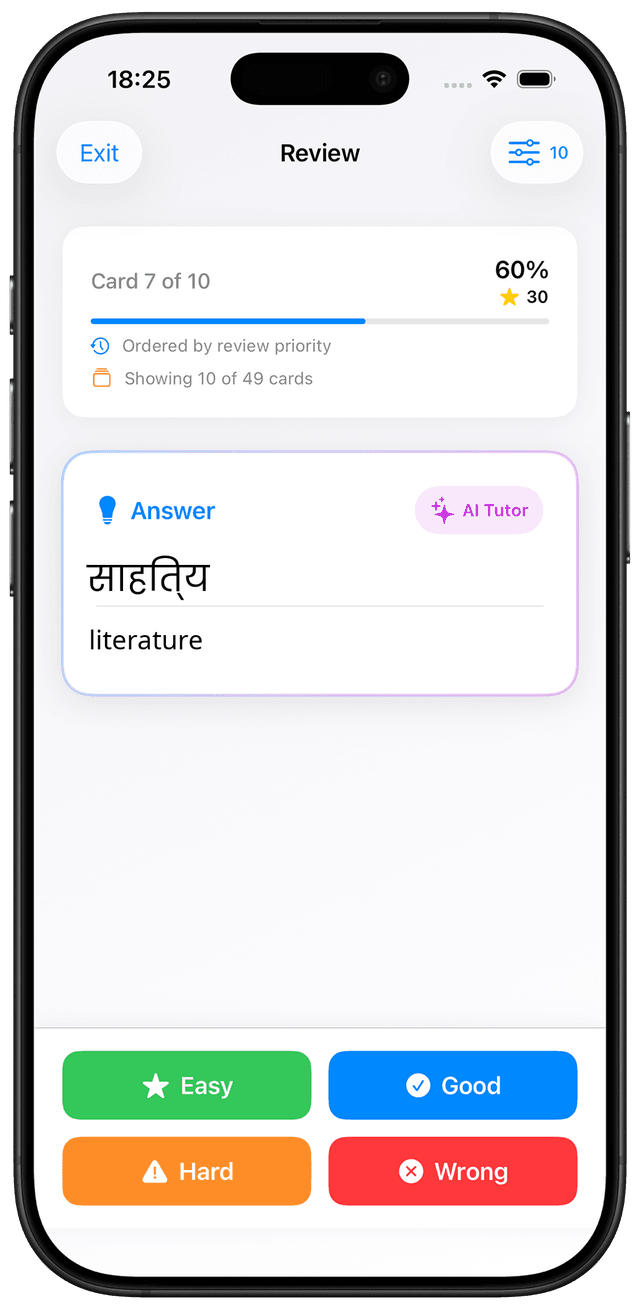
C1 introduced तत्सम vocabulary as a stylistic option. At C2, शुद्ध हिन्दी is the default for any serious written register: Doordarshan news scripts, parliamentary speeches, academic monographs, and high literary prose. The most common Hindi words have three or four parallel forms across रजिस्टर levels, and a C2 user picks the right one without effort. हवा, वायु, पवन, समीर. आग, अग्नि, पावक, अनल. दिन, दिवस, वासर, अह्न. Knowing the form is C1. Choosing the form by the demand of the context is C2.
Why start here? Sanskritised lexis is the single biggest marker separating educated written Hindi from spoken Hindi. UGC NET Hindi, the Sahitya Akademi reading list, and serious journalism in journals like हंस, वागर्थ, and नया ज्ञानोदय assume this vocabulary as background. Without it, even fluent Hindi reads as colloquial.
The strategy: Each card carries four register variants of the same idea: देशज, तद्भव, तत्सम, and a rarer literary synonym. You stop thinking word by word and start thinking by register layer.
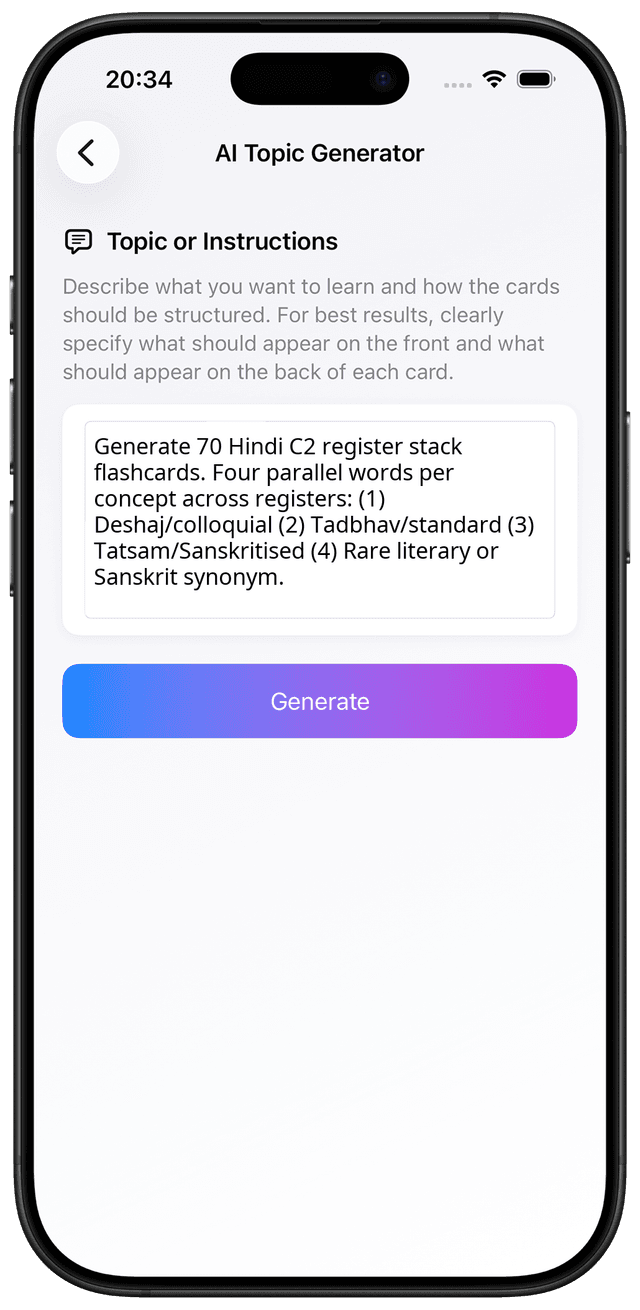
Generate 70 Hindi C2 register stack flashcards. For each concept give four parallel words across registers: (1) Deshaj/colloquial (2) Tadbhav/standard (3) Tatsam/Sanskritised (4) Rare literary or Sanskrit synonym. Cover 70 high-frequency concepts: fire (आग/अग्नि/पावक/अनल), wind (हवा/वायु/पवन/समीर), water (पानी/जल/नीर/सलिल), sun (सूरज/सूर्य/भानु/दिवाकर), moon (चांद/चंद्र/शशि/राकेश), eye (आंख/नेत्र/लोचन/चक्षु), face (मुंह/मुख/आनन/वदन), day (दिन/दिवस/वासर/अह्न), night (रात/रात्रि/निशा/यामिनी), road (रास्ता/मार्ग/पथ/वर्त्म), house (घर/गृह/आवास/निकेतन), king (राजा/नृप/भूपति/महीप). Front: Hindi colloquial form (Devanagari). Back: all four registers labelled, with one short Hindi sentence showing literary use.
Reading Premchand, Yashpal, Krishna Sobti, Phanishwar Nath Renu, Mahadevi Verma, or Bhisham Sahni in the original without leaning on a dictionary is the most reliable test of C2 Hindi. The vocabulary in गोदान, मैला आंचल, यामा, ज़िंदगीनामा, and तमस belongs to a literary register that sits between conversational Hindi and pure Sanskritised prose. Words like हुलस उठना (to swell with joy), विवश (helpless, compelled), अकुलाहट (restlessness), तजुर्बा (experience, with Persianate weight), जीवट (grit), पगडंडी (footpath through fields). Each carries a specific narrative function that a B2 paraphrase cannot reach.
The goal: To read 20th-century Hindi fiction at reading speed and feel the register choices the author is making, not just the plot. Premchand's irony depends on his lexis. Renu's आंचलिक texture depends on his lexis. Mahadevi's lyric prose depends on her lexis. C2 means catching those choices in real time.
The strategy: Cards draw from passages in major Hindi literary works of the 20th century. Each card carries a source line, the literary function of the word, and how the same term reads in non-literary contemporary use.
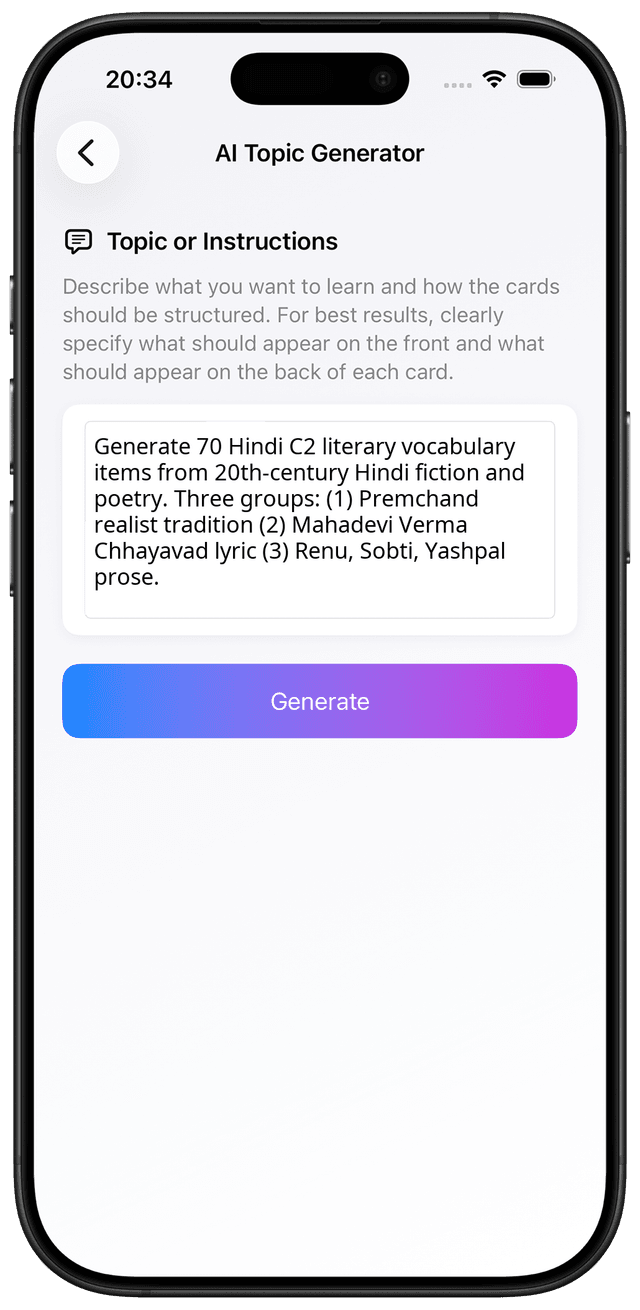
Generate 70 Hindi C2 literary vocabulary items drawn from 20th-century Hindi fiction and poetry. Three groups: (1) Premchand and the realist tradition: विवश, हुलसना, अकुलाहट, तजुर्बा, जीवट, पगडंडी, आसरा, मरम्मत, खुदगर्ज़, पुनीत, ओझल, कोफ़्त, बेगर्ज़, गुजर-बसर, सहूलियत. (2) Mahadevi Verma and the Chhayavad lyric register: अनुगूंज, पीड़ा, करुणा, मूक, निशीथ, अंतर्द्वंद्व, सिहरन, उद्वेग, मर्म, स्तब्ध, स्मृति. (3) Renu, Sobti, Yashpal and post-Independence prose: आंचलिकता, तमस, गहराई, कगार, झल्लाहट, बेबसी, खटास, अबोला, सन्नाटा, ठहराव, बेचैनी. Front: Hindi word and a short literary passage line. Back: English equivalent plus literary function label and the work it appears in.
C1 covered the muhavare that appear daily in Hindi newspapers and educated conversation. C2 adds the older, denser idioms that turn up in literary essays, political speech, court rhetoric, and दैनिक हिंदुस्तान or जनसत्ता opinion columns. नक्कारखाने में तूती की आवाज़ (a small voice drowned in noise). आम के आम गुठलियों के दाम (a double benefit). अंत भला तो सब भला (all's well that ends well). नाच न जाने आंगन टेढ़ा (a bad workman blames his tools). नौ नकद, न तेरह उधार (a bird in hand is worth two in the bush). At this level, the test is recognising the idiom under pressure and using it where it strengthens the argument rather than weakens it.
Why this matters: A correctly placed लोकोक्ति in a Hindi essay or speech can do more rhetorical work than several paragraphs of argument. UPSC essay graders and Hindi literature examiners reward this kind of fluency, and misuse stands out immediately. The same applies to UPSC Hindi optional answers and academic Hindi writing.
The strategy: Cards group the 100 most rhetorically powerful muhavare and lokoktiyan by communicative function: warning, irony, judgement, consolation, criticism. Each card carries an example of correct rhetorical use and a note on register.
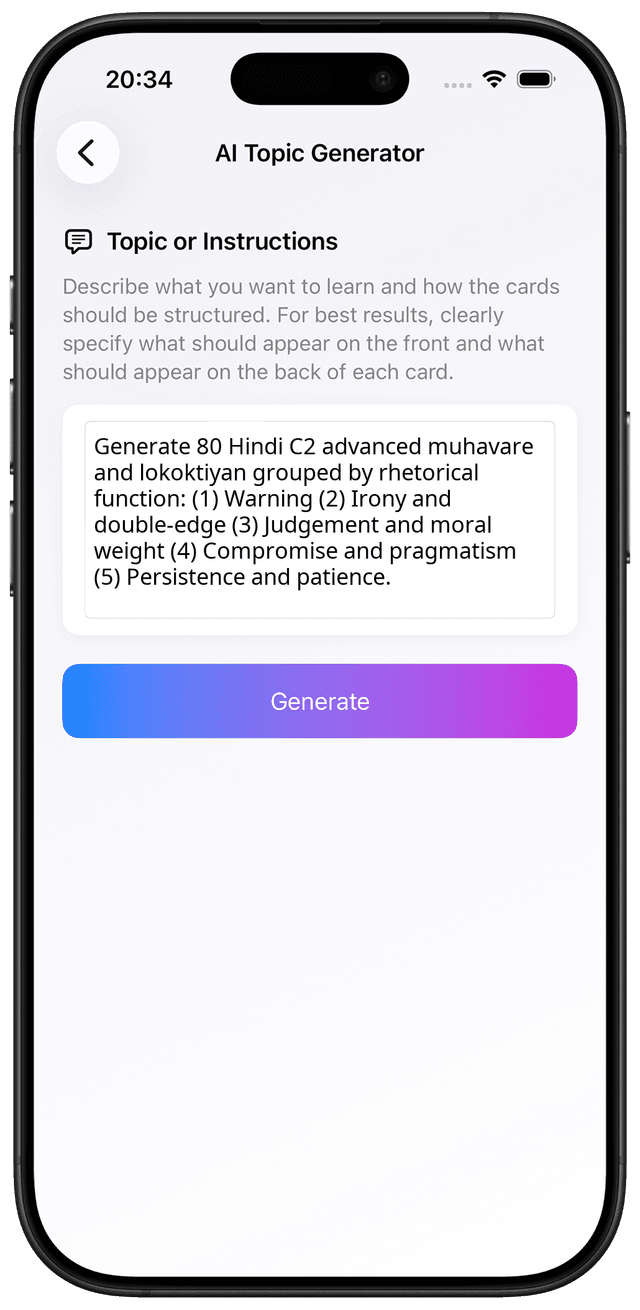
Generate 80 Hindi C2 advanced muhavare and lokoktiyan organised by rhetorical function. Five groups: (1) Warning and caution: नक्कारखाने में तूती की आवाज़, दूध का जला छाछ भी फूंक-फूंक कर पीता है, सांप भी मरे लाठी भी न टूटे, धोबी का कुत्ता न घर का न घाट का, हाथी निकल गया दुम रह गई. (2) Irony and double-edge: आम के आम गुठलियों के दाम, अंधा क्या चाहे दो आंखें, चोर की दाढ़ी में तिनका, नाच न जाने आंगन टेढ़ा, खोदा पहाड़ निकली चुहिया. (3) Judgement and moral weight: करनी का फल, जैसी करनी वैसी भरनी, बोए पेड़ बबूल का तो आम कहां से होय, अंत भला तो सब भला, जो गरजते हैं वो बरसते नहीं. (4) Compromise and pragmatism: नौ नकद न तेरह उधार, हींग लगे न फिटकरी रंग चोखा आए, थोथा चना बाजे घना, अधजल गगरी छलकत जाए. (5) Persistence and patience: रोम एक दिन में नहीं बना, धैर्य का फल मीठा होता है, करत-करत अभ्यास के जड़मति होत सुजान. Front: idiom (Devanagari) plus a rhetorical context sentence. Back: literal meaning, pragmatic use, and an English near-equivalent.
Hindi academic writing has a vocabulary of its own. JNU, BHU, Allahabad University, and the Sahitya Akademi all produce scholarship in Hindi where the lexis is dense, abstract, and largely तत्सम. Words like विश्लेषण (analysis), समीक्षा (review or critique), अधिमत (preferred view), संदर्भ (reference), अनुसंधान (research), प्रतिपादन (formulation), उपपत्ति (proof or established conclusion), अध्ययन-क्षेत्र (field of study). UGC NET Hindi and Hindi doctoral work assume command of this register at the level of being able to write in it, not just read it.
The goal: Active command of the 200 fixed phrases and abstract nouns that recur in Hindi scholarly writing: introductions, literature reviews, methodology sections, argumentation, citation, and conclusions. You should be able to draft a Hindi academic abstract or seminar paper without slipping into translated English structures.
The strategy: Cards group phrases by section of the scholarly text: introduction, हंगमा (problem statement), साहित्य समीक्षा (literature review), विधि (methodology), विश्लेषण (analysis), निष्कर्ष (conclusion). Each phrase is shown in a realistic sentence from an authentic academic context.
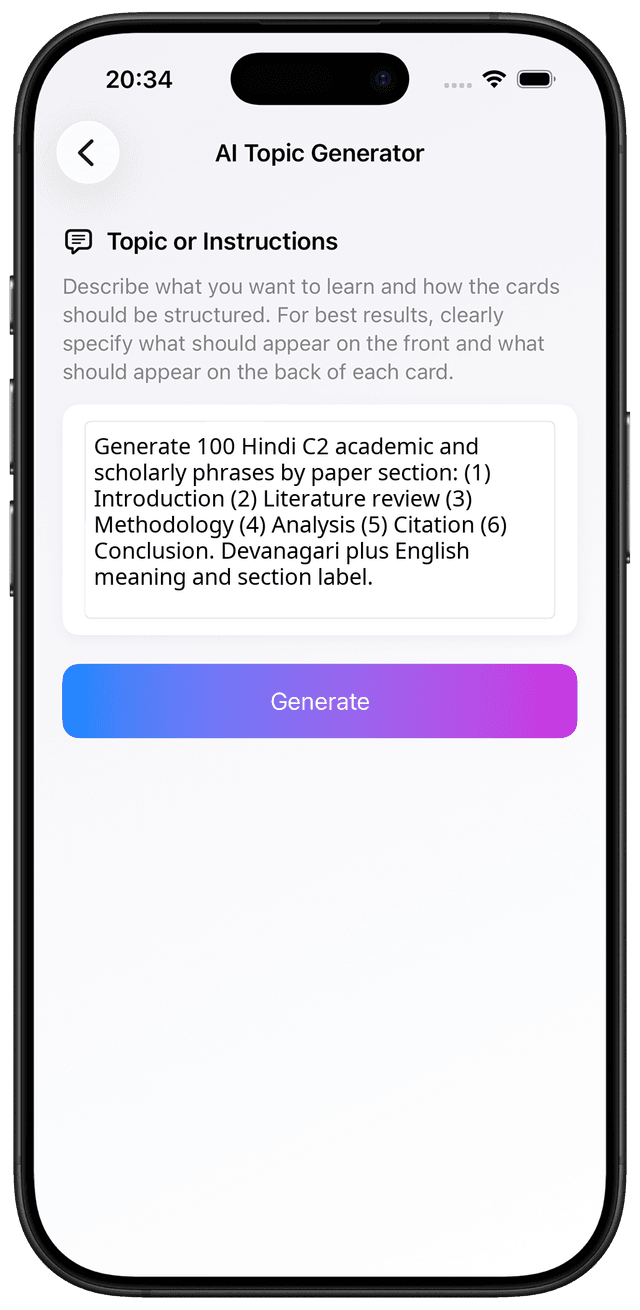
Generate 100 Hindi C2 academic and scholarly phrases for research writing. Six groups by paper section: (1) Introduction and problem statement: प्रस्तुत शोध-पत्र में, इस अध्ययन का उद्देश्य, समस्या यह है कि, इस प्रश्न को इस प्रकार रखा जा सकता है, मूल जिज्ञासा यह है. (2) Literature review: पूर्व अध्ययनों में देखा गया है कि, इस विषय पर महत्वपूर्ण कार्य हुआ है, अधिकांश विद्वानों का मत है कि, इसके विपरीत कुछ शोधार्थियों का मानना है, इस संदर्भ में डा० नामवर सिंह का योगदान उल्लेखनीय है. (3) Methodology: इस अध्ययन में गुणात्मक पद्धति अपनाई गई है, आंकड़ों का संग्रह, क्षेत्र-कार्य के माध्यम से, साक्षात्कार आधारित विश्लेषण. (4) Analysis: तर्क यह है कि, यह स्पष्ट करना आवश्यक है, उपर्युक्त उदाहरण यह दर्शाता है कि, इसका तात्पर्य यह है कि, इसका निहितार्थ यह है. (5) Citation and reference: यथोक्त, उद्धृत, संदर्भ ग्रंथ-सूची, फलस्वरूप, उपरोक्त के अनुसार. (6) Conclusion: निष्कर्षतः यह कहा जा सकता है, इस अध्ययन के निहितार्थ, आगे और शोध की आवश्यकता है, उक्त विश्लेषण से स्पष्ट है कि. Front: Hindi phrase (Devanagari). Back: English meaning and section label.
Hindi compound verbs (संयुक्त क्रिया) are the heart of fluent Hindi expression and the single grammar feature where intermediate learners produce the most awkward sentences. खाना, खा लेना, खा जाना, खा डालना, खा बैठना, खा निकलना each say something slightly different about completeness, intent, surprise, or affect. C2 mastery is the ability to pick the right vector verb (लेना, देना, जाना, डालना, बैठना, उठना, निकलना, पड़ना, रखना) without thinking, and to feel the meaning slide between सकर्मक and अकर्मक uses of the same root.
Why this matters: Compound verbs do not appear in textbook grammar lists, so they are often the last thing learners actually internalise. They are also the feature that most signals fluent Hindi to native speakers. Get them right and your Hindi reads as natural; get them wrong and even rich vocabulary cannot save the sentence. The same applies to the सकर्मक / अकर्मक distinction and the कर्मवाच्य (passive) and भाववाच्य constructions that turn up in formal Hindi.
The strategy: Cards present compound-verb minimal sets: same root, different vector verbs, with one sentence each so you learn the shade by feel rather than by rule.
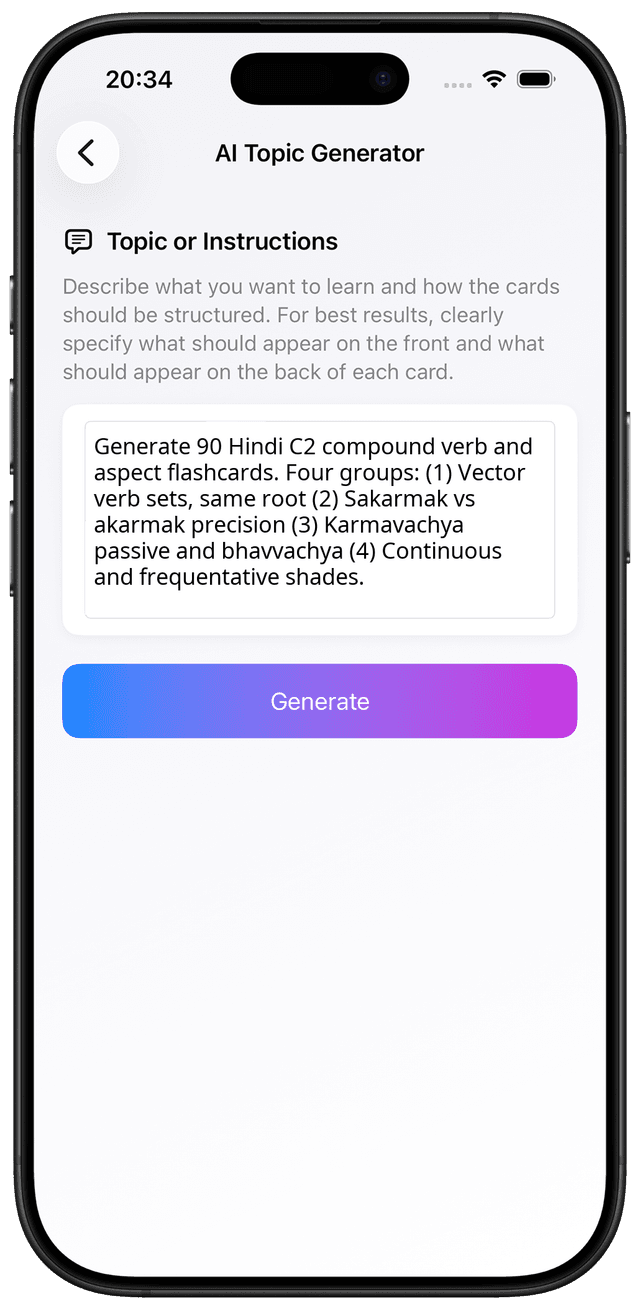
Generate 90 Hindi C2 compound verb and verbal aspect flashcards. Four groups: (1) Vector verb minimal sets, same root: खाना/खा लेना/खा जाना/खा डालना/खा बैठना; पढ़ना/पढ़ लेना/पढ़ डालना/पढ़ बैठना; कहना/कह देना/कह बैठना/कह डालना; गिरना/गिर पड़ना/गिर जाना; उठना/उठ बैठना/उठ पड़ना/उठ खड़ा होना. (2) Sakarmak vs akarmak precision: खुलना vs खोलना, पकना vs पकाना, बनना vs बनाना, बिकना vs बेचना, मिलना vs मिलाना, टूटना vs तोड़ना, छूटना vs छोड़ना. (3) Karmavachya (passive) and bhavvachya: किताब पढ़ी जाती है, यह काम किया जा चुका है, यहां हिंदी बोली जाती है, मुझसे चला नहीं जाता, इस विषय पर बहुत लिखा गया है. (4) Continuous and frequentative shades: करता रहता है vs कर रहा है vs किया करता है vs करता आ रहा है vs करने लगता है. Front: Hindi sentence (Devanagari) with the compound verb in context. Back: English translation plus the precise aspectual or transitive shade in one line.
C2 means following Ravish Kumar's prime-time monologue, an editorial in जनसत्ता, a Lok Sabha debate, or a Vinod Dua-style political column without effort. The vocabulary is specific: सत्ता-पक्ष and विपक्ष structures, बहुमत calculations, गठबंधन politics, संवैधानिक प्रावधान references, न्यायिक सक्रियता debates, गोदी मीडिया and वैकल्पिक मीडिया framings. Each carries political weight in current Hindi discourse, and knowing which word a writer or speaker is reaching for tells you their position before they spell it out.
The goal: Active command of the political and media commentary vocabulary that runs through Hindi journalism, parliamentary speech, and educated political conversation. UPSC essay writing, civil services Hindi interviews, and any journalistic Hindi role demand this layer.
The strategy: Cards group terms by their function in political discourse: institutional, procedural, ideological, journalistic, and rhetorical. Each card carries a real example sentence from a Hindi editorial or speech.
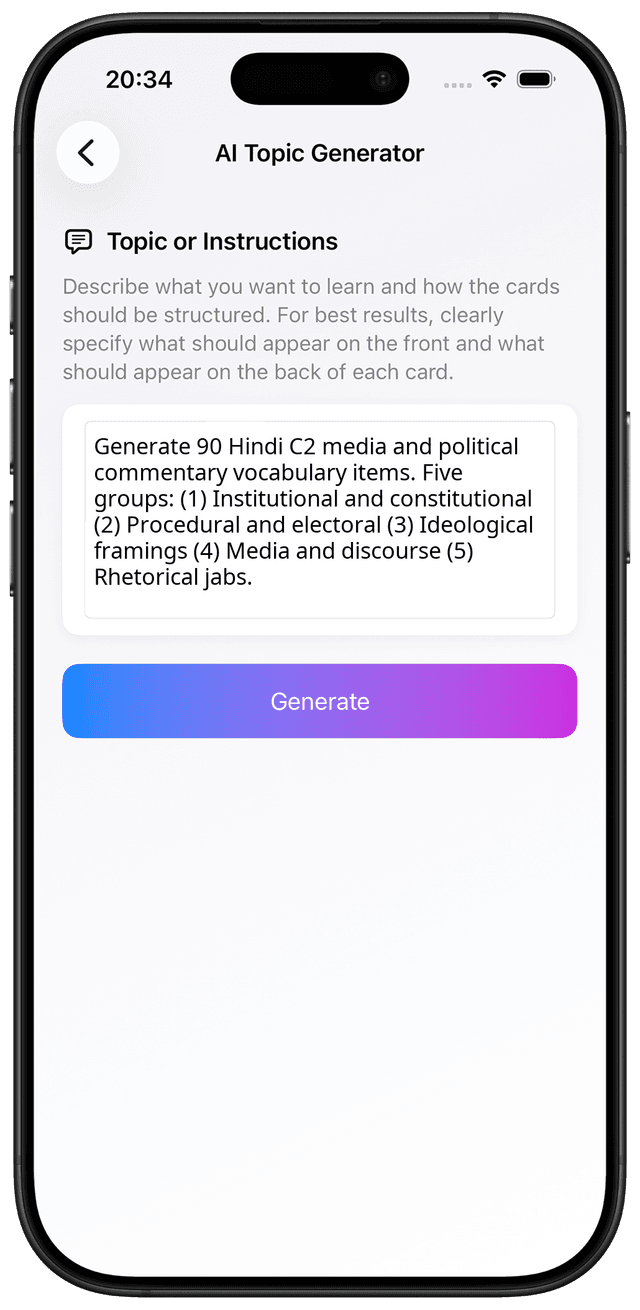
Generate 90 Hindi C2 media and political commentary vocabulary items. Five groups: (1) Institutional and constitutional: संसद, विधानसभा, राज्यसभा, संवैधानिक प्रावधान, मौलिक अधिकार, नीति-निर्देशक तत्व, न्यायिक समीक्षा, संघीय ढांचा, सत्ता का विकेंद्रीकरण, संवैधानिक संशोधन. (2) Procedural and electoral: बहुमत, अल्पमत, गठबंधन, अविश्वास प्रस्ताव, स्थगन प्रस्ताव, अध्यादेश, संसदीय समिति, दल-बदल विरोधी कानून, राष्ट्रपति शासन. (3) Ideological framings: वामपंथ, दक्षिणपंथ, धर्मनिरपेक्षता, बहुलवाद, सांप्रदायिकता, राष्ट्रवाद, उदारवाद, सुधारवाद, परिवर्तनकामी राजनीति. (4) Media and discourse: संपादकीय, टिप्पणी-कारिता, मीडिया विमर्श, गोदी मीडिया, वैकल्पिक मीडिया, खोजी पत्रकारिता, तथ्य-जांच, सूचना का अधिकार, पारदर्शिता, जवाबदेही. (5) Rhetorical jabs: कथित, तथाकथित, मुखौटा, ढोल पीटना, सत्ता का दलाल, जुमलेबाजी, बयानबाजी, खानापूर्ति, लीपापोती. Front: Hindi term plus an editorial-style example sentence. Back: English meaning plus a function label and connotation note.
Hindi at C2 reaches in both directions. The Sanskritised end gives you शुद्ध हिन्दी for academia and government. The Persianate end gives you the Urdu-influenced ghazal and Hindustani register for poetry, film lyrics, and a softer literary tone. Harivansh Rai Bachchan in मधुशाला, Sahir, Gulzar, Faiz read in Devanagari, Mahadevi's lyric Hindi, Bhisham Sahni's restrained prose. Each leans on a Persianate lexis: फ़ज़ा (atmosphere), हसरत (longing), नज़र (gaze), जुस्तजू (search), ख़ामोशी (silence), तन्हाई (solitude). A C2 reader switches between Sanskritised and Persianate registers based on the genre and feels the weight each carries.
The milestone: Completing this phase means your Hindi can move across the full literary range Bollywood and Hindi-Urdu poetry assume: from the Sanskritised abstraction of academic essays to the Persianate intimacy of a ghazal, with the everyday Khariboli of conversation sitting in between. This is what C2 Hindi looks like in practice.
Looking ahead: Beyond C2, the work shifts to specialised registers: legal Hindi (विधिक हिन्दी), administrative Hindi (राजभाषा), film and theatre script writing, and translation work. Every C2 card you lock in is one card less for those specialised tracks.
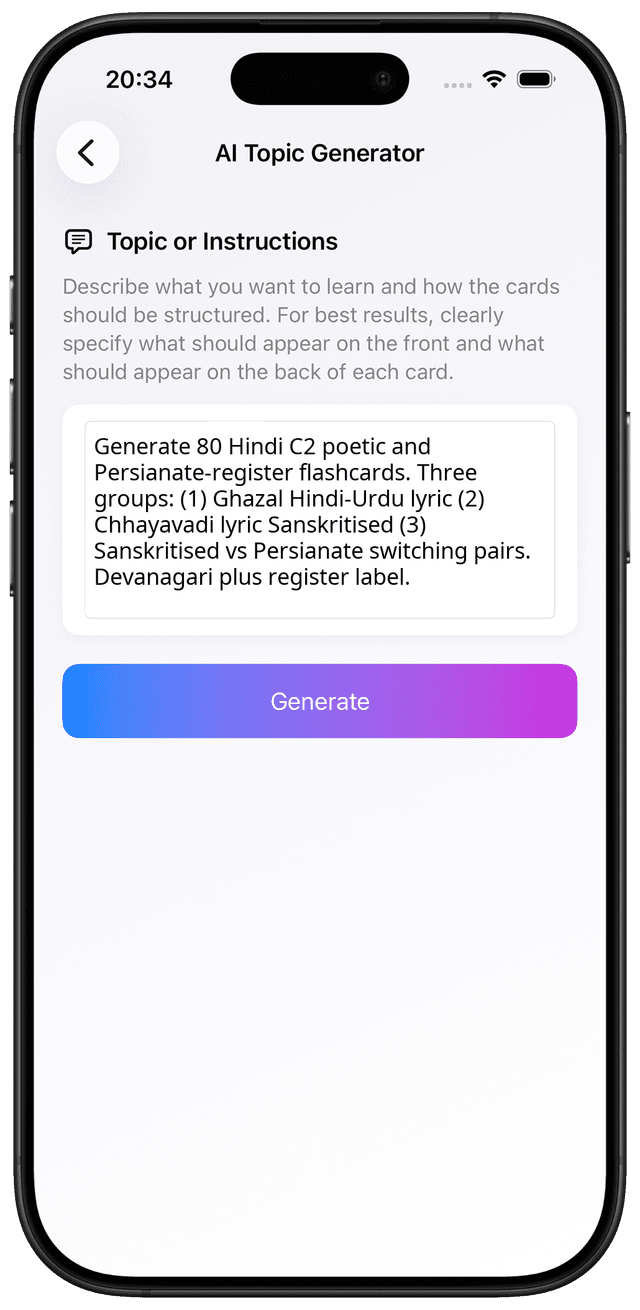
Generate 80 Hindi C2 poetic and Persianate-register flashcards. Three groups: (1) Ghazal and Hindi-Urdu lyric vocabulary in Devanagari: फ़ज़ा, हसरत, नज़र, जुस्तजू, ख़ामोशी, तन्हाई, सुकून, बेताबी, बेरुख़ी, सिलसिला, कशिश, ख़्वाहिश, अदा, इश्क़, मोहब्बत, रंजिश, गुफ़्तगू, मंज़र. (2) Chhayavadi lyric Sanskritised: निशीथ, सिहरन, अनुगूंज, मूक, मर्म, स्तब्ध, करुणा, पीड़ा, उद्वेग, अंतर्द्वंद्व, स्मृति, क्षणिक, शाश्वत. (3) Switching pairs (same idea in Sanskritised vs Persianate register): प्रेम/मोहब्बत, स्मृति/याद, मौन/ख़ामोशी, एकांत/तन्हाई, अभिलाषा/हसरत, खोज/जुस्तजू, वातावरण/फ़ज़ा, दृष्टि/नज़र, शांति/सुकून, इच्छा/ख़्वाहिश. Front: Hindi word (Devanagari) plus a one-line ghazal or chhayavad-style example. Back: English meaning, register label (Persianate or Sanskritised), and a switching counterpart.
At C2 the vocabulary you are still missing is less frequent and more context-dependent than at any earlier level. A तत्सम word might appear once in a 5,000-word Hindi essay, and a literary phrase might surface twice in a 400-page novel. Spaced repetition is built for this. The cards you keep forgetting come back more often, the ones you have locked in quietly drop back, and your study time lands where it actually moves the needle.
C2 builds directly on C1. Use the links below to review the prerequisite level or return to the full Hindi guide.
Copy any prompt from this guide into MindCards and your first C2 Hindi deck is ready in seconds. No account needed. The app is free on iOS.