
Spaced repetition explained
Why reviewing at the right interval locks in advanced Hindi vocabulary faster than re-reading.
You have B1. You can hold a conversation, get through most everyday situations, and read a simple Hindi text. B2 is where the language stops feeling like an effort. Formal Hindi that required active translation starts arriving more directly. You can follow a news editorial, write a formal letter, and engage with academic or political content in Hindi.
B2 covers roughly 4,000 words in total. This guide focuses on the structures and vocabulary that actually move your Hindi forward: passive constructions for reading official and formal text, conditional mood for hypothetical argument, nominalisation for formal register, advanced conjunctions for complex sentences, and collocations that make your Hindi sound natural rather than just grammatically adequate.
Seven phases with copy-paste prompts for MindCards. Each one builds a focused flashcard deck. Spaced repetition then schedules each card just before you are likely to forget it, so you retain more with less time spent reviewing.
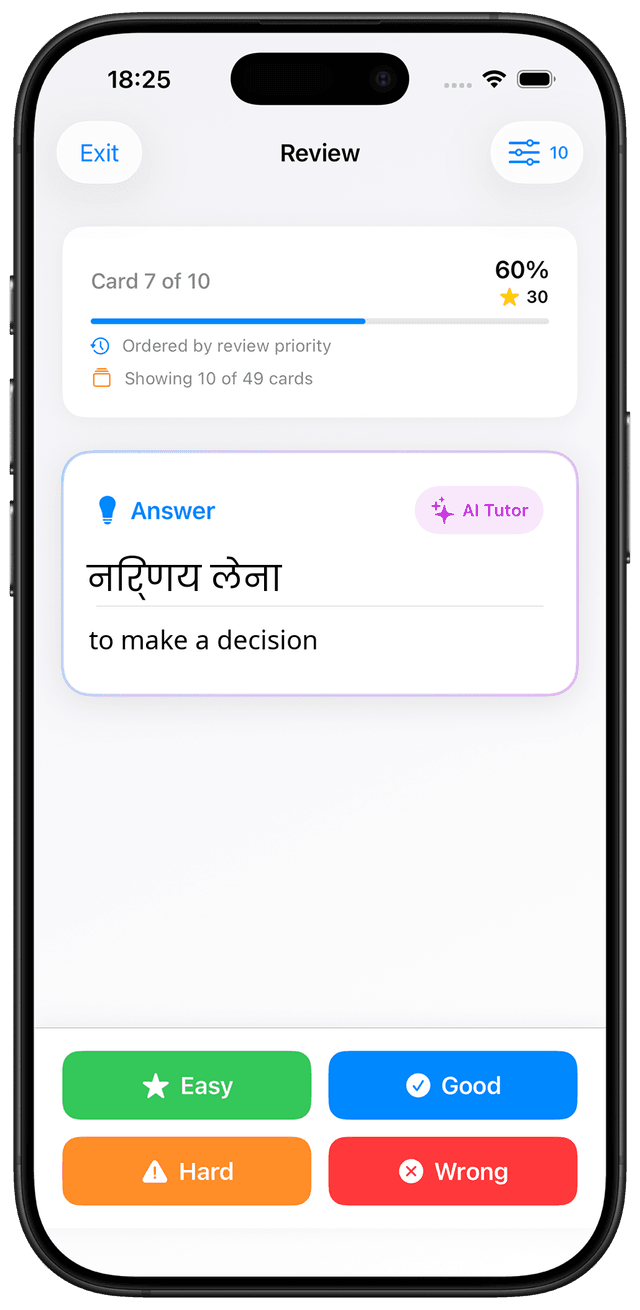
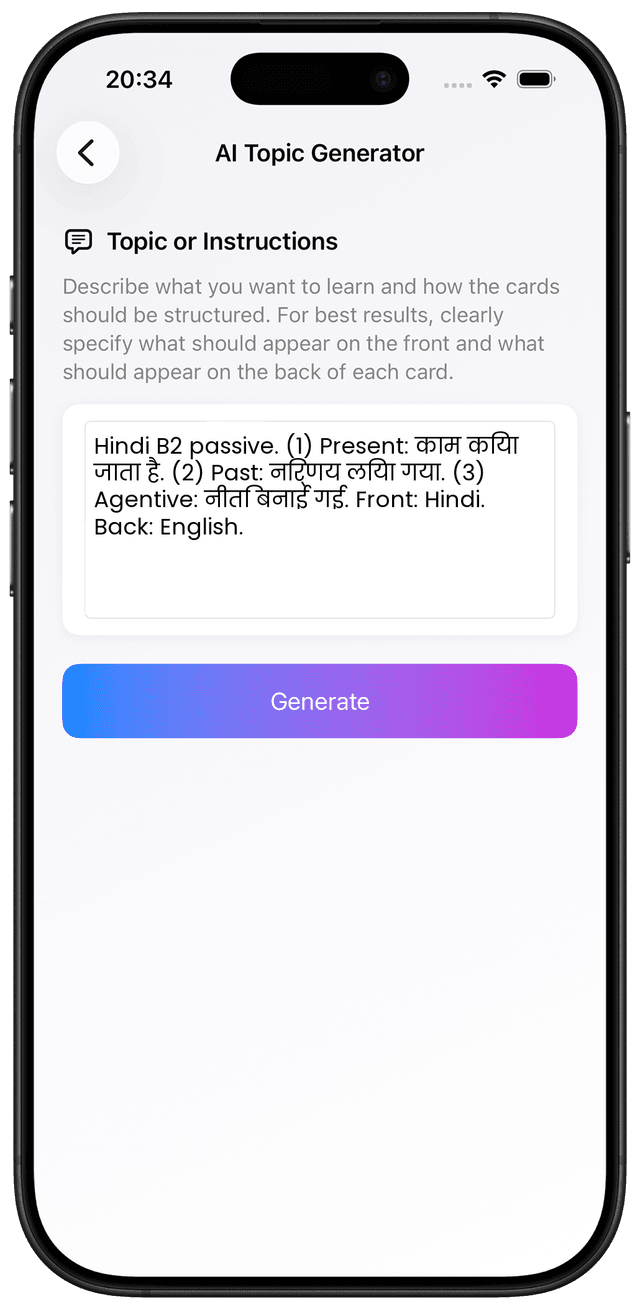
Hindi passive constructions use the verb जाना with the past participle to form the passive: काम किया जाता है (the work is done), पत्र लिखा गया (the letter was written). Unlike English, the agent can be dropped entirely or introduced with के द्वारा or से. Formal and official Hindi uses passive voice extensively, so not knowing it means large parts of written Hindi stay opaque.
Why start here? Passive voice separates B1 from B2 Hindi in written contexts. News reports, government notices, academic papers, and formal correspondence all favour passive constructions. Once you recognise the pattern, you can follow official Hindi without mentally unscrambling every sentence.
The strategy: This deck focuses on the most frequent passive patterns with transitive verbs, including both impersonal and agentive forms, so you can both read and produce formal passive Hindi.
Generate 60 Hindi B2 passive voice examples. Three groups: (1) Present habitual passive: काम किया जाता है, पत्र भेजा जाता है, खाना बनाया जाता है. (2) Past passive: पत्र लिखा गया, बैठक आयोजित की गई, निर्णय लिया गया. (3) Agentive passive with के द्वारा: सरकार के द्वारा नीति बनाई गई, समिति के द्वारा रिपोर्ट तैयार की गई. Front: Hindi sentence (Devanagari). Back: English + passive pattern label.
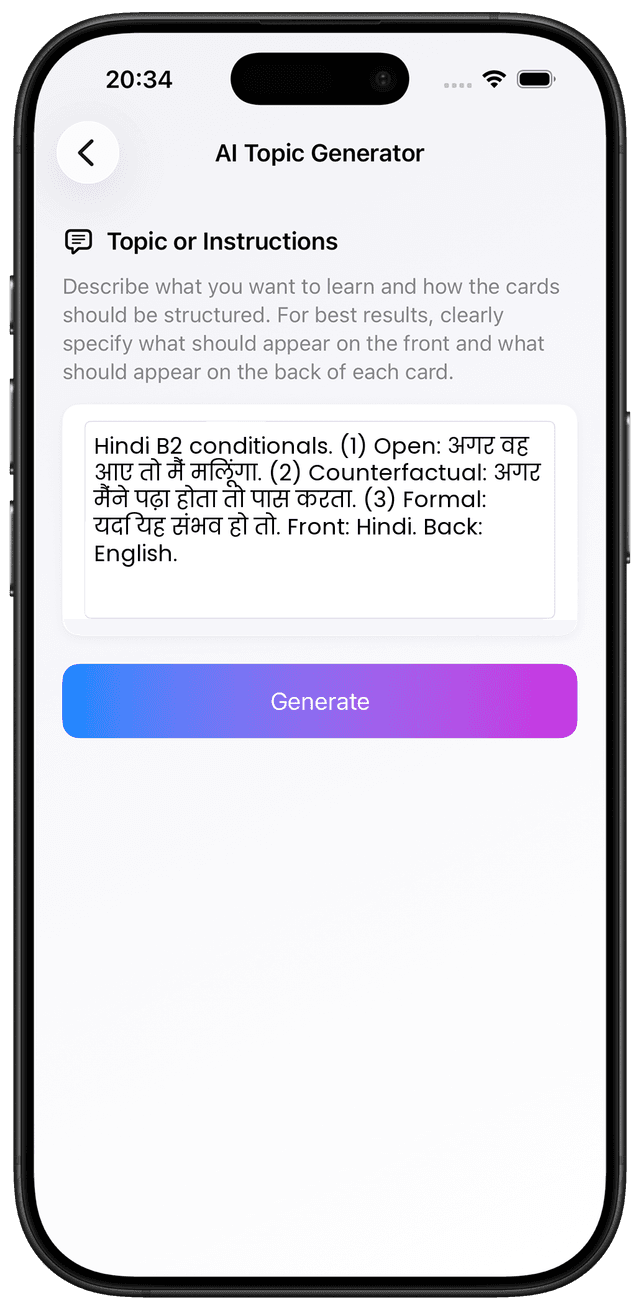
Hindi conditionals use अगर or यदि with the subjunctive for open conditions (अगर वह आए तो अच्छा होगा) and a past-form pattern for counterfactuals (अगर वह आता तो मैं मिलता). The counterfactual construction, expressing what would have happened if things had been different, is one of the clearest markers of B2 Hindi and appears in formal argument, literary writing, and political discourse.
Why this matters: Conditionals let you speculate, argue hypothetically, and discuss alternative outcomes. Without them, you can only state what did or will happen. Getting counterfactuals right also signals grammatical sophistication that listeners and readers notice.
The strategy: This deck separates open conditions from counterfactuals and drills each pattern with high-frequency verbs before expanding into the complex conditional sentences found in formal Hindi.
Generate 60 Hindi B2 conditional examples. Three groups: (1) Open conditions with अगर + subjunctive: अगर वह आए तो मैं मिलूंगा, अगर पैसे हों तो यात्रा करें. (2) Counterfactuals (past-form): अगर वह आता तो मैं मिलता, अगर मैंने पढ़ा होता तो परीक्षा पास करता. (3) Formal conditionals with यदि in written Hindi: यदि यह संभव हो तो, यदि कोई आपत्ति न हो तो. Front: Hindi sentence (Devanagari). Back: English + condition type label.
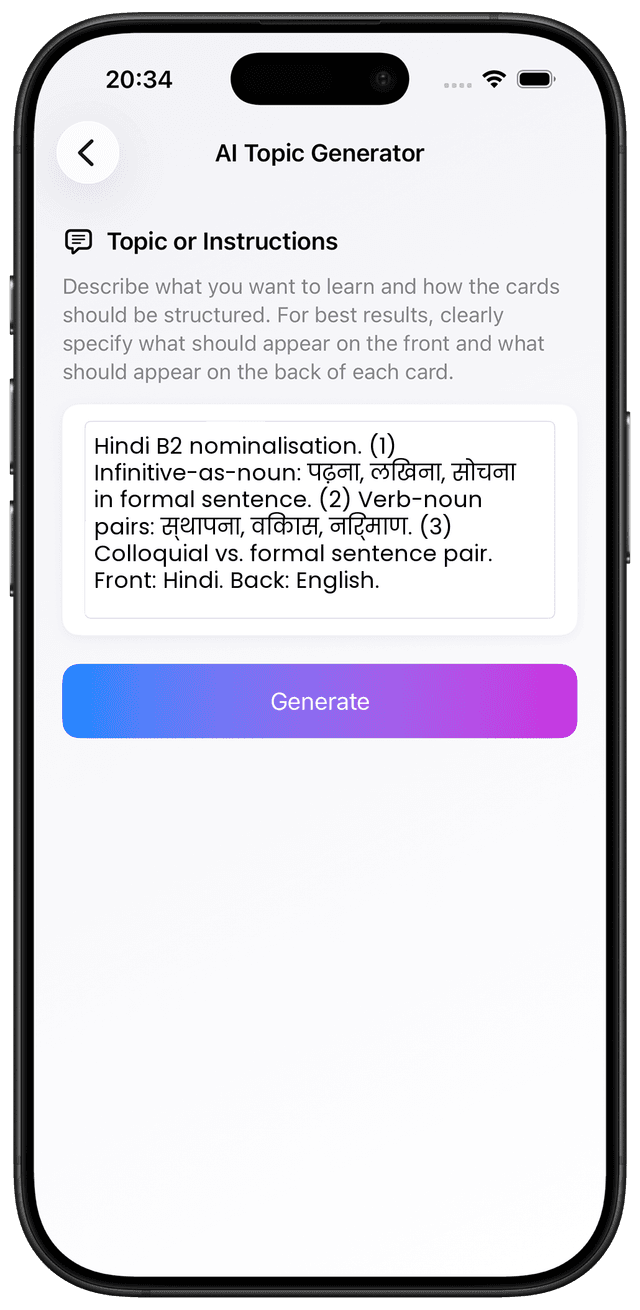
Formal Hindi writing converts verbs into nouns using the infinitive form as a noun (पढ़ना अच्छा है) or through standard suffixes that produce abstract nouns: शिक्षा (from शिक्षा-related roots), विकास, स्थापना, निर्माण. Newspapers, policy documents, and academic texts use this extensively. Reading formal Hindi without recognising these nominal forms means missing the core argument structure of a sentence.
Why add this now? Nominalisation is the single biggest stylistic difference between conversational and written Hindi. B2 reading tasks require you to parse dense nominal phrases. Producing them yourself is what shifts your writing from intermediate to upper-intermediate.
The strategy: This deck pairs verbs with their nominal counterparts in both colloquial and formal example sentences, so you can see the register shift and learn to make it deliberately.
Generate 60 Hindi B2 nominalisation pairs. Three groups: (1) Infinitive-as-noun: पढ़ना, लिखना, सोचना, समझना, बोलना each in a formal sentence. (2) Verb-to-abstract-noun pairs: स्थापित करना/स्थापना, विकसित करना/विकास, निर्माण करना/निर्माण, शासन करना/शासन, प्रबंधन करना/प्रबंधन. (3) Each pair in two sentences: colloquial (verb form) and formal (noun form) showing the same idea. Front: formal Hindi sentence (Devanagari). Back: colloquial version + English.
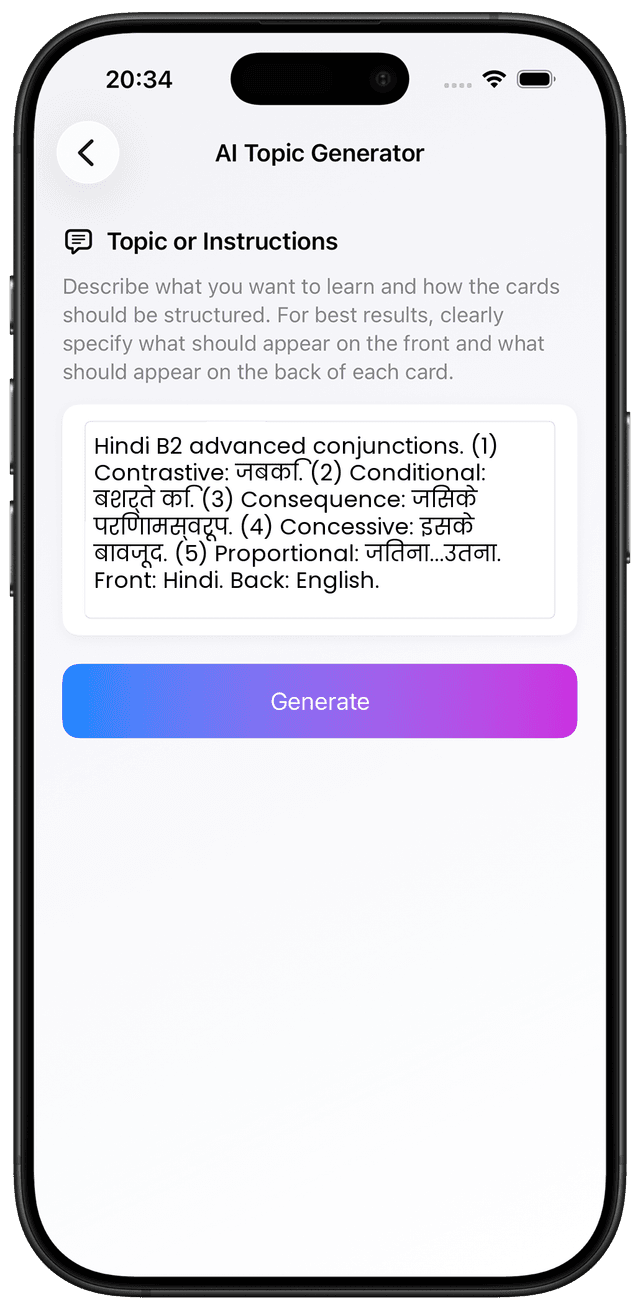
At B1, you learned the common connectors. At B2 the range expands: जबकि (whereas, contrastive), जिसके परिणामस्वरूप (as a result of which), बशर्ते कि (provided that), इसके बावजूद (despite this), चाहे (whether, concessive), and the correlative pair जितना...उतना (the more...the more). These structures appear in editorial writing, formal debate, and academic argument.
Why this comes next: Complex subordination is what makes an argument sound structured rather than a list of facts. B2 writing tasks reward these connectors directly, and reading news and opinion in Hindi becomes much faster once you stop treating each long sentence as a grammar puzzle.
The strategy: This deck organises B2-level conjunctions by their logical function: condition, contrast, consequence, concession, and proportion, so you can reach for the right connector when you need it.
Generate 60 Hindi B2 conjunctions and complex sentence examples. Five groups: (1) Contrastive: जबकि, इसके विपरीत, जहां एक ओर...वहीं दूसरी ओर. (2) Conditional/restrictive: बशर्ते कि, जब तक, जब तक नहीं. (3) Consequence: जिसके परिणामस्वरूप, इसलिए...कि, अतः. (4) Concessive: चाहे, इसके बावजूद, भले ही...फिर भी. (5) Proportional: जितना...उतना, जैसा...वैसा. Front: Hindi conjunction + example sentence (Devanagari). Back: English + function label.
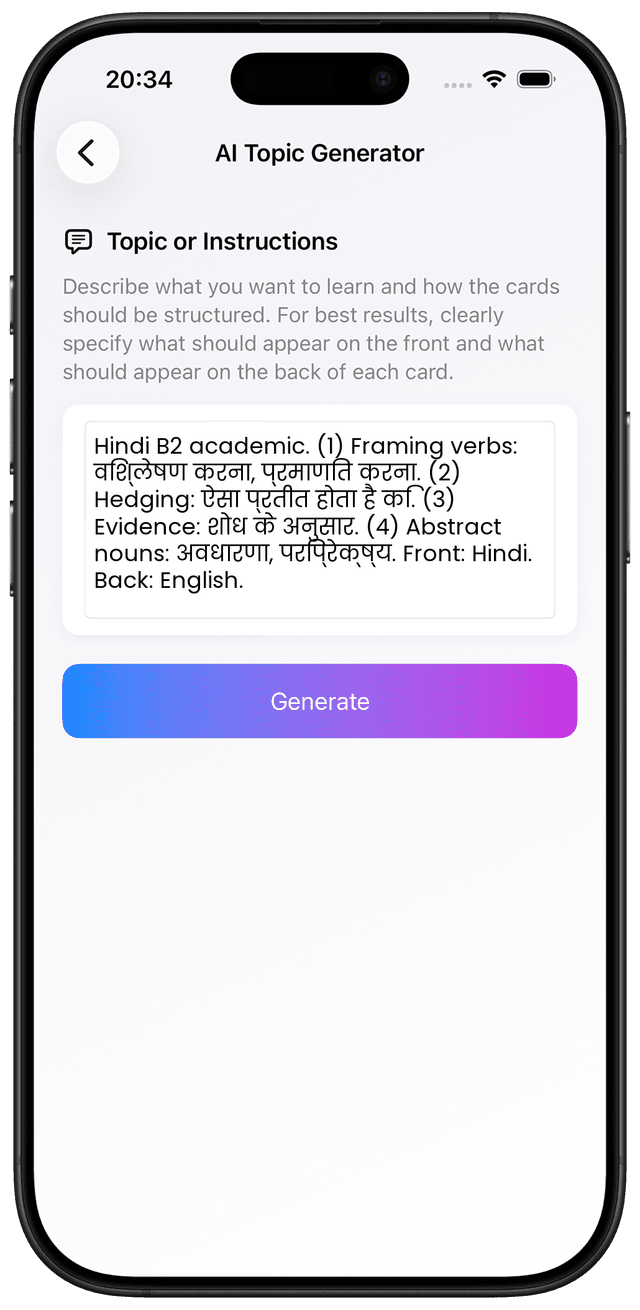
University study in Hindi, professional research, and literary reading all require vocabulary that rarely appears in conversation: अवधारणा (concept), परिप्रेक्ष्य (perspective), विश्लेषण (analysis), परिणाम (outcome), अनुमान (hypothesis), प्रमाण (evidence). This vocabulary also appears in UPSC preparation materials, Hindi journalism, and any written Hindi in an institutional context.
Why this is practical: Academic vocabulary is one of the primary reasons adults pursue Hindi beyond B1. It also covers the terminology needed for understanding Hindi language content about history, culture, science, and public policy, areas where Hindi remains a major publishing language in India.
The strategy: This deck covers academic framing verbs and their nominal forms, hedging and qualification phrases, evidence and citation structures, and the vocabulary for structured written argument at B2 level.
Generate 80 Hindi B2 academic vocabulary items. Four groups: (1) Academic framing verbs: विश्लेषण करना, प्रमाणित करना, तर्क देना, स्थापित करना, निष्कर्ष निकालना, समीक्षा करना. (2) Hedging phrases: ऐसा प्रतीत होता है कि, अनुमान लगाया जा सकता है कि, यह संभावना से इनकार नहीं किया जा सकता कि. (3) Evidence phrases: शोध के अनुसार, अध्ययन से पता चलता है कि, तथ्यों के आधार पर. (4) Abstract nouns: अवधारणा, परिप्रेक्ष्य, विश्लेषण, परिणाम, प्रमाण, संदर्भ. Front: Hindi (Devanagari). Back: English + usage note.
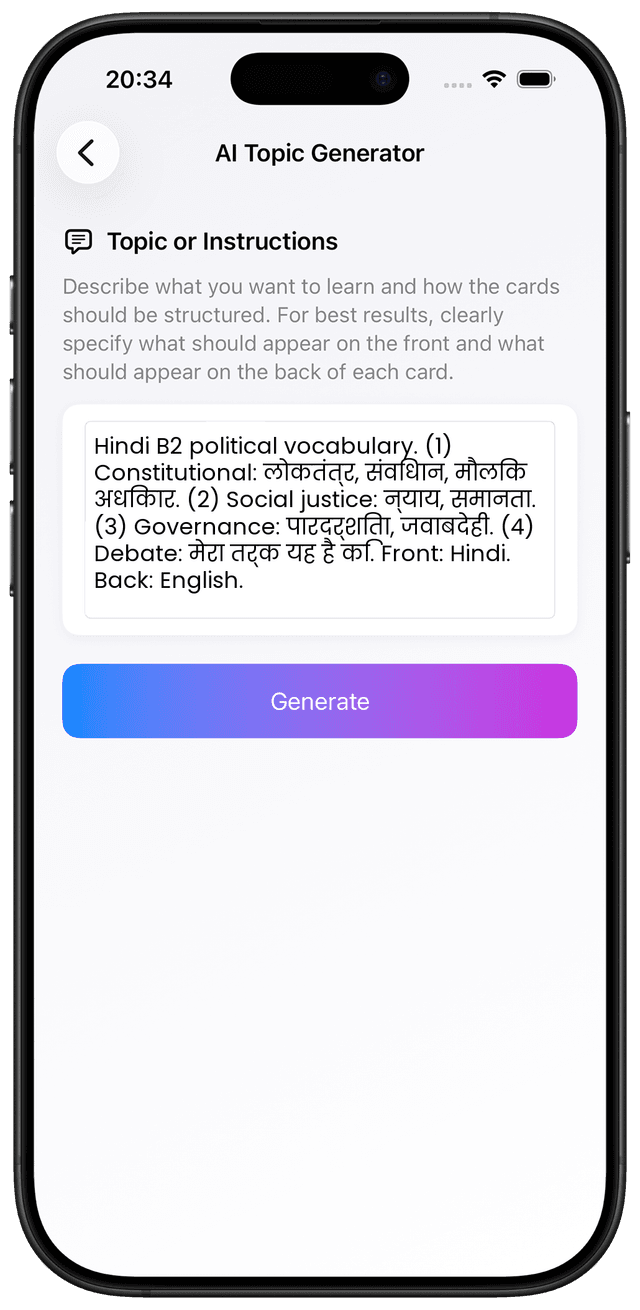
At B2 you can follow political news and actually discuss it: argue a position, use constitutional vocabulary, and engage with the ideas that Hindi-speaking public life draws on. Terms like लोकतंत्र (democracy), संविधान (constitution), न्याय (justice), समानता (equality), and स्वतंत्रता (freedom) are central to editorial writing, public debate, and UPSC preparation.
The goal: To build the content vocabulary for real opinions and structured argument in Hindi rather than just summarising what you heard. This phase covers the political, democratic, and philosophical vocabulary that appears in Hindi newspapers, radio debates, and formal public discourse.
Generate 80 Hindi B2 political and philosophical vocabulary items. Four groups: (1) Constitutional and democratic terms: लोकतंत्र, संविधान, मौलिक अधिकार, न्यायपालिका, विधायिका, कार्यपालिका, संसद, मतदान. (2) Social justice and philosophy: न्याय, समानता, स्वतंत्रता, धर्मनिरपेक्षता, सामाजिक न्याय, अल्पसंख्यक अधिकार. (3) Policy and governance: नीति निर्माण, जन कल्याण, पारदर्शिता, जवाबदेही, भ्रष्टाचार, सुधार. (4) Opinion and debate phrases: मेरा तर्क यह है कि, इस दृष्टिकोण से, इसके विरुद्ध यह कहा जा सकता है कि. Front: Hindi (Devanagari). Back: English.
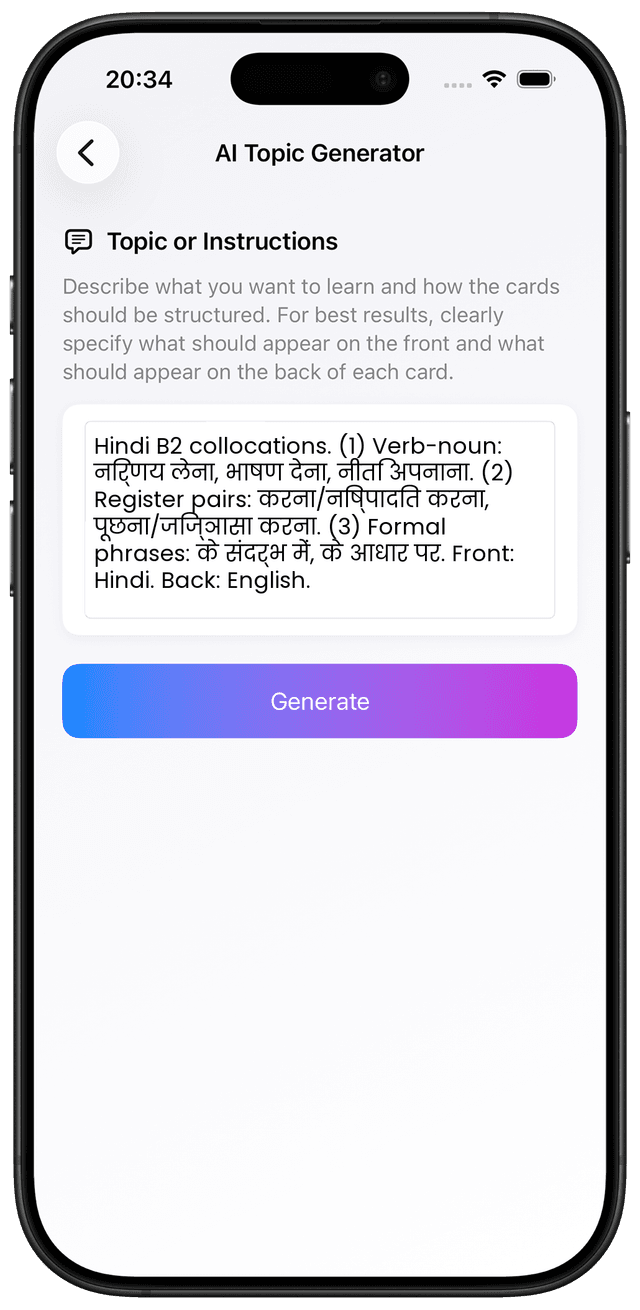
Native Hindi speakers do not just know words. They know which words belong together: निर्णय लेना (not करना), भाषण देना (not बोलना), समस्या हल करना, आलोचना करना, नीति अपनाना. Getting collocations right is what makes Hindi sound less like a learner. At B2, it is one of the fastest ways to close the gap with native speech.
The milestone: With this deck, your B2 vocabulary toolkit is complete. You have passive constructions for reading formal texts, conditional mood for hypothetical argument, nominalisation for formal register, advanced conjunctions for complex sentences, academic vocabulary for formal writing, political content for opinion tasks, and collocations for natural sound. That covers the full B2 communicative range for advanced Hindi.
Looking ahead: C1 extends each of these areas further, adding literary register, finer stylistic control, and a broader idiomatic range. Every card you lock in at B2 cuts C1 study time.
Generate 70 Hindi B2 collocations and register-aware phrases. Three groups: (1) Verb-noun collocations: निर्णय लेना, भाषण देना, समस्या हल करना, नीति अपनाना, आलोचना करना, प्रयास करना, ध्यान देना, योगदान देना, सुझाव देना. (2) Register pairs (colloquial vs. formal): करना/निष्पादित करना, पूछना/जिज्ञासा करना, बताना/सूचित करना, चाहना/इच्छा रखना. (3) Fixed formal phrases: के संदर्भ में, के परिप्रेक्ष्य में, को ध्यान में रखते हुए, के आधार पर. Front: Hindi phrase + example sentence (Devanagari). Back: English + register note.
At B2, Hindi vocabulary is less predictable than the core words you learned at A1 to B1. Spaced repetition handles this well: cards you find hard appear more often, cards you know well drop back. You spend time where it counts, not where you are already comfortable.
B2 builds on B1 and prepares you for C1 Hindi. Use the links below to move between levels or return to the full Hindi guide.
Join learners building advanced Hindi with spaced repetition and AI-powered vocabulary generation. No account needed. Download and start your first B2 deck today.