
Spaced Repetition Explained
Learn why spacing reviews is key to mastering Hindi A1 vocabulary.
Hindi A1 vocabulary is your launchpad into real conversation. These core words and phrases appear in greetings, shopping, transport, and introductions every day across India and Hindi-speaking communities worldwide.
Many learners plateau because they memorize disconnected word lists without mastering Devanagari reading, verb conjugation patterns, and gender agreement. This guide gives you a sequence that turns study time into usable Hindi.
MindCards helps you retain vocabulary with spaced repetition and active recall. Use the prompts below to generate focused decks for real beginner scenarios in Hindi.
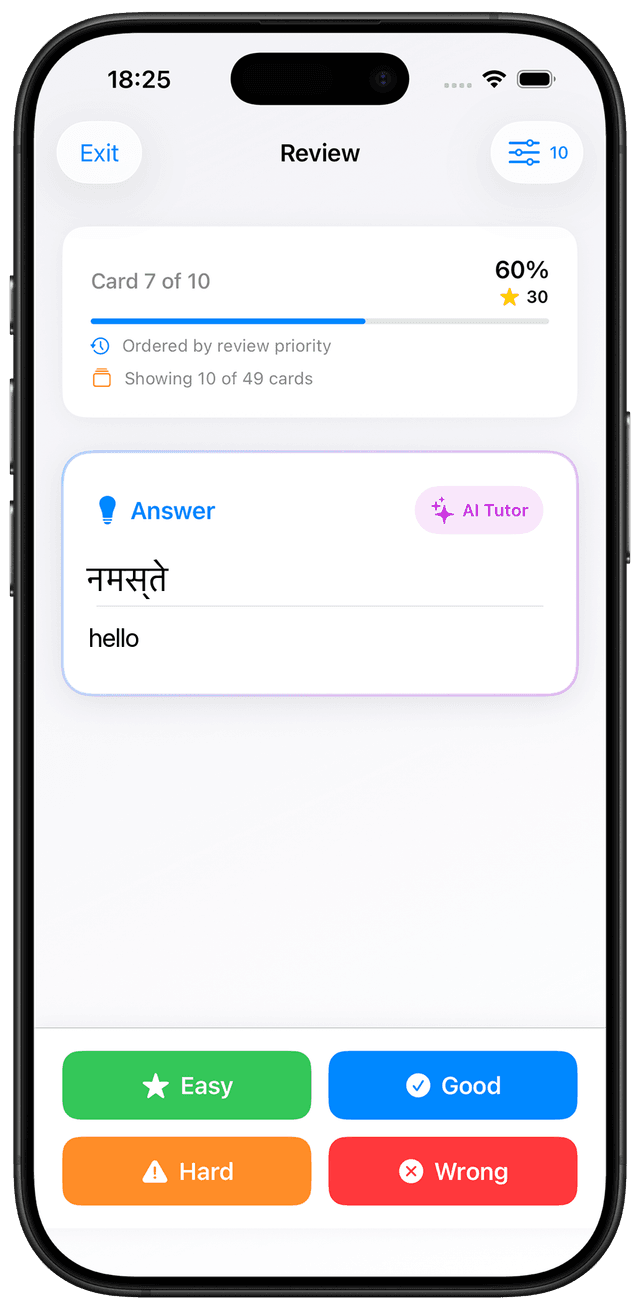
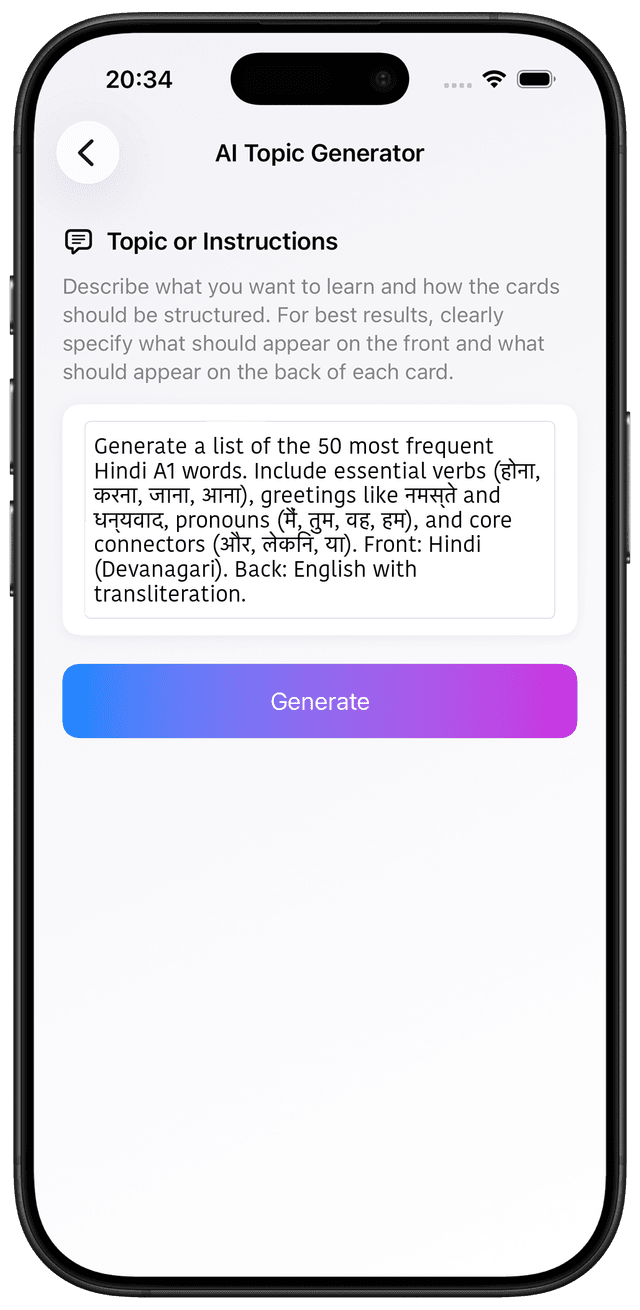
Start with high-frequency verbs, greetings, pronouns, and everyday connectors. In Hindi, this core set unlocks basic introductions, polite requests, and simple daily exchanges.
Why start here? Hindi verbs like होना (to be), करना (to do), and जाना (to go) form the backbone of almost every sentence you will hear or speak.
The Strategy: Build starter cards with Devanagari on the front and English on the back to strengthen direct script-reading recall from day one.
Generate a list of the 50 most frequent Hindi A1 words. Include essential verbs (होना, करना, जाना, आना), greetings like नमस्ते and धन्यवाद, pronouns (मैं, तुम, वह, हम), and core connectors (और, लेकिन, या). Front: Hindi (Devanagari). Back: English with transliteration.
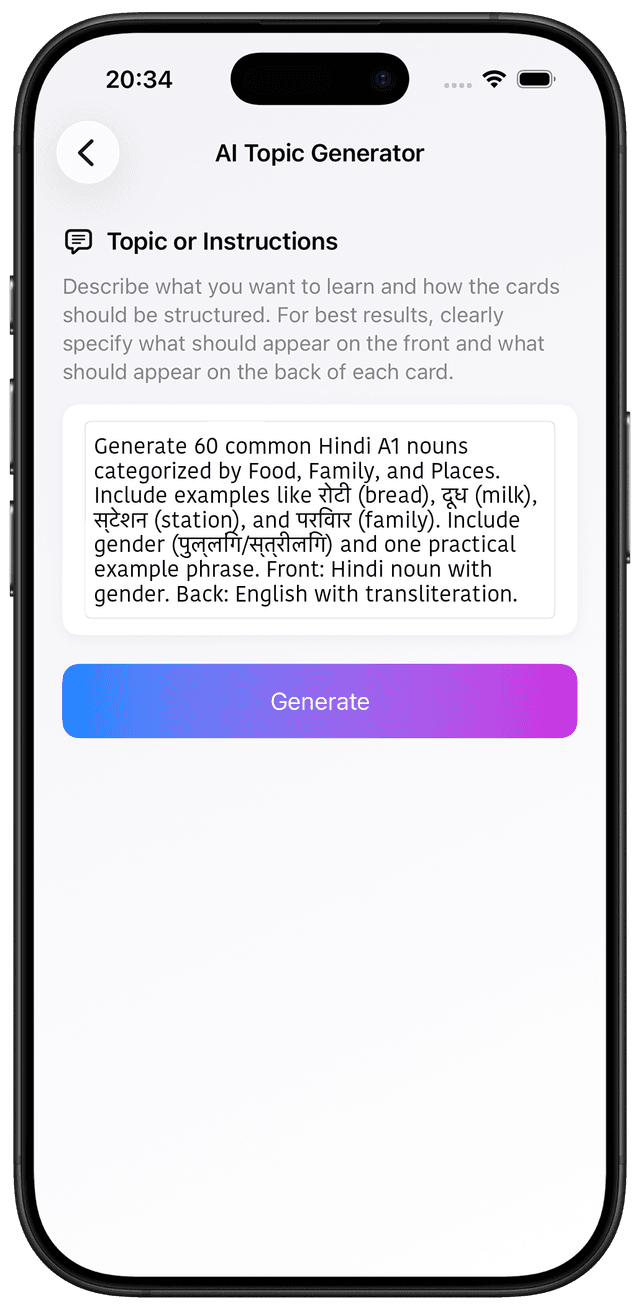
Expand into survival nouns for family, food, places, and common objects. Hindi has grammatical gender for every noun, so learning gender from the start prevents agreement errors later.
Why this next? You cannot describe your day without nouns like पानी (water), दुकान (shop), or परिवार (family), and gender awareness matters early because adjectives and verbs agree with it.
The Strategy: Learn nouns with gender markers (पुल्लिंग/स्त्रीलिंग) and one short phrase so postposition patterns start to feel natural.
Generate 60 common Hindi A1 nouns categorized by Food, Family, and Places. Include examples like रोटी (bread), दूध (milk), स्टेशन (station), and परिवार (family). Include gender (पुल्लिंग/स्त्रीलिंग) and one practical example phrase. Front: Hindi noun with gender. Back: English with transliteration.
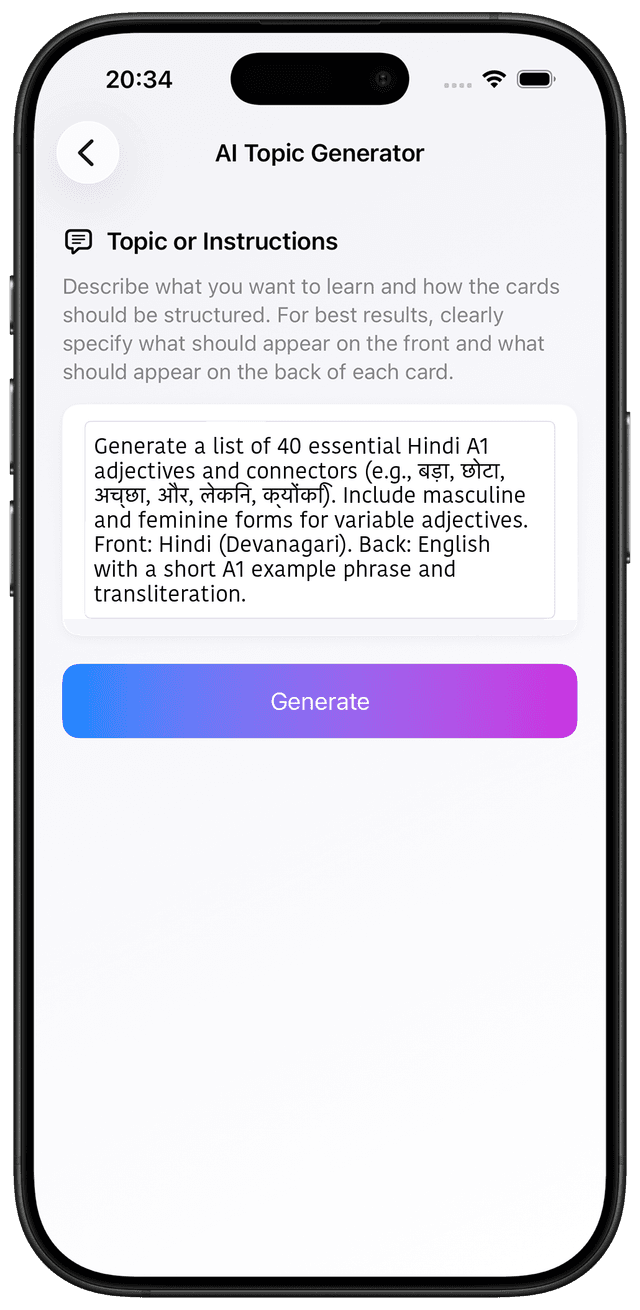
Add adjectives and connectors to move from isolated words to complete, useful beginner sentences. Hindi adjectives change form based on noun gender, so practicing agreement early builds accuracy.
Why this matters: Connectors like और (and), लेकिन (but), and क्योंकि (because) help you express ideas naturally instead of giving one-word answers.
The Strategy: Use mini-sentence cards that train gender agreement and contextual recall simultaneously.
Generate a list of 40 essential Hindi A1 adjectives and connectors (e.g., बड़ा, छोटा, अच्छा, और, लेकिन, क्योंकि). Include masculine and feminine forms for variable adjectives. Front: Hindi (Devanagari). Back: English with a short A1 example phrase and transliteration.
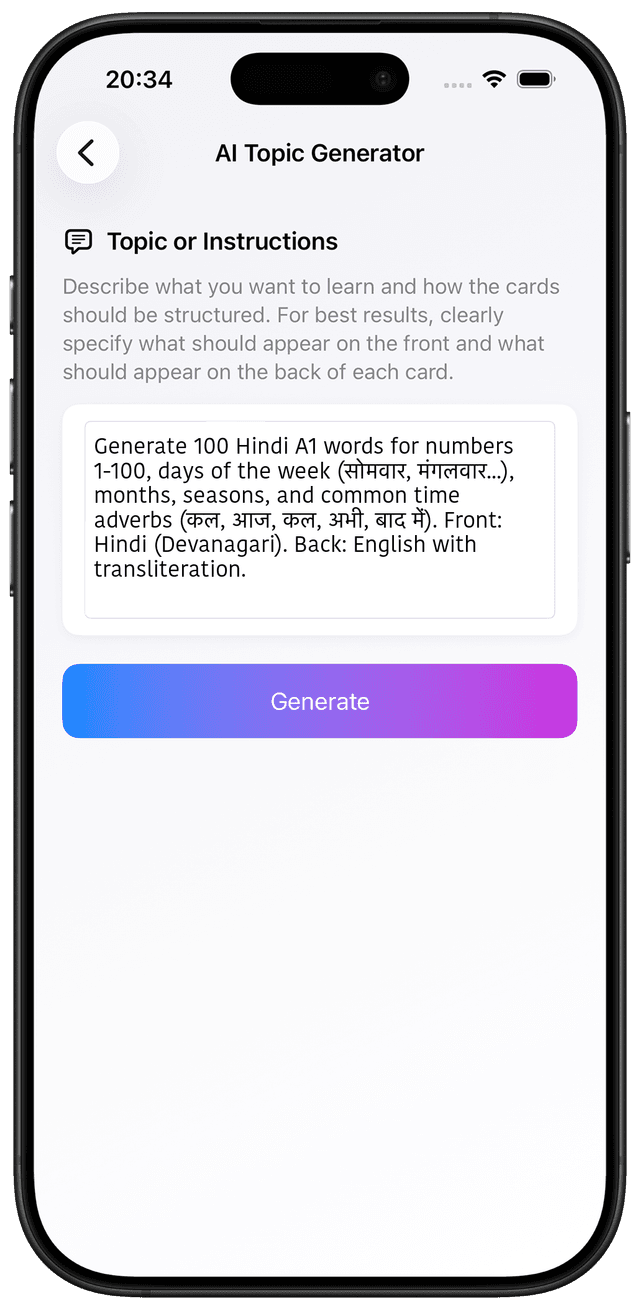
Learn Hindi numbers, weekdays, months, and common time expressions so you can plan routines, understand schedules, and navigate daily life.
Why this is vital: Time language appears constantly in transport, appointments, and everyday planning. Hindi uses Devanagari numerals alongside Western digits, so recognizing both is practical.
Generate 100 Hindi A1 words for numbers 1-100, days of the week (सोमवार, मंगलवार...), months, seasons, and common time adverbs (कल, आज, कल, अभी, बाद में). Front: Hindi (Devanagari). Back: English with transliteration.
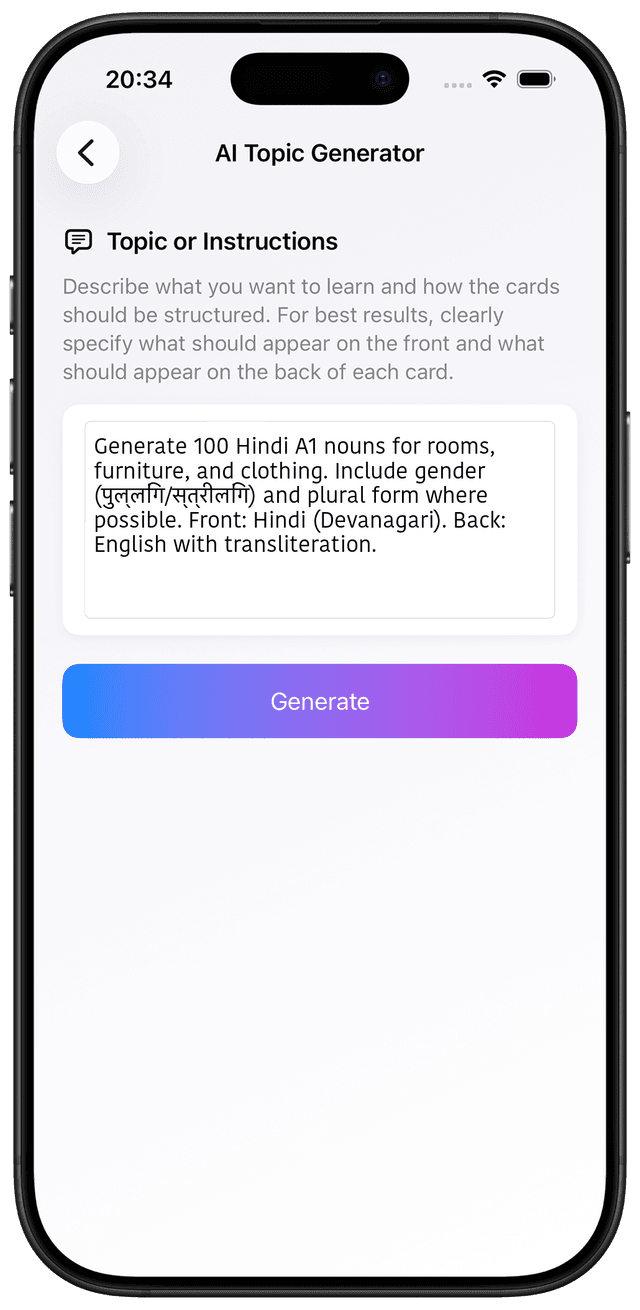
Learn vocabulary for rooms, furniture, clothing, and routine actions so you can describe your personal world clearly in Hindi.
Goal: Talk about home life and daily habits without switching back to English. Hindi household vocabulary is used constantly and builds a practical foundation for longer conversations.
Generate 100 Hindi A1 nouns for rooms, furniture, and clothing. Include gender (पुल्लिंग/स्त्रीलिंग) and plural form where possible. Front: Hindi (Devanagari). Back: English with transliteration.
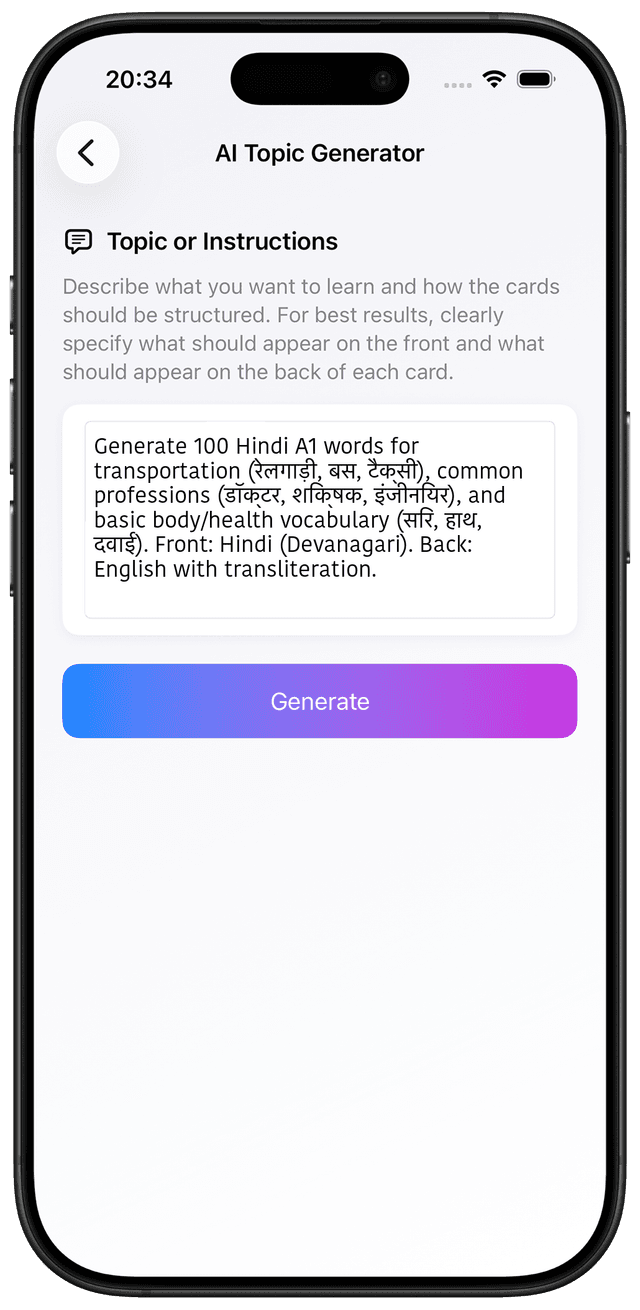
Cover essential words for transportation, jobs, and basic health topics to handle practical situations across Hindi-speaking regions, from railway stations to pharmacies.
Why now? This vocabulary helps with immediate real-world tasks like asking for directions, describing symptoms, and navigating public transport — the most common beginner interactions.
Generate 100 Hindi A1 words for transportation (रेलगाड़ी, बस, टैक्सी), common professions (डॉक्टर, शिक्षक, इंजीनियर), and basic body/health vocabulary (सिर, हाथ, दवाई). Front: Hindi (Devanagari). Back: English with transliteration.
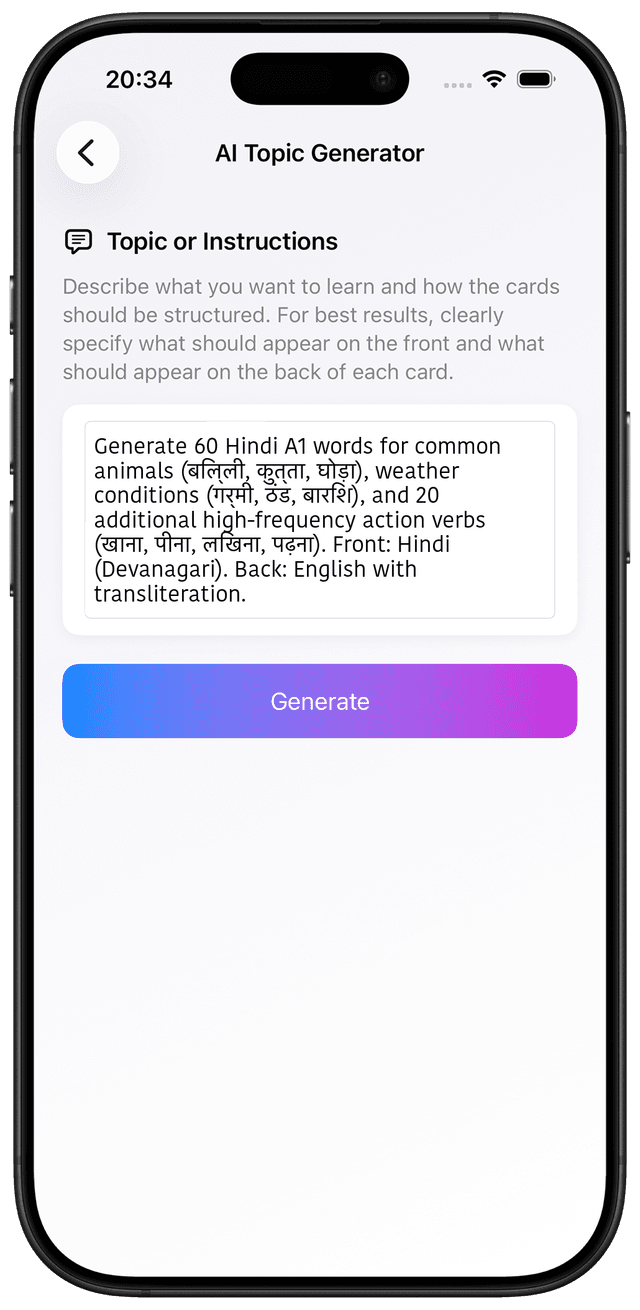
Finish your A1 base with frequent action verbs, weather, animals, and environment terms so your active vocabulary feels complete and flexible.
Milestone: At this point, you can handle many short everyday Hindi conversations with much more confidence. Verb roots and postposition patterns will start to feel familiar and predictable.
Generate 60 Hindi A1 words for common animals (बिल्ली, कुत्ता, घोड़ा), weather conditions (गर्मी, ठंड, बारिश), and 20 additional high-frequency action verbs (खाना, पीना, लिखना, पढ़ना). Front: Hindi (Devanagari). Back: English with transliteration.
MindCards combines active recall and spacing to move Hindi vocabulary from recognition into real conversation use.
Keep this deck in daily rotation to lock in Devanagari reading speed, verb patterns, and practical phrase chunks.
Build practical Hindi for daily life with smart flashcards, AI deck generation, and spaced repetition designed for long-term retention.