
Spaced repetition explained
Why reviewing at the right interval locks in Hindi A2 vocabulary faster than re-reading.
You have your A1 foundation. Now comes the part where Hindi starts to click. At A2, you learn to describe what happened yesterday, express what you like and dislike, get through a shopping trip, and make plans for next week.
This guide focuses on the things that actually matter at this level: the ne-construction that trips up most learners, the postpositions that change noun forms, and the adjective agreement patterns that separate A1 from A2 Hindi.
Seven phases with copy-paste prompts for MindCards. Each one builds a focused deck using spaced repetition so you retain vocabulary with far less effort than traditional study methods.
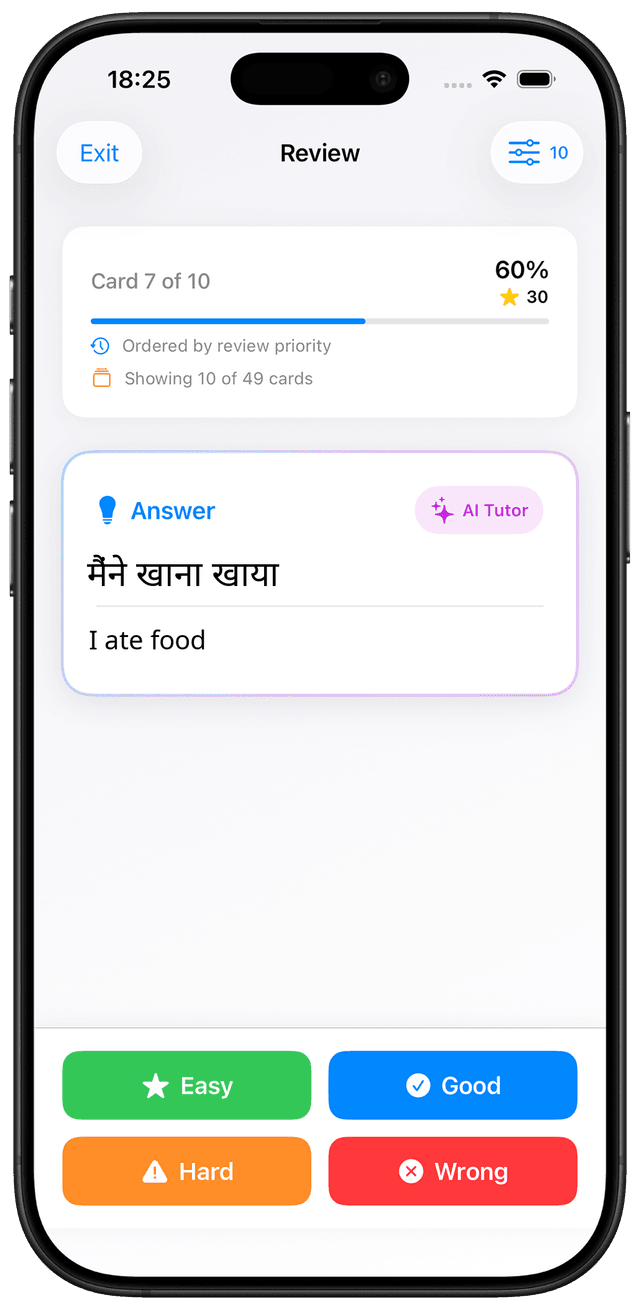
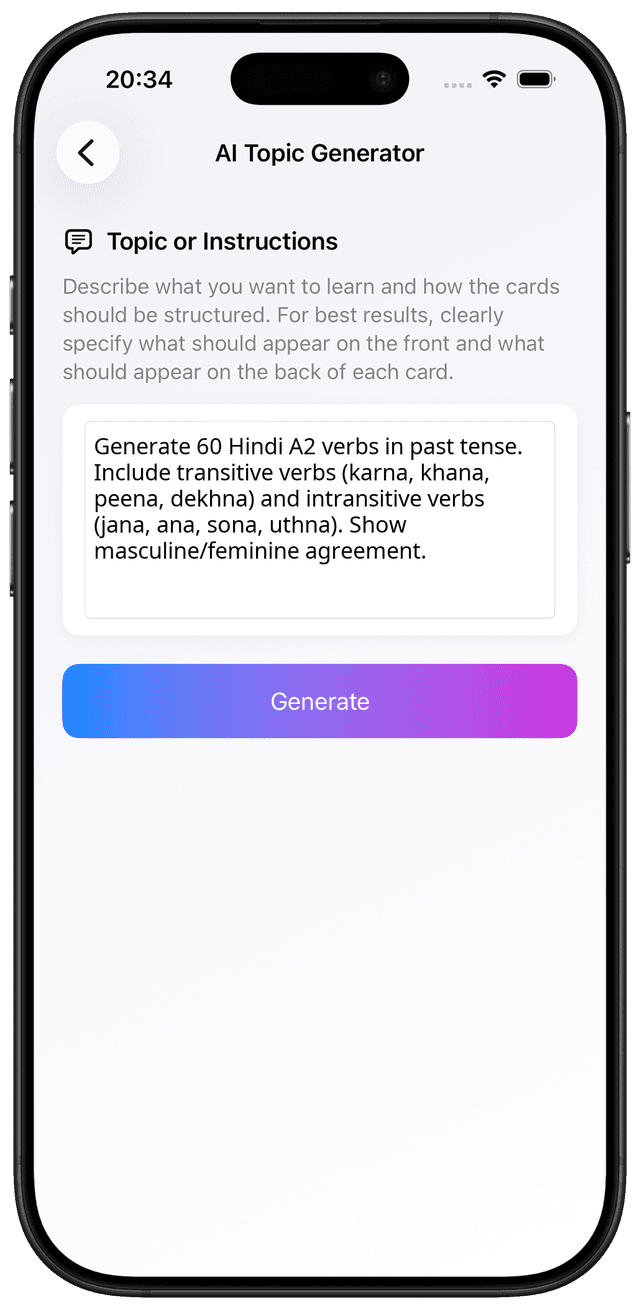
Hindi past tense is shaped by two things: whether the verb is transitive or intransitive, and whether the subject is masculine or feminine. Intransitive verbs agree with the subject; transitive verbs in the past tense agree with the object when the subject takes the postposition ने (ne).
Why start here? You cannot describe a trip, tell a story, or explain what happened without the past tense. It also unlocks ne-construction, which is one of the most tested features of Hindi grammar at this level.
The strategy: Focus on the four agreement forms (masculine singular, masculine plural, feminine singular, feminine plural) through real sentences so the pattern becomes automatic rather than a rule you recite.
Generate 60 Hindi A2 verbs in past tense. Include transitive verbs (करना, खाना, पीना, देखना, लिखना, पढ़ना, लेना, देना) and intransitive verbs (जाना, आना, सोना, उठना, बैठना). Show masculine/feminine agreement and ne-construction for transitive verbs. Front: Hindi infinitive (Devanagari). Back: past tense forms + English.
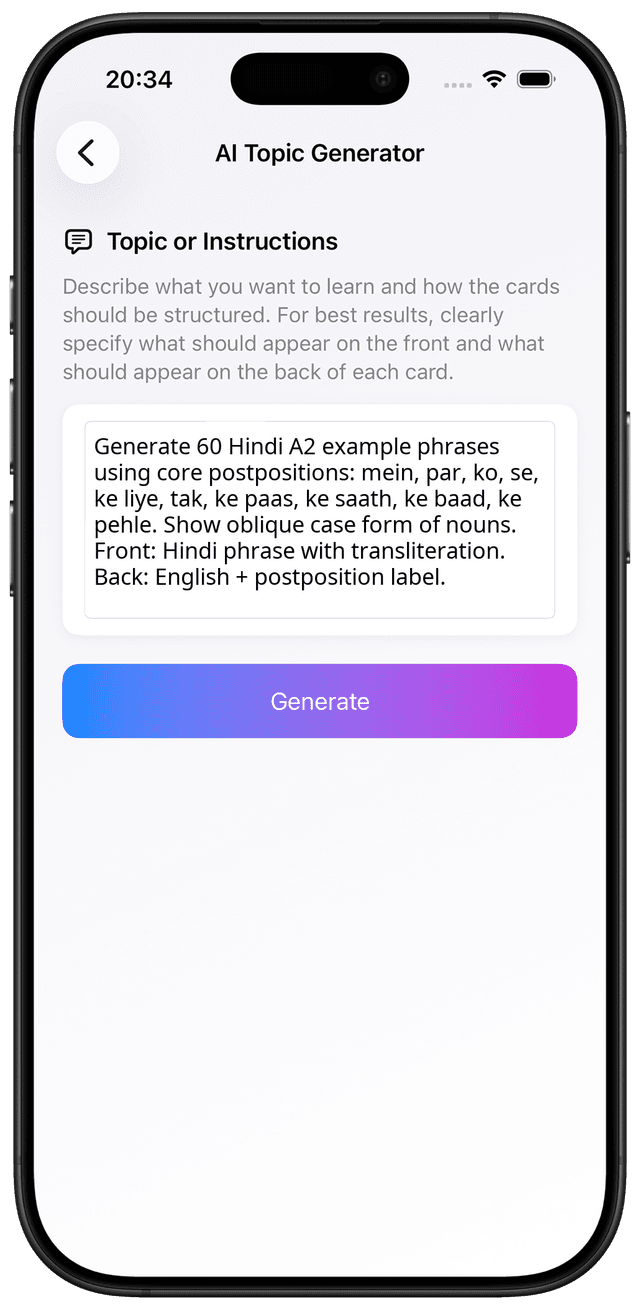
Hindi uses postpositions instead of prepositions: they follow the noun rather than precede it. At the A2 level, the most important ones are में (in), पर (on/at), को (to/for), से (from/with), के लिए (for), तक (until/up to), and के पास (near/possession).
Why postpositions matter: These small words change the entire meaning of a sentence. Getting them right is one of the clearest signs of moving from A1 to A2 Hindi. They also trigger noun form changes, so you need to learn them alongside their patterns.
The strategy: Learn each postposition with two or three short example phrases showing the noun form change. Pattern exposure beats memorizing grammar tables.
Generate 60 Hindi A2 example phrases using core postpositions: में, पर, को, से, के लिए, तक, के पास, के साथ, के बाद, के पहले. Show the oblique case form of nouns when required. Front: Hindi phrase (Devanagari) with transliteration. Back: English translation + postposition label.
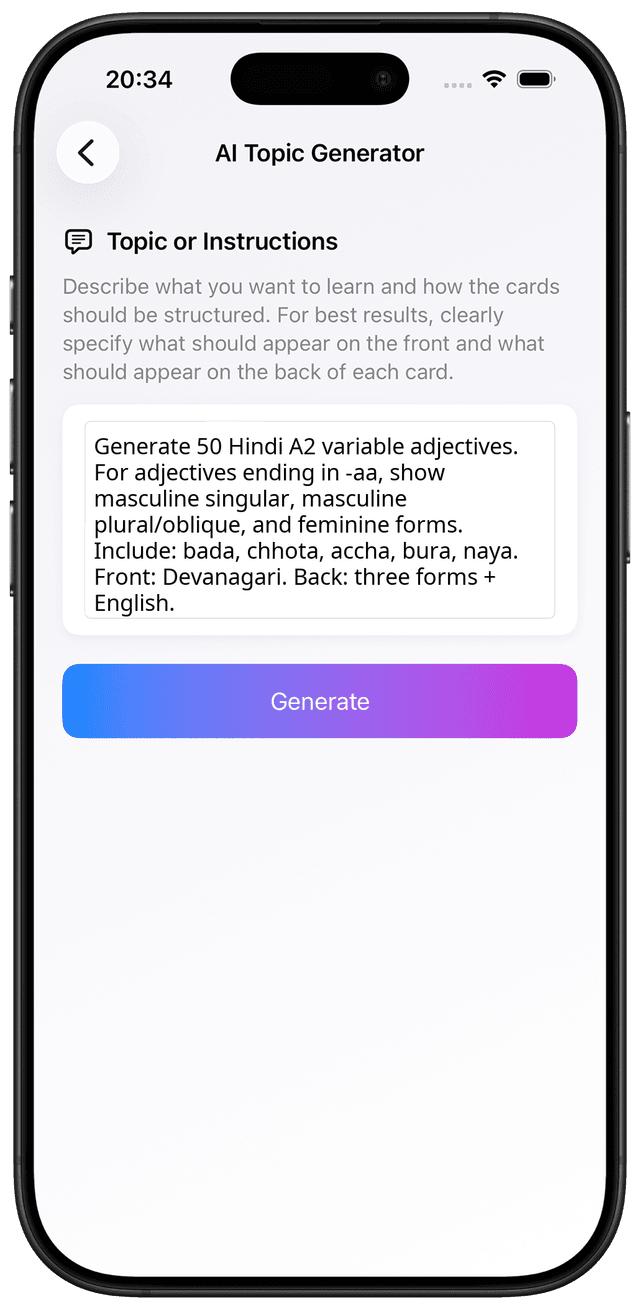
Hindi adjectives that end in आ (aa) change to agree with the gender and number of the noun: बड़ा (big, masculine singular) becomes बड़े (masculine plural or oblique) and बड़ी (feminine). Adjectives ending in a consonant do not change. Mastering this distinction is the difference between sounding A1 and A2.
Why this matters: Adjective agreement is everywhere in Hindi. Every description, every sentence with a quality or quantity, depends on it. At A2, you need this to be automatic, not a pause you take before speaking.
The strategy: Learn variable adjectives in all three forms alongside a concrete noun example. Pairing form with example is far more effective than drilling a grammar table in isolation.
Generate 50 Hindi A2 variable adjectives with all agreement forms. For each adjective ending in -aa, show masculine singular, masculine plural/oblique, and feminine forms. Include: बड़ा, छोटा, अच्छा, बुरा, नया, पुराना, गरम, ठंडा, लंबा, मोटा. Front: adjective in Devanagari. Back: all three forms + English + example phrase.
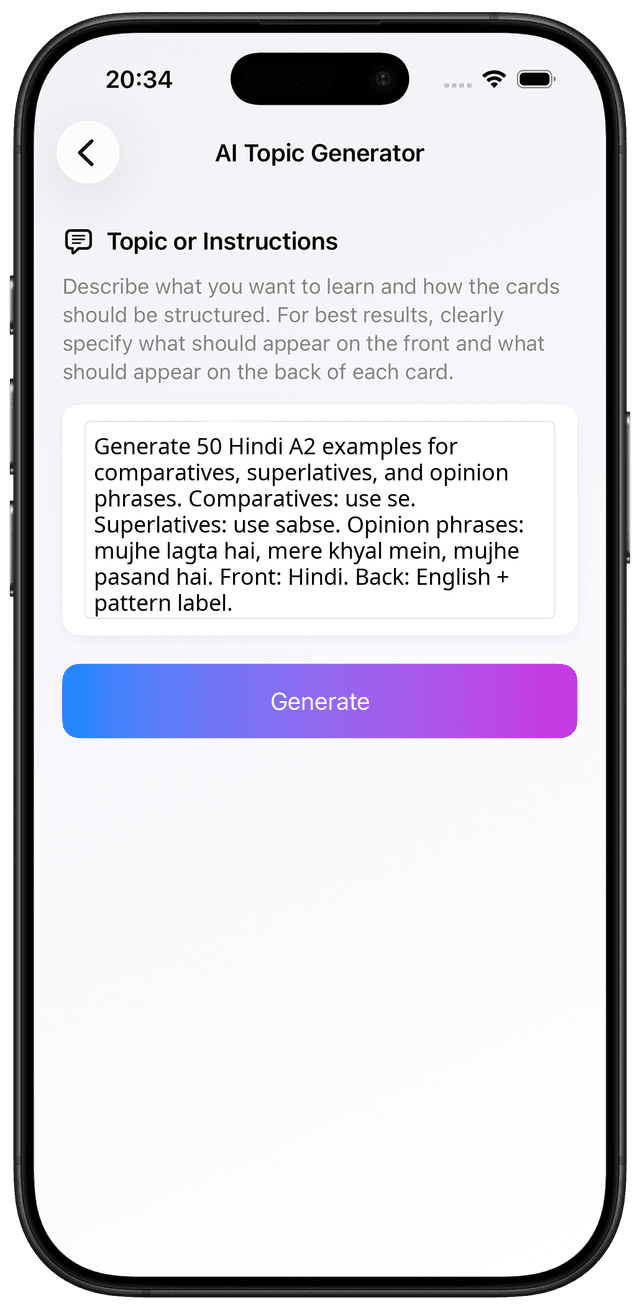
Hindi comparatives use से to mark the standard of comparison: यह किताब उस किताब से बड़ी है (this book is bigger than that one). Superlatives use सबसे. Opinion phrases like मुझे लगता है (I think/feel), मेरे ख़याल में (in my opinion), and मुझे पसंद है (I like) are essential for real conversation.
Why add opinions now? Being able to evaluate, prefer, and compare things is a core A2 skill. Without this vocabulary, you can state facts but cannot hold a real conversation where people ask what you think.
The strategy: Pair comparative structures with opinion vocabulary so you can naturally express reactions and preferences, not just isolated facts.
Generate 50 Hindi A2 examples for comparatives, superlatives, and opinion phrases. Comparatives: use से (यह...से बड़ा है). Superlatives: use सबसे (सबसे अच्छा). Opinion phrases: मुझे लगता है, मेरे ख़याल में, मुझे पसंद है/नहीं है, मैं सोचता/सोचती हूं. Front: Hindi phrase (Devanagari). Back: English + pattern label.
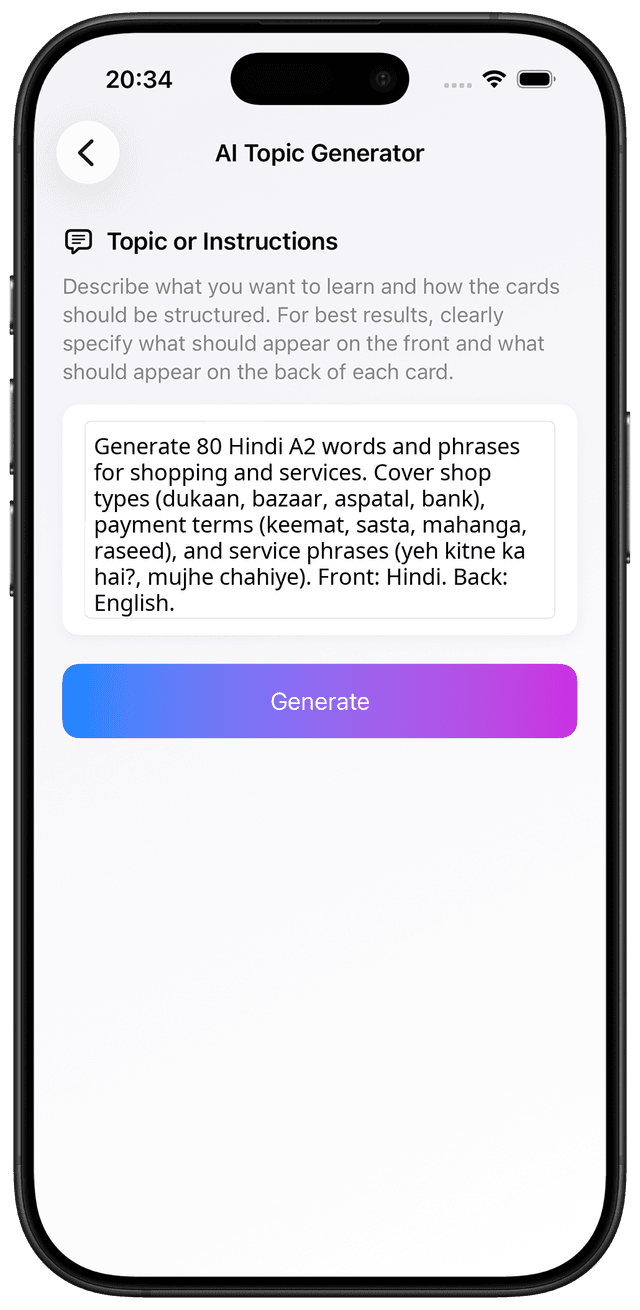
At A2, a shopping interaction should feel manageable end to end: asking about price, bargaining, paying, and getting a receipt. This phase covers market vocabulary, payment terms, and common service contexts like pharmacies, banks, and booking tickets.
Why this is practical: Hindi markets and service interactions have their own set of phrases and polite formulas. Knowing them means you do not have to switch to English when a transaction gets more complex than ordering food.
The strategy: Mix product words, price vocabulary, and transactional phrases together so you can get through a real interaction rather than recognizing words in isolation.
Generate 80 Hindi A2 words and phrases for shopping and services. Cover shop types (दुकान, बाज़ार, अस्पताल, बैंक, डाकघर), payment terms (कीमत, सस्ता, महंगा, रसीद, नकद, कार्ड), clothing and sizes (नाप, फिटिंग), and service phrases (यह कितने का है?, क्या आपके पास...है?, मुझे...चाहिए). Front: Hindi (Devanagari). Back: English with transliteration.
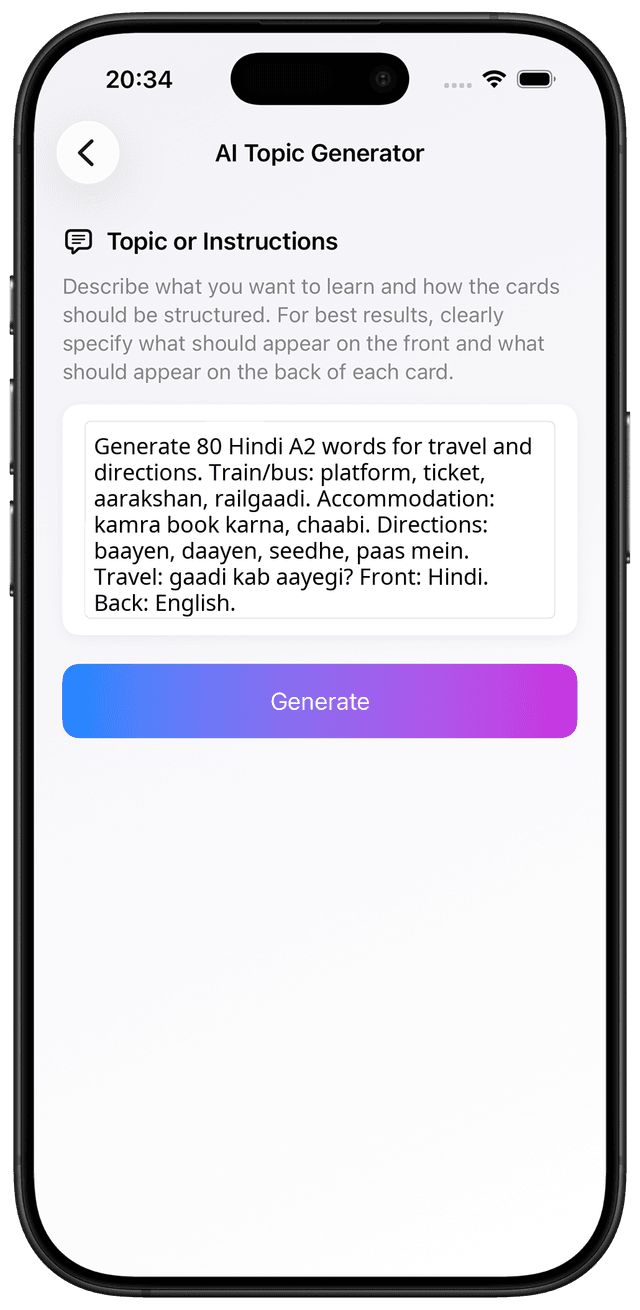
India's rail network is one of the largest in the world, and navigating it requires specific vocabulary: प्लेटफ़ॉर्म (platform), समय-सारणी (timetable), आरक्षण (reservation), गाड़ी (train). This phase also covers hotel check-in, giving and understanding directions, and handling common travel situations in Hindi.
Why travel vocabulary matters: Travel is one of the most common real-world contexts for Hindi learners. Whether you are travelling in India or in a Hindi-speaking community, this vocabulary gets you through practical situations without relying on English.
The strategy: Cover transport, accommodation, and directions as one connected topic so you can navigate complete journeys rather than isolated scenarios.
Generate 80 Hindi A2 words and phrases for travel and directions. Include train and bus vocabulary (प्लेटफ़ॉर्म, टिकट, आरक्षण, समय-सारणी, रेलगाड़ी, बस अड्डा), accommodation (कमरा बुक करना, चाबी, चेक-आउट), directions (बाएं, दाएं, सीधे, पास में, दूर, चौराहा), and travel phrases (गाड़ी कब आएगी?, निकटतम स्टेशन कहां है?). Front: Hindi (Devanagari). Back: English.
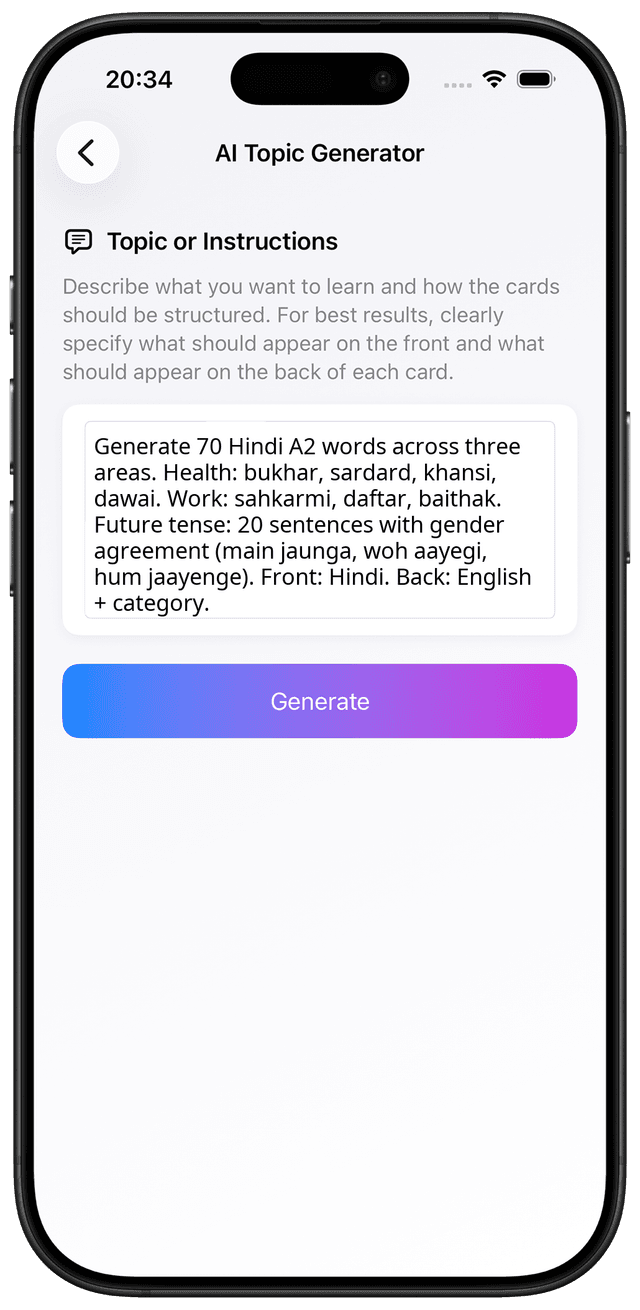
The final A2 phase covers vocabulary for describing symptoms and medical appointments, daily work and professional life, and the Hindi future tense. Hindi future tense uses person-number-gender endings: जाऊंगा, जाएगी, जाएंगे. You need this to talk about plans, make promises, and discuss what will happen.
The milestone: With this deck, your A2 Hindi vocabulary is complete. You can narrate past events using the right agreement forms, handle postpositions confidently, describe and compare things, manage everyday transactions, and talk about future plans. That covers the full A2 picture for Hindi.
Generate 70 Hindi A2 words and phrases across three areas. Health: symptoms and medical (बुखार, सिरदर्द, खांसी, दवाई, डॉक्टर से मिलना, नुस्खा). Work: job and daily routine (सहकर्मी, दफ्तर, बैठक, तनख़्वाह, काम पर जाना). Future tense: 20 sentences with gender-number agreement (मैं जाऊंगा, वह आएगी, हम जाएंगे). Front: Hindi (Devanagari). Back: English + category label.
At A2, Hindi becomes a game of pattern recognition. Active recall drills past tense agreement and postposition rules until you stop pausing mid-sentence to think about endings. Spaced repetition schedules each review right before you would otherwise forget it.
A2 vocabulary sits between the A1 foundation and B1 fluency. Use the links below to move between levels or return to the full Hindi guide.
Join learners building their Hindi fluency with AI-powered flashcards and spaced repetition. No account or signup required.