
Spaced repetition explained
Why reviewing at the right interval locks in Hindi B1 vocabulary faster than re-reading.
You have the A2 foundation. Now build the Hindi that lets you hold a real conversation. At B1, the language stops being about basic exchanges and starts being about genuine communication: expressing ideas politely with the subjunctive, using compound verbs that sound like a native speaker, and engaging with Hindi in professional and public contexts.
B1 covers roughly 2,000 words in total. Not all of them come up equally often. This guide focuses on the vocabulary and structures that appear again and again in authentic Hindi, the ones that make your Hindi sound noticeably more fluent rather than just grammatically adequate.
Each of the seven phases below comes with a ready-to-use AI prompt. Paste it into MindCards and the app builds a custom flashcard deck in seconds. Spaced repetition then schedules each card just before you are likely to forget it, so you retain more with less time spent reviewing.
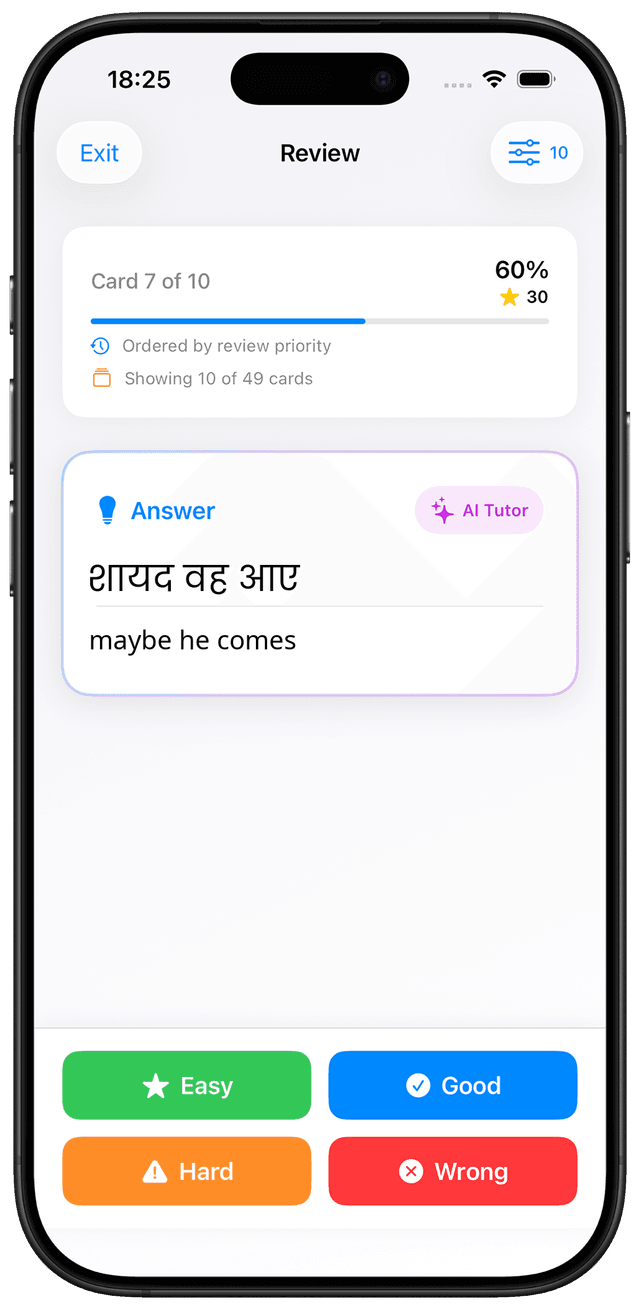
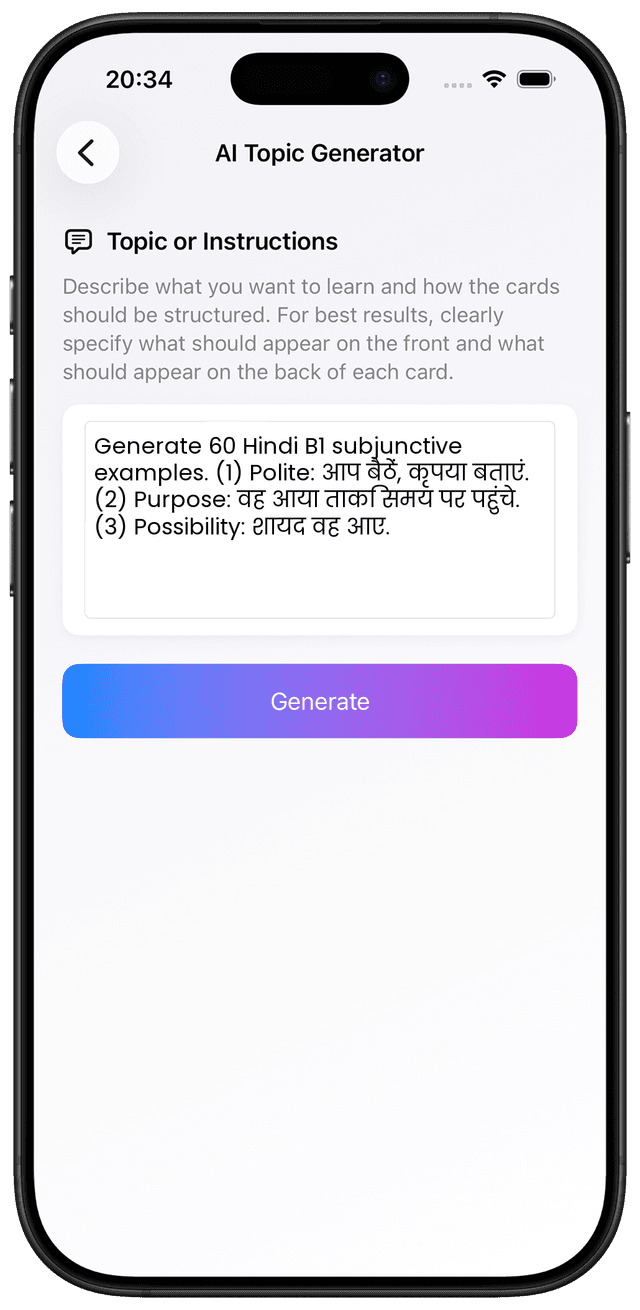
The Hindi subjunctive is the most important step between A2 and B1. You use it for polite requests, suggestions, purpose clauses, and possibility. Structures like शायद वह आए (maybe he comes), आप बैठें (please sit), and ताकि (so that) all depend on the subjunctive form, and without it your Hindi sounds much more blunt than you intend.
Why start here? The subjunctive shows up in formal requests, polite conversation, and any sentence expressing purpose, doubt, or wishful thinking. Learning the high-frequency forms early covers most real-world use without needing every irregular variant at once.
The strategy: This deck focuses on the subjunctive with शायद, चाहिए, ताकि, and direct polite requests so you build the core patterns before expanding into less common uses.
Generate 60 Hindi B1 examples of the subjunctive mood. Three groups: (1) Polite requests: आप बैठें, कृपया बताएं, क्या आप मदद करें. (2) Purpose clauses with ताकि: वह जल्दी आया ताकि समय पर पहुंचे. (3) Possibility with शायद: शायद वह आए, शायद बारिश हो. Front: Hindi sentence (Devanagari). Back: English + subjunctive pattern label.
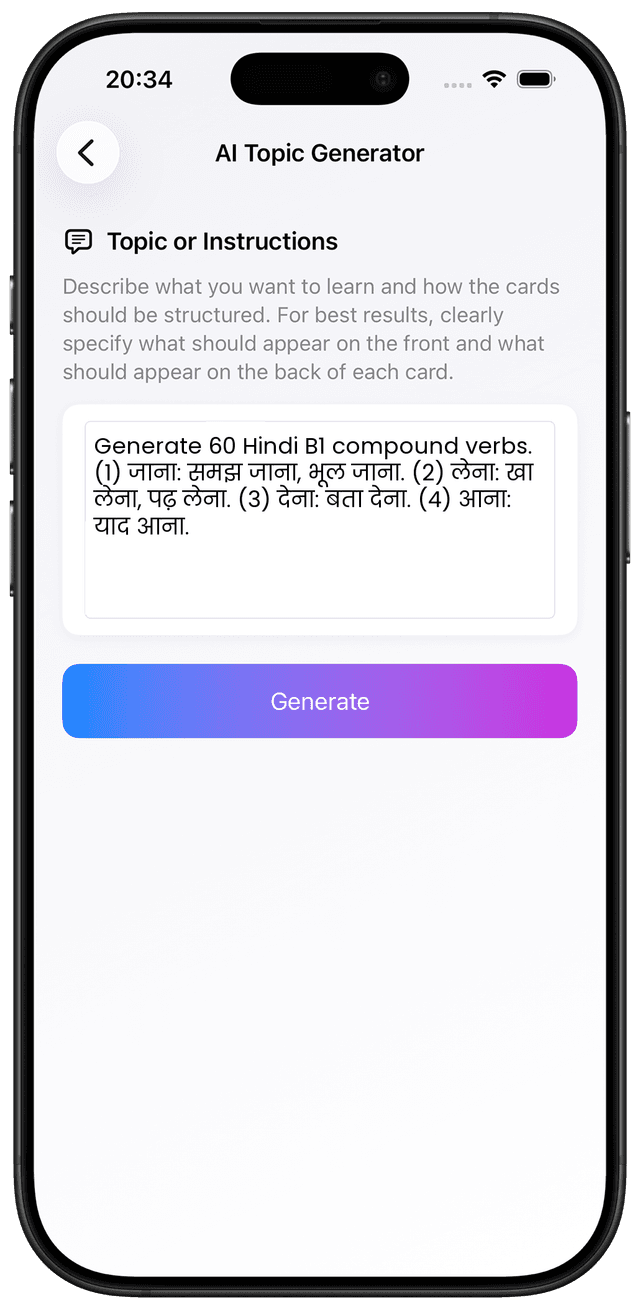
Hindi compound verbs pair a main verb with a vector verb like जाना, लेना, देना, or आना to add nuance about completion, direction, or benefit. खा लेना (to eat up, for oneself), बता देना (to tell, for someone else), and समझ जाना (to come to understand) all carry meaning that a single verb cannot convey. These patterns are everywhere in natural Hindi speech.
Why this matters: Native speakers use compound verbs constantly. Without them, you can be understood, but you will sound like a textbook. Getting these right is one of the clearest markers of moving from A2 to B1 Hindi.
The strategy: Learn each vector verb with a set of main verbs that pair with it naturally. Pattern exposure through real examples is more effective than abstract grammar rules.
Generate 60 Hindi B1 compound verb examples. Four groups by vector verb: (1) जाना (completion/change): समझ जाना, सो जाना, भूल जाना. (2) लेना (benefit for self): खा लेना, पढ़ लेना, सीख लेना. (3) देना (benefit for other): बता देना, दे देना, कर देना. (4) आना (gradual/habitual): समझ में आना, याद आना. Front: compound verb (Devanagari). Back: English + vector verb label.
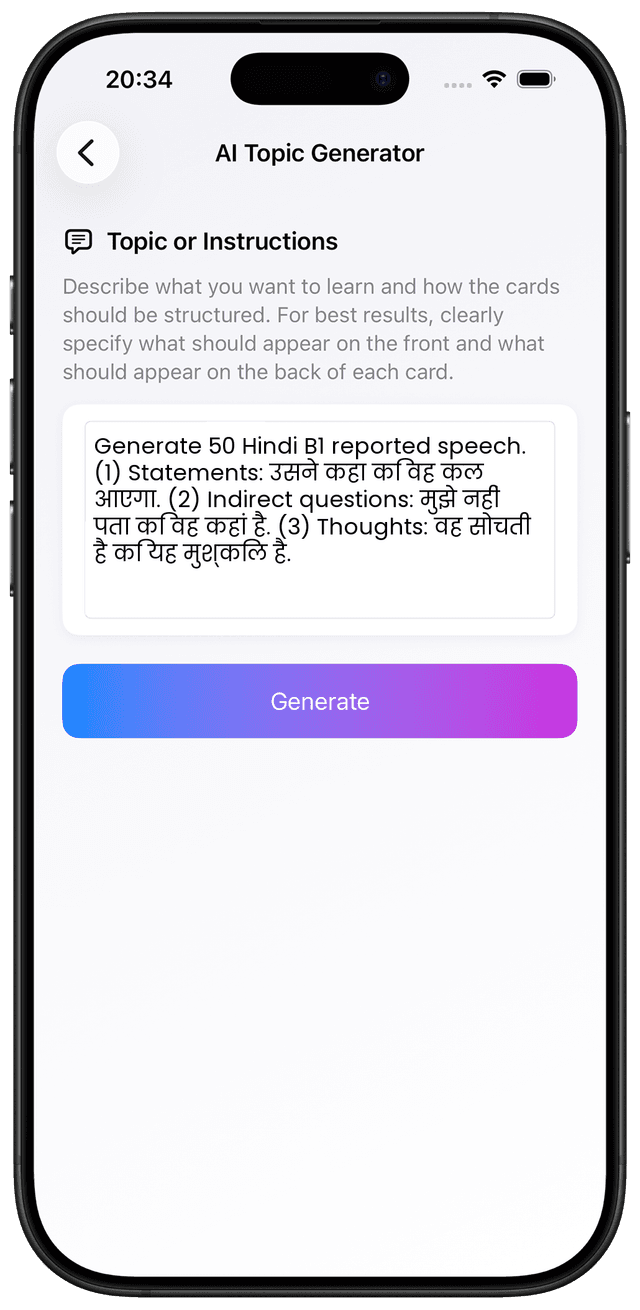
Reported speech in Hindi uses the complementizer कि (that) to introduce what someone said or thought. Direct questions become indirect by adding कि or a question word followed by a verb in the appropriate tense. Structures like उसने कहा कि वह आएगा (he said that he would come) and मुझे नहीं पता कि वह कहां है (I don't know where he is) are central to B1-level conversation.
Why add this now? You cannot relay information, summarize conversations, or describe others' opinions without reported speech. It also feeds into academic and formal registers where indirect speech is the standard.
The strategy: Build cards around the कि construction and the most common reporting verbs: कहना, बताना, सोचना, पूछना, लगना. Add indirect question patterns alongside direct equivalents.
Generate 50 Hindi B1 reported speech examples. Three groups: (1) Statements with कि: उसने कहा कि वह कल आएगा, मुझे लगता है कि यह सही है. (2) Indirect questions: मुझे नहीं पता कि वह कहां है, उसने पूछा कि आप कब आएंगे. (3) Reported thoughts and opinions: वह सोचती है कि यह मुश्किल है. Front: Hindi sentence (Devanagari). Back: English + pattern label.
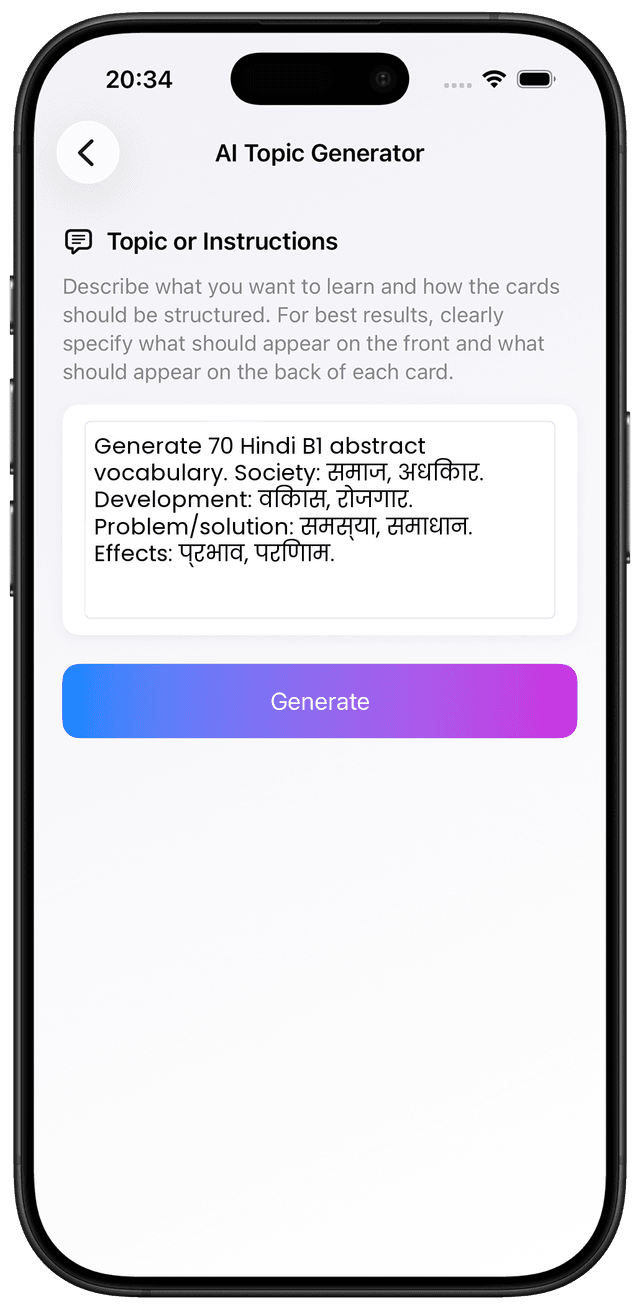
At B1, Hindi moves beyond concrete nouns and everyday verbs into abstract ideas: समाज (society), विकास (development), समस्या (problem), समाधान (solution), प्रभाव (effect), और संबंध (relationship). You need this vocabulary to discuss current events, share opinions, and engage with Hindi media and formal writing.
Why this is essential: B1 discussions require abstract vocabulary. You cannot talk about social issues, politics, or your own views on complex topics without it. This vocabulary also appears heavily in Hindi newspapers, radio, and formal speech.
The strategy: Learn these words alongside their most frequent collocations, since knowing समस्या without knowing समस्या का समाधान is only half the picture.
Generate 70 Hindi B1 abstract and formal vocabulary items. Categories: society (समाज, नागरिक, अधिकार, कर्तव्य), development and economy (विकास, उद्योग, व्यापार, रोजगार), problem and solution (समस्या, समाधान, चुनौती, प्रयास), and effects and relationships (प्रभाव, संबंध, परिणाम, कारण). Include one collocated phrase for each word. Front: Hindi (Devanagari). Back: English + example phrase.
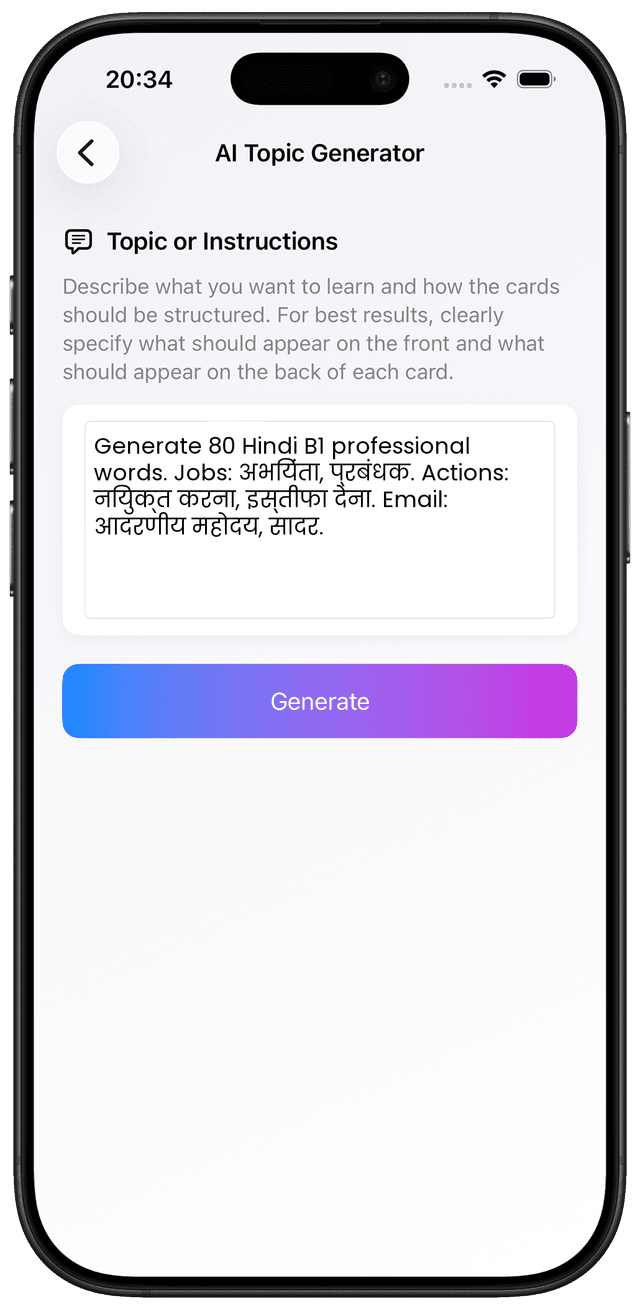
B1 Hindi becomes practical for professional settings. Job interviews, office email, meetings, and formal correspondence all use vocabulary that does not come up in daily conversation. Whether you are working with colleagues in India, doing business across Hindi-speaking regions, or planning to study or work in an Indian context, this vocabulary is directly applicable.
Why this comes next: Professional vocabulary is one of the most frequent reasons adults learn Hindi to an intermediate level. Knowing the formal register also helps with official documents, government communication, and any written Hindi in an institutional context.
The strategy: This deck covers job titles, workplace actions, formal email openers and closers, and meeting vocabulary for standard professional situations.
Generate 80 Hindi B1 words and phrases for Work and Professional Contexts. Include: job titles (अभियंता, लेखाकार, प्रबंधक, स्वतंत्र पेशेवर, प्रशिक्षु), workplace actions (नियुक्त करना, इस्तीफा देना, आवेदन करना, रिपोर्ट सौंपना, समय सीमा पूरी करना), formal email phrases (आदरणीय महोदय, सादर, आपके पत्र के संदर्भ में), meeting vocabulary (कार्यसूची, विचार रखना, सारांश करना, प्रस्ताव करना). Front: Hindi (Devanagari). Back: English.
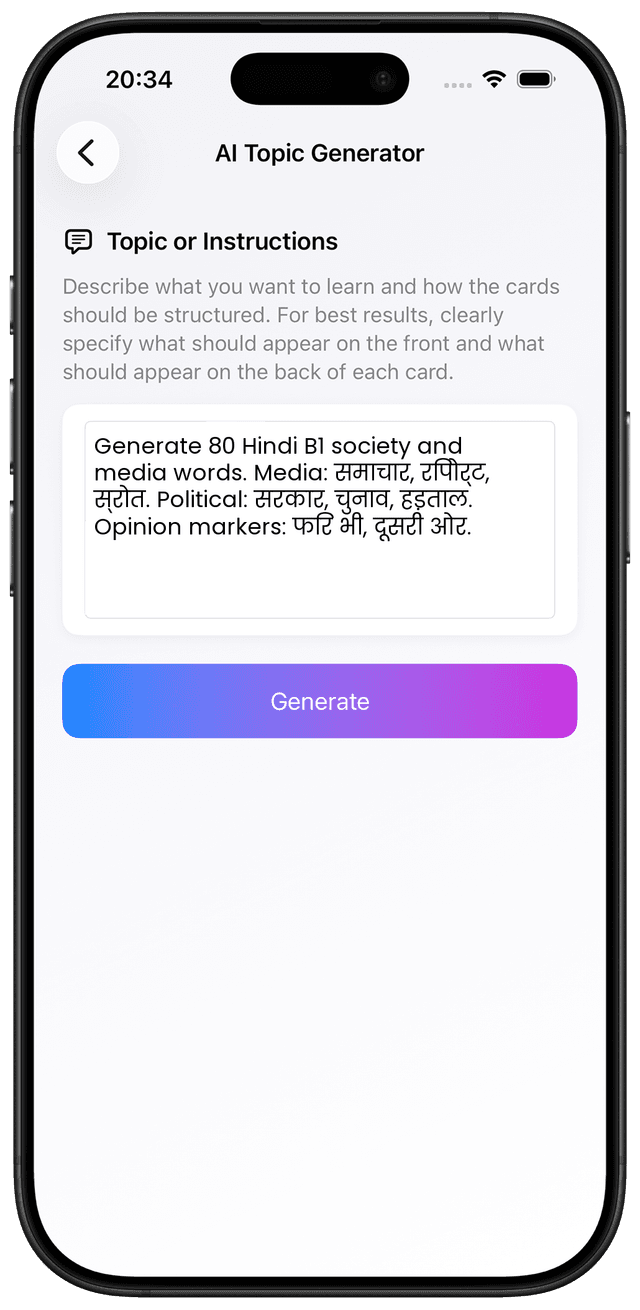
B1 is the level where you start engaging with Hindi in a broader social context: following a news report, reading an editorial, or discussing a current issue. Hindi news vocabulary, political terms, and discussion phrases are central to understanding authentic Hindi content and participating in informed conversations.
The goal: To give you the vocabulary for conversation about everyday public life in India and the Hindi-speaking world, so you can follow Hindi news, join discussions, and understand the cultural and political context of the language you are learning.
Generate 80 Hindi B1 words and phrases for Society and Media. Include: media vocabulary (समाचार, रिपोर्ट, संपादकीय, स्रोत, प्रसारण, प्रकाशित करना), social and political terms (सरकार, विपक्ष, चुनाव, हड़ताल, प्रदर्शन, विधेयक), discussion phrases (ताजी खबरों के अनुसार, बताया गया है कि, सरकार ने घोषणा की), opinion markers (फिर भी, दूसरी ओर, इसके विपरीत). Front: Hindi (Devanagari). Back: English.
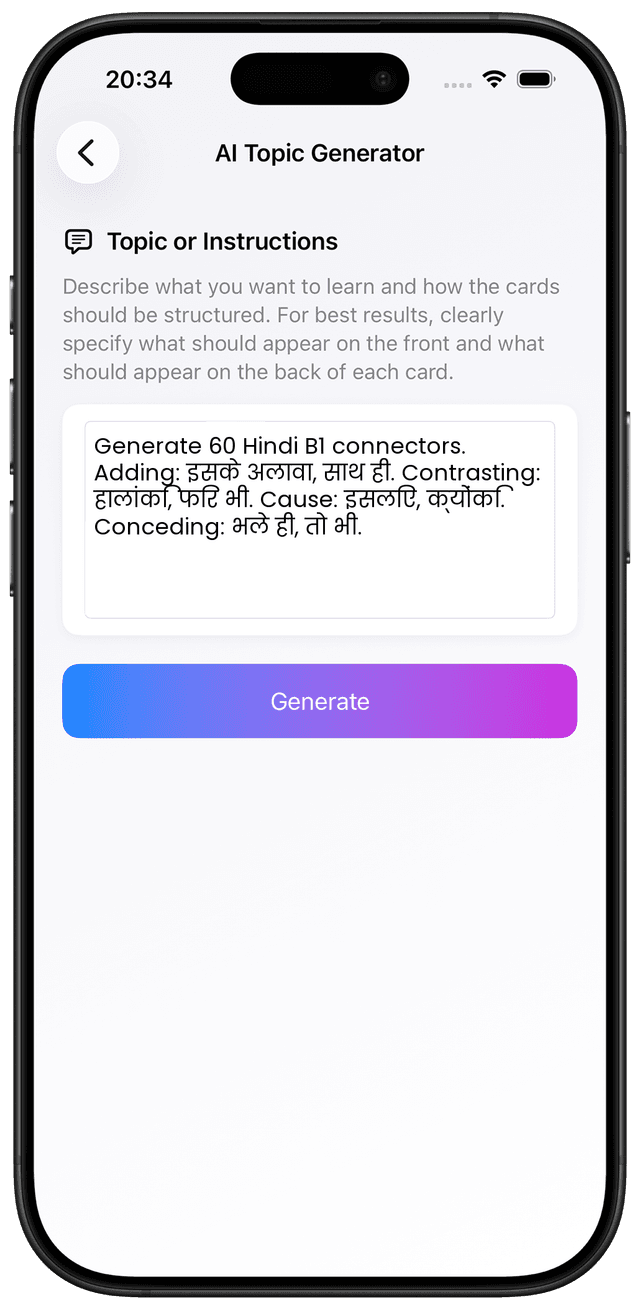
Connectors turn a list of facts into a coherent argument. At B1, written and spoken tasks reward clear structure: adding information, contrasting ideas, expressing cause and result, and conceding a point. Hindi has a rich set of connectors that operate differently depending on register, and getting them right makes your Hindi sound noticeably more fluent and natural.
The milestone: With this deck, your B1 vocabulary toolkit is complete. You have the subjunctive for politeness and purpose, compound verbs for natural expression, reported speech for relaying information, and vocabulary for professional life, society, and structured argument. That covers the full B1 communicative range for real-world Hindi.
Generate 60 Hindi B1 connectors and discourse markers. Five groups: (1) Adding: इसके अलावा, साथ ही, इतना ही नहीं. (2) Contrasting: लेकिन, परंतु, हालांकि, फिर भी. (3) Cause and result: इसलिए, क्योंकि, अतः, परिणामस्वरूप. (4) Conceding: यद्यपि, भले ही, तो भी. (5) Examples and clarification: उदाहरण के लिए, यानी, अर्थात. Front: Hindi connector + example sentence (Devanagari). Back: English + usage note.
At B1, Hindi becomes a game of pattern recognition. Active recall drills the subjunctive, compound verb patterns, and postposition rules until you stop pausing mid-sentence to think. Spaced repetition schedules each review right before you would otherwise forget it.
B1 vocabulary sits above A2 and prepares you for advanced fluency in Hindi. Use the links below to move between levels or return to the full Hindi guide.
Join learners building their Hindi fluency with AI-powered flashcards and spaced repetition. No account or signup required.