You may be studying wrong. It's not your fault; you were likely taught that the best way to learn is to read your textbook, highlight key phrases, and re-read your notes until they stick.
But have you ever spent hours highlighting, only to stare at an exam paper and realize your mind is blank?
Psychologists call this the "Illusion of Competence." When you re-read notes, your brain recognizes the text, tricking you into thinking you know the concept. But recognition is not the same as retrieval.
If you want to memorize faster and actually retain information, you need to switch to the "Gold Standard" of learning science: Active Recall.
What is Active Recall?
Active recall (also known as "retrieval practice") is a learning method where you force your brain to retrieve information from memory without looking at the answer.
Think of your brain like a muscle. Passive studying (reading) is like watching someone else do push-ups. You understand the movement, but you aren't getting stronger. Active recall is getting on the floor and doing the push-ups yourself.
Every time you struggle to answer a question, you are physically strengthening the neural pathways in your brain. This "struggle" is what researchers call "Desirable Difficulty", and it is the key to long-term memory.
The Science: Proof It Works
This isn't just a "study hack"; it is backed by decades of rigorous data.
In a landmark study by Roediger & Karpicke (2006), researchers compared students who studied a text four times (passive) against students who studied once and took practice tests (active).
The Result: The active recall group outperformed the passive group by nearly 30% on long-term retention tests.
Later, Dunlosky et al. (2013) reviewed hundreds of study techniques. They rated popular methods like highlighting and summarizing as "Low Utility" because they rarely work long-term. Only two techniques earned a "High Utility" rating:
- Active Recall (Practice Testing)
- Spaced Repetition (Distributed Practice)
How to Use Active Recall (The Right Way)
You can start using this method today with three simple techniques.
1. The "Blurting" Method
This is active recall in its rawest form.
- Read a section of your textbook.
- Close the book and hide your notes.
- Take a blank sheet of paper and "blurt" (write down) absolutely everything you can remember.
- Open the book and fill in the gaps with a red pen. This forces you to face exactly what you don't know.
2. The Feynman Technique
Try to explain a concept out loud in simple terms, as if you were teaching a 5-year-old. If you stumble or use jargon you can't define, you have identified a gap in your knowledge.
3. Flashcards (The Most Efficient Method)
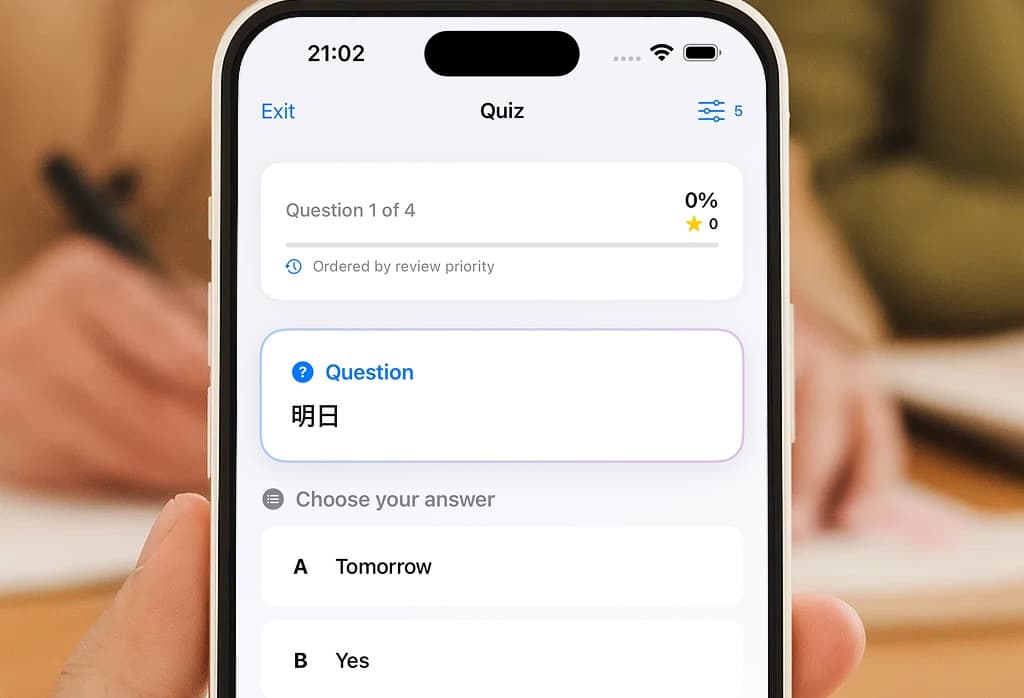
Flashcards are the ultimate active recall tool because they give you a direct prompt (Question) and force a retrieval (Answer).
However, most students make a critical mistake: They spend more time making flashcards than actually using them.
Hand-writing flashcards is slow. Typing them out is tedious. This is where modern AI flashcard generators change the game.
The Problem with Traditional Flashcards
Creating a deck of 100 flashcards for a biology exam might take you 3 hours. That is 3 hours of passive work (copying notes) and zero hours of active learning.
To maximize your grades, you need to minimize the creation time and maximize the testing time.
The Solution: Turn Notes into Flashcards Instantly
If you are looking for the best study apps in 2026, you need a tool that automates the busy work.
MindCards is an app designed specifically to solve this problem. It uses advanced AI to turn notes into flashcards in seconds.
- Scan to Study: distinct from other apps, you can simply take a photo of your textbook page or handwritten notes.
- AI Generation: The AI analyzes the text and automatically generates high-quality active recall questions and answers.
- Efficiency: What used to take you 3 hours of typing now takes 30 seconds of scanning.
Don't Forget Spaced Repetition
Active recall builds the memory; Spaced Repetition keeps it there.
The Forgetting Curve (a concept by Hermann Ebbinghaus) shows that you will forget roughly 50% of what you learn within 24 hours unless you review it.
A good spaced repetition app will automatically schedule your reviews. If you get a card wrong, you see it tomorrow. If you get it right, you see it in 3 days, then 7 days, then a month.
MindCards has this algorithm built-in. It ensures you are only studying the cards you are about to forget, saving you hours of wasted time reviewing things you already know.
(Want to learn more about the science behind optimal review scheduling? Check out our complete guide to Spaced Repetition.)
Final Thoughts
If you are serious about improving your grades, you must stop passive reading. It feels easy, but it is a waste of time.
By combining the science of Active Recall with Spaced Repetition and the speed of an AI flashcard generator, you can learn more in less time.
Ready to test the theory? Download MindCards today to turn your notes into flashcards instantly and start studying smarter, not harder.