
Spaced repetition explained
Why spacing reviews locks in script recognition faster than re-reading.
Devanagari is one of the most logical writing systems in the world. Unlike English spelling, what you see is almost always what you say: every letter has exactly one sound, and the script is organized by the physics of how sounds are made in the mouth.
Most learners skip the script and start with vocabulary using romanized transliteration. That works for a few weeks. Then it stops working. You cannot use a Hindi dictionary, read signs, or access most learning materials without Devanagari. This guide gets you through the script before that wall appears.
Each phase below targets a specific layer of the script. Use the prompts to generate focused flashcard decks in MindCards, work through one phase at a time, and you will be reading basic Hindi sentences within a few weeks.
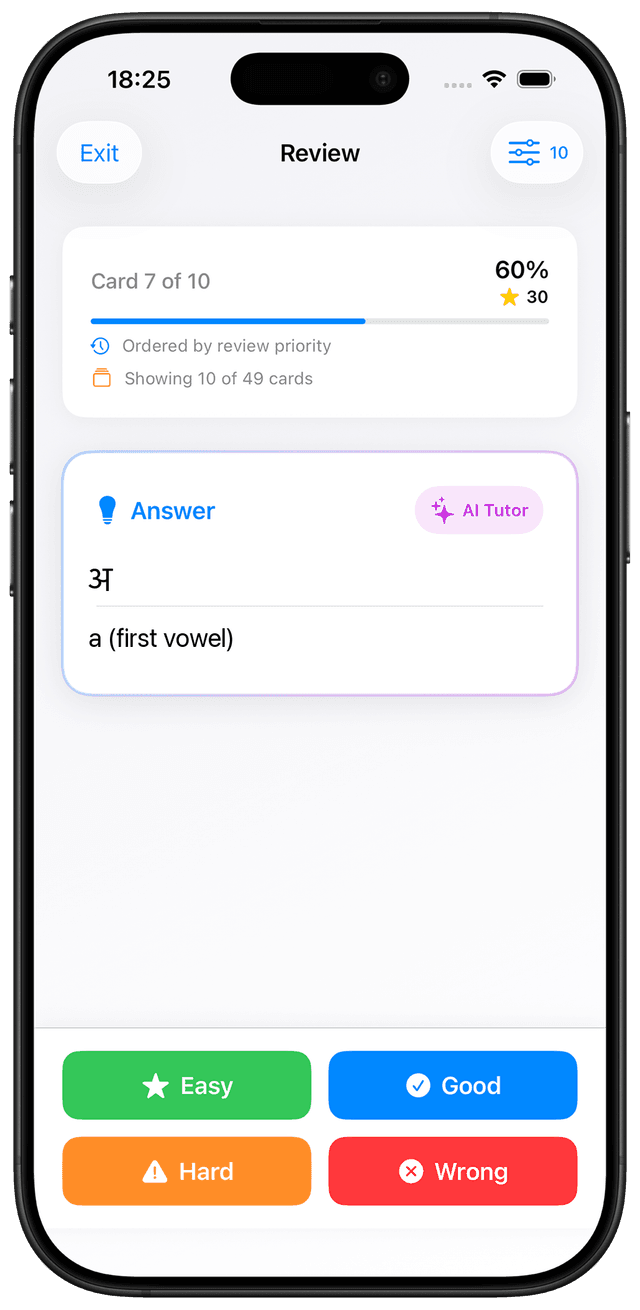
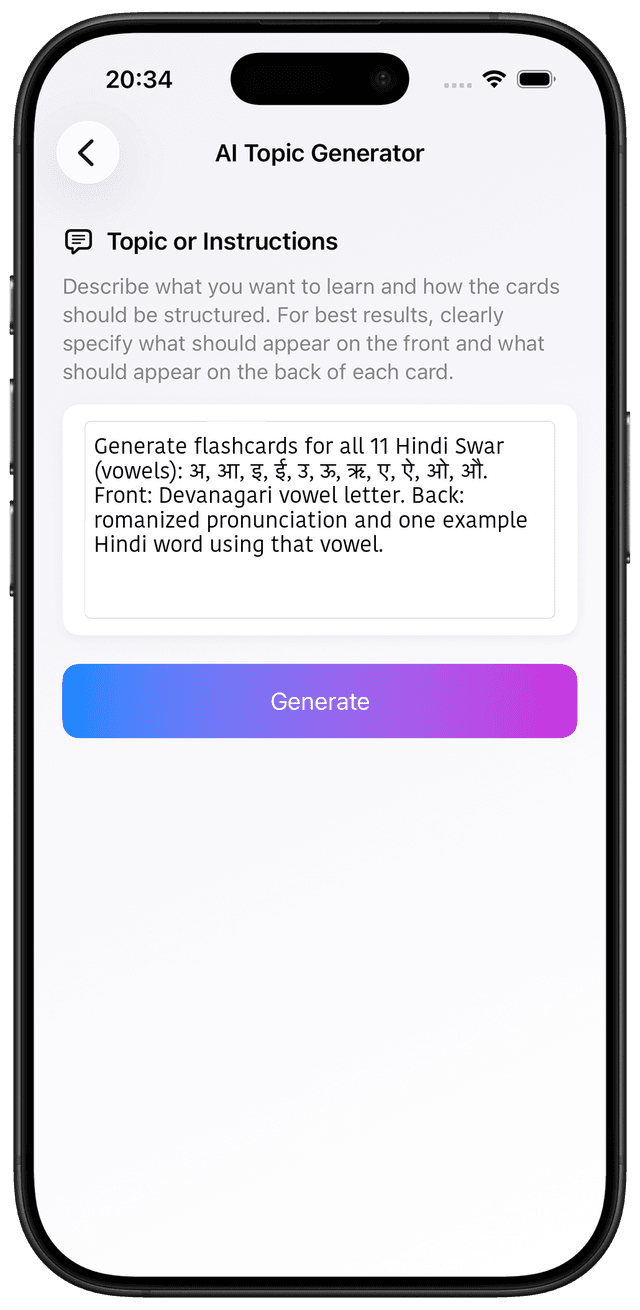
Every Hindi word is built on vowel sounds. The 11 Swar (स्वर) are the standalone vowel letters: अ, आ, इ, ई, उ, ऊ, ऋ, ए, ऐ, ओ, औ. They appear at the start of words and as full letters wherever a vowel stands alone.
Why start here? Every Hindi syllable is built around a vowel sound. Once you know these 11 shapes, you can already read the start of thousands of Hindi words.
The strategy: Put the Devanagari letter on the front of the card and the romanized sound on the back. Drill until each shape triggers the sound automatically, with no translation step in between.
Generate flashcards for all 11 Hindi Swar (vowels): अ, आ, इ, ई, उ, ऊ, ऋ, ए, ऐ, ओ, औ. Front: Devanagari vowel letter. Back: romanized pronunciation and one example Hindi word using that vowel.
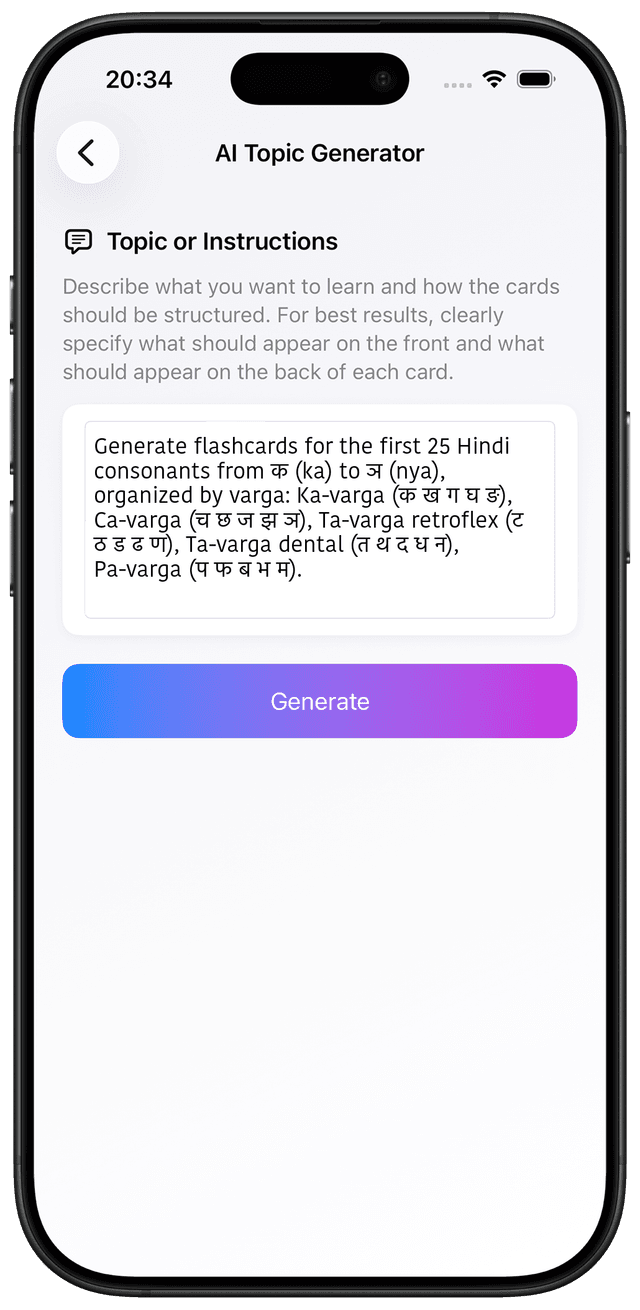
Hindi organizes its 33 consonants into groups by where sound is made in the mouth. The first 25 run from क (ka) to ञ (nya) and cover the velars, palatals, retroflexes, dentals, and labials in that order.
Why this grouping helps: Learning consonants as phonetic groups, not a random list, lets you hear the pattern. क, ख, ग, घ are all made in the same place; only voicing and aspiration differ.
The strategy: Use paired cards that contrast aspirated and unaspirated versions (क vs. ख, ग vs. घ) to train the distinctions that trip up most learners.
Generate flashcards for the first 25 Hindi consonants from क (ka) to ञ (nya), organized by varga: Ka-varga (क ख ग घ ङ), Ca-varga (च छ ज झ ञ), Ta-varga retroflex (ट ठ ड ढ ण), Ta-varga dental (त थ द ध न), Pa-varga (प फ ब भ म). Front: Devanagari consonant. Back: romanized sound, place of articulation, one short example word.
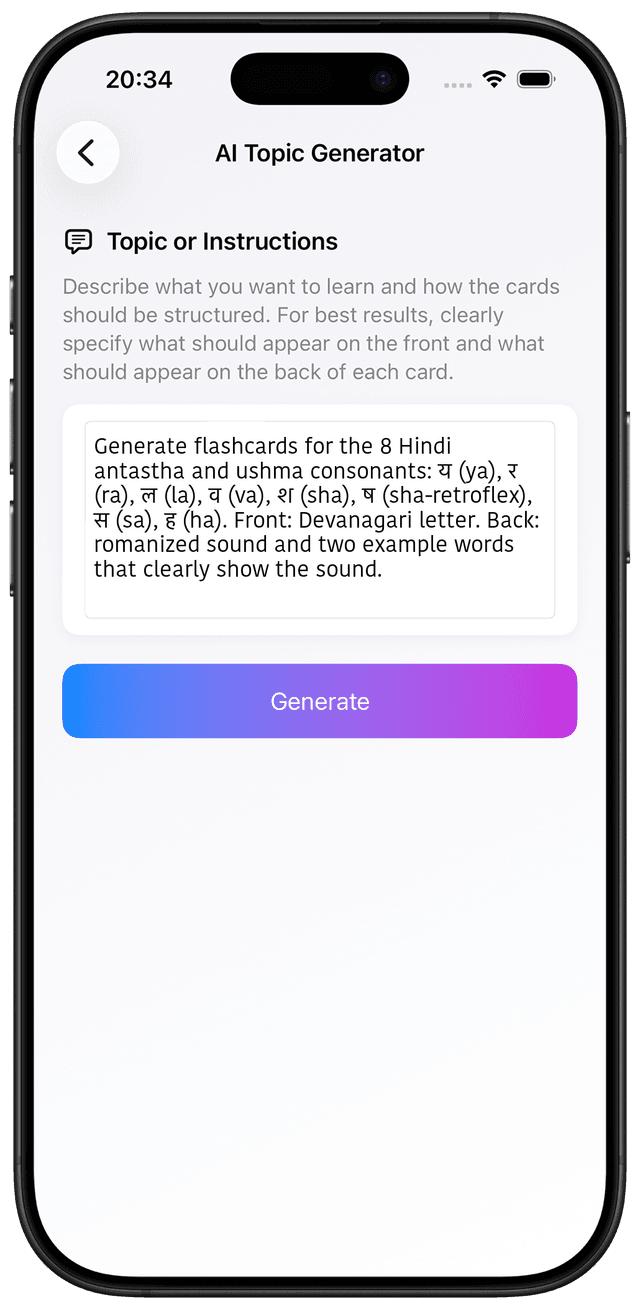
The last eight consonants (य, र, ल, व, श, ष, स, ह) behave differently from the varga consonants. They include the semi-vowels (antastha) and the sibilants and breath sounds (ushma). These letters appear constantly in everyday Hindi and are worth isolating for focused practice.
Pay attention to: The three sibilants श (sha), ष (sha-retroflex), and स (sa) look and sound similar, and mixing them up is one of the most common mistakes beginners make. A dedicated deck for these three alone is worth building.
The strategy: Drill these eight letters as a unit, then create a mini-contrast deck for श/ष/स pairs.
Generate flashcards for the 8 Hindi antastha and ushma consonants: य (ya), र (ra), ल (la), व (va), श (sha), ष (sha-retroflex), स (sa), ह (ha). Front: Devanagari letter. Back: romanized sound and two example words that clearly show the sound. Add a note for श/ष/स distinguishing the three sibilants.
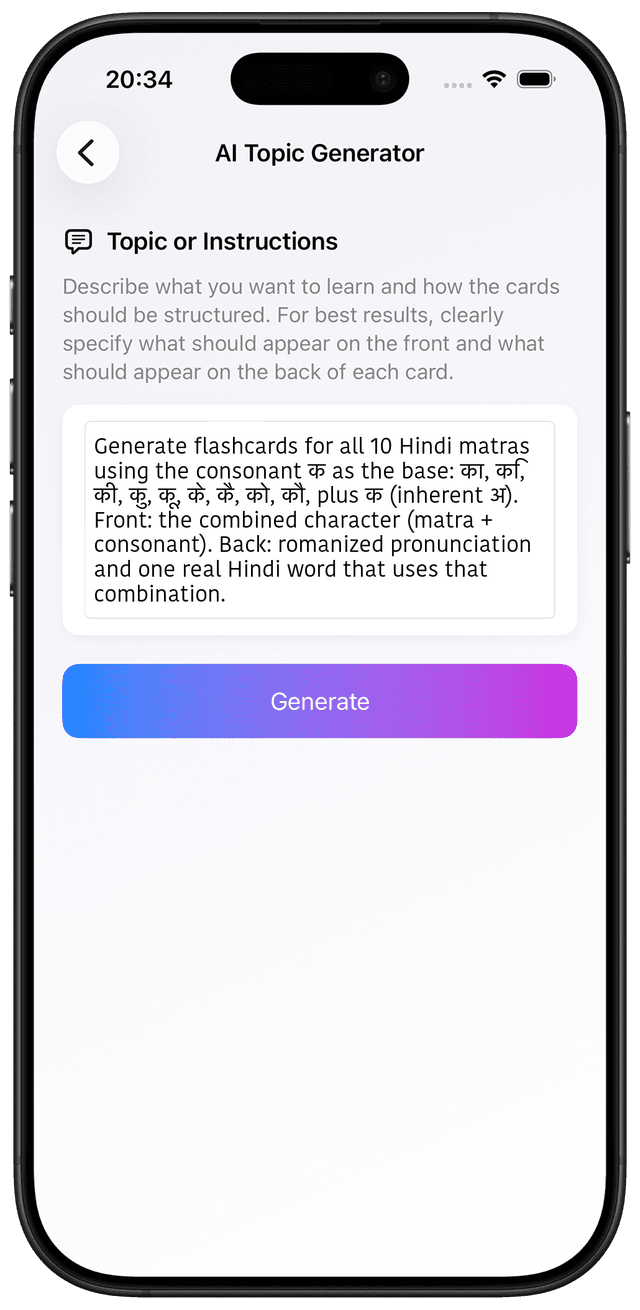
In Devanagari, vowels attached to a consonant are written as diacritics called matras (मात्राएँ). When आ attaches to क, it becomes का. When इ attaches, it becomes कि. Learning matras is what takes you from reading isolated letters to reading actual words.
Why matras matter: Almost every Hindi word uses them. Skip matras and you can read almost nothing. Learn them and most Hindi text opens up.
The strategy: Fix one base consonant (क is the standard choice) and drill all 10 matra forms: का, कि, की, कु, कू, के, कै, को, कौ, plus the inherent अ sound (क on its own). Then repeat with other consonants.
Generate flashcards for all 10 Hindi matras using the consonant क as the base: का, कि, की, कु, कू, के, कै, को, कौ, plus क (inherent अ). Front: the combined character (matra + consonant). Back: romanized pronunciation and one real Hindi word that uses that combination.
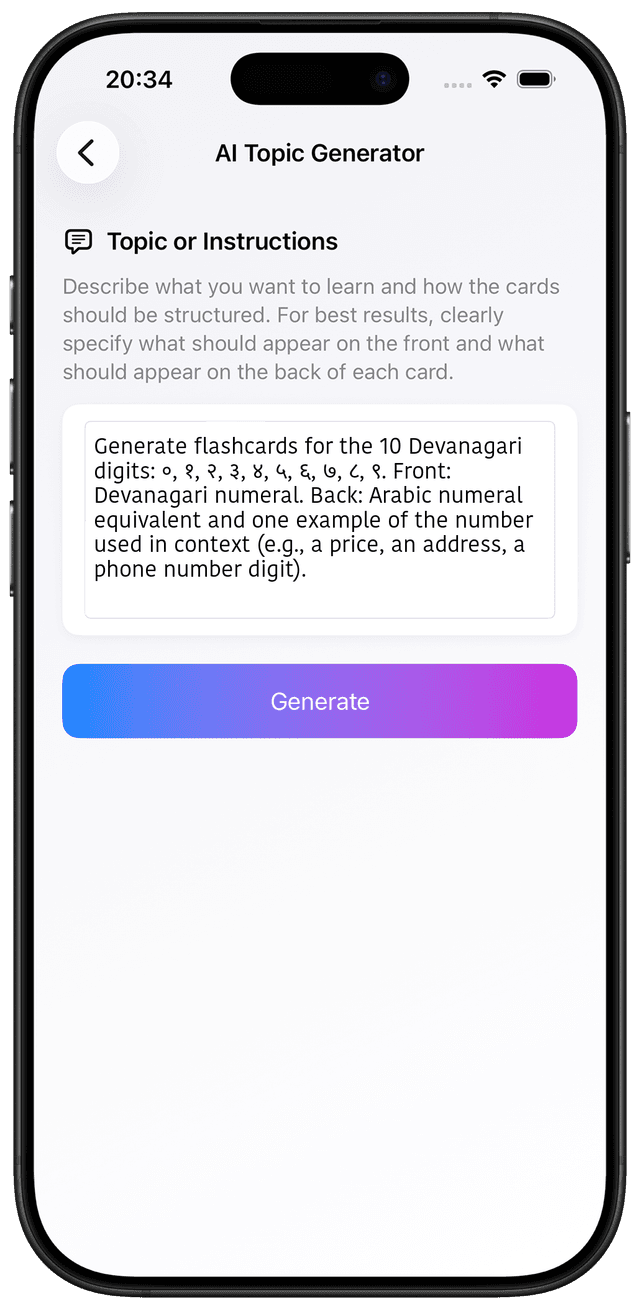
Devanagari has its own set of digits: ०, १, २, ३, ४, ५, ६, ७, ८, ९. They show up on street signs, bus routes, prices, and government documents across India. Western Arabic digits (0–9) are common too, but knowing the Devanagari ones means you can read numbers wherever they appear.
Good news: There are only ten shapes to learn, and once you know them, multi-digit numbers follow exactly the same place-value logic as the Arabic numerals you already know.
Generate flashcards for the 10 Devanagari digits: ०, १, २, ३, ४, ५, ६, ७, ८, ९. Front: Devanagari numeral. Back: Arabic numeral equivalent and one example of the number used in context (e.g., a price, an address, a phone number digit).
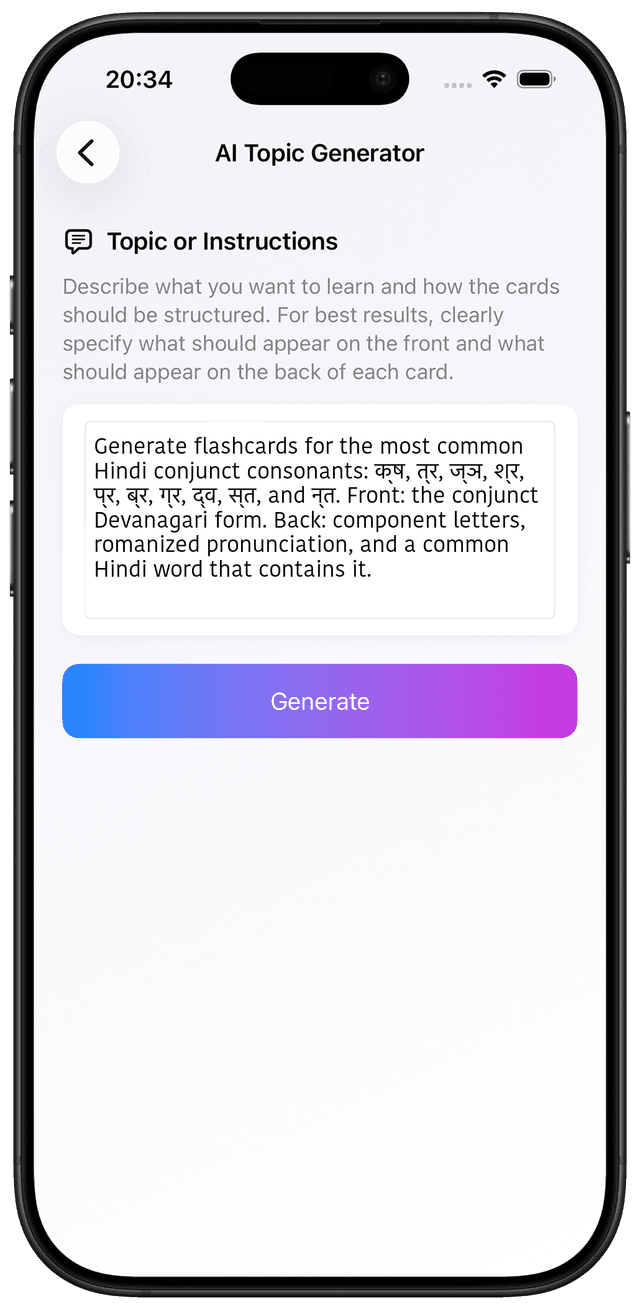
When two or more consonants appear together without a vowel between them, they form a conjunct (samyuktakshar / संयुक्ताक्षर). Some conjuncts look like fused versions: क + ष = क्ष. Others look completely different: ज + ञ = ज्ञ. These show up in many common Hindi words and place names.
The most common ones to learn first: क्ष, त्र, ज्ञ, श्र, and the virama-based forms like प्र, ब्र, and ग्र. These appear in words you will see within the first week of reading Hindi texts.
The strategy: Learn conjuncts through the words they appear in, not in isolation.
Generate flashcards for the most common Hindi conjunct consonants: क्ष, त्र, ज्ञ, श्र, प्र, ब्र, ग्र, द्व, स्त, and न्त. Front: the conjunct Devanagari form. Back: component letters, romanized pronunciation, and a common Hindi word that contains it.
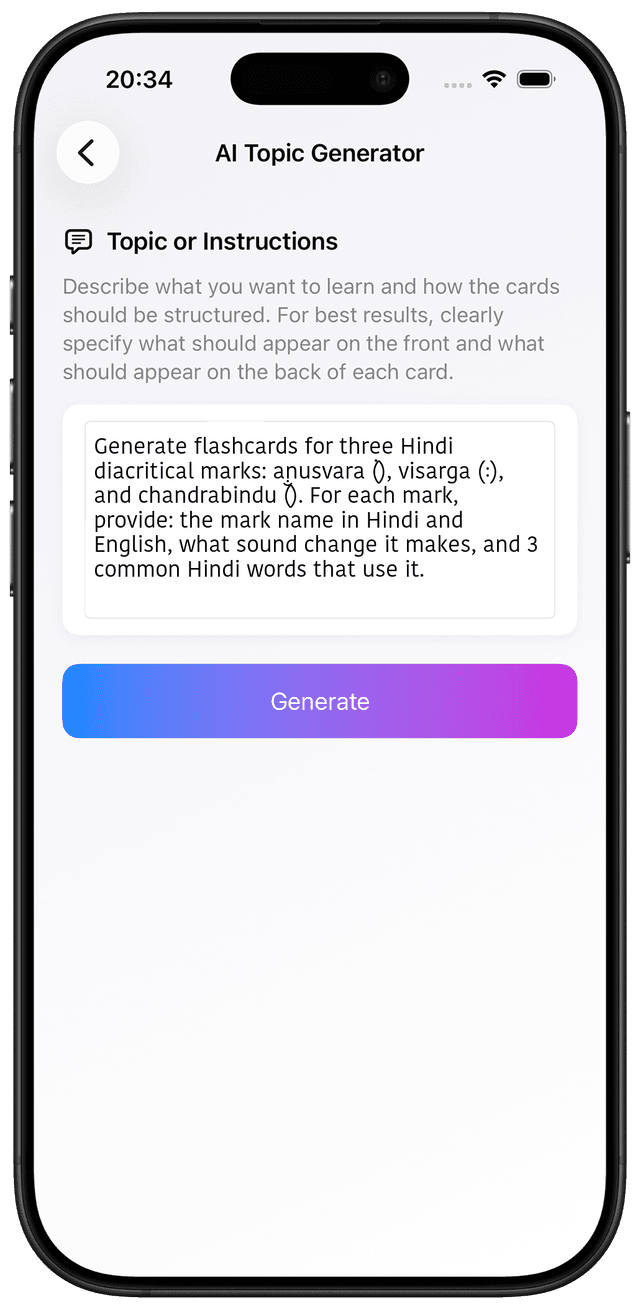
Three marks modify sounds without being full consonants. The anusvara (ं) nasalizes the preceding vowel or represents a nasal consonant before another consonant. The visarga (ः) adds an echo of a breath sound after a vowel. The chandrabindu (ँ) indicates a nasalized vowel, often in poetry and Sanskrit-origin words.
Where you will see them: Anusvara is in words you will recognize immediately: हिंदी (Hindi), संस्कृत (Sanskrit), पंजाब (Punjab). These marks come up constantly in real Hindi text.
The strategy: Learn each mark through a handful of words that use it. That way the mark connects to something concrete, not just an abstract rule.
Generate flashcards for three Hindi diacritical marks: anusvara (ं), visarga (ः), and chandrabindu (ँ). For each mark, provide: the mark name in Hindi and English, what sound change it makes, and 3 common Hindi words that use it. Front: the mark with its name. Back: pronunciation rule and example words.
Reading Devanagari is a recognition skill. Spaced repetition trains your brain to recognize shapes faster, cutting the pause between seeing a letter and knowing its sound.
With the script in place, the A1 vocabulary guide is the natural next step. It picks up exactly where this one leaves off.
Generate Devanagari flashcard decks in seconds with AI, then let spaced repetition handle the rest. No account needed, no subscriptions.