
Spaced repetition explained
Why reviewing at the right interval locks in advanced Hindi vocabulary faster than re-reading.
You have B2. You can read a Hindi newspaper, write a formal letter, and hold your ground in most conversations. C1 is where Hindi stops being work. Formal texts that required active effort start arriving more naturally. You can follow a news editorial, read Hindi literature, and engage with intellectual content in Hindi without stopping to decode every sentence.
C1 covers roughly 6,000 to 8,000 words in active use. This guide focuses on the 1,500+ that move you forward at this level: register control for switching between colloquial and formal Hindi, advanced idioms that appear in journalism and educated conversation, literary vocabulary drawn from the Sanskritised register of formal Hindi, discourse markers for complex written argument, academic writing conventions for university and UPSC contexts, and the subtle near-synonym distinctions that make Hindi sound considered rather than just correct.
Seven phases with copy-paste prompts for MindCards. Each one builds a focused flashcard deck. Spaced repetition schedules each card just before you are likely to forget it, so you retain more with less time reviewing.
At C1, the gap between spoken and written Hindi becomes one of your main concerns. Conversational Hindi relies on short verb forms, contracted words, and borrowed English terms. Formal Hindi in newspapers, government documents, and academic writing uses a distinct Sanskritised register with different vocabulary and sentence structures. Knowing the same idea in three registers and choosing deliberately between them is the core C1 skill.
Why start here? Register switching separates C1 Hindi from B2. A B2 speaker knows कहना and कहा. A C1 speaker chooses between बताया, कहा, उल्लेख किया, and सूचित किया based on whether the context is a text message, a news report, or an official document.
The strategy: This deck pairs colloquial, standard, and formal variants of the same idea. You build the habit of register-switching at the word and phrase level before moving to full sentence construction.
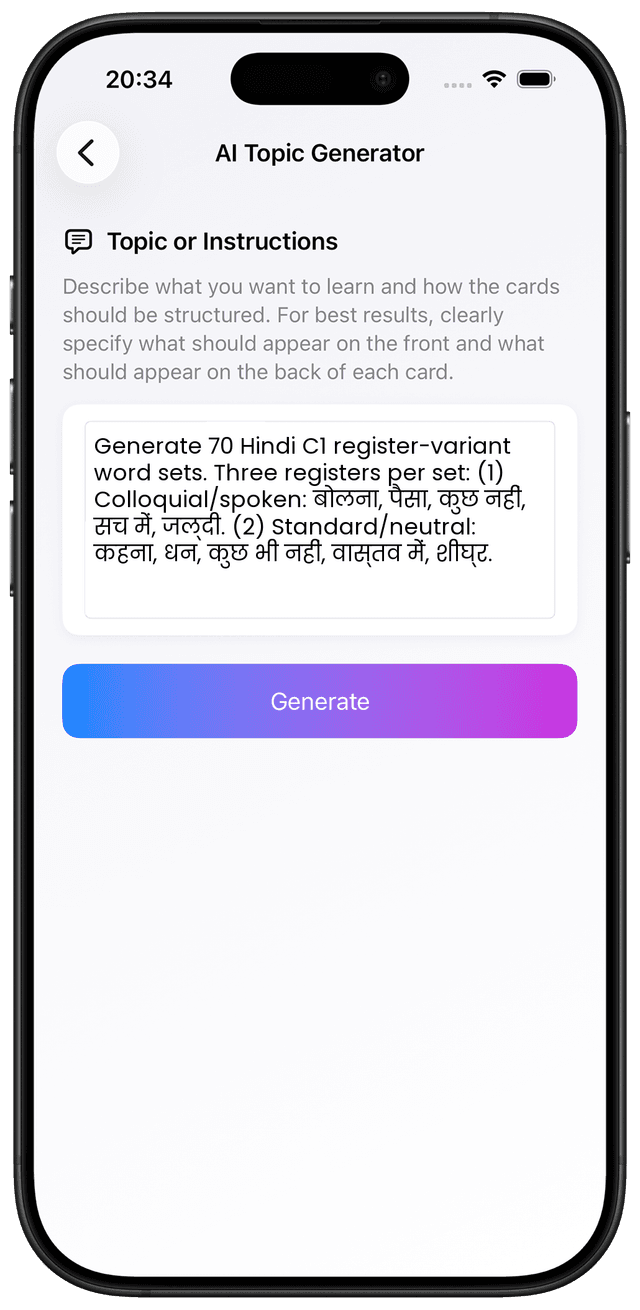
Generate 70 Hindi C1 register-variant word sets. Three registers per set: (1) Colloquial/spoken: बोलना, पैसा, कुछ नहीं, सच में, जल्दी. (2) Standard/neutral: कहना, धन, कुछ भी नहीं, वास्तव में, शीघ्र. (3) Formal/written Sanskritised: निवेदन करना, अर्थ, किंचित भी नहीं, यथार्थ में, त्वरित. Group by semantic category: communication, money, negation, truth, speed. Front: Hindi colloquial form (Devanagari). Back: standard + formal equivalents with register label.
Hindi has a rich tradition of मुहावरे (idiomatic expressions) and लोकोक्तियां (proverbs). These appear throughout journalism, political speeches, literature, and educated conversation. Knowing that आंखें चार होना means to fall in love, that नाक में दम करना means to pester someone severely, or that अंधों में काना राजा means a mediocre person becomes important among those who know nothing, is part of what C1 fluency in Hindi actually looks like.
Why this matters: Idioms and proverbs appear in UPSC preparation materials, Hindi literature courses, and any authentic Hindi text aimed at educated readers. Missing one in a conversation or an editorial can mean misreading the tone entirely.
The strategy: This deck covers the 60 most commonly encountered मुहावरे and लोकोक्तियां in Hindi media and public discourse, grouped by theme, each with context and a usage example.
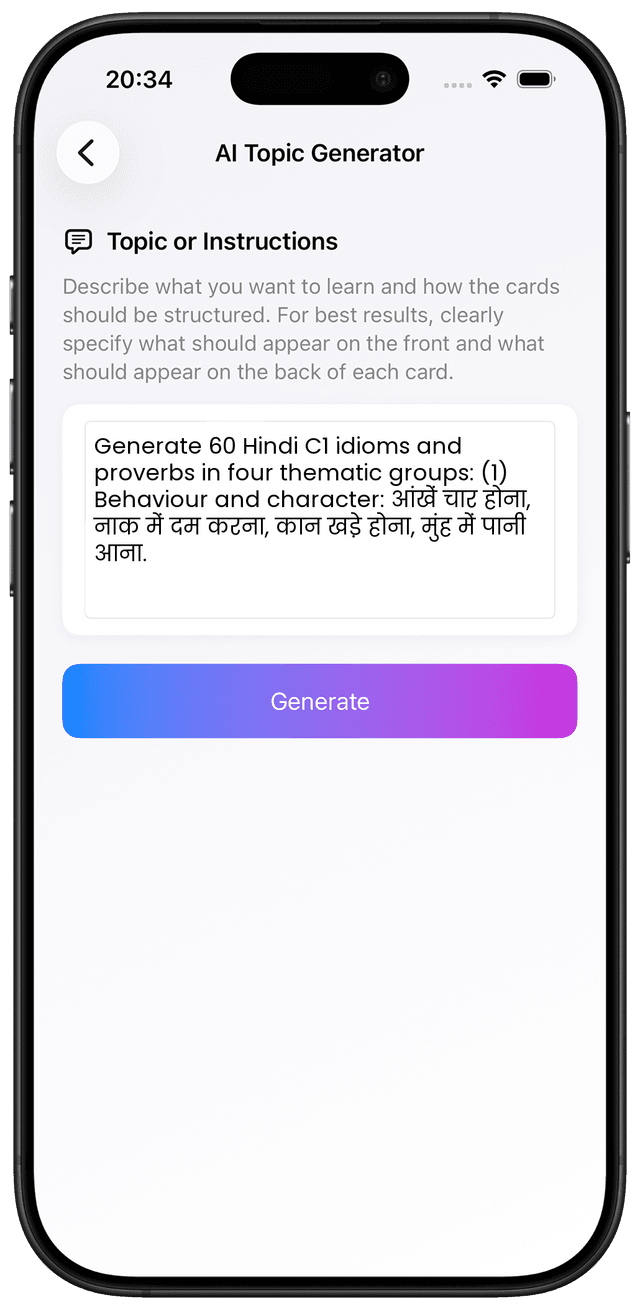
Generate 60 Hindi C1 idioms and proverbs in four thematic groups: (1) Behaviour and character: आंखें चार होना, नाक में दम करना, कान खड़े होना, मुंह में पानी आना. (2) Effort and result: आसमान से गिरे खजूर में अटके, एक पंथ दो काज, अंधों में काना राजा, बिना मेहनत फल नहीं. (3) Communication and truth: मुंह पर पत्थर रखना, बात का बतंगड़ बनाना, चुप्पी साधना. (4) Time and urgency: लोहा गर्म है मारो हथौड़ा, समय का चक्र. Front: Hindi idiom or proverb (Devanagari). Back: literal meaning + actual meaning + example sentence.
C1 written Hindi is expected to handle complex argument structures: introducing a position, qualifying it, acknowledging counter-evidence, and reaching a clear conclusion. B2 teaches the basic connectors like लेकिन and इसलिए. C1 requires the precise markers that signal exact logical relationships between clauses and paragraphs in formal prose: यद्यपि...तथापि, इसके बावजूद भी, यह कहना अनुचित नहीं होगा कि, इस संदर्भ में यह उल्लेखनीय है कि.
Why add this now? Written argument in Hindi journalism, academic papers, and formal essays uses these markers throughout. Reading the Hindu Hindi edition, Dainik Bhaskar opinion pieces, or UPSC essay answers fluently depends on recognising and using them. Producing them yourself is what shifts your writing from intermediate to advanced.
The strategy: This deck covers C1-level discourse markers organised by their argumentative function, each shown in a complete Devanagari sentence with a register note.
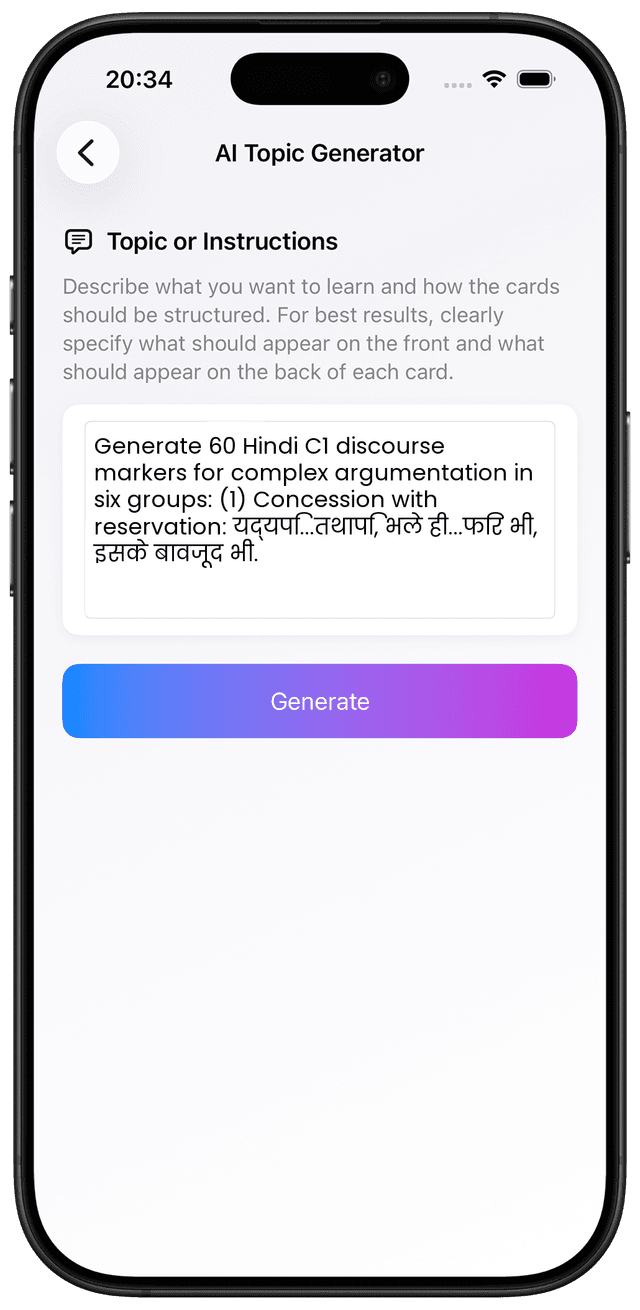
Generate 60 Hindi C1 discourse markers for complex argumentation in six groups: (1) Concession with reservation: यद्यपि...तथापि, भले ही...फिर भी, इसके बावजूद भी. (2) Logical consequence: अतः यह स्पष्ट है कि, इस कारण से, परिणामतः. (3) Reformulation: दूसरे शब्दों में, स्पष्ट करते हुए, अर्थात. (4) Contrast: इसके विपरीत, जबकि दूसरी ओर, तुलनात्मक रूप से. (5) Emphasis: विशेष रूप से, इस संदर्भ में उल्लेखनीय है, सबसे महत्वपूर्ण बात. (6) Conclusion: संक्षेप में कहें तो, उपरोक्त से स्पष्ट है कि, निष्कर्षतः. Front: Hindi discourse marker + example sentence (Devanagari). Back: English + function label.
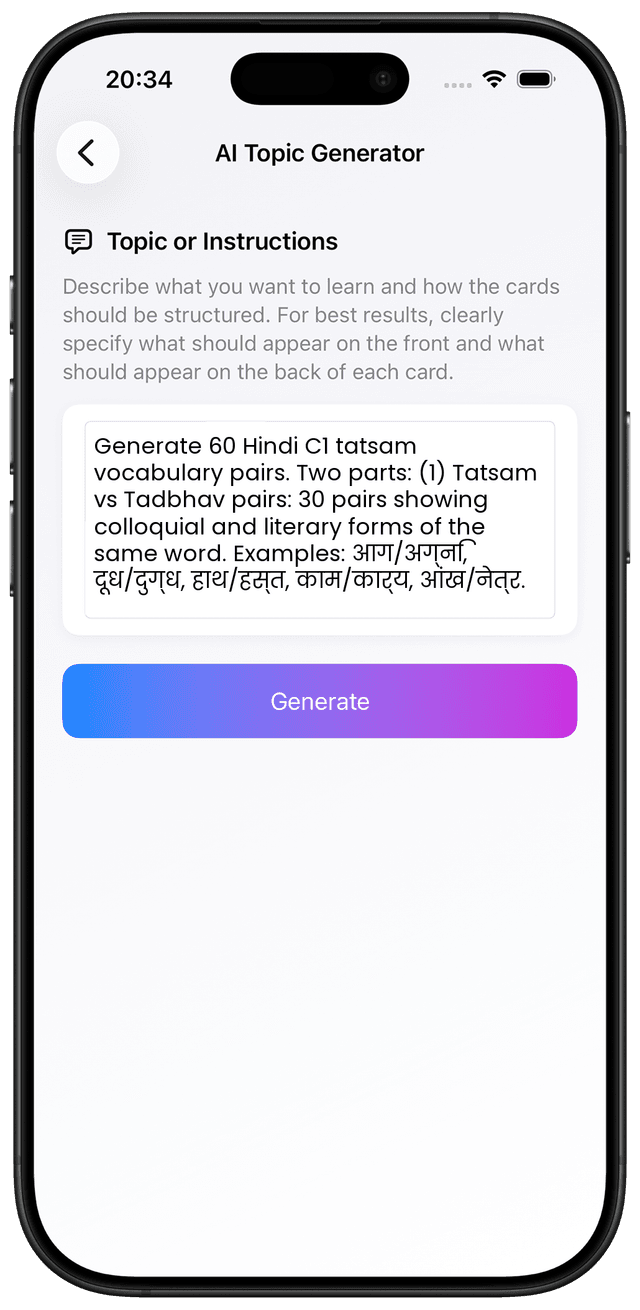
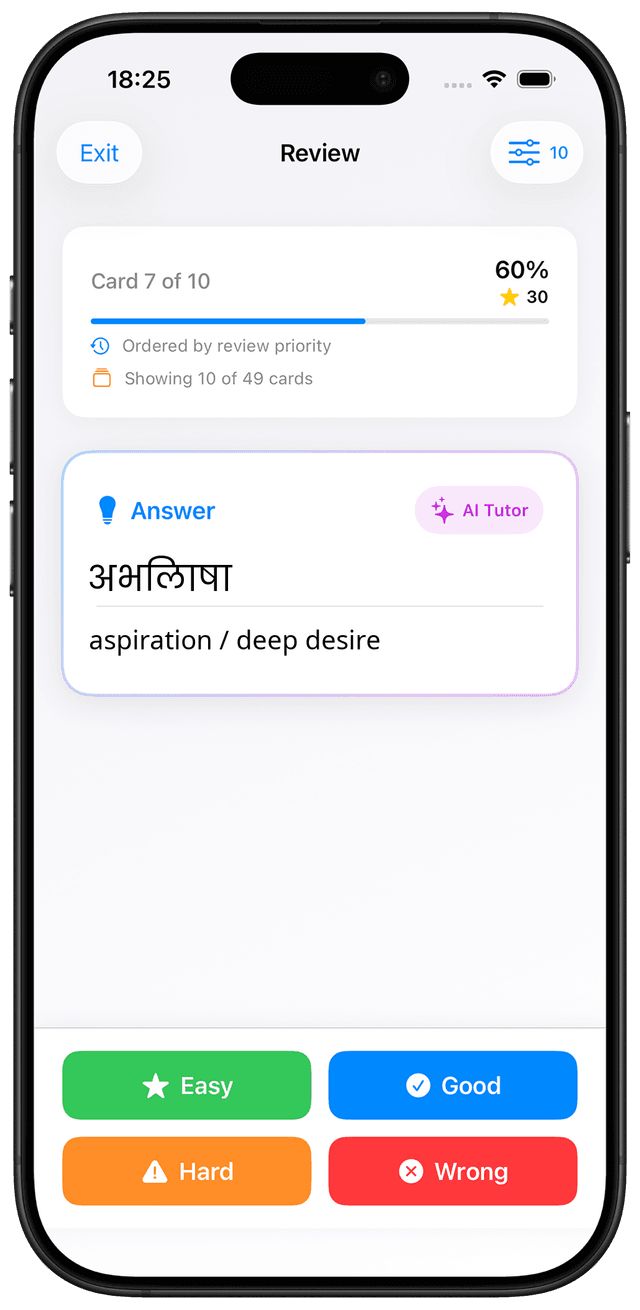
At C1, formal and literary Hindi draws extensively from Sanskrit vocabulary through तत्सम words: direct Sanskrit borrowings that appear unchanged in formal Hindi. Words like अभिलाषा (deep desire), प्रतीक्षा (waiting), आत्मसात करना (to absorb/internalise), and विरोधाभास (contradiction) are standard in newspapers, speeches, and literature but rarely appear in conversational Hindi. Reading Hindi literature, watching serious Hindi cinema, or engaging with Hindi philosophy requires this vocabulary.
Why this is essential: Tatsam vocabulary is the single biggest stylistic marker of educated formal Hindi. News anchors, politicians giving formal speeches, academic writers, and Hindi literary authors all use it extensively. Without it, C1 texts and audio feel dense even when you know all the common words.
The strategy: This deck pairs colloquial तद्भव (Prakrit-derived) forms with their तत्सम equivalents, so you recognise the register shift and can make it deliberately.
Generate 60 Hindi C1 tatsam vocabulary pairs. Two parts: (1) Tatsam vs Tadbhav pairs: 30 pairs showing colloquial and literary forms of the same word. Examples: आग/अग्नि, दूध/दुग्ध, हाथ/हस्त, काम/कार्य, आंख/नेत्र, मुंह/मुख, आसमान/आकाश, रात/रात्रि, सूरज/सूर्य. (2) Literary abstract vocabulary in formal sentences: 30 items including अभिलाषा, प्रतीक्षा, विरोधाभास, समन्वय, अभिव्यक्ति, परिकल्पना, संकल्प, उत्कर्ष. Front: Hindi literary form (Devanagari). Back: colloquial equivalent + English + register note.
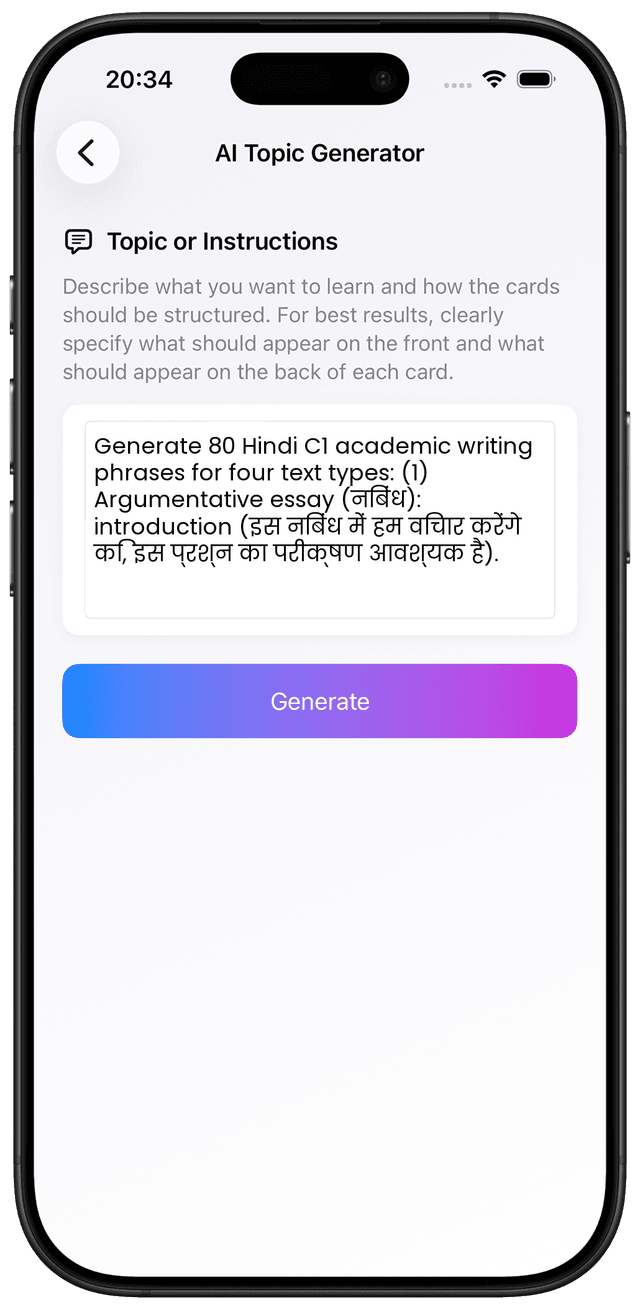
University study in Hindi, UPSC essay writing, and professional research all require command of specific text types: the निबंध (argumentative essay), the समीक्षा (review or critique), the शोध-सारांश (research summary), and formal academic correspondence. Each text type has structural and lexical conventions that differ from general writing.
Why this comes next: Hindi university education and UPSC preparation both test academic text production extensively. Knowing the structural phrases for different text types, and the vocabulary for hedging, evidence presentation, and academic argument, directly affects your written performance.
The strategy: This deck covers the lexical and structural conventions of the main C1 text types, with ready-to-use phrases for introduction, development, and conclusion in standard academic Hindi.
Generate 80 Hindi C1 academic writing phrases for four text types: (1) Argumentative essay (निबंध): introduction (इस निबंध में हम विचार करेंगे कि, इस प्रश्न का परीक्षण आवश्यक है), development (एक प्रमुख तर्क यह है कि, इसके विपरीत यह कहा जा सकता है), conclusion (उपरोक्त विवेचन से स्पष्ट होता है कि). (2) Critique (समीक्षा): लेखक का मत है कि, इस रचना की विशेषता, आलोचनात्मक दृष्टि से. (3) Research summary: शोध से यह निष्कर्ष निकलता है कि, अध्ययन के अनुसार, इस क्षेत्र में और शोध की आवश्यकता है. (4) Formal correspondence: महोदय/महोदया, उक्त विषय में सविनय निवेदन है कि, कृपया उचित कार्रवाई करने की कृपा करें. Front: Hindi phrase (Devanagari). Back: English + text type label.
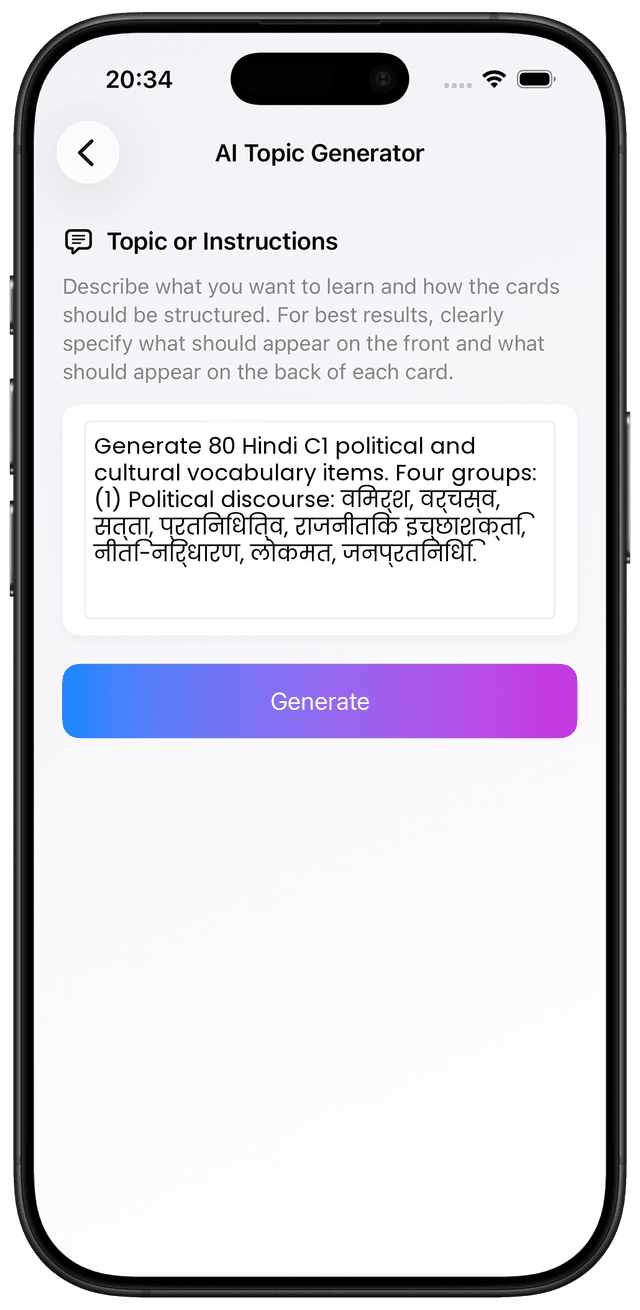
At C1 you can follow political debate, engage with Indian cultural and intellectual life, and read serious journalism with minimal effort. Terms like विमर्श (discourse/debate), वर्चस्व (hegemony/dominance), हाशिया (margins/marginalisation), प्रतिनिधित्व (representation), and सांस्कृतिक पहचान (cultural identity) appear throughout Hindi journalism, academic writing, and political commentary.
The goal: To build the conceptual vocabulary for real intellectual engagement in Hindi rather than just following the basic facts of a news story. This phase covers the political, philosophical, and cultural vocabulary that appears in Hindi newspapers like Jansatta, Dainik Jagran editorial pages, and academic writing on Indian society and culture.
Generate 80 Hindi C1 political and cultural vocabulary items. Four groups: (1) Political discourse: विमर्श, वर्चस्व, सत्ता, प्रतिनिधित्व, राजनीतिक इच्छाशक्ति, नीति-निर्धारण, लोकमत, जनप्रतिनिधि. (2) Social and cultural identity: सांस्कृतिक पहचान, हाशिया, समावेश, विविधता, सामाजिक न्याय, अल्पसंख्यक समुदाय. (3) Intellectual and philosophical: विचारधारा, द्वंद्व, तर्कसंगतता, नैतिकता, मानवीय गरिमा, अभिव्यक्ति की स्वतंत्रता. (4) Media and public sphere: जनमाध्यम, मीडिया विमर्श, सूचना का अधिकार, पारदर्शिता, जवाबदेही, लोकतांत्रिक मूल्य. Front: Hindi term (Devanagari). Back: English + usage example.
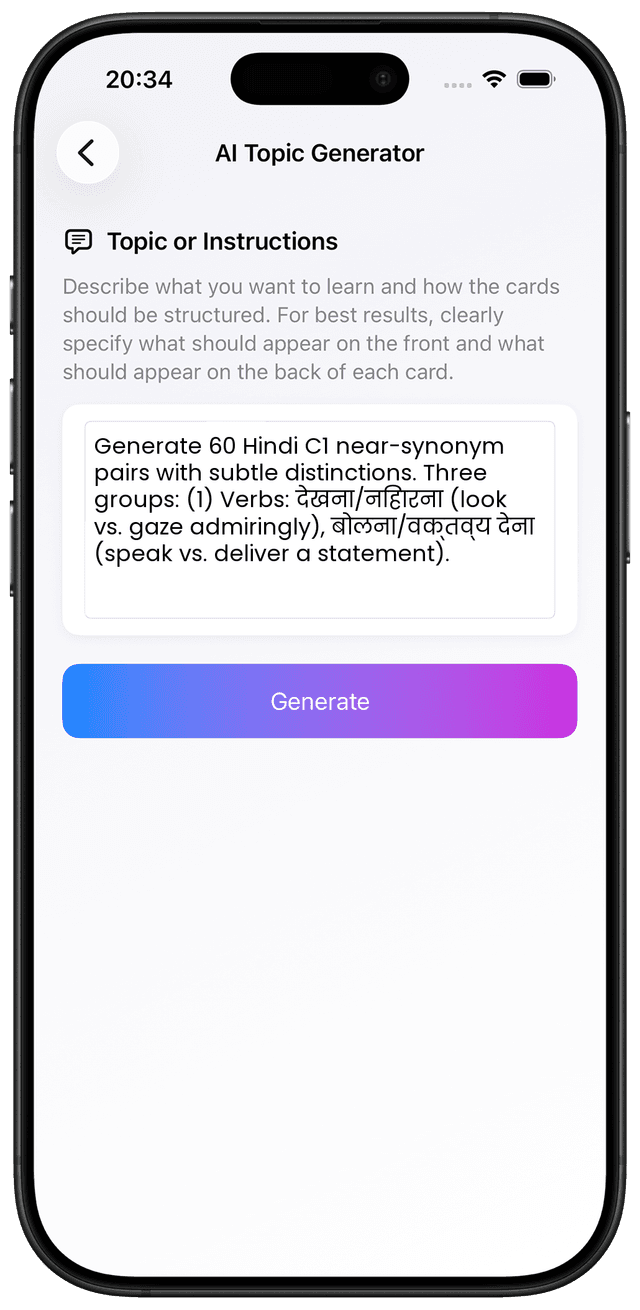
Native Hindi speakers do not just know words; they know the subtle distinctions between near-synonyms. The difference between देखना and निहारना (the latter implying lingering, admiring attention), between डर and भय (भय is more formal and serious), or between थकान and श्रम (one is the state, the other is the effort) is exactly the kind of nuance that distinguishes C1 from B2 Hindi. At this level, getting these distinctions right is what makes your Hindi sound considered rather than just correct.
The milestone: Completing this phase means your C1 vocabulary toolkit covers register variation, advanced idioms, discourse markers, literary vocabulary, academic writing, political and cultural discourse, and stylistic nuance. That covers the full C1 communicative range for professional Hindi and serious academic engagement.
Looking ahead: C2 extends each of these areas further, adding rare literary vocabulary, archaic forms, and deeper idiomatic range. Every card locked in at C1 reduces C2 study time.
Generate 60 Hindi C1 near-synonym pairs with subtle distinctions. Three groups: (1) Verbs: देखना/निहारना (look vs. gaze admiringly), बोलना/वक्तव्य देना (speak vs. deliver a statement), सोचना/विचार करना (think vs. deliberate), चलना/प्रस्थान करना (walk vs. depart formally). (2) Nouns: डर/भय (fear colloquial vs. formal), थकान/श्रम (fatigue vs. labour/effort), घर/आवास (home vs. residence formal), बात/विषय (thing said vs. subject/matter). (3) Adjectives: बड़ा/वृहत (big vs. vast/grand), अच्छा/श्रेष्ठ (good vs. excellent/superior), पुराना/प्राचीन (old vs. ancient). Front: colloquial Hindi word (Devanagari). Back: formal equivalent + subtle distinction explained in English.
At C1, Hindi vocabulary is less predictable than the high-frequency words you learned at lower levels. Spaced repetition handles this directly: cards you find hard appear more often, cards you know well drop back. You spend time where it counts. The same technique that builds A1 words builds C1 idioms and literary vocabulary.
C1 builds on B2 and prepares you for near-native C2 fluency in Hindi. Use the links below to move between levels or return to the full Hindi guide.
Join learners building advanced Hindi with spaced repetition and AI-powered vocabulary generation. No account needed. Download and start your first C1 deck today.