
Spaced repetition explained
Why reviewing at the right interval is the key to retaining mastery-level Russian vocabulary
You have C1 Russian. You can switch registers, write a structured эссе, and read a Russian novel without pausing every paragraph. C2 is where the effort drops away entirely. The mental work of monitoring your Russian fades, you reach for the right фразеологизм without thinking, and you produce written Russian that does not read as translated.
This guide covers the 1,000+ vocabulary items that close the remaining gap between advanced and near-native Russian. Idiomatic phrases (фразеологизмы) come first, because wrong word pairings are the most visible signal of a non-native writer. Then literary Russian drawn from Pushkin, Dostoevsky, Tolstoy, and Bulgakov; academic register for theses and journals; mastery-level aspect and case choices; Russian proverbs (пословицы) in real context; канцелярит and legal Russian for professional work; and current spoken Russian for genuine conversational range. The whole path is built around TORFL IV (ТРКИ-4) expectations.
Each of the seven phases below includes a ready-to-use AI prompt. Paste it into MindCards and your first deck for that topic builds in seconds. Spaced repetition then schedules each card at the right interval, so your review time goes to the items you are actually forgetting and not the ones you have already locked in.
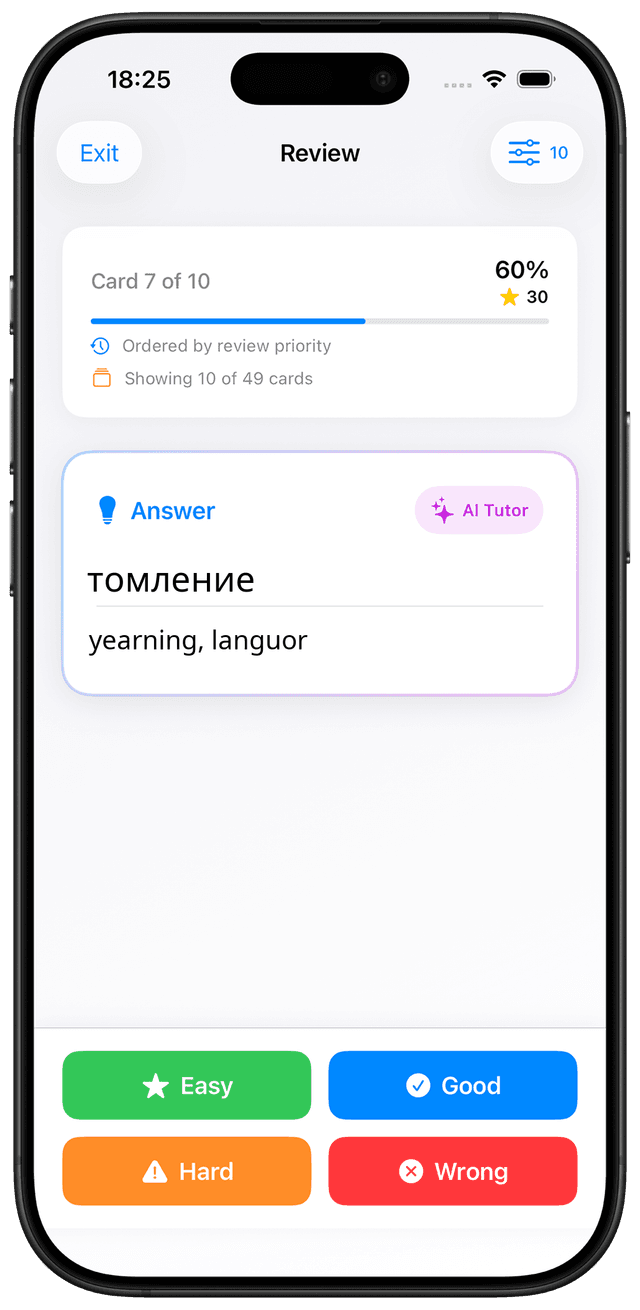
C2 Russian is not a longer word list. It is the habit of reaching for whole idiomatic phrases the way an educated native speaker does. The distance between C1 and C2 is mostly in this layer. Натянутый как струна, душа не на месте, водить за нос, бить баклуши, на седьмом небе, как в воду глядел, ни в зуб ногой. A native chooses these without pausing. A C1 learner translates the literal meaning and ends up with an awkward paraphrase. TORFL IV (ТРКИ-4) flags this gap immediately in the speaking and writing modules.
Why start here? Idiomatic density is the most reliable marker of C2 Russian. A Russian assessor reading your writing notices the absence of фразеологизмы before they notice anything else. This phase targets 200 of the most frequent set phrases from contemporary Russian press, literary prose, and educated speech, grouped by semantic field so the patterns become easier to internalise.
The strategy: Each card pairs the фразеологизм with a real context sentence from journalism or literature and a note on register. You build recognition and production together, not separately.
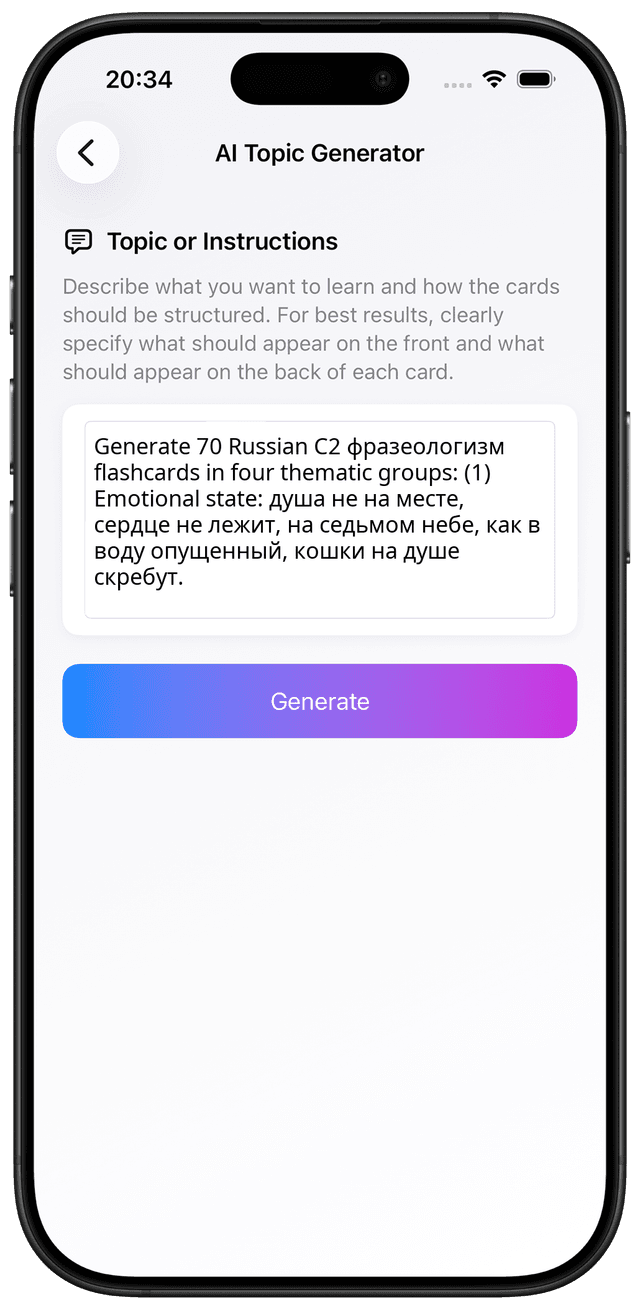
Generate 70 Russian C2 фразеологизм flashcards in four thematic groups: (1) Emotional state: душа не на месте, сердце не лежит, на седьмом небе, как в воду опущенный, кошки на душе скребут, душа в пятки ушла, не в своей тарелке, как на иголках. (2) Behaviour and intent: водить за нос, вешать лапшу на уши, играть с огнём, ходить вокруг да около, гнуть свою линию, лезть на рожон, набивать руку, плыть по течению. (3) Knowledge and competence: ни в зуб ногой, как свои пять пальцев, собаку съесть, ни уха ни рыла, мастер на все руки, светлая голова, держать ухо востро. (4) Outcome and result: остаться с носом, попасть впросак, как в воду глядел, сесть в калошу, попасть пальцем в небо, разбиться в лепёшку. Front: фразеологизм + context sentence. Back: literal meaning + actual meaning + register note.
Reading Достоевский, Толстой, Булгаков, or going back to Пушкин without leaning on a dictionary requires a vocabulary set that sits between formal and literary Russian. This is not the lexicon of newspaper journalism. It is the vocabulary of inner life, lyrical description, and authorial reflection that fills serious Russian prose. Слова like томление, упование, тщедушный, исступление, обыватель, мещанство, юродивый. The same vocabulary turns up in literary criticism, philosophical essays, and feuilleton journalism in Литературная газета and Новый мир.
The goal: To give you enough literary register vocabulary that you can read a passage of Tolstoy or Bulgakov and follow the narrative choices the author is making, not just the plot. This matters for the TORFL IV чтение (reading) module and for written production at C2, where literary echoes are read as a signal of true mastery rather than a flourish.
The strategy: The deck draws directly from passages in canonical Russian-language works. Each card includes a source context, the literary function, and a contemporary contrast so you can feel where the same word still lives in modern Russian.
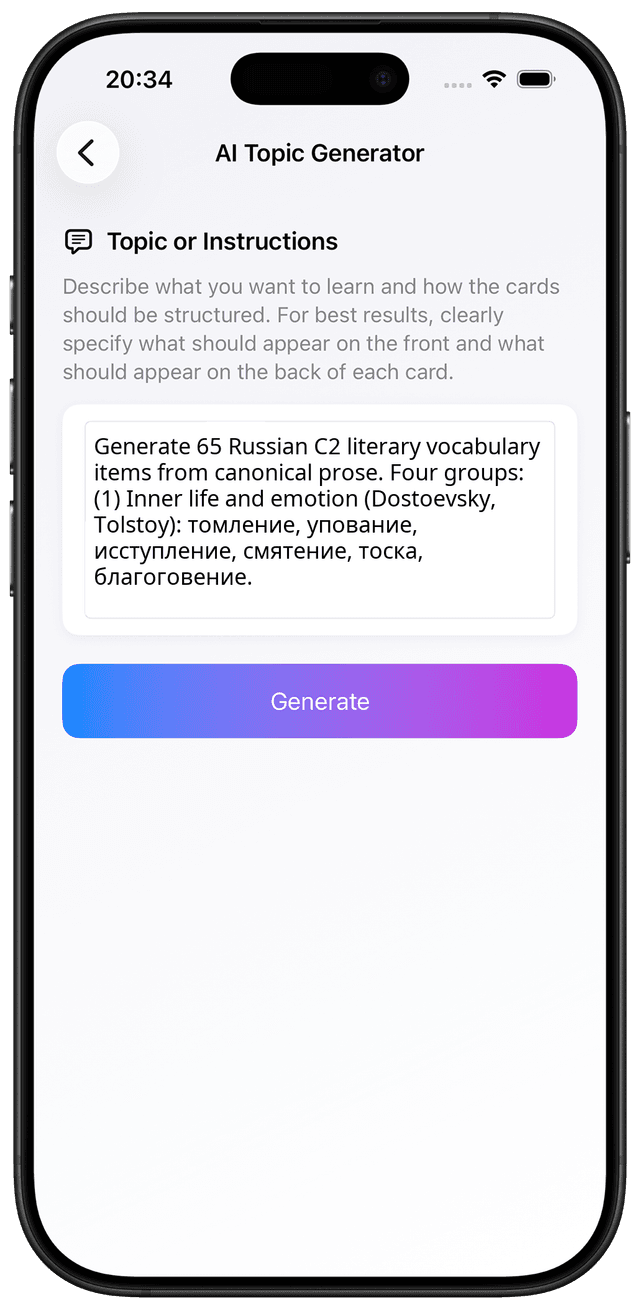
Generate 65 Russian C2 literary vocabulary items from canonical prose. Four groups: (1) Inner life and emotion (Dostoevsky, Tolstoy): томление, упование, исступление, смятение, тоска, благоговение, душевный надлом, нравственное падение, угрызения совести, отрада. (2) Social and moral types (Gogol, Chekhov, Bulgakov): обыватель, мещанство, тщедушный, юродивый, лицемерие, мракобесие, чинопочитание, прихлебатель, праздность, добродетель. (3) Lyrical description (Pushkin, Bunin, Pasternak): сумерки, дрёма, нега, безмолвие, мерцать, трепетать, увядать, сокровенный, вешний, лазурный. (4) Authorial reflection (Tolstoy, Bulgakov): провидение, рок, неизбывный, бренный, тщета, суетность, преходящий, упование. Front: Russian word + sentence from a literary context (note the author). Back: English equivalent + literary function label.
TORFL IV writing tasks and Russian-language graduate study both require academic prose that sounds written, not spoken. That means specific verbs (обуславливать, опосредовать, постулировать), specific noun phrases (предметная область, понятийный аппарат, методологическая основа), and the connective vocabulary that holds a long argument together (в данном контексте следует отметить, что; необходимо подчеркнуть, что; вышесказанное позволяет утверждать, что). Without this layer you can be grammatically clean and still read as a translated thesis.
Why this matters: Russian academic writing has its own rhythm. Sentences are longer than in English academic prose, embedded clauses are common, and the writer is expected to disappear behind passive constructions and nominalisation. A C2 user produces this style on purpose. A C1 user fights it.
The strategy: The deck covers the verbs, noun phrases, and connectives that recur across Russian-language academic journals and university theses. Each card includes a short extract showing the term in real academic context.
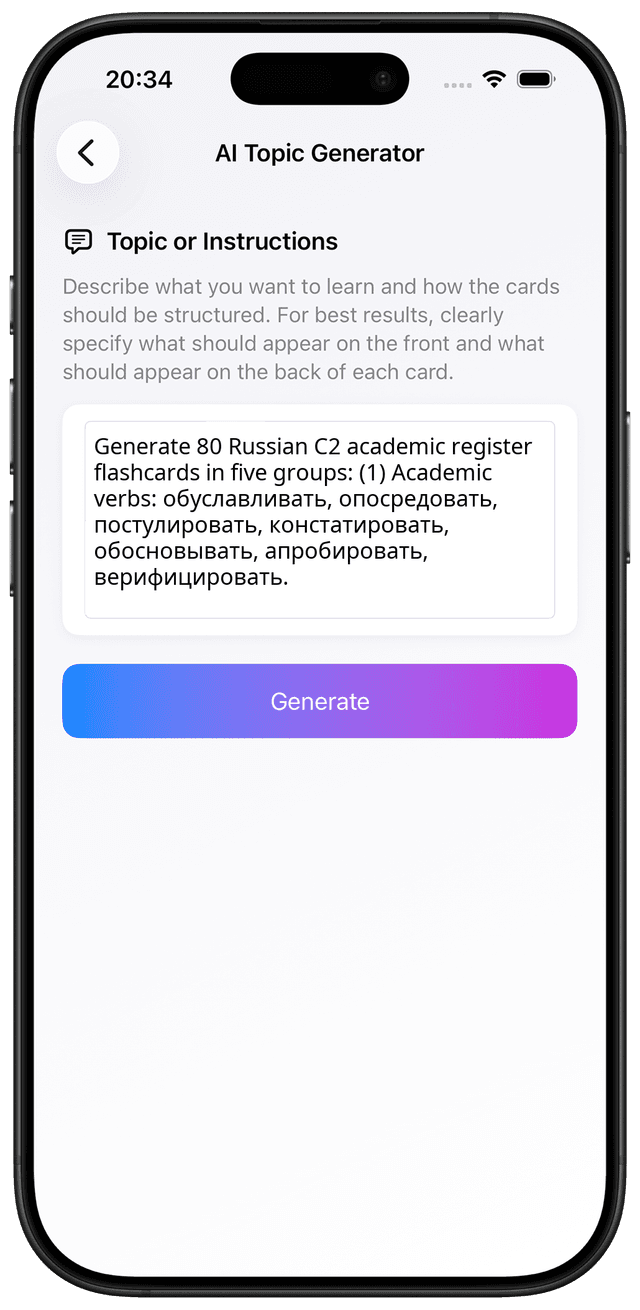
Generate 80 Russian C2 academic register flashcards in five groups: (1) Academic verbs: обуславливать, опосредовать, постулировать, констатировать, рассматривать в качестве, выявлять, обосновывать, апробировать, экстраполировать, верифицировать. (2) Academic noun phrases: предметная область, понятийный аппарат, методологическая основа, гипотеза исследования, теоретическая база, эмпирический материал, обобщающий вывод, концептуальная модель. (3) Argument connectives: в данном контексте следует отметить что, необходимо подчеркнуть что, вышесказанное позволяет утверждать что, представляется правомерным предположить что, тем самым подтверждается тезис о том что. (4) Hedging: представляется вероятным, можно осторожно предположить, в определённой степени, как правило, в большинстве случаев. (5) Conclusion: подводя итог проведённого исследования, обобщая вышесказанное, в свете полученных данных можно заключить. Front: term + academic context. Back: English + function label.
C1 aspect is about applying the perfective/imperfective rule. C2 aspect is about the choices native speakers make inside that rule when both forms are technically possible. Я читал эту книгу vs Я прочитал эту книгу in answer to whether you know its content. Я не сдавал экзамен vs Я не сдал экзамен with completely different implications. The same applies to case at this level. The instrumental of comparison (бежать стрелой), the genitive of negation in its discretionary form, the dative of involuntary action (мне не работается), and other distinctions are usually invisible in C1 instruction and decisive at C2.
The goal: To read these choices in Russian texts and make them yourself without thinking. At C2 you are expected to handle aspect shifts in literary narration, case nuance in journalism, and the discretionary cases (genitive of negation, partitive genitive) without losing the thread.
The strategy: The deck presents minimal pairs and short passages. The same sentence shifts aspect or case and the meaning changes. You learn to feel the difference rather than apply a rule.
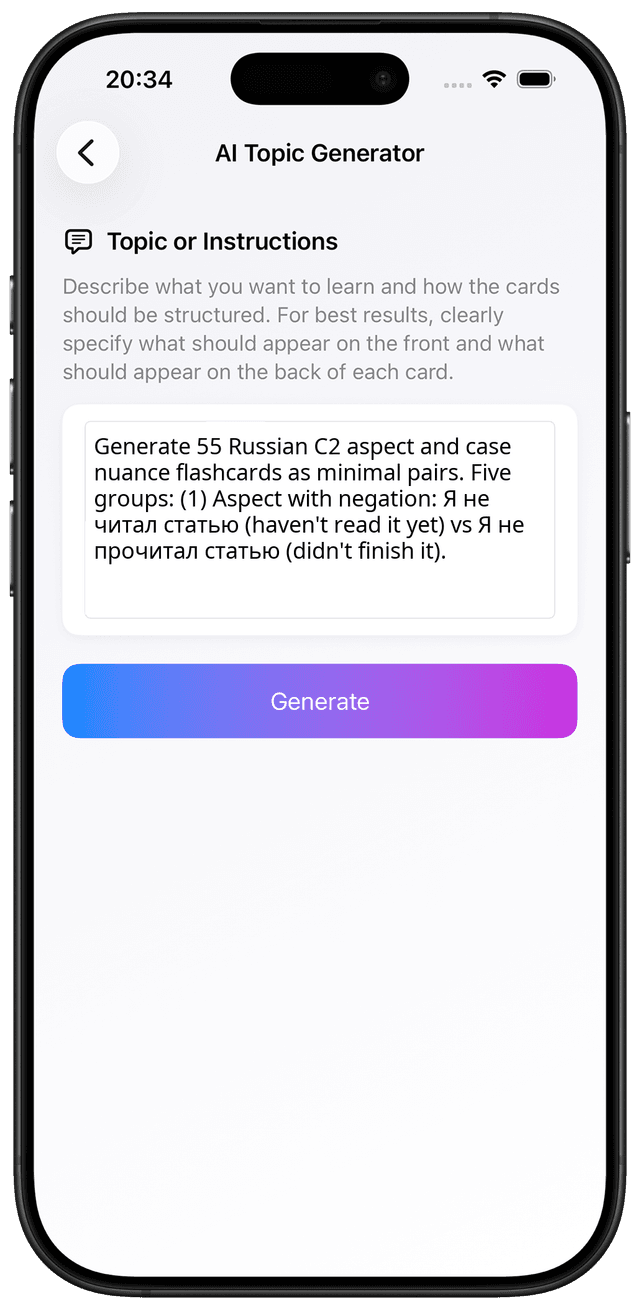
Generate 55 Russian C2 aspect and case nuance flashcards as minimal pairs. Five groups: (1) Aspect with negation: Я не читал статью (haven't read it yet) vs Я не прочитал статью (didn't finish it). (2) Aspect of past completion: Я читал Достоевского (familiar with) vs Я прочитал Достоевского (read the specific work). (3) Discretionary genitive of negation: Я не вижу окно (concrete) vs Я не вижу смысла (abstract). (4) Partitive genitive: дай мне хлеб vs дай мне хлеба (some bread). (5) Instrumental of manner and comparison: бежать стрелой, идти гуськом, лететь птицей; дательный безличный: мне не спится, мне не работается, ему не пишется. Front: pair of sentences. Back: English for both + note on the nuance.
Russian пословицы and поговорки are not optional decoration at C2. Native speakers reach for them in conversation, political commentary, journalism, and literary prose. Без труда не вытащишь и рыбку из пруда. На безрыбье и рак рыба. Один в поле не воин. Семь раз отмерь, один отрежь. Knowing what these mean, recognising them in context, and placing one well in your own writing is a concrete signal of near-native competence. Misusing a proverb is worse than not using one at all.
Why add this now? Proverbs index cultural knowledge, not just linguistic knowledge. A Russian assessor at TORFL IV listens for them in conversation, and Russian editorial writing routinely opens or closes with one. This phase covers the 50 highest-frequency proverbs plus 30 поговорки specific to political and educated everyday speech.
The strategy: Cards show the proverb, its literal sense, its pragmatic use, and a model sentence showing how a Russian speaker would actually introduce it in real conversation or in a piece of writing.
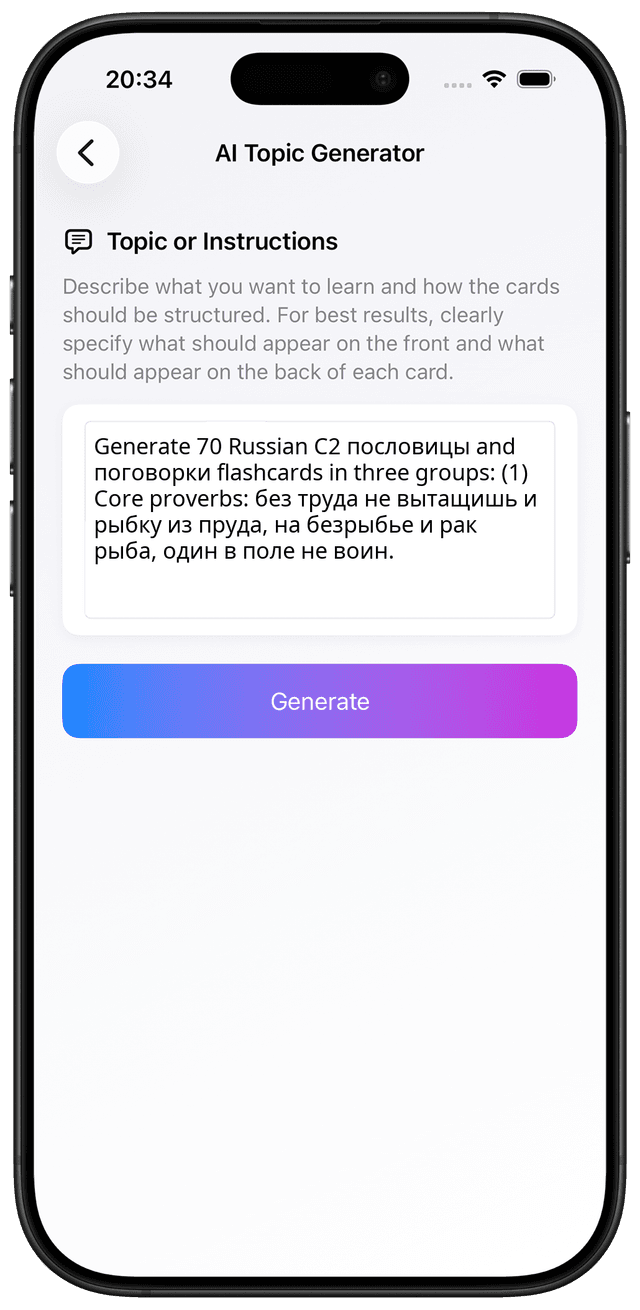
Generate 70 Russian C2 пословицы and поговорки flashcards in three groups: (1) Core proverbs (пословицы): без труда не вытащишь и рыбку из пруда, на безрыбье и рак рыба, один в поле не воин, семь раз отмерь один отрежь, не имей сто рублей а имей сто друзей, тише едешь дальше будешь, цыплят по осени считают, яблоко от яблони недалеко падает, любишь кататься люби и саночки возить, утро вечера мудренее. (2) Political and journalistic поговорки: куй железо пока горячо, рыба гниёт с головы, ложка дёгтя в бочке мёда, после нас хоть потоп, лес рубят щепки летят, своя рубашка ближе к телу. (3) Everyday educated speech: на ловца и зверь бежит, в тихом омуте черти водятся, не всё то золото что блестит, дарёному коню в зубы не смотрят. Front: proverb + context sentence. Back: literal sense + pragmatic meaning + usage note.
Russian law, public administration, and bureaucratic correspondence share a fixed register that Корней Чуковский famously labelled канцелярит. It is heavy on nominalisation, verbal nouns, and stock formulas, and it does not flex into casual register. В соответствии с пунктом. Настоящим уведомляем Вас. Принимая во внимание изложенные обстоятельства. Постановляется. Suit yourself or not, if you are practising law, working in policy, translating documents, or doing graduate research in a Russian-speaking context, these phrases turn up in real documents every day. Getting them wrong marks your text as non-native to anyone reading professionally.
The goal: To build active command of the 150 most common fixed expressions in Russian legal texts (решения суда, постановления, договоры), administrative correspondence, and regulatory writing. The line between near-C2 and true C2 in professional Russian contexts often runs through whether you can produce these phrases yourself rather than just decode them on the page.
The strategy: Phrases are grouped by document type: судебные акты, договоры, официальные письма, нормативные документы. Each card shows the phrase inside a realistic document extract.
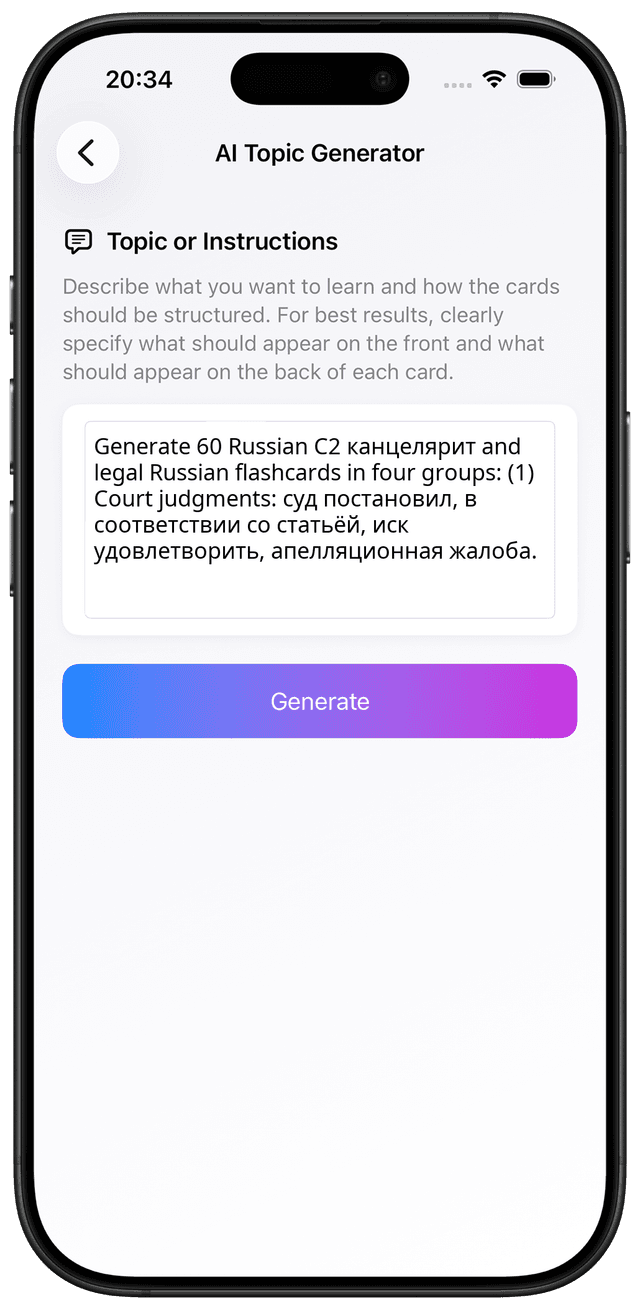
Generate 60 Russian C2 канцелярит and legal Russian flashcards in four groups: (1) Court judgments and procedure: суд постановил, в соответствии со статьёй, на основании пункта, иск удовлетворить, в удовлетворении иска отказать, апелляционная жалоба, кассационная инстанция, надлежащим образом уведомлён. (2) Contracts and agreements: стороны пришли к соглашению о нижеследующем, в случае нарушения настоящего договора, предмет договора, обязательства сторон, форс-мажорные обстоятельства, расторжение в одностороннем порядке. (3) Official correspondence: настоящим уведомляем Вас, в ответ на Ваше обращение, прошу принять к сведению, с уважением, в соответствии с действующим законодательством. (4) Regulatory and policy: вступает в силу со дня официального опубликования, утверждается приказом, в порядке установленном, в пределах своих полномочий, во исполнение постановления. Front: phrase + document context. Back: English + document type label.
Mastery-level Russian also means handling spoken Russian as it actually sounds in 2026. Молодёжный сленг like забить, зашквар, кринж, и токсичный. Discourse softeners and intensifiers like короче, в общем, типа, как бы, мол. Vulgar-adjacent register markers like блин, чёрт, ёлки-палки that signal everyday emotion without crossing into actual мат. Knowing where each word sits on the register map is the difference between sounding like a fluent foreigner and sounding like a native Russian speaker your age.
The C2 milestone: Completing this phase means your Russian C2 toolkit covers фразеологизмы, literary register, academic Russian, mastery aspect and case, пословицы, канцелярит, and current spoken Russian. That is the full TORFL IV (ТРКИ-4) communicative range and the lexical density that genuinely native-feeling Russian requires.
What comes next: Beyond C2 the work is no longer about acquisition. It is reading, writing, and conversing in Russian on a daily basis. MindCards keeps your decks in spaced rotation so the items you do not encounter naturally stay locked in.
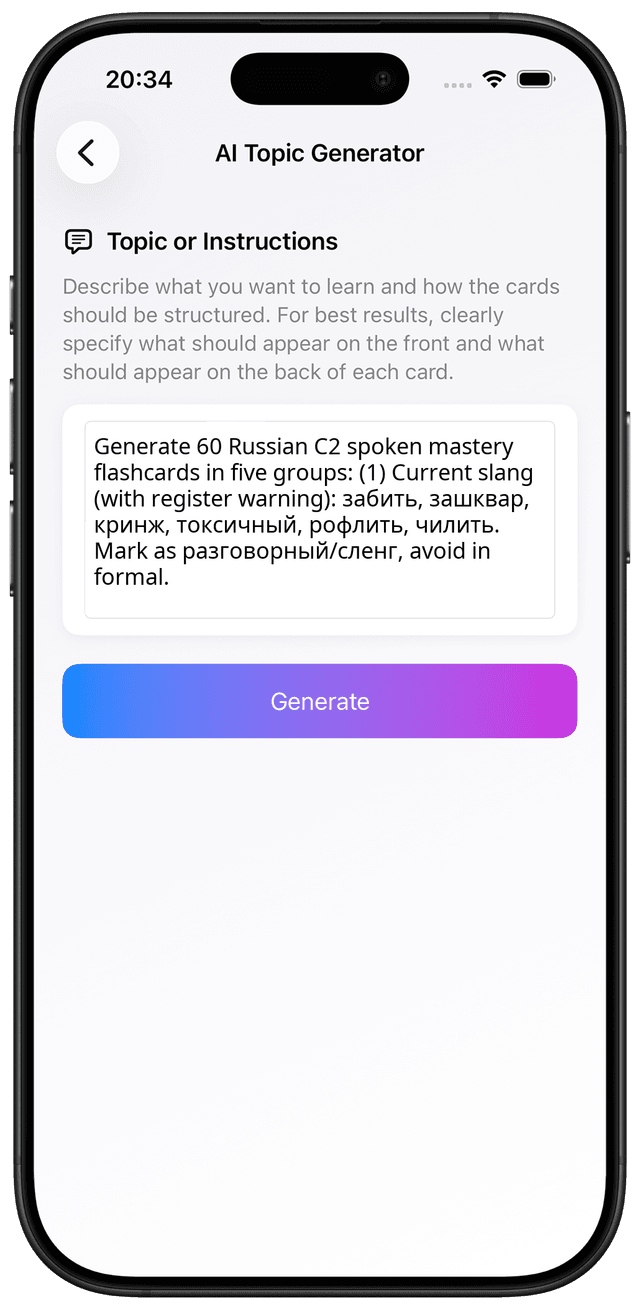
Generate 60 Russian C2 spoken mastery flashcards in five groups: (1) Current youth and online slang (with register warning): забить (на что-то), зашквар, кринж, токсичный, рофлить, чилить, флексить. Mark each as разговорный/сленг and avoid in formal contexts. (2) Discourse softeners and hedges: короче, в общем, типа, как бы, ну так, в принципе, по сути. (3) Emotional intensifiers (mild): блин, чёрт возьми, ёлки-палки, чёрт побери, ёшкин кот. (4) Conversational particles at C2: же, ведь, разве, неужели, мол, дескать, небось, пожалуй (revisited from C1 with finer pragmatic distinctions). (5) Modern colloquial constructions: давай в смысле; ну такое; не очень; так себе; норм; ок; ясно. Front: Russian + spoken context sentence. Back: English equivalent + register label + when to avoid.
At C2 the vocabulary you are missing is less frequent and more context-dependent than at any earlier level. Spaced repetition is well suited to this work: the фразеологизмы, пословицы, and fixed legal phrases you keep forgetting surface more often, and the ones you have already locked in quietly drop back. Your review time goes where it actually moves the needle.
C2 builds directly on C1. Use the links below to review the prerequisite level or return to the full Russian guide.
Copy any prompt from this guide into MindCards and your first C2 deck is ready in seconds. No account needed. The app is free on iOS.