
Spaced Repetition Explained
Learn why timing your reviews improves Cyrillic retention.
Cyrillic is the essential gateway to Russian. If you cannot read the script, vocabulary growth and listening progress stay slower than they should.
Most beginners struggle because they try to memorize all letters at once without a sequence for sound mapping, softness patterns, and practical reading fluency.
This guide gives you a focused seven-phase path with AI prompts and spaced repetition so each review session moves you from symbol recognition to real reading confidence.
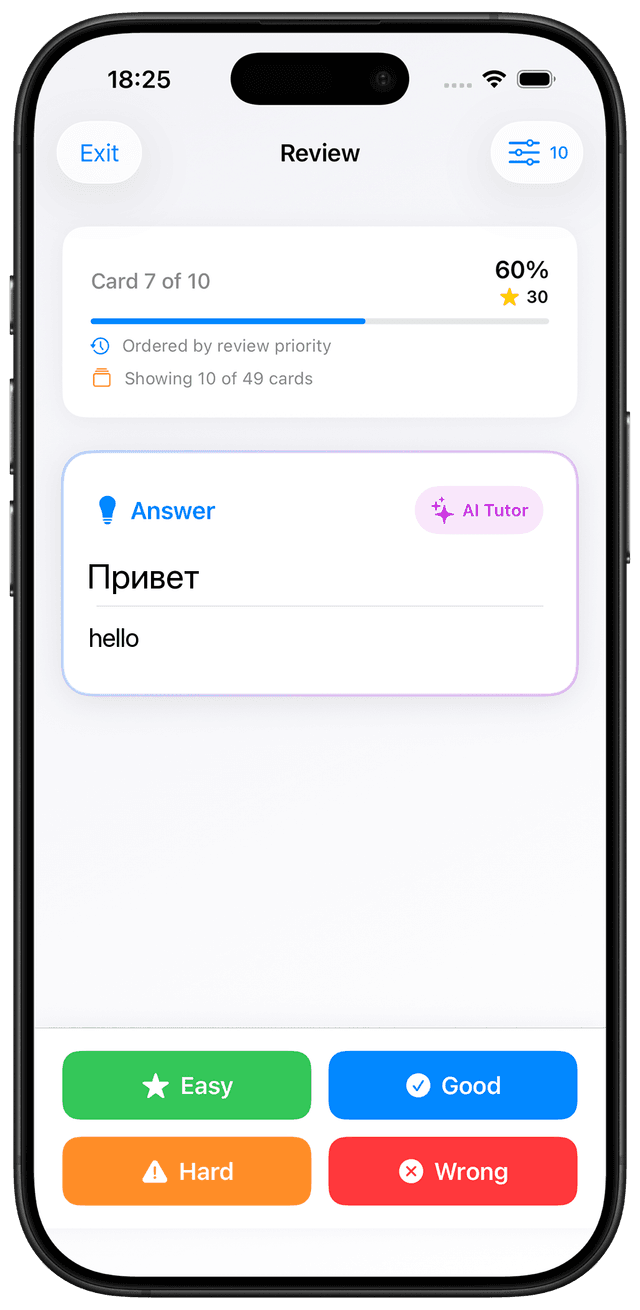
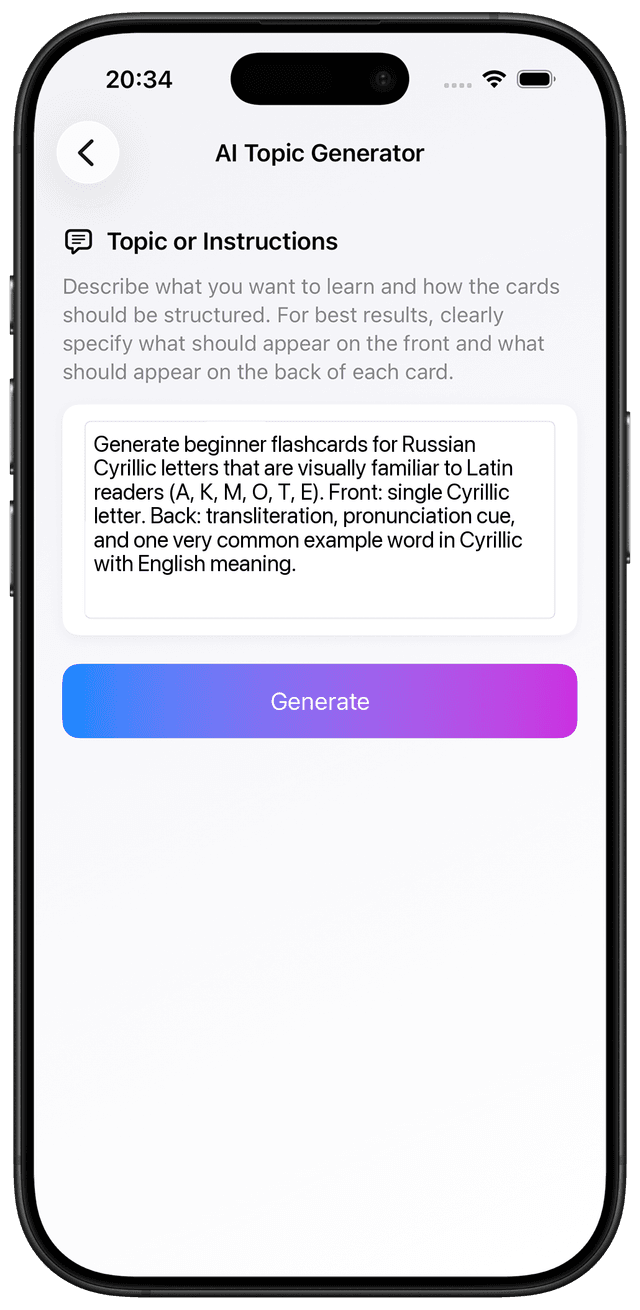
Begin with Cyrillic letters that look familiar and sound close to what you already know. This gives you immediate momentum and lowers the initial barrier.
Why start here? Quick wins build confidence and help you read your first words almost immediately.
The Strategy: Focus on shape-plus-sound pairing, then review with short high-frequency examples like мама and том.
Generate beginner flashcards for Russian Cyrillic letters that are visually familiar to Latin readers (А, К, М, О, Т, Е). Front: single Cyrillic letter. Back: transliteration, pronunciation cue, and one very common example word in Cyrillic with English meaning.
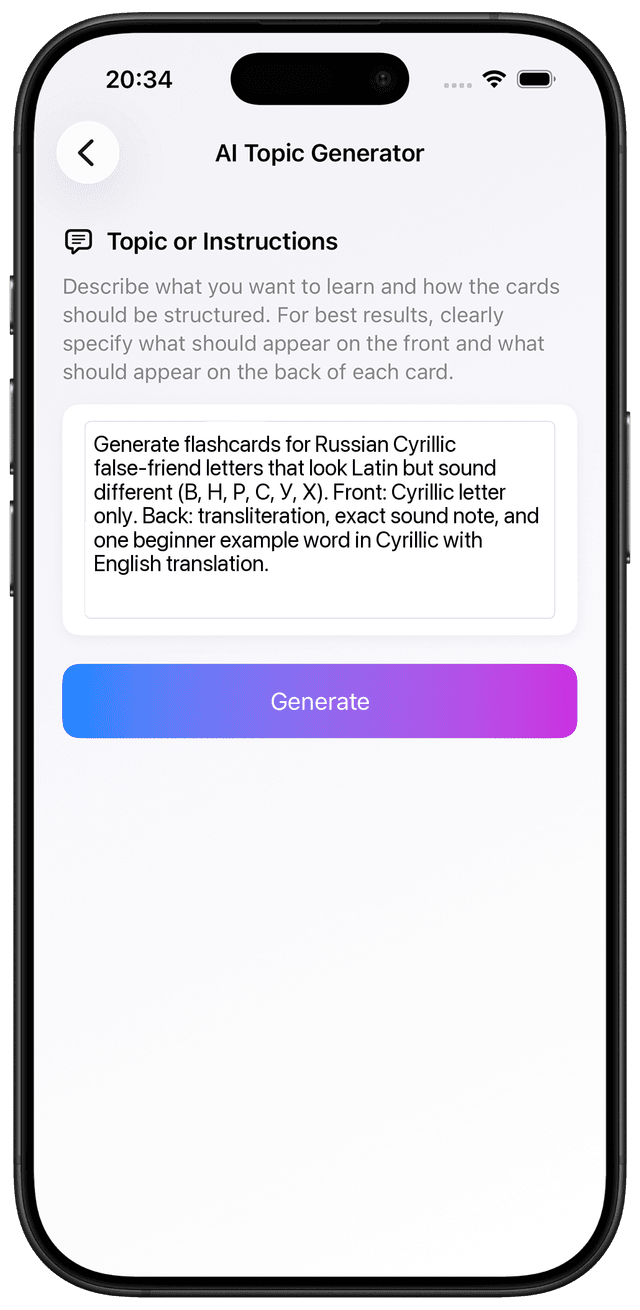
Now tackle letters that trick beginners because they look familiar but represent different sounds in Russian.
Why this phase matters: Most early reading mistakes come from these letters, not from the completely new ones.
The Strategy: Drill contrast pairs (e.g., В vs B, Н vs H) so your brain stops applying English reading habits.
Generate flashcards for Russian Cyrillic false-friend letters that look Latin but sound different (В, Н, Р, С, У, Х). Front: Cyrillic letter only. Back: transliteration, exact sound note, and one beginner example word in Cyrillic with English translation.
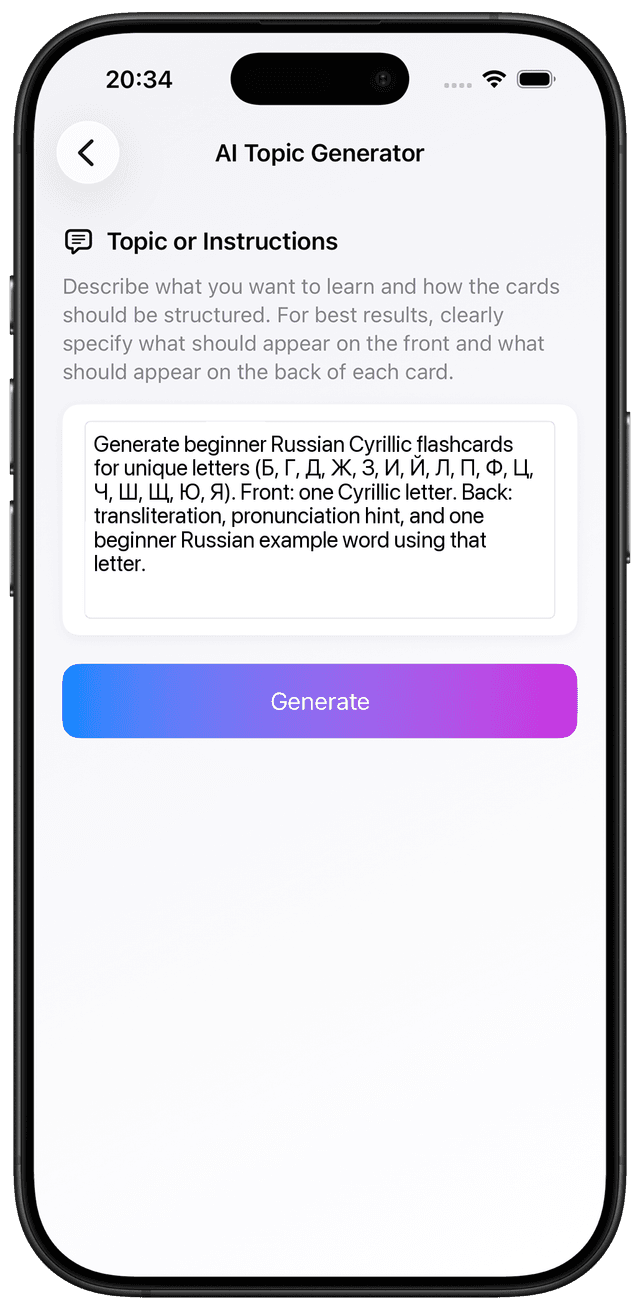
Add the uniquely Cyrillic letters that have no direct Latin visual equivalent and appear constantly in basic vocabulary.
Why this unlocks progress: Once these symbols are automatic, beginner texts stop looking like random shapes.
The Strategy: Learn in small sets and test active recall daily instead of passively rereading charts.
Generate beginner Russian Cyrillic flashcards for unique letters (Б, Г, Д, Ж, З, И, Й, Л, П, Ф, Ц, Ч, Ш, Щ, Ю, Я). Front: one Cyrillic letter. Back: transliteration, pronunciation hint, and one beginner Russian example word using that letter.
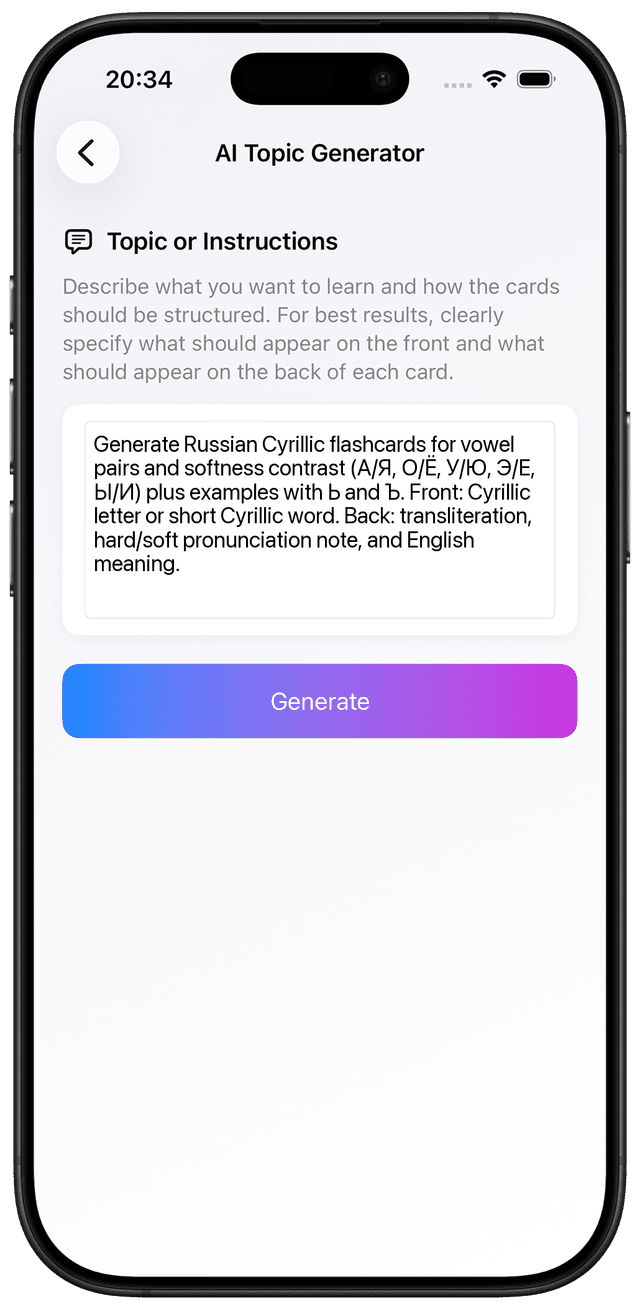
Russian reading quality improves fast when you understand hard vs soft pronunciation and how vowel choices shape consonant sounds.
Key concept: Ь and Ъ are not pronounced as standalone vowels, but they strongly affect pronunciation and word boundaries.
The Strategy: Practice minimal pairs and short words where softness changes the sound pattern.
Generate Russian Cyrillic flashcards for vowel pairs and softness contrast (А/Я, О/Ё, У/Ю, Э/Е, Ы/И) plus examples with Ь and Ъ. Front: Cyrillic letter or short Cyrillic word. Back: transliteration, hard/soft pronunciation note, and English meaning.
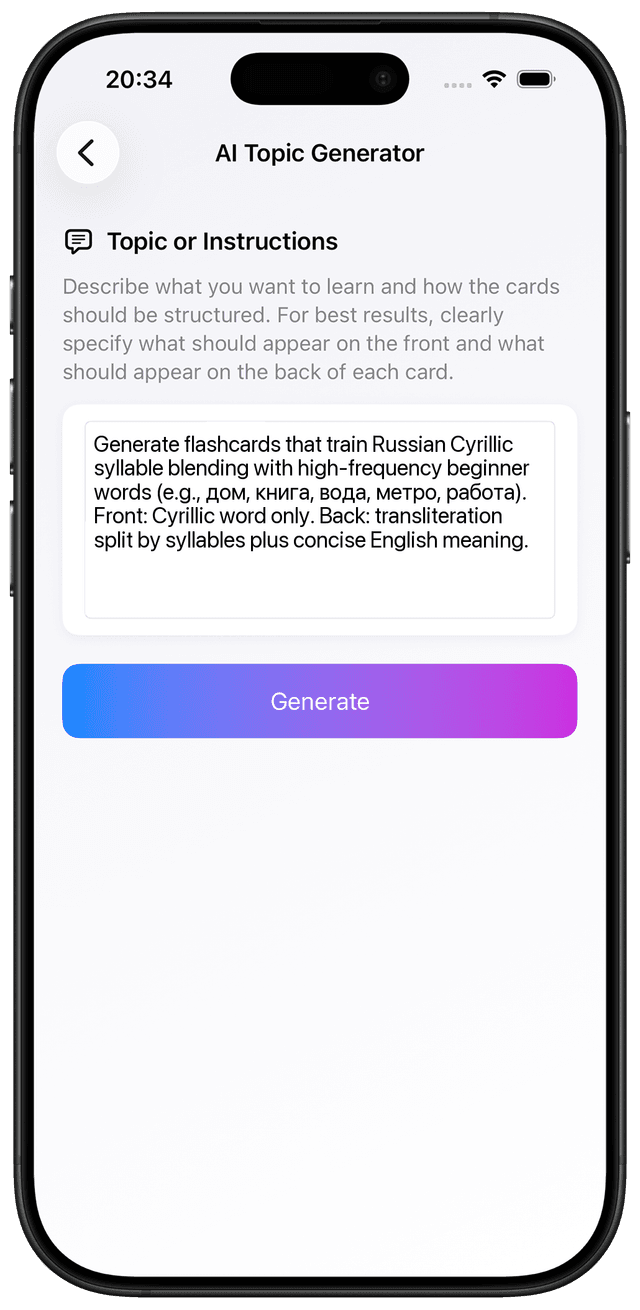
Move from isolated letters to smooth decoding by practicing common syllable patterns that appear in beginner Russian vocabulary.
Why this is a turning point: Reading speed grows when you chunk syllables instead of sounding out each symbol separately.
The Strategy: Train C+V and C+V+C combinations with words like дом, книга, вода, метро.
Generate flashcards that train Russian Cyrillic syllable blending with high-frequency beginner words (e.g., дом, книга, вода, метро, работа). Front: Cyrillic word only. Back: transliteration split by syllables plus concise English meaning.
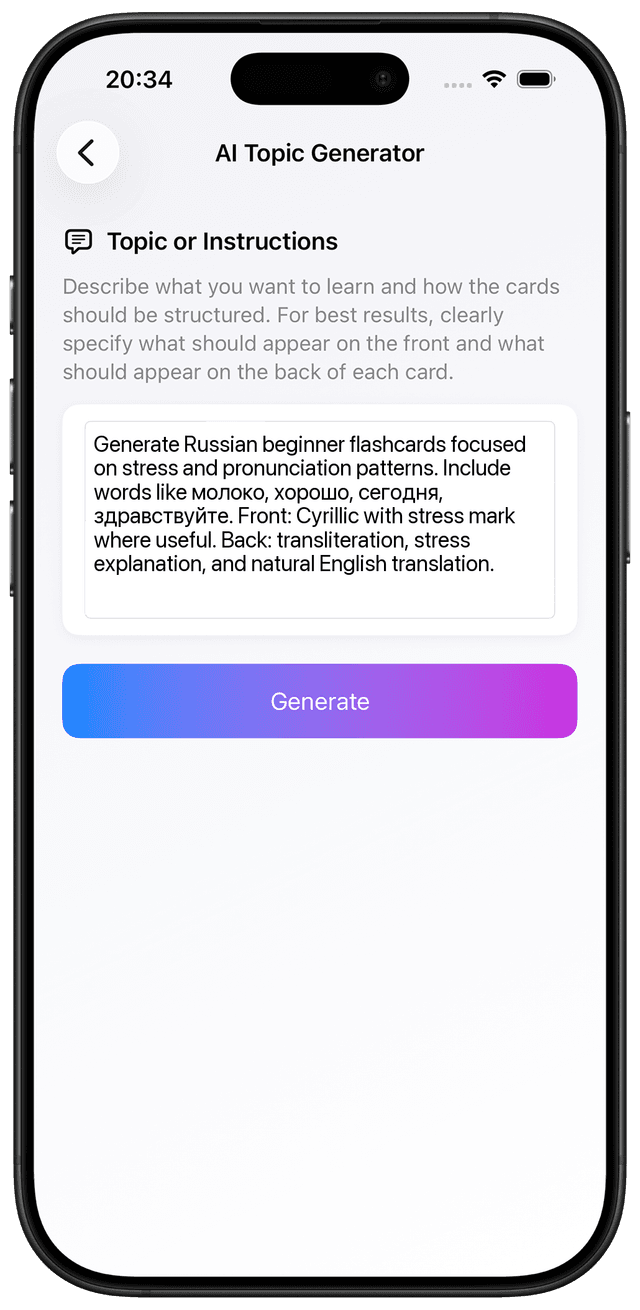
At this stage, train stress-aware reading and common pronunciation changes that differ from textbook letter-by-letter output.
Why now? Stress patterns explain why familiar words can sound different in real speech.
The Strategy: Review cards with marked stress and short audio-like pronunciation notes to connect text and sound.
Generate Russian beginner flashcards focused on stress and pronunciation patterns. Include words like молоко, хорошо, сегодня, здравствуйте. Front: Cyrillic with stress mark where useful. Back: transliteration, stress explanation, and natural English translation.
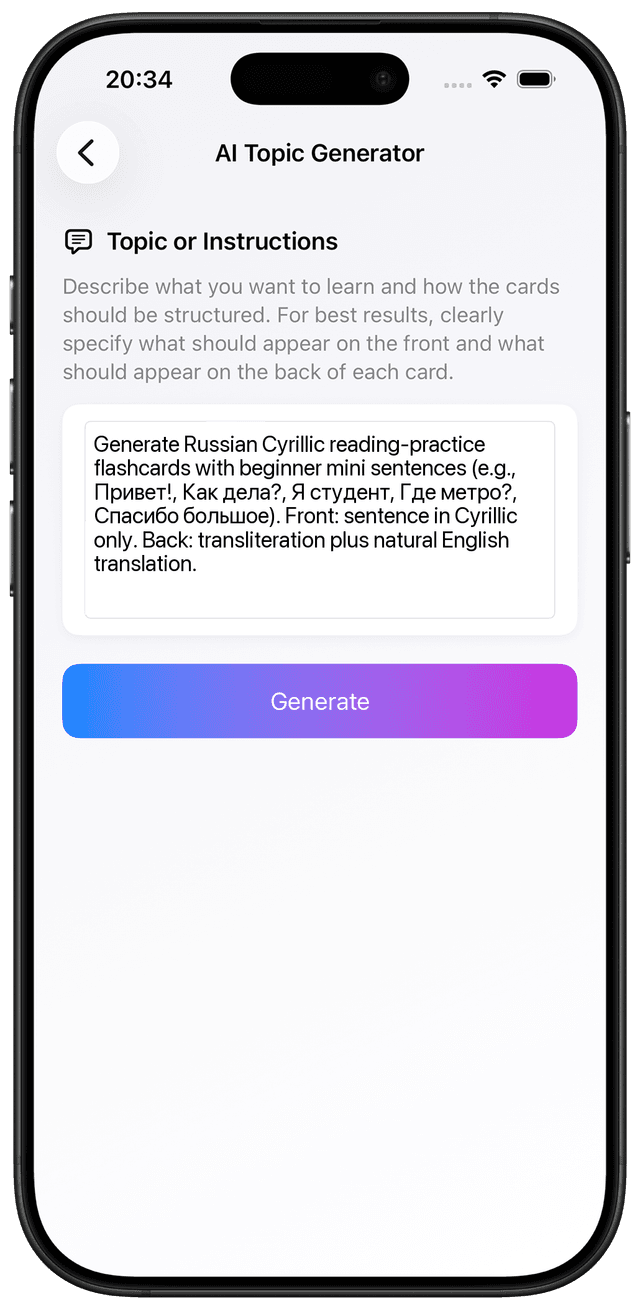
Finish by reading full beginner mini sentences so Cyrillic becomes a usable tool, not just a memorized chart.
Milestone: You can now decode common signs, greetings, and short daily phrases at practical speed.
The Strategy: Practice high-frequency sentence frames such as Я студент, Где метро?, and Как дела?
Generate Russian Cyrillic reading-practice flashcards with beginner mini sentences (e.g., Привет!, Как дела?, Я студент, Где метро?, Спасибо большое). Front: sentence in Cyrillic only. Back: transliteration plus natural English translation.
MindCards combines active recall with spaced repetition so Cyrillic moves from short-term recognition into durable reading skill.
Once your Cyrillic decoding feels natural, continue with practical A1 words and phrases to build conversation-ready Russian.
Learn Cyrillic and practical Russian vocabulary with AI-generated decks, active recall, and spaced repetition that keeps progress consistent.