
Spaced repetition explained
Why reviewing at the right interval locks in advanced Russian B2 vocabulary faster
You have B1 Russian. You can hold a conversation, read a simple news article with effort, and navigate everyday situations. B2 is where that effort drops noticeably. Sentences that used to require active decoding start arriving whole. You stop translating and start thinking in Russian.
B2 covers roughly 4,000 words in total. This guide focuses on the 1,000+ that actually move the needle: participles and gerunds for reading written Russian, formal register for TORFL B2 writing tasks, advanced conjunctions for complex sentences, society and political vocabulary for opinion work, collocations for natural speech, and media vocabulary for authentic Russian comprehension.
Each of the seven phases below includes a ready-to-use AI prompt. Copy it into MindCards and it generates a custom flashcard deck in seconds. Spaced repetition then schedules each card at the right interval so you retain more with less time reviewing.
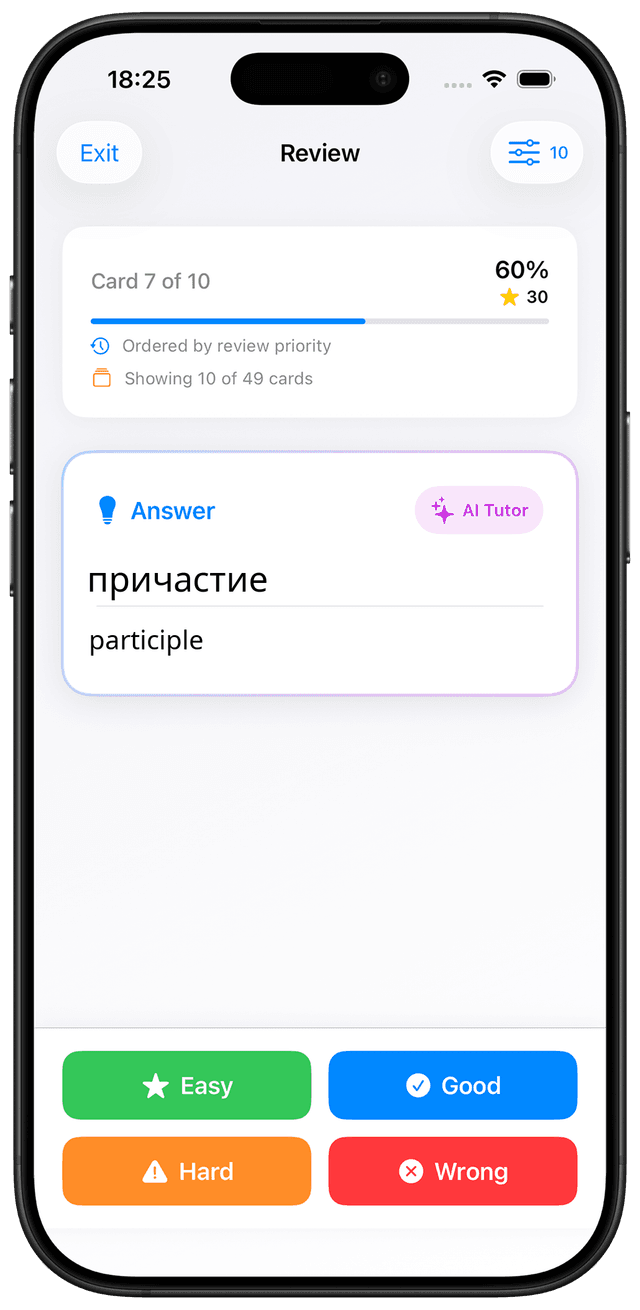
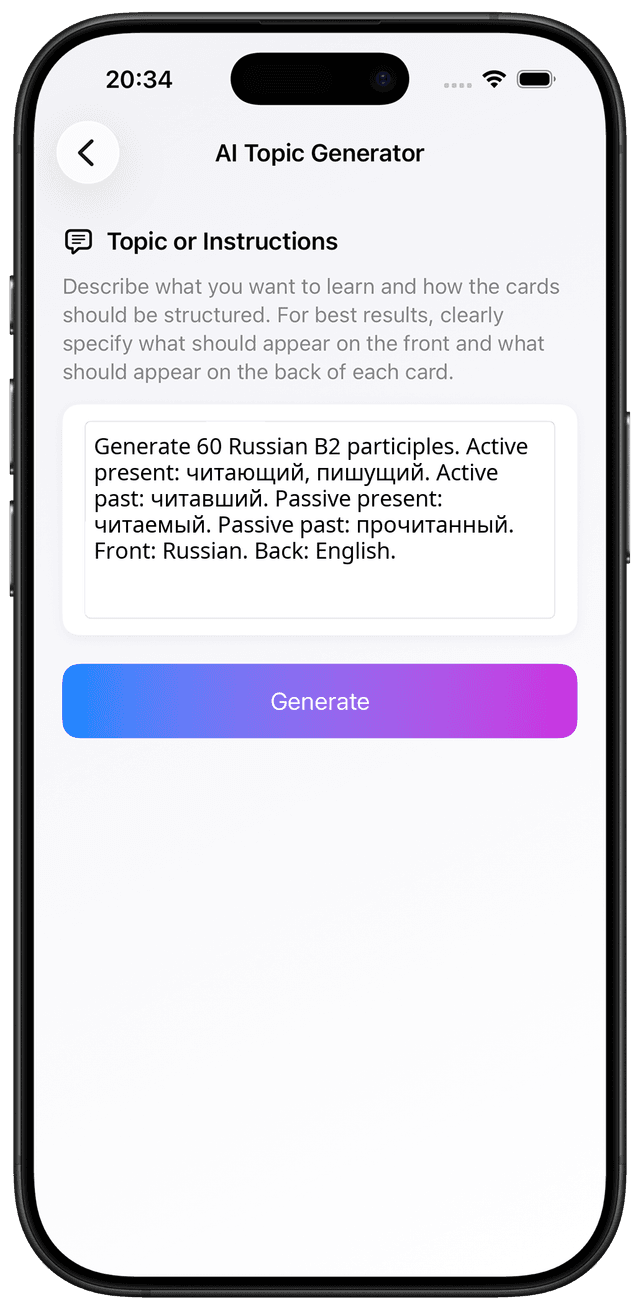
Russian participles are verb forms that function as adjectives. They appear constantly in written Russian but almost never in everyday speech. The читающий студент (the reading student) and the прочитанная книга (the read book) follow rules about tense, voice, and aspect that you need to read newspapers, literature, and official documents without hitting a wall every paragraph.
Why participles are B2 territory: Every Russian newspaper and academic text uses participial constructions to pack more information into a sentence. Without recognising them, you lose track of what modifies what.
The strategy: Learn active and passive participles in present and past tense as separate decks. The formation rules are consistent once you see them as transformations of verb conjugation patterns.
Generate 60 Russian B2 participle examples. Group 1 (15 active present participles): читающий, пишущий, говорящий, идущий, знающий. Group 2 (15 active past participles): читавший, писавший, говоривший, шедший. Group 3 (15 passive present participles): читаемый, изучаемый, обсуждаемый. Group 4 (15 passive past participles): прочитанный, написанный, сделанный, построенный. Front: Russian participle + phrase. Back: English + type label.
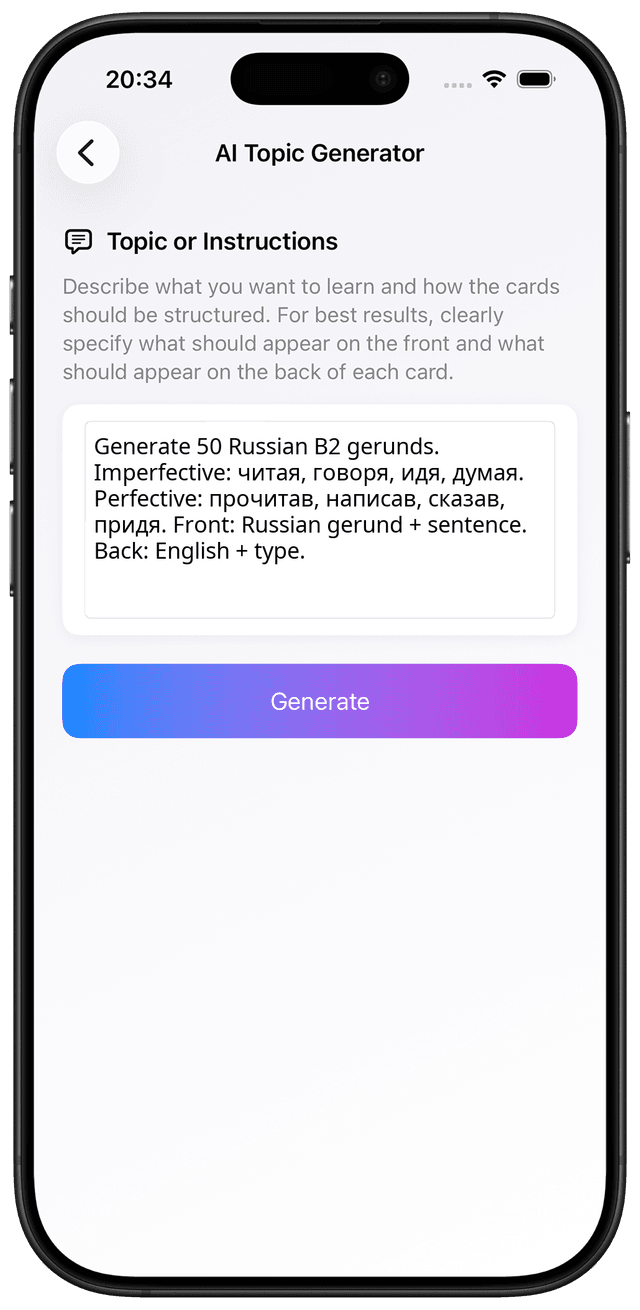
Russian gerunds, or verbal adverbs (деепричастия), describe an action happening at the same time as or before the main verb. Читая газету, он пил кофе (Reading the newspaper, he drank coffee). Прочитав книгу, она пошла спать (Having read the book, she went to sleep). They are invariable, which makes them simpler than participles, but knowing when the subject must be the same in both clauses is what separates correct use from learner errors.
Why gerunds matter at B2: Russian literary and journalistic prose relies on gerunds to create economy of expression. A sentence with three actions linked by gerunds is natural in written Russian but impossible to decode if you have only studied conversational forms.
The strategy: Drill imperfective gerunds (simultaneous actions) and perfective gerunds (prior actions) separately. Each card includes a complete sentence so the subject constraint becomes automatic.
Generate 50 Russian B2 gerund examples. Group 1 (25 imperfective gerunds): читая, пиша, говоря, идя, думая, слушая, работая, отвечая, смотря, зная. Each with a full example sentence. Group 2 (25 perfective gerunds): прочитав, написав, сказав, придя, подумав, услышав, сделав, построив, решив. Each with a full example sentence. Front: Russian gerund + sentence. Back: English + type label (imperfective/perfective).
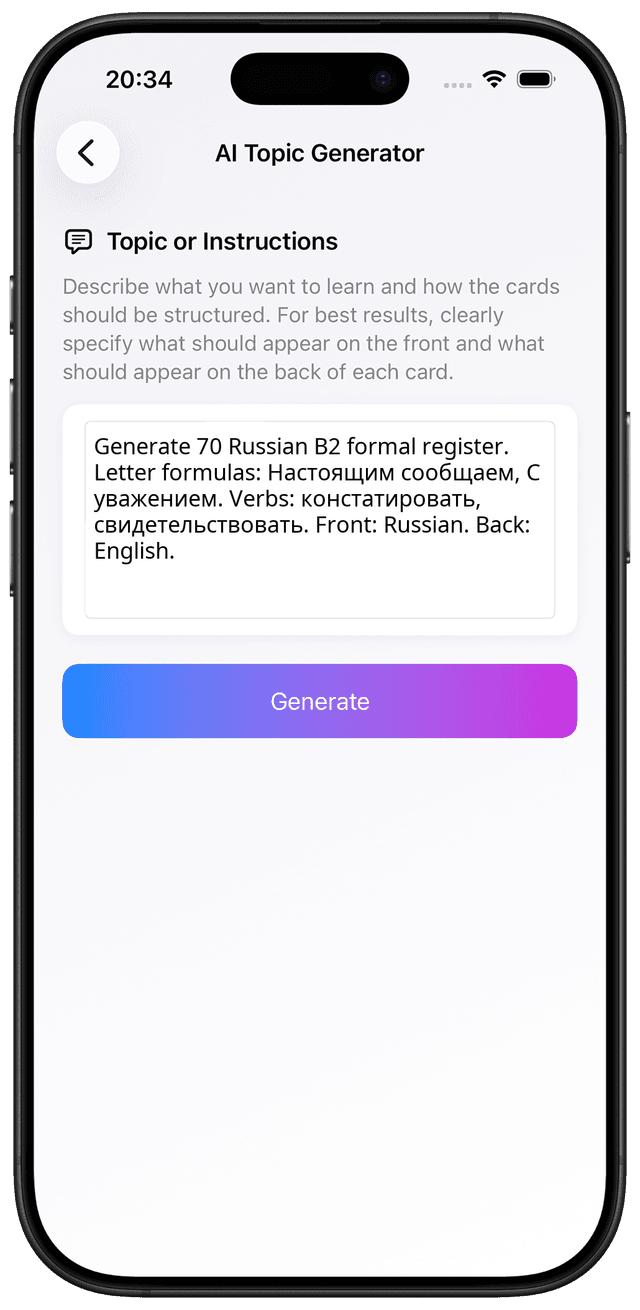
Written Russian at B2 follows conventions quite different from spoken Russian. Official letters, business correspondence, and academic texts use stock phrases that Russian institutions expect. С уважением, Настоящим сообщаем, В ответ на Ваш запрос, Просим принять к сведению. These are not stylistic choices but expected formulas in Russian institutional writing.
Academic Russian also uses a layer of vocabulary you rarely hear in conversation. Verbs like констатировать, свидетельствовать, обосновывать, и обусловливать appear in essays, research, and news commentary. Passive constructions with краткими причастиями (short participles) are common: было принято, является частью, считается нормой. This register gap is the main reason B1 Russian speakers struggle with written texts even when their grammar is solid.
Why this phase? TORFL B2 writing tasks require formal register. Russian academic and official writing has its own vocabulary and construction patterns that this phase addresses directly.
The strategy: Cards cover formal letter formulas, academic verbs with example sentences, and register-shift pairs showing the conversational word next to its formal equivalent.
Generate 70 Russian B2 words and phrases for formal written Russian. Group 1 (20 letter and document formulas): Настоящим сообщаем, В ответ на Ваш запрос, С уважением, Просим принять к сведению, В связи с вышеизложенным, Во вложении направляем, Доводим до Вашего сведения, По Вашему поручению. Group 2 (20 academic verbs with example sentences): констатировать, свидетельствовать, обосновывать, обусловливать, анализировать, характеризовать, рассматривать, выявлять, определять, раскрывать. Group 3 (15 short passive participles in context): было принято, является, считается, признано, установлено, подтверждено, указывается. Group 4 (15 register-shift pairs): но / однако, много / многочисленные, думать / полагать, делать / осуществлять, использовать / применять. Front: Russian. Back: English + register label.
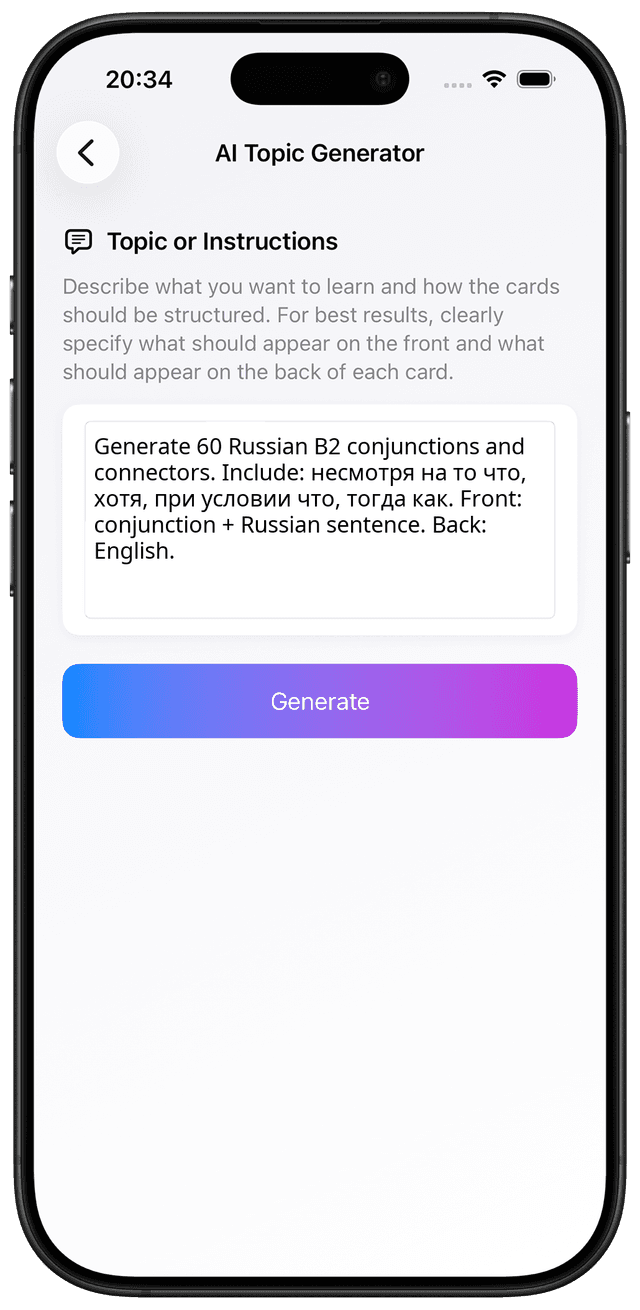
B2 Russian writing requires connecting ideas across complex sentence structures. At B1 you used simple и, но, потому что, and когда. At B2 you need the full range: несмотря на то что (despite), хотя (although), при условии что (provided that), вследствие того что (as a result of), по мере того как (as, in proportion as), and тогда как (whereas). These conjunctions signal logical relationships that make Russian prose readable and sound genuinely fluent.
Russian also uses a set of discourse connectors in written argumentation that you do not hear in conversation. Следовательно, таким образом, в частности, в особенности, с одной стороны...с другой стороны, тем не менее, и в то же время appear in every piece of structured writing. Knowing them is the difference between linking sentences and building an argument.
Why connectors are B2 markers: Short sentences with simple connectors sound like B1. Subordinate clauses with appropriate discourse markers are what TORFL B2 examiners hear as upper-intermediate fluency.
The strategy: Each card pairs the conjunction with two example sentences so you absorb its meaning in context, not as an isolated form.
Generate 60 Russian B2 conjunctions and connectors with example sentences. Group 1 (20 subordinating conjunctions): несмотря на то что, хотя, при условии что, вследствие того что, по мере того как, тогда как, прежде чем, в то время как, поскольку, ввиду того что. Group 2 (20 discourse markers): следовательно, таким образом, в частности, в особенности, тем не менее, в то же время, с одной стороны, с другой стороны, при этом, вместе с тем. Group 3 (20 cause and consequence): поэтому, в результате, благодаря тому что, вопреки, при этом, отсюда, из чего следует, в связи с этим, ввиду этого, по этой причине. Front: conjunction + Russian sentence. Back: English + function label.
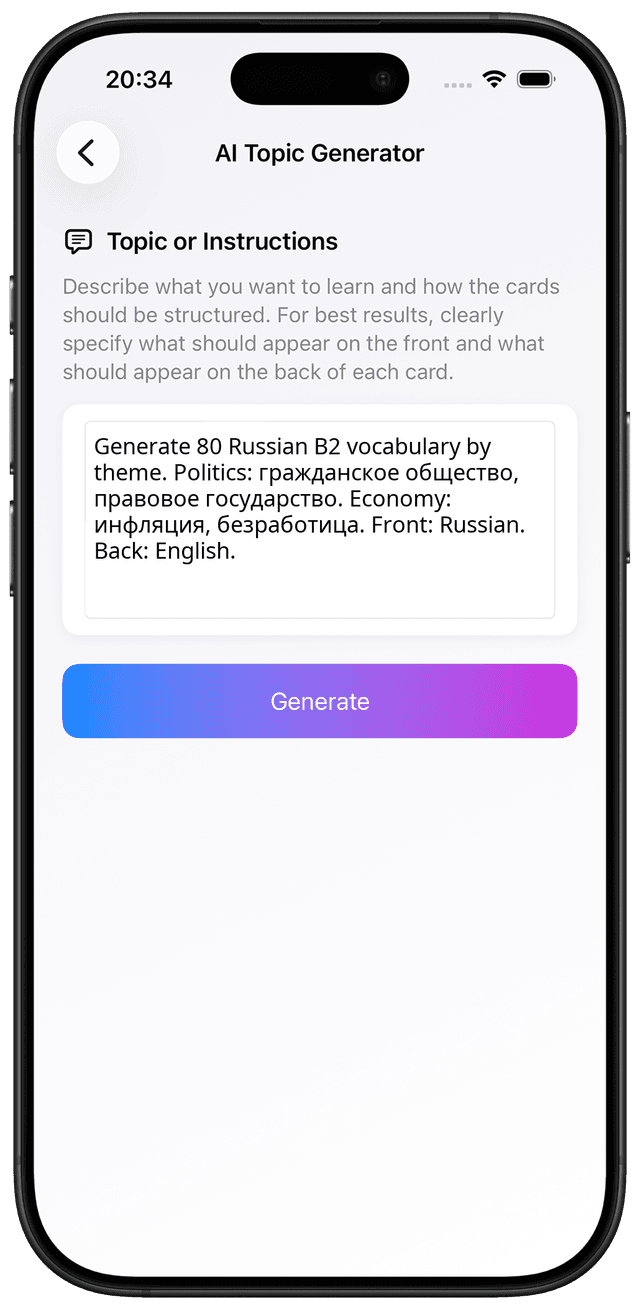
TORFL B2 reading and listening texts use social and political topics: economic policy, public institutions, civic life, environmental issues, and media commentary. You need vocabulary that lets you read these texts without constant lookups and respond to them in writing and speech with appropriate specificity.
Russian political and social vocabulary has its own terms. Гражданское общество, государственное управление, социальная политика, правовое государство, рыночная экономика, and миграционная политика appear in Russian news commentary regularly. Russian journalism also uses nominalised forms: рост (growth), снижение (decline), укрепление (consolidation), rather than the verbal equivalents. Recognising these patterns lets you decode texts by structure, not word by word.
Why society and politics at B2: Authentic Russian texts at B2 level consistently use social and political topics. Building this vocabulary before TORFL B2 means you are working with context, not decoding individual unfamiliar words.
The strategy: The deck groups 80 items by theme. Each entry includes an example sentence from the type of context you find in B2 reading and listening tasks.
Generate 80 Russian B2 thematic vocabulary items. Theme 1 - Politics and state (20): гражданское общество, государственное управление, правовое государство, законодательство, избирательная система, парламент, правительство, министерство, политическая партия, государственная дума, конституция, федерация, муниципалитет, региональная власть, международные отношения, дипломатия, санкции, внешняя политика, внутренняя политика, безопасность. Theme 2 - Economy (20): рыночная экономика, инфляция, безработица, ВВП, бюджет, налоги, инвестиции, экспорт, импорт, торговый баланс, экономический рост, кризис, финансирование, субсидии, приватизация, государственный сектор, конкуренция, монополия, малый бизнес, предпринимательство. Theme 3 - Environment (20): окружающая среда, экология, климатические изменения, загрязнение, возобновляемые источники энергии, устойчивое развитие, биоразнообразие, переработка отходов, выбросы, природные ресурсы, водные ресурсы, лесной фонд, экологическая политика, углеродный след, экологические нормы, промышленные отходы, энергетический переход, зелёная экономика, национальные парки, охрана природы. Theme 4 - Society and media (20): социальная политика, миграционная политика, демография, рождаемость, urbanization, гражданство, права человека, свобода слова, СМИ, социальные сети, дезинформация, журналистика, цифровизация, образование, здравоохранение, социальная защита, неравенство, бедность, средний класс, гражданское общество. Front: Russian. Back: English + theme label.
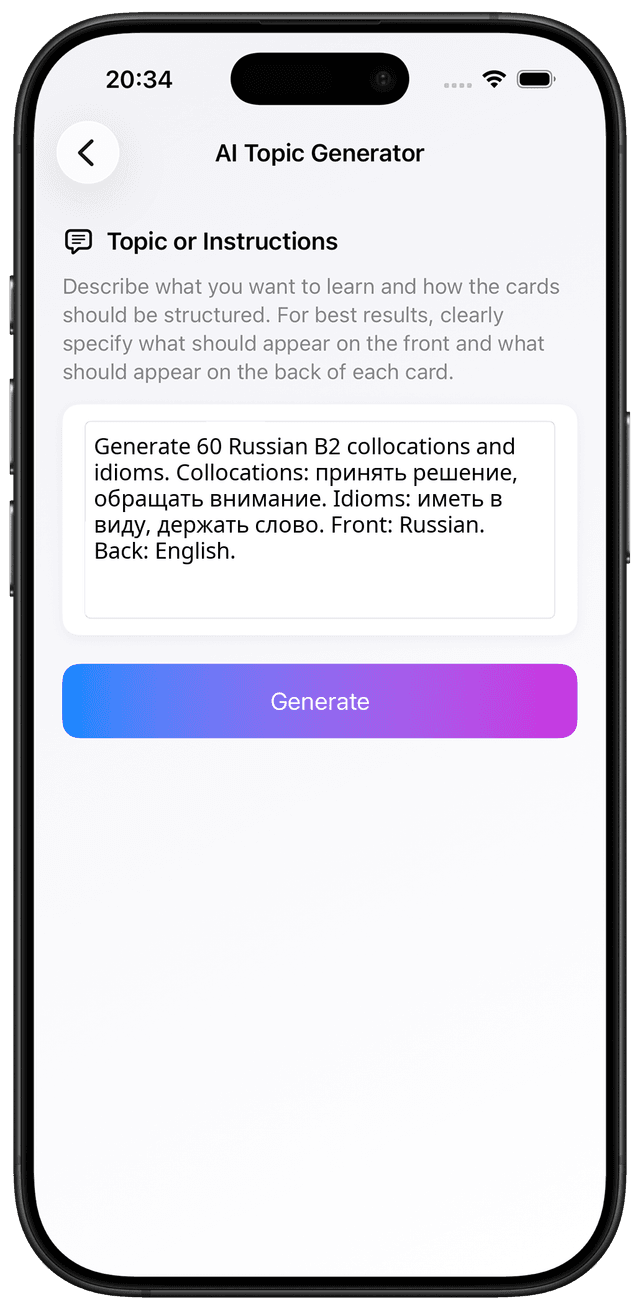
Native Russian speakers do not use textbook Russian in conversation. They use set phrases, collocations (word combinations that sound natural to a Russian ear), and idioms that grammatical study alone does not prepare you for. At B2 your vocabulary needs these patterns or your Russian sounds unnaturally stiff even when your grammar is correct.
Russian collocations follow their own logic, and direct translation from English causes interference errors. You make a decision in English but принять решение in Russian. You pay attention but обращать внимание. You take advantage but воспользоваться возможностью. Russian also has a layer of conversational idioms that appear in informal speech and literature: дать слово, иметь в виду, принять во внимание, потерять голову, держать слово. These phrases are the difference between sounding like a textbook and sounding like someone who actually knows the language.
The goal: Close the gap between textbook Russian and the Russian you actually hear in films, podcasts, and conversations with native speakers. Collocations and idioms alongside the contexts where they appear.
The strategy: Each card shows the phrase in a sentence so you learn the collocation in use, not as an isolated pair. This is how native speakers store these patterns.
Generate 60 Russian B2 collocations and idiomatic expressions. Group 1 (20 verb-noun collocations): принять решение, обращать внимание, воспользоваться возможностью, нести ответственность, оказывать влияние, принимать меры, вести переговоры, подводить итоги, уделять время, делать вывод, вносить вклад, ставить цель, решать проблему, принимать участие, задавать вопрос. Group 2 (20 common idioms with meaning): иметь в виду (to mean/keep in mind), держать слово (to keep a promise), потерять голову (to lose one's head), дать слово (to give one's word), принять во внимание (to take into account), сводить концы с концами (to make ends meet), быть не в своей тарелке (to feel out of place), ни рыба ни мясо (neither fish nor fowl), бить баклуши (to loaf), выйти из положения (to find a way out). Group 3 (20 spoken B2 register phrases): на самом деле, в общем, по сути, как раз, так сказать, в принципе, между прочим, кстати, вообще говоря, с точки зрения, в конечном счёте, при всём том, что касается, не говоря уже о. Front: Russian phrase + sentence. Back: English + type label.
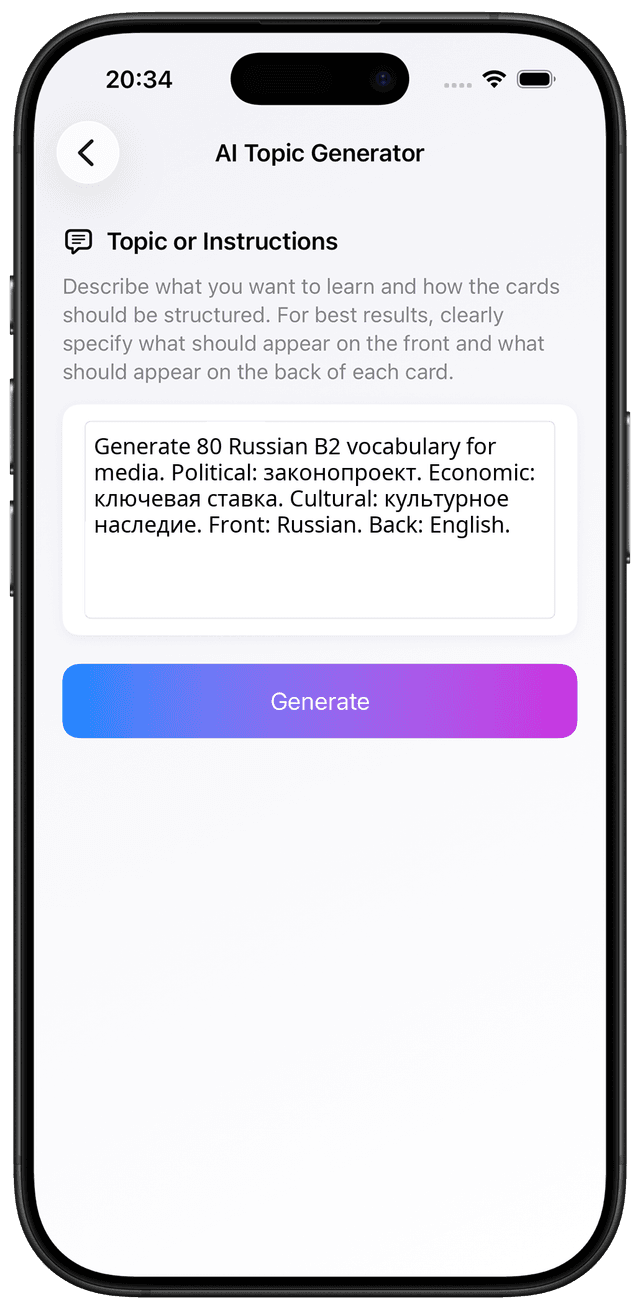
At B2 you should be able to follow a Russian news broadcast, read an opinion column in a major newspaper, and understand a podcast on a topic you care about without stopping at every paragraph. The vocabulary gap that blocks this is rarely grammar but exposure to the specific word sets used in Russian journalism, commentary, and cultural writing.
Russian journalism uses structures that do not appear in textbooks. Impersonal constructions (сообщается, известно, отмечается, указывается), reporting verbs that differ from conversational equivalents (заявил, подчеркнул, констатировал instead of сказал), and nominalised forms (рост, снижение, укрепление, ужесточение) appear constantly in B2 listening and reading texts. Knowing these patterns lets you decode texts by structure, not by looking up each word individually.
The B2 milestone: With this phase complete, your Russian B2 vocabulary and grammar are solid. You can follow a Russian news broadcast, write a formal essay, discuss social and political topics, and sit TORFL B2 without hitting an unknown-word wall. C1 builds directly on these foundations by extending your idiomatic range and control of stylistic register.
Generate 80 Russian B2 vocabulary items for authentic media comprehension. Register 1 - Political and institutional (25): законопроект, постановление, указ, поправка, ратификация, парламентские слушания, государственная программа, федеральный бюджет, национальный проект, государственная корпорация, лоббирование, коалиция, оппозиция, явка избирателей, губернатор, сенатор, депутат, спикер, пресс-секретарь, внешнеполитический курс, дипломатические отношения, двусторонние переговоры, санкционное давление, урегулирование конфликта, гуманитарный кризис. Register 2 - Economic reporting (25): ключевая ставка, инфляционное давление, торговый дефицит, внешний долг, валютный курс, биржевые котировки, фондовый рынок, экспортная выручка, инвестиционный климат, деловая активность, промышленное производство, потребительский спрос, банковский сектор, антимонопольное регулирование, государственные расходы, налоговая нагрузка, субсидирование, экономический спад, рецессия, стагнация, стагфляция, структурные реформы, диверсификация экономики, импортозамещение, цифровая экономика. Register 3 - Cultural commentary (30): культурное наследие, национальная идентичность, историческая память, культурный диалог, межкультурное взаимодействие, социальная мобильность, демографическая ситуация, образовательная реформа, научное сообщество, академическая среда, литературная премия, театральный сезон, кинофестиваль, художественная выставка, культурная политика, музейное дело, архивное хранение, документальное кино, авторское кино, телевизионный сериал, телевещание, медиапространство, журналистское расследование, общественное мнение, социальный опрос, экспертное сообщество, аналитический центр, гражданская журналистика, сетевые СМИ, информационное агентство. Front: Russian term + journalism-style example sentence. Back: English equivalent.
At B2 the vocabulary is less predictable than A1 to B1 core words. You encounter academic registers, political language, and idiomatic phrases that do not follow simple patterns. Spaced repetition handles this well: cards you find difficult appear more often, cards you know well drop back. You spend time where it counts, not on words you already know.
B2 builds on B1 and prepares you for C1. Use the links below to move between levels or return to the full Russian guide.
Build your Russian B2 vocabulary with AI-generated decks and spaced repetition that adapts to what you actually find difficult. Free to download. No account required. Start with the phase that covers your biggest gap.