
Spaced repetition explained
Why reviewing at the right interval is key to locking in Russian A2 vocabulary
You've built your A1 foundation. Now it's time to learn the language you'll actually use in conversation. At A2, the real shift happens when you master past tense endings, aspect pairs, and the case patterns that make your Russian sound natural to native speakers.
This guide skips the filler and focuses on the high-impact stuff: the gender-based endings that trip up most learners, the verbal aspects you need to describe your day, and the daily Genitive and Accusative patterns that appear in nearly every sentence.
We've grouped these into seven phases with ready-to-use prompts. Just paste them into MindCards to generate custom decks that use spaced repetition to help you remember everything with less effort.
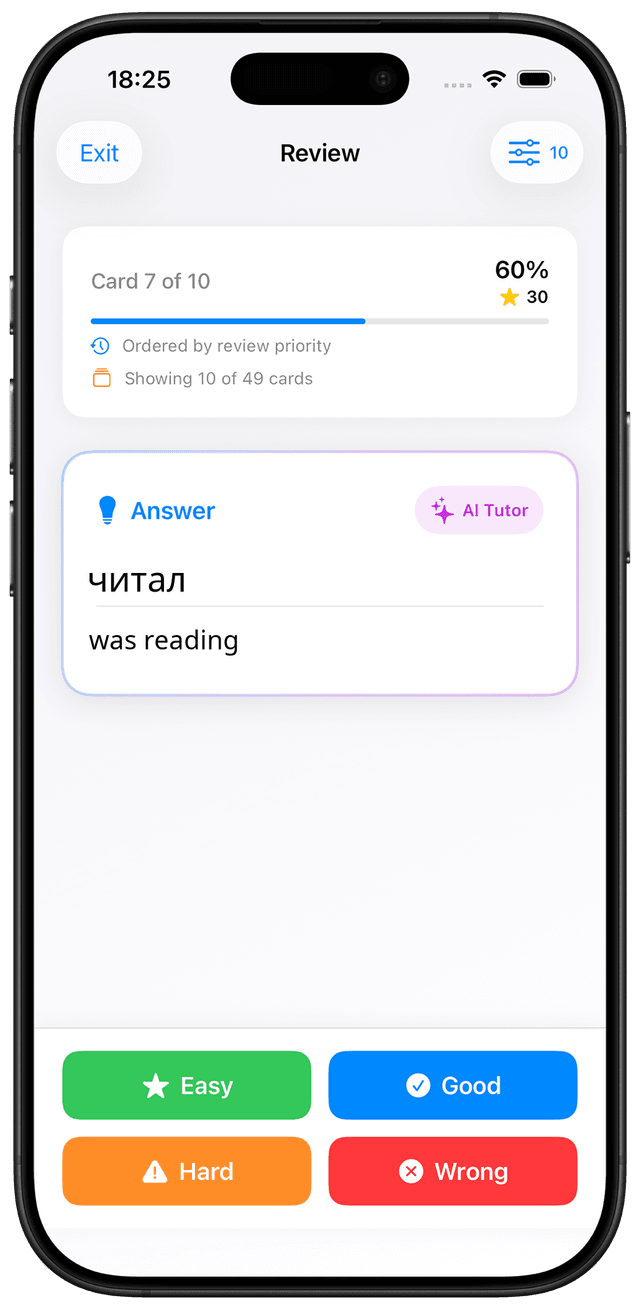
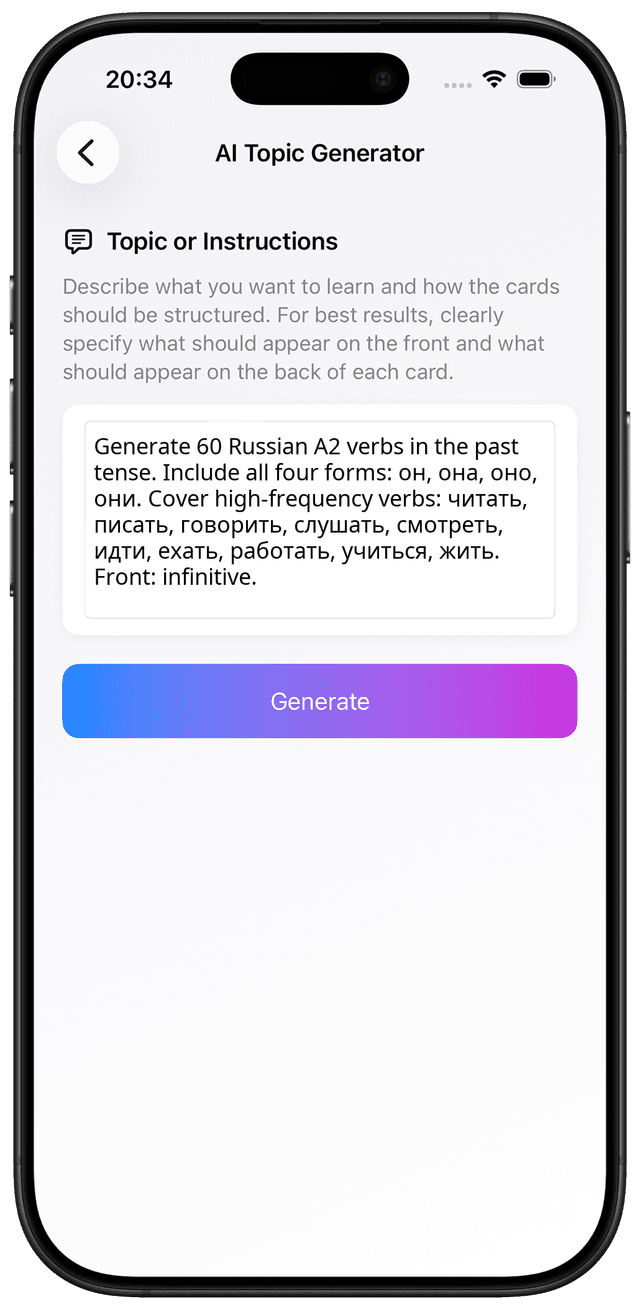
Russian past tense is actually quite logical once you see the pattern. Unlike English, verbs change based on the gender and number of the subject—he, she, it, or they—rather than the person (I, you, he).
Why start here? You can't tell a story or describe your day without the past tense. It's also a major focus of the TORFL A2 speaking tasks, where you'll need to talk about completed actions.
The strategy: Focus on absorbing the four gender forms (он/она/оно/они) early on so they become automatic.
Generate 60 Russian A2 verbs in the past tense. Include all four forms: он, она, оно, они. Cover high-frequency verbs: читать, писать, говорить, слушать, смотреть, идти, ехать, работать, учиться, жить. Front: infinitive. Back: он/она/оно/они forms + English meaning.
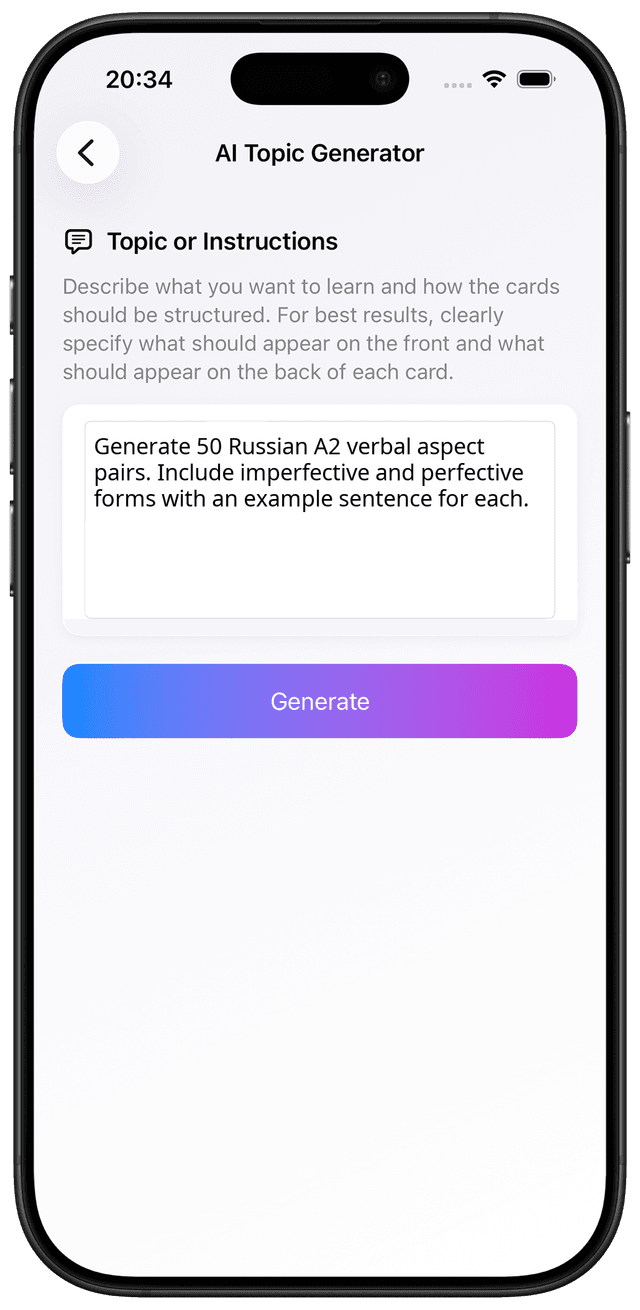
Verbal aspect is often called the 'heart' of Russian grammar. Most verbs come in pairs: the imperfective for ongoing or habitual actions, and the perfective for completed, one-time events. The difference between reading (читать) and finishing a book (прочитать) changes your meaning entirely.
Why aspect matters: Getting the aspect right is one of the clearest signals of fluency. Russian speakers switch between these pairs constantly. At the A2 level, you'll want to master about 50 of the most common pairs.
The strategy: Learn these pairs as single units with a short example sentence to see how the meaning shifts in context.
Generate 50 Russian A2 verbal aspect pairs. Include imperfective and perfective forms with an example sentence for each. Pairs: читать/прочитать, писать/написать, говорить/сказать, делать/сделать, покупать/купить, открывать/открыть, закрывать/закрыть, давать/дать. Front: imperfective. Back: perfective + example sentences showing both uses.
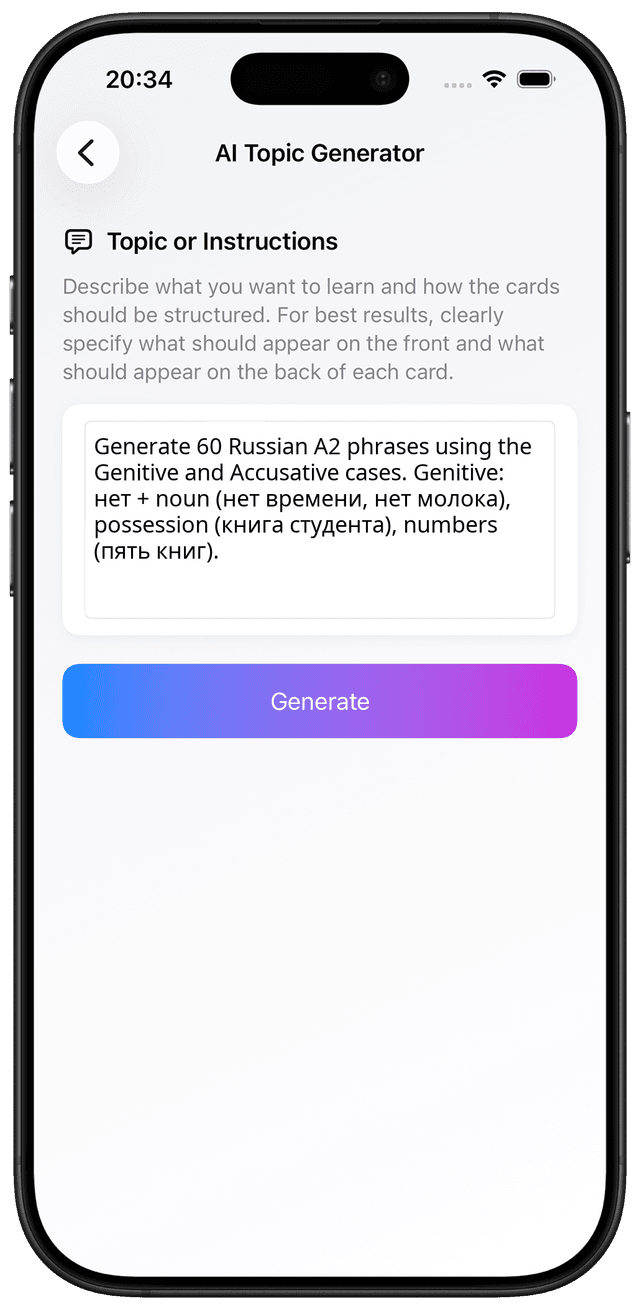
At the A2 level, two cases become immediately useful: the Genitive (for possession, numbers, and 'nothing') and the Accusative (for direct objects and moving toward places). You likely saw these at A1, but now you'll start using them without needing to pause.
Why cases? These two appear in almost every sentence. Mastering them early helps you stop worrying about endings and start focusing on what you actually want to say.
The strategy: Use short, realistic phrases rather than abstract grammar tables. It's much easier to remember 'нет времени' than a list of Genitive endings.
Generate 60 Russian A2 phrases using the Genitive and Accusative cases. Genitive: нет + noun (нет времени, нет молока), possession (книга студента), numbers (пять книг). Accusative: direct objects (читаю книгу, вижу друга) and movement verbs (иду в магазин). Front: Russian phrase. Back: English + case label.
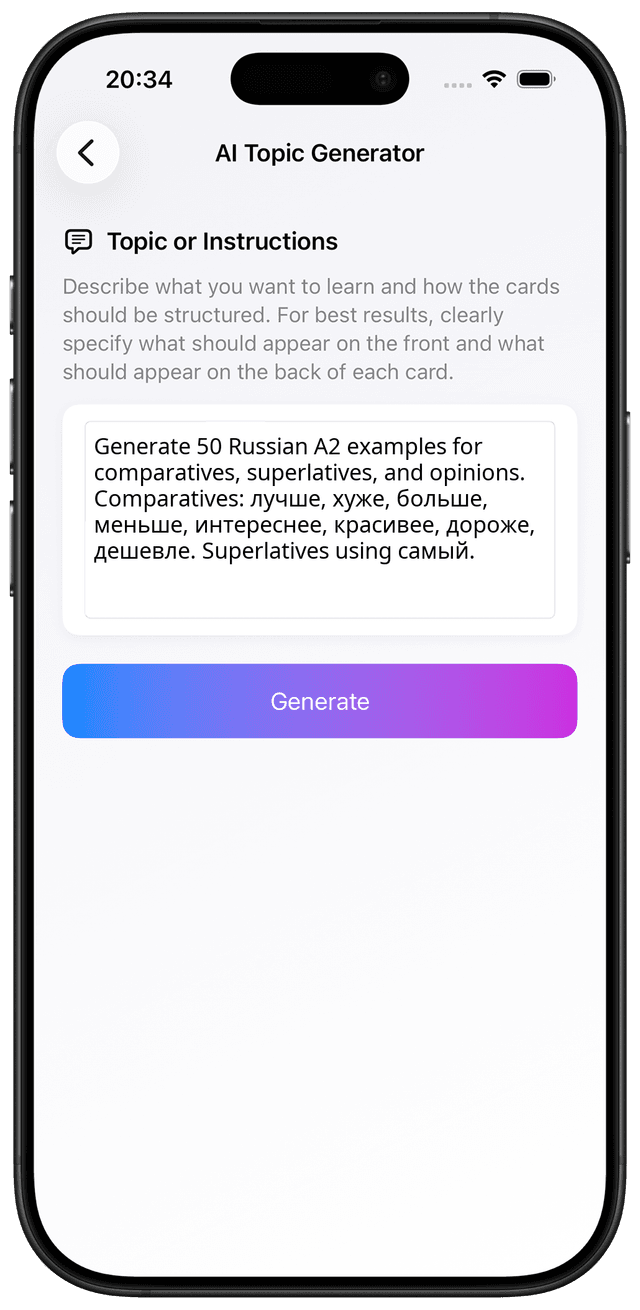
Russian comparatives are formed with more or a suffix: лучше, хуже, больше, меньше, интереснее, красивее. Superlatives use самый. The A2 level also requires vocabulary for expressing opinions: Я думаю, что..., По-моему, Мне кажется, что...
Why add opinions now? TORFL A2 speaking and writing tasks ask you to describe and evaluate. A vocabulary set for comparison and opinion turns isolated words into actual A2 responses.
The strategy: Combine comparative forms with opinion phrases so you can compare and evaluate in one connected batch.
Generate 50 Russian A2 examples for comparatives, superlatives, and opinions. Comparatives: лучше, хуже, больше, меньше, интереснее, красивее, дороже, дешевле. Superlatives using самый. Opinion phrases: Я думаю, что..., По-моему, Мне кажется, что..., Я согласен/согласна. Front: Russian phrase. Back: English + pattern label.
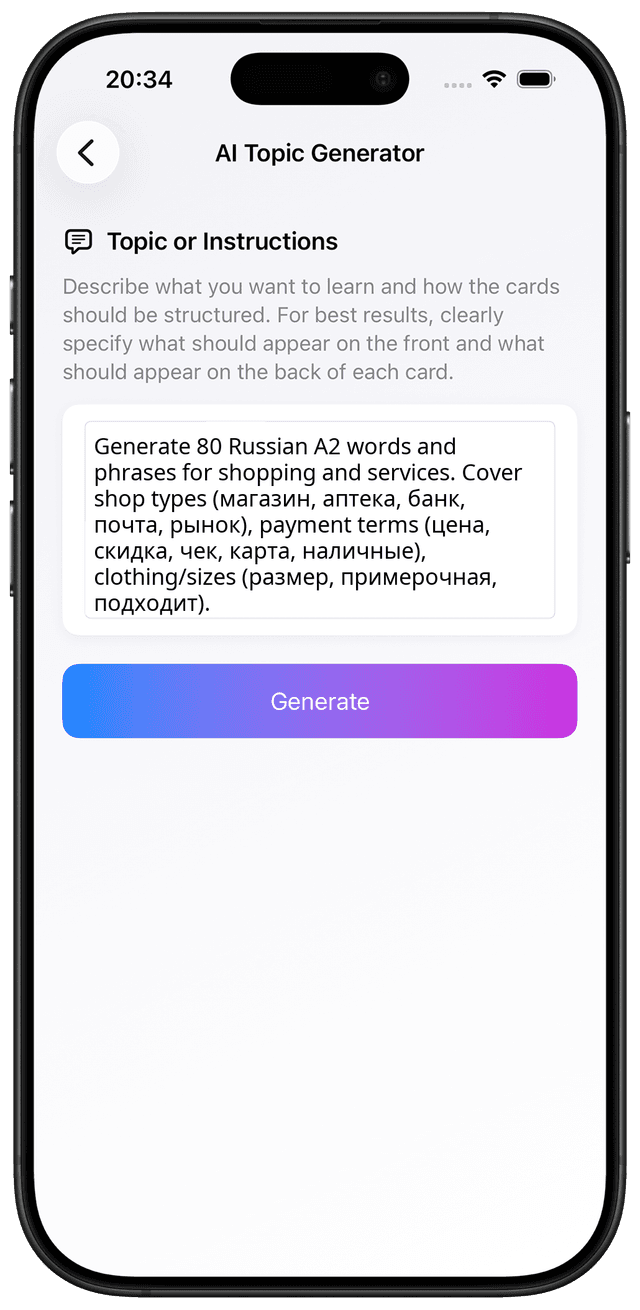
At A2, you should handle a real shopping interaction end to end: asking for something by size, paying, getting a receipt, returning an item. This phase also covers pharmacy, bank, and post office language that appears in every TORFL A2 scenario.
Why this is tested: Shopping and service situations require practical transactional vocabulary. TORFL A2 speaking and writing tasks use them precisely because the grammar needed is manageable but the vocabulary range is wide.
The strategy: This deck mixes product vocabulary, money terms, and service phrases so you can get through a real transaction without switching to English.
Generate 80 Russian A2 words and phrases for shopping and services. Cover shop types (магазин, аптека, банк, почта, рынок), payment terms (цена, скидка, чек, карта, наличные), clothing/sizes (размер, примерочная, подходит), and service phrases (Сколько стоит?, Есть ли у вас...?, Я хочу вернуть). Front: Russian. Back: English.
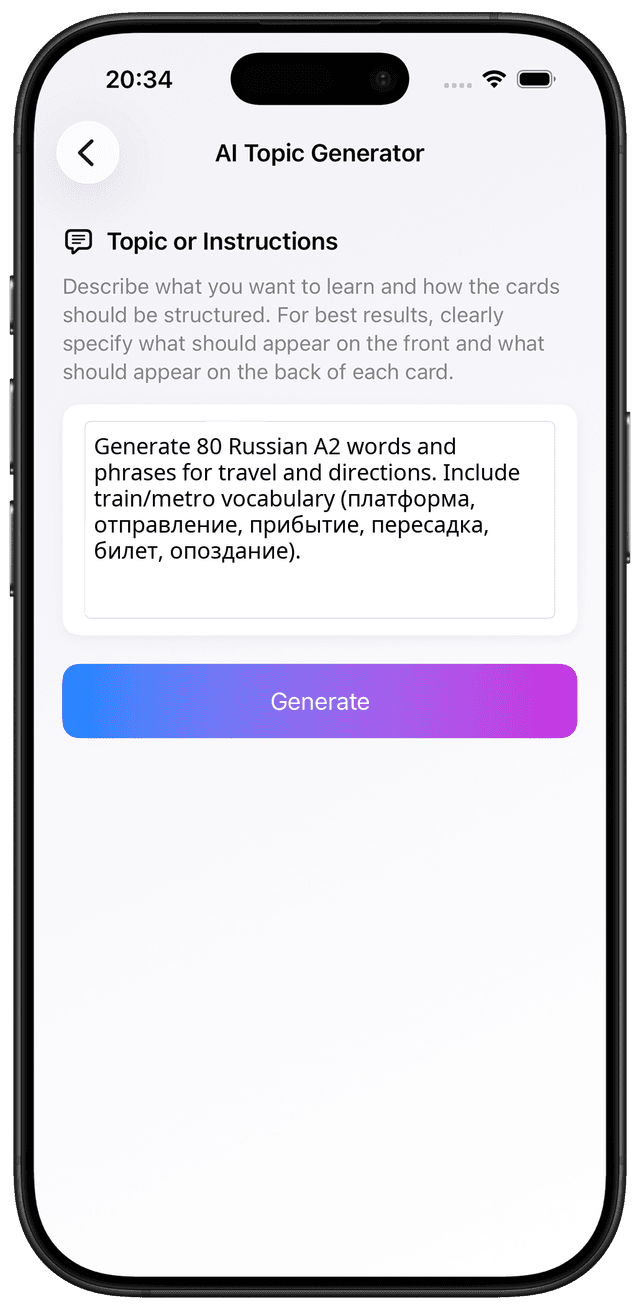
Russia has extensive rail and metro networks. Navigating them requires specific vocabulary: платформа, отправление, пересадка, билет, расписание. This phase also covers hotel check-in, giving directions, and handling common travel problems in Russian.
Why travel vocabulary matters: Travel is a core topic area in the TORFL A2 exam. The vocabulary here is also immediately practical for anyone visiting Russian-speaking countries.
The strategy: This deck covers transport, accommodation, and directional language so you can navigate without mentally switching between separate word lists.
Generate 80 Russian A2 words and phrases for travel and directions. Include train/metro vocabulary (платформа, отправление, прибытие, пересадка, билет, опоздание), accommodation (забронировать номер, двухместный номер, завтрак включён, стойка регистрации), directions (налево, направо, прямо, на углу, напротив), and travel problems (Поезд опаздывает, Где ближайшее метро?). Front: Russian. Back: English.
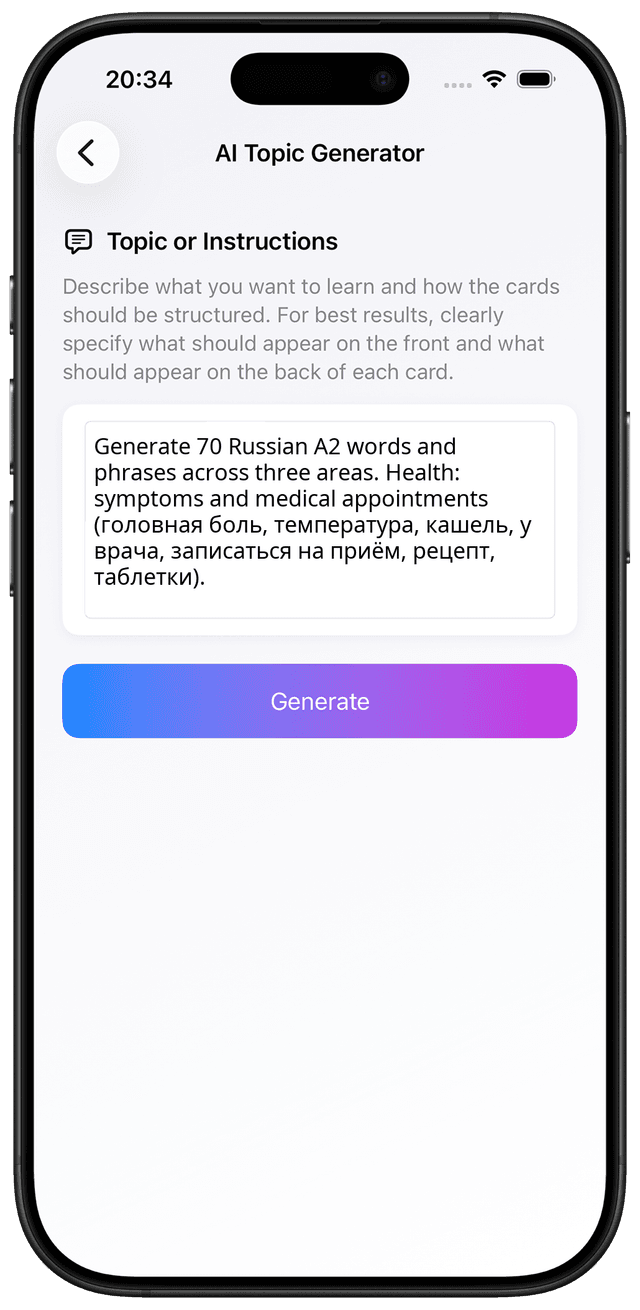
The final A2 phase covers health vocabulary for symptoms and appointments, work and daily routine language, and the Russian future tense with both imperfective (буду + infinitive) and perfective forms for talking about plans.
The milestone: With this deck, your A2 vocabulary is complete. You can describe past events with past tense verbs, switch between aspect pairs, handle shopping and travel, express opinions with comparisons, and talk about future plans. That covers the full A2 picture for Russian.
Generate 70 Russian A2 words and phrases across three areas. Health: symptoms and medical appointments (головная боль, температура, кашель, у врача, записаться на приём, рецепт, таблетки). Work: job and routine (коллега, офис, совещание, зарплата, уволиться, конец рабочего дня). Future tense: 20 sentences using буду + infinitive or perfective future (Я буду читать, Я прочитаю). Front: Russian. Back: English + category label.
At the A2 level, Russian becomes a game of pattern recognition. MindCards uses active recall to drill past tense forms and case patterns so you don't have to pause and think mid-sentence. Spaced repetition ensures you review words right before you'd otherwise forget them.
A2 vocabulary sits between the A1 foundation and B1 fluency. Use the links below to move between levels or return to the full Russian guide.
Join thousands of learners building their Russian fluency with AI-powered flashcards and spaced repetition. No account or signup required.