
Spaced repetition explained
Why reviewing at the right interval locks in Russian B1 vocabulary faster than daily drilling
You have the A2 grammar. Past tense, aspect pairs, basic cases. The problem at B1 is vocabulary: grammar holds up, but you run out of words mid-sentence on topics that matter.
This guide targets that specifically. Seven phases cover the vocabulary domains that define B1 Russian: prefixed motion verbs, conditionals, abstract nouns, complex connectors, emotional language, current affairs, and formal written register.
Each phase has a ready-to-use prompt for MindCards. Paste it in, generate a deck, and spaced repetition handles the scheduling from there.
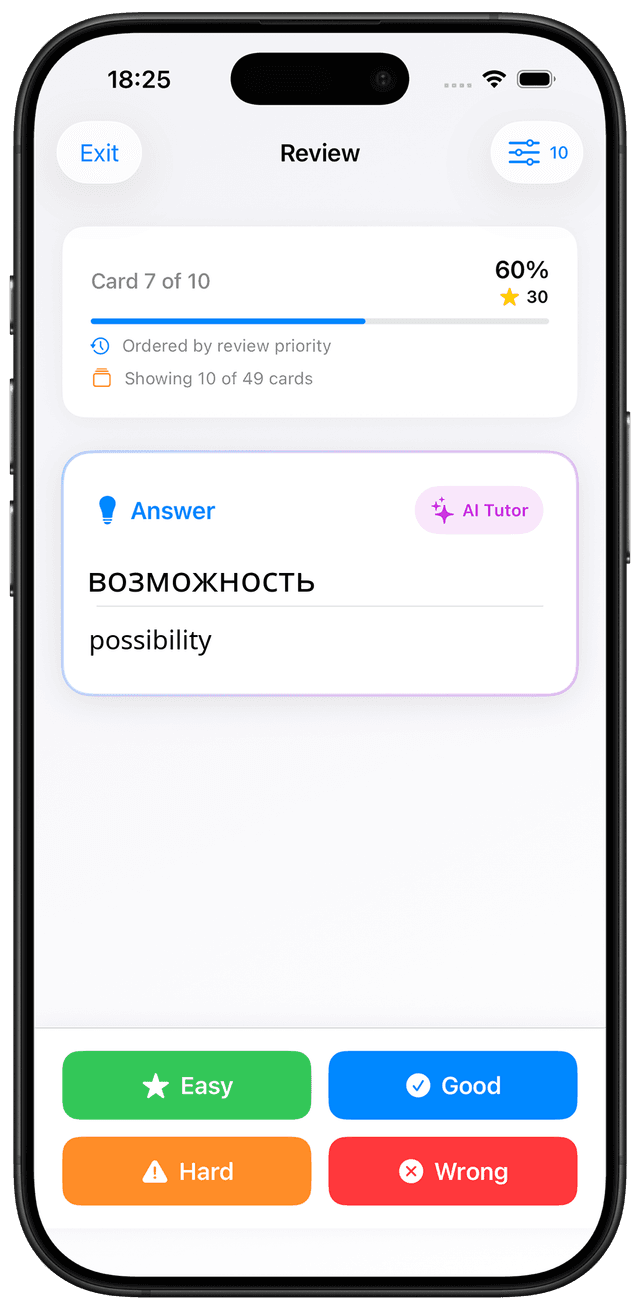
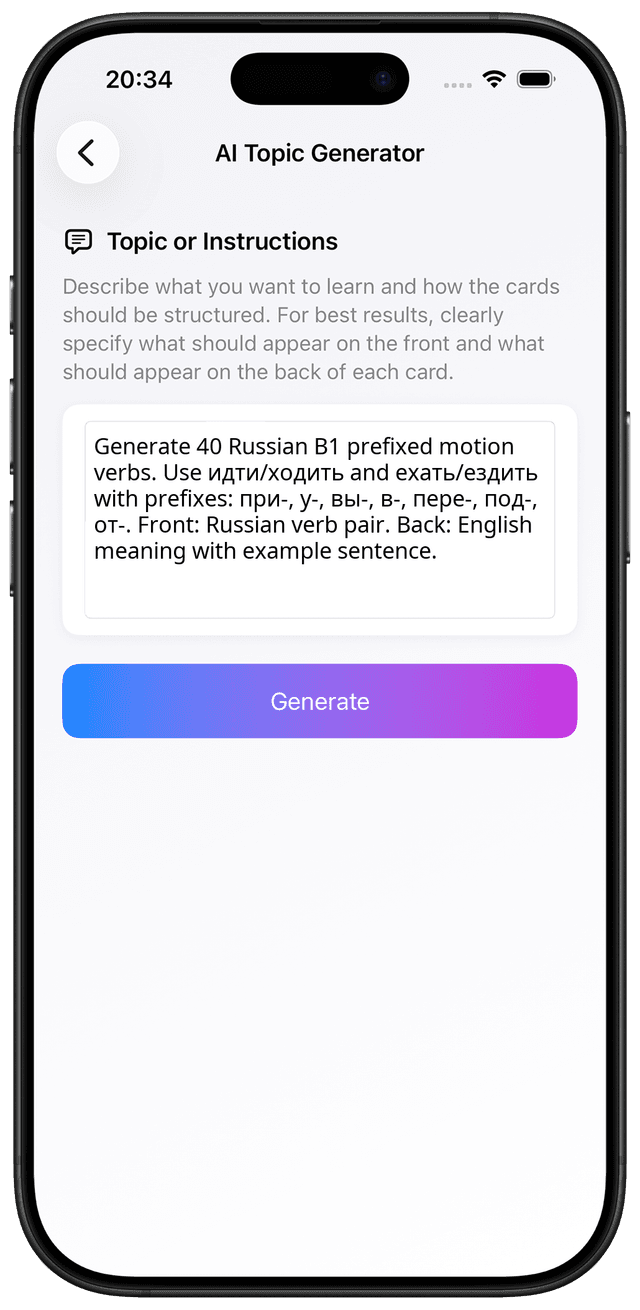
Russian motion verbs look tricky until you see the prefix logic. Each prefix adds a specific directional meaning: при- signals arrival, у- signals departure, вы- means exiting a space, в- means entering one. The base pairs идти/ходить and ехать/ездить carry you; the prefixes tell you where.
Why this is B1 territory: Motion verbs with prefixes appear constantly in everyday speech. Without them you can describe simple movement, but you cannot tell stories about coming and going with any precision.
The strategy: Drill each prefix as a meaning, not just a spelling change. One prefix deck, four base verbs, cards that lock in because the logic is consistent.
Generate 40 Russian B1 prefixed motion verbs. Use идти/ходить and ехать/ездить with prefixes: при-, у-, вы-, в-, пере-, под-, от-. Front: Russian verb pair. Back: English meaning with example sentence.
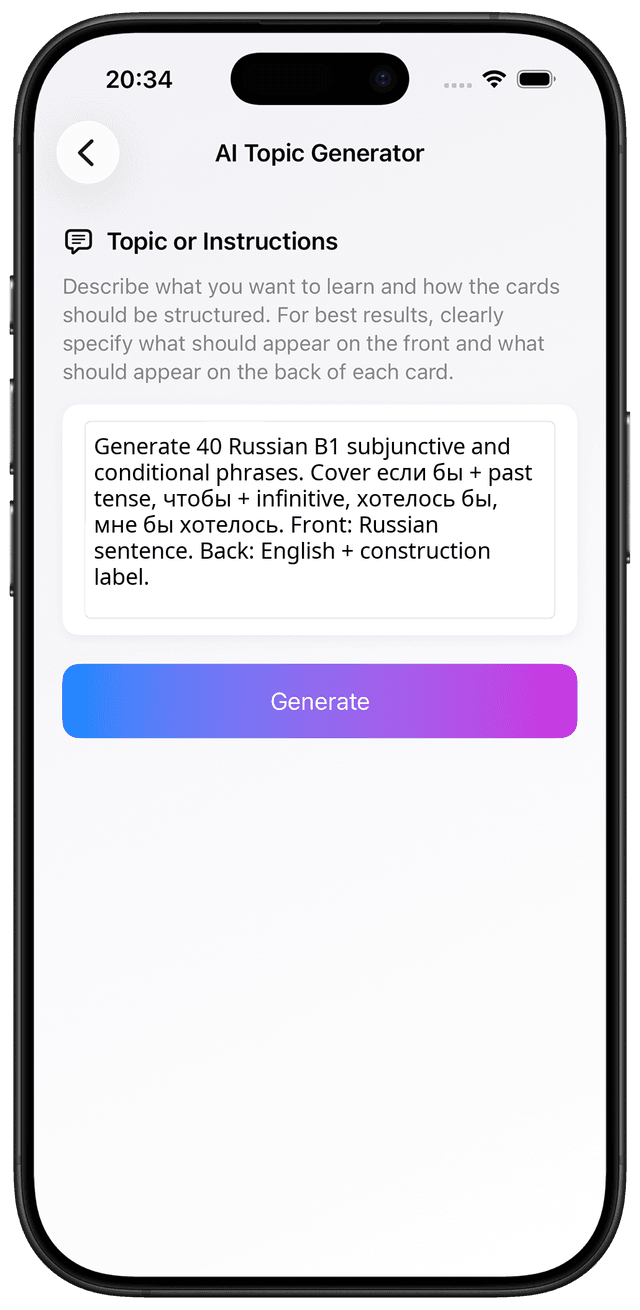
The Russian subjunctive uses one formula: past tense verb plus бы. Simple in theory, harder in practice because бы placement shifts depending on what you want to emphasise. Knowing если бы, чтобы, and хотелось бы lets you handle polite requests, hypotheticals, and reported wishes in natural order.
Why now: TORFL B1 speaking and writing tasks regularly ask you to describe hypothetical situations and express wishes. Knowing this grammar without the vocabulary to go with it slows you down.
The strategy: Build full conditional sentences as flashcard fronts, not just isolated forms. Recognition in context is faster to build than abstract recall.
Generate 40 Russian B1 subjunctive and conditional phrases. Cover если бы + past tense, чтобы + infinitive, хотелось бы, мне бы хотелось. Front: Russian conditional sentence. Back: English translation + construction label.
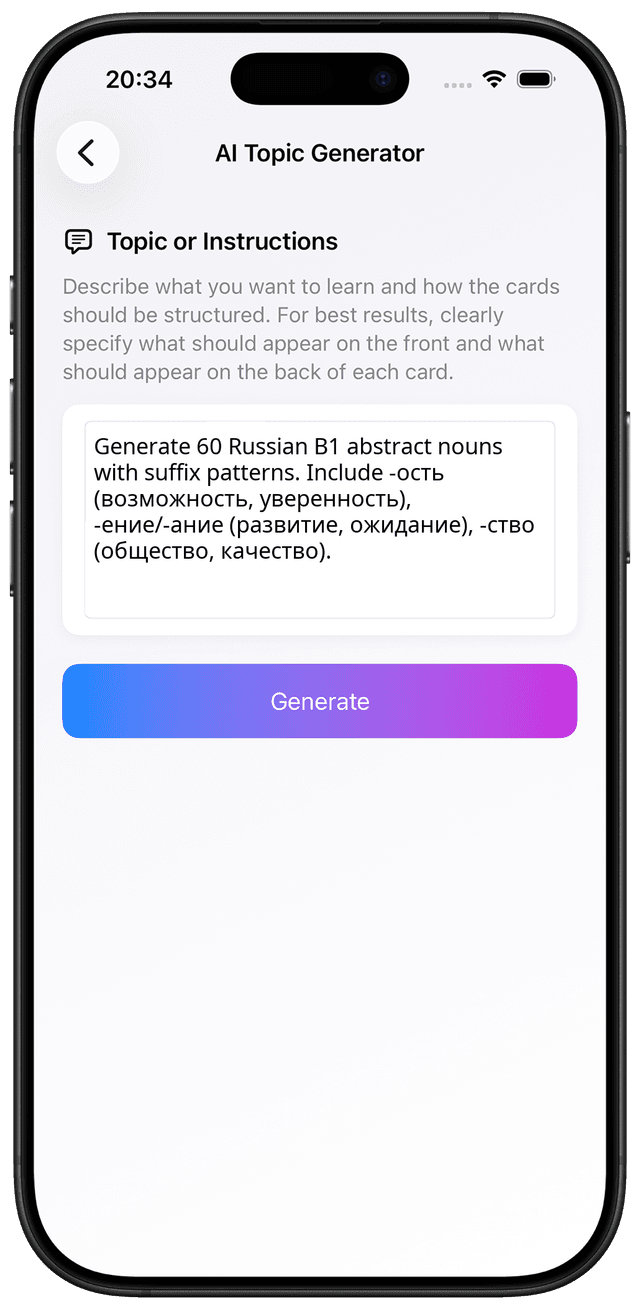
At B1 you start discussing ideas, feelings, and situations rather than just objects and actions. Russian builds abstract nouns from adjectives and verbs using suffixes like -ость, -ение, -ание, -ство. Learn the patterns once and you can read many unfamiliar nouns without looking them up.
Why abstract nouns matter: You cannot discuss news, opinions, or your own inner life without them. Words like возможность, развитие, отношение, and поведение show up in every B1-level text.
The strategy: Learn the suffix patterns first, then build vocabulary by family. Once you know the adjective красивый, recognising красота becomes automatic.
Generate 60 Russian B1 abstract nouns with suffix patterns. Include -ость (возможность, уверенность), -ение/-ание (развитие, ожидание), -ство (общество, качество). Front: Russian noun. Back: English + suffix pattern label.
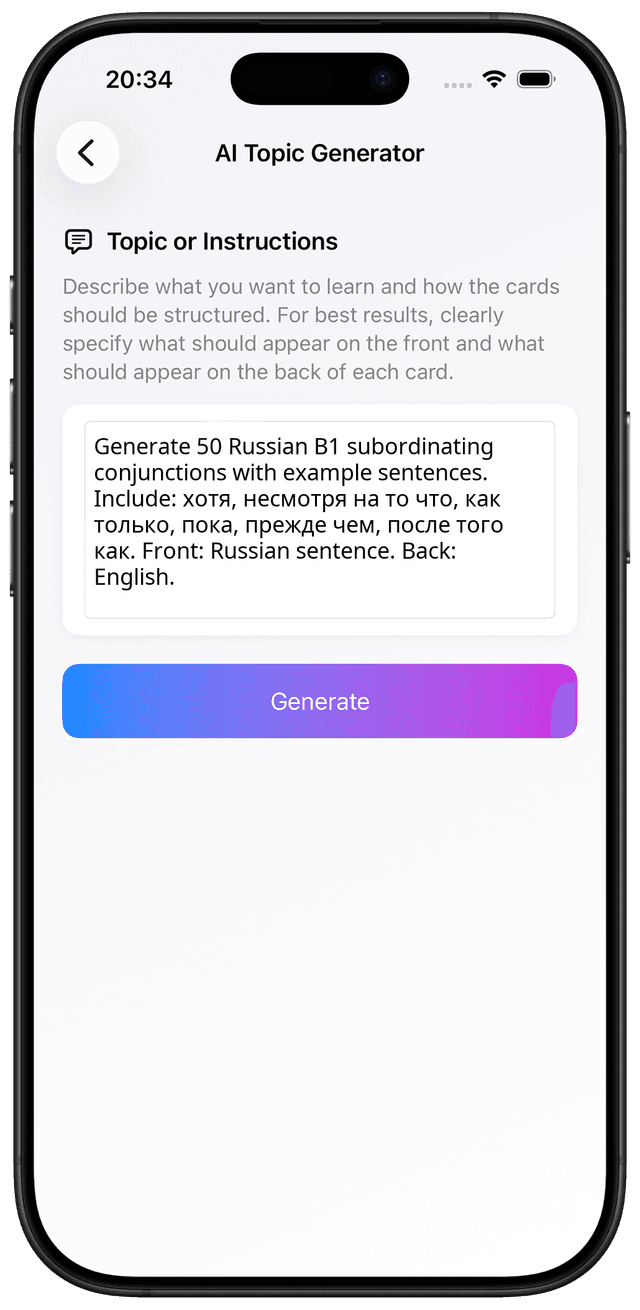
B1 Russian requires you to connect ideas across multiple clauses. At A2 you used simple и, но, и потому что. At B1 you need the full toolkit: несмотря на то что (despite), хотя (although), как только (as soon as), пока (while/until), и прежде чем (before). These conjunctions signal logical relationships that make speech sound genuinely fluent.
Why connectors are B1 markers: Short sentences strung together sounds like A2. Subordinate clauses with appropriate conjunctions are what listeners hear as intermediate fluency. This deck closes that gap.
The strategy: Cards pair each conjunction with two example sentences so you feel its meaning in both positive and negative contexts.
Generate 50 Russian B1 subordinating conjunctions and connectors with example sentences. Include: хотя, несмотря на то что, как только, пока, прежде чем, после того как, для того чтобы, благодаря тому что. Front: conjunction + Russian sentence. Back: English translation.
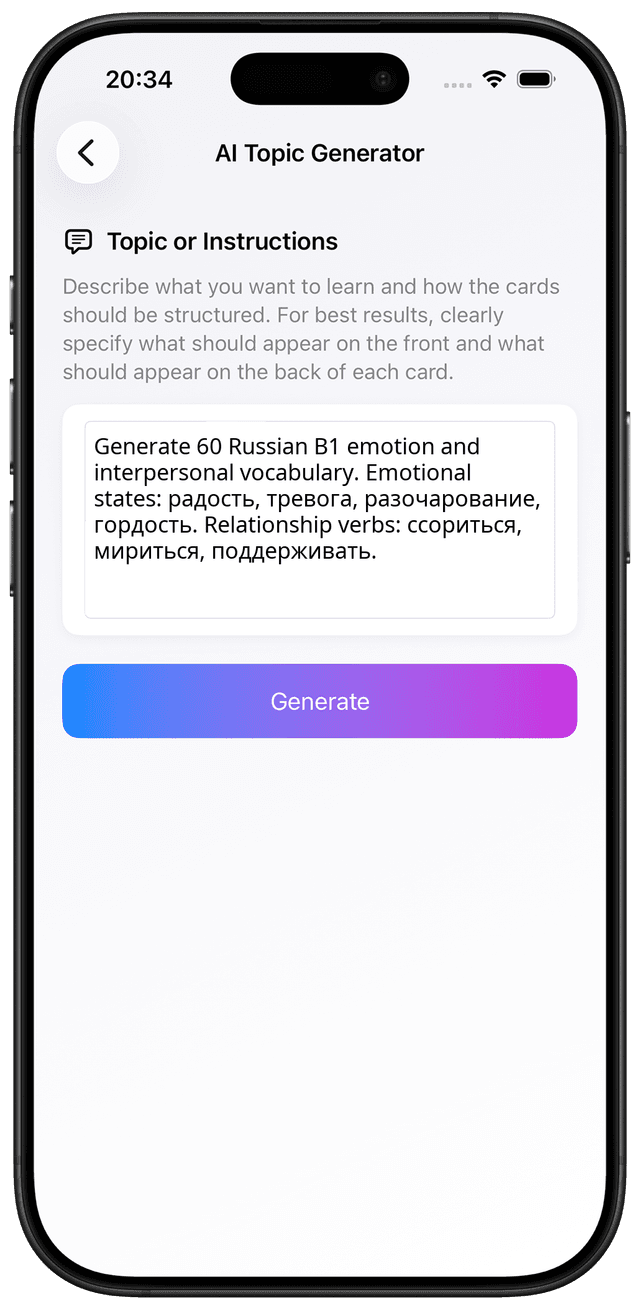
Describing how people feel and how relationships work is core B1 territory. This phase moves past happy and sad into vocabulary like разочарование (disappointment), беспокойство (anxiety), доверие (trust), and уважение (respect), plus verbs like ссориться (to argue), мириться (to make up), and поддерживать (to support).
Why this phase? Russian speakers discuss emotions and character in everyday conversation more directly than many learners expect. Without this vocabulary you end up giving one-word answers on topics that matter.
The strategy: Learn pairs of emotional states and the verbs that link them. Feeling and change-of-feeling cards cluster naturally in memory.
Generate 60 Russian B1 emotion and interpersonal vocabulary items. Include emotional states (радость, тревога, разочарование, гордость), relationship verbs (ссориться, мириться, поддерживать, доверять), and character adjectives (честный, терпеливый, вспыльчивый). Front: Russian. Back: English.
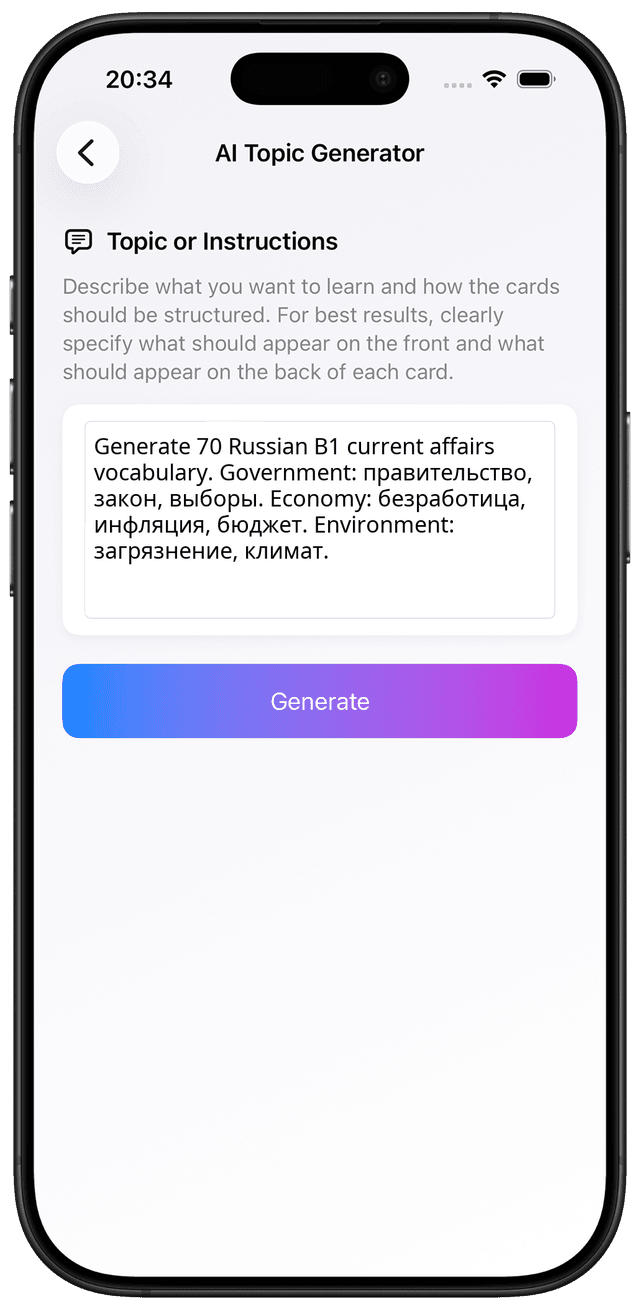
Following Russian news and talking about public life needs a specific layer of vocabulary: government, economics, environment, and social topics. Words like правительство (government), окружающая среда (environment), безработица (unemployment), and гражданин (citizen) come up constantly in adult conversations and news broadcasts.
Why current affairs at B1: TORFL B1 reading and listening sections use journalistic texts as source material. This vocabulary makes those texts readable rather than overwhelming.
The strategy: Group cards by topic cluster (economics, environment, politics) so review sessions build thematic associations rather than isolated word lists.
Generate 70 Russian B1 society and current affairs vocabulary items. Cover government (правительство, закон, выборы), economy (безработица, инфляция, бюджет), environment (загрязнение, климат, окружающая среда), and civic life (гражданин, права, обязанности). Front: Russian. Back: English.
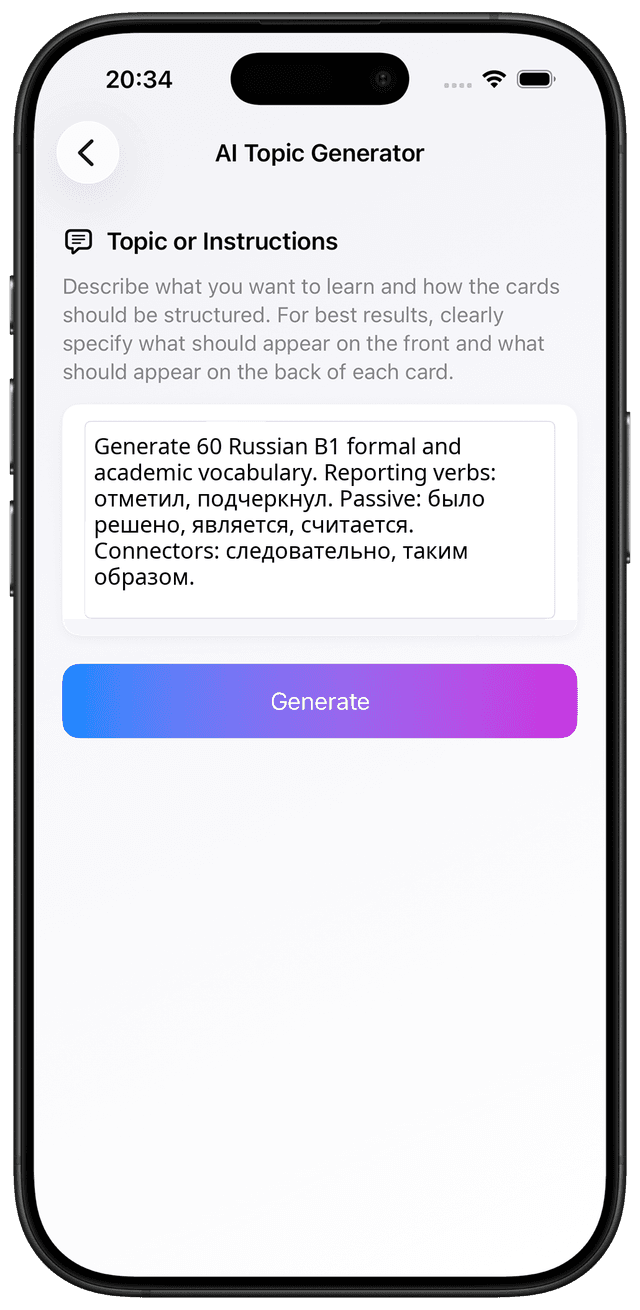
Written Russian at B1 level runs in a noticeably more formal register than everyday speech. Where a conversation uses сказал, a newspaper uses отметил or подчеркнул. That gap causes friction when reading articles, official texts, or academic materials. This phase covers the formal verbs, passive constructions, and academic connectors that show up constantly in written Russian.
The B1 milestone: After this phase your vocabulary covers motion verbs, conditionals, abstract nouns, complex connectors, emotional language, current affairs, and formal register. That covers the full B1 picture for Russian. You can read intermediate texts, hold real conversations, and handle any TORFL B1 topic area.
Generate 60 Russian B1 formal and academic vocabulary items. Include formal reporting verbs (отметил, подчеркнул, свидетельствует), passive constructions (было решено, является, считается), academic connectors (следовательно, таким образом, в частности), and formal nouns (исследование, анализ, результат). Front: Russian. Back: English + register label.
At B1 level the vocabulary load increases and the distinctions between similar words start to matter. MindCards uses active recall to drill those distinctions, and spaced repetition to schedule reviews right before you would otherwise forget. You end up spending less time studying and retaining more of it.
B1 sits between A2 grammar fluency and B2 upper-intermediate. Use the links below to move between levels or return to the full Russian guide.
Build conversational Russian with AI-powered flashcards and spaced repetition. No account or signup required. Just paste a prompt and start learning.