
Spaced repetition explained
Why reviewing at the right interval locks in advanced Russian vocabulary faster
You have B2. You can read a Russian newspaper, write a formal email, and get through most conversations without hitting a wall. C1 is where that effort drops noticeably. Russian that required active decoding starts arriving automatically. You stop translating and start thinking in Russian.
C1 covers roughly 6,000 to 8,000 words in active use. This guide focuses on the 1,500+ that actually move you forward at this level: register control for switching between colloquial and formal Russian, idioms that run through journalism and educated speech, discourse markers for complex written argumentation, nominal style for reading dense texts, academic writing conventions for TORFL C1 and university contexts, domain-specific vocabulary for professional settings, and pragmatic particles for genuine spoken fluency.
Each of the seven phases below includes a ready-to-use AI prompt. Paste it into the MindCards app and it generates a custom flashcard deck in seconds. Spaced repetition then schedules each card just before you are likely to forget it, so you retain more with less time reviewing.
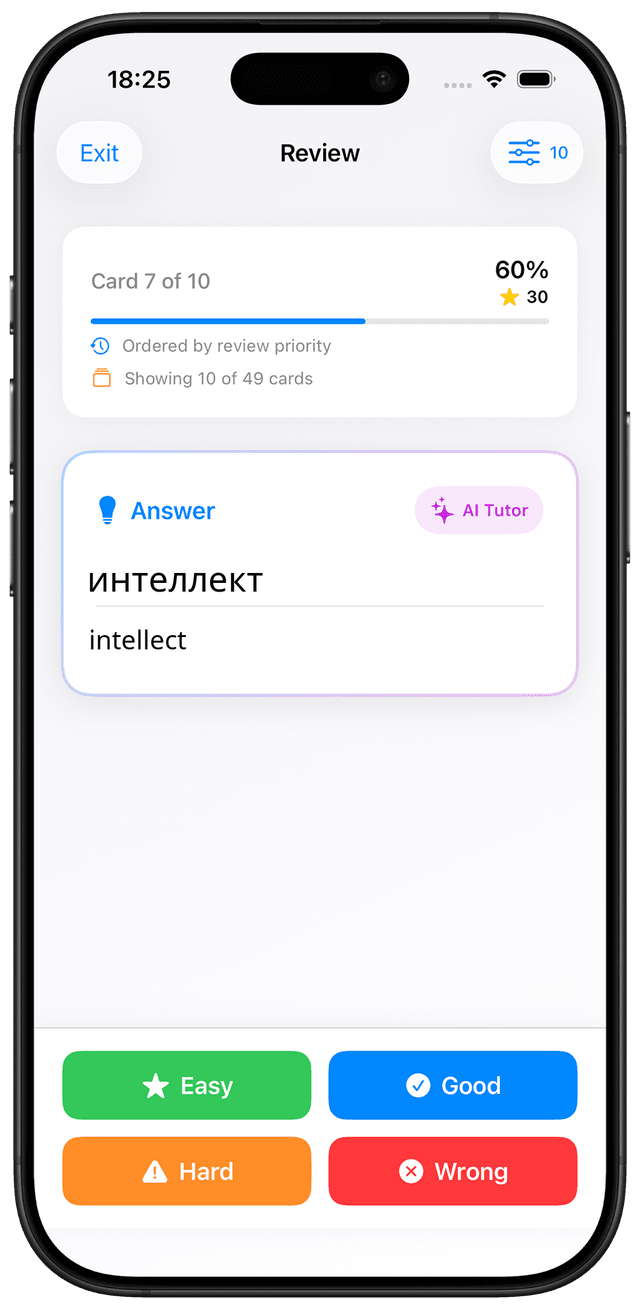
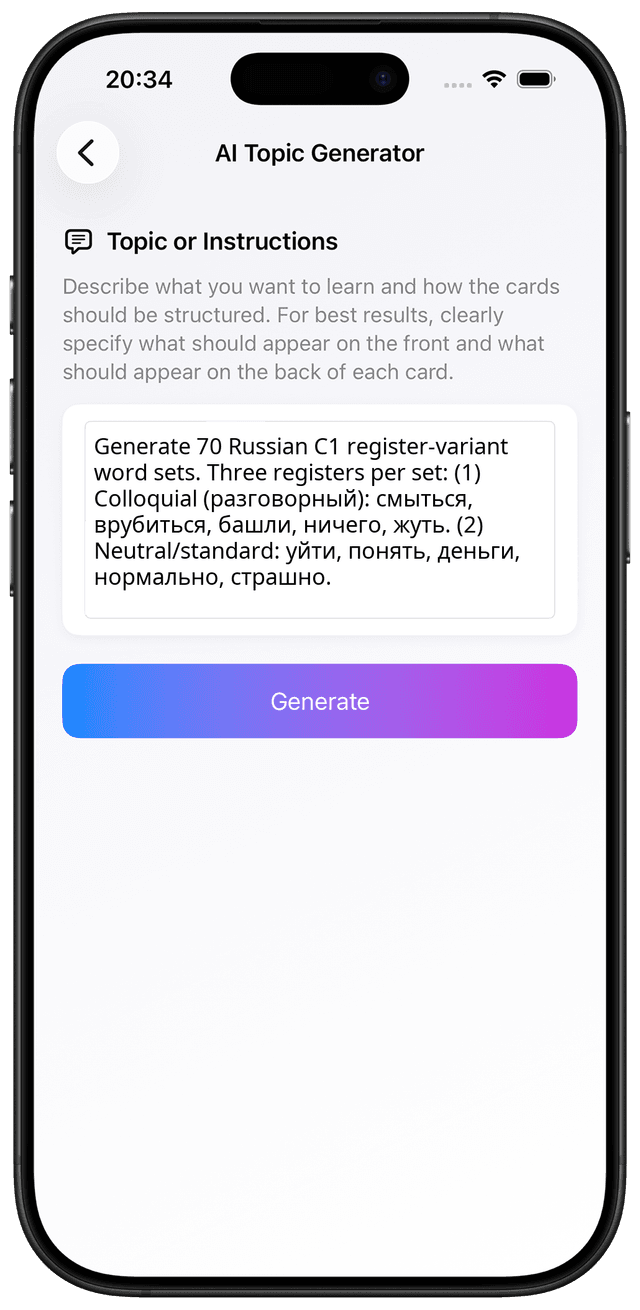
At C1, knowing more words matters less than knowing which word fits the context. Russian has distinct register layers. The gap between разговорный (colloquial spoken Russian) and книжный (literary/formal written Russian) is considerable, and mixing registers sounds immediately off to a native speaker. C1 requires switching deliberately between them.
Why start here? Register control is what makes C1 Russian sound natural rather than just grammatically correct. A B2 speaker knows both удрать and уйти mean to leave. A C1 speaker chooses between them based on whether the setting is a kitchen conversation or a formal report.
The strategy: This deck pairs colloquial, standard, and formal variants of the same concept so you build register-switching as an automatic habit, not a conscious lookup.
Generate 70 Russian C1 register-variant word sets. Three registers per set: (1) Colloquial (разговорный): смыться, врубиться, башли, ничего, жуть. (2) Neutral/standard: уйти, понять, деньги, нормально, страшно. (3) Formal/literary (книжный): удалиться, постигнуть, средства, приемлемо, ужасающий. Group by semantic category: departure, understanding, money, quality, intensity. Front: colloquial form. Back: standard + formal equivalents with register label.
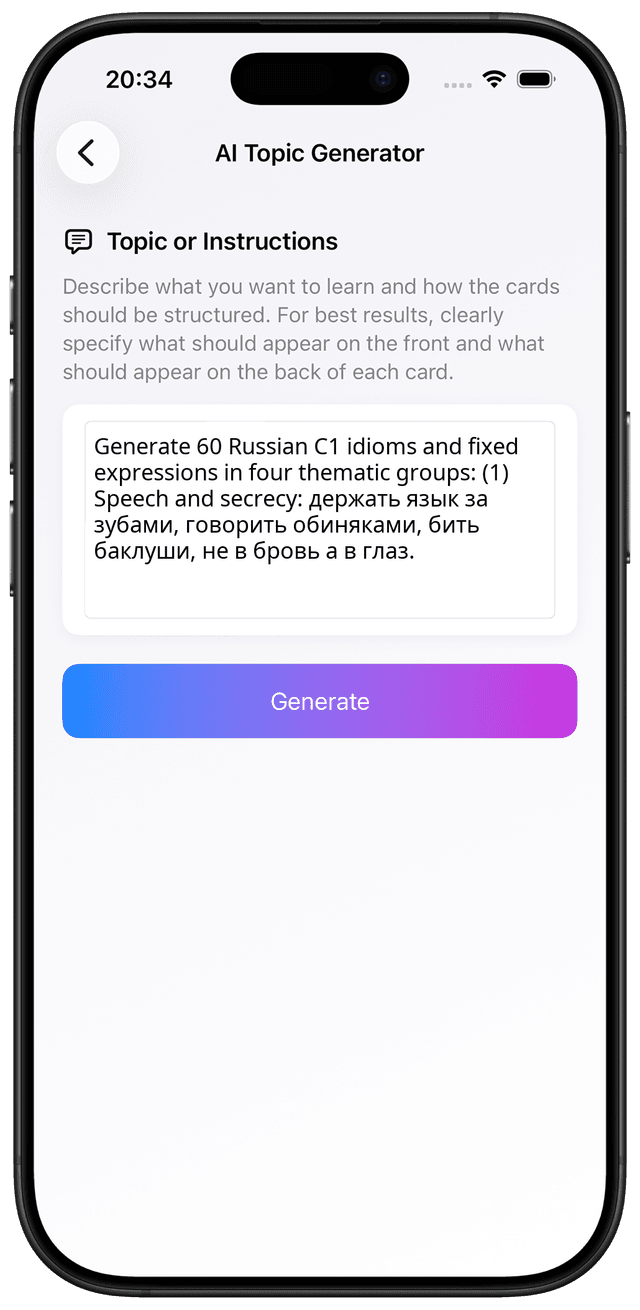
Russian idioms are unavoidable at C1. They appear in journalism, literature, political commentary, and everyday conversation between educated native speakers. Knowing that держать язык за зубами means to keep quiet, or that остаться с носом means to be cheated, is part of what fluency at this level requires.
Why this matters: The TORFL C1 exam tests idiom comprehension in reading and listening sections. In professional contexts, missing an idiomatic phrase can mean misunderstanding the tone or actual content of what is being communicated.
The strategy: This deck covers the 60 most frequently encountered idioms in Russian journalism and professional communication, grouped by theme so patterns become easier to remember.
Generate 60 Russian C1 idioms and fixed expressions in four thematic groups: (1) Speech and secrecy: держать язык за зубами, говорить обиняками, бить баклуши, не в бровь а в глаз. (2) Deception and outcome: остаться с носом, водить за нос, попасть впросак, сесть в лужу. (3) Effort and persistence: не покладая рук, через пень-колоду, лезть из кожи вон, гнуть свою линию. (4) Time and urgency: тянуть резину, на скорую руку, не за горами, откладывать в долгий ящик. Front: Russian idiom. Back: literal meaning + actual meaning + example sentence.
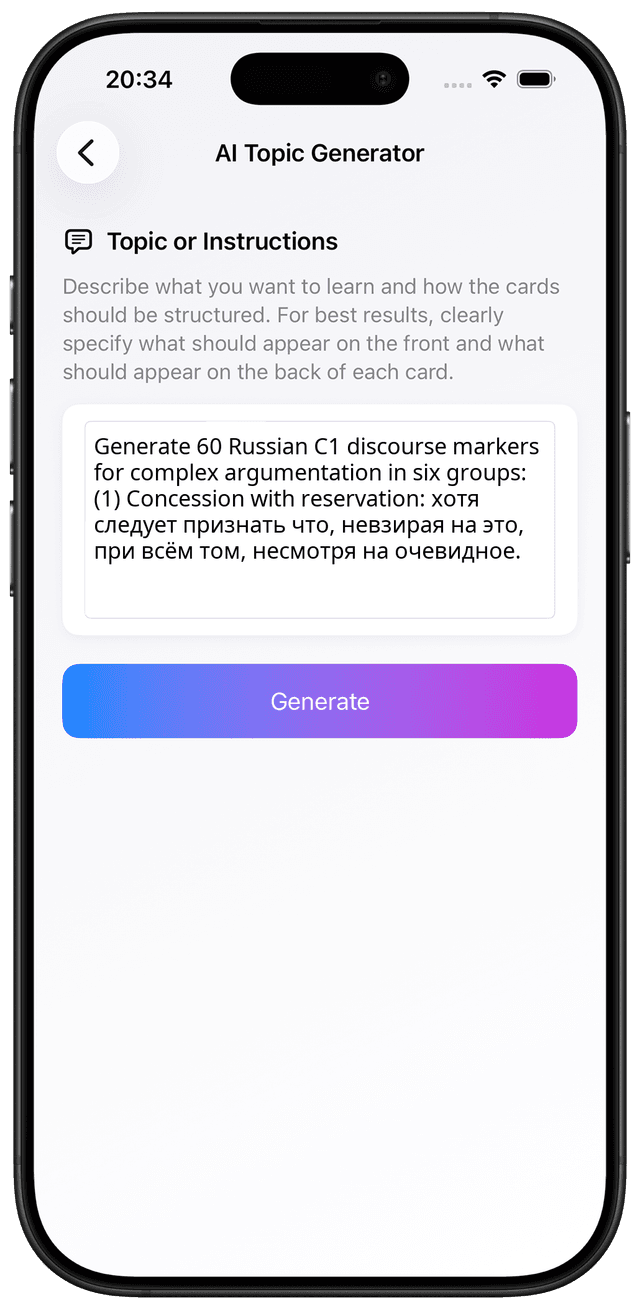
C1 Russian writing and speech require handling complex argument structure: introducing a position, qualifying it, acknowledging counter-evidence, and landing a conclusion. B2 covers basic connectors. C1 requires the precise markers that signal logical relationships between clauses and paragraphs in formal Russian prose.
Why add this now? TORFL C1 writing tasks require structured essays and formal responses. Discourse markers give your writing the shape of an argument rather than a list of connected sentences. The same markers appear in Russian newspaper opinion pieces and academic texts.
The strategy: This deck covers C1-level discourse markers by argumentative function, each shown in a complete sentence drawn from the type of written Russian you find at this level.
Generate 60 Russian C1 discourse markers for complex argumentation in six groups: (1) Concession with reservation: хотя следует признать что, невзирая на это, при всём том, несмотря на очевидное. (2) Logical consequence: отсюда следует что, соответственно, вследствие этого, таким образом. (3) Reformulation: иными словами, точнее говоря, то есть в данном контексте. (4) Contrast: тогда как, в противовес этому, вместе с тем следует отметить. (5) Emphasis: прежде всего, в особенности, что немаловажно. (6) Conclusion: подводя итог можно констатировать, в заключение отметим. Front: Russian discourse marker + example sentence. Back: English + function label.
At C1, Russian formal writing relies heavily on a nominal style where ideas are expressed through nouns and noun phrases rather than verbs. Combined with extended participial constructions and subordinate clauses, this creates the dense, compressed style of Russian academic, legal, and bureaucratic writing. Reading a Russian court ruling, a university thesis, or official government text requires familiarity with these patterns.
Why this is important: Both reading dense Russian texts and producing formal written Russian depend on internalising this style. Without it, C1 texts feel difficult even when you know all the individual words.
The strategy: This deck drills the transformation from verbal to nominal constructions and builds the reading-comprehension muscle for nested participial and subordinate clause structures typical of formal Russian.
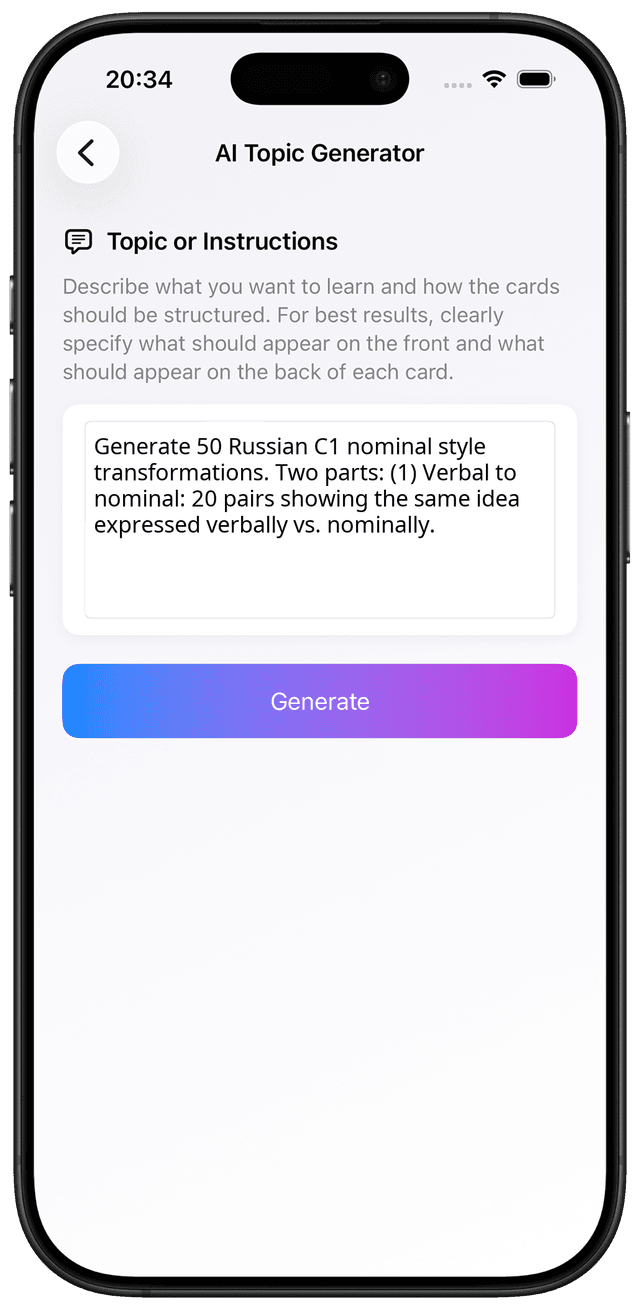
Generate 50 Russian C1 nominal style transformations. Two parts: (1) Verbal to nominal: 20 pairs showing the same idea expressed verbally vs. nominally. Examples: Правительство решило (verbal) vs. Решение правительства (nominal); Проект выполняется vs. Выполнение проекта. Include verbs: осуществлять, рассматривать, ограничивать, использовать, разрабатывать. (2) Complex nested clauses: 30 sentence examples from legal and academic Russian with nested relative clauses and extended participial phrases. Front: verbal form or nested clause. Back: nominal equivalent or analytical breakdown.
University study in Russian, the TORFL C1 exam, and professional communication all require command of specific text types: the рассуждение (discursive essay), the аргументированный ответ (structured argument), the резюме (summary), and formal correspondence. Each follows structural and lexical conventions that differ from general writing.
Why this comes next: Russian university study and the TORFL C1 writing module both test academic text production. Knowing the stock phrases for each text type, and the vocabulary specific to argumentation and summary, directly affects written scores.
The strategy: This deck covers the lexical and structural conventions of the main C1 Russian text types, with ready-to-use phrases for introduction, development, and conclusion that match the register examiners expect.
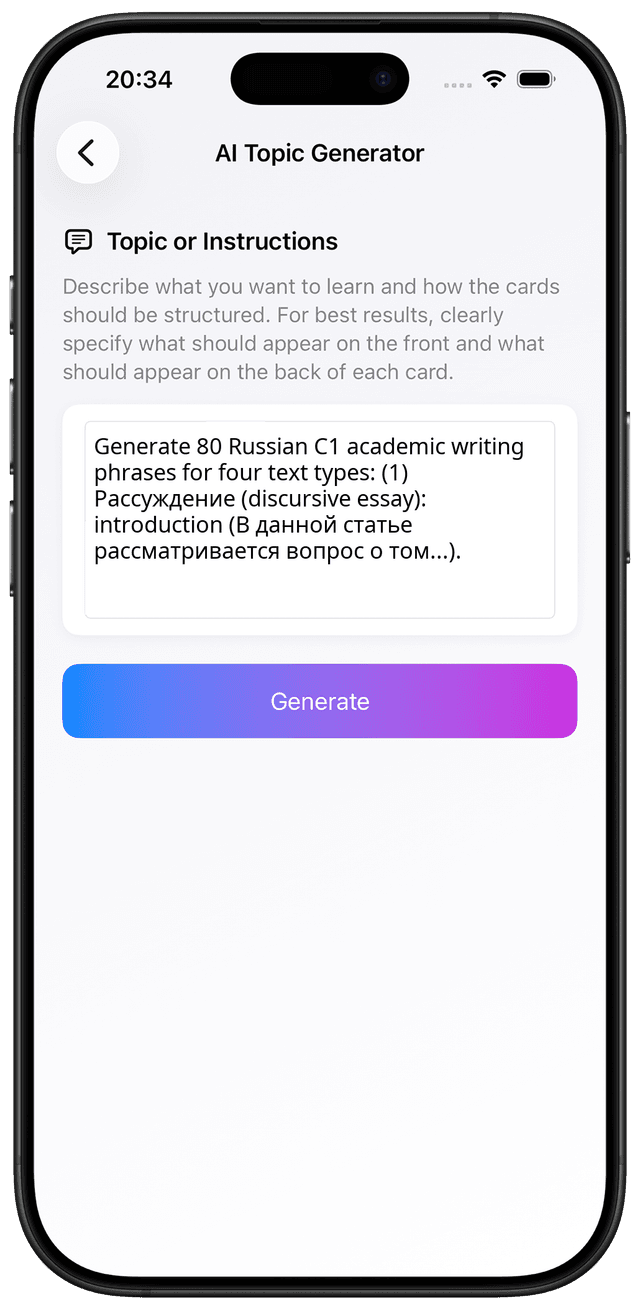
Generate 80 Russian C1 academic writing phrases for four text types: (1) Рассуждение (discursive essay): introduction (В данной статье рассматривается вопрос о том...), development (Весомым аргументом в пользу этого служит..., Вместе с тем нельзя не учитывать...), conclusion (Таким образом, можно констатировать что...). (2) Аргументированный ответ: По моему мнению..., Я придерживаюсь позиции что..., Представляется спорным утверждение о том что. (3) Резюме: В тексте рассматривается..., Автор приходит к выводу что..., Ключевая мысль состоит в том что. (4) Formal letters: В ответ на Ваш запрос..., Позвольте обратить Ваше внимание на..., С уважением. Front: Russian phrase. Back: English + text type label.
Professional and specialist communication in Russian requires vocabulary that general study does not cover. Legal Russian, business Russian, and the language of Russian public institutions each have their own terminology. Without it, working in a Russian-speaking environment or reading authentic specialist texts means constant workarounds.
The goal: To build the professional vocabulary that lets you operate in Russian-speaking work environments without workarounds. This phase covers the domains most commonly tested in TORFL C1 and appearing in Russian professional contexts: law, economics, administration, and media.
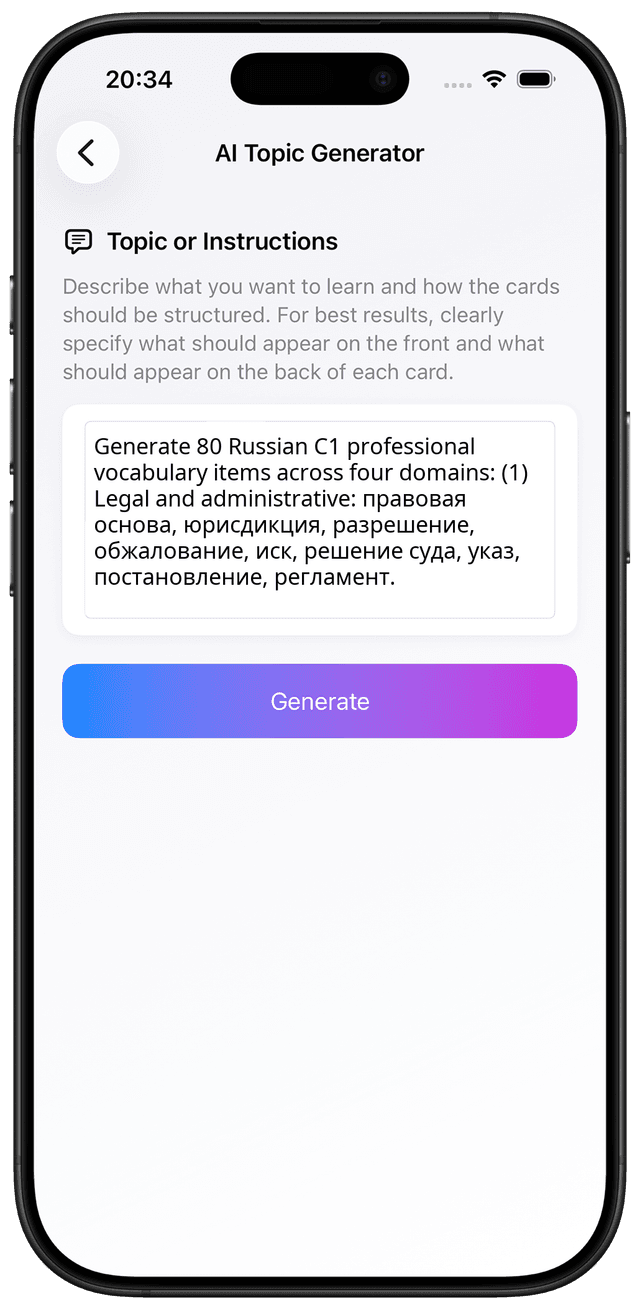
Generate 80 Russian C1 professional vocabulary items across four domains: (1) Legal and administrative: правовая основа, юрисдикция, разрешение, обжалование, иск, решение суда, указ, постановление, регламент, правомочный. (2) Economics and finance: валовый внутренний продукт, бюджетная политика, субсидия, погашение долга, инвестиционный коэффициент, торговый дефицит, капиталовложения, доходность. (3) Public administration: федеральный орган, подача заявления, решение, срок обжалования, официальный, административный, управленческое решение. (4) Media and communication: освещение событий, свобода прессы, медиапространство, журналистское расследование, формирование общественного мнения. Front: Russian term. Back: English + domain + example sentence.
Particles and pragmatic hedges are among the most difficult aspects of Russian for non-native speakers. Words like же, ведь, разве, неужели, мол, дескать, небось, and пожалуй appear throughout spoken and written Russian and fundamentally change the pragmatic force of an utterance. At C1 you are expected to understand and begin using them correctly. Getting particles right shifts your Russian from accurate to natural.
The C1 milestone: Completing this phase means your C1 vocabulary toolkit covers register variation, idioms, discourse structure, nominal style, academic writing, professional vocabulary, and pragmatic nuance. That is the full C1 communicative range for TORFL C1 and professional Russian use.
Looking ahead: C2 builds finer stylistic distinctions and deeper idiomatic range. The pragmatic control you build here is the foundation for C2 spoken authenticity and literary comprehension.
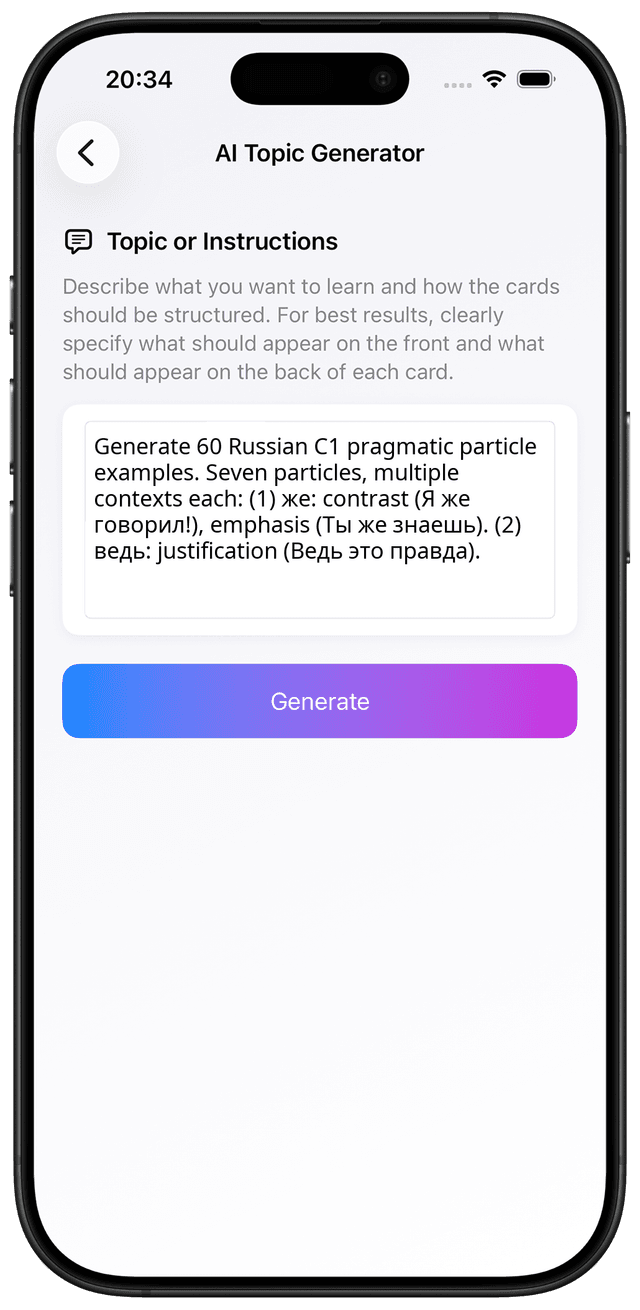
Generate 60 Russian C1 pragmatic particle examples. Seven particles, multiple contexts each: (1) же: contrast (Я же говорил!), emphasis (Ты же знаешь). (2) ведь: justification (Ведь это правда), appeal to shared knowledge (Ты ведь понимаешь). (3) разве: doubt (Разве это возможно?), rhetorical (Разве не так?). (4) неужели: disbelief (Неужели он пришёл?). (5) мол / дескать: reported speech marker (Он сказал мол устал). (6) небось: probability/informality (Небось устал). (7) пожалуй: hedged agreement (Пожалуй, ты прав). Front: Russian sentence with particle. Back: English + particle function label.
At C1 the vocabulary is more specialised and less predictable than at lower levels. Spaced repetition handles this directly: cards you find difficult appear more often, cards you know well drop back. You spend time where it counts. The same technique that builds A1 core words builds C1 idioms, register variants, and pragmatic particles.
C1 builds on B2 and prepares you for near-native C2 fluency. Use the links below to move between levels or return to the full Russian guide.
Build your Russian C1 vocabulary with AI-generated decks and spaced repetition that adapts to what you actually find difficult. Free to download. No account required. Start with the phase that covers your biggest gap.