
Spaced repetition explained
Why reviewing at the right interval is the key to retaining mastery-level Italian C2 vocabulary
You have C1 Italian. You read newspaper columns without effort, write a structured saggio, switch register between colloquial and formal in conversation. C2 is the next step: literary register on the page, fine semantic nuance in your word choice, idioms and proverbs that arrive on cue, and the cultural references that Italian public discourse takes for granted. The mental effort drops to zero.
This guide covers the 1,000+ vocabulary items that close the gap between advanced and near-native Italian. Literary register comes first, since it is the most visible marker of C2 reading. Then fine semantic nuance, lower-frequency modi di dire and proverbi, legal Italian for institutional contexts, stylistic and rhetorical figures for written production, scholarly discourse for the saggio, and the literary canon that contemporary Italian writers reach for as shared shorthand.
Each of the seven phases below includes a ready-to-use AI prompt. Paste it into MindCards and your first deck for that phase builds in seconds. Spaced repetition then schedules every card at the right interval, so your review time goes to the items you are actually forgetting. The whole guide is built for serious CELI 5 and CILS C2 candidates and for advanced learners working in Italian professionally.
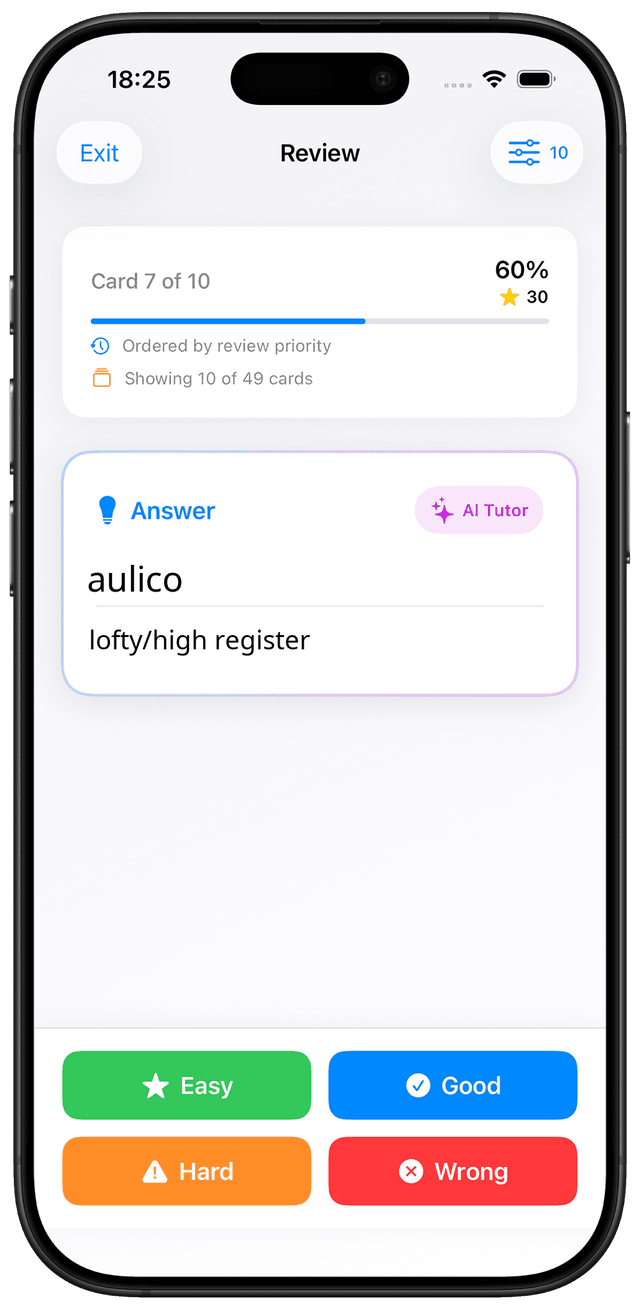
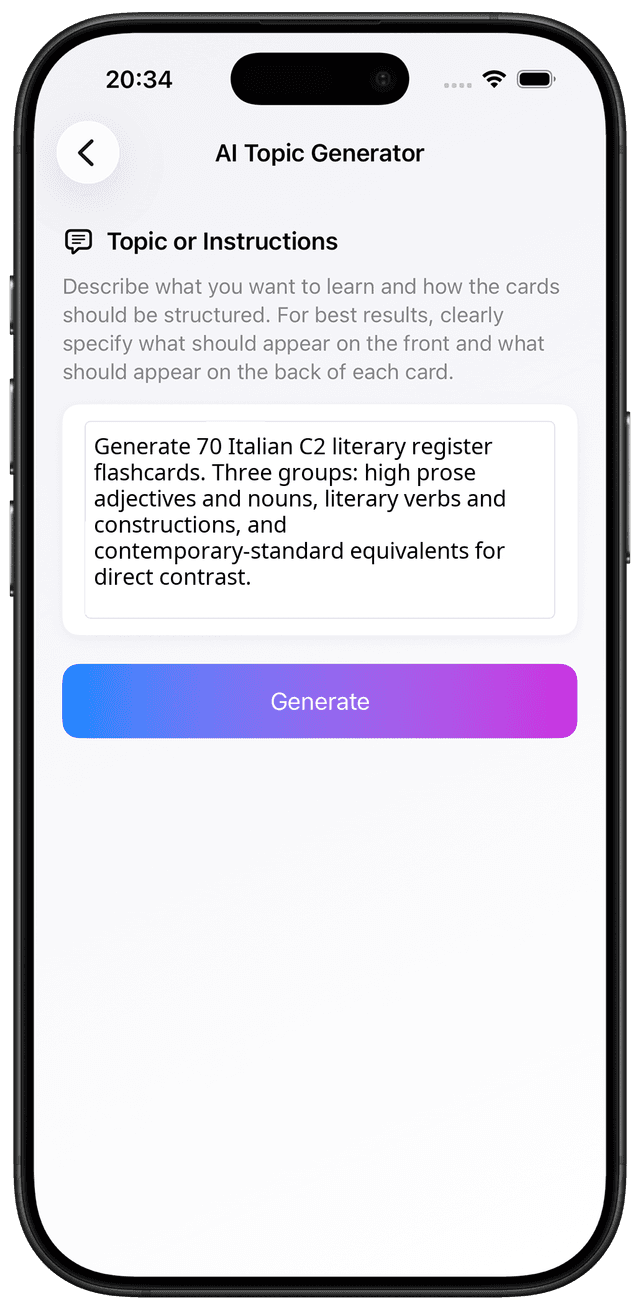
C2 Italian opens up a register that C1 only borders on. The vocabulary of Manzoni's prose, Calvino's essays, Ginzburg's novels, and Camilleri's narrative voice lives in a layer above formal standard Italian. Words like aulico, eloquio, austero, scarno, sommesso, dovizia, oblio, and pertugio appear constantly in serious Italian writing and rarely in everyday speech. Reading I promessi sposi or Se questo e un uomo without leaning on a dictionary depends on this vocabulary.
This is not academic vocabulary in the C1 sense. It is the literary register that Italian writers reach for to set tone, build atmosphere, and signal stylistic intent. A C1 reader follows the plot. A C2 reader follows the choices the author is making at the word level.
Why start here? Literary register is the most visible marker of C2 Italian reading. CELI 5 and CILS C2 reading sections pull from contemporary literary essays and journalism that assume this vocabulary. Without it, the texts feel thicker than they should.
The strategy: Each card pairs a literary item with a real passage from twentieth and twenty-first century Italian prose, plus a contemporary-standard equivalent so you feel the register gap directly.
Generate 70 Italian C2 literary register flashcards. Three groups: (1) High prose adjectives and nouns: aulico, austero, scarno, sommesso, scaltro, dovizia, oblio, pertugio, sgomento, brama, vituperio, fasto, retaggio, lascito. (2) Literary verbs and constructions: rammentare, soggiacere, ergersi, mestare, scrutare, indugiare, schermirsi, rimuginare, soppesare, vagheggiare. (3) Contemporary-standard equivalents for direct contrast: ricordare, sottostare, alzarsi, mescolare, osservare, esitare, pensare a fondo, valutare, sognare. Front: literary item + sentence from Manzoni, Calvino, Ginzburg, Camilleri, or similar. Back: contemporary equivalent + register note + author context.
Italian is rich in near-synonyms that share an English translation but carry sharply different shades. Capire and comprendere both translate as understand, but capire is immediate while comprendere implies depth and reflection. Guardare and osservare both translate as look, but osservare brings deliberate attention. Decidere and deliberare both translate as decide, but deliberare belongs to formal and institutional contexts. C2 is where you stop choosing between them by feel and start choosing by purpose.
These distinctions show up in writing more than in speech. A C2 writer picks the right verb the first time. A C1 writer often picks the more common option and reads as flatter than the source intended. CELI 5 and CILS C2 writing rubrics reward precise lexical choice within the same semantic field.
Why this matters: Lexical precision is the C2 marker that gives your written Italian voice. Native readers register the difference between paura and timore the moment they read it, even if they could not explain the rule.
The strategy: Cards present near-synonym sets in minimal-pair contexts so you build the choice habit, not just the vocabulary list.
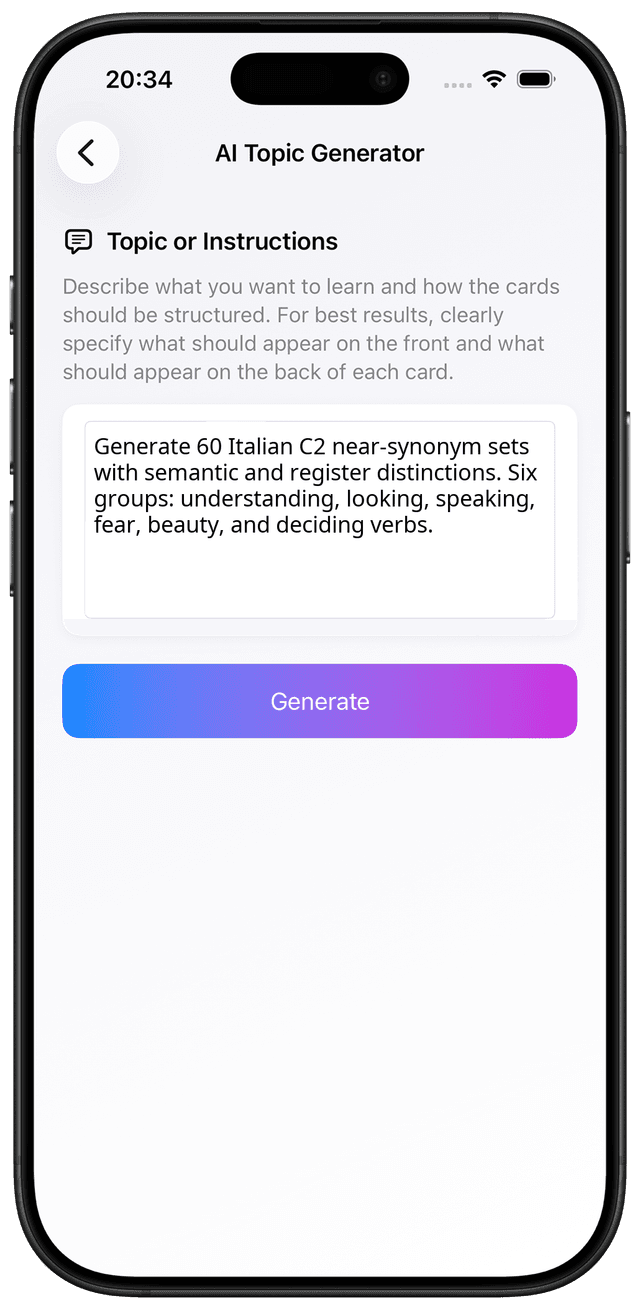
Generate 60 Italian C2 near-synonym sets with semantic and register distinctions. Six groups: (1) Understanding: capire, comprendere, intendere, afferrare, cogliere. (2) Looking: guardare, osservare, scrutare, fissare, contemplare. (3) Speaking: dire, affermare, sostenere, dichiarare, asserire, riferire. (4) Fear: paura, timore, sgomento, terrore, apprensione, inquietudine. (5) Beauty: bello, splendido, leggiadro, avvenente, grazioso, mirabile. (6) Deciding: decidere, deliberare, risolvere, statuire, determinare. Front: synonym set + a context sentence where one specific item fits. Back: English + which item fits why + register and emotional shade note.
C1 covers high-frequency Italian idioms in journalism and educated speech. C2 goes deeper: lower-frequency modi di dire that turn up in literature, theatre, and political commentary, plus the proverbi that native speakers pull out in conversation. Knowing that fare orecchie da mercante means to feign deafness on purpose, or that chi va piano va sano e va lontano carries a specific cultural sense of patience, is part of what separates C2 comprehension from C1 comprehension.
Italian proverbs come loaded with regional flavour. Tuscan, Neapolitan, Venetian, and Sicilian proverbs all show up in national writing. Using one well at the right moment is a mark of cultural fluency that no amount of grammar can fake. Using one wrong is worse than not using it at all.
Why this comes third: CELI 5 listening and reading sections regularly include idioms and proverbs presented without gloss. You either know them or you mishear the passage.
The strategy: The deck pairs each item with a real-use context, a literal meaning, and a pragmatic note on when a native speaker would actually deploy it.
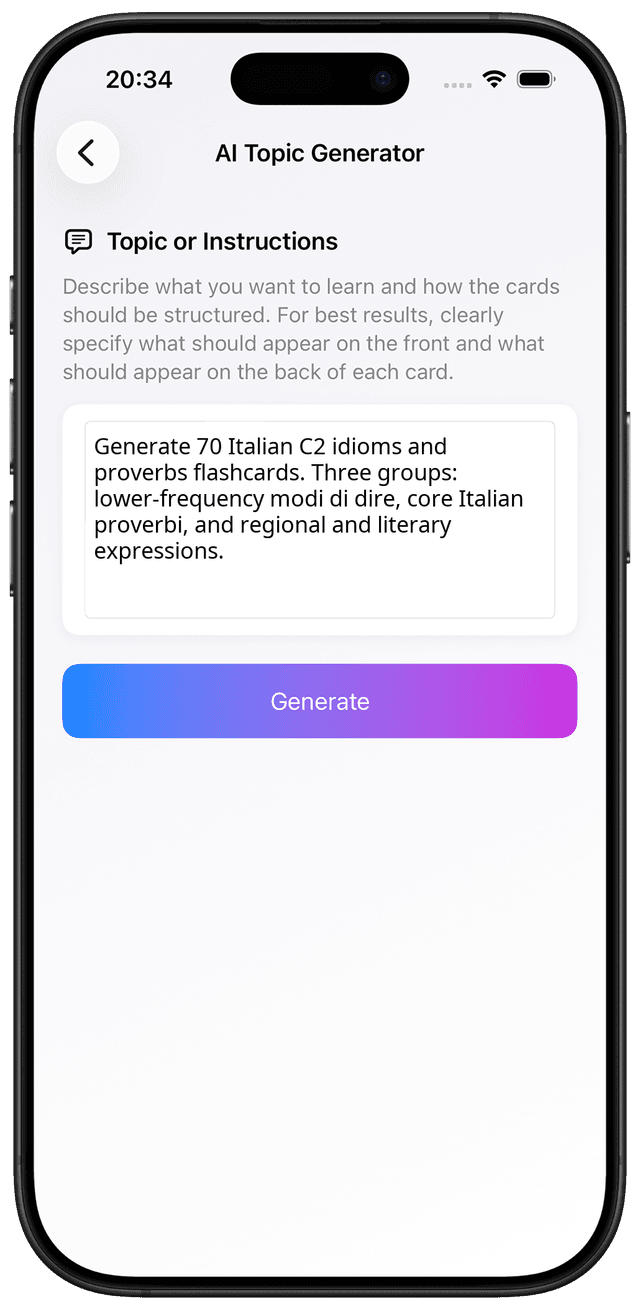
Generate 70 Italian C2 idioms and proverbs flashcards. Three groups: (1) Lower-frequency modi di dire: fare orecchie da mercante, prendere lucciole per lanterne, menare il can per l'aia, chiudere bottega, gettare la spugna, dare buca a qualcuno, fare di tutta l'erba un fascio, avere la coda di paglia, tagliare la testa al toro. (2) Core Italian proverbi: chi va piano va sano e va lontano, l'erba del vicino e sempre piu verde, chi dorme non piglia pesci, paese che vai usanza che trovi, a buon intenditor poche parole, non tutto il male vien per nuocere, tra il dire e il fare c'e di mezzo il mare. (3) Regional and literary expressions: piove sul bagnato, prendere fischi per fiaschi, fare il passo del gambero, raddrizzare le gambe ai cani. Front: expression + context sentence. Back: literal meaning + pragmatic use + when a native speaker would say it.
Italian law, public administration, and institutional writing share a vocabulary that almost never appears in everyday speech and almost always appears in legal texts, court documents, regulations, and serious journalism on legal matters. Working in Italy at a professional level, reading court decisions, dealing with notaries, or following political-judicial news requires real fluency in this register.
Legal Italian uses heavy subjunctive constructions, archaic conjunctions, and a vocabulary built largely from Latin roots: in ottemperanza a, in deroga a, ai sensi dell'articolo, a far data dal, fatto salvo, l'interessato, l'avente diritto, il dante causa. These structures look heavy at first read and become natural once you have seen the same forms across enough documents.
The goal: To turn legal Italian from a wall of text into a readable register. CILS C2 reading frequently includes legal and institutional passages, and a C2 speaker working in Italy will see this language regularly.
The strategy: Cards are grouped by document type so you build the cognitive frame as well as the vocabulary: court decision, statute, contract, public notice.
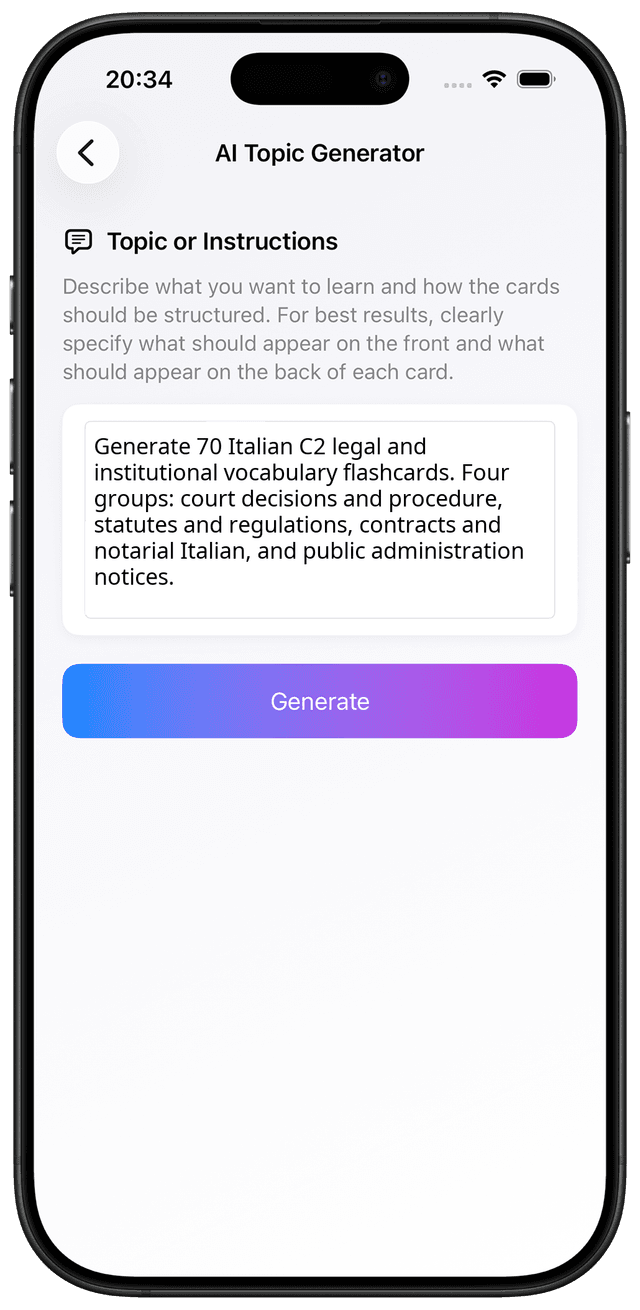
Generate 70 Italian C2 legal and institutional vocabulary flashcards. Four groups: (1) Court decisions and procedure: il giudice, la sentenza, il ricorrente, il convenuto, statuire, deliberare, rigettare il ricorso, accogliere la domanda, in via principale, in subordine, fermo restando che, nonostante quanto eccepito. (2) Statutes and regulations: ai sensi dell'articolo, in ottemperanza a, in deroga a, a far data dal, salvo diversa disposizione, fatto salvo, in conformita a, nei termini previsti. (3) Contracts and notarial Italian: le parti convengono, in forza del presente atto, l'interessato, l'avente diritto, il dante causa, sotto la propria responsabilita, da intendersi, e cura di. (4) Public administration and notices: l'amministrazione competente, il provvedimento, l'istanza, il diniego, l'accoglimento, decade dal diritto. Front: term or phrase + document context. Back: English equivalent + document type + register note.
CELI 5 and CILS C2 written production expect editorial-quality Italian. That means deliberate rhetorical figures, not flourishes. Antitesi to sharpen a contrast. Anafora to build rhythm. Domanda retorica to shift the reader. Climax to escalate. Litote to understate. In Italian opinion writing, journalism, and academic prose, these figures are expected tools. Their absence is what marks a text as competent but not C2.
C1 writers can produce a clean essay without rhetorical figures. C2 writers cannot. The absence itself reads as foreign once you are in this register. Italian assessors are reading for stylistic control as a separate criterion from grammar and lexical range.
Why this matters: CELI 5 and CILS C2 writing rubrics list stylistic control as an explicit scoring dimension. A grammatically perfect essay without rhetorical shape will not reach C2.
The strategy: Cards cover the rhetorical figures most common in Italian editorial and academic writing, each shown in a real example from Italian journalism or essays, with a note on when the figure strengthens an argument and when it tips into overreach.
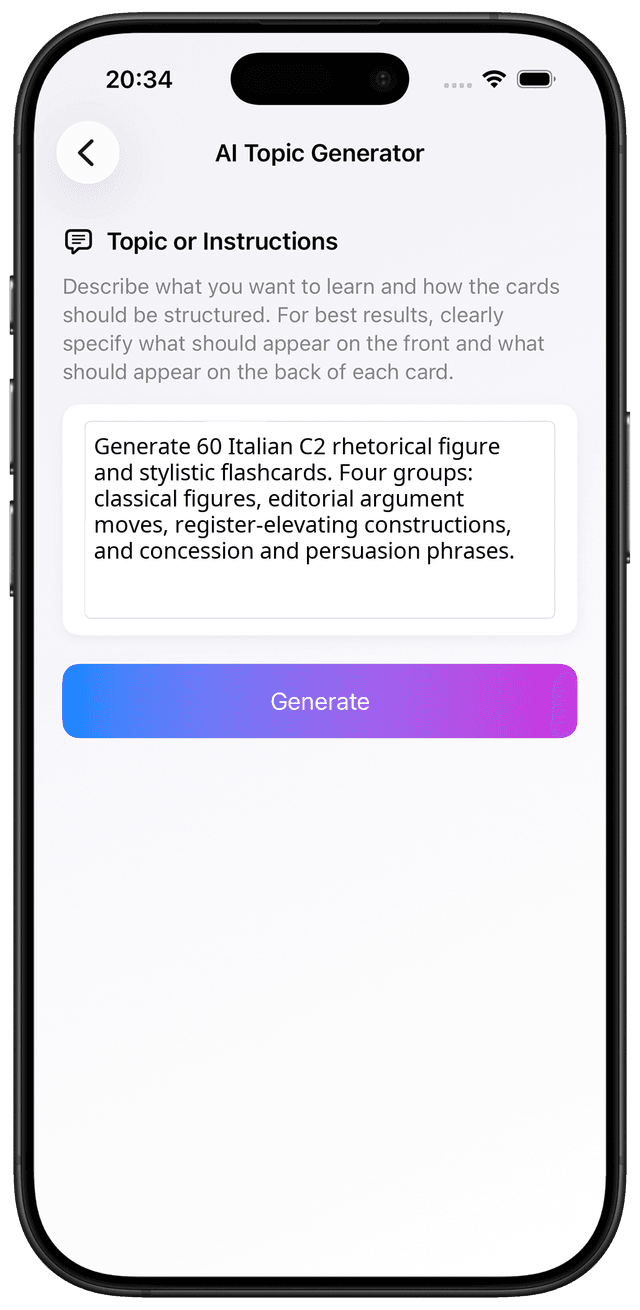
Generate 60 Italian C2 rhetorical figure and stylistic flashcards. Four groups: (1) Classical figures: l'antitesi, l'anafora, il climax, l'anticlimax, la litote, l'iperbole misurata, la sineddoche, l'ossimoro, il chiasmo, la perifrasi, l'allitterazione. (2) Editorial argument moves: se e vero che... non e meno vero che, occorre tuttavia rilevare che, e proprio qui che si gioca, cio che e in gioco, sarebbe ingenuo pensare che, non si tratta tanto di... quanto piuttosto di. (3) Register-elevating constructions: appare opportuno interrogarsi su, non e privo di significato che, vale la pena di soffermarsi su, in tutta franchezza, a ben vedere. (4) Concession and persuasion: anche il piu prudente osservatore dovra ammettere che, nessuna analisi onesta potrebbe ignorare che, e bene riconoscere che. Front: figure or phrase + Italian editorial example. Back: English explanation + rhetorical label + usage note.
Scholarly Italian has its own conventions. The CILS C2 saggio breve and the CELI 5 written tasks both expect you to handle academic register: framing a research question, presenting evidence, qualifying claims, and concluding with measured force. The vocabulary for this work is largely separate from journalistic Italian, even though both are formal.
Italian academic writing uses verbs like postulare, ipotizzare, corroborare, suffragare, confutare, problematizzare, contestualizzare, and ricondurre. It uses nominalised academic structures: la disamina, la trattazione, l'inquadramento teorico, l'approfondimento, la confutazione. It uses hedging constructions: parrebbe, si potrebbe sostenere, non e dato sapere, occorre cautela nel concludere. These are the moves that scholarly readers expect.
The goal: To give you the vocabulary and constructions that academic Italian uses by default. This is what separates a C2 saggio from a long C1 essay.
The strategy: Cards are grouped by the move they perform: framing, evidence, qualification, refutation, conclusion. Each card includes a sample sentence as it would appear in an Italian academic article.
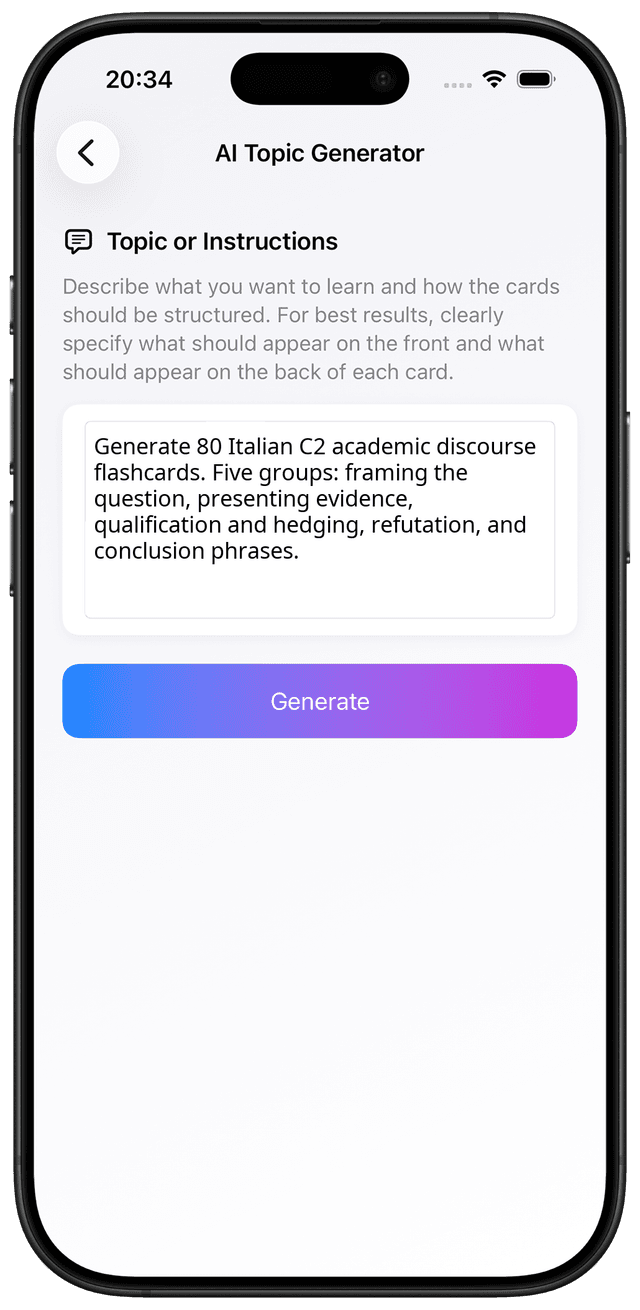
Generate 80 Italian C2 academic discourse flashcards. Five groups: (1) Framing and posing the question: la presente trattazione si propone di, occorre preliminarmente inquadrare, il quesito centrale verte su, ai fini della presente disamina, e opportuno premettere che. (2) Presenting evidence: i dati raccolti suffragano l'ipotesi che, le evidenze empiriche corroborano, e stato osservato in piu studi che, conformemente alle ricerche precedenti. (3) Qualification and hedging: parrebbe lecito sostenere che, occorre cautela nel concludere, non e dato stabilire con certezza, una lettura piu attenta suggerisce che. (4) Refutation: tale interpretazione non regge a un esame piu approfondito, occorre confutare l'idea secondo cui, e tesi smentita dai dati. (5) Conclusion: alla luce di quanto esposto, in ultima analisi, e lecito concludere che, le evidenze convergono nel sostenere. Front: phrase + academic context. Back: English equivalent + rhetorical function.
Italian literary culture is referential to a degree that surprises learners. Dante's Inferno is quoted in newspaper editorials. Manzoni's Don Abbondio shows up in political commentary as a stock figure for moral cowardice. Calvino's Lezioni americane and Eco's essays are reference points in everyday cultural discussion. Native speakers do not always recognise every reference, but they recognise the pattern: a phrase that lands a little differently is probably an allusion, and treating it as ordinary will misread the sentence.
C2 reading and listening tasks pull from this referential layer. A line from Dante repurposed in a column on Italian politics is meant to do work. Recognising the source, or at least recognising that there is a source, is part of the comprehension. This is also why C2 Italian feels culturally dense in a way C1 does not.
The C2 milestone: Once you can recognise the high-frequency literary references that Italian writers reach for, the cultural depth of CELI 5 and CILS C2 texts becomes accessible. You are not reading the source works for fun. You are recognising the way Italian public discourse layers them in.
The strategy: Cards cover the highest-frequency references from the Italian canon: Dante phrases that survive in everyday Italian, Manzoni characters and quotations that function as cultural shorthand, and modern reference points from Calvino, Eco, Pasolini, and Ginzburg.
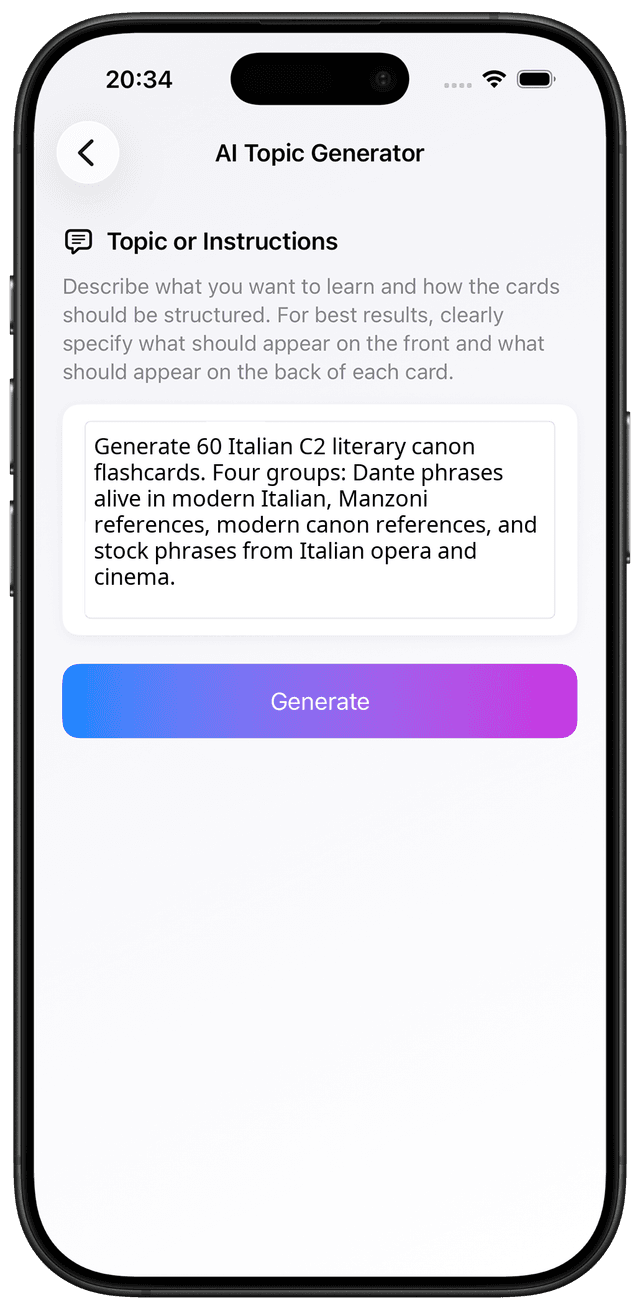
Generate 60 Italian C2 literary canon flashcards. Four groups: (1) Dante phrases alive in modern Italian: nel mezzo del cammin di nostra vita, lasciate ogni speranza voi ch'entrate, galeotto fu il libro, non ti curar di lor ma guarda e passa, fatti non foste a viver come bruti. (2) Manzoni references: don Abbondio (moral cowardice), l'Innominato (sudden conversion), Renzo e Lucia (the betrothed), questo matrimonio non s'ha da fare, la sventurata rispose, la peste manzoniana. (3) Modern canon references: Calvino's leggerezza, rapidita, esattezza, visibilita, molteplicita; Eco on the open work and semiotic codes; Pasolini on consumerism and dialect; Ginzburg's lessico famigliare. (4) Stock phrases from Italian opera and cinema: la commedia e finita, ridi pagliaccio, vissero felici e contenti. Front: phrase or reference + context where a modern Italian writer might use it. Back: source + cultural function + how to recognise the allusion.
At C2 the vocabulary that still trips you up is lower in frequency and more bound to context than at any earlier level. Spaced repetition handles this directly: the literary terms, proverbi, and legal phrases that keep slipping come back more often, the ones you have locked in quietly drop back. Your review time goes where it actually moves your Italian forward.
C2 builds directly on C1. Use the links below to review the prerequisite level or return to the full Italian guide.
Copy any prompt from this guide into MindCards and your first C2 deck is ready in seconds. No account needed. The app is free on iOS.