
Spaced repetition explained
Why reviewing at the right interval is the key to locking in advanced Italian C1 vocabulary
You have B2 Italian. You can read a newspaper article with effort, hold a conversation on familiar topics, and write a formal email. C1 is where that effort drops. Texts that required active decoding start arriving whole. You stop translating in your head and start understanding directly in Italian.
C1 covers roughly 6,000 to 8,000 words in active use. This guide focuses on the 1,500+ that actually move you forward at this level. The seven phases work through stylistic register control, idioms from journalism and professional speech, discourse markers for structured argument, nominal style for dense formal texts, academic writing conventions, professional vocabulary for work contexts, and pragmatic nuance for natural spoken Italian.
Each of the seven phases below includes a ready-to-use AI prompt. Paste it into the MindCards app and it generates a custom flashcard deck in seconds. Spaced repetition then schedules each card just before you are likely to forget it, so you retain more with less time reviewing.
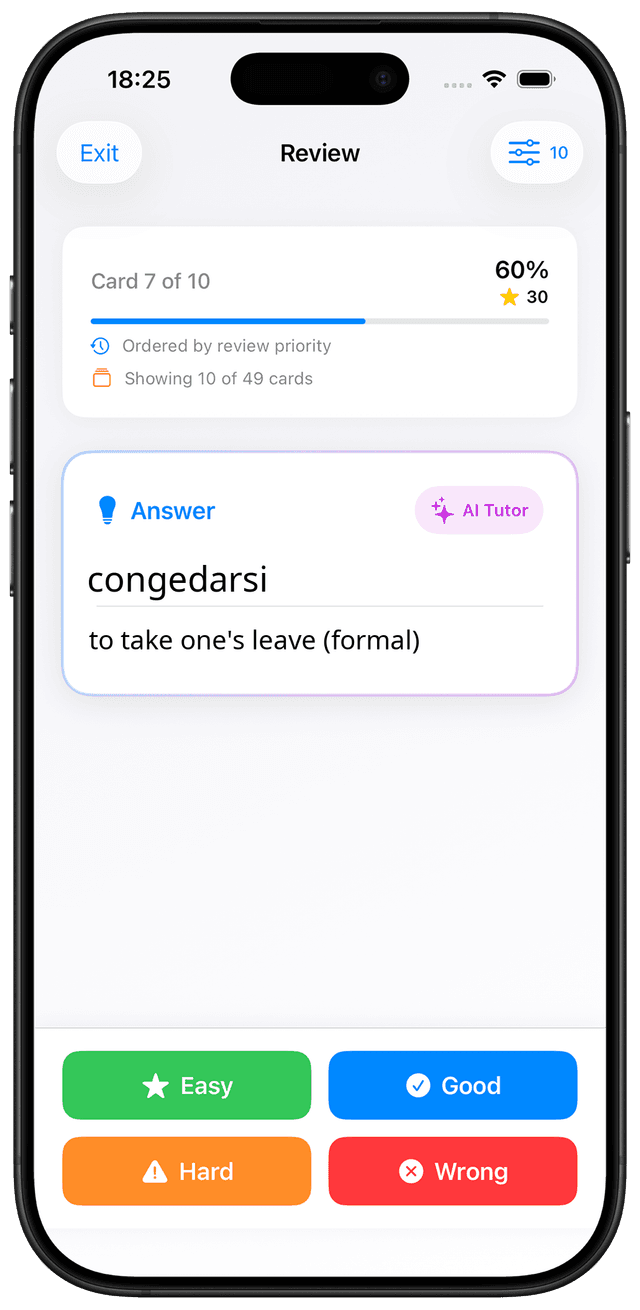
At C1, Italian divides sharply between registers in ways a B2 learner does not yet control automatically. The gap between colloquial spoken Italian and formal written prose is wider than you might expect. Switching between them deliberately, from familiare to aulico or burocratico, is a core C1 competence. A B2 speaker knows that andarsene and congedarsi both express leaving. A C1 speaker chooses between them because the context demands it.
Italian register variation shows up in word choice, but also in syntax. Colloquial Italian drops subject pronouns freely, uses che as a general connector, and prefers shorter sentences. Formal written Italian uses explicit subjects, complex subordinate structures, and nominalisations. Getting this right matters in professional email, academic writing, and any formal public communication in Italian.
Why start here? Register control is what makes C1 Italian sound native rather than just correct. Without it, you can be grammatically accurate and still sound foreign in every formal context.
The strategy: This deck pairs colloquial, neutral, and formal variants of the same idea so you build the habit of register-switching at the word and sentence level.
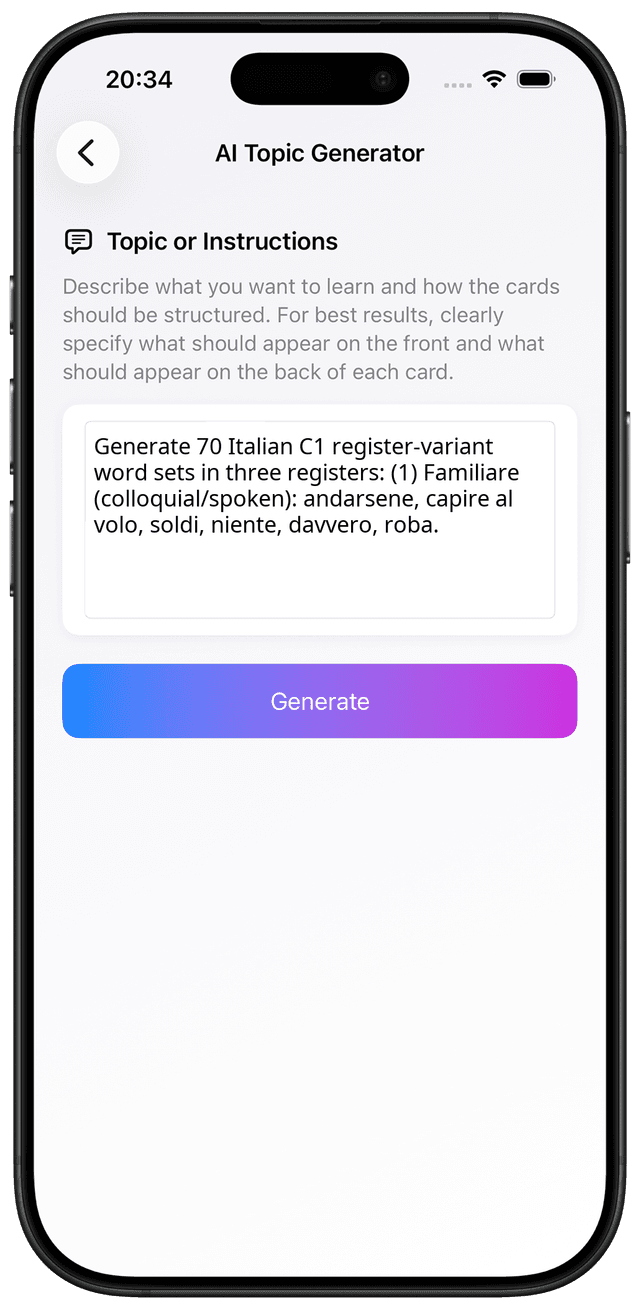
Generate 70 Italian C1 register-variant word sets in three registers: (1) Familiare (colloquial/spoken): andarsene, capire al volo, soldi, niente, davvero, roba. (2) Standard/neutral: partire, capire, denaro, nulla, veramente, cosa. (3) Formale/aulico: congedarsi, comprendere pienamente, risorse finanziarie, alcunche, effettivamente, questione. Group by semantic category: departure, understanding, money, negation, emphasis, topic. Front: Italian colloquial form. Back: standard + formal equivalents with register label.
Italian idioms appear in journalism, political speech, literary commentary, and ordinary conversation between educated speakers. Missing them means misreading the tone and sometimes the content. Knowing that avere le mani in pasta means to be deeply involved, or that non vedere l'ora literally means something quite different from its actual use (to look forward to), is part of what C1 Italian comprehension requires.
The CELI C1 exam tests idiom comprehension in reading and listening sections. In professional contexts, an idiomatic phrase missed or misused can change the meaning of a document or a conversation entirely.
Why this matters: Italian idioms are not optional at C1. They are the texture of the language at the level where native speakers operate.
The strategy: This deck covers 60 high-frequency Italian idioms grouped by theme, each shown in a real sentence so you learn the usage, not just the definition.
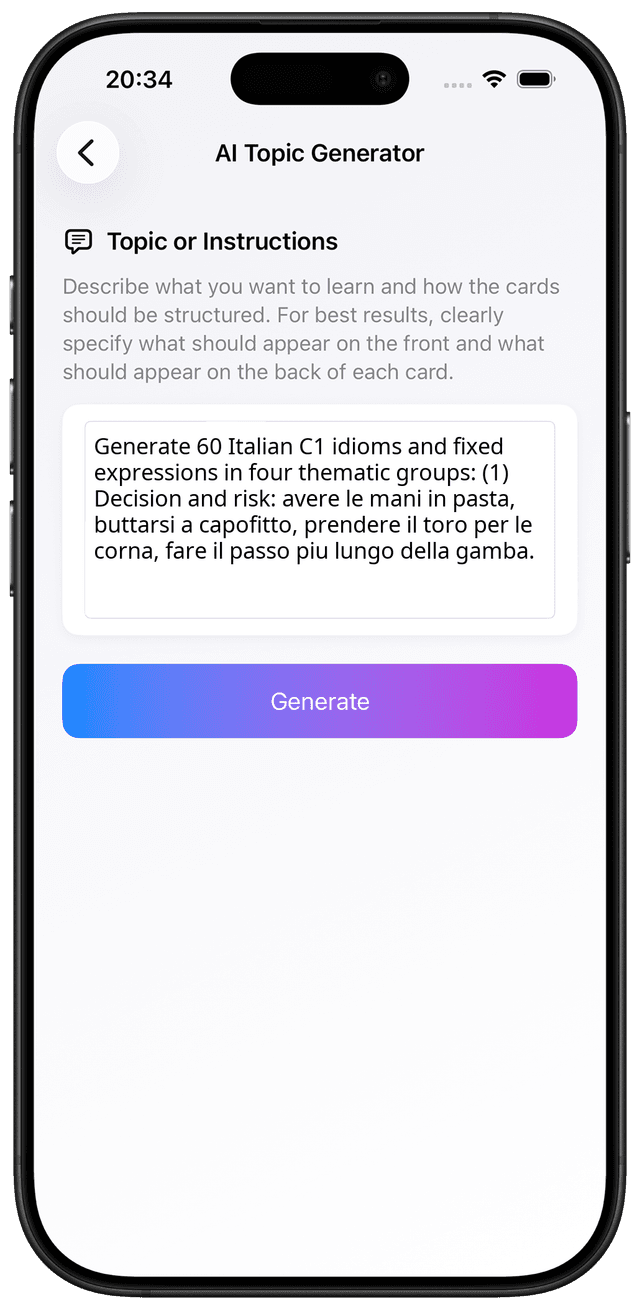
Generate 60 Italian C1 idioms and fixed expressions in four thematic groups: (1) Decision and risk: avere le mani in pasta, buttarsi a capofitto, prendere il toro per le corna, fare il passo piu lungo della gamba. (2) Communication and honesty: non avere peli sulla lingua, parlare chiaro e tondo, girare intorno al problema, dire pane al pane. (3) Success and difficulty: cavarsela, farcela, essere alle strette, non essere acqua fresca. (4) Time and urgency: non vedere l'ora, in quattro e quattr'otto, perdere tempo prezioso, all'ultimo momento. Front: Italian idiom. Back: literal meaning + actual meaning + example sentence.
C1 written and spoken Italian is expected to handle complex argument structure: presenting a position, qualifying it, conceding counter-evidence, and drawing a clear conclusion. B2 teaches the basic connectors. C1 requires the precise markers that signal logical relationships between clauses and paragraphs in formal prose. Without them, your Italian reads as a sequence of statements rather than an argument.
Italian journalism and academic prose use connectors that rarely appear in B2 textbooks. Ciononostante, a tal proposito, premesso che, ne consegue che, in ultima analisi, e altrettanto vero che are all structures that distinguish C1 writing from B2 writing.
Why this comes third? The CELI C1 writing module requires structured essays and formal opinions. Discourse markers give your writing the shape of an argument. Without them, even a grammatically correct essay fails on cohesion.
The strategy: This deck covers C1-level Italian discourse markers organised by argumentative function, each shown in a complete sentence.
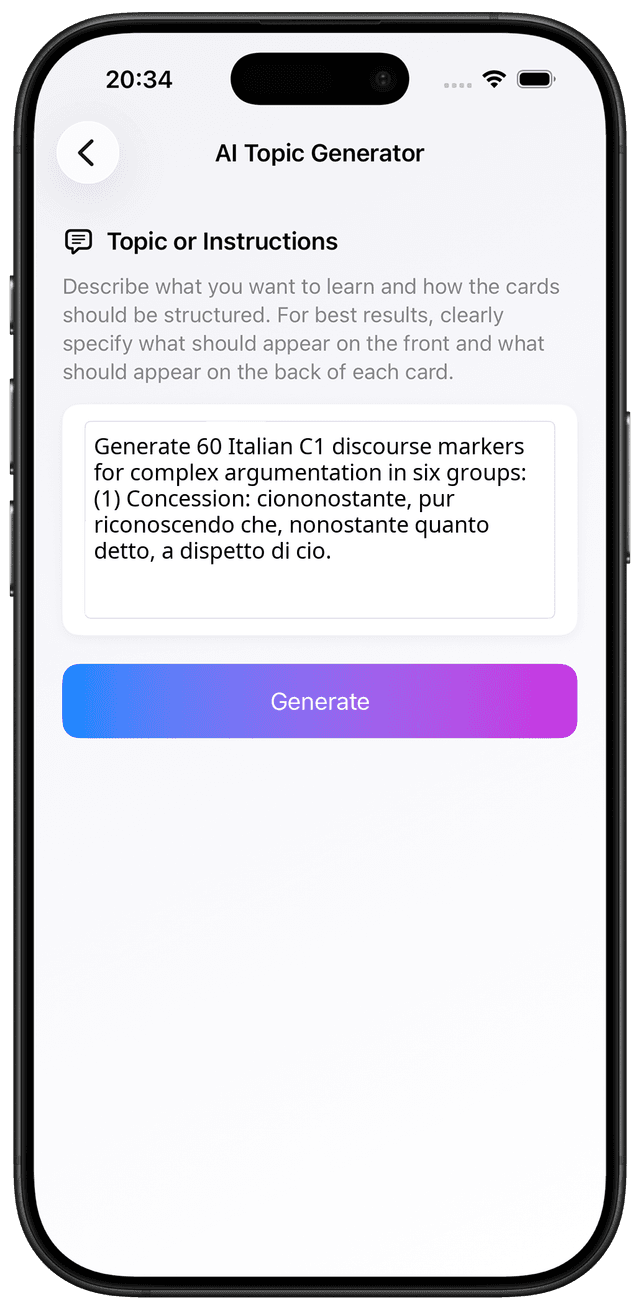
Generate 60 Italian C1 discourse markers for complex argumentation in six groups: (1) Concession: ciononostante, pur riconoscendo che, nonostante quanto detto, a dispetto di cio. (2) Logical consequence: ne consegue che, per tale ragione, di rimando, da cio deriva. (3) Clarification: in altri termini, vale a dire, piu precisamente, detto altrimenti. (4) Contrast: per contro, d'altro canto, tuttavia occorre rilevare che, al contrario di quanto. (5) Emphasis: soprattutto, in particolar modo, non da ultimo, e opportuno sottolineare. (6) Conclusion: in ultima analisi, alla luce di quanto esposto, in definitiva, a conclusione di. Front: Italian discourse marker + example sentence. Back: English + function label.
Italian formal prose, particularly in academic, legal, and journalistic contexts, relies on nominalisations. Ideas that colloquial Italian expresses through verbs appear as nouns and noun phrases in formal writing. La decisione del governo instead of il governo ha deciso. L'incremento della produttivita instead of la produttivita e incrementata. This compression is the default mode of formal Italian, and reading it fluently requires familiarity with it.
Embedded relative clauses and gerundive constructions also mark formal Italian. Constructions like trattandosi di una questione complessa, avendo considerato tutte le variabili, and tenendo conto dei dati disponibili are standard in reports, legal texts, and academic papers. Understanding them passively and using them actively are both C1-level skills.
Why is this essential? Reading a government notice, an insurance contract, or a university syllabus in Italian requires this style. Without it, C1 texts feel difficult even when you know every individual word.
The strategy: This deck drills verbal-to-nominal transformations and builds comprehension of complex embedded structures.
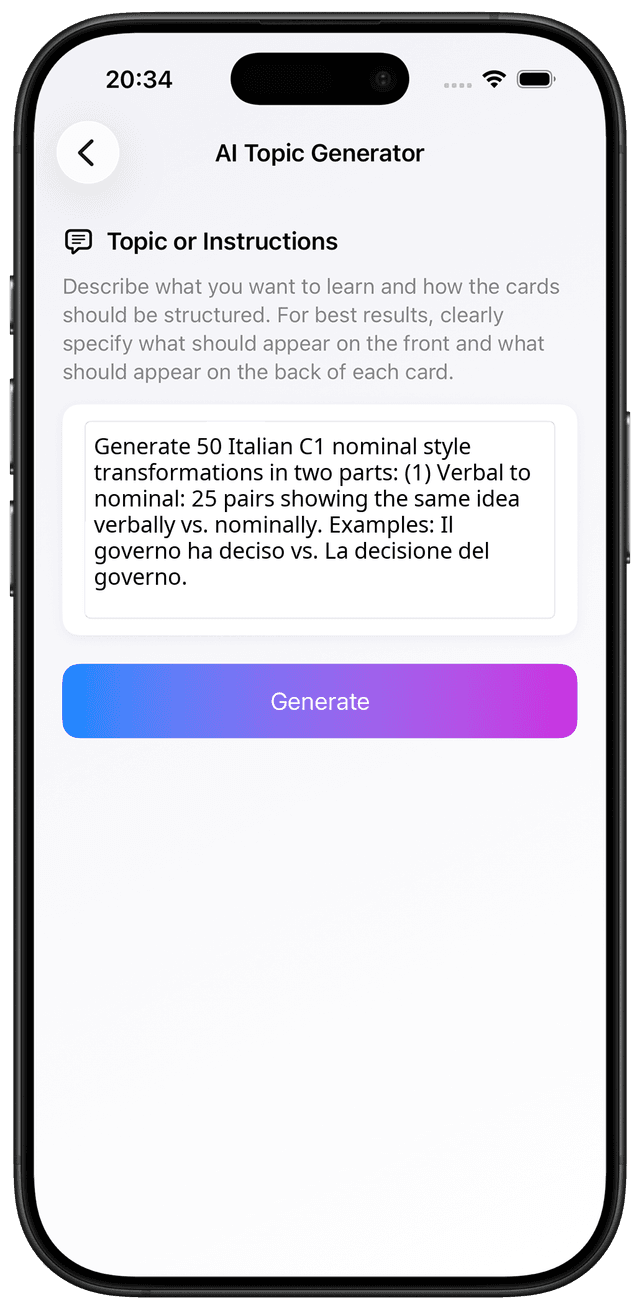
Generate 50 Italian C1 nominal style transformations in two parts: (1) Verbal to nominal: 25 pairs showing the same idea verbally vs. nominally. Examples: Il governo ha deciso vs. La decisione del governo; Si prevede un aumento vs. L'incremento previsto; L'azienda ha ridotto i costi vs. La riduzione dei costi aziendali. Include verbs: aumentare, ridurre, migliorare, garantire, promuovere, individuare, rafforzare. (2) Complex gerundive and participial clauses: 25 examples from legal and academic Italian with embedded relative clauses and gerundive phrases. Front: verbal form or embedded clause. Back: nominal equivalent or analytical breakdown.
University study in Italian, the CELI C1 exam, and professional communication at C1 all require command of specific text types. The saggio argomentativo (argumentative essay), the relazione (report), the lettera formale (formal letter), and the commento critico (critical commentary) each have structural and lexical conventions. Knowing these conventions is a scoring factor in written exams.
Italian academic writing has its own vocabulary. Verbs like argomentare, corroborare, confutare, approfondire, e sintetizzare belong to this register. So do the nominalised forms of academic reasoning: l'analisi, la valutazione, la dimostrazione, la contestualizzazione. Italian academic prose also favours passive constructions and impersonal forms: si osserva che, risulta evidente che, e stato dimostrato da.
Why this comes next: CELI C1 writing tasks test formal register, text-type conventions, and lexical range all at once. This phase covers the phrases and vocabulary that directly affect your written score.
The strategy: This deck covers the lexical and structural conventions of the main C1 text types, with ready-to-use phrases for introduction, development, and conclusion.
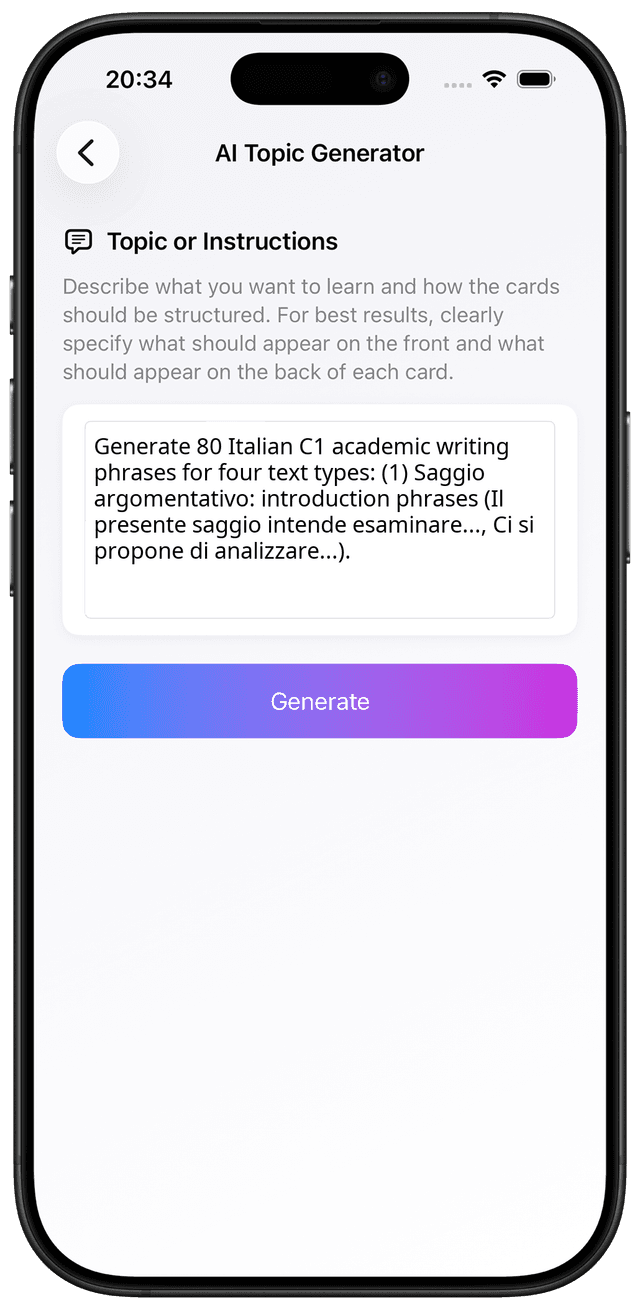
Generate 80 Italian C1 academic writing phrases for four text types: (1) Saggio argomentativo: introduction phrases (Il presente saggio intende esaminare..., Ci si propone di analizzare...), development (Un argomento fondamentale a sostegno di..., Occorre tuttavia rilevare che..., Si puo obiettare che...), conclusion (Alla luce di quanto analizzato..., In conclusione si puo affermare che...). (2) Relazione: Il presente documento ha lo scopo di..., I dati raccolti indicano che..., Si raccomanda pertanto di... (3) Lettera formale: Con riferimento alla Sua del..., La presente per comunicare che..., Rimanendo a disposizione per ulteriori chiarimenti... (4) Commento critico: Il testo si propone di..., L'autore sostiene che..., Un aspetto problematico e rappresentato da... Front: Italian phrase. Back: English + text type label.
Legal Italian, business Italian, and the vocabulary of Italian public institutions all have their own terminology. Working in Italy at a professional level, reading authentic specialist texts, or navigating Italian bureaucracy requires this domain-specific vocabulary that B2 does not systematically cover.
Italian professional language has some distinctive features. Legal texts use subjunctives extensively. Business communication relies on nominalised verbs: l'approvvigionamento, la rendicontazione, la valorizzazione. Bureaucratic Italian uses impersonal passive constructions: viene comunicato che, e fatto divieto di, si dispone che. Each domain has fixed formulas that native speakers recognise immediately.
The goal: To build the professional vocabulary that lets you operate in Italian-speaking work environments without reaching for workarounds. This phase covers the domains most commonly tested in CELI C1 and Torino University Italian as a Foreign Language exams.
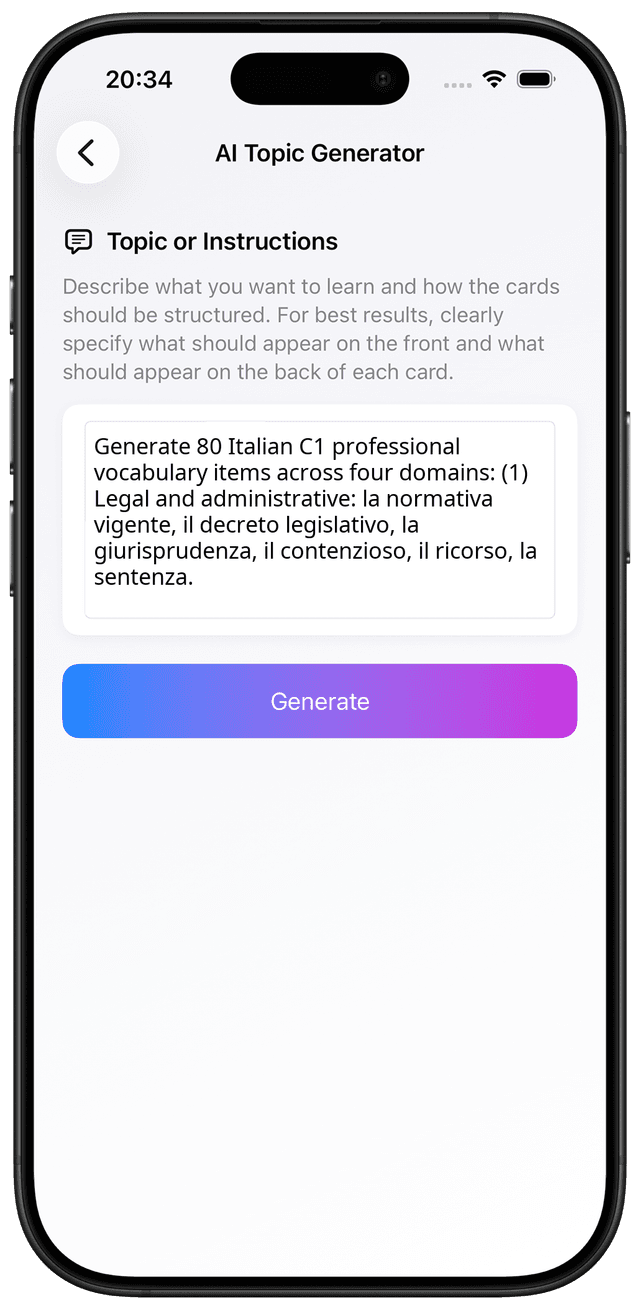
Generate 80 Italian C1 professional vocabulary items across four domains: (1) Legal and administrative: la normativa vigente, il decreto legislativo, la giurisprudenza, il contenzioso, il ricorso, la sentenza, l'ente pubblico, il bando di concorso, la procedura d'appalto, il codice civile. (2) Economics and finance: il fatturato, il bilancio, la liquidita, il piano industriale, la rendicontazione, l'approvvigionamento, il margine operativo, il capitale circolante. (3) Public administration: la delibera comunale, l'ufficio competente, la modulistica, il rilascio del nulla osta, la presa d'atto, la conferenza di servizi, il dirigente responsabile. (4) Media and communication: la rassegna stampa, il servizio giornalistico, l'inviato speciale, la redazione, il commento editoriale, la trasmissione in diretta. Front: Italian term. Back: English + domain + example sentence.
Italian has a rich set of modal and pragmatic expressions that non-native speakers typically underuse. Words and constructions like mica, magari, pur di, figurarsi, semmai, addirittura, and ci mancherebbe altro carry specific pragmatic weight. They appear in nearly every natural Italian conversation and change the register, the degree of certainty, and the speaker's stance significantly. Getting these right is what shifts your Italian from accurate to natural.
Italian also uses the conditional and subjunctive for pragmatic softening in ways that go beyond their grammatical function. Vorrei sapere is softer than voglio sapere. Potrebbe essere is hedged in a way che potrebbe non means. At C1 you understand and deploy these distinctions automatically rather than stopping to calculate them.
The C1 milestone: Completing this phase means your C1 vocabulary covers register control, idioms, discourse structure, nominal style, academic writing, professional vocabulary, and pragmatic nuance. That is the full C1 communicative range for CELI C1, PLIDA C1, and professional Italian.
Looking ahead: C2 builds finer literary distinctions and a deeper idiomatic range. The pragmatic control you build here is the foundation for C2 spoken authenticity.
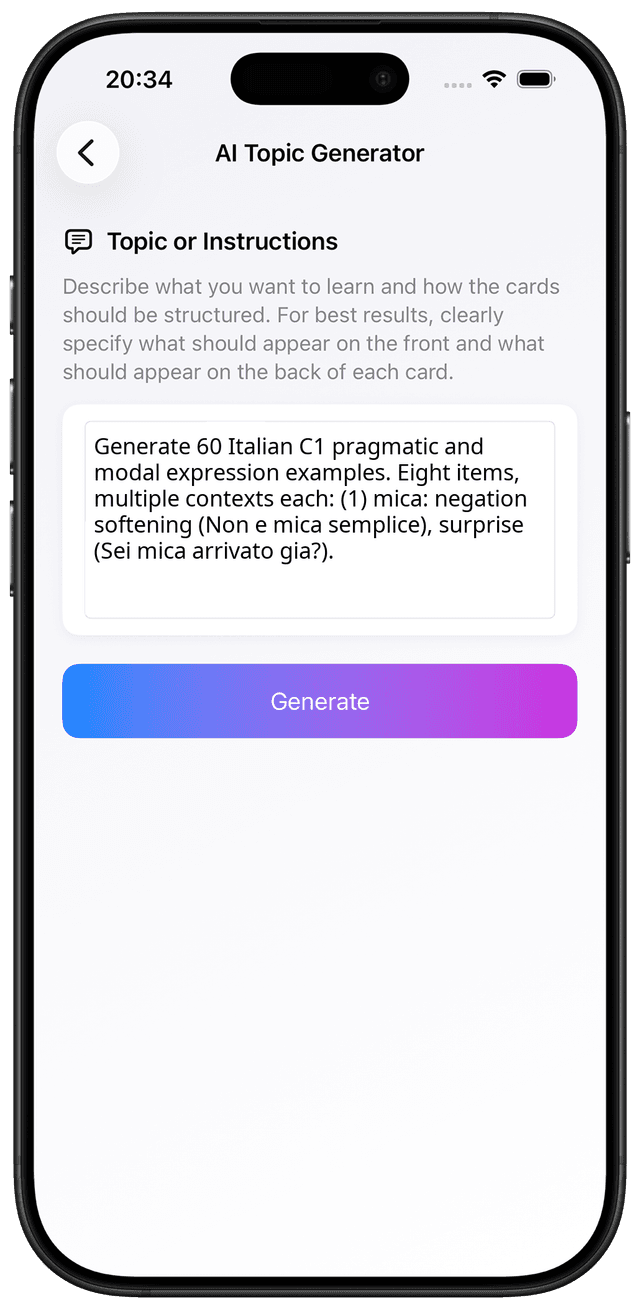
Generate 60 Italian C1 pragmatic and modal expression examples. Eight items, multiple contexts each: (1) mica: negation softening (Non e mica semplice), surprise (Sei mica arrivato gia?). (2) magari: wish (Magari potessi venire), possibility (Magari ha ragione). (3) pur di: in order to at any cost (Farebbe qualsiasi cosa pur di riuscire). (4) figurarsi: strong negation/emphasis (Se non lo sa lui, figurarsi noi). (5) semmai: correction (Semmai il problema e un altro). (6) addirittura: even more than expected (E addirittura peggiorato). (7) ci mancherebbe: of course not/naturally (Ci mancherebbe altro che protestasse). (8) Conditional and subjunctive for softening: Vorrei sapere vs. Voglio sapere; Potrebbe essere vs. E; Sarebbe opportuno vs. E necessario. Front: Italian sentence with pragmatic item. Back: English + pragmatic function label.
At C1 the vocabulary is more specialised and less predictable than at lower levels. Spaced repetition handles this directly: cards you find difficult appear more often, cards you know well drop back. You spend time where it counts. The same technique that builds A1 words builds C1 idioms and pragmatic expressions.
C1 builds on B2 and prepares you for near-native C2 fluency. Use the links below to move between levels or return to the full Italian guide.
Build your Italian C1 vocabulary with AI-generated decks and spaced repetition that adapts to what you actually find difficult. Free to download. No account required. Start with the phase that covers your biggest gap.