
Spaced repetition explained
Why reviewing at the right interval makes Italian B1 grammar stick
You have the A2 foundation. Now build the Italian that lets you hold a real conversation, follow the news, and write a structured argument. B1 is where you move from managing a conversation to actually participating in one, and the gap comes down mostly to three grammar structures: the Congiuntivo, the Condizionale, and indirect speech.
B1 covers roughly 1,500 to 2,000 words and structures. Not all of them matter equally. This guide focuses on the ones that come up most often in the CELI B1 exam and in everyday Italian conversation: the trigger phrases that introduce the Congiuntivo, the se-clause patterns that use the Condizionale, the discourse connectors that give your writing structure, and topic-specific vocabulary for work, society, and Italian culture.
Each phase includes a ready-to-use AI prompt. Copy it into MindCards and you get a focused deck built around real B1 Italian. The app handles spaced repetition from there, scheduling reviews at the interval that keeps each word in memory without overloading your study sessions.
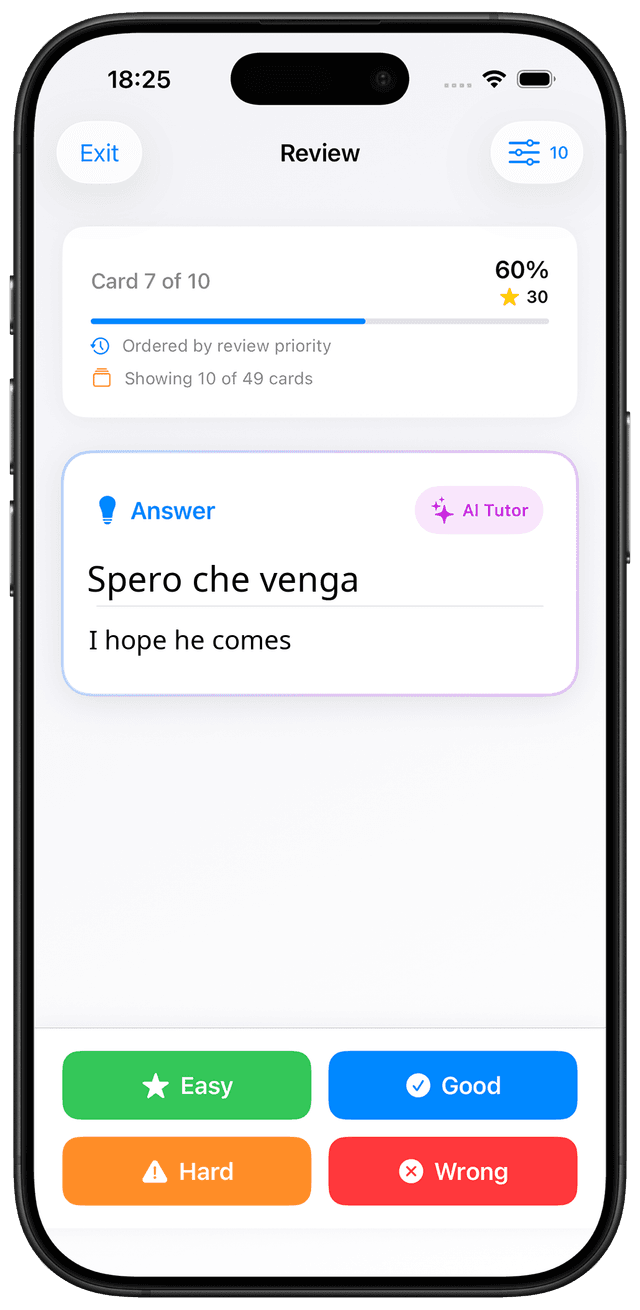
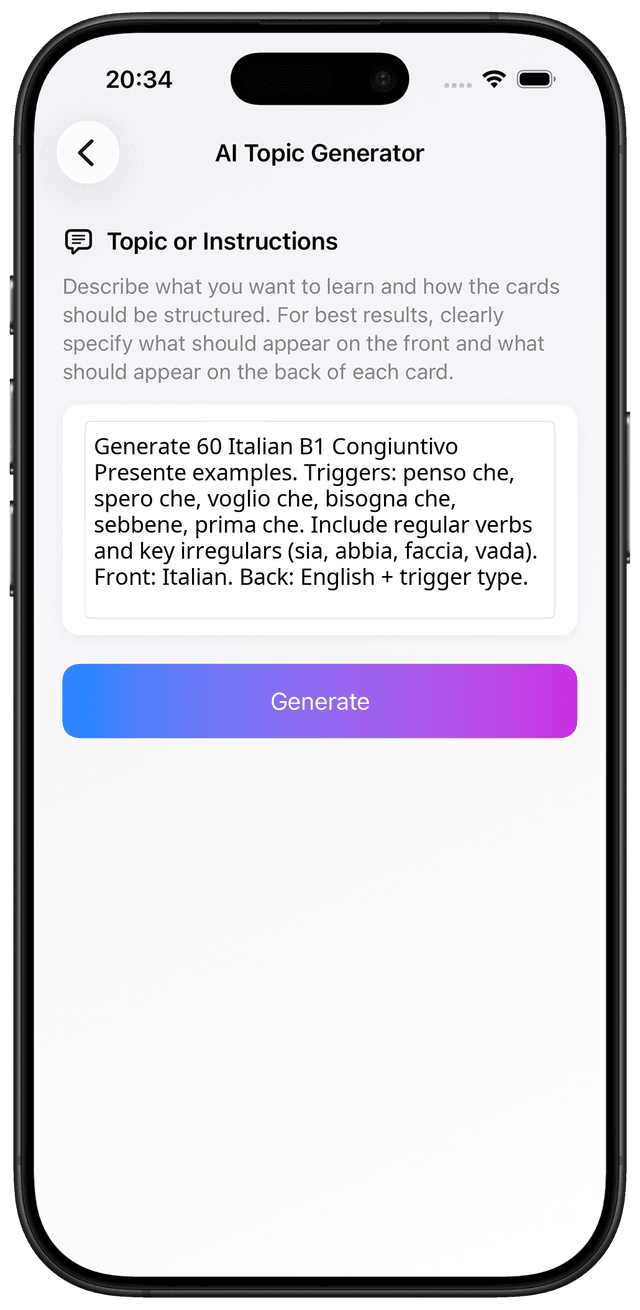
The Congiuntivo is the mood Italians use when expressing doubt, hope, fear, opinion, and necessity. It follows trigger phrases like penso che, spero che, voglio che, bisogna che, and sebbene. English has largely abandoned the subjunctive in everyday speech, which is why Italian learners find the Congiuntivo confusing at first. The pattern is clearer than it looks: the same cluster of trigger verbs almost always introduces it.
The present Congiuntivo has regular patterns for -are, -ere, and -ire verbs, but a handful of common verbs are irregular: essere becomes sia, avere becomes abbia, fare becomes faccia, andare becomes vada, venire becomes venga, sapere becomes sappia. These six form the core of the irregular group and appear constantly in real speech.
Why start here? The Congiuntivo is the single grammar structure that most clearly separates B1 Italian from A2 Italian. CELI B1 writing tasks regularly ask you to express opinions and conditions, and both require it.
The strategy: This deck pairs each trigger phrase with a complete example sentence so you learn the Congiuntivo in the context where it actually appears, not as a conjugation table you have to consciously recall.
Generate 60 Italian B1 examples of the Congiuntivo Presente. Include 10 trigger phrases (penso che, spero che, voglio che, bisogna che, sebbene, benche, nonostante, affinche, prima che, a meno che) each used with 3-4 sentences. Cover both regular verbs (-are/-ere/-ire patterns) and key irregulars (sia, abbia, faccia, vada, venga, sappia). Front: Italian sentence with the trigger phrase. Back: English + name of the trigger type.
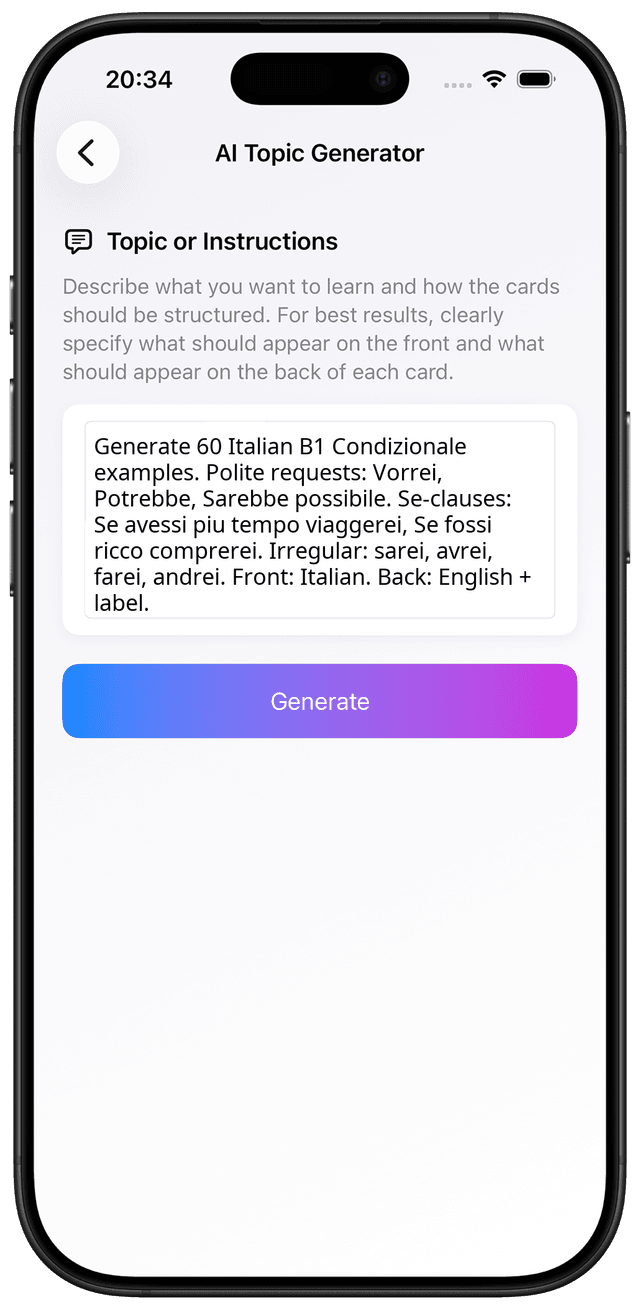
The Condizionale is Italian's conditional mood, covering two main uses: hypothetical statements and polite requests. For polite requests, the Condizionale replaces blunt present-tense demands in restaurants, shops, and offices. Vorrei instead of Voglio. Potrebbe instead of Puo. Getting this register right makes a real practical difference when you are interacting with native Italian speakers in formal or semi-formal situations.
The hypothetical use pairs the Condizionale with the Congiuntivo Imperfetto in se-clauses. Se avessi piu tempo, viaggerei di piu. Se fossi italiano, vivrei a Roma. The se-clause uses the Congiuntivo Imperfetto (avessi, fossi, potessi), and the main clause uses the Condizionale Presente (viaggerei, vivrei, potrei). This combination is tested in every CELI B1 writing prompt that asks about plans, wishes, or hypothetical scenarios.
Why the Condizionale next? After the Congiuntivo, the Condizionale is the structure that Italian speakers notice most when it is missing. Combining the two unlocks hypothetical conversations and formal registers at the same time.
The strategy: This deck covers Condizionale Presente conjugations for regular and irregular verbs, the se-clause construction with Congiuntivo Imperfetto, and a set of polite request patterns you can use immediately.
Generate 60 Italian B1 Condizionale examples. Include: 15 polite request sentences (Vorrei, Potrebbe, Sarebbe possibile, Mi potrebbe aiutare?), 20 hypothetical se-clauses pairing Congiuntivo Imperfetto + Condizionale (Se avessi piu tempo, viaggerei; Se fossi ricco, comprerei), and irregular Condizionale forms (essere: sarei, avere: avrei, fare: farei, andare: andrei, venire: verrei, potere: potrei, dovere: dovrei, sapere: saprei, volere: vorrei). Front: Italian. Back: English + usage label (Polite / Hypothetical).
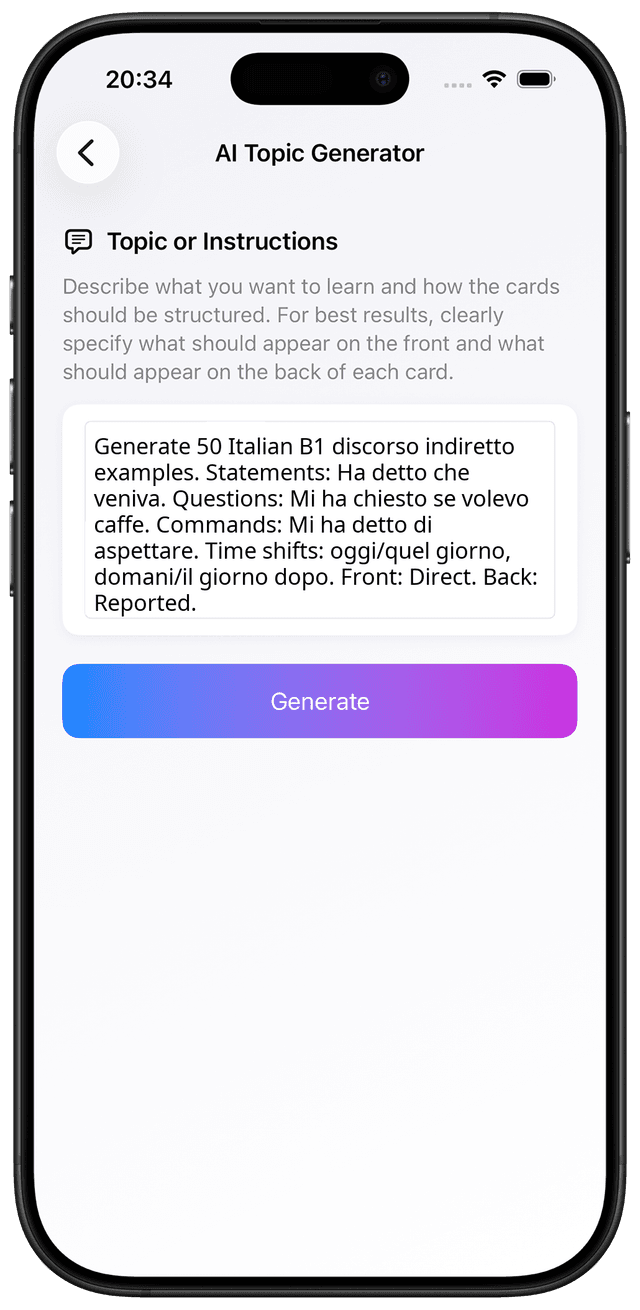
Reported speech in Italian shifts tenses in ways that are slightly different from English. When the reporting verb is in the past (disse, ha detto), the original present tense shifts to Imperfetto, and the original future shifts to Condizionale. Ha detto che veniva becomes the reported form of Ha detto che viene, where veniva is the Imperfetto standing in for the original present. This tense backshift is predictable once you know the pattern.
Reporting questions uses se for yes/no questions and the same question word for information questions. Mi ha chiesto se volevo caffe. Mi ha chiesto dove abitavo. Commands shift to di + infinitive: Mi ha detto di aspettare. These three patterns cover the vast majority of reported speech situations you will encounter in Italian at B1 level.
Why indirect speech at B1? CELI B1 listening and reading tasks regularly ask you to report what someone said or asked. Without the tense shift rules, both the test and real conversation become difficult to follow.
The strategy: This deck presents direct and indirect versions side by side so the transformation is clear. You see the original sentence and the reported version together, which makes the tense shift automatic rather than a rule you have to consciously apply.
Generate 50 Italian B1 indirect speech examples (discorso indiretto). Cover: 15 statement pairs (direct: Vengo domani / indirect: Ha detto che veniva il giorno dopo), 15 question pairs (direct: Vuoi caffe? / indirect: Mi ha chiesto se volevo caffe), 10 command pairs (direct: Aspetta! / indirect: Mi ha detto di aspettare), and 10 examples of time expression shifts (oggi to quel giorno, domani to il giorno dopo, ieri to il giorno prima). Front: Direct speech sentence. Back: Reported form + tense shift note.
At B1, expressing an opinion means more than Penso che sia bello. Italian has a range of phrases for agreeing partially, disagreeing politely, conceding a point while maintaining your position, and structuring an argument across several sentences. Da un lato... dall'altro, nonostante cio, tuttavia, eppure, d'altronde are all connectors that CELI B1 essays reward. Using them signals that you can handle complex thought in Italian, not just simple statements.
The register difference also matters here. Formal written Italian for essays uses different connector vocabulary than spoken Italian. Tuttavia and pertanto are written; pero and quindi work in both registers. Knowing which to use where stops your writing from sounding either too stiff or too conversational for the task type.
Why opinion language at this stage? The CELI B1 writing component includes a discursive essay or an opinion piece. Without a range of connectors and stance markers, your writing reads like a list of statements rather than a structured argument.
The strategy: This deck covers opinion phrases, discourse connectors, and contrast markers across both formal and informal registers so you can adapt to different task types without memorizing two separate vocabulary sets.
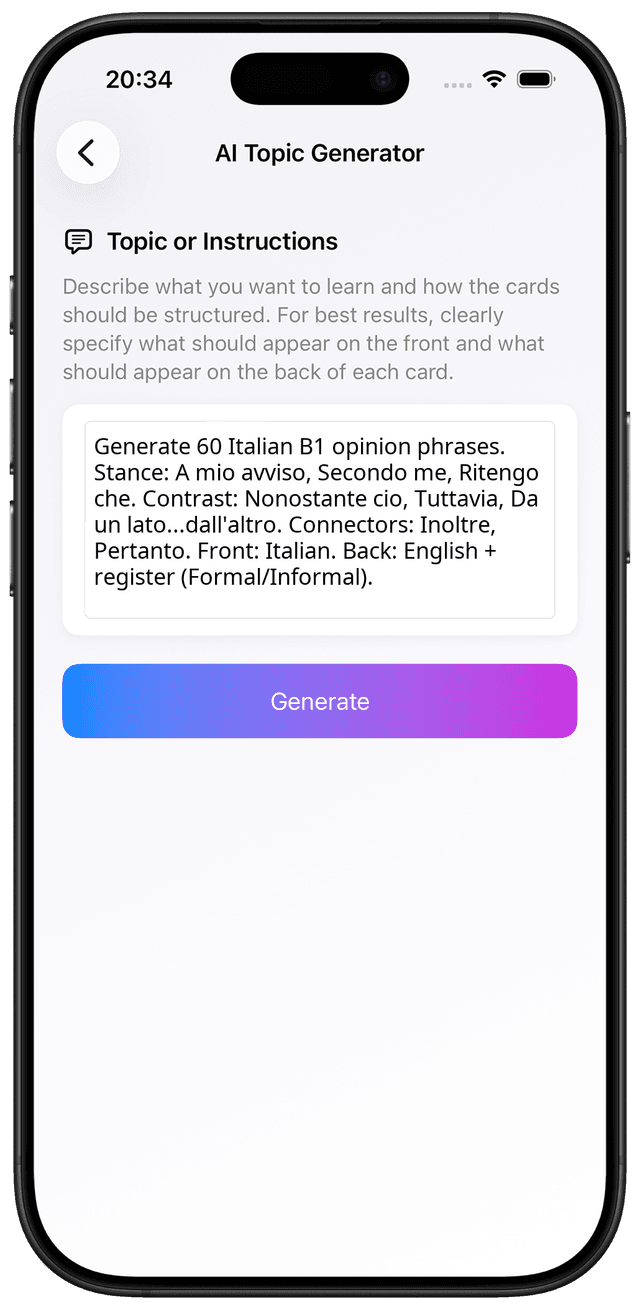
Generate 60 Italian B1 opinion and argument phrases. Include: 15 stance openers (A mio avviso, Secondo me, Sono convinto/a che, Ritengo che + congiuntivo, Dal mio punto di vista), 15 contrast and concession phrases (Nonostante cio, Tuttavia, Eppure, D'altronde, Da un lato...dall'altro, Sebbene + congiuntivo), 15 adding and sequencing connectors (Inoltre, Pertanto, Di conseguenza, In primo luogo, In conclusione, A tal proposito), and 15 partial agreement phrases (E vero che...tuttavia, Capisco che...pero, Non si puo negare che...eppure). Front: Italian phrase + example sentence. Back: English + register label (Formal/Informal).
B1 topics in CELI exams include the workplace, social issues, the environment, and technology. This phase covers the specialist vocabulary for each area. Italian workplace language is fairly formal: colloquio di lavoro, contratto a tempo indeterminato, formazione professionale, diritti dei lavoratori. Social issue vocabulary covers topics that come up in news reading and discussion: disoccupazione, immigrazione, cambiamento climatico, disuguaglianza sociale.
Italian news language uses a higher register than everyday conversation. Verbs like affermare, dichiarare, sottolineare, and ribadire appear in political and social commentary in place of the simpler dire. Reading Italian news at B1 means encountering these verb choices regularly, and knowing them makes the difference between following the argument and losing the thread.
Why topic vocabulary at B1? CELI B1 reading and listening texts consistently use work and social issue contexts. Without topic-specific vocabulary, even grammatically competent learners struggle to extract meaning from news-style texts.
The strategy: This deck groups vocabulary by topic area so you can study one domain at a time and build a coherent mental map of each subject rather than a random list of unrelated words.
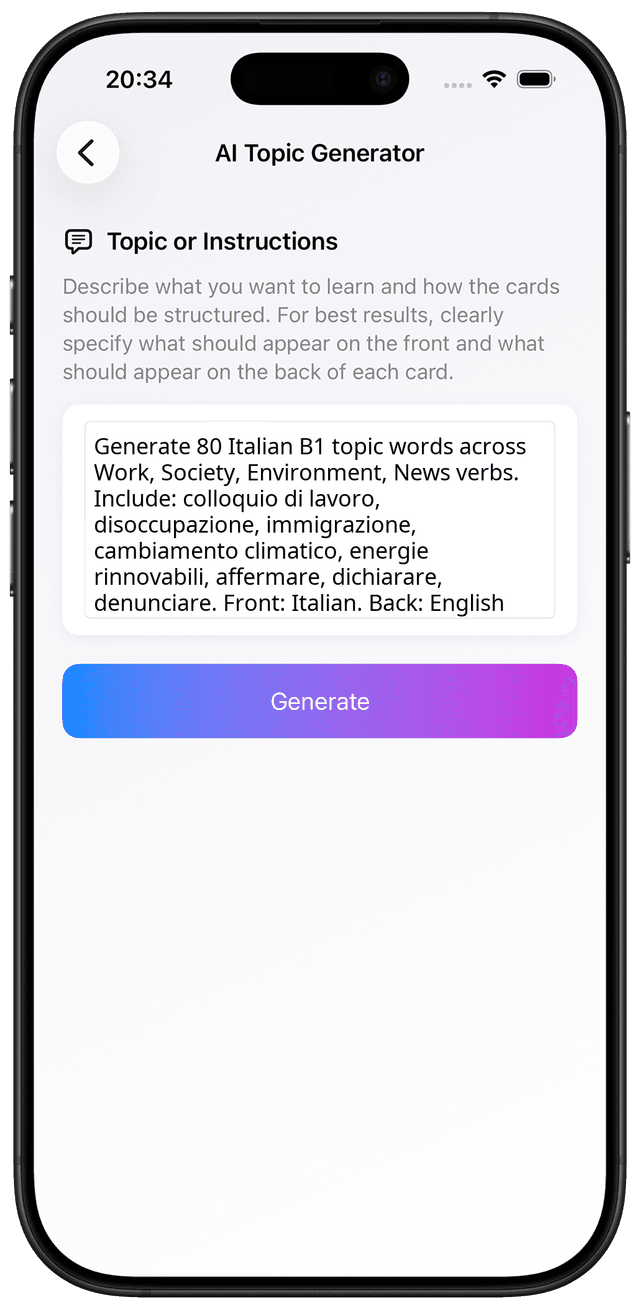
Generate 80 Italian B1 words and phrases across four topic areas. Work (20 words): colloquio di lavoro, contratto a tempo indeterminato/determinato, stipendio netto/lordo, ferie, permesso, dimissioni, licenziamento, straordinari, telelavoro, formazione. Society (20 words): disoccupazione, immigrazione, integrazione, disuguaglianza, poverta, welfare, diritti civili, manifestazione, sciopero, solidarieta. Environment (20 words): cambiamento climatico, emissioni, energie rinnovabili, inquinamento, riciclo, sostenibilita, deforestazione, biodiversita, siccita, alluvione. News verbs (20): affermare, dichiarare, sottolineare, ribadire, denunciare, proporre, approvare, respingere, confrontarsi, negoziare. Front: Italian. Back: English.
Italian at B1 includes culturally specific vocabulary that does not translate directly. The concept of la dolce vita is one layer, but underneath it are more precise terms: aperitivo (the pre-dinner drink with snacks that is a social institution in northern Italy), spritz (the Veneto drink that became a national ritual), sagra (a local festival built around a single food), and osteria (a type of informal restaurant distinct from trattoria or ristorante). Knowing these terms lets you understand Italian cultural writing rather than just guessing from context.
Italian art and history vocabulary is also relevant at B1. Rinascimento, barocco, affresco, campanile, chiostro, patrimonio dell'umanita appear in reading texts, guided tours, and museum materials. You encounter them constantly in Italy and in Italian-language cultural content online. Without them, your comprehension has gaps that grammar knowledge alone cannot fill.
Why cultural vocabulary at B1? CELI B1 reading texts often feature Italian cultural contexts. Learners who only study grammar and general vocabulary miss the cultural layer that makes comprehension complete.
The strategy: This deck covers food culture, social rituals, and art history vocabulary so you can read Italian cultural content and follow conversations about Italian life without constant dictionary lookups.
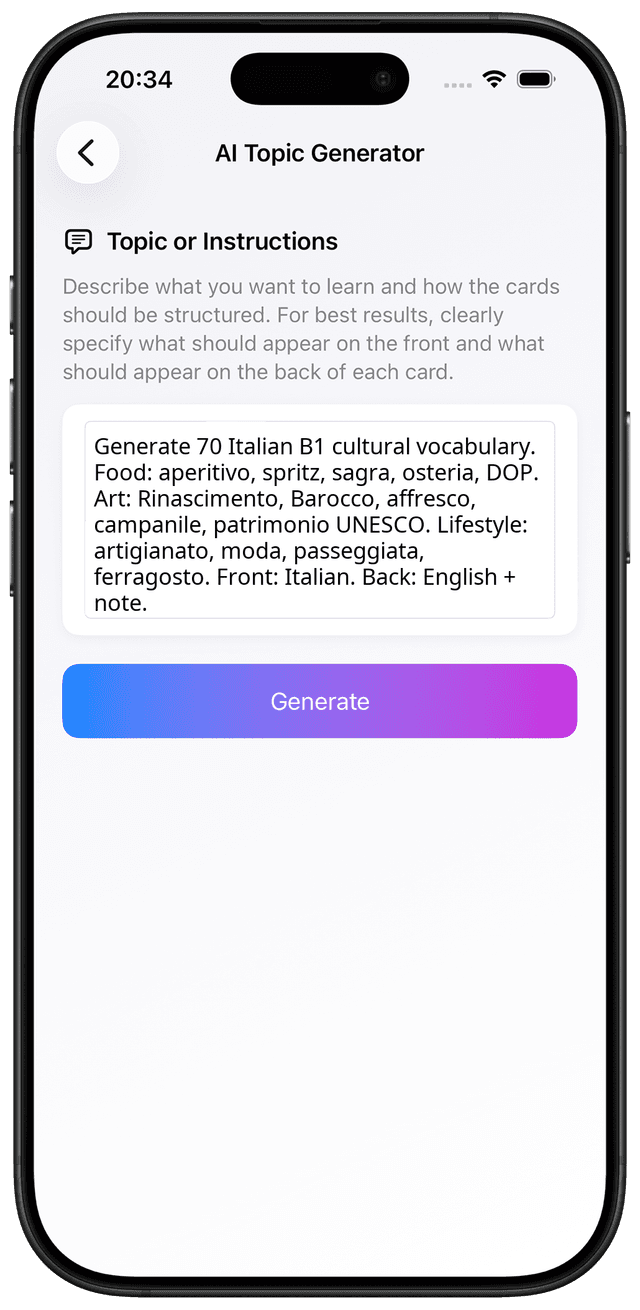
Generate 70 Italian B1 cultural vocabulary items across three areas. Food and social culture (25): aperitivo, spritz, aperitivo, sagra, sagra, osteria, trattoria, ristorante, pizzeria, mescita, cantina, mercato, mercatino, dolce vita, pranzo domenicale, convivio, degustazione, chilometro zero, DOP, IGP, slow food, toast (Italian sense), bar (Italian sense), caffetteria, gelateria. Art and heritage (25): Rinascimento, Barocco, affresco, mosaico, campanile, chiostro, cripta, patrimonio dell'umanita, sito UNESCO, scavo archeologico, ruderi, restauro, pinacoteca, galleria, scultura, architettura, duomo, basilica, battistero, fontana, piazza, borgo, centro storico, palazzo, villa. Lifestyle and fashion (20): artigianato, made in Italy, moda, stilista, sartoria, boutique, vintage, look, tendenza, collezione, passegiata, ferragosto, villeggiatura, vacanza, benessere, terme, centro benessere, yoga, pilates, jogging. Front: Italian. Back: English + cultural note where useful.
The final B1 phase covers three verb structures that give you more options when you write or speak. The Gerundio (stare + gerundio for ongoing actions: sto studiando, stava parlando) lets you describe actions in progress in both present and past frames. The Participio Passato used in absolute constructions (Finita la riunione, siamo andati a pranzo) appears in formal and literary Italian. The Passivo voice (Il documento e stato firmato, La legge viene approvata) is common in news, business, and academic writing.
These structures also allow you to vary your sentences. Instead of always using active constructions, the Passivo lets you foreground the object of an action. Instead of sempre sto leggendo, the Gerundio gives you range. Italian at B1 is not just more vocabulary. It is also being able to express the same idea in multiple ways and choosing the construction that fits the context.
The milestone: With this deck complete, your Italian B1 vocabulary covers the Congiuntivo, Condizionale, indirect speech, opinion language, topic-specific vocabulary for work and society, cultural knowledge, and complex verb structures. That is a full B1 picture. You can follow Italian news, read Italian cultural content, and hold a sustained conversation on a range of topics without constant grammatical hesitation.
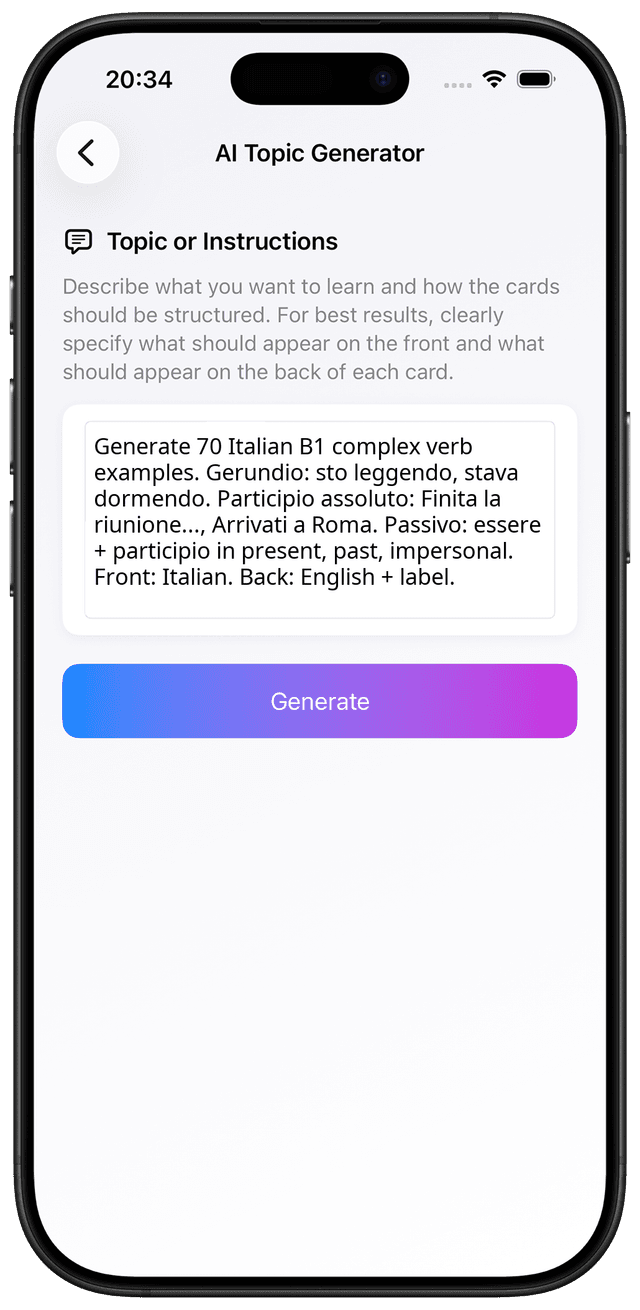
Generate 70 Italian B1 examples across three complex verb structures. Gerundio progressivo (20): stare + gerundio in present (sto leggendo, sta aspettando) and past (stava dormendo, stavamo mangiando) with range of verbs. Participio assoluto (20): absolute participial constructions (Finita la riunione... Arrivati a Roma... Letto il documento... Presa la decisione...) with formal example sentences. Passivo voice (30): essere + participio (Il libro e stato scritto da..., La legge e stata approvata, Il premio viene assegnato ogni anno, I biglietti sono stati venduti) using present, past, and impersonal forms. Front: Italian. Back: English + structure label (Gerundio / Participio / Passivo).
B1 grammar structures like the Congiuntivo and Condizionale require pairing a form with a trigger context, not just memorizing conjugation tables. Spaced repetition and active recall are how those pairings become automatic. MindCards schedules each card at the interval where you are just about to forget it, which is the most efficient time to review. Rereading notes produces far slower retention.
B1 vocabulary sits between A2 fluency and B2 upper-intermediate. Use the links below to move between levels or return to the full Italian guide.
Build your Italian B1 vocabulary with AI-generated decks and spaced repetition that adapts to what you actually struggle with. Free to download. No account required. Start with any phase that matches where you are right now.