
Spaced repetition explained
Why reviewing at the right interval locks in Italian A2 vocabulary
You have the A1 foundation. Now build Italian you can use in a real conversation. The A2 jump is the Passato Prossimo, Italy's everyday past tense, along with the grammar that separates halting Italian from natural Italian: the Imperfetto for background descriptions, reflexive verbs for daily routines, and the Futuro Semplice for plans.
A2 covers roughly 1,000 words and structures, and they are not all equal. This guide focuses on the ones that come up most often: the verbs that take essere in the Passato Prossimo, the reflexive constructions that appear in every health and daily-life topic, and the opinion phrases that make your Italian sound considered rather than mechanical.
Each phase includes a ready-to-use AI prompt. Copy it into MindCards and you get a focused deck built around real Italian grammar and vocabulary. The app's spaced repetition then decides when each card comes back, spacing reviews so you retain A2 Italian faster than working through word lists alone.
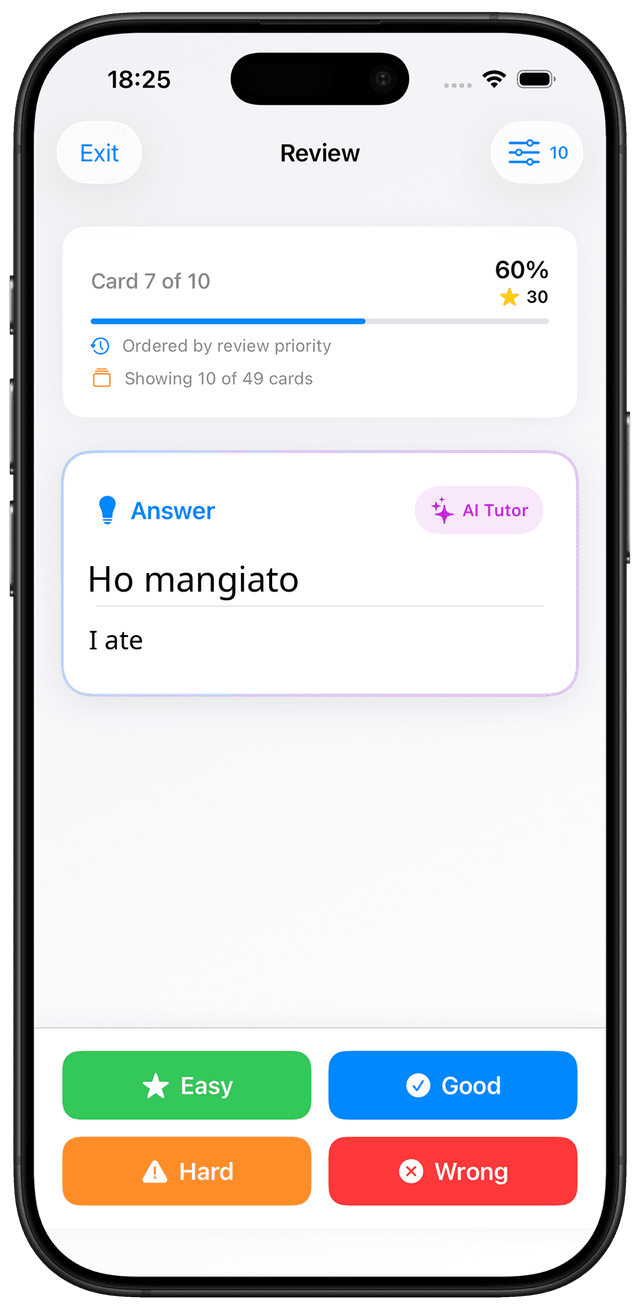
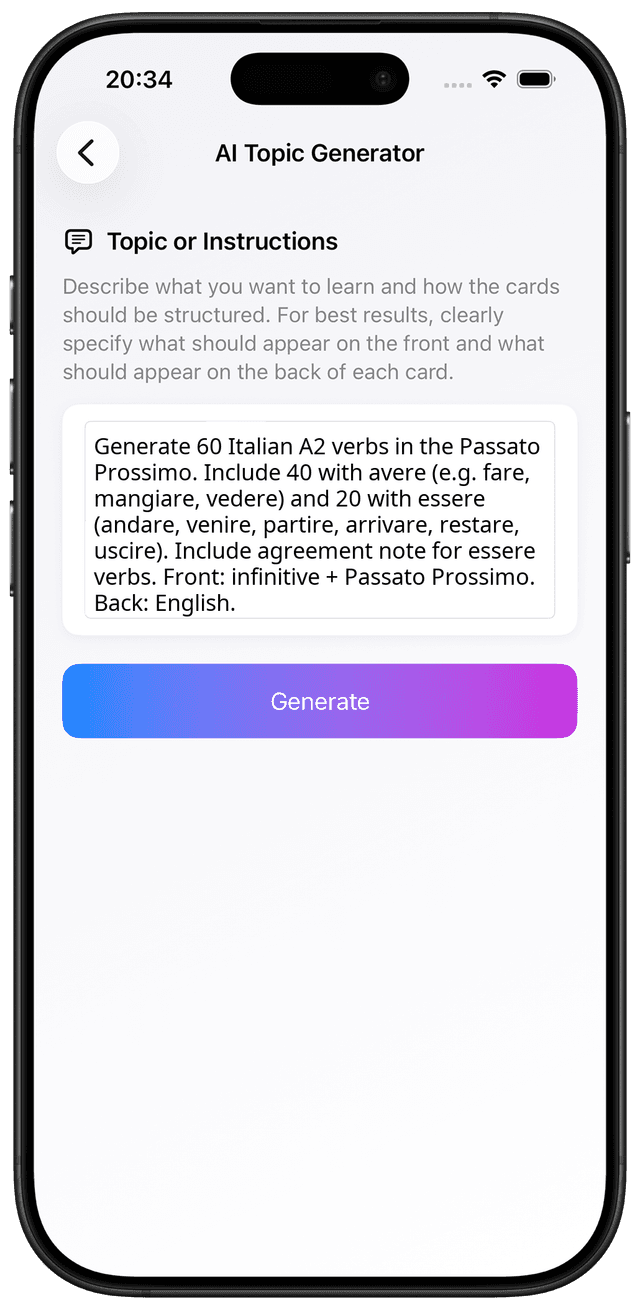
The Passato Prossimo is how Italians talk about past events in everyday speech. It uses a helper verb (avere or essere) plus a past participle. Regular -are verbs end in -ato, -ere verbs in -uto, and -ire verbs in -ito. But the choice between avere and essere matters: verbs of motion and change of state take essere, and the past participle then agrees in gender and number with the subject.
The essere group includes many common verbs: andare (to go), venire (to come), partire (to leave), arrivare (to arrive), restare (to stay), cadere (to fall), nascere (to be born), and morire (to die). When essere is the helper, the participle agrees: lui è andato, lei è andata, loro sono andati. The deck covers both groups so the agreement rule becomes automatic rather than something you have to look up mid-sentence.
Why start here? Every other A2 topic assumes you can describe something that already happened. The Passato Prossimo unlocks that, and it is the first structure tested in CELI A2 speaking and writing tasks.
The strategy: This deck focuses on 60 high-frequency verbs with their correct helper (avere or essere), past participle form, and a natural example sentence on the back so you learn word order and agreement together.
Generate 60 Italian A2 verbs in the Passato Prossimo. Include 40 with avere (e.g. fare, mangiare, vedere, comprare, prendere, scrivere, finire) and 20 with essere (andare, venire, partire, arrivare, restare, cadere, nascere, morire, uscire, tornare). Include agreement note for essere verbs. Front: infinitive + correct Passato Prossimo form with io. Back: English + a short example sentence using io or noi.
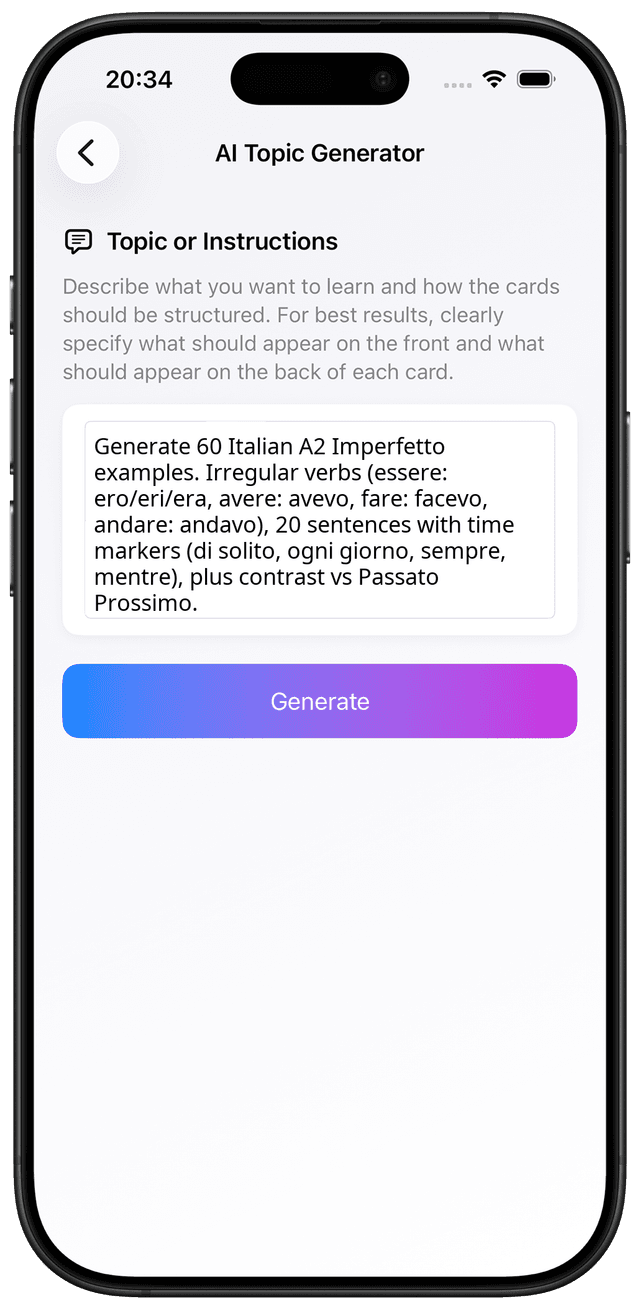
The Imperfetto describes ongoing states, background details, and repeated habits in the past. While the Passato Prossimo marks a completed event, the Imperfetto handles what things were like at the time. English speakers find this distinction tricky because English blurs the two with 'I was doing' and 'I did' in ways that feel interchangeable but are not in Italian.
A quick test: if you would say 'I was doing' or 'I used to do' in English, that is Imperfetto. If you would say 'I did' for a single completed event, use the Passato Prossimo. The classic contrast sentence is Leggevo quando ha suonato il telefono: he was reading (Imperfetto, ongoing background) when the phone rang (Passato Prossimo, sudden event). The Imperfetto of essere and avere comes up constantly: ero, avevo.
Why the Imperfetto next? At A2, you need both past tenses to tell a proper story. Passato Prossimo for what happened, Imperfetto for what things were like. CELI A2 writing tasks almost always require this combination.
The strategy: This deck covers Imperfetto conjugations for core verbs, common time markers (di solito, ogni giorno, da bambino, mentre), and contrast sentences showing when to choose Imperfetto over Passato Prossimo.
Generate 60 Italian A2 Imperfetto examples. Include: conjugations for key irregular verbs (essere: ero/eri/era, avere: avevo, fare: facevo, andare: andavo, volere: volevo, potere: potevo, sapere: sapevo), 20 sentences with time markers (di solito, ogni giorno, da bambino, sempre, mentre, spesso), and 10 contrast pairs showing Passato Prossimo vs Imperfetto (e.g. Leggevo quando ha suonato il telefono). Front: Italian sentence. Back: English + tense label (PP or Imp) with a usage note.
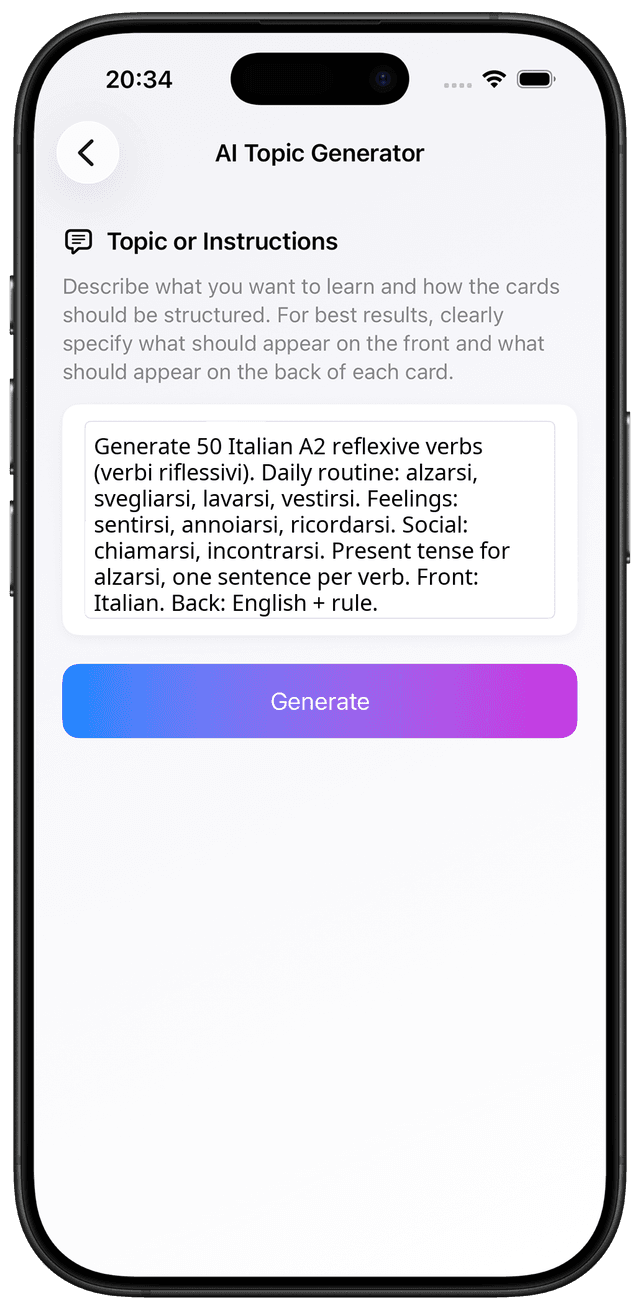
Italian uses reflexive verbs more than English does. Alzarsi, svegliarsi, vestirsi, lavarsi, and ricordarsi all require a reflexive pronoun that changes with the subject: mi, ti, si, ci, vi, si. In the Passato Prossimo, reflexive verbs always take essere as the helper, and the past participle agrees with the subject.
The agreement follows a clear rule: mi sono alzato/alzata, ci siamo alzati/alzate. The gender of the participle matches the subject, and the number matches whether the subject is singular or plural. The deck includes example sentences so you see the agreement in context rather than reading it as an abstract rule. Daily routine vocabulary is built almost entirely from reflexives, which is why they appear in nearly every A2 speaking prompt.
Why reflexive verbs matter: Daily routine, descriptions of feelings, and introductions all rely on this structure. They come up in almost every CELI A2 topic, from daily life to health situations.
The strategy: This deck covers 50 high-frequency reflexive verbs in the present tense with all pronouns, plus their Passato Prossimo forms with essere and agreement rules shown in real sentences.
Generate 50 Italian A2 reflexive verb examples (verbi riflessivi). Cover daily routine verbs (alzarsi, svegliarsi, lavarsi, vestirsi, addormentarsi, sedersi), feeling and state verbs (sentirsi, annoiarsi, ricordarsi, dimenticarsi, preoccuparsi), and social verbs (chiamarsi, incontrarsi, salutarsi). Include full conjugation table in present tense for alzarsi, then one example sentence each for the rest. Add 10 Passato Prossimo sentences with essere and agreement notes. Front: Italian. Back: English + reflexive pronoun rule.
Italian comparatives use più or meno before the adjective, and the adjective still agrees in gender and number. Questo film è più interessante dell'altro for a masculine noun, but Questa storia è più interessante dell'altra needs the feminine form. Italian also has a small group of irregular comparatives: buono becomes migliore, cattivo becomes peggiore, grande can become maggiore, and piccolo can become minore.
The Superlativo Relativo uses il/la/i/le più or il/la/i/le meno: il più bello, la più bella, i più belli. The Superlativo Assoluto adds -issimo/a/i/e to the adjective stem without an article: bellissimo, interessantissima, simpaticissimi. Knowing both forms lets you sound natural rather than always reaching for molto before an adjective.
Why add opinions now? After past tenses and reflexive verbs, the next CELI A2 task is expressing views and reactions. Italian phrases like Secondo me..., A mio parere..., and Penso che... signal opinions in ways native speakers recognize immediately.
The strategy: This deck combines comparative and superlative patterns with opinion vocabulary so you can evaluate, contrast, and recommend in one connected batch.
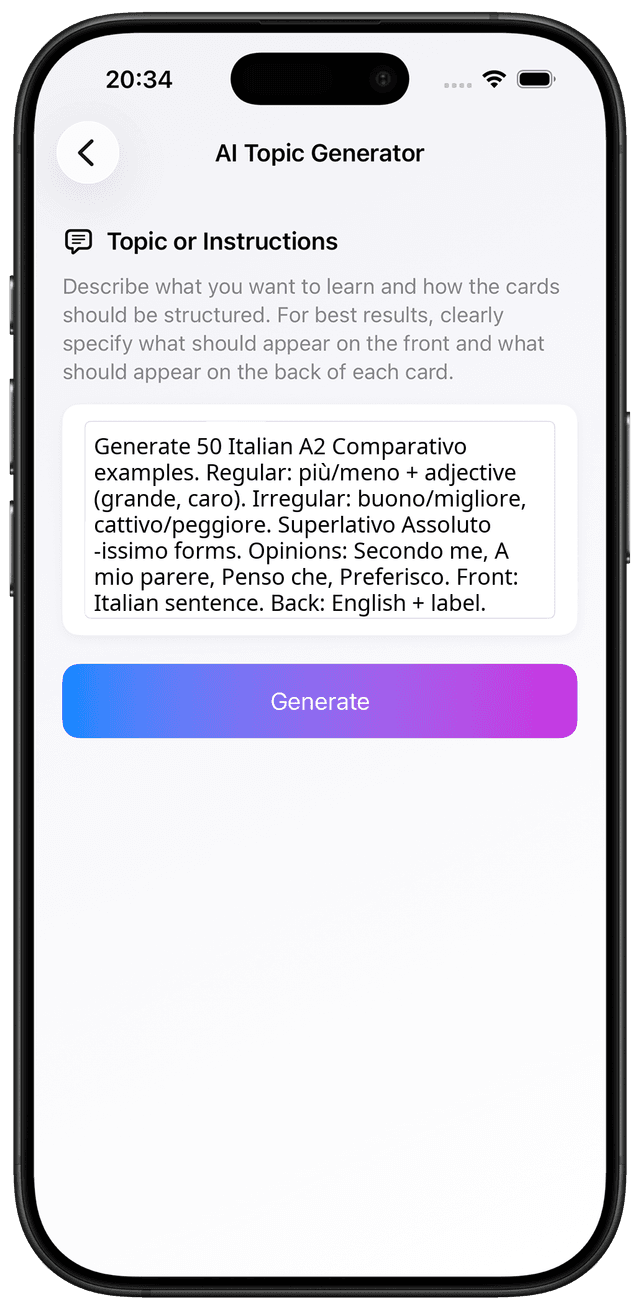
Generate 50 Italian A2 examples for Comparativo and Superlativo. Include: regular patterns with più/meno + adjective (grande, caro, interessante), irregular forms (buono/migliore/il migliore, cattivo/peggiore/il peggiore), Superlativo Assoluto with -issimo forms (bellissimo, bravissima, simpaticissimi), and 20 opinion phrases (Secondo me, A mio parere, Penso che, Trovo che, Preferisco, Sono d'accordo, Non sono d'accordo). Front: Italian sentence. Back: English + pattern label (Comparativo / Superlativo / Opinion).
Italian shopping has a vocabulary layer that A1 never reaches. Knowing your taglia (clothing size) from your numero (shoe size), understanding that saldi refers to the regulated seasonal sale periods in January and July, and asking confidently in a farmacia or a macelleria all require words that go well beyond tourist basics. This phase covers the full range.
One thing worth knowing about Italian service culture: using the conditional rather than the present tense is noticeably more polite. Vorrei (I would like) is almost always more appropriate than Voglio (I want) in a shop or cafe. Potrebbe aiutarmi? (Could you help me?) sounds far more natural than Può aiutarmi? in a formal service context. Getting the register right makes a real difference.
Why this is tested: CELI A2 writing and speaking tasks use shopping and service situations because they require practical transactional vocabulary without needing complex grammar structures.
The strategy: This deck mixes product vocabulary, payment terms, and useful service phrases so you can handle real Italian shopping situations from the mercato to the banca.
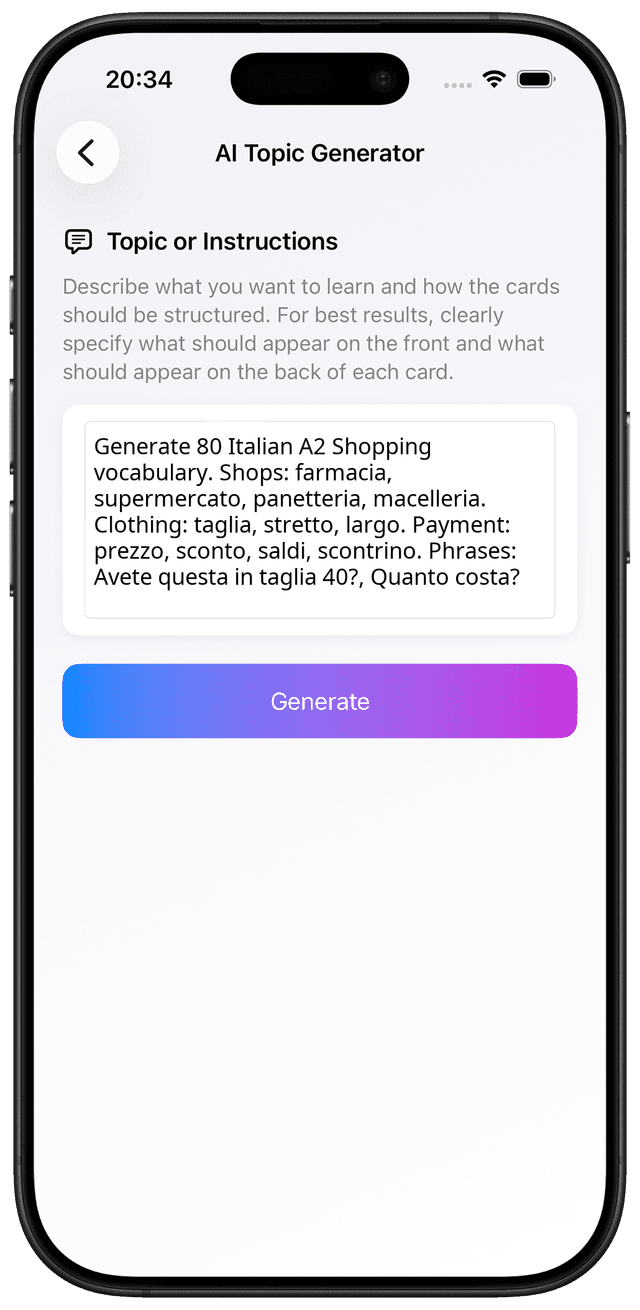
Generate 80 Italian A2 words and phrases for Shopping and Services. Cover: shop types (farmacia, supermercato, panetteria, macelleria, libreria, banca, ufficio postale), clothing and sizes (taglia, numero, stretto, largo, camerino, cambiare), payment terms (prezzo, sconto, saldi, scontrino, ricevuta, pagare con carta, pagare in contanti), and service phrases (Avete questa in taglia 40?, Quanto costa?, Vorrei un rimborso, Posso pagare con carta?). Front: Italian. Back: English.
Italy has an extensive rail network run by Trenitalia and Italo, and navigating it requires specific vocabulary: binario (platform), partenza (departure), coincidenza (connection), biglietto (ticket). This phase also covers hotel check-in, giving and following directions, and handling the practical problems that come up while travelling in Italy.
Directions in Italian use a sinistra (left) and a destra (right), but also positional phrases: di fronte a (opposite), in fondo alla strada (at the end of the street), al semaforo (at the traffic lights), vicino a (near). These appear in CELI A2 listening tasks where someone asks a passer-by for directions in a simulated street scenario.
Why travel vocabulary matters: Travel is one of the main topic areas in the CELI A2 exam. The vocabulary here is also immediately practical for anyone spending time in Italy or Italian-speaking Switzerland.
The strategy: This deck combines train, accommodation, and directional vocabulary in one study session. Grouping them means you can follow an Italian journey from buying the ticket to finding the hotel without needing separate word lists for each part.
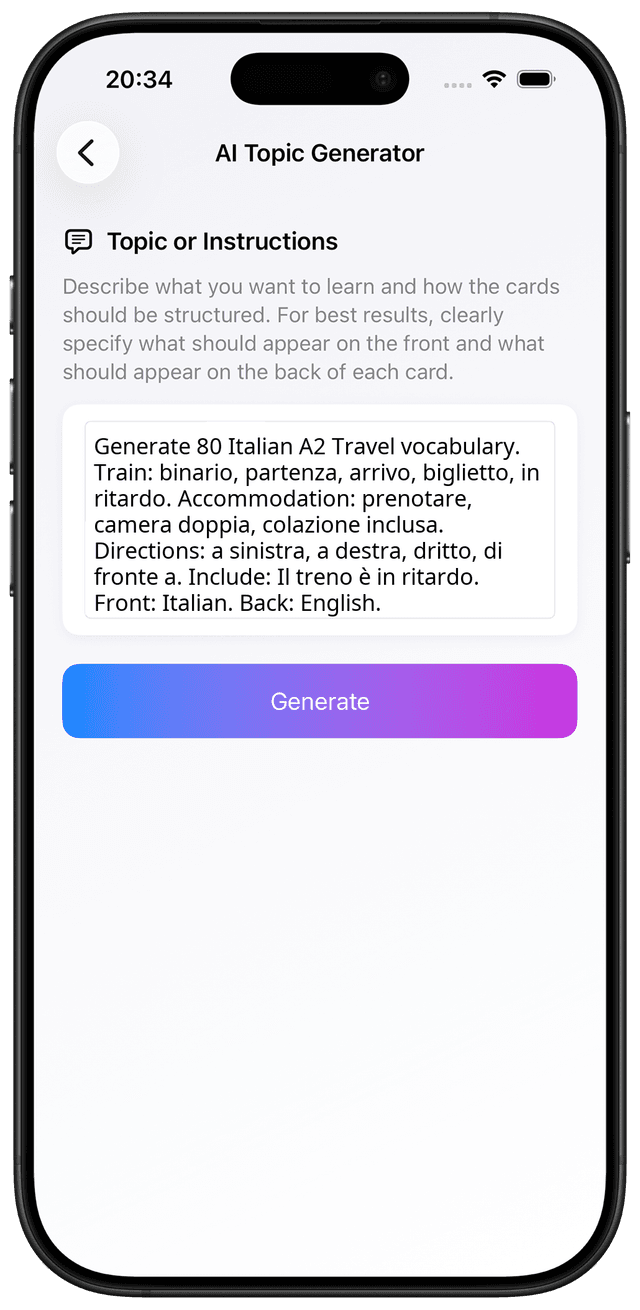
Generate 80 Italian A2 words and phrases for Travel and Directions. Include: train vocabulary (binario, partenza, arrivo, biglietto, andata e ritorno, cambiare treno, in ritardo, coincidenza), accommodation (prenotare una camera, camera doppia, colazione inclusa, reception, fare il check-out), directions (a sinistra, a destra, sempre dritto, all'angolo di, di fronte a, in fondo alla strada, vicino a), and travel problems (Il treno è in ritardo, Ho perso il bagaglio, Dov'è la stazione più vicina?). Front: Italian. Back: English.
The final A2 phase covers three areas that come up in every exam: health vocabulary for describing symptoms and making appointments, work and daily routine language, and the Futuro Semplice for plans and predictions. Italian also uses stare per + infinitive for something about to happen right now, and andare + infinitive for near-future plans, and this deck covers both alongside the full Futuro Semplice conjugation.
The difference between the two future forms is worth knowing. Vado a studiare domani (near future, going to) sounds immediate and conversational. Studierò domani (Futuro Semplice) is slightly more formal and can convey a firm commitment or prediction. At A2 level, knowing both and being able to switch between them puts you well ahead of most self-taught learners in speaking and writing assessments.
The milestone: With this deck, your Italian A2 vocabulary is complete. You can describe past events with the Passato Prossimo and Imperfetto, express reflexive daily routines, handle shopping and travel situations, and talk about future plans in both registers. That is the full A2 picture.
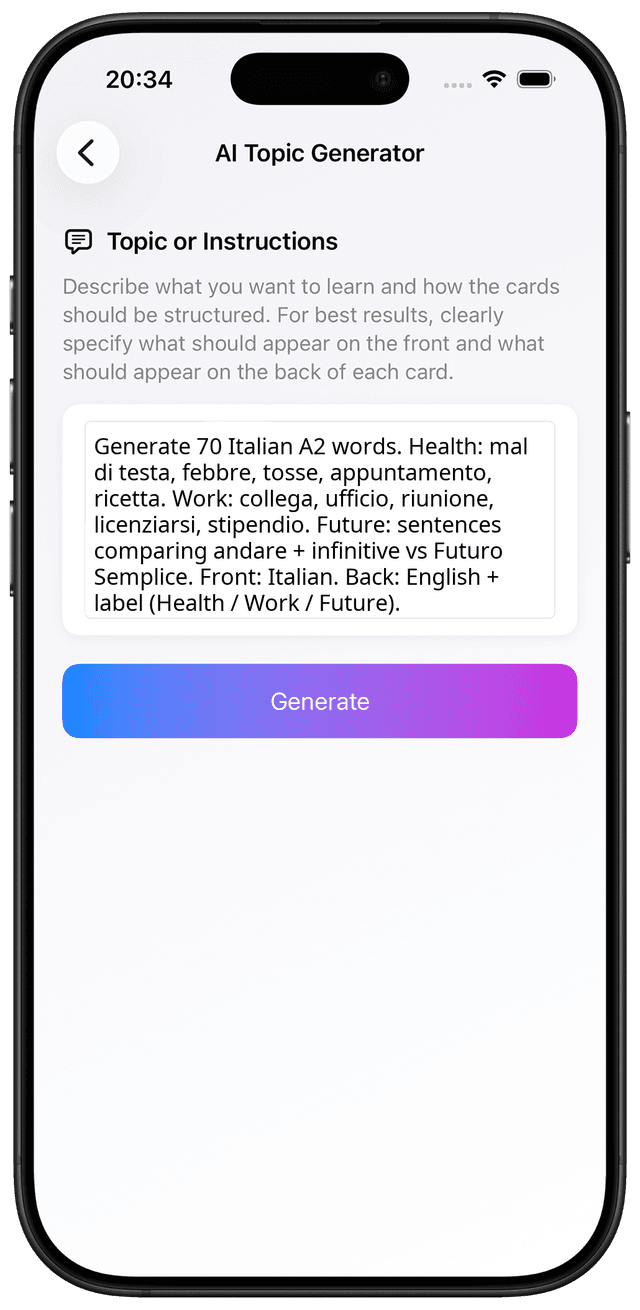
Generate 70 Italian A2 words and phrases across three areas. Health: symptoms and medical appointments (mal di testa, febbre, tosse, dal medico, prendere un appuntamento, ricetta, compresse, allergia). Work: job and routine vocabulary (collega, ufficio, riunione, fine giornata, licenziarsi, stipendio, a tempo pieno, part-time). Future: 20 sentences comparing andare + infinitive (Vado a studiare domani) with Futuro Semplice (Studierò domani) for plans and predictions. Front: Italian. Back: English + category label (Health / Work / Future).
MindCards uses spaced repetition and active recall, both well-supported by research, to help you retain A2 vocabulary faster and for longer. The Passato Prossimo, reflexive verbs, and Imperfetto all involve pairing a form with a meaning and a context. Retrieval practice is how those pairings stick. Rereading a word list does not produce the same result.
A2 vocabulary sits between the A1 foundation and B1 fluency. Use the links below to move between levels or return to the full Italian guide.
Build your Italian A2 vocabulary with AI-generated decks and spaced repetition that adapts to what you actually struggle with. Free to download. No account required. Start with any phase that interests you most.