
Spaced Repetition Explained
Learn why spacing reviews is key to mastering Italian A1 vocabulary.
Italian A1 vocabulary is your launchpad into real conversation. These core words and phrases appear in greetings, cafes, shopping, transport, and introductions.
Most learners plateau because they memorize random lists without mastering article forms, common verb patterns, and high-frequency phrase chunks. This guide gives a practical sequence so each study session builds usable Italian.
MindCards helps you retain vocabulary using spaced repetition and active recall. Use the prompts below to generate focused decks tailored to real beginner Italian scenarios, not generic word dumps.
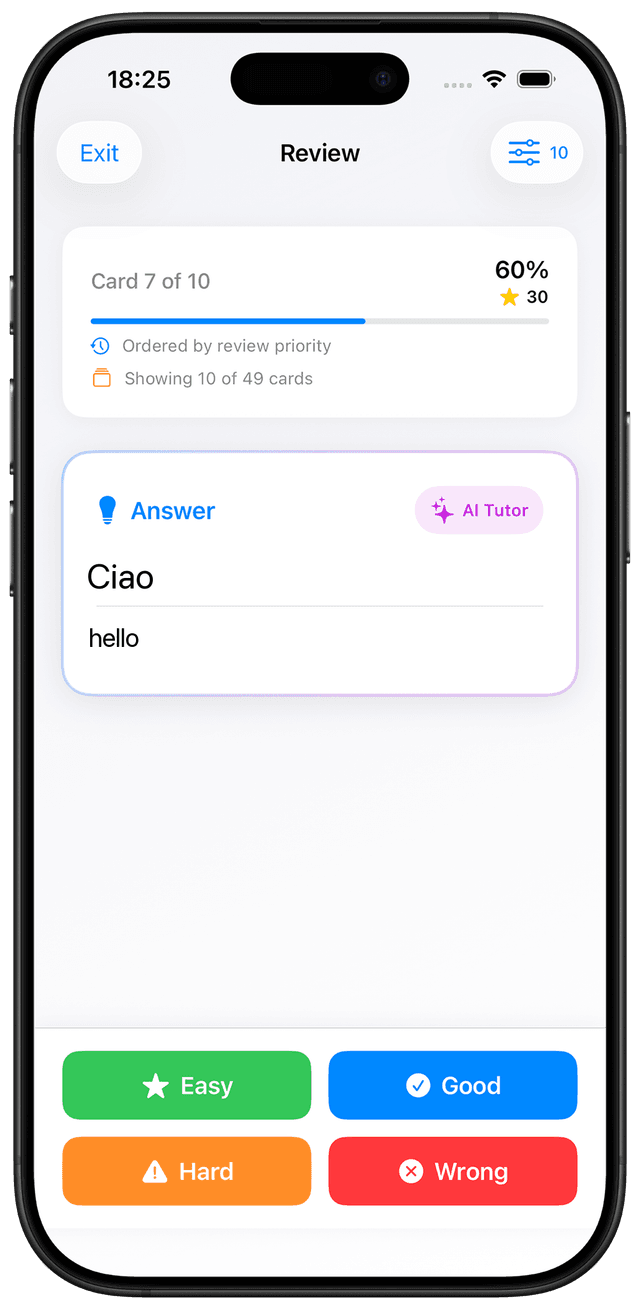
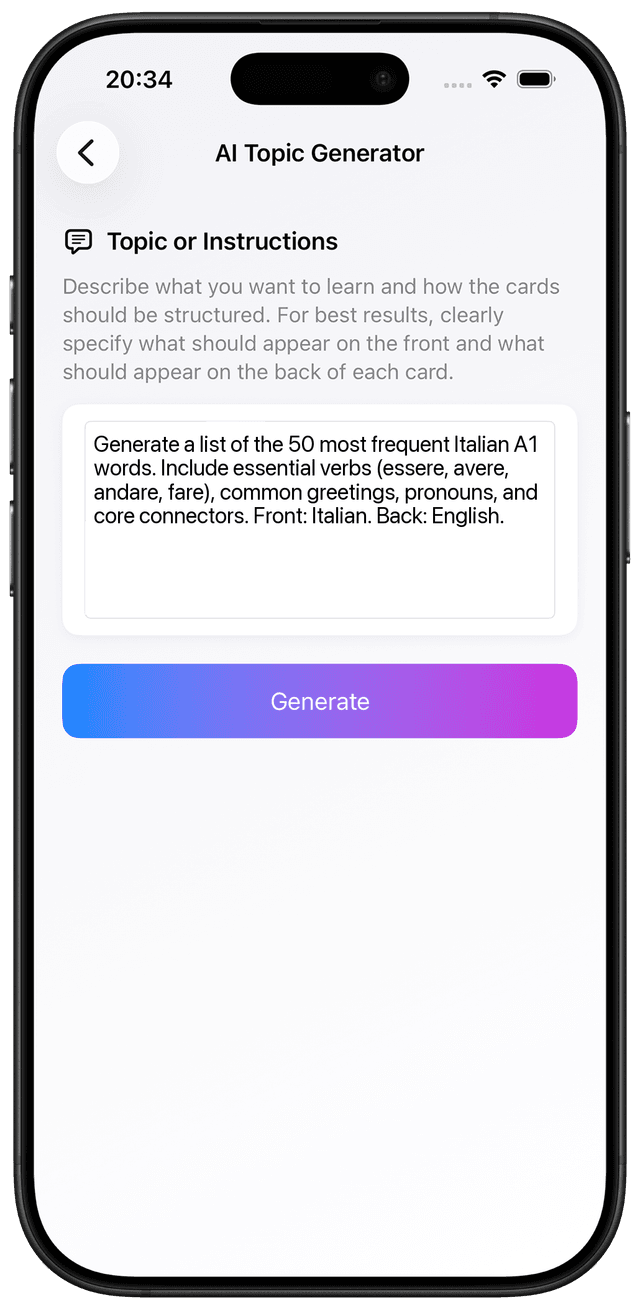
Start with high-frequency verbs, greetings, pronouns, and everyday connectors. These words unlock a large part of beginner-level Italian communication in real daily situations.
Why start here? You quickly recognize core Italian sentence patterns built around essere/avere and common greetings.
The Strategy: Build a starter deck that includes common spoken variants used in everyday Italian.
Generate a list of the 50 most frequent Italian A1 words. Include essential verbs (essere, avere, andare, fare), common greetings, pronouns, and core connectors. Front: Italian. Back: English.
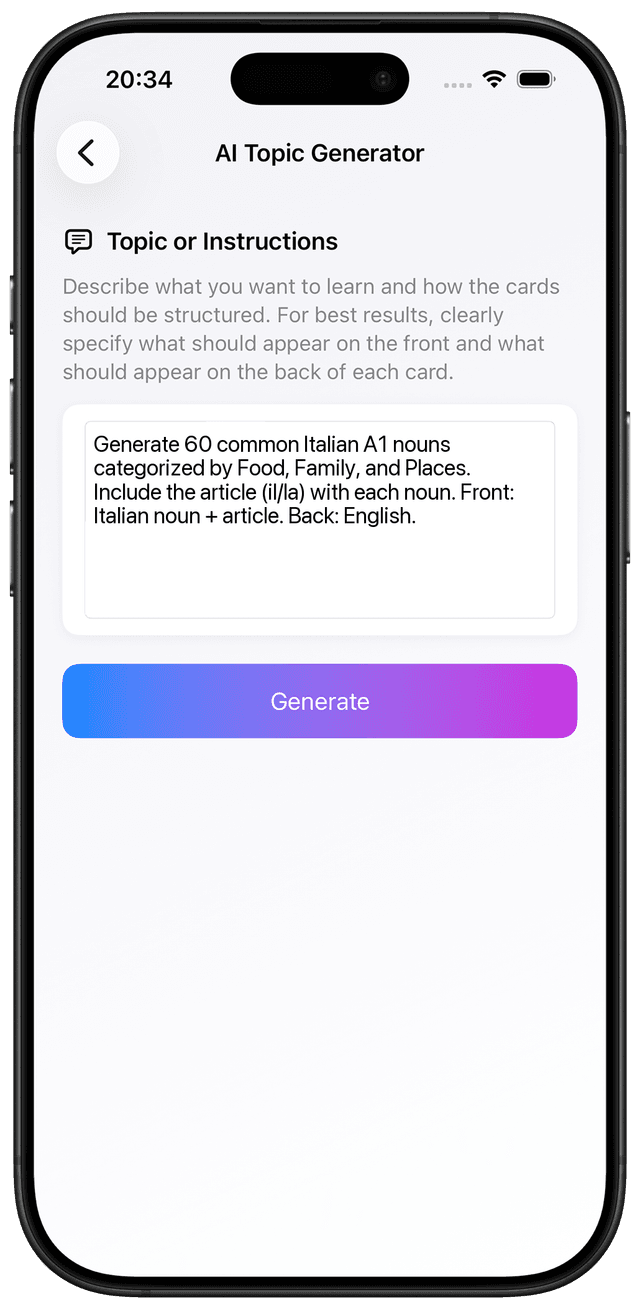
Expand into survival nouns for food, family, places, and daily objects. This is where Italian becomes immediately useful for travel and daily routines - from ordering pizza or pasta to asking for the train station.
Why this next? You cannot describe everyday life without these nouns, and article choice matters early in Italian.
The Strategy: Practice nouns with article forms (il/lo/la/l') to build gender intuition and listening accuracy.
Generate 60 common Italian A1 nouns categorized by Food, Family, and Places. Include examples like pizza, pasta, stazione, and famiglia. Include the article form (il/lo/la/l') with each noun and one practical example phrase. Front: Italian noun + article. Back: English.
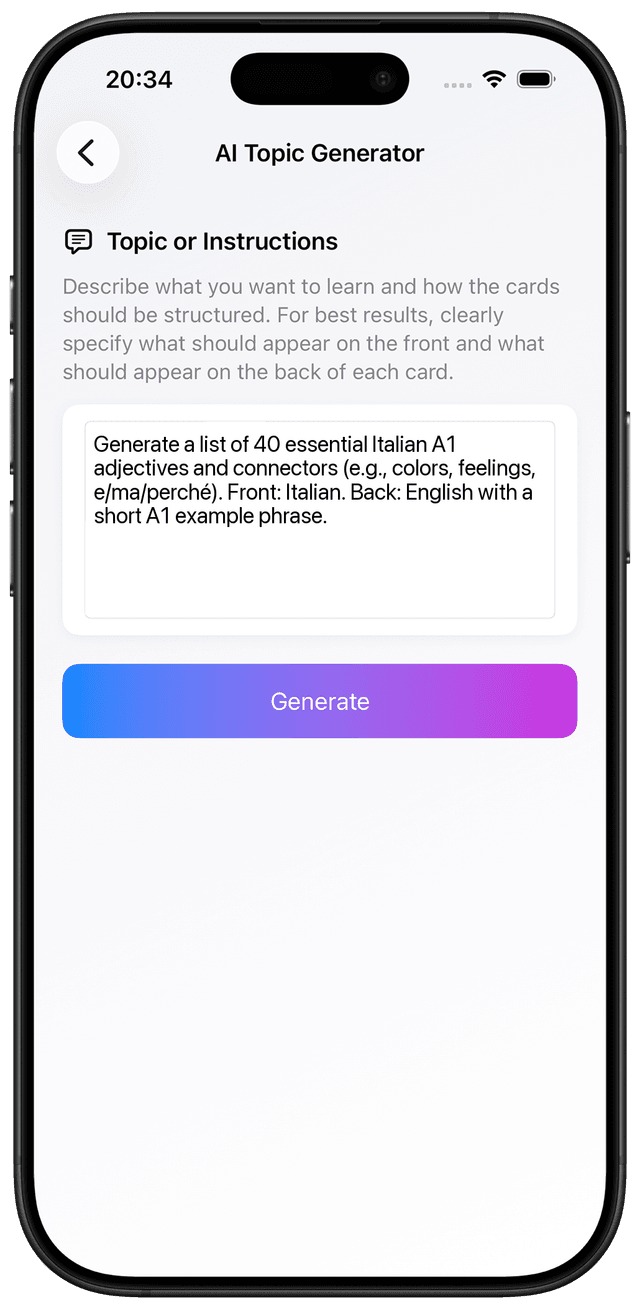
Add descriptive words and simple connectors to move from isolated words to useful, natural Italian sentences.
Why this matters: Adjective agreement and connector usage are key for sounding natural in everyday Italian.
The Strategy: Build mini-sentence cards that force contextual recall instead of isolated memorization.
Generate a list of 40 essential Italian A1 adjectives and connectors (e.g., colors, feelings, e/ma/perché). Front: Italian. Back: English with a short A1 example phrase.
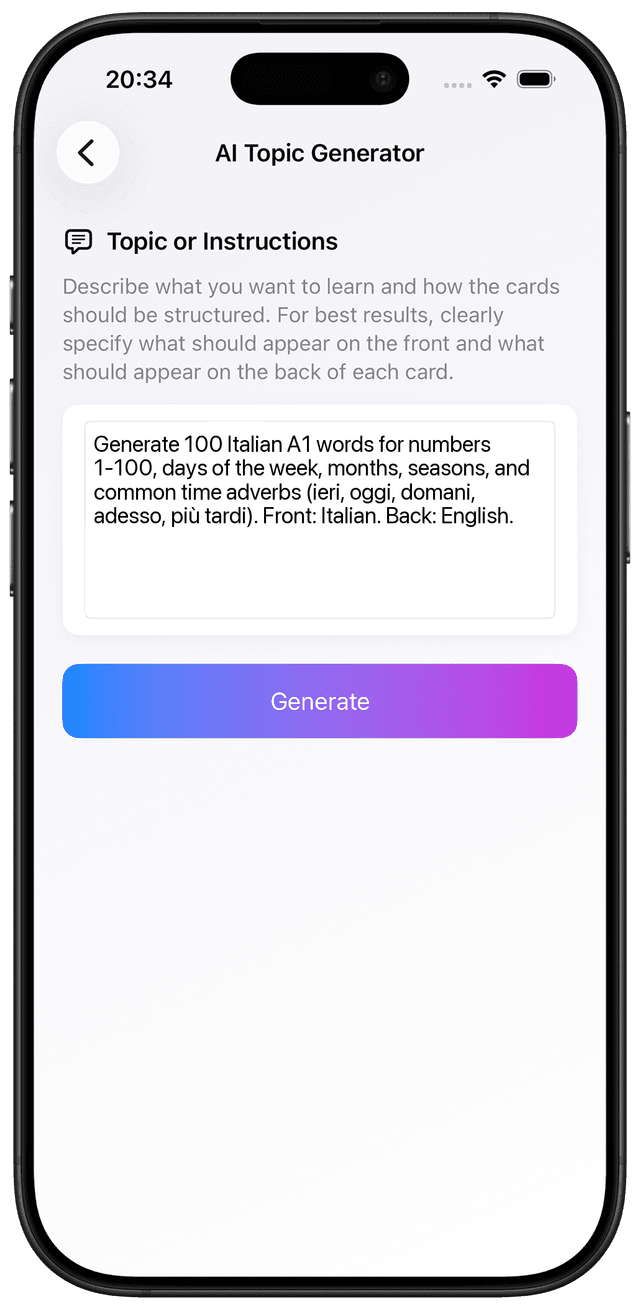
Learn numbers, weekdays, months, and common time expressions so you can schedule, book, and coordinate daily activities in Italian.
Why this is vital: Time language appears constantly in appointments, transport, and routine planning.
Generate 100 Italian A1 words for numbers 1-100, days of the week, months, seasons, and common time adverbs (ieri, oggi, domani, adesso, più tardi). Front: Italian. Back: English.
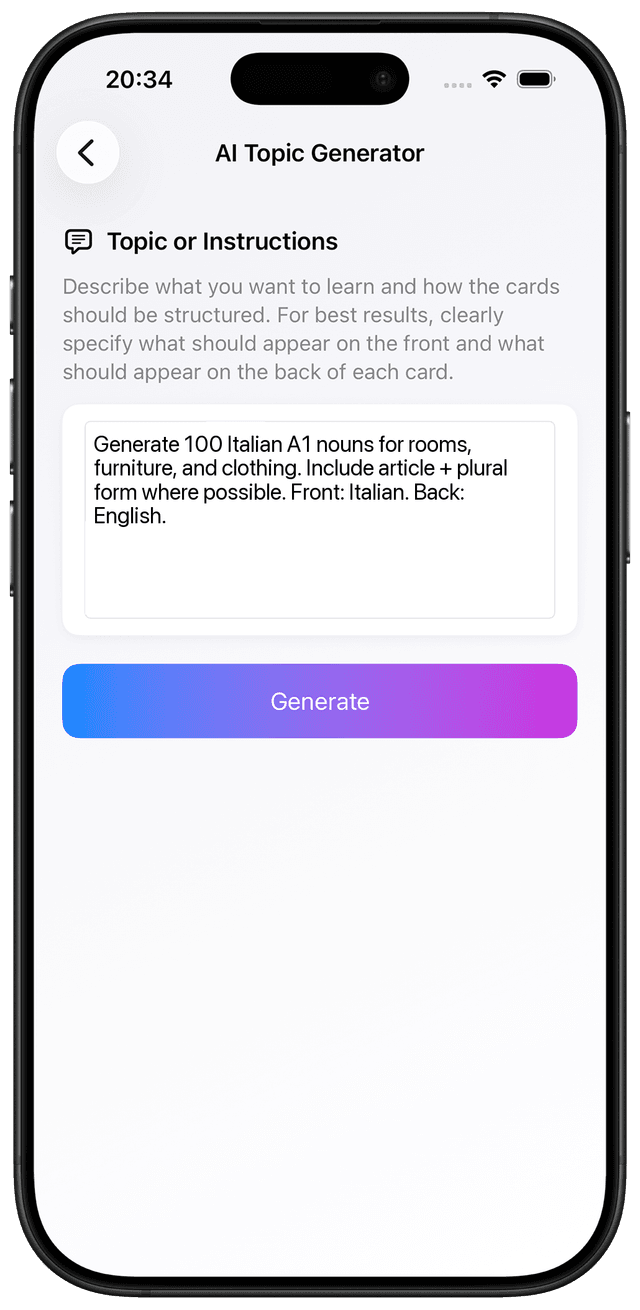
Learn vocabulary for rooms, furniture, clothing, and routines so you can describe your personal world clearly in Italian.
Goal: Speak about home and routine topics confidently in common A1 situations.
Generate 100 Italian A1 nouns for rooms, furniture, and clothing. Include article + plural form where possible. Front: Italian. Back: English.
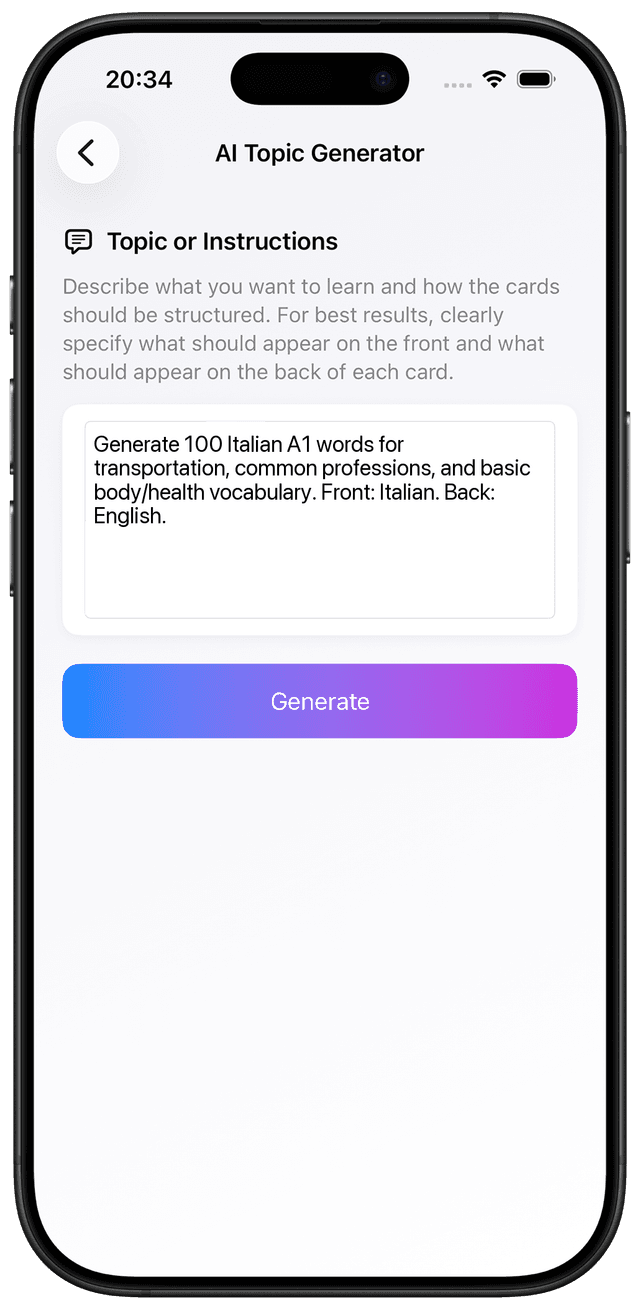
Cover essential vocabulary for transportation, jobs, and basic health topics to handle practical situations confidently in Italian-speaking environments, such as buying train tickets or asking simple pharmacy questions.
Why now? This vocabulary helps immediately with stations, workplaces, pharmacies, and day-to-day problem solving.
Generate 100 Italian A1 words for transportation, common professions, and basic body/health vocabulary. Front: Italian. Back: English.
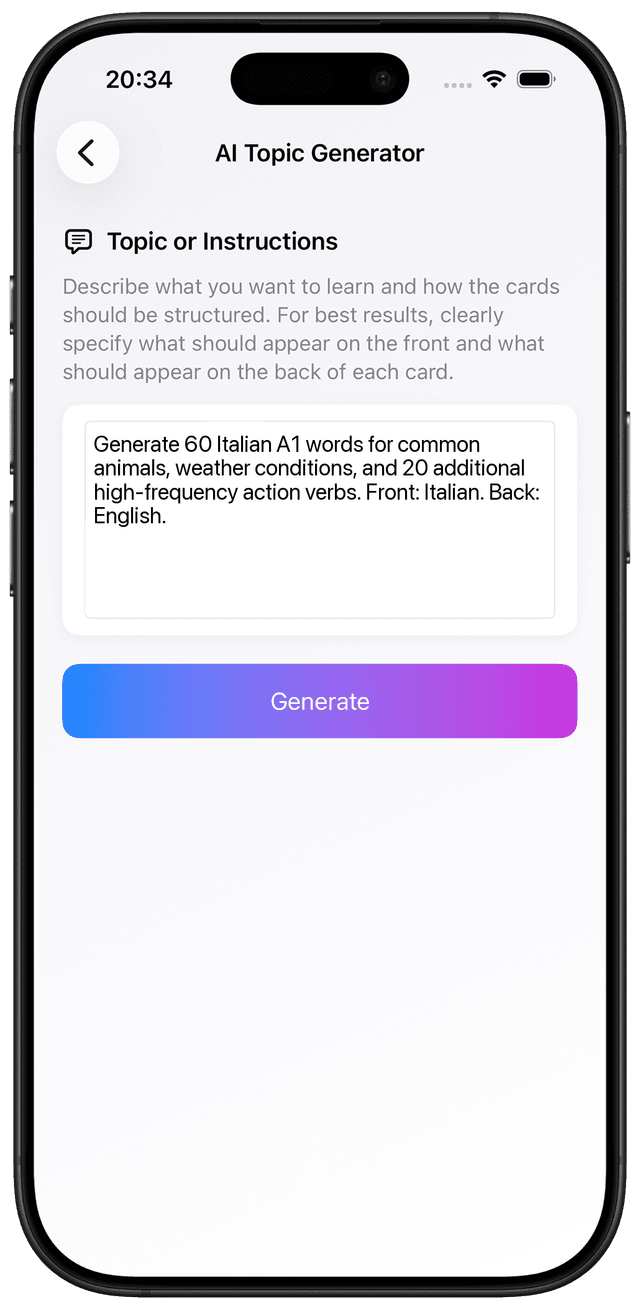
Finish your A1 base with frequent action verbs, weather, animals, and environment terms to round out your active Italian vocabulary.
Milestone: At this stage, you can sustain short everyday conversations with stronger fluency and confidence.
Generate 60 Italian A1 words for common animals, weather conditions, and 20 additional high-frequency action verbs. Front: Italian. Back: English.
MindCards uses active recall plus spacing to turn Italian vocabulary into usable speaking and listening memory.
Keep this deck in daily rotation to strengthen article usage, common verb forms, and high-frequency phrase chunks. When you feel solid on A1, move up to A2.
Learn Italian with momentum using smart flashcards, AI deck generation, and spaced repetition built for consistent real-world progress.