
Spaced repetition explained
Why reviewing at the right interval locks in advanced Italian B2 vocabulary
You have B1 Italian. You can hold a conversation, read a news article with effort, and navigate everyday situations. B2 is where that effort drops noticeably. Sentences that used to require active decoding start arriving whole. You stop translating and start thinking in Italian.
B2 covers roughly 4,000 words in total. This guide focuses on the 1,000+ that actually move the needle: the Congiuntivo Imperfetto and Trapassato for complex past clauses, the Condizionale Passato for hypotheticals, formal writing phrases for CELI B2 tasks, advanced connectors for structured arguments, social and political vocabulary for opinion work, collocations for natural speech, and media vocabulary for authentic Italian comprehension.
Each of the seven phases below includes a ready-to-use AI prompt. Copy it into the MindCards app and it generates a custom flashcard deck in seconds. Spaced repetition then schedules each card at the right interval, so you retain more with less time reviewing.
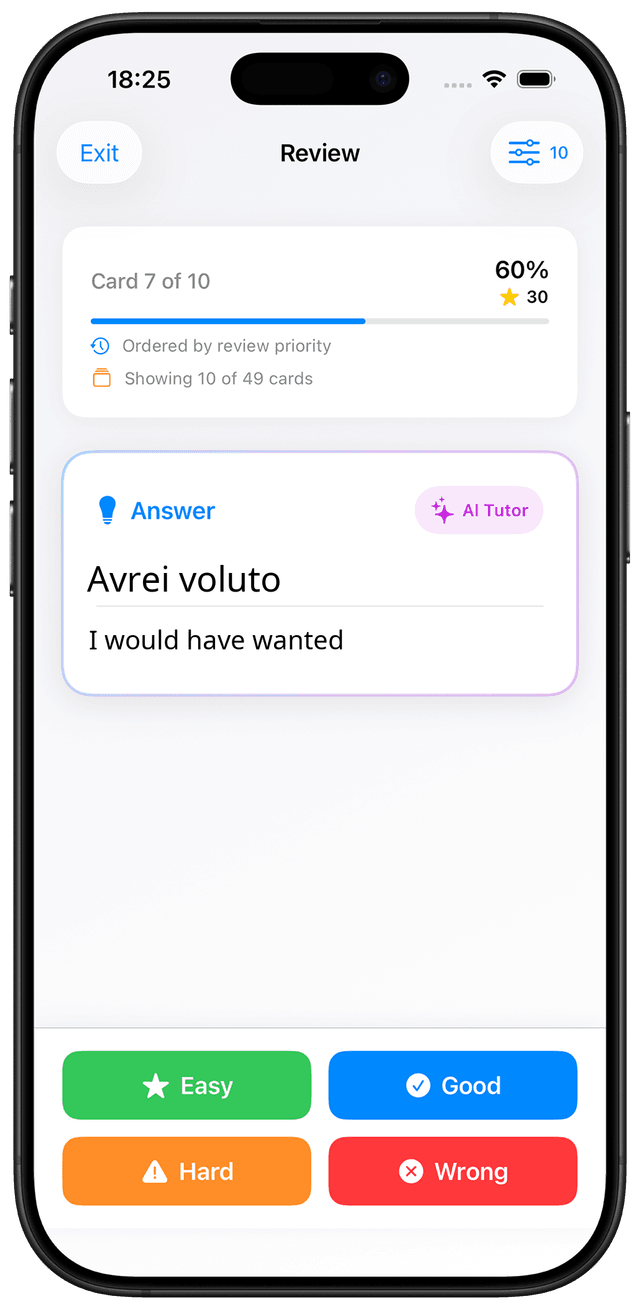
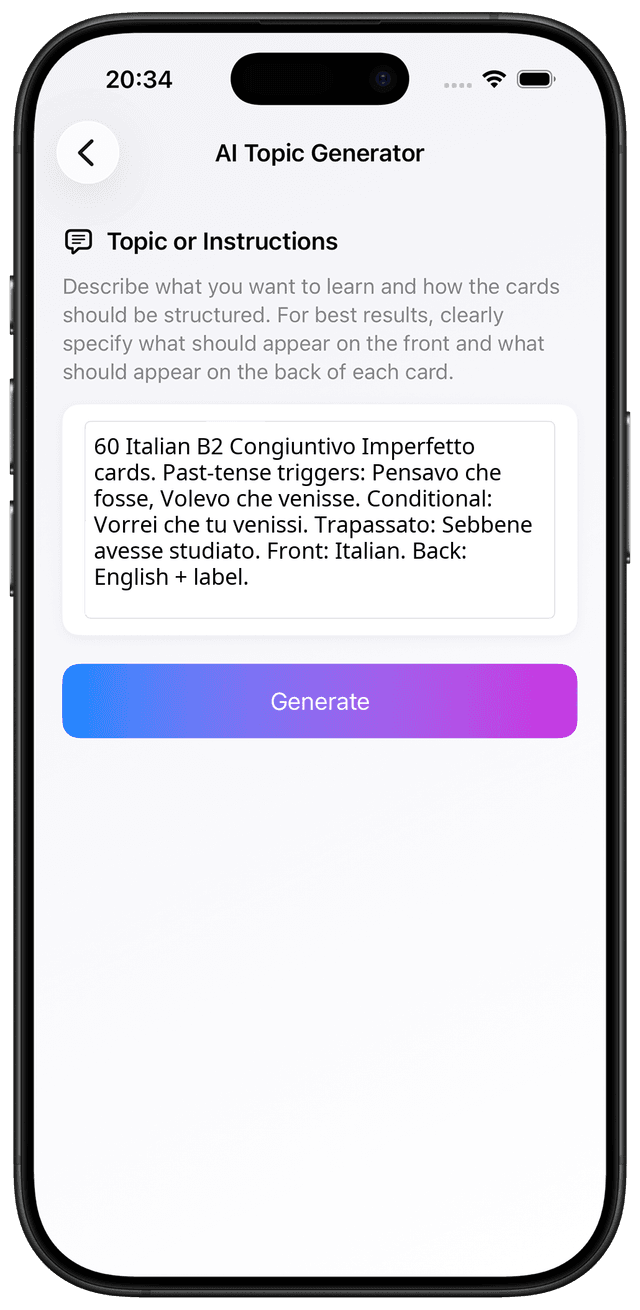
You know the Congiuntivo Presente from B1. At B2 the Congiuntivo Imperfetto takes over whenever the main clause is in a past or conditional tense. Pensavo che fosse difficile (I thought it was difficult) uses the Imperfetto because the main verb pensavo is past. Vorrei che venissi (I would like you to come) uses it because vorrei is conditional. This sequence-of-tense rule is what separates B1 use of the subjunctive from B2 control of it.
The Congiuntivo Trapassato extends this to completed past actions. Sebbene avesse studiato molto, non aveva superato l'esame. The Trapassato (avesse studiato) refers to an action completed before the main clause. It uses the Congiuntivo Imperfetto of avere or essere plus the past participle, following the same auxiliary rules as the Passato Prossimo.
Why start here? The sequence-of-tenses rule for the Congiuntivo is the clearest marker of B2 Italian. CELI B2 writing tasks consistently test whether you can apply it correctly under time pressure.
The strategy: This deck pairs trigger verbs with both present and past main clauses so you absorb the tense shift automatically, not as a rule you have to consciously apply each time.
Generate 60 Italian B2 examples of Congiuntivo Imperfetto and Trapassato. Group 1 (25 Congiuntivo Imperfetto): past main verb + Congiuntivo Imperfetto (Pensavo che fosse stanco, Volevo che venisse, Era necessario che partisse, Speravo che avesse ragione). Group 2 (20 conditional trigger + Congiuntivo Imperfetto): Vorrei che tu venissi, Sarebbe meglio che parlasse, Mi piacerebbe che capisse. Group 3 (15 Congiuntivo Trapassato): Sebbene avesse studiato, non aveva capito; Anche se fossero arrivati prima, non avrebbero trovato posto. Front: Italian sentence. Back: English + tense label.
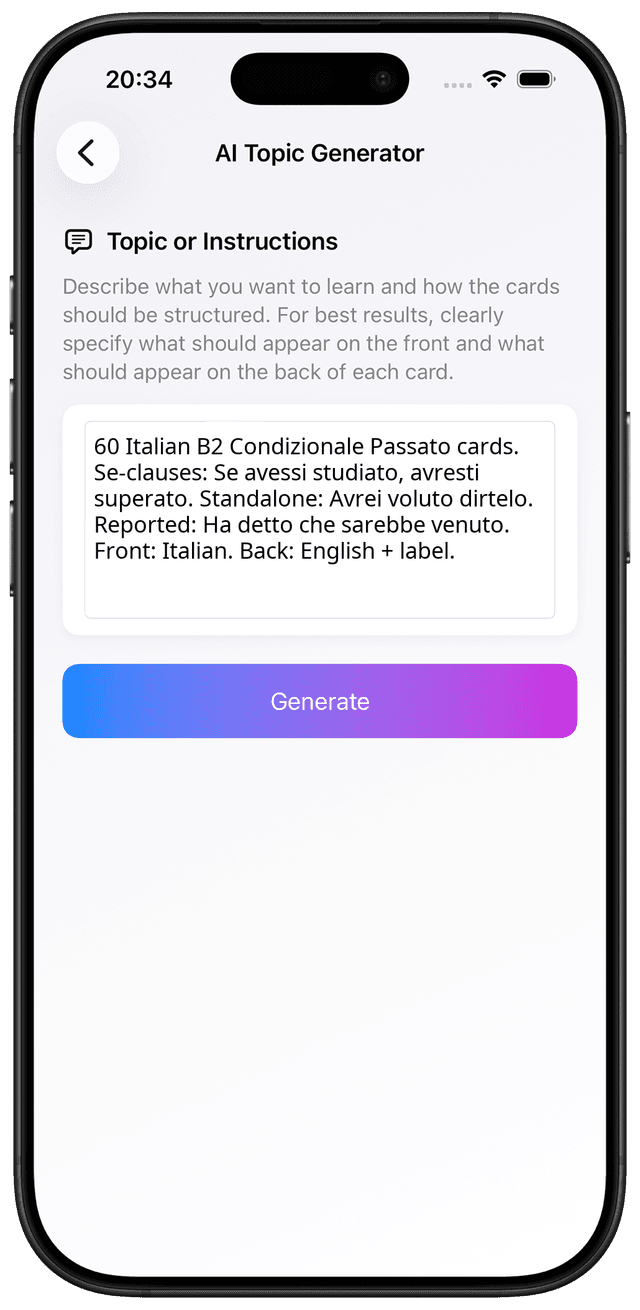
The Condizionale Passato is Italian's way of expressing what would have happened if circumstances had been different. Se avessi studiato di piu, avresti superato l'esame. Se fosse arrivato in tempo, avrebbe visto lo spettacolo. The structure pairs the Congiuntivo Trapassato in the se-clause with the Condizionale Passato in the result clause. Both halves use compound tenses, which is why learners at B1 often avoid this structure and why mastering it marks a genuine B2 shift.
The Condizionale Passato also appears without a se-clause when expressing regret or a wish about a past situation: Avrei voluto dirtelo prima. Sarei dovuto venire prima. These forms appear constantly in Italian film, news, and everyday conversation when someone reflects on past events. They are more idiomatic than any direct English equivalent, which is one reason they need dedicated practice.
Why this second? After the Congiuntivo Imperfetto, the Condizionale Passato is the structure Italian speakers notice most when it is missing. Together they cover the hypothetical past, which is one of the most common registers in Italian conversation.
The strategy: This deck covers full se-clause pairs alongside standalone Condizionale Passato expressions so you practise both the conditional structure and the idiomatic standalone use.
Generate 60 Italian B2 Condizionale Passato examples. Group 1 (30 full se-clause pairs): Se avessi studiato di piu, avresti superato; Se fosse arrivato, avrebbe visto; Se avessimo prenotato, saremmo entrati. Cover both essere and avere auxiliaries. Group 2 (20 standalone Condizionale Passato): Avrei voluto dirtelo; Sarei dovuto restare; Non avrei mai pensato che; Avrei preferito un approccio diverso. Group 3 (10 indirect speech with Condizionale Passato): Ha detto che sarebbe venuto; Pensava che avrebbe finito prima. Front: Italian. Back: English + structure label (Se-clause / Standalone / Reported speech).
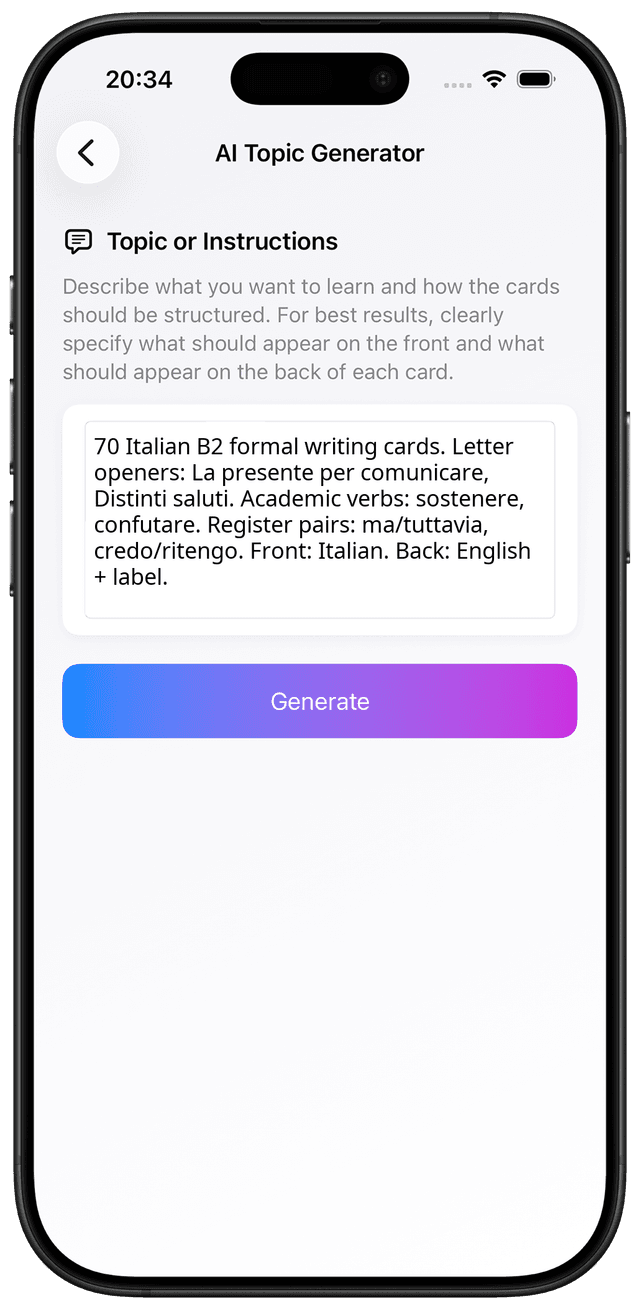
Written Italian at B2 follows conventions that differ significantly from spoken Italian. Formal letters, opinion essays, and official correspondence use stock phrases that Italian institutions expect. La presente per comunicare che..., in attesa di un gentile riscontro, distinti saluti, con riferimento alla Sua del... These are not stylistic choices, they are expected formulas in Italian institutional contexts.
Academic Italian writing uses a different vocabulary from everyday speech. Verbs like sostenere, confutare, ribadire, approfondire, e evidenziare appear in essays and news commentary. Nominalisation is common: l'aumento instead of aumentare, la riduzione instead of ridurre, la crescita instead of crescere. Italian formal prose tends toward longer sentences with more subordinate clauses than English formal writing, which requires specific connectors to handle correctly.
Why this phase? CELI B2 requires a formal letter and an opinion essay. Both are scored partly on register appropriateness. Italian institutional writing has its own stock phrases and academic verbs that this phase covers directly.
The strategy: The deck covers formal correspondence formulas, academic verbs with example sentences, and register-shift pairs showing the everyday word alongside its formal equivalent.
Generate 70 Italian B2 words and phrases for formal written Italian. Group 1 (20 letter formulas): La presente per comunicare che, Con riferimento alla Sua del, In risposta alla Sua richiesta, In attesa di un gentile riscontro, Le porgo distinti saluti, Cordiali saluti, Alla cortese attenzione di, A seguito del nostro incontro. Group 2 (20 academic verbs with example sentences): sostenere, confutare, ribadire, approfondire, evidenziare, analizzare, valutare, verificare, dimostrare, illustrare. Group 3 (15 nominalisations): l'aumento, la riduzione, la crescita, il calo, il miglioramento, il deterioramento, l'incremento. Group 4 (15 register-shift pairs): ma / tuttavia, molti / numerosi, credo / ritengo, fare / effettuare, usare / utilizzare. Front: Italian. Back: English + register label.
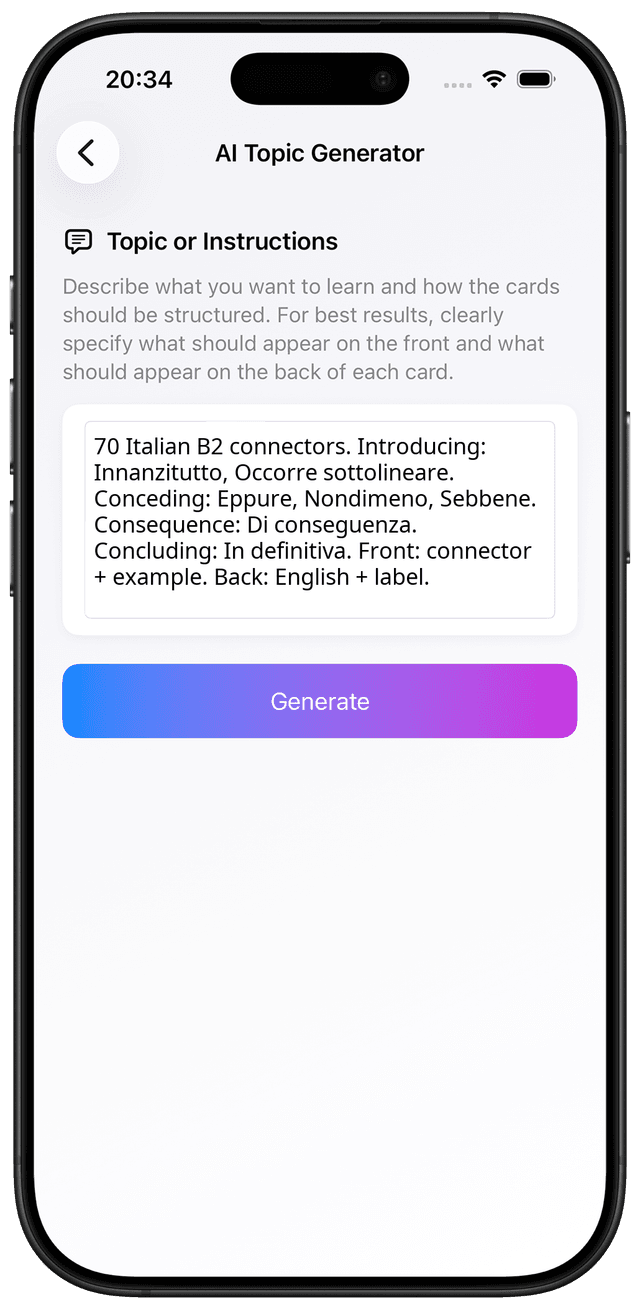
B2 writing tasks require you to build an argument, not just state one. Italian has connectors for introducing a claim, conceding a counterargument, signalling a consequence, and closing with a synthesis. The connectors at B2 go well beyond B1 basics like pero and quindi. Eppure, nondimeno, per contro, cio nonostante, di conseguenza, a tal riguardo, come si evince da are all structures that CELI B2 examiners look for.
Italian formal argumentation also uses specific patterns for agreeing and disagreeing formally. Non si puo non riconoscere che, e indubbio che, bisogna tuttavia rilevare che, and occorre pero precisare che are ways of acknowledging a point while qualifying it. These patterns show that you can handle nuance in writing, not just add more vocabulary.
Why this phase? CELI B2 essay tasks are scored partly on cohesion. Examiners tell immediately whether a candidate controls these structures or is improvising. Together with formal register, argumentation connectors cover most of what separates a B2 essay from a B1 essay.
The strategy: Each card pairs the connector with a full example sentence so you learn it in context, not in isolation from the discourse it belongs to.
Generate 70 Italian B2 connectors and argumentation phrases. Group 1 (15 introducing and emphasising): Innanzitutto, In primo luogo, Occorre sottolineare che, E opportuno precisare che, Come si evince da, A tal riguardo. Group 2 (15 conceding and contrasting): Eppure, Nondimeno, Cio nonostante, Per contro, Sebbene + congiuntivo, Benche + congiuntivo, Malgrado cio, Bisogna tuttavia rilevare che. Group 3 (15 consequence and cause): Di conseguenza, Per tale motivo, Ne deriva che, A causa di cio, Alla luce di quanto detto. Group 4 (15 synthesising and concluding): In conclusione, Alla luce di quanto esposto, Tutto sommato, In definitiva, Tenuto conto di. Group 5 (10 qualification): Non si puo non riconoscere che, E indubbio che, Occorre pero precisare che. Front: connector + example sentence. Back: English + function label.
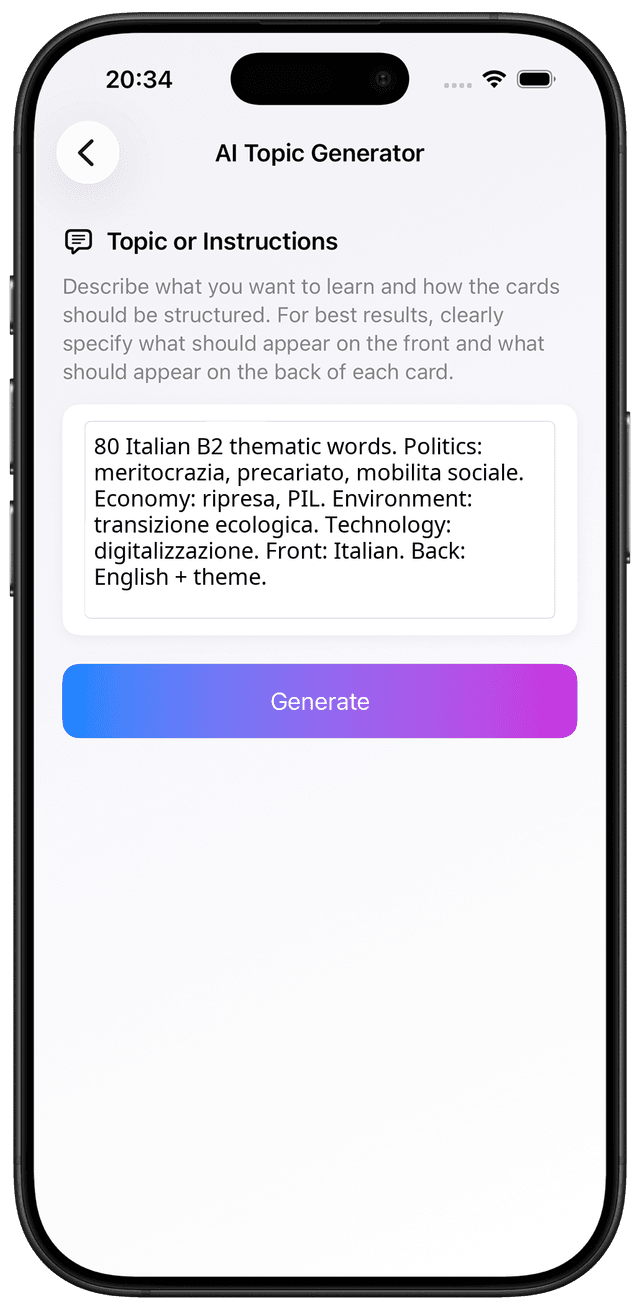
CELI B2 reading and listening passages use social and political topics: economic inequality, environmental policy, immigration, work and labour rights, urban development, and technology. You need vocabulary that lets you read these texts without stopping constantly and produce commentary on them in writing and speech.
Italian political and social vocabulary has its own specific terms. La meritocrazia, il precariato, il reddito di cittadinanza, la mobilita sociale, il divario nord-sud, le politiche di welfare, and l'emigrazione giovanile appear in Italian newspaper and news commentary regularly. Italian journalism also uses specific nominalised forms: la ripresa (recovery), il rallentamento (slowdown), il consolidamento (consolidation), rather than their verbal equivalents.
Why society and politics? B2 authentic texts almost always use social topics. CELI B2 listening extracts come from Italian radio news and current affairs programmes. Building this vocabulary before sitting the exam means you are decoding context, not individual words.
The strategy: The deck groups 80 words and phrases by theme. Each entry includes a sentence from the type of context you encounter in B2 reading and listening tasks.
Generate 80 Italian B2 thematic vocabulary items. Theme 1 - Politics and institutions (20): la meritocrazia, il precariato, il reddito di cittadinanza, la mobilita sociale, il divario nord-sud, le politiche di welfare, la disoccupazione giovanile, l'emigrazione giovanile, il governo di coalizione, il sistema elettorale, la riforma costituzionale, la fiducia parlamentare, il decreto legge, la manovra finanziaria, il piano nazionale, la governance, la sussidiarieta, il federalismo, l'autonomia regionale, il comune. Theme 2 - Economy (20): la ripresa economica, il rallentamento, il PIL, l'inflazione, il deficit, la competitivita, le esportazioni, la bilancia commerciale, il mercato del lavoro, la delocalizzazione. Theme 3 - Environment (20): la transizione ecologica, le energie rinnovabili, l'impatto ambientale, il cambiamento climatico, la sostenibilita, la biodiversita, l'inquinamento atmosferico, la siccita, il dissesto idrogeologico, la decarbonizzazione. Theme 4 - Technology and society (20): la digitalizzazione, l'intelligenza artificiale, i dati personali, la privacy, la disinformazione, l'esclusione digitale, il telelavoro, la transizione digitale, l'e-commerce, le piattaforme digitali. Front: Italian. Back: English + theme label.
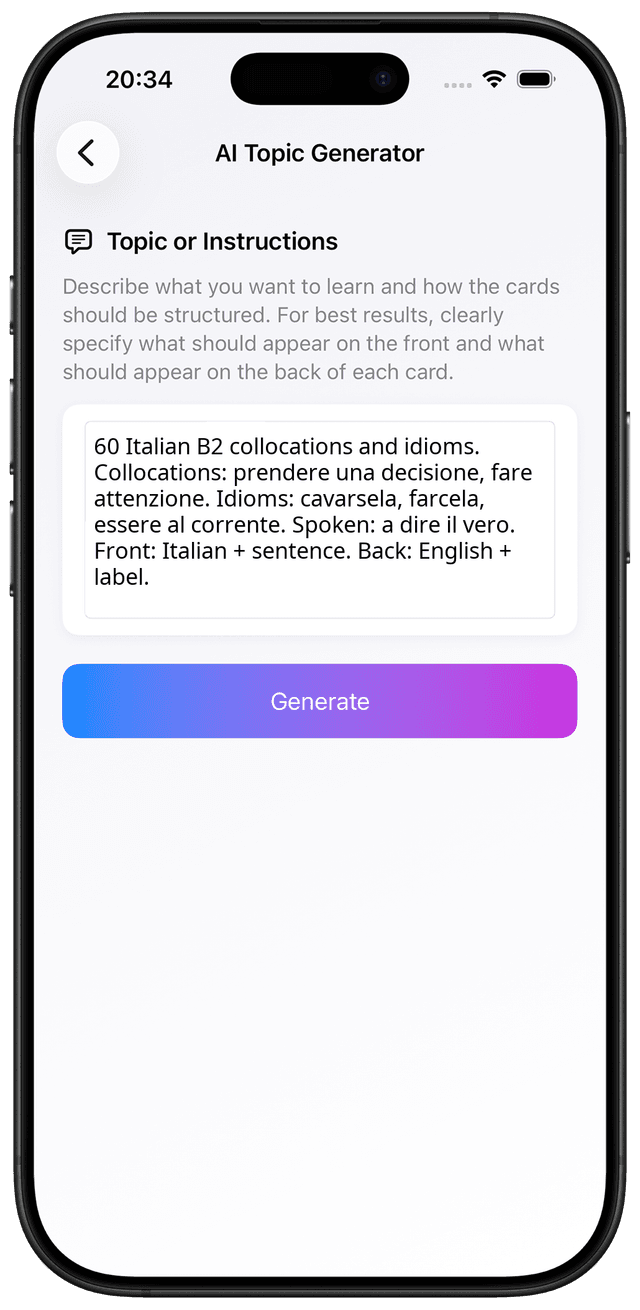
Native Italian speakers do not use textbook Italian in conversation. They use set phrases, collocations (word pairings that sound natural to an Italian ear), and idioms that grammatical study alone does not prepare you for. At B2 your vocabulary needs these patterns or your Italian sounds unnaturally stiff even when your grammar is correct.
Collocations are particularly important because English-speaker errors often come from translating them directly. You make a decision in English but you prendere una decisione in Italian. You pay attention in English but you fare attenzione. You take advantage in English but you approfittare di. Italian verb-noun pairings follow their own logic, and knowing them avoids the interference errors that mark a learner at B2.
The goal: Close the gap between textbook Italian and the Italian you actually hear in films, podcasts, and conversations with native speakers. This phase builds collocations and common idioms alongside the contexts where they appear.
The strategy: Each card shows the phrase in a sentence so you learn the collocation in use, not as an isolated pair. This is how native speakers store these patterns in long-term memory.
Generate 60 Italian B2 collocations and idiomatic expressions. Group 1 (20 verb-noun collocations): prendere una decisione, fare attenzione, approfittare di, mettere in dubbio, dare per scontato, tenere conto di, rendersi conto di, fare a meno di, andare a finire, portare avanti, mandare avanti, mettere in pratica, dare fastidio, fare del proprio meglio, perdere di vista. Group 2 (20 common idioms with meaning): cavarsela (to manage), farcela (to make it), prenderla bene/male (to take it well/badly), metterci del proprio (to put in effort), essere al corrente (to be aware), essere alle strette (to be in a tight spot), tagliare la testa al toro (to settle something once and for all), non vedere l'ora (to look forward to). Group 3 (20 spoken B2 register phrases): a dire il vero, in fondo, di fatto, come mai, per cui, nel senso, alla fine dei conti, a conti fatti, senza dubbio, a quanto pare. Front: Italian phrase + sentence. Back: English + register note (Collocation/Idiom/Spoken).
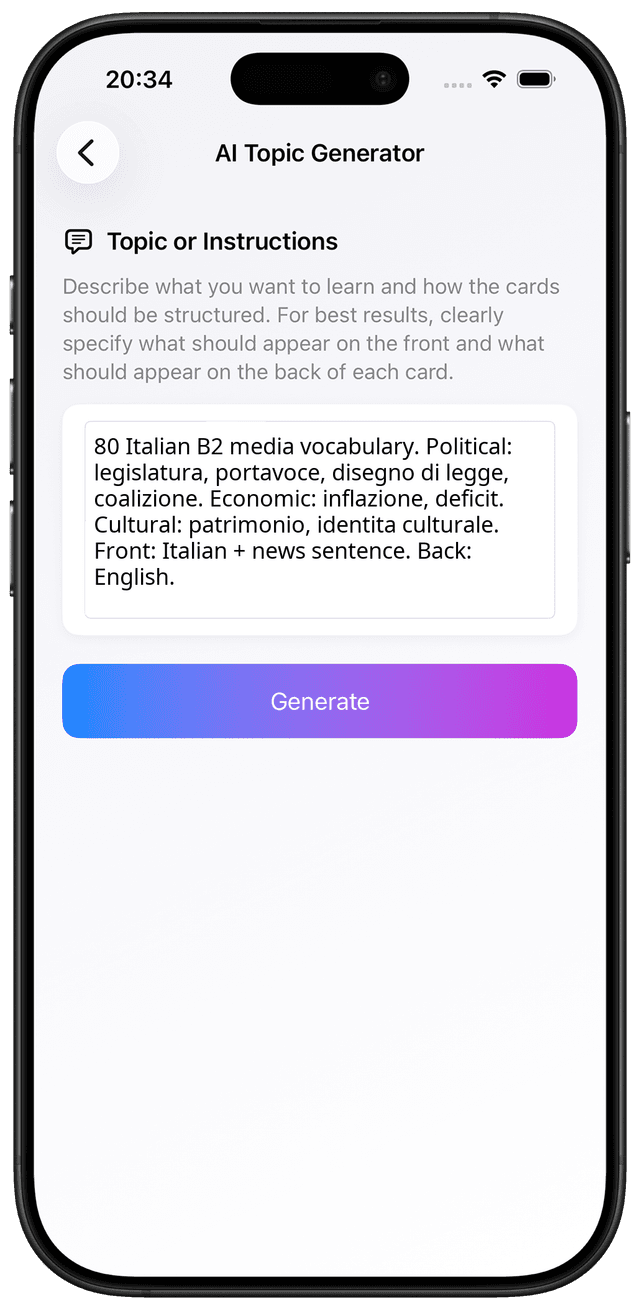
At B2 you should be able to follow a Radio RAI documentary, read an opinion column in La Repubblica, and understand a podcast on a topic you care about without stopping every few minutes. The vocabulary gap that blocks this is usually not grammar but exposure to the specific word sets used in Italian-language journalism, commentary, and cultural writing.
Italian journalism uses specific structures that do not appear in textbooks. The passive with si (si e deciso che, si prevede un aumento), impersonal constructions (e previsto che, risulta che, si apprende da fonti), and nominalisation (il rialzo, il cedimento, il rilancio) appear constantly in B2 listening and reading texts. Recognising these patterns matters as much as knowing individual words.
The B2 milestone: With this phase complete, your Italian B2 vocabulary and grammar are solid. You can follow an Italian news broadcast, write a structured opinion essay, discuss complex social topics, and sit CELI B2 without reaching for a dictionary at every sentence. C1 builds directly on these foundations by extending your idiomatic range and control of complex register.
Generate 80 Italian B2 vocabulary items for authentic media comprehension. Register 1 - Political and institutional (25): la legislatura, il governo di transizione, il portavoce, la riforma, l'emendamento, il disegno di legge, il Senato, la Camera dei Deputati, il voto di fiducia, la nomina, il mandato, il decreto, la coalizione, la minoranza, la maggioranza, l'opposizione, il Presidente del Consiglio, la Conferenza Stato-Regioni, l'Unione Europea, il Parlamento Europeo, la Corte Costituzionale, la magistratura, la sentenza, il ricorso, l'appello. Register 2 - Economic reporting (25): l'inflazione, il tasso di interesse, il mercato azionario, la recessione, la ripresa economica, il deficit di bilancio, il debito pubblico, la crescita del PIL, l'export, gli investimenti, il tasso di disoccupazione, il rialzo, il cedimento, il rilancio, la contrazione, la fusione, l'acquisizione, le quotazioni, la Borsa, i mercati finanziari, la BCE, il Fondo Monetario Internazionale, il rating, l'agenzia di rating, la capitalizzazione. Register 3 - Cultural commentary (30): il patrimonio culturale, l'identita nazionale, la diversita linguistica, il fenomeno sociale, la tendenza, il divario generazionale, l'integrazione culturale, la memoria storica, il cinema d'autore, il teatro di prosa, la letteratura contemporanea, l'editoria, la stampa, il giornalismo d'inchiesta, la cronaca, il reportage, l'inchiesta giornalistica, il programma di approfondimento, il talk show, il documentario, la fiction televisiva, la serie, il palinsesto, il canone Rai, la televisione pubblica, la rete, il format, la critica letteraria, il saggio, la narrativa. Front: Italian term + journalism-style example sentence. Back: English equivalent.
At B2 the vocabulary is less predictable than A1-B1 core words. You encounter academic registers, political language, and idiomatic phrases that do not follow simple patterns. Spaced repetition handles this well: cards you find difficult appear more often, cards you know well drop back. You spend time where it counts, not on words you already know.
B2 builds on B1 and prepares you for C1. Use the links below to move between levels or return to the full Italian guide.
Build your Italian B2 vocabulary with AI-generated decks and spaced repetition that adapts to what you actually find difficult. Free to download. No account required. Start with the phase that covers your biggest gap.