
Spaced repetition explained
Why reviewing at the right interval is the key to retaining mastery-level Dutch vocabulary
You have C1 Dutch. You can switch register, follow a Volkskrant editorial, write a structured formal letter, and hold your own in a Dutch meeting without translating mid-sentence. C2 is where the remaining effort drops away. Idioms arrive on time. Juridical Dutch reads like normal prose. You can write a paragraph that does not feel translated.
This guide covers the 1,500+ items that close the last gap between advanced and near-native Dutch. Native collocations come first, because wrong combinations are the single most visible non-native marker. Then comes CNaVT Educatief Professioneel exam vocabulary, deep idiom density, juridical and ambtelijk Dutch for legal and policy work, academic register for Dutch wetenschappelijk schrijven, professional domain vocabulary in healthcare, economics, policy, and media, and finally the stylistic control that makes Dutch prose feel authored rather than produced.
Each of the seven phases below includes a ready-to-use AI prompt. Paste it into MindCards and your first deck for that topic builds in seconds. Spaced repetition then schedules each card at the right interval, so your review time goes to the items you are actually still forgetting.
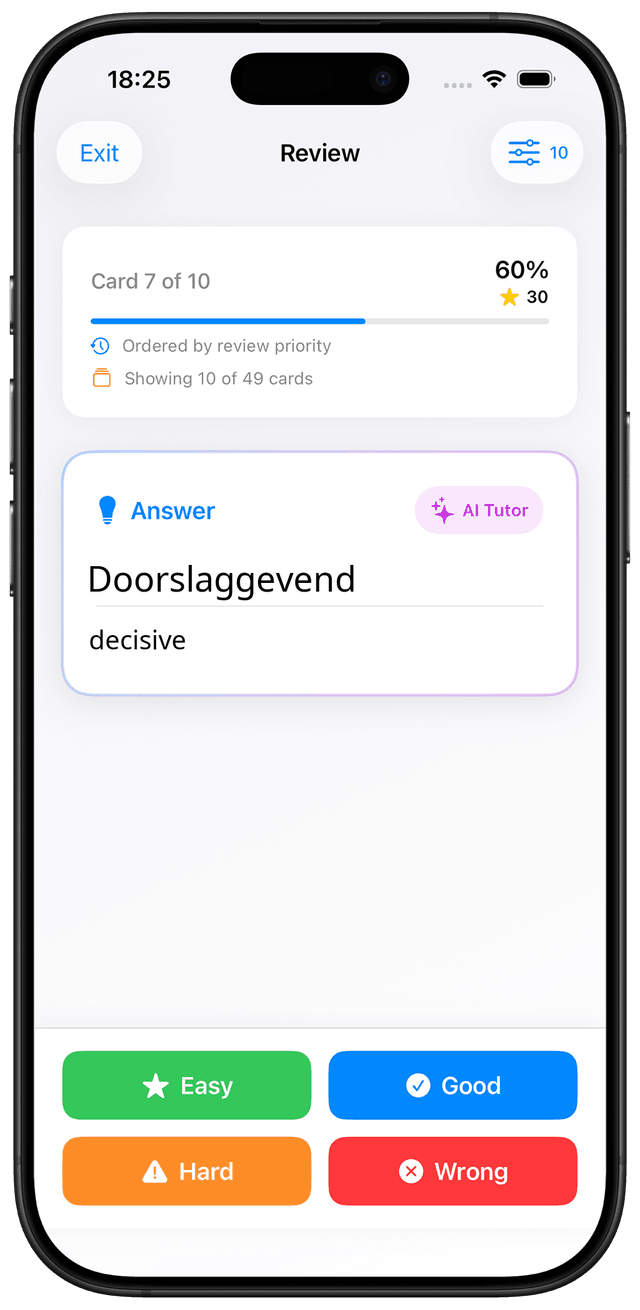
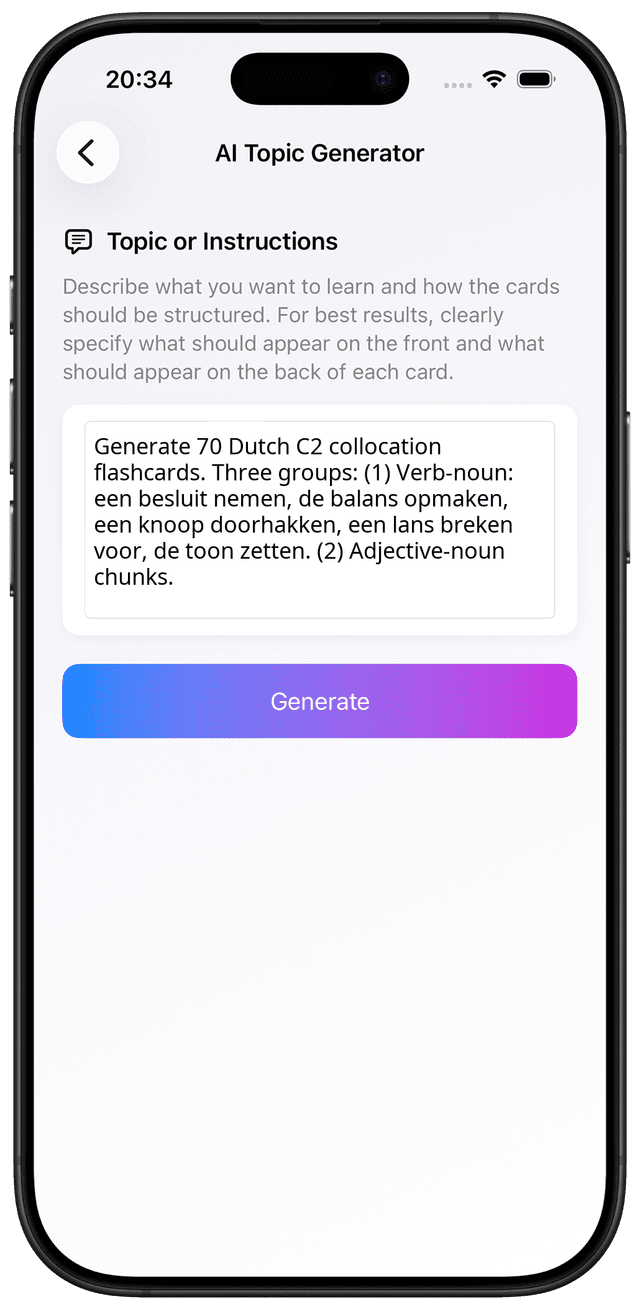
C2 Dutch is rarely about new words. It is about combining the words you already know the way Dutch speakers actually combine them. The distance between you and a native at this level is mostly collocational. Educated speakers do not pick a verb and a noun independently. They pull whole chunks: een besluit nemen, de balans opmaken, een knoop doorhakken, de aandacht vestigen op, een lans breken voor, de toon zetten. A native produces these without thinking. A learner builds them word by word, and that effort shows in writing.
Why start here? Wrong collocations are the single most visible signal of a non-native writer at C2. CNaVT Educatief Professioneel raters notice unusual word combinations before they notice grammar slips. This deck targets the 200 most frequent verb-noun, adjective-noun, and adverb-verb chunks from contemporary Dutch press, policy documents, and educated speech.
The strategy: Each card pairs the full collocation with a native-context sentence and the most common learner error to avoid. You build recognition and active production in the same pass.
Generate 70 Dutch C2 collocation flashcards. Three groups: (1) Verb-noun collocations: een besluit nemen, de balans opmaken, een knoop doorhakken, de aandacht vestigen op, een lans breken voor, de toon zetten, een conclusie trekken, de schijn wekken, een standpunt innemen, het voortouw nemen, gehoor geven aan, een beroep doen op. (2) Adjective-noun: doorslaggevend argument, indringende vraag, schrijnend gebrek, omstreden besluit, voor de hand liggende oplossing, ingrijpend voorstel, gevoelig dossier, sluitende redenering. (3) Common learner errors to contrast: een conclusie trekken not maken, een besluit nemen not maken, gelijk hebben not zijn, iets ter sprake brengen not bespreken, aandacht besteden aan not geven. Front: Dutch collocation plus example sentence. Back: English equivalent plus a usage note on register or common error.
The CNaVT Educatief Professioneel certificate is the Dutch-language qualification for working as a teacher, lecturer, or other educational professional in Dutch-medium institutions. It tests the vocabulary of pedagogy, didactiek, curriculum, evaluation, and the institutional language of Dutch and Flemish education. This is C2 because the tasks ask you to read policy notes, write lesson reflections, present pedagogical positions, and handle staff-room and parent-teacher conversations at full professional speed.
The exam vocabulary does not overlap fully with general C2. It is more specific: words like doorlopende leerlijn, formatieve evaluatie, leerlinggericht onderwijs, schoolwerkplan, klassenmanagement, differentiatie naar niveau, leerstoornis, ouderbetrokkenheid. Treating these as everyday vocabulary is what the exam measures.
Why this matters: Educatief Professioneel is the C2-level CNaVT profile that opens doors to teaching positions in the Netherlands and Flanders. Without command of this domain vocabulary, even strong general Dutch falls short on the writing and presentation tasks. The reading and listening tasks both lean on authentic Dutch and Flemish education texts.
The strategy: This deck covers the 150 most frequent pedagogical and institutional terms from CNaVT past papers and Dutch and Flemish education policy documents, with example sentences pulled from authentic school contexts.
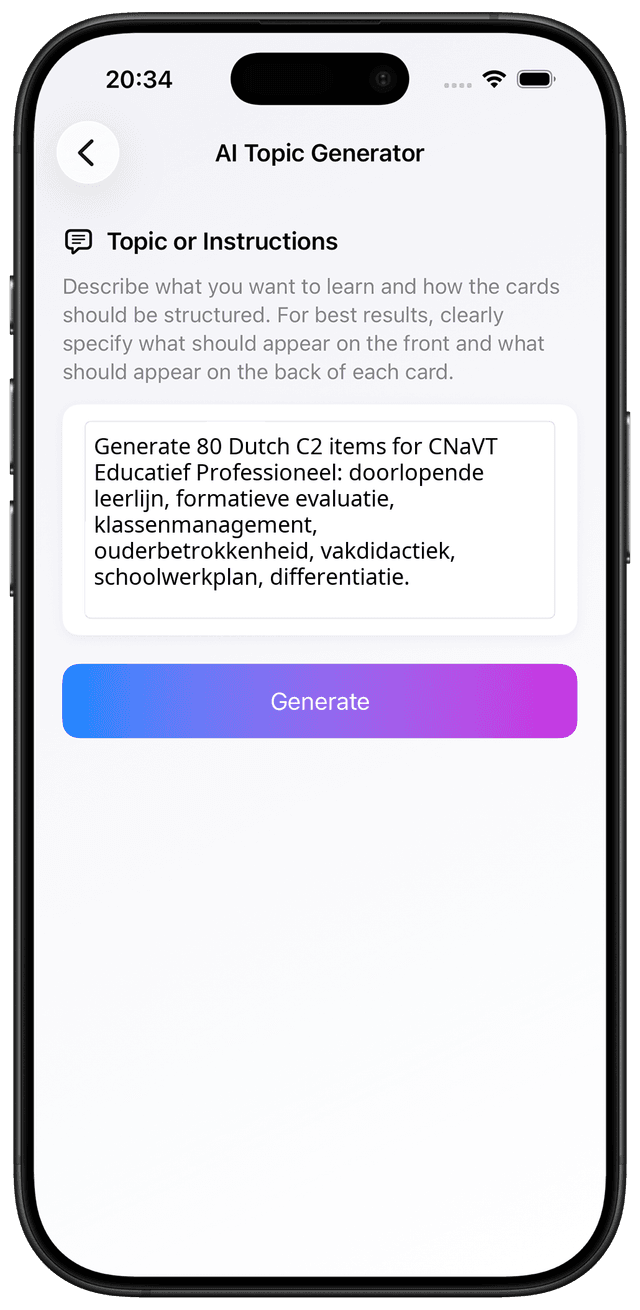
Generate 80 Dutch C2 vocabulary items aligned to CNaVT Educatief Professioneel. Four groups: (1) Didactiek and curriculum: doorlopende leerlijn, leerdoelen formuleren, kerndoel, eindterm, leerplandoel, formatieve evaluatie, summatieve toetsing, leerlinggericht onderwijs, differentiatie naar niveau, handelingsgericht werken. (2) School organisation and policy: schoolwerkplan, jaarplan, zorgplan, schoolbestuur, medezeggenschapsraad, ouderbetrokkenheid, onderwijsinspectie, kwaliteitsbeleid, schoolprofiel. (3) Classroom and pedagogy: klassenmanagement, leerstoornis, dyslexieprotocol, gedragsproblematiek, motivatiebevordering, executieve functies, peerfeedback, leerstrategie. (4) Professional context: vakdidactiek, lerarenopleiding, stagebegeleiding, intervisie, professionalisering, lesbezoek, functioneringsgesprek. Front: Dutch term plus authentic example sentence. Back: English equivalent plus a domain label and example use in CNaVT-style writing.
C1 covered the idioms you meet in Dutch newspapers and professional meetings. C2 adds the layer underneath: the uitdrukkingen that appear in essays, novels, opinion columns, and political speech, often carrying ironic or rhetorical weight. Knowing that iemand in het ootje nemen is to pull someone's leg, that de hand in eigen boezem steken is to take responsibility, or that met de mantel der liefde bedekken means to gloss over with kindness, is part of what makes C2 Dutch feel native rather than translated.
Many of these idioms are bijbelse uitdrukkingen (biblical), historical, or maritime in origin. A C2 speaker recognises the cultural reference, hears the register, and knows when an idiom is in play and when it is being used ironically. Misreading the irony is worse than missing the idiom altogether.
Why this matters: Dutch literary prose and serious journalism rely on idiom density at this level. NRC editorials, Volkskrant columns, and writers like Grunberg, Mulisch, or Hermans use idioms as load-bearing parts of the argument, not decoration. Missing the idiom means missing the position.
The strategy: This deck covers the 80 most frequent C2 uitdrukkingen in literary and journalistic Dutch, with cultural origin notes where they help: biblical, historical, maritime, or agricultural.
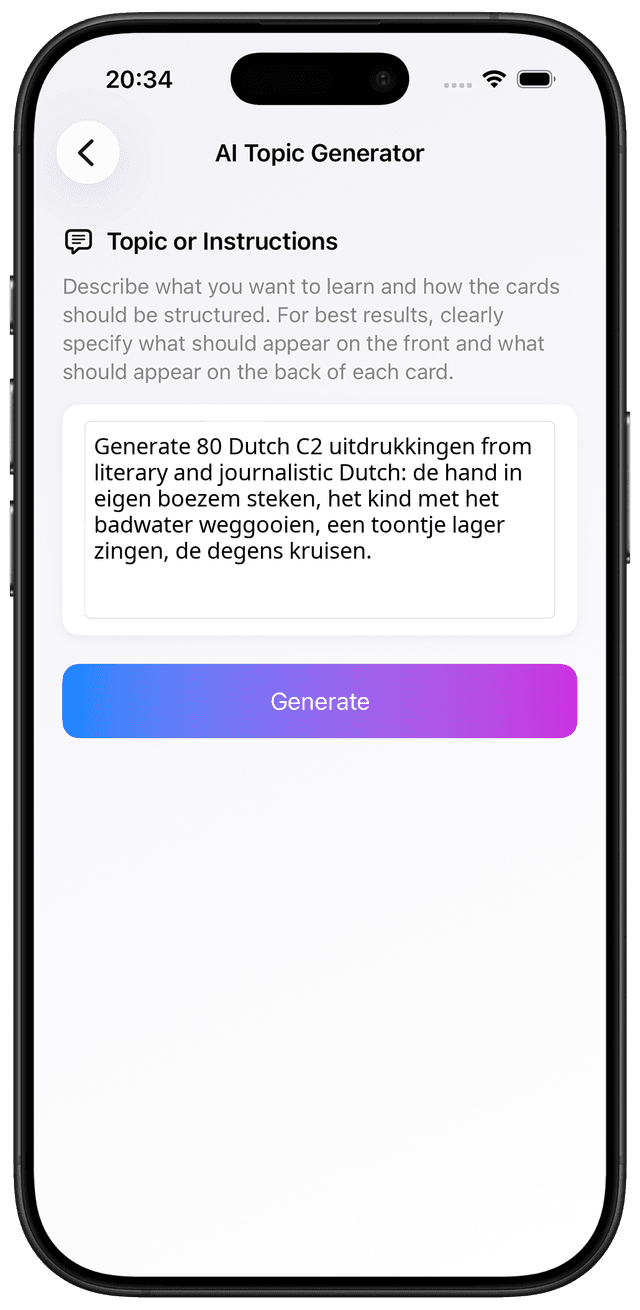
Generate 80 Dutch C2 idioms and uitdrukkingen from literary and journalistic Dutch. Four thematic groups: (1) Moral and rhetorical: de hand in eigen boezem steken, met de mantel der liefde bedekken, iemand de wacht aanzeggen, iemand in het ootje nemen, het kind met het badwater weggooien, met twee maten meten, een toontje lager zingen. (2) Power and conflict: de degens kruisen, het onderspit delven, aan het langste eind trekken, iemand het gras voor de voeten wegmaaien, met de billen bloot moeten, de kat de bel aanbinden, de kop in het zand steken. (3) Truth and concealment: er geen doekjes om winden, de waarheid geweld aandoen, een loopje nemen met de waarheid, iemand om de tuin leiden, achter de schermen, koren op de molen van iemand. (4) Biblical and historical origin: jobstijding, de zondebok zijn, gebraden duiven die in de mond vliegen, aan iemands lippen hangen, met lood in de schoenen. Front: Dutch idiom plus literary or journalistic context sentence. Back: English meaning plus origin label and usage note.
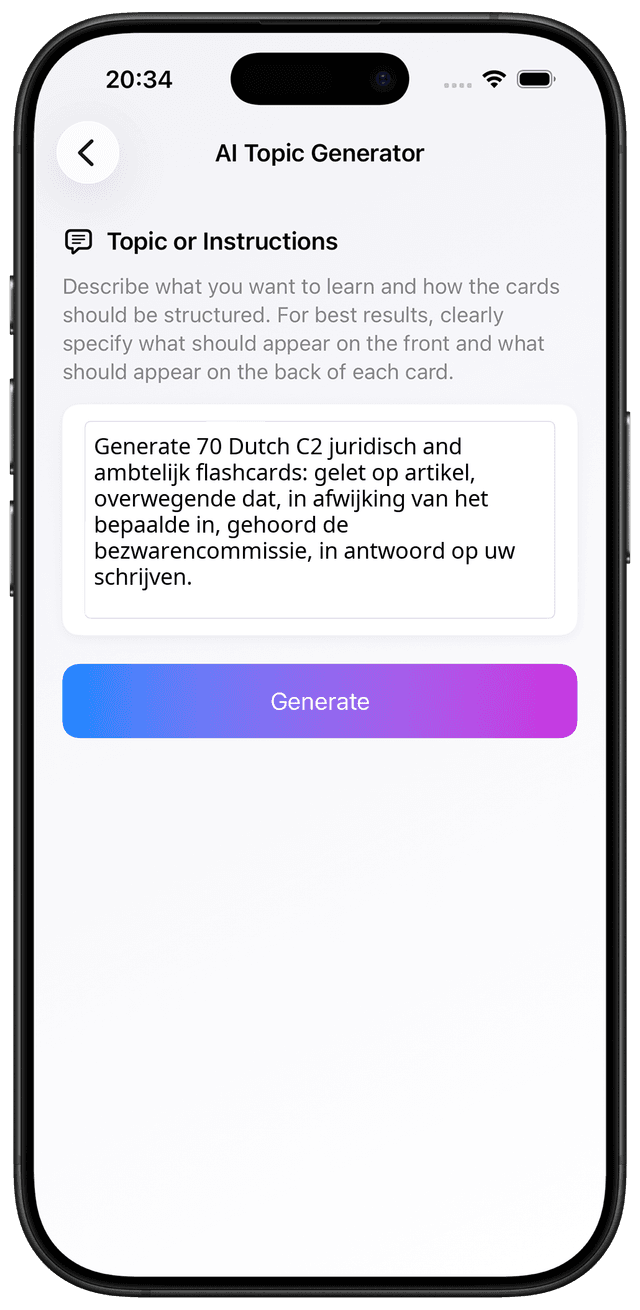
Dutch law, public administration, and policy share a fixed and dense vocabulary that does not flex into casual register. If you work in or with Dutch and Flemish institutions, this layer is not optional. Court judgments, university regulations, employment contracts, and ministerial letters all use it. Gelet op artikel, overwegende dat, in afwijking van, met inachtneming van het bepaalde in, de Raad van State, het bestuursorgaan, de bezwarencommissie. Each phrase is a fixed building block, and producing the wrong one in a formal letter is immediately noticeable.
Ambtelijk Nederlands is also famous for nominale stijl carried to its limit and for the passive constructions that hide who is doing what. C1 introduces the style. C2 asks you to read it without effort and produce it correctly when the context calls for it.
The goal: Active command of the 150 most common fixed phrases in Dutch legal texts, administrative correspondence, and policy documents. The line between near-C2 and true C2 in professional contexts often runs through whether you can produce these phrases correctly rather than just recognise them in print.
The strategy: Phrases are grouped by document type: court judgments, administrative decisions, official letters, and policy memos. Each card shows the phrase inside a realistic Dutch document extract.
Generate 70 Dutch C2 juridical and ambtelijk flashcards in four groups: (1) Court judgments and procedure: gelet op artikel, overwegende dat, de rechtbank acht het aannemelijk, de vordering wordt toegewezen, de vordering wordt afgewezen, in eerste aanleg, in hoger beroep, gezag van gewijsde, in kort geding. (2) Administrative decisions: het bestuursorgaan besluit, in afwijking van het bepaalde in, met inachtneming van, bij gebreke van, onverminderd het bepaalde in, gehoord de bezwarencommissie, conform de Algemene wet bestuursrecht. (3) Official correspondence: in antwoord op uw schrijven, naar aanleiding van uw verzoek, ik bericht u hierbij dat, met vriendelijke groet, hoogachtend, in afschrift verzonden aan. (4) Policy and regulatory: in het kader van het beleidsplan, onder verwijzing naar, voor zover hier van belang, tenzij anders bepaald, conform de geldende regelgeving. Front: Dutch phrase plus document context. Back: English plus document type label.
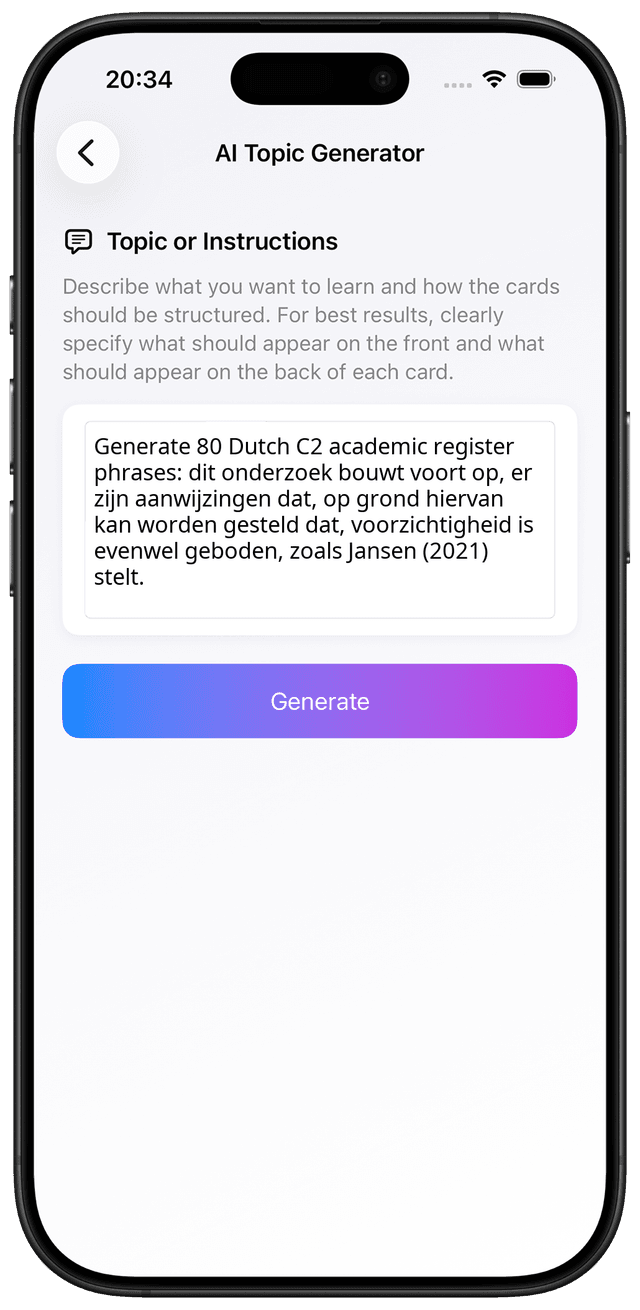
Dutch academic writing has its own conventions. C1 introduces the structure phrases. C2 expects you to handle the full toolkit: hedged claims, careful citation phrasing, methodological vocabulary, and the metadiscourse markers that signal a writer guiding the reader through an argument. Onderzoeken laten zien dat. Dit onderzoek bouwt voort op. Uit de data komt naar voren dat. Er valt evenwel op te merken dat. These are not optional polish. They are the load-bearing scaffolding of a Dutch academic paper.
At C2 you are also expected to manage epistemic stance: signalling certainty, uncertainty, and disagreement with the literature without being either timid or arrogant. Dutch academic Dutch leans toward understatement, so phrases like het is niet ondenkbaar dat, er zijn aanwijzingen dat, en this study suggests, are doing real argumentative work.
Why this comes next: Whether you are reading a Dutch master's thesis, writing a paper for a Dutch journal, or sitting a CNaVT Educatief Professioneel writing task, you need this layer. Without it your academic Dutch reads as competent but flat, and Dutch readers feel the absence.
The strategy: This deck covers the 100 most frequent academic register phrases in Dutch journal articles and theses, sorted by argumentative function: framing, hedging, citing, contrasting, and concluding.
Generate 80 Dutch C2 academic register phrases in five groups: (1) Framing and motivation: dit onderzoek bouwt voort op, een centrale vraag in dit verband is, onderzoeken laten zien dat, in eerdere studies is aangetoond dat, er bestaat consensus over. (2) Hedging and stance: er zijn aanwijzingen dat, het is niet ondenkbaar dat, dit suggereert dat, op grond hiervan kan worden gesteld dat, voorzichtigheid is hier evenwel geboden. (3) Citing and engaging with literature: zoals Jansen (2021) stelt, in lijn met de bevindingen van, in tegenstelling tot wat eerder werd verondersteld, hier valt op af te dingen dat. (4) Methodological discourse: aan de hand van een mixed-methods aanpak, op basis van een kwalitatieve analyse, de operationalisering van het begrip, de validiteit van de meting, de generaliseerbaarheid van de bevindingen. (5) Conclusion and limitation: samenvattend kan worden geconcludeerd dat, de bevindingen wijzen erop dat, een beperking van dit onderzoek is, vervolgonderzoek zou zich kunnen richten op. Front: Dutch phrase. Back: English plus function label and a typical sentence frame.
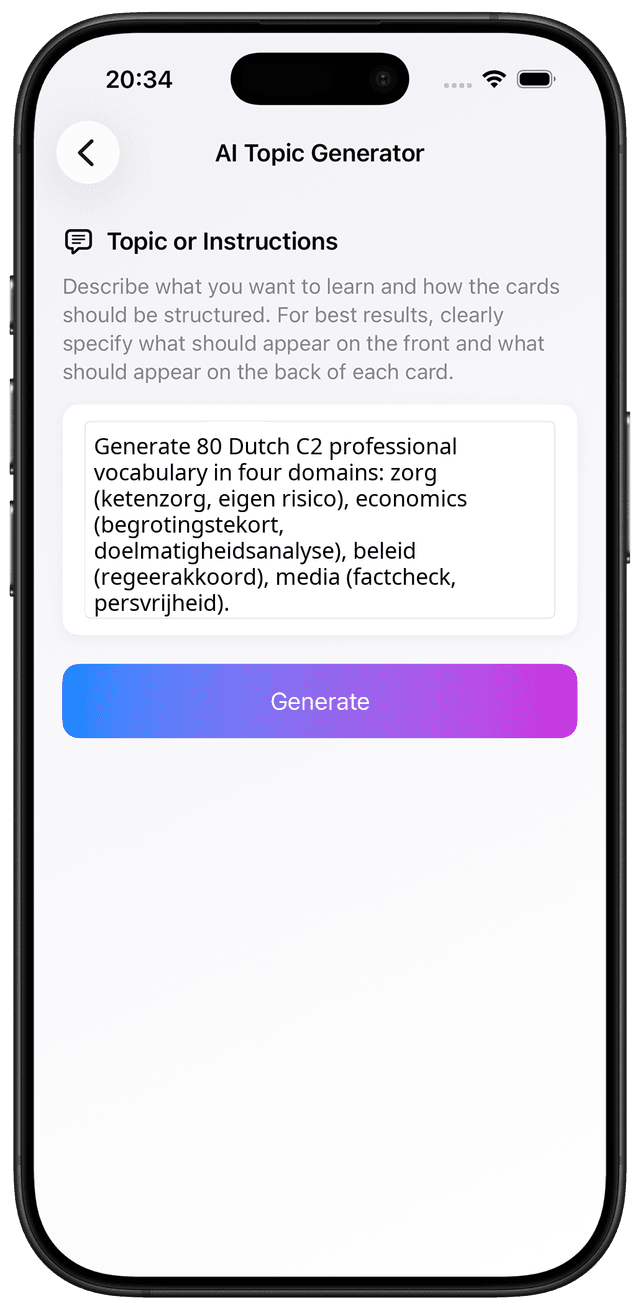
At C2 you are working in Dutch, not just functioning in it. That usually means engaging with at least one domain in depth: healthcare, economics, policy, finance, or media. The terminology in each is rich and specific. A general C2 Dutch speaker who picks up a Dutch hospital report or a TNO policy note quickly runs into vocabulary that does not appear in general decks: indicatiestelling, ketenzorg, eigen risico, hoofdlijnenakkoord, doelmatigheidsanalyse, beleidskader.
This phase is selective by design. It covers the high-frequency professional vocabulary across the four domains most likely to come up in CNaVT Educatief Professioneel readings and in Dutch professional life: healthcare (zorg), economics and finance, public policy, and media and journalism. The aim is not exhaustive coverage but the items most likely to come up in real documents.
The goal: Professional vocabulary you can actually use in Dutch-speaking professional environments. This deck is calibrated to CNaVT exam tasks and to real Dutch and Flemish workplace documents.
The strategy: Cards are grouped by domain, with a context sentence drawn from an authentic professional document type for each.
Generate 80 Dutch C2 professional vocabulary items in four domains: (1) Zorg and healthcare: indicatiestelling, ketenzorg, eerstelijnszorg, tweedelijnszorg, eigen risico, zorgverzekering, behandelplan, multidisciplinair overleg, kwetsbare patiëntengroep, evidence-based richtlijn, mantelzorg, palliatieve zorg. (2) Economics and finance: doelmatigheidsanalyse, kosteneffectiviteit, conjunctuurbeleid, hoofdlijnenakkoord, begrotingstekort, vermogensrendementsheffing, koopkrachtbeeld, productiviteitsgroei, investeringsklimaat. (3) Public policy: beleidskader, beleidsmonitor, uitvoeringsbesluit, regeerakkoord, kabinetsstandpunt, voortgangsrapportage, hoorzitting, maatschappelijk middenveld, draagvlak. (4) Media and journalism: hoofdredactioneel commentaar, opinie-onderzoek, achtergrondartikel, persvrijheid, journalistieke onafhankelijkheid, factcheck, bronvermelding, redactionele lijn. Front: Dutch term plus authentic document context. Back: English plus domain label and example sentence.
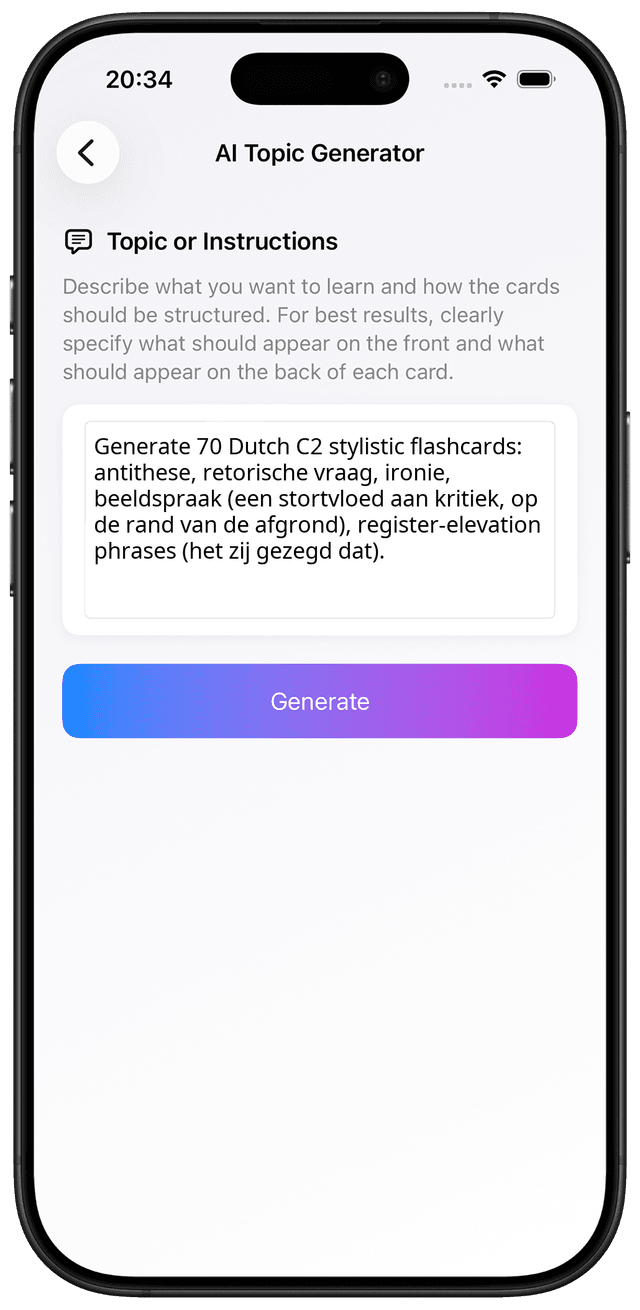
C2 mastery is also stylistic. At this level Dutch writers reach for beeldspraak (metaphor and figurative language), gevarieerd zinsbouw, and the rhetorical devices that mark a piece of writing as authored rather than just produced: antithese, retorische vraag, climax, understatement, ironie. Knowing the names is the easy part. Recognising when a device is in use, and deploying one in your own writing without it sounding forced, is the C2 milestone.
Dutch literary and editorial prose also relies on register variation within a single text. A Volkskrant editorial may shift in two sentences from formal academic Dutch to a sharp idiomatic line to a deliberately understated conclusion. Reading that movement, and producing it, is the kind of stylistic control that CNaVT C2 raters and serious Dutch readers look for.
The C2 milestone: Completing this phase means your toolkit covers native collocations, CNaVT Educatief Professioneel domain vocabulary, deep idiom density, juridical and ambtelijk register, academic register, professional domain vocabulary, and stylistic control. That is the full active range that NCT2 C2, CNaVT Educatief Professioneel, and Dutch and Flemish professional life expect.
Looking ahead: From here, the work becomes maintenance: read serious Dutch every day, write regularly, and let spaced repetition surface the items you are still missing. The phases above keep you focused on the highest-yield gaps rather than on whatever happens to be on the next page.
Generate 70 Dutch C2 high-register prose and stylistic flashcards in five groups: (1) Rhetorical figures: antithese, retorische vraag, climax, understatement, ironie, eufemisme, hyperbool, paradox, metafoor, metonymie. (2) Beeldspraak and fixed metaphors in Dutch prose: een stortvloed aan kritiek, een sluier van geheimzinnigheid, op de rand van de afgrond, met een korreltje zout nemen, een doorn in het oog. (3) Register-elevation phrases for written argument: het zij gezegd dat, men is geneigd te denken dat, het ligt voor de hand om te veronderstellen dat, er kan moeilijk aan worden voorbijgegaan dat, niet in de laatste plaats. (4) Concession with rhetorical weight: zij het met enige reserve, hoezeer ook, hoe dan ook, ongeacht het feit dat, dit alles laat onverlet dat. (5) Stylistic markers of authored prose: anaforische opening, opsomming met climaxwerking, ironische distantie, gemarkeerde inversie. Front: Dutch phrase or figure plus an editorial or literary context sentence. Back: English equivalent plus a stylistic function label.
At C2, the items you are still missing are less frequent and more context-dependent than at any earlier level. Spaced repetition is suited to exactly this work: collocations, uitdrukkingen, and fixed phrases you keep forgetting come back more often, items you have already locked in drop back. Your review time goes where it actually moves the needle.
C2 builds directly on C1. Use the links below to review the prerequisite level or return to the full Dutch guide.
Copy any prompt from this guide into MindCards and your first C2 deck is ready in seconds. No account needed. The app is free on iOS.