
Spaced repetition explained
Why reviewing at the right interval locks in advanced Dutch vocabulary
You have B2. You can read a Dutch newspaper, write a formal email, and hold your own in most conversations. C1 is where the effort starts to drop. Dutch that required conscious processing begins arriving automatically. You stop translating mid-sentence.
C1 covers roughly 5,000 to 7,000 words in active use. This guide focuses on the 1,200+ that actually move you forward at this level: register control for switching between informal and formal Dutch, idioms that appear throughout journalism and professional speech, discourse markers for complex written argument, nominale stijl for reading dense administrative and academic texts, academic writing conventions for university and exam contexts, domain-specific vocabulary for professional settings, and modal particles for genuine spoken Dutch fluency.
Each of the seven phases below includes a ready-to-use AI prompt. Paste it into MindCards and the app generates a custom flashcard deck. Spaced repetition then schedules each card just before you are likely to forget it, so you retain more with less review time.
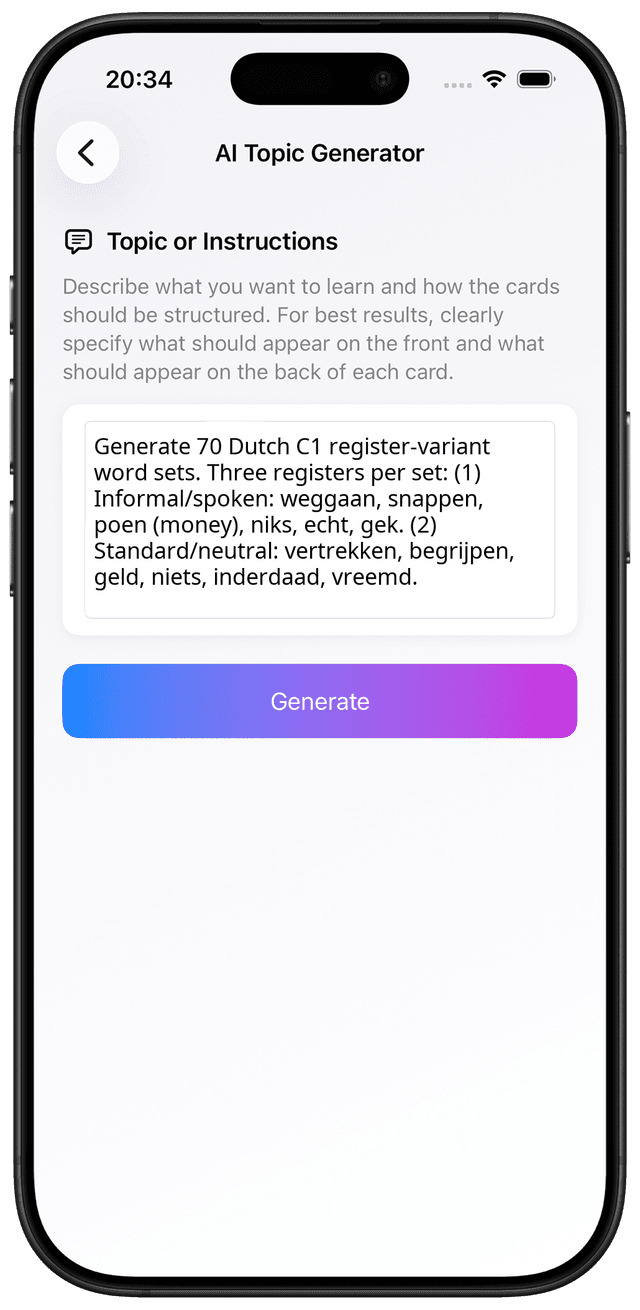
At C1, what separates you from B2 is not knowing more words but knowing which word to use in which situation. Dutch has clear register divisions: the gap between everyday spoken Dutch and formal written Dutch is wide. Switching registers deliberately, from informeel to formeel or academic style, is a core C1 competency.
A B2 speaker knows that vertrekken and weggaan both mean to leave. A C1 speaker picks between them depending on whether the context is a text message or a formal resignation letter. The same applies to honderdtallen of other word pairs that share meaning but differ sharply in register.
Why start here? Register control is what makes C1 Dutch sound natural rather than just correct. Get this right and the other phases fall into place more easily because you start reading authentic Dutch texts with a sharper ear for register.
The strategy: This deck pairs informal, standard, and formal variants of the same idea so you build the habit of register-switching at word level.
Generate 70 Dutch C1 register-variant word sets. Three registers per set: (1) Informal/spoken: weggaan, snappen, poen (money), niks, echt, gek. (2) Standard/neutral: vertrekken, begrijpen, geld, niets, inderdaad, vreemd. (3) Formal/written: zich begeven, vatten, middelen, geenszins, zeker, opmerkelijk. Group by category: movement, understanding, money, negation, agreement, emphasis. Front: Dutch informal form. Back: standard + formal equivalents with register label.
C1 Dutch idioms go beyond the B2 set. Where B2 covers iets door de vingers zien and voor de hand liggend, C1 adds the idioms that appear in Dutch journalism, political speech, and professional conversation between educated speakers. Knowing that iemand het vel over de oren halen means to swindle someone, or that iets in het juiste perspectief plaatsen is a formal way to say something should be put in context, is part of what C1 fluency looks like.
Fixed expressions at C1 also include the collocational phrases that native speakers reach for automatically but learners tend to construct incorrectly. Een conclusie trekken rather than maken, een beslissing nemen rather than doen, iets ter sprake brengen rather than een onderwerp bespreken.
Why this matters: Dutch idioms appear constantly in NRC, de Volkskrant, and public radio. Missing an idiomatic phrase in a meeting or a document means missing the tone, not just the literal content.
The strategy: This deck covers the 60 most frequently encountered C1 idioms in Dutch journalism and professional communication, grouped by theme.
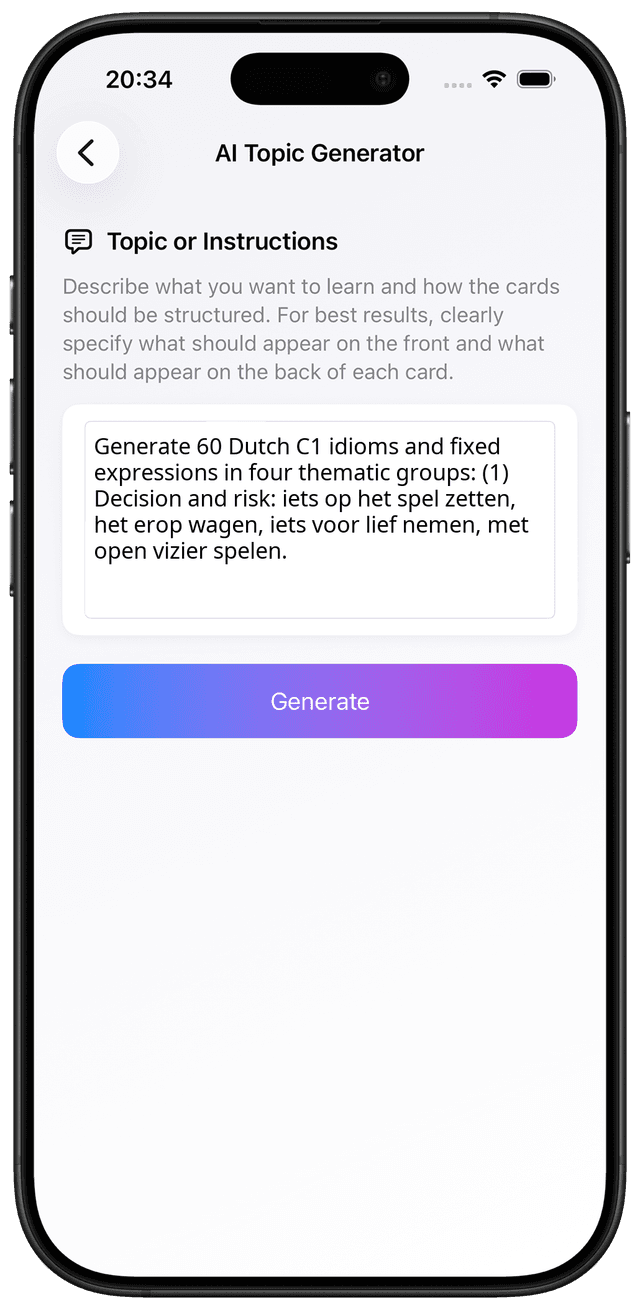
Generate 60 Dutch C1 idioms and fixed expressions in four thematic groups: (1) Decision and risk: iets op het spel zetten, het erop wagen, iets voor lief nemen, met open vizier spelen. (2) Communication and truth: iemand het hemd van het lijf vragen, geen blad voor de mond nemen, met de billen bloot moeten, achter de rug omgaan. (3) Success and failure: aan het kortste eind trekken, de spijker op de kop slaan, het onderspit delven, er niet van afkomen. (4) Formal collocations: een conclusie trekken, iets ter sprake brengen, in aanmerking nemen, op de proef stellen. Front: Dutch idiom + example sentence. Back: English meaning + usage note.
C1 written and spoken Dutch handles complex argument structure: introducing a position, qualifying it, conceding counter-evidence, and landing a clear conclusion. B2 teaches connectors like derhalve and bovendien. C1 requires the precise markers that signal logical relationships between clauses and paragraphs in formal prose and academic writing.
Dutch opinion journalism and academic papers follow recognizable argument patterns. Once you can produce the markers that signal each step, your Dutch writing reads like someone who has spent time in Dutch-medium education, not just someone who studied Dutch as a foreign language.
Why this now? Discourse markers are what give writing the shape of an argument rather than a list of sentences. They also appear in NT2 C1 writing tasks and in any professional Dutch document where you need to present a position clearly.
The strategy: This deck covers C1-level discourse markers by argumentative function, each shown in a complete sentence from authentic Dutch writing contexts.
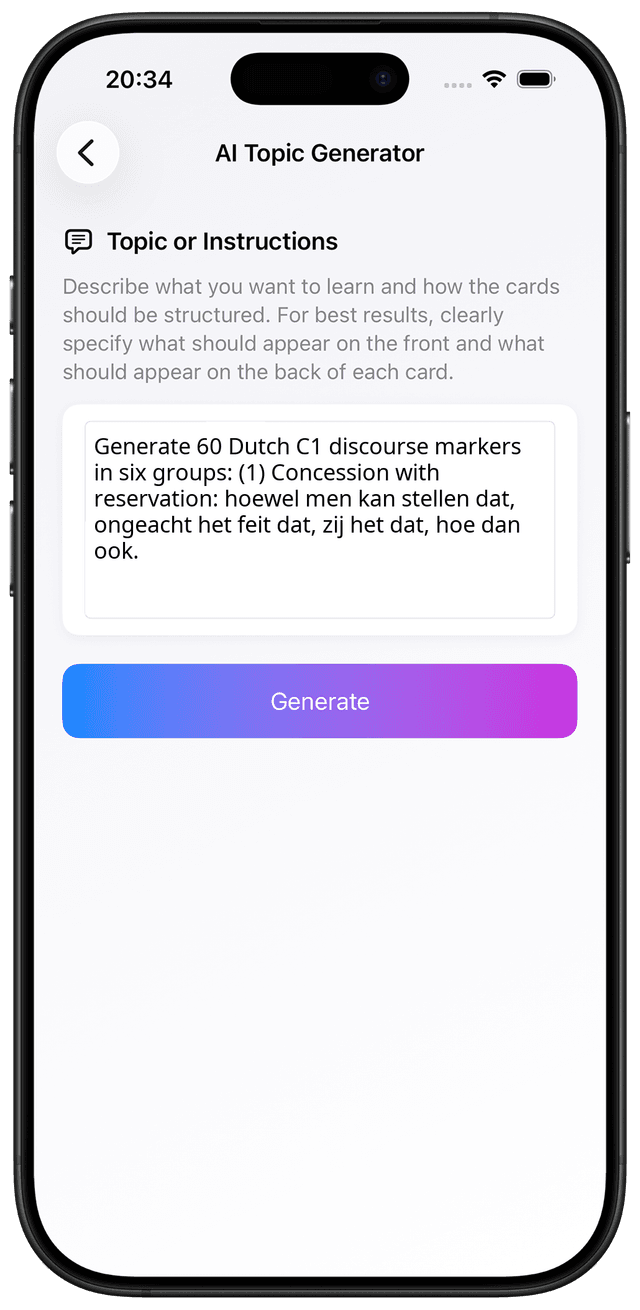
Generate 60 Dutch C1 discourse markers in six groups: (1) Concession with reservation: hoewel men kan stellen dat, ongeacht het feit dat, zij het dat, hoe dan ook. (2) Logical consequence: hieruit volgt dat, dienovereenkomstig, als gevolg hiervan, wat impliceert dat. (3) Reformulation: met andere woorden, dat wil zeggen, anders geformuleerd. (4) Contrast and counter-argument: daar staat tegenover dat, in tegenstelling tot, dit neemt niet weg dat. (5) Emphasis and focus: met name, in het bijzonder, niet in de laatste plaats. (6) Summary and conclusion: samenvattend kan worden gesteld, ter afsluiting, alles overziend. Front: Dutch discourse marker + sentence. Back: English + function label.
Formal Dutch writing relies on nominale stijl, where ideas are expressed through noun phrases rather than verbs. Combined with extended participial constructions, this creates the dense, compressed style of Dutch administrative documents, legal texts, and academic prose. Reading a Dutch insurance policy, university syllabus, or government regulation requires familiarity with this style.
The transformation from verbal to nominal is systematic. De rechter heeft besloten (verbal) becomes het besluit van de rechter (nominal). De minister voert maatregelen in becomes de invoering van maatregelen door de minister. Learning to produce and read these transformations fluently is what separates C1 from B2 in formal written Dutch.
Why this matters: Dutch university study, professional communication, and any serious engagement with government or legal documents all require this style. Without it, C1 texts feel opaque even when you know all the individual words.
The strategy: This deck drills the shift from verbal to nominal style and builds reading comprehension for heavily embedded clause structures.
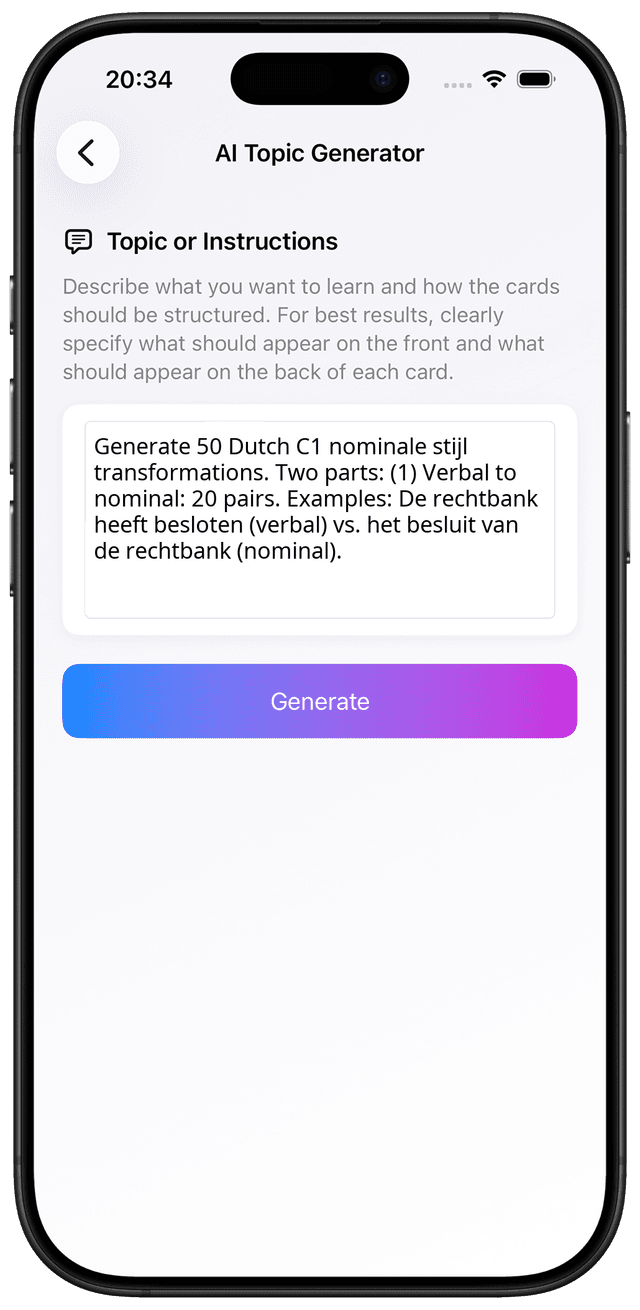
Generate 50 Dutch C1 nominale stijl transformations. Two parts: (1) Verbal to nominal: 20 pairs. Examples: De rechtbank heeft besloten (verbal) vs. het besluit van de rechtbank (nominal); De overheid voert beleid in vs. de invoering van beleid door de overheid. Include verbs: uitvoeren, besluiten, beoordelen, vaststellen, aanpassen, onderscheiden. (2) Complex nested clauses: 30 sentence examples from legal and academic Dutch with nested relative clauses and extended participial phrases. Front: verbal form or nested clause. Back: nominal equivalent or analytical breakdown.
University study in Dutch, NT2 C1 writing tasks, and professional communication at C1 all require command of specific text types: the betoog (argumentative essay), the beschouwing (reflective piece), the samenvatting (summary), and formal correspondence. Each has structural and lexical conventions that differ from general writing.
Dutch academic writing has specific structural phrases that appear predictably: Ter inleiding kan worden opgemerkt dat, Een belangrijk argument hiervoor is, Desondanks kan worden gesteld dat, Tot slot kan worden geconcludeerd dat. Knowing these as fixed phrases means you produce them automatically rather than constructing each one from scratch.
Why this comes next: NT2 C1 writing tasks and Dutch university assignments both test academic text production. Knowing the structural phrases for each text type directly affects your written output and how it reads to a Dutch audience.
The strategy: This deck covers the lexical and structural conventions of the main C1 text types, with ready-to-use phrases for introduction, development, and conclusion in each one.
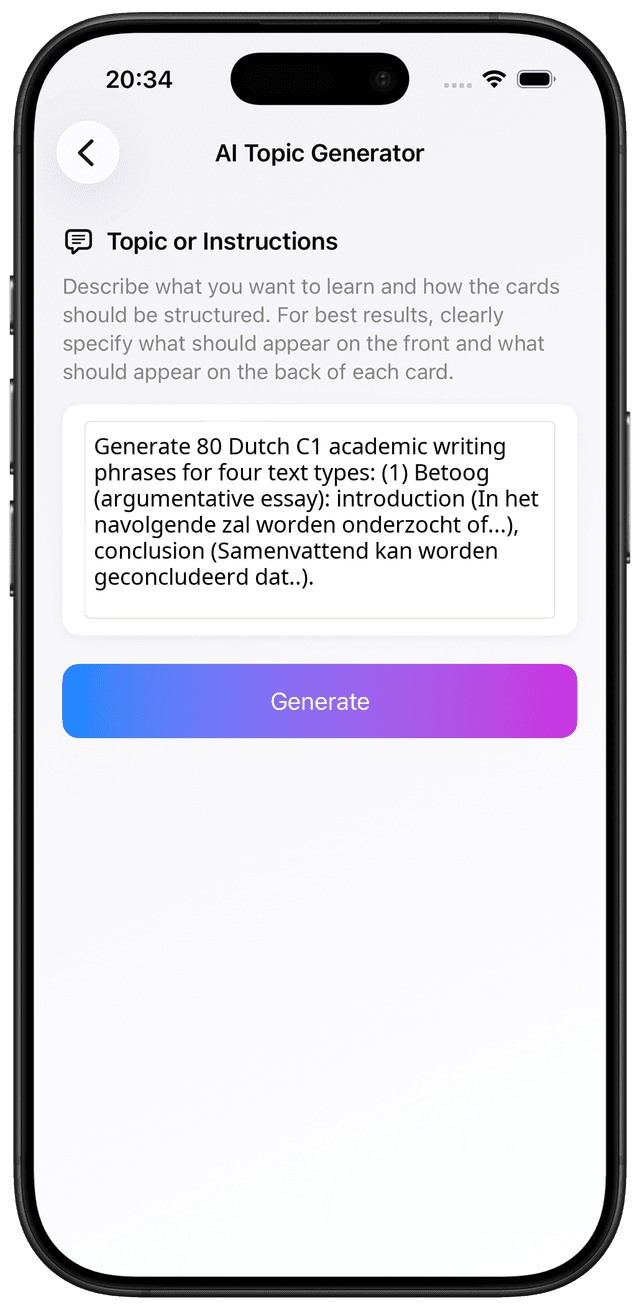
Generate 80 Dutch C1 academic writing phrases for four text types: (1) Betoog (argumentative essay): introduction (In het navolgende zal worden onderzocht of...), development (Een wezenlijk argument hiervoor is..., Hier tegenover staat dat...), conclusion (Samenvattend kan worden geconcludeerd dat...). (2) Beschouwing: Naar mijn mening..., Ik ben van oordeel dat..., Het lijkt mij twijfelachtig of.... (3) Samenvatting: De tekst behandelt..., De auteur concludeert dat..., De kernboodschap luidt. (4) Formal letters: Met verwijzing naar..., Ik sta mij toe op te merken dat..., Met vriendelijke groeten. Front: Dutch phrase. Back: English + text type label.
At C1 you are starting to work or study in Dutch, or at least deal with Dutch professional contexts. Legal Dutch, business Dutch, and the vocabulary of public institutions all have their own terminology that does not appear in general vocabulary courses. Without it, you may understand a conversation but miss the precise meaning of a document or a formal exchange.
Dutch professional life also uses borrowed English vocabulary with specific meanings: een deadline halen, een briefing geven, de focus leggen op, een follow-up afspreken. Knowing which of these are standard in formal written Dutch and which belong to informal office speech is a register question, and getting it wrong in a formal letter is noticeable.
The goal: Professional vocabulary you can actually use in Dutch-speaking work environments. This phase covers the domains most useful for people working in or with the Netherlands: law, economics, public administration, and institutional Dutch.
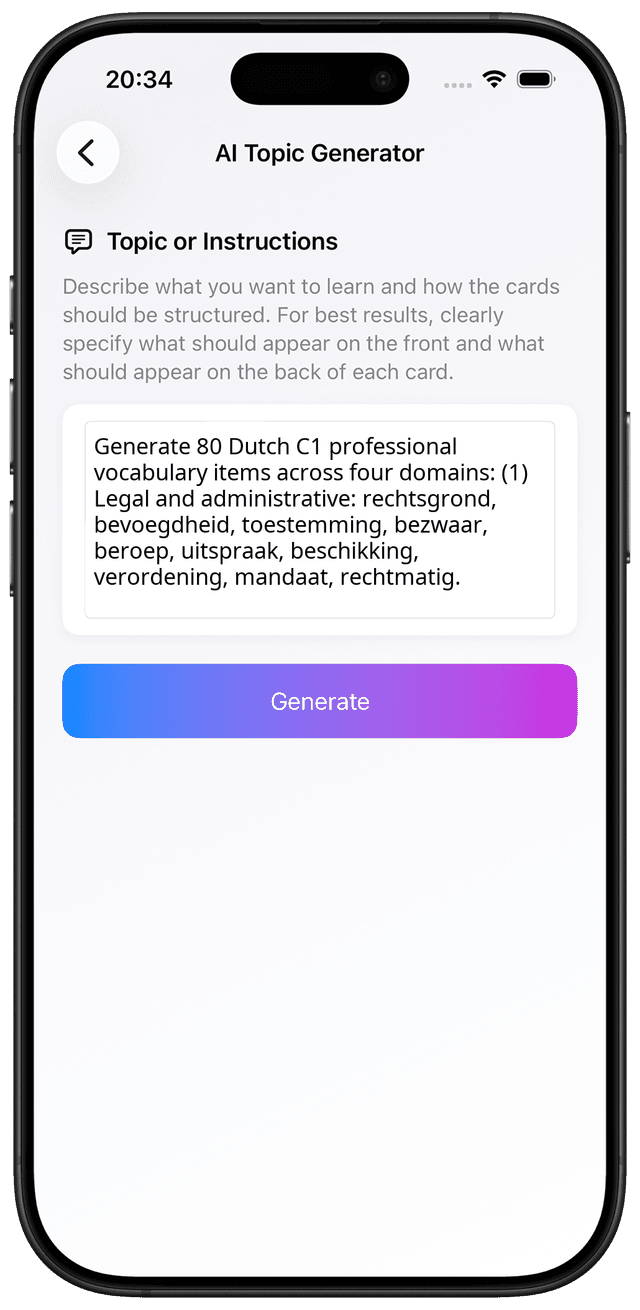
Generate 80 Dutch C1 professional vocabulary items across four domains: (1) Legal and administrative: rechtsgrond, bevoegdheid, toestemming, bezwaar, beroep, uitspraak, beschikking, verordening, mandaat, rechtmatig. (2) Economics and finance: bruto binnenlands product, begrotingsbeleid, subsidieverlening, schuldafbouw, investeringsquote, handelsoverschot, vermogensbeheer, rendement. (3) Public administration: rijksdienst, aanvraagprocedure, besluit, bezwaartermijn, ambtelijk, bestuurlijk, handhavingsbesluit. (4) Professional communication: een deadline halen, een briefing geven, de focus leggen op, stakeholders informeren, escaleren. Front: Dutch term. Back: English + domain + example sentence.
Modal particles and pragmatic markers are among the most difficult aspects of Dutch for non-native speakers. Words like wel, toch, hoor, zeker, nou, eigenlijk, gewoon, and even appear in almost every spoken Dutch exchange and change the pragmatic meaning of an utterance significantly. At C1 you are expected to understand and produce them correctly.
The difference between Dat is wel goed and Dat is goed is subtle but real. Dat weet je toch? presupposes shared knowledge. Dat snap ik niet, hoor softens a statement of confusion. Getting these particles right shifts your Dutch from technically correct to genuinely natural sounding.
The C1 milestone: Completing this phase means your vocabulary toolkit covers register control, idioms at C1 depth, discourse markers for complex argument, nominale stijl for formal reading and writing, academic text conventions, professional vocabulary, and pragmatic nuance. That is the full C1 communicative range for NT2 C1 and professional Dutch.
Looking ahead: C2 builds finer stylistic distinctions and a broader idiomatic range. The pragmatic control you build in this phase is the foundation for C2 spoken authenticity.
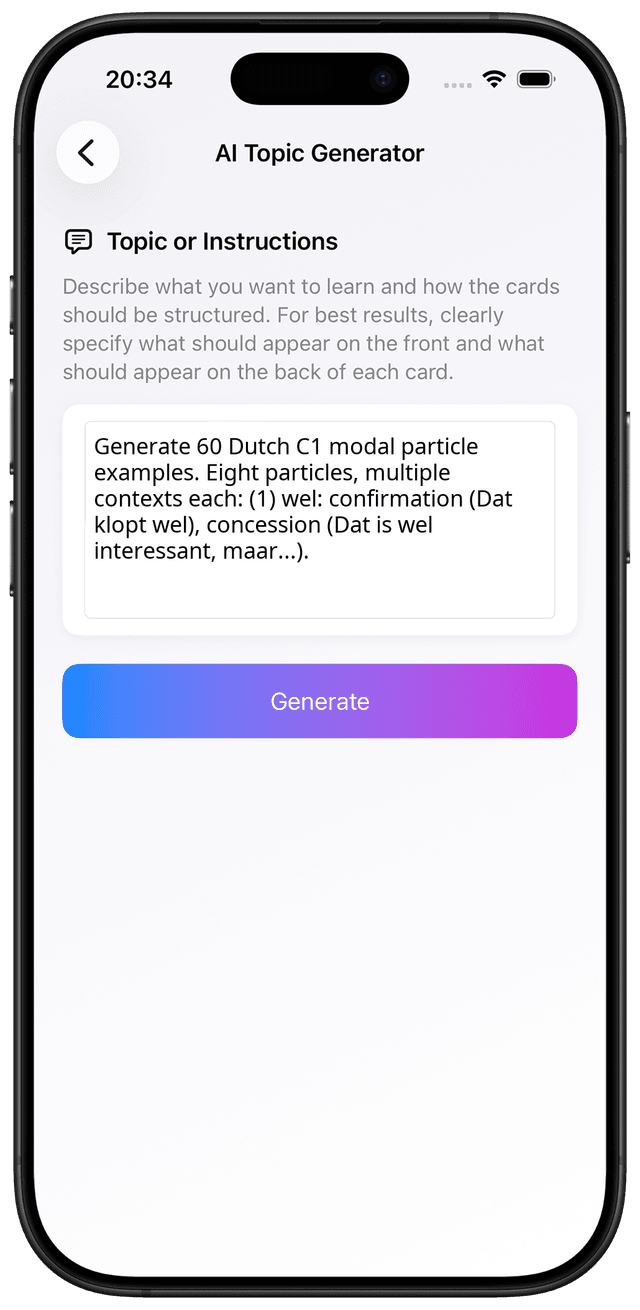
Generate 60 Dutch C1 modal particle examples. Eight particles, multiple contexts each: (1) wel: confirmation (Dat klopt wel), concession (Dat is wel interessant, maar...). (2) toch: presupposed knowledge (Dat weet je toch?), encouragement (Doe het toch maar). (3) hoor: softening (Dat weet ik niet, hoor), assurance (Dat lukt wel, hoor). (4) zeker: certainty (Dat weet ik zeker), expectation (Je komt toch zeker?). (5) nou: emphasis (Nou ja), transition (Nou, dan gaan we). (6) eigenlijk: mild contrast (Eigenlijk had ik iets anders gepland), hedging. (7) gewoon: normalization (Dat doe je gewoon zo). (8) even: softening request (Kun je even helpen?). Front: Dutch sentence with particle. Back: English + particle function label.
At C1 the vocabulary is more specialised and less predictable than at lower levels. Spaced repetition handles this directly: cards you find difficult appear more often, cards you know well drop back. You put time where it counts. The same technique that builds A1 words builds C1 idioms and modal particles.
C1 builds on B2 and leads into C2. If advanced connectors, formal writing, and the word formation patterns from B2 are not solid yet, go back and work through those first. When C1 starts to feel automatic, continue to C2 for native collocations, CNaVT Educatief Professioneel prep, and high-register prose.
Build your Dutch C1 vocabulary with AI-generated decks and spaced repetition that adapts to what you actually find difficult. Free to download. No account required. Start with the phase that targets your biggest gap.