
Spaced repetition explained
Why reviewing at the right interval locks in advanced Dutch vocabulary
B1 gave you the tools to function in Dutch society. B2 is where Dutch starts feeling less like a performance and more like a language you actually use. The grammar is still there, but the bottleneck shifts to vocabulary: you need the right word, not just a grammatically correct sentence.
B2 covers roughly 4,000 words in total. This guide focuses on the 900+ that make the biggest difference: advanced connectors for argumentation, formal writing register for professional contexts, complex grammar for precision, idioms and collocations for natural speech, media vocabulary for authentic comprehension, civic Dutch for NT2 and real-world institutions, and word formation so you can decode Dutch you have never seen before.
Each phase has a ready-to-use AI prompt. Copy it into MindCards and the app generates a focused flashcard deck. Spaced repetition then schedules each card at the point where it is most likely to stick, so you spend your review time on what you actually need to practice.
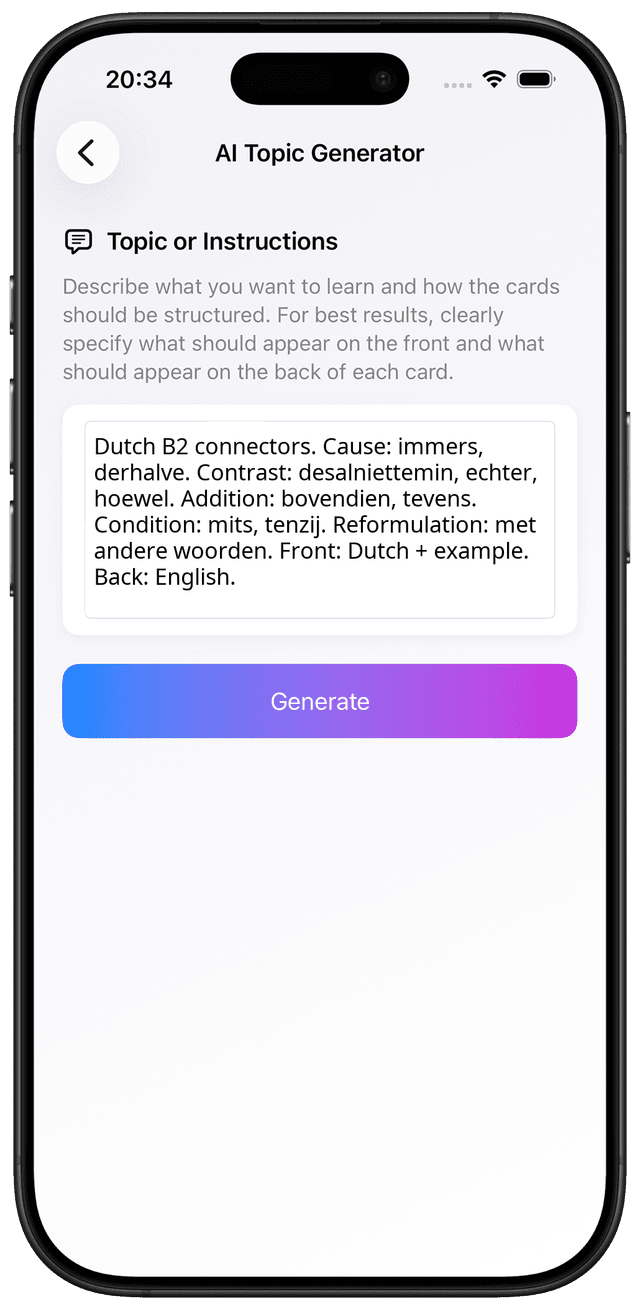
At B1 you learned toch, juist, and eigenlijk. At B2 you need the full set of connectors that structure a written argument or a spoken debate: immers (after all), derhalve (therefore), dermate dat (to such a degree that), naarmate (as/the more), terwijl tegelijkertijd (while at the same time), wat betreft (regarding). These are the connectors you see in NRC editorials, policy documents, and university lectures.
The difference between B1 and B2 Dutch connectors is register precision. Omdat is fine for everyday speech but in a formal document you want aangezien. En is fine for a list but in an argument you want bovendien or daarboven. Knowing the formal equivalent of each casual connector is what moves your Dutch from functional to fluent-sounding.
Why start here? Connectors are the skeleton of every argument you make in Dutch. Get them right and everything else reads and sounds much more natural. Get them wrong and even correct Dutch grammar sounds like it was written by a learner.
The strategy: This deck pairs each connector with its register (formal/informal) and a contrasting example sentence, so you learn not just the word but when and why to use it.
Generate 70 Dutch B2 connectors and argumentation phrases in five groups: (1) Cause and consequence: immers, derhalve, aangezien, dientengevolge, met als gevolg dat, zodat, waardoor. (2) Contrast and concession: desalniettemin, echter, daarentegen, niettemin, hoewel, terwijl, ofschoon. (3) Addition and reinforcement: bovendien, daarboven, tevens, ook nog, niet alleen maar ook. (4) Condition and degree: mits, tenzij, naarmate, voor zover, dermate dat. (5) Reformulation: met andere woorden, dat wil zeggen, anders gezegd. Front: Dutch connector + example sentence. Back: English + register label (formal/neutral).
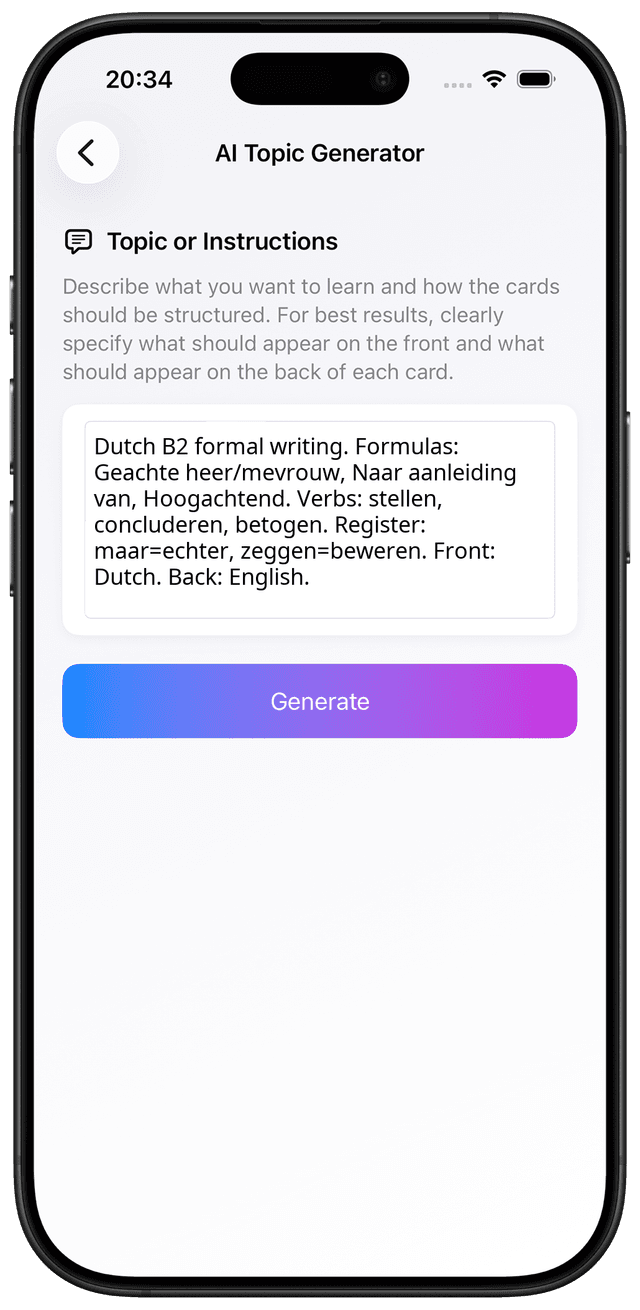
Formal Dutch writing follows conventions that differ from spoken Dutch. Letters to a municipality start with Geachte heer/mevrouw. Reports use passive constructions: er wordt geconcludeerd dat, er dient rekening gehouden te worden met. Academic prose uses er wordt gesteld dat, zoals blijkt uit, het valt op te merken dat. These constructions are awkward to produce unless you have practiced them as fixed phrases.
The NT2 staatsexamen II writing tasks specifically test whether you can produce a formal letter, a summary of an argument, and a short essay at B2 register. Even outside exam contexts, anyone who needs to write to Dutch government agencies, universities, or professional contacts needs this register. Many advanced learners find spoken B2 easier than written B2 precisely because formal writing requires these fixed formulas.
Why formal writing at B2: Producing formal Dutch is what separates a competent speaker from a professional-level user. This deck covers letter formulas, academic verbs, formal alternatives to everyday phrasing, and hedging language that adds precision.
The strategy: Each card pairs a formal phrase with a plain-Dutch equivalent, so you learn both the register shift and the meaning in context.
Generate 70 Dutch B2 formal writing vocabulary items in four groups: (1) Letter formulas: Geachte heer/mevrouw, Naar aanleiding van, In antwoord op uw brief van, Bijgaand treft u aan, Met vriendelijke groet, Hoogachtend, Ik verzoek u vriendelijk. (2) Academic and report verbs: stellen, concluderen, aantonen, beargumenteren, toelichten, veronderstellen, betogen, constateren. (3) Register-shift pairs: denken -> van mening zijn, maar -> echter, veel mensen -> een groot aantal mensen, zeggen -> beweren/stellen. (4) Hedging and qualification: naar verluidt, voor zover bekend, in zekere zin, met enig voorbehoud. Front: Dutch phrase. Back: English + register note.
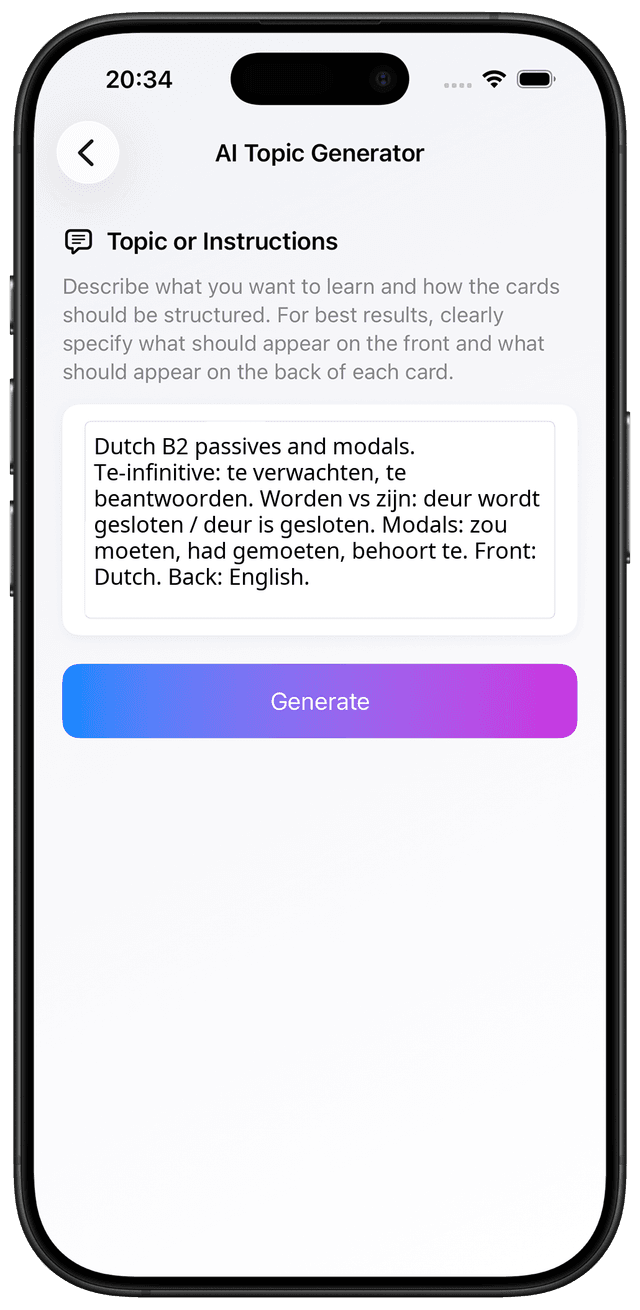
Dutch passives at B2 go beyond the basic worden construction. The te-infinitive passive (het te verwachten resultaat, een te beantwoorden vraag) is used constantly in formal Dutch and is largely invisible to learners who have not specifically studied it. The worden/zijn distinction for passive (describes action vs. describes state) also becomes important at this level: de deur wordt gesloten versus de deur is gesloten.
Modal verb phrases become more complex at B2. Zou moeten (should have, implying it did not happen), had gemoeten (was obligated but failed), mag worden verwacht dat (may be expected that), behoort te (ought to) are all used in formal and semi-formal contexts. Getting these distinctions right matters in job interviews, formal emails, and anywhere precision is expected.
Why this now? These constructions appear constantly in Dutch news, government documents, and professional communication. Many B1 learners can recognize them passively but cannot produce them actively. This deck closes that gap.
The strategy: This deck works through te-infinitive passives, worden/zijn state distinctions, and modal verb phrases in realistic formal sentences so the patterns become automatic.
Generate 60 Dutch B2 passive and modal constructions as example sentences. Four groups: (1) Te-infinitive passives: te verwachten, te beantwoorden, te onderscheiden, te vermijden, te bereiken. Give a full sentence per example. (2) Worden vs zijn passive: de deur wordt gesloten / de deur is gesloten, het besluit werd genomen / het besluit is genomen. (3) Complex modal phrases: zou moeten (but didn't), had gemoeten, mag worden verwacht dat, behoort te, dient te worden. (4) Impersonal passives: er wordt vergaderd, er wordt besloten dat, er dient rekening gehouden te worden met. Front: Dutch. Back: English + construction type label.
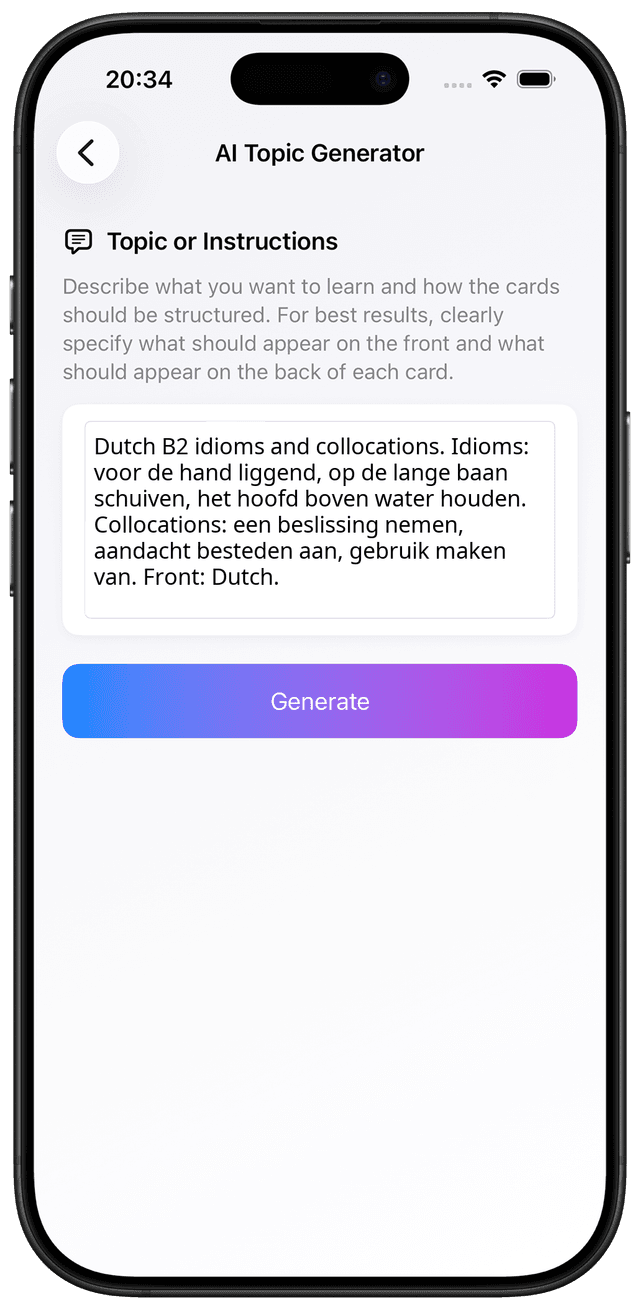
Native Dutch speakers use idioms constantly. Iets door de vingers zien (to turn a blind eye to something), voor de hand liggend (obvious), op de lange baan schuiven (to postpone indefinitely), het erover eens zijn (to agree), van de hand doen (to get rid of, to sell), iets te bieden hebben (to have something to offer). These cannot be guessed from their components and must be learned as fixed units.
Collocations are the pairings that just sound right in Dutch: een beslissing nemen (not maken), aandacht besteden aan (not geven), gebruik maken van (not nemen), een rol spelen (not hebben). Learners who reach B2 but have not specifically studied collocations produce Dutch that sounds slightly off even when grammatically correct. The issue is almost always collocations, not grammar.
Why idioms at B2: Dutch conversation, television, and journalism are full of idioms and fixed collocations. Knowing 40 or 50 high-frequency ones removes a significant friction from real-world Dutch comprehension and makes your own Dutch sound natural.
The strategy: This deck covers idioms in full sentences so you hear how they are used, and collocations in verb-noun pairs with example sentences that make the right pairing feel natural.
Generate 60 Dutch B2 idioms and collocations in three groups: (1) High-frequency Dutch idioms with full sentence example: iets door de vingers zien, voor de hand liggend, op de lange baan schuiven, het erover eens zijn, van de hand doen, een oogje dichtknijpen, met de nek aankijken, het hoofd boven water houden. (2) Verb-noun collocations: een beslissing nemen, aandacht besteden aan, gebruik maken van, een rol spelen, verantwoordelijkheid dragen, rekening houden met, een bijdrage leveren. (3) Register pairs (informal idiom + formal equivalent). Front: Dutch idiom + sentence. Back: English meaning + usage note.
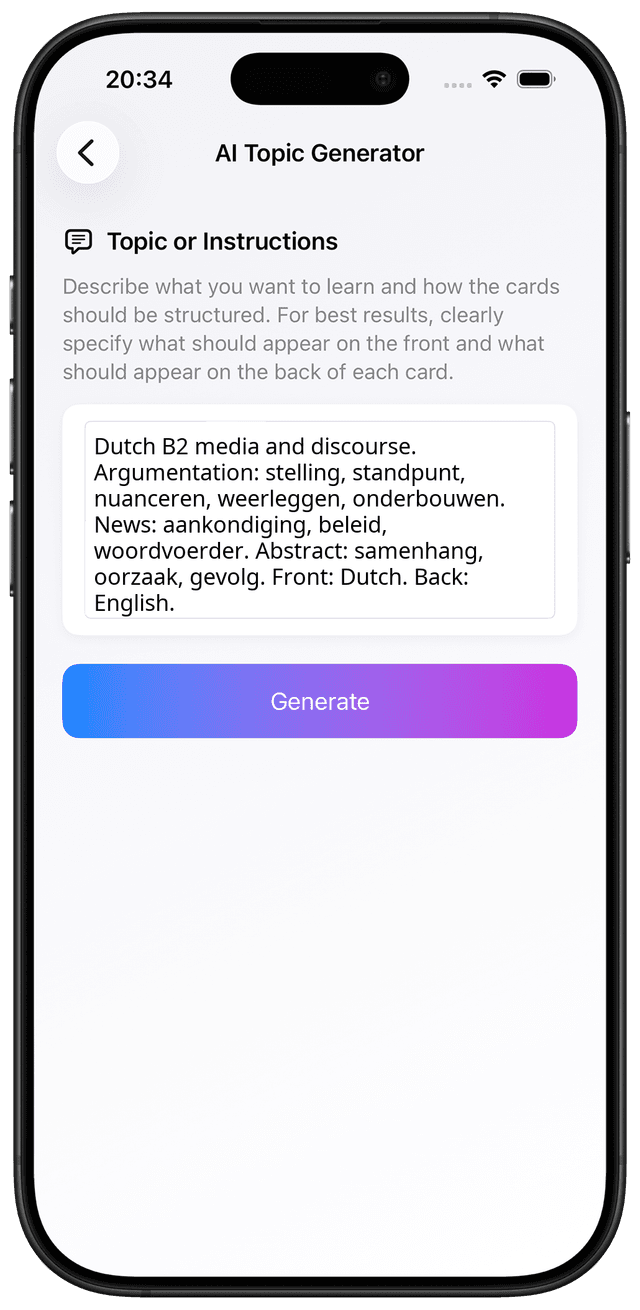
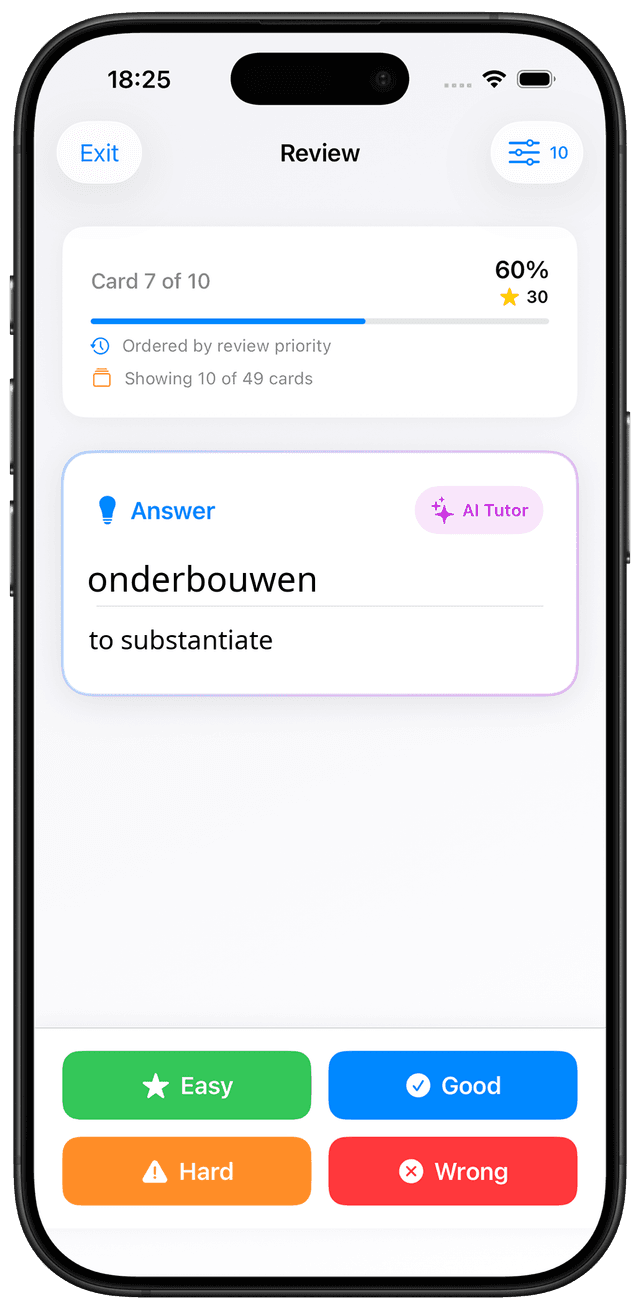
B2 reading comprehension covers newspaper articles, opinion columns, and podcasts that discuss abstract topics. The vocabulary for this includes not just topic words but discourse words: stelling (thesis), standpunt (viewpoint), tegenstander (opponent), voorstander (supporter), nuanceren (to nuance), relativeren (to put in perspective), weerleggen (to refute), onderbouwen (to substantiate). These are the words that let you follow and participate in Dutch intellectual discussion.
Dutch public debate has specific conventions. Columns in de Volkskrant and NRC follow argument structures that use these discourse words predictably. Once you recognize the pattern, following a Dutch opinion piece becomes much easier because the structure tells you what kind of sentence is coming next.
Why media vocabulary at B2: The fastest way to improve B2 Dutch after completing a course is consistent input from authentic Dutch media. But that input only works if the vocabulary is accessible enough to follow. This deck builds the critical mass you need to get genuine benefit from Dutch podcasts, news, and TV.
The strategy: This deck covers discourse vocabulary for following arguments, news register words for reading Dutch journalism, and abstract nouns that appear in both academic and media contexts.
Generate 80 Dutch B2 media and abstract discourse vocabulary in three groups: (1) Discourse and argumentation: stelling, standpunt, tegenstander, voorstander, nuanceren, relativeren, weerleggen, onderbouwen, redenering, bewijs, gevolgtrekking, aanname. (2) News register: aankondiging, maatregel, beleid, voorstel, debat, reactie, woordvoerder, besluitvorming, uitvoering, handhaving. (3) Abstract nouns for academic discussion: samenhang, verband, oorzaak, gevolg, perspectief, benadering, invloed, consequentie, verhouding, context. Front: Dutch term + example sentence. Back: English + domain label.
The NT2 staatsexamen II (state exam for non-native Dutch speakers) tests all four skills at B2 level: reading, listening, writing, and speaking. The reading texts include official documents, news articles, and opinion pieces. The writing tasks require a formal summary and a letter or short essay. The speaking task involves presenting and defending a position.
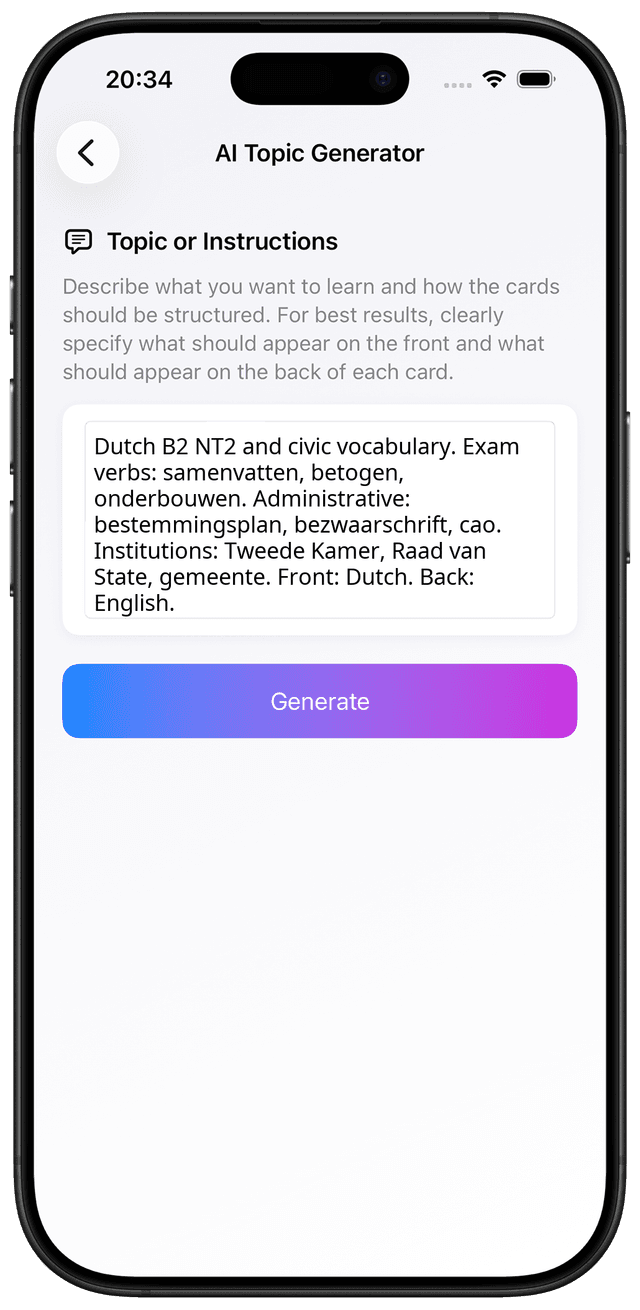
Beyond the exam, B2 civic vocabulary covers the Dutch systems that affect daily life at an advanced level: bestemmingsplan (zoning plan), bezwaarschrift (letter of objection), handhaving (enforcement), subsidieaanvraag (grant application), arbeidsovereenkomst (employment contract), collectieve arbeidsovereenkomst (collective labour agreement, known as cao). These terms appear in any serious professional or administrative interaction with Dutch institutions.
Why NT2 vocabulary at B2: Whether or not you sit the exam, NT2 staatsexamen II is the standard reference for B2 Dutch proficiency in the Netherlands. The vocabulary and text types it covers map exactly onto the language you encounter in professional and civic contexts.
The strategy: This deck covers exam-relevant vocabulary for formal texts, advanced civic and administrative terms, and the register markers that distinguish B2 from B1 in official Dutch contexts.
Generate 80 Dutch B2 NT2 and civic vocabulary items in three groups: (1) NT2 exam text vocabulary: samenvatten, betogen, standpunt innemen, onderbouwen, beschrijven, analyseren, vergelijken, toelichten, beoordelen. (2) Administrative and legal terms: bestemmingsplan, bezwaarschrift, handhaving, subsidieaanvraag, arbeidsovereenkomst, cao, ontslagprocedure, aanbesteding, vergunning, beschikking. (3) Dutch institutional vocabulary: Tweede Kamer, Eerste Kamer, Raad van State, rechtbank, gemeente, provincie, rijksoverheid, toezichthouder, inspectie. Front: Dutch term. Back: English + context note.
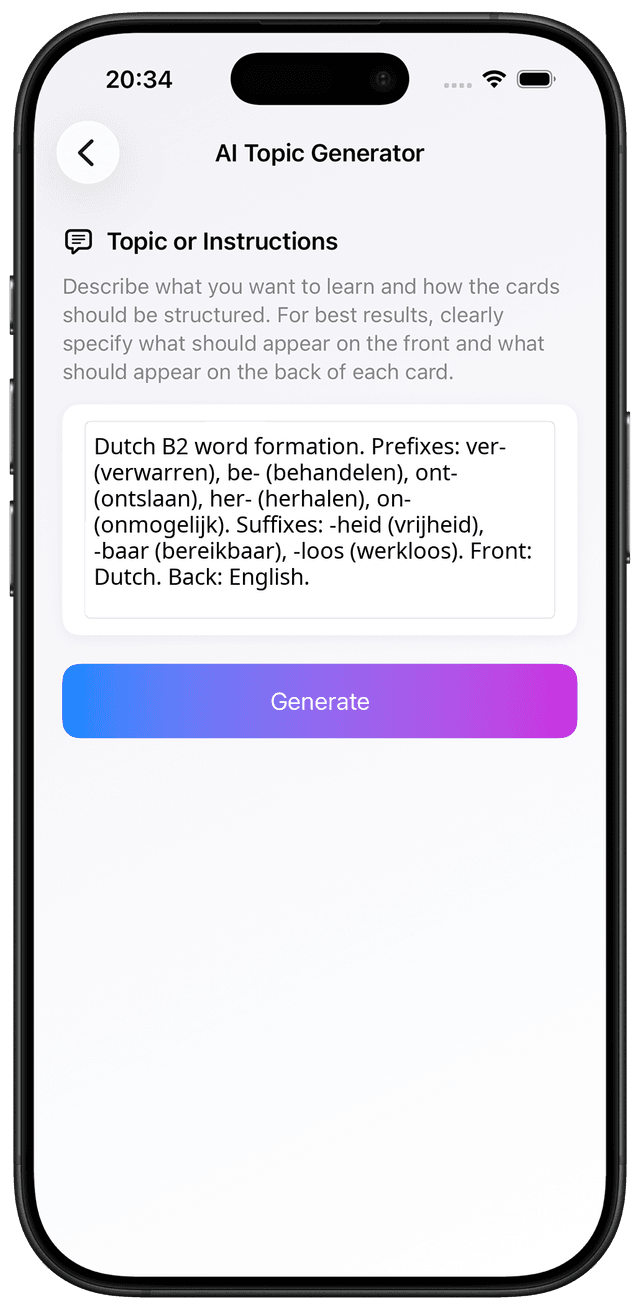
Dutch word formation is highly productive. Once you know the common prefixes (ver-, be-, ont-, her-, on-) and suffixes (-heid, -ing, -lijk, -baar, -achtig, -loos), you can decode and generate vocabulary you have never seen before. Verwarring (confusion) from verwarren, onbegrijpelijk (incomprehensible) from begrijpen + on- + -lijk, uitvoerbaar (feasible) from uitvoeren + -baar. This is how Dutch expands from a known core to an active vocabulary of several thousand words.
At B2 you also start noticing that Dutch has strong preferences for word order in longer sentences that go beyond the V2 rule and verb-end in subordinate clauses. The position of manner, place, and time adverbials (manner before place before time) and the interaction between focus particles (juist, zelfs, alleen) and sentence meaning become reliable tools rather than traps.
The B2 milestone: With this phase complete, your Dutch vocabulary covers advanced connectors, formal writing, complex grammar structures, idioms and collocations, media discourse, civic vocabulary, and productive word formation. That is the full B2 range for NT2 staatsexamen II and professional use in the Netherlands.
Generate 70 Dutch B2 word formation items. Three groups: (1) Prefix meaning and examples: ver- (change of state: verwarren, verbouwen, verliezen), be- (transitivity: behandelen, bereiken, bezoeken), ont- (reversal/removal: ontslaan, ontwerpen, ontmoeten), her- (repetition: herhalen, herkennen, herzien), on- (negation: onmogelijk, onbegrijpelijk, onbekend). (2) Suffix patterns: -heid (abstract noun from adjective: vrijheid, zekerheid, moeilijkheid), -baar (possibility: bereikbaar, begrijpbaar, uitvoerbaar), -lijk (adjectival: duidelijk, waarschijnlijk, onmogelijk), -loos (without: werkloos, zinloos, dakloos). (3) Compound inference: 10 compound words to decode from parts. Front: Dutch word. Back: English + word formation analysis.
At B2 the vocabulary is less predictable than the core A1-B1 words. Spaced repetition handles this well: cards you find difficult come back more often, cards you have locked in drop to longer intervals. You put time where it counts instead of reviewing what you already know.
B2 builds on B1. If subordinate clauses and conditional sentences from B1 are not solid yet, go back and work through those first. The full Dutch guide links every level together.
Build your Dutch B2 vocabulary with AI-generated decks and spaced repetition that adjusts to what you actually find difficult. Free to download. No account required. Start with the phase that addresses your biggest gap.