
Spaced repetition explained
Why reviewing at the right interval locks in Dutch B1 vocabulary and grammar structures
A2 got you through daily survival. B1 is where Dutch stops being a set of phrases and starts being a language you can actually think in. The jump is real: subordinate clauses, conditional sentences, opinion language, and vocabulary for work, civic life, news, and abstract reasoning.
B1 is roughly 2,000 words, but not all of them matter equally. Subordinate clause word order is the structural shift that separates B1 from A2. Once that is solid, opinion phrases, conditionals, and civic vocabulary stack up quickly. This guide works through them in that order.
Each phase has a ready-to-use AI prompt. Copy it into MindCards and the app generates a focused deck built around real Dutch structures. Spaced repetition handles the scheduling, so you study each card at the moment it is most likely to stick, not just when you happen to open the app.
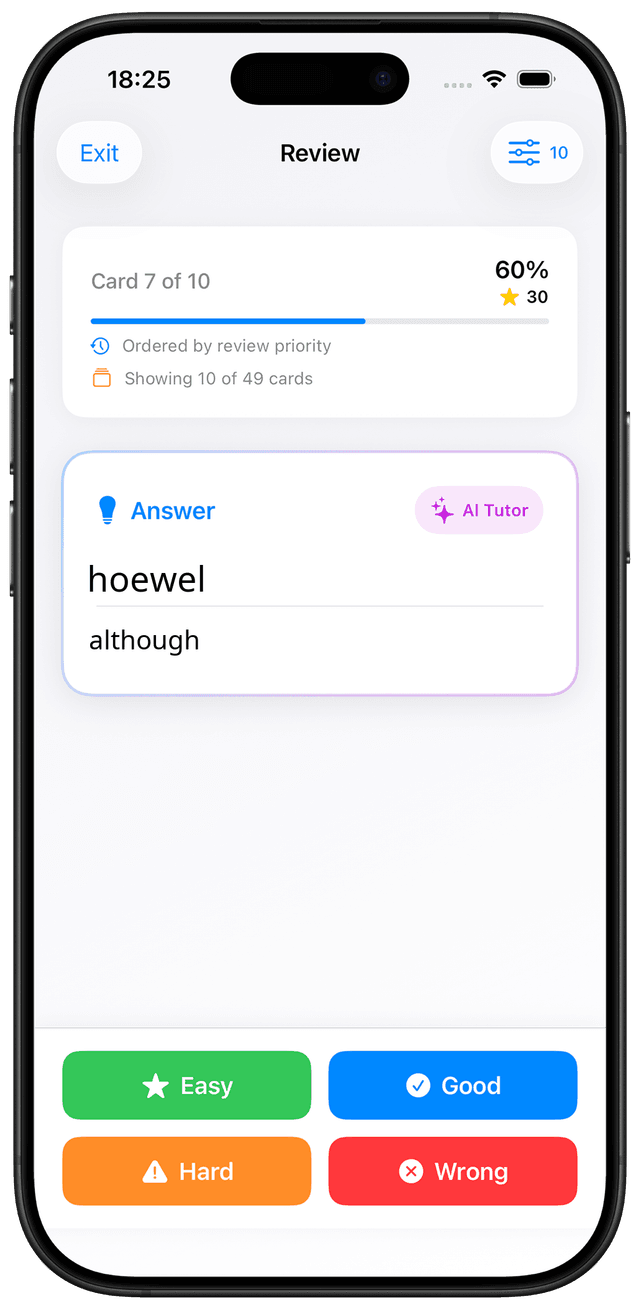
At B1, you stop relying on simple main clauses strung together with en and maar. Dutch has a set of subordinating conjunctions that push the verb to the end of the clause: omdat, hoewel, als, wanneer, tenzij, zodat, terwijl, nadat, voordat, sindsdien. These are not optional extras; they appear in every interview, news segment, and workplace conversation in the Netherlands.
The verb-end rule in subordinate clauses catches learners who got comfortable with verb-second in main clauses. Ik ga naar huis becomes Ik blijf thuis omdat ik ziek ben, not omdat ik ben ziek. The word order switch is the one thing that consistently marks a B1 speaker versus someone still at A2. Getting this into muscle memory through retrieval practice is worth the specific focus.
Why start here? Subordinate clause word order is the structural backbone of B1 Dutch. Everything else in this guide sits on top of it. Once the verb-end rule is automatic, the rest of B1 grammar slots in much faster.
The strategy: This deck covers 15 subordinating conjunctions, each with four contrasting examples (main clause vs. subordinate clause), so the word-order difference gets reinforced from multiple angles at once.
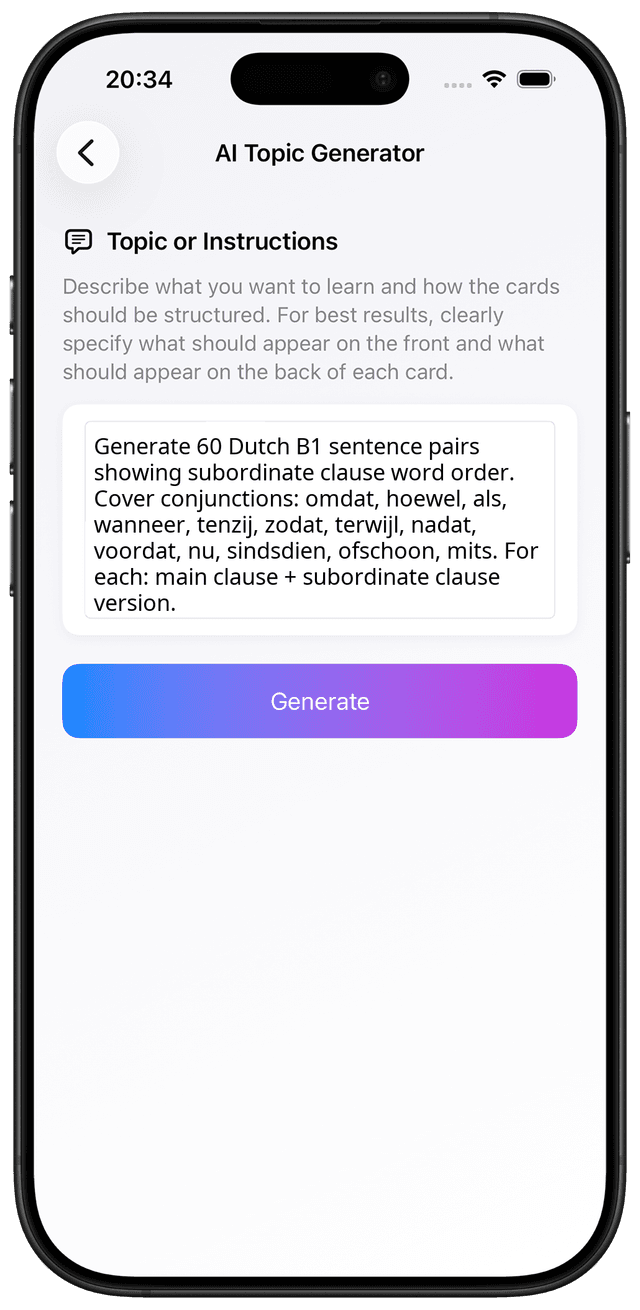
Generate 60 Dutch B1 sentence pairs showing subordinate clause word order. Cover conjunctions: omdat, hoewel, als, wanneer, tenzij, zodat, terwijl, nadat, voordat, nu, sindsdien, ofschoon, mits. For each: main clause version + subordinate clause version showing verb-end rule. Front: Dutch main clause. Back: Dutch subordinate clause + English translation + conjunction label.
B1 listening and speaking tasks require you to express opinions, agree, disagree, and qualify statements. Ik denk dat, ik vind dat, naar mijn mening, according to me (volgens mij) all take subordinate clause word order. So do phrases like het lijkt mij dat, ik ben het er niet mee eens dat, and het klopt niet dat. You cannot produce these correctly if Phase 1 is still shaky.
Dutch has a set of nuance words that English learners often miss: toch (yet/still, used to push back gently), juist (precisely/exactly, used for mild contradiction), nou (well, used to soften or introduce a counterpoint), eigenlijk (actually, used when the truth is different from what was expected). These four words appear constantly in Dutch conversation and subtly shift the register of everything around them.
Why this matters for the inburgering exam: B1 speaking tasks ask you to respond to a statement with an opinion and a reason. Ik vind dat plus a subordinate clause with the reason is the standard structure. Without opinion language, you default to very flat responses that score poorly on fluency and cohesion.
The strategy: This deck pairs opinion phrases with their common conversational follow-up structures and includes toch, juist, nou, and eigenlijk in realistic contexts so you can hear how Dutch speakers actually soften and redirect.
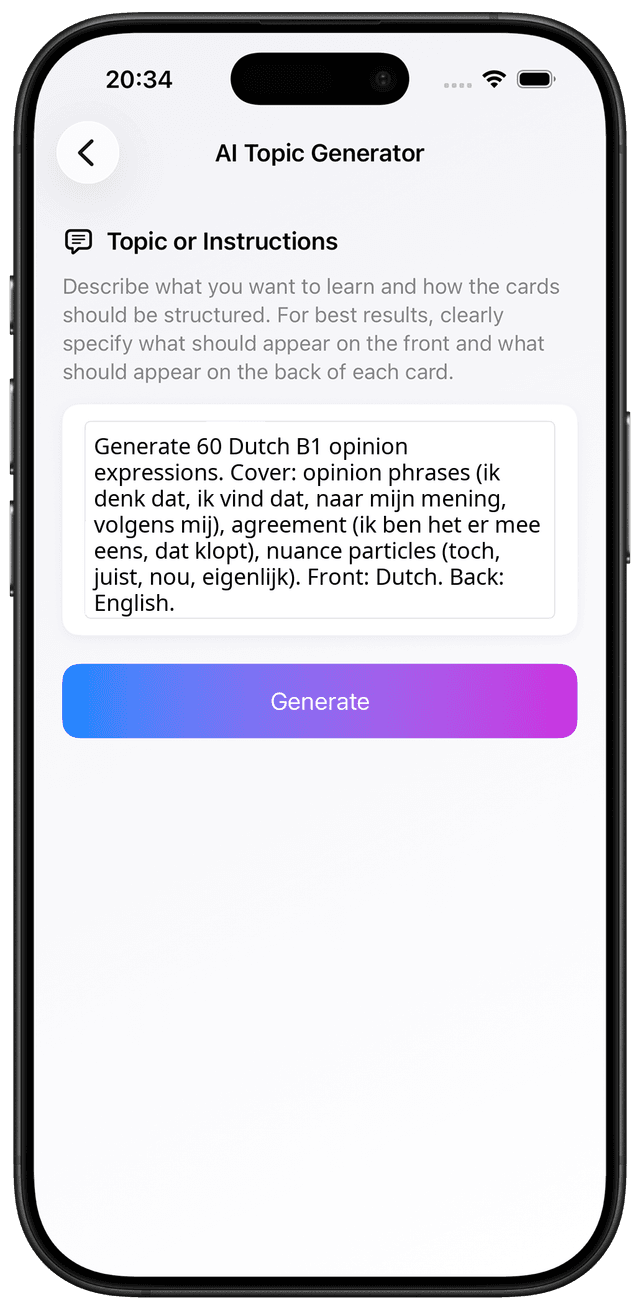
Generate 60 Dutch B1 opinion and nuance expressions. Cover: opinion phrases (ik denk dat, ik vind dat, naar mijn mening, volgens mij, het lijkt mij dat), agreement and disagreement (ik ben het er mee eens, ik ben het er niet mee eens, dat klopt, dat klopt niet), nuance particles (toch, juist, nou, eigenlijk, wel, zelfs), and qualifying phrases (aan de ene kant, aan de andere kant, maar toch, hoewel ik begrijp dat). Front: Dutch phrase. Back: English + usage note.
Conditional sentences in Dutch split into real conditions (Als het regent, blijf ik thuis) and hypothetical conditions (Als ik meer tijd had, zou ik Nederlands studeren). The real condition uses the present tense for both clauses. The hypothetical uses the imperfect for the condition and zou plus infinitive for the result. This distinction matters for everyday conversation about plans, wishes, and workarounds.
The zou construction also handles polite requests and reported speech in Dutch. Zou je dit kunnen doen? is the standard polite question form at work or in service situations. Hij zei dat hij zou komen is how reported speech works in Dutch. Both are essential B1 forms, and both use zou in a slightly different way. The deck treats them as related but separate patterns.
Why this now? Conditionals and hypotheticals come up constantly when discussing plans, preferences, and what-if scenarios. These conversations happen in job interviews, casual chats about weekend plans, and inburgering speaking tasks alike.
The strategy: This deck works through real conditionals, hypothetical conditionals, polite zou requests, and reported speech structures in realistic dialogues so the four uses of zou get separated clearly.
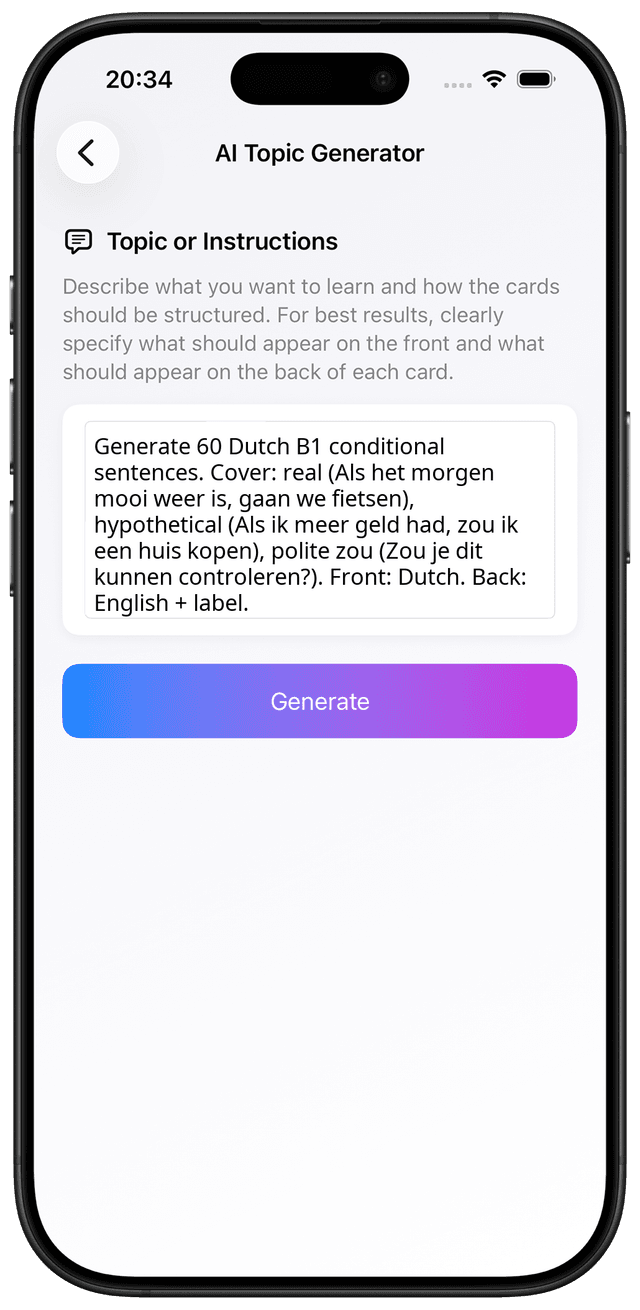
Generate 60 Dutch B1 conditional and hypothetical sentences. Cover: real conditionals (Als het morgen mooi weer is, gaan we fietsen), hypothetical conditionals (Als ik meer geld had, zou ik een huis kopen), polite zou requests (Zou je dit kunnen controleren?, Zou ik even mogen bellen?), and reported speech (Hij zei dat hij zou helpen, Ze vroeg of ik zou komen). Front: Dutch. Back: English + type label (real / hypothetical / polite / reported).
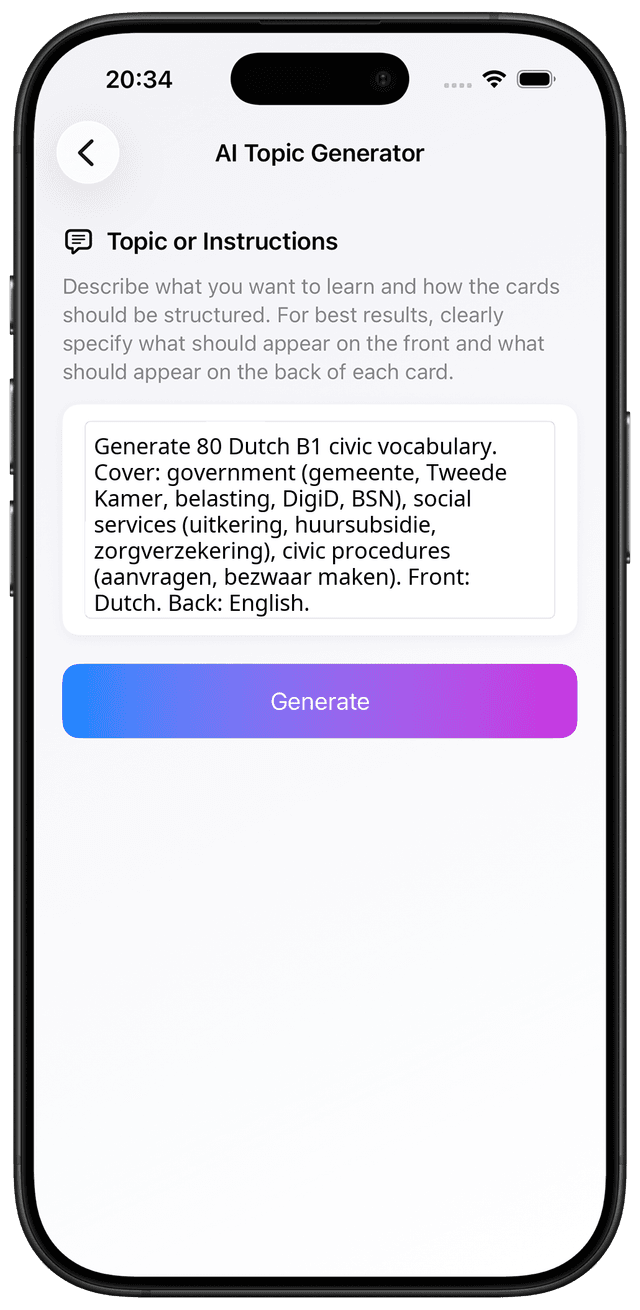
B1 in the Netherlands context means inburgering and civic integration. Dutch society has a specific vocabulary for institutions, rights, and social participation: gemeenteraad (municipal council), inkomensbelasting (income tax), sociale zekerheid (social security), huursubsidie (rent subsidy), uitkering (benefit payment), bezwaar maken (to lodge an objection), DigiD (the government digital identity). This vocabulary is not optional for anyone living in the Netherlands.
Dutch culture has specific concepts worth knowing at B1: polderen (the Dutch consensus model), gedogen (tolerating without formally approving), doe maar gewoon, verzuiling (pillarisation, the historical separation of society into groups). Understanding these words gives you access to conversations about Dutch news, politics, and cultural identity that are otherwise opaque.
Why civic vocabulary at B1: The inburgering B1 exam specifically tests civic knowledge in Dutch. Even outside exam contexts, understanding municipality letters, tax forms, and healthcare registration requires this layer of administrative language.
The strategy: This deck covers government and administration vocabulary, social services terms, rights and procedures, and key Dutch cultural concepts, with short contextual sentences that show these words in realistic administrative situations.
Generate 80 Dutch B1 civic and society words. Cover: government and administration (gemeente, gemeenteraad, burgemeester, wethouder, Tweede Kamer, referendum, belasting, DigiD, BSN), social services (uitkering, bijstand, huursubsidie, zorgverzekering, eigen risico, sociale zekerheid), civic procedures (aanvragen, bezwaar maken, indienen, registreren, verlengen), and Dutch cultural concepts (polderen, gedogen, verzuiling). Front: Dutch. Back: English + short context note.
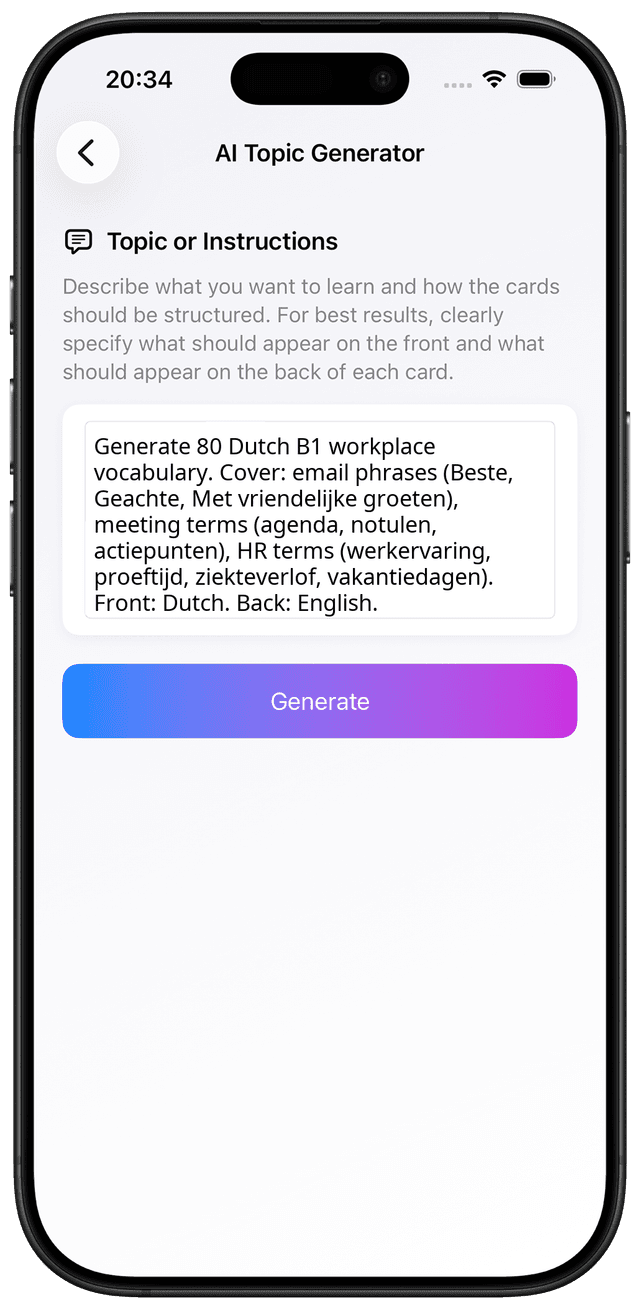
Dutch workplace communication at B1 requires a specific register. Emails start with Beste [name], and end with Met vriendelijke groeten. Meetings involve agenda items, actiepunten, notulen, and besluitvorming. Job interviews ask you to describe your werkervaring, sterke punten, and where you see yourself in vijf jaar. Dutch employers also expect you to understand your rechten as an employee: vakantiedagen, ADV-uren, ziekteverlof, proeftijd.
Dutch office culture has specific norms. Meetings run according to an agenda, decisions are documented in notulen, and direct disagreement in meetings is more acceptable than in many other cultures. The Dutch word vergadering is a regular meeting, but bespreking is a smaller discussion. The difference matters in how you phrase a meeting request in an email or calendar invite.
Why professional Dutch matters: Getting hired and functioning at a Dutch workplace requires professional register on top of everyday fluency. The gap between understanding a conversation and being able to write a clear workplace email is significant, and this deck closes it.
The strategy: This deck covers formal email phrases, meeting vocabulary, HR and contract terms, and job interview language with realistic examples from Dutch professional contexts.
Generate 80 Dutch B1 professional and workplace vocabulary items. Cover: email phrases (Beste, Geachte, Met vriendelijke groeten, Naar aanleiding van, Bijgaand vindt u), meeting vocabulary (agenda, notulen, actiepunten, besluit, vergadering, bespreking, rondvraag), HR and employment terms (werkervaring, sollicitatiegesprek, proeftijd, ziekteverlof, vakantiedagen, loonstrook, cao), and direct communication (Ik stel voor dat, Ik ben het er niet mee eens, Kunt u dit toelichten?). Front: Dutch. Back: English + register note (formal/semi-formal).
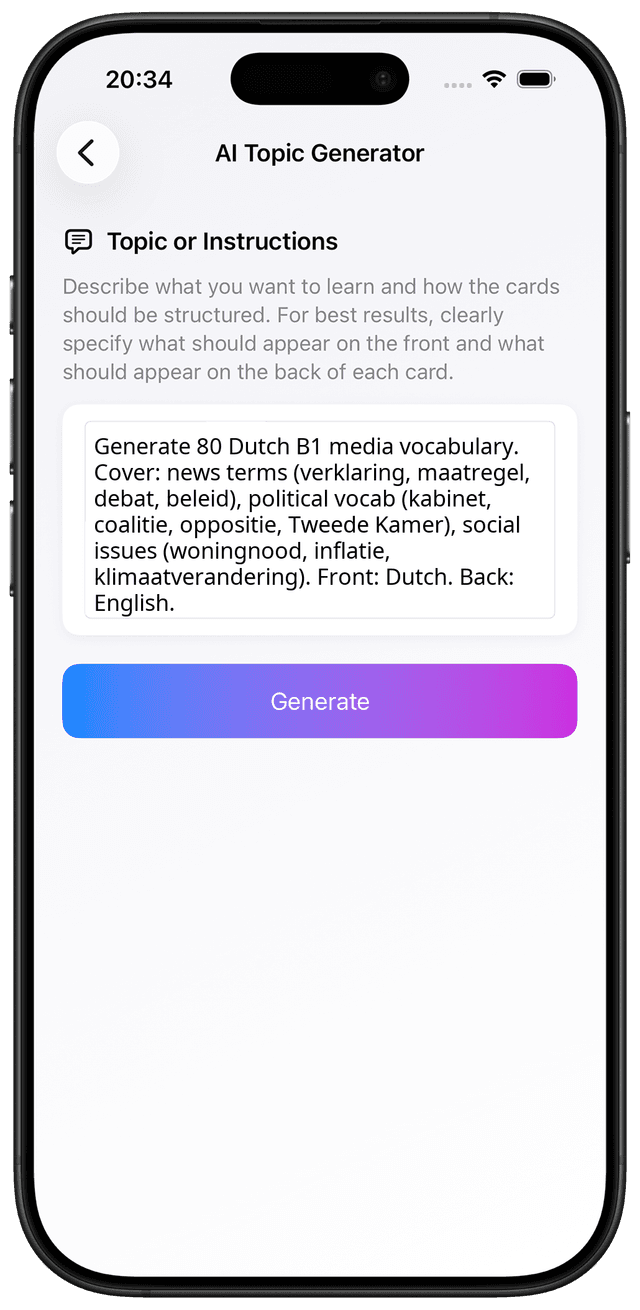
Dutch news language has its own register. Verklaringen (statements), maatregelen (measures), kabinetsformatie (coalition formation), Kamerdebat (parliamentary debate), inwoners (residents), woningnood (housing crisis), inflatie, energierekening. If you want to follow the NOS, read de Volkskrant, or participate in conversations about Dutch current affairs, this vocabulary is the entry point.
B1 reading tasks include newspaper articles and they test whether you can extract the main point, identify the author's position, and understand formal written Dutch. The passive voice appears constantly in news language: er wordt besloten (a decision is being made), er is aangekondigd (it has been announced), er wordt verwacht (it is expected). Recognizing passives is an A2 skill, but producing them and reading them under pressure is a B1 skill.
Why media vocabulary at B1: Following Dutch news gives you consistent, high-quality input at exactly B1 register. It also gives you conversation topics. Dutch social conversations often involve current affairs, and being able to engage requires knowing the vocabulary.
The strategy: This deck covers news and media vocabulary, passive constructions in formal text, political and social keywords, and common newspaper phrases with example headlines and summary sentences.
Generate 80 Dutch B1 media and current events vocabulary. Cover: news terms (verklaring, maatregel, aankondiging, debat, beleid, rapport, onderzoek, incident), political vocabulary (kabinet, coalitie, oppositie, motie, referendum, minister-president, Tweede Kamer), social issues (woningnood, inflatie, energierekening, klimaatverandering, asielzoekers, integratie), and passive constructions in news language (er wordt besloten, er is aangekondigd, er wordt verwacht, er is bekend gemaakt). Front: Dutch. Back: English + context sentence.
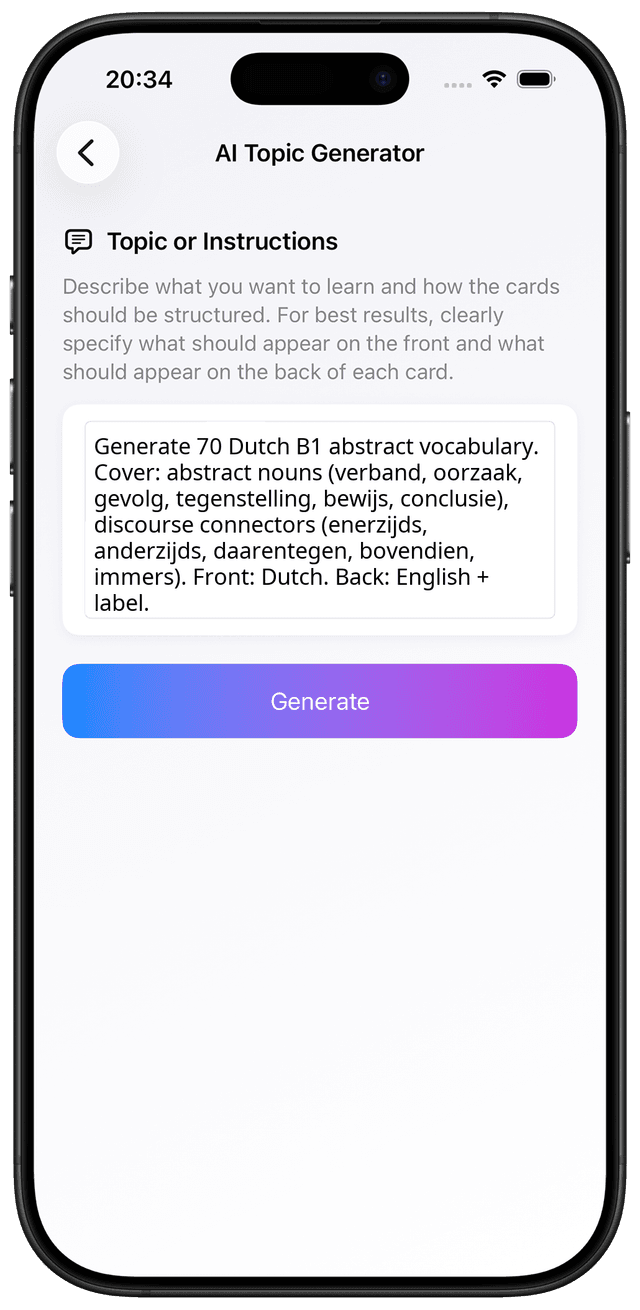
The final B1 phase covers abstract language for discussing ideas, making comparisons, and structuring arguments. Words like verband (connection), oorzaak (cause), gevolg (consequence), tegenstelling (contrast), overeenkomst (similarity), perspectief (perspective), benadering (approach), bewijs (evidence). These are the words that let you go from describing facts to analyzing them in Dutch.
B1 speakers can compare and contrast, explain cause and effect, and support a position with examples. The connectors that do this work are different from the basic A1/A2 set: enerzijds, anderzijds, daarentegen, bovendien, bovengenoemde, immers, aangezien, derhalve, daardoor, daarbij. Most learners know en and maar. These are the connectors that signal intermediate level to a Dutch listener.
The B1 milestone: With this deck complete, your Dutch vocabulary covers complex sentence structures, opinion language, conditionals, civic life, professional contexts, media, and abstract reasoning. That is the full B1 range, and it is enough to hold real conversations, follow Dutch TV, and function in Dutch workplaces and institutions.
Generate 70 Dutch B1 abstract vocabulary and discourse markers. Cover: abstract nouns (verband, oorzaak, gevolg, tegenstelling, overeenkomst, perspectief, benadering, bewijs, argument, conclusie), discourse connectors (enerzijds, anderzijds, daarentegen, bovendien, immers, aangezien, derhalve, daardoor, daarbij, ten slotte), and analytical phrases (dat heeft te maken met, een gevolg hiervan is, dit toont aan dat, in vergelijking met, aan de hand van). Front: Dutch. Back: English + function label (contrast / cause / addition / conclusion).
B1 vocabulary covers abstract words and complex grammatical structures, not just concrete nouns. Research on spaced retrieval practice shows it works just as well for grammar forms and discourse markers as for basic vocabulary. Actively retrieving a subordinate clause structure is what builds the automatic response you need in real conversation, more than re-reading grammar tables.
B1 builds on A2. If the past tenses and separable verbs from A2 are not solid yet, go back and solidify those first. The full Dutch guide links everything together.
Build your Dutch B1 vocabulary with AI-generated decks and spaced repetition that adjusts to what you actually find difficult. Free to download. No account required. Start with the phase that addresses your biggest gap.