
Spaced repetition explained
Why reviewing at the right interval locks in Dutch A2 vocabulary
You have the A1 foundation. Now build Dutch you can use in actual conversations. The A2 jump is the Voltooid Tegenwoordige Tijd (the past tense Dutch uses in everyday speech), separable verbs that rearrange entire sentences, and modal constructions that make you sound polite rather than blunt in shops and offices.
A2 is roughly 1,000 words and structures. Not all of them are equal. The VTT past tense and separable verbs cover most of what you will actually say. Modal verb phrases cover most of what you need to say politely in shops, offices, and medical situations. This guide goes through those in order.
Each phase has a ready-to-use AI prompt. Copy it into MindCards and the app generates a focused deck built around real Dutch grammar. Spaced repetition then handles scheduling, so you review each card just before you are likely to forget it rather than re-reading the same lists.
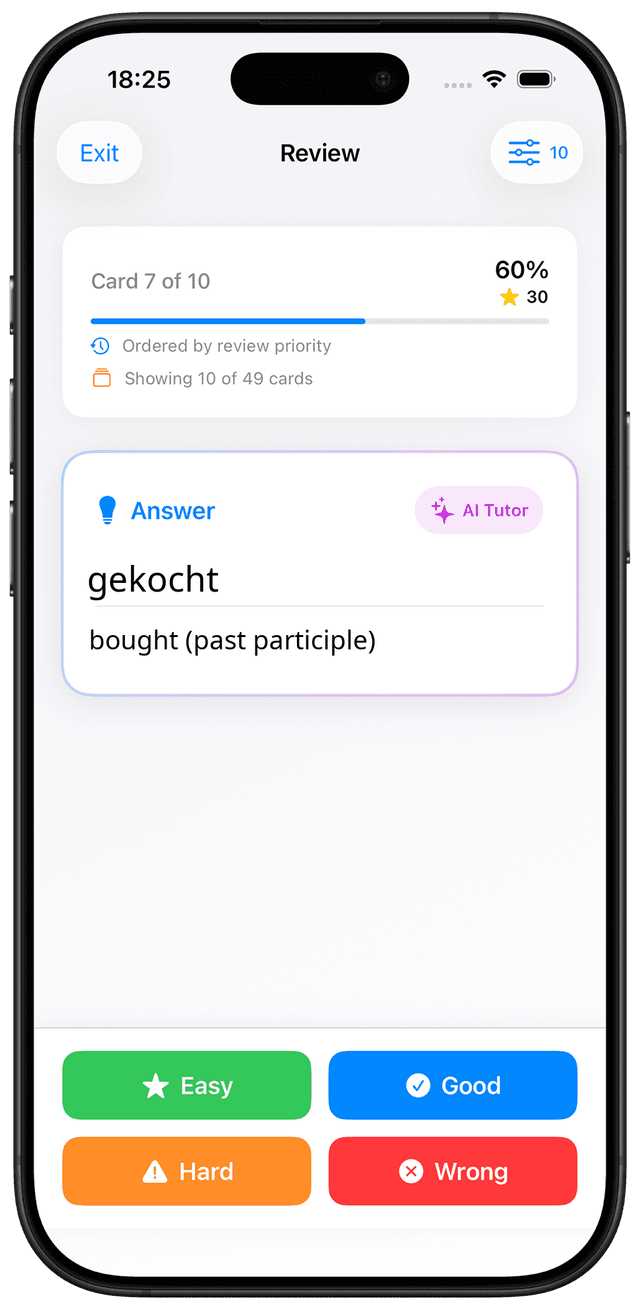
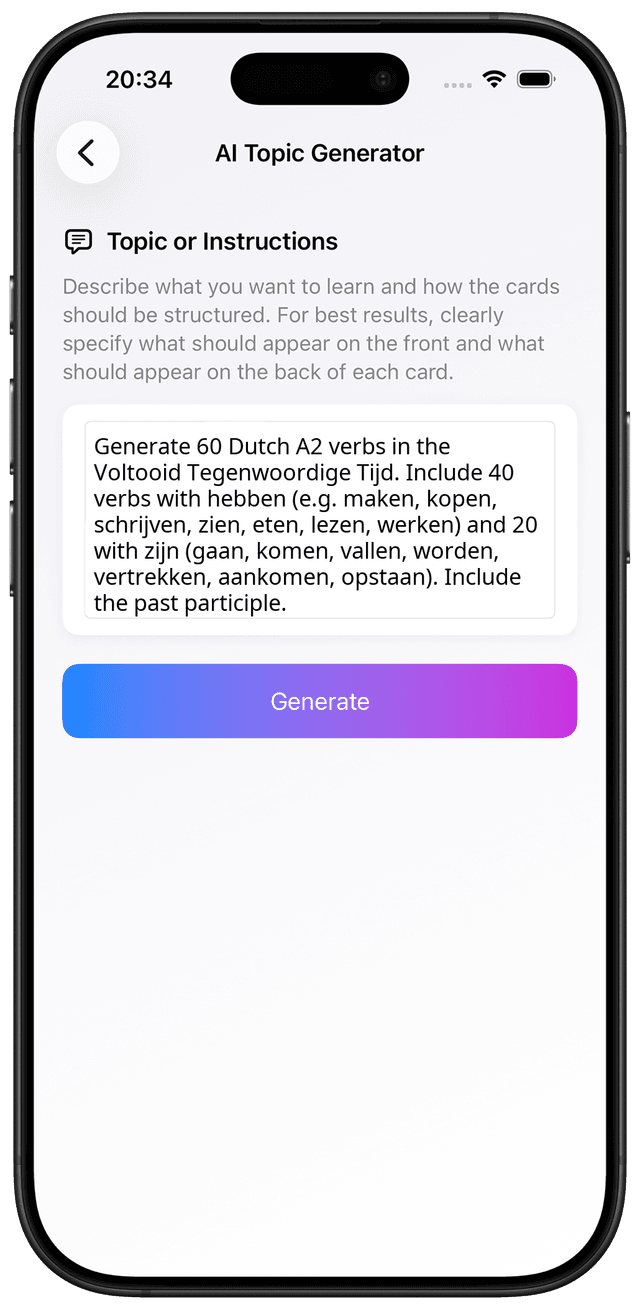
The Voltooid Tegenwoordige Tijd (VTT) is the past tense Dutch speakers use in everyday conversation. Like German's Perfekt, it combines a helper verb (hebben or zijn) with a past participle. Regular past participles take a ge- prefix plus -t or -d at the end, with the ending determined by the 't kofschip rule. Irregular verbs have their own forms and are worth learning early.
The choice between hebben and zijn follows a pattern: zijn goes with movement and state-change verbs (gaan, komen, vallen, worden), and hebben with most others. In spoken Dutch, the VTT handles nearly all past narration. The simple past (Onvoltooid Verleden Tijd) is mostly a written form.
Why start here? Every other A2 topic assumes you can talk about something that already happened. The VTT unlocks that, and it is the past tense structure tested in inburgering A2 speaking and writing tasks.
The strategy: This deck focuses on 60 high-frequency verbs with their correct helper verb (hebben or zijn), the past participle form, and a natural example sentence on the back so you absorb real sentence structure, not just isolated forms.
Generate 60 Dutch A2 verbs in the Voltooid Tegenwoordige Tijd. Include 40 verbs with hebben (e.g. maken, kopen, schrijven, zien, eten, lezen, werken) and 20 with zijn (gaan, komen, vallen, worden, vertrekken, aankomen, opstaan). Include the past participle and one short example sentence. Front: infinitive + correct VTT form. Back: English + example sentence using ik or wij.
Spoken Dutch uses the VTT for almost all past narration, but the Onvoltooid Verleden Tijd (OVT) appears constantly in written texts and with a handful of very common verbs: zijn (was/waren), hebben (had/hadden), zullen, and kunnen. You will run into it every time you read a Dutch news article.
Regular OVT verbs follow the same 't kofschip rule as the VTT: stems ending in a 't kofschip' letter get -te/-ten, the rest get -de/-den. Irregular verbs have their own forms. The deck covers both so you can recognize the OVT in text without having to stop and look things up.
Why the OVT now? At A2, you need both past tenses to read Dutch texts and follow formal contexts. The OVT of zijn and hebben appear in nearly every paragraph of written Dutch, so you cannot avoid it.
The strategy: This deck covers the most common irregular OVT forms plus the regular conjugation pattern, with example sentences contrasting written and spoken registers.
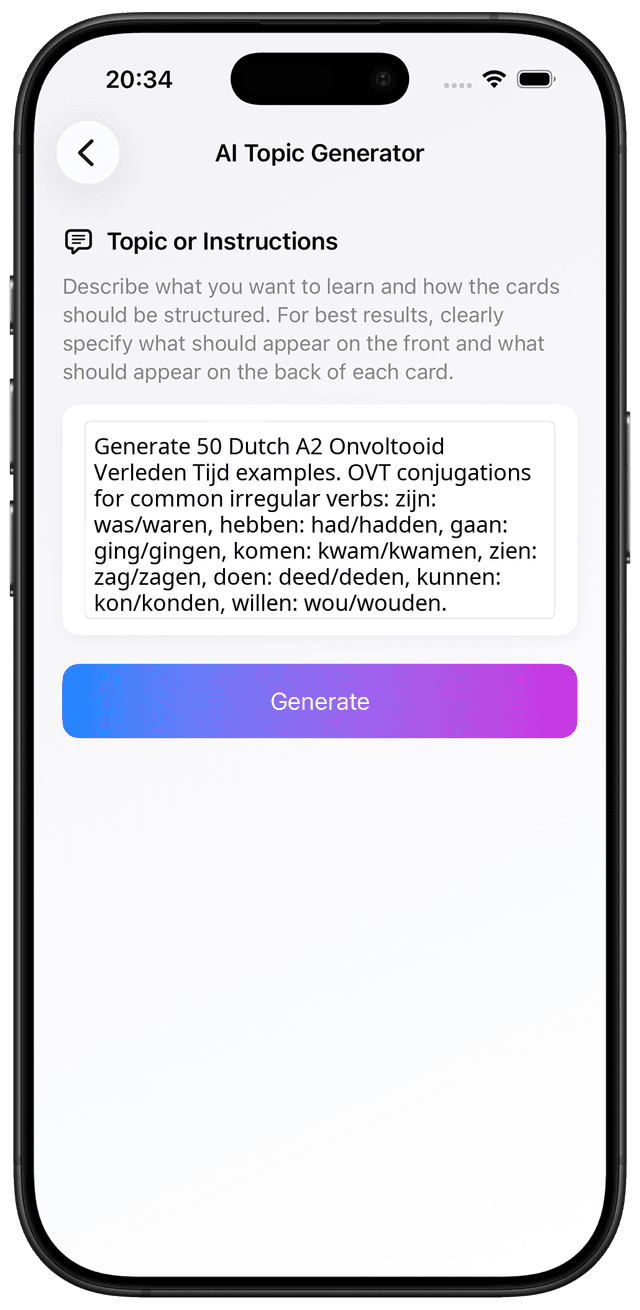
Generate 50 Dutch A2 Onvoltooid Verleden Tijd examples. Include: OVT conjugations for the 15 most common irregular verbs (zijn: was/waren, hebben: had/hadden, gaan: ging/gingen, komen: kwam/kwamen, zien: zag/zagen, doen: deed/deden, kunnen: kon/konden, willen: wou/wouden, zeggen: zei/zeiden, weten: wist/wisten, staan: stond/stonden, zitten: zat/zaten, liggen: lag/lagen, lopen: liep/liepen, schrijven: schreef/schreven), the regular -te/-ten and -de/-den pattern explained with 10 examples using the t kofschip rule. Front: Dutch OVT sentence. Back: English + tense label (OVT) with a usage note on register.
Separable verbs split apart in Dutch main clauses in a way that has no equivalent in English. Opbellen (to call) becomes Ik bel je op in a main clause: the prefix op travels to the end. In subordinate clauses with omdat or dat, the verb stays together: Ik weet dat hij je ophelt. You need to know both positions or the sentence sounds wrong.
The VTT of separable verbs adds a complication: the ge- prefix goes between the separable prefix and the stem. So opbellen becomes opgebeld, meenemen becomes meegenomen, uitleggen becomes uitgelegd. The deck works through these patterns in main clauses, subordinate clauses, and past tense forms so the word-order rules sink in through repeated exposure rather than memorized rules.
Why separable verbs matter: Everyday Dutch conversation is packed with separable verbs. Opstaan, afspreken, meenemen, uitleggen, aankomen, terugkomen, opbellen, invullen all appear in practical situations from making appointments to following directions.
The strategy: This deck covers 50 high-frequency separable verbs with main clause, subordinate clause, and VTT examples for each group so the word-order rules stick through repetition.
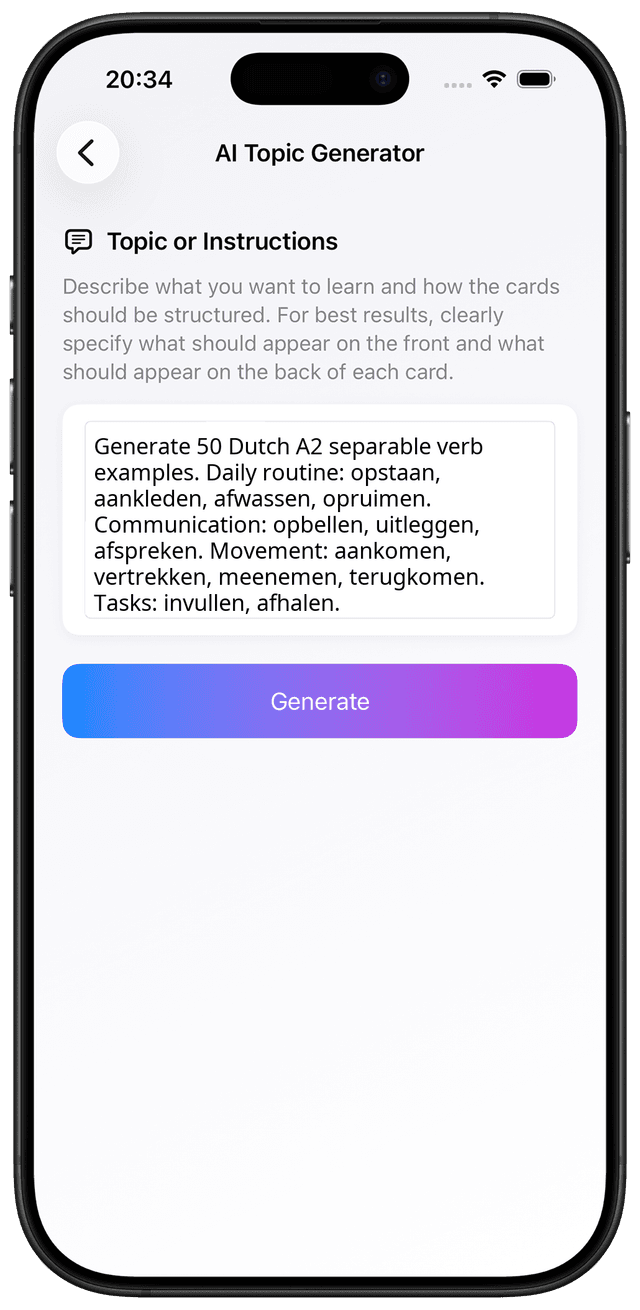
Generate 50 Dutch A2 separable verb examples (scheidbare werkwoorden). Cover: daily routine verbs (opstaan, aankleden, afwassen, opruimen), communication verbs (opbellen, uitleggen, afspreken, terugbellen), movement and direction verbs (aankomen, vertrekken, meenemen, terugkomen, doorgaan), and household/task verbs (invullen, afhalen, uitzetten, aanzetten). For each verb include: main clause example (Ik bel je op), subordinate clause example (omdat ik je opbel), and VTT form (Ik heb je opgebeld). Front: Dutch. Back: English + clause type label.
Dutch modals (kunnen, willen, mogen, moeten, hoeven, zullen) follow verb-second order and push the infinitive to the end of the clause. Kun je dit uitleggen? uses inversion for questions. In subordinate clauses, the modal comes after the subject with the infinitive last: Ik weet dat je dit kunt doen.
The conditional form zou + infinitive is the polite register for requests. Zou ik een afspraak kunnen maken? is what you actually say at a reception desk or pharmacy. Ik wil een afspraak sounds blunt by comparison. Inburgering candidates encounter this register constantly in administrative and medical situations.
Why add modals now? After past tenses and separable verbs, polite requests and permission phrases complete the grammar core you need for practical Dutch interaction. Modal verbs appear in nearly every administrative and service situation.
The strategy: This deck combines modal verb conjugations with zou + infinitive polite forms and practical service phrases so you can request, ask permission, and explain obligations in one connected batch.
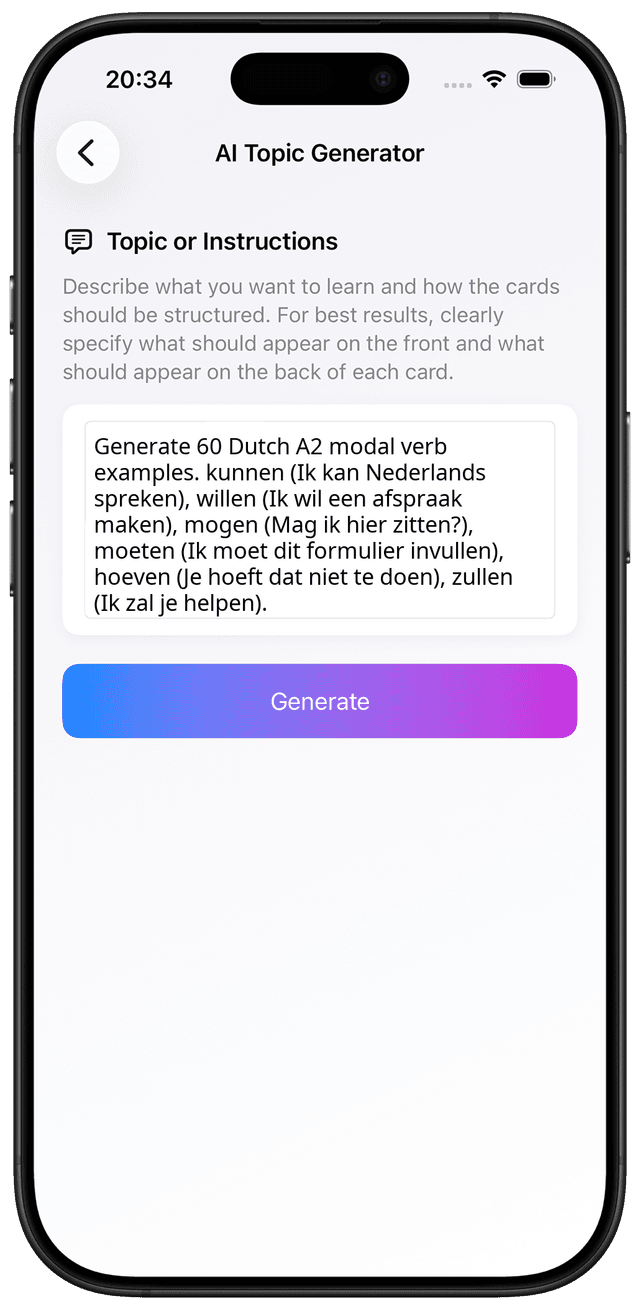
Generate 60 Dutch A2 modal verb examples. Cover kunnen (ability: Ik kan Nederlands spreken), willen (want: Ik wil een afspraak maken), mogen (permission: Mag ik hier zitten?), moeten (obligation: Ik moet dit formulier invullen), hoeven (not need to: Je hoeft dat niet te doen), zullen (promise/offer: Ik zal je helpen). Include 15 zou + infinitive polite request examples (Zou ik een afspraak kunnen maken?, Zou u dit kunnen uitleggen?). For each modal add a main clause and a subordinate clause example. Front: Dutch sentence. Back: English + modal label and usage note.
Dutch shopping has its own vocabulary that A1 never covers. The uitverkoop is a clearance sale, a bonnetje is a receipt, a factuur is an invoice. Maat covers clothing sizes, but shoe sizes use a different word, pointure. In practice, these distinctions come up in every shop, and getting them wrong produces confusion rather than just a slightly foreign accent.
Dutch service culture expects a polite conditional register. Ik zou graag een afspraak willen maken is standard. Ik wil een afspraak sounds like a demand. The gap between the two is not large grammatically, but it is noticeable to staff, and learning the polite form from the start saves you from having to unlearn a blunt habit later.
Why this is tested: Inburgering A2 writing and speaking tasks use shopping and service situations because they require practical transactional vocabulary without complex grammar structures.
The strategy: This deck mixes product vocabulary, payment terms, and common service phrases so you can handle real Dutch transactions from the supermarkt to the gemeente desk.
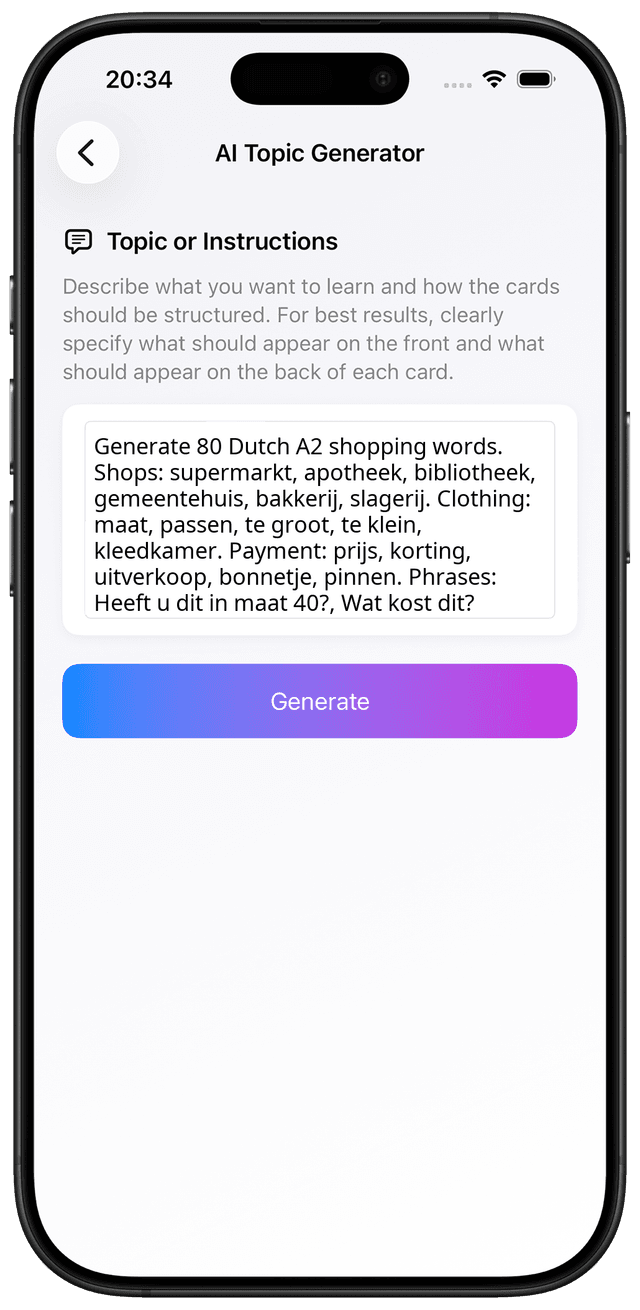
Generate 80 Dutch A2 words and phrases for Shopping and Services. Cover: shop types (supermarkt, apotheek, bibliotheek, gemeentehuis, postkantoor, bakkerij, slagerij), clothing and sizes (maat, passen, te groot, te klein, kassierk, kleedkamer), payment terms (prijs, korting, uitverkoop, bonnetje, factuur, pinnen, contant betalen), and service phrases (Heeft u dit in maat 40?, Wat kost dit?, Kan ik dit ruilen?, Zou ik met de manager kunnen spreken?). Front: Dutch. Back: English.
The Dutch public transport system runs on an ov-chipkaart and a vocabulary of its own: perron (platform), vertrektijd (departure time), aankomsttijd (arrival time), overstappen (to change trains). This phase covers that layer, plus hotel check-in, directions, and the phrases you need when something goes wrong.
Dutch directions use linksaf, rechtsaf, and rechtdoor, but also position phrases: aan het einde van de straat (at the end of the street), schuin tegenover (diagonally opposite), voorbij de brug (past the bridge). These appear in A2 listening tasks where a speaker describes a route through a Dutch neighborhood.
Why travel vocabulary matters: Travel and transport are major topic areas in the inburgering A2 exam. The vocabulary here is also immediately practical for anyone living in or visiting the Netherlands.
The strategy: This deck combines train and bus vocabulary, accommodation terms, and directional phrases so you can navigate from the station to the hotel without separate word lists for each context.
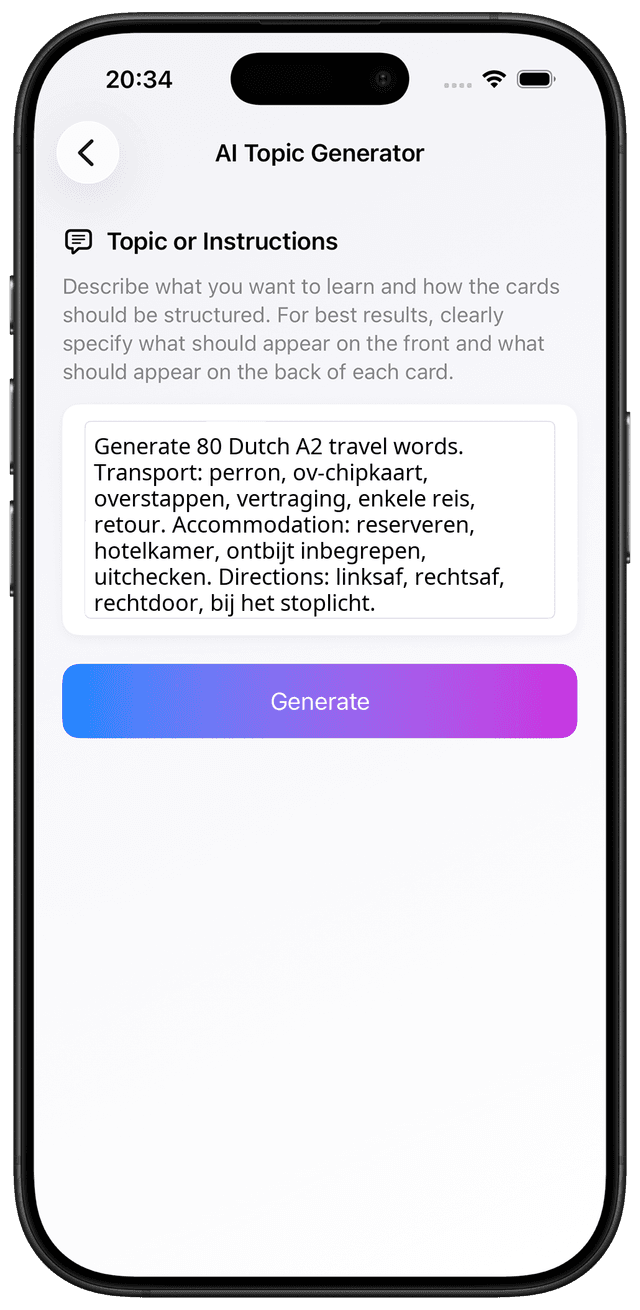
Generate 80 Dutch A2 words and phrases for Travel and Directions. Include: public transport vocabulary (perron, vertrektijd, aankomsttijd, ov-chipkaart, overstappen, vertraging, enkele reis, retour, tram, metro, bus), accommodation (reserveren, hotelkamer, tweepersoonskamer, ontbijt inbegrepen, receptie, uitchecken), directions (linksaf, rechtsaf, rechtdoor, bij het stoplicht, aan het einde van de straat, schuin tegenover, voorbij de brug, op de hoek van), and travel problems (De trein heeft vertraging, Mijn bagage is kwijt, Waar is het dichtstbijzijnde station?). Front: Dutch. Back: English.
The last A2 phase covers health vocabulary for symptoms and appointments, work vocabulary for contracts and routines, and the future constructions: gaan + infinitive for immediate plans, zullen + infinitive for promises and predictions, and the present tense with a future time marker for near-future events. In conversation, Ik ga morgen werken is more natural than a full Futur construction for most situations.
Work vocabulary in Dutch has specific contract terms that appear in job listings and at the employment agency: vast contract (permanent), tijdelijk contract (temporary), parttijd (part time), proeftijd (probation period). These come up in A2 assessment scenarios and in real conversations about work situation and housing registration.
The milestone: With this deck, your Dutch A2 vocabulary is complete. You can now describe past events with the VTT and OVT, handle separable verbs and modal constructions, navigate shopping and travel, and discuss health and work topics. That covers the full A2 picture needed for everyday Dutch life and inburgering assessment.
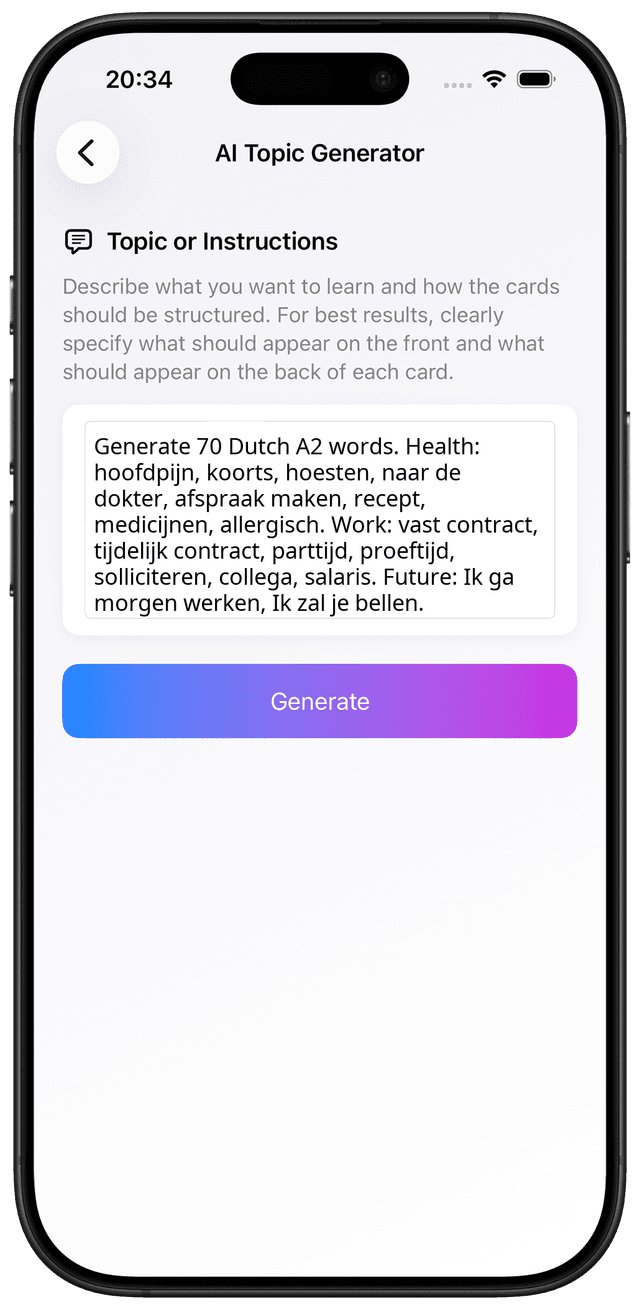
Generate 70 Dutch A2 words and phrases across three areas. Health: symptoms and medical appointments (hoofdpijn, koorts, hoesten, naar de dokter gaan, een afspraak maken, recept, medicijnen, allergisch). Work: job and contract vocabulary (vast contract, tijdelijk contract, parttijd, proeftijd, solliciteren, collega, vergadering, salaris, werkloos, werkgever). Future: 20 sentences using gaan + infinitive (Ik ga morgen werken), zullen + infinitive (Ik zal je bellen), and present tense with future time markers (Morgen heb ik een afspraak). Front: Dutch. Back: English + category label (Health / Work / Future).
Spaced repetition and active recall both have solid research support for vocabulary retention. VTT past tense, separable verbs, and modal constructions all rely on pairing a form with a meaning and a context. Retrieval practice is how those pairings stick. Reading a word list passively does not do the same job.
If you are just starting out, go back to A1 first. If you have the A1 words solid, this is where to go next. Ready for more? The B1 guide covers subordinate clauses, opinion language, and professional Dutch.
Build your Dutch A2 vocabulary with AI-generated decks and spaced repetition that adapts to what you actually struggle with. Free to download. No account required. Start with any phase that interests you most.