
Spaced repetition explained
Why reviewing at the right interval is the key to retaining mastery-level Arabic vocabulary
You have C1 Arabic. You can read a long-form opinion column, write a structured argument with embedded clauses, and follow an academic lecture without leaning on translation. C2 is where the effort drops away entirely. The mental work of monitoring your Arabic fades, you reach for the right literary phrase without pause, and you produce written Arabic that does not read as a translation from English.
This guide covers the 1,500+ items that close the remaining gap between advanced and near-native Arabic. Literary فصحى comes first, because the absence of literary register is the most visible signal of a non-native writer. Then classical Arabic and Jahili lexicon for the inherited core that surfaces in every serious essay; specialised academic register across four high-demand fields; advanced balagha for the rhetorical figures that make Arabic prose sing; cross-dialect mastery for genuine pan-Arab communication; near-synonym precision for the fine word choices that an editor notices; and full conscious stylistic control for the C2 endpoint. The whole path is built around ACTFL Distinguished and ALPT Advanced Plus expectations.
Each of the seven phases below includes a ready-to-use AI prompt. Paste it into MindCards and your first deck for that topic builds in seconds. Spaced repetition then schedules each card at the right interval, so your review time goes to the items you are actually forgetting and not the ones you have already locked in.
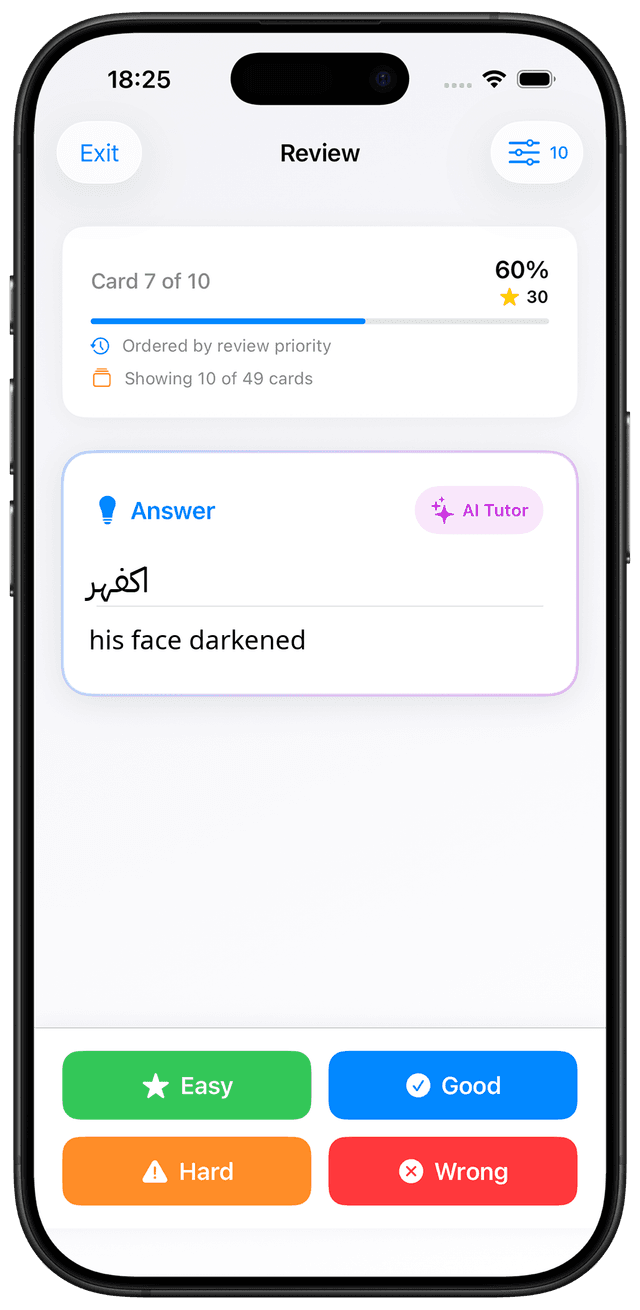
C2 Arabic is not a longer word list bolted onto C1. It is the habit of reading a novel by Naguib Mahfouz, an essay by Taha Hussein, or a short story by Yusuf Idris without ever stopping for a dictionary. The vocabulary at this level sits between contemporary MSA and the older literary tradition. Words like وجوم, اِكفهرّ, نضارة, سَجِيّة, مُحيّا, اِغترَب, وَحشة, اِنطوى على نفسه. A native reader handles these inside the flow of the sentence. A C1 reader pauses on each one. The TORFL-equivalent ACTFL Distinguished rating and the Arabic Language Proficiency Test (ALPT) both probe directly at this layer.
Why start here? Literary فصحى is the most reliable marker of C2 Arabic. An Arabic editor reading your prose notices the absence of literary register before they notice anything else. This phase targets 250 of the highest-frequency literary words and collocations from twentieth-century Arabic fiction, grouped by semantic field so the patterns become easier to internalise.
The strategy: Each card pairs the literary item with a real passage from a canonical Arabic novel or short story and a note on the contemporary contrast. You learn the literary word and you also learn where it still lives in current Arabic writing.
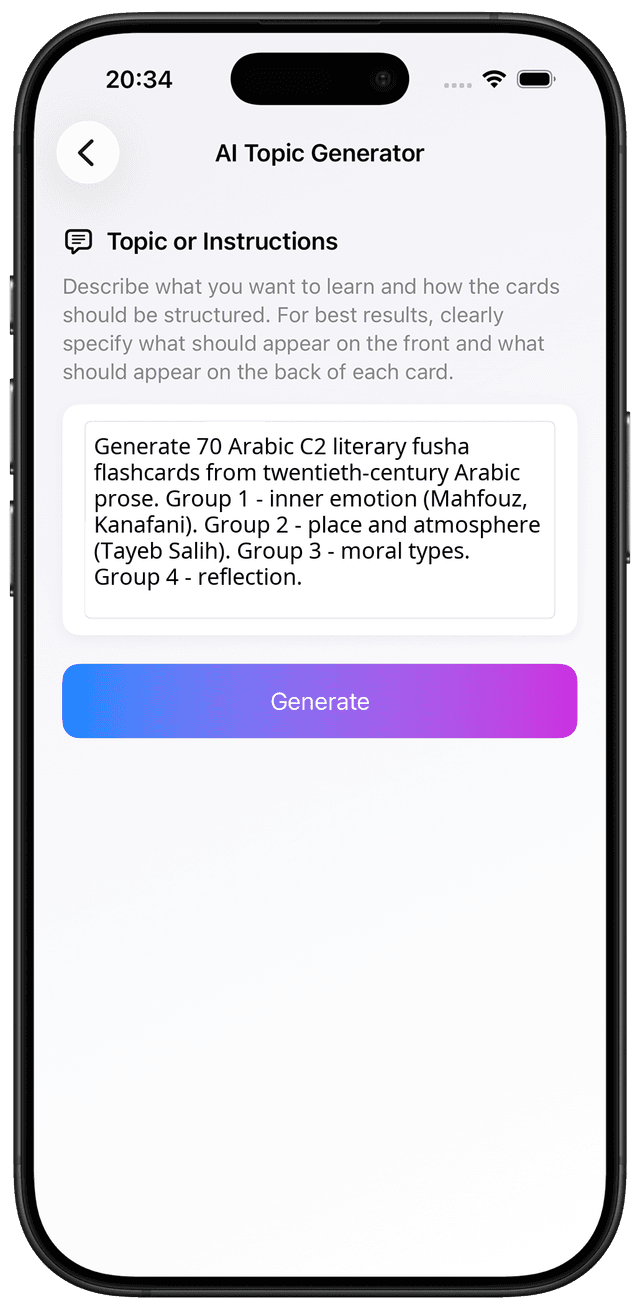
Generate 70 Arabic C2 literary فصحى flashcards in four thematic groups drawn from twentieth-century Arabic prose. Group 1 - Inner state and emotion (Mahfouz, Kanafani): وجوم, اكفهرّ وجهه, نضارة الشباب, سجيّة طيبة, مُحيّا مشرق, وحشة الغربة, انطوى على نفسه, تمتم بكلمات غير مفهومة, ساوره شعور بـ, ألمّت به الذكرى. Group 2 - Description of place and atmosphere (Tayeb Salih, Hanan al-Shaykh): الغسق, الشفق, خفقت أوراق الشجر, تسلّلت أشعّة الشمس, انبثّ النور, تهادى نسيم, ساد الصمت, خيّم الهدوء. Group 3 - Social and moral types (Taha Hussein, Yusuf Idris): الخامل الذكر, المتزلّف, الأبيّ, الشهم, البخيل المتعالي, المتزمّت, الطيّب القلب, السليط اللسان. Group 4 - Authorial reflection and narration: ولم يخطر بباله أنّ, تساءل في قرارة نفسه, لم يدر كيف, راودته الفكرة, ذرفت عيناه, استبدّ به القلق. Front: Arabic word or collocation with a real literary sentence in context (note the author). Back: English equivalent, literal sense, and literary function label.
Modern فصحى inherits a deep classical layer that surfaces constantly in serious writing. A Friday khutbah, a literary essay in Al-Adab, a presidential speech, a thesis on Arabic poetics. They all draw on a vocabulary set that goes back to the Jahili odes (المعلّقات), the Quran, and the prose of al-Jahiz and Ibn al-Muqaffa'. Words like الذراع (forearm/cubit as a unit and as an idiom), البَسُوس, الناقة, اللُّجَّة, الفَيافي, الصرح, الحَرَن, البَتُول. These are not museum pieces. They appear in editorial writing and serious literary criticism every week.
The goal: To give you enough classical lexical depth that a passage of literary criticism, a long-form essay in Al-Jadeed, or a quoted line of pre-Islamic poetry reads at conversational speed rather than as a translation exercise. This vocabulary also unlocks deeper comprehension of the cultural references that educated Arabic-speakers reach for in everyday formal speech.
The strategy: The deck draws from Quranic verses (with their meaning in context), lines of pre-Islamic and Umayyad poetry, classical prose extracts, and contemporary Arabic essays that quote these sources. Each card includes the classical source, the current usage, and the rhetorical function.
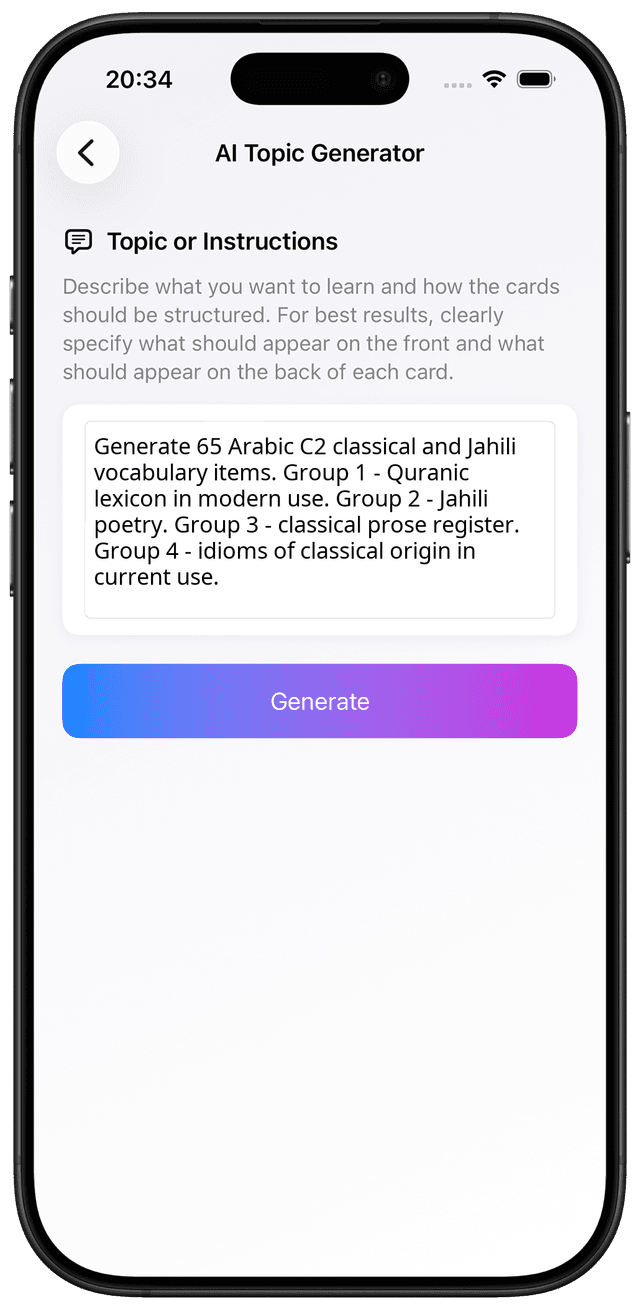
Generate 65 Arabic C2 classical and Jahili vocabulary items in four groups. Group 1 - Quranic lexicon in modern use (20): استحوذ على, آلى على نفسه, جدير بـ, دانٍ من, حَفِيٌّ بـ, ذو شأن, لا يألو جهداً, ضرب به المثل, جرى مجرى, خَلَتْ من قبل. Group 2 - Jahili poetry and metaphor (15): الفَيافي, الصُّبح, طَلَل, الناقة الوَجناء, القَلائص, الجَمَل, الذِئاب, الكَواكِب. Group 3 - Classical prose register (al-Jahiz, Ibn al-Muqaffa) (15): مُروءة, شَهامة, نُبل, بَلاغة, فصاحة, بديهة حاضرة, سرعة خاطر, دَهاء, حِكمة بالغة. Group 4 - Idiomatic phrases of classical origin in current use (15): على قَدَم وساق, على حافّة الهاوية, بين عشيّة وضحاها, في غمضة عين, لا ناقة له فيها ولا جمل, طَوَتْ صفحة الماضي, حُلم ليلة صيف, الزَّبَد والغُثاء. Front: Arabic item with a quotation showing its classical source and one contemporary sentence using it. Back: English equivalent, classical context, and current rhetorical function.
C2 academic Arabic is no longer the generic register of any thesis. It is the specialised lexicon of one or two disciplines that you can move through without effort. A philosophy paper uses ميتافيزيقا, ظاهراتيّة, العقلانيّة النقديّة, الأخلاق المعياريّة. A legal text uses القرينة القانونيّة, الدفع الشكلي, الاجتهاد القضائي, المسؤوليّة التقصيريّة. An economics paper uses السياسة النقديّة, التضخّم الركودي, مرونة الطلب السعريّة, العَجز الهيكلي. At C2 you read in your field at speed, and you can produce written Arabic that an Arabic-speaking specialist accepts as competent professional prose.
Why this matters at C2: The ACTFL Distinguished rating and the ALPT Advanced Plus thresholds both test specialised reading and writing directly. If you plan to do graduate work, publish in an Arabic-language journal, or work as a professional translator at conference level, this vocabulary is the gate you must pass.
The strategy: The deck covers four high-demand specialised fields. Each card pairs a technical term with a sentence drawn from real academic writing in that field, plus a brief domain note. You build several specialised vocabularies side by side rather than betting on one and being lost in the others.
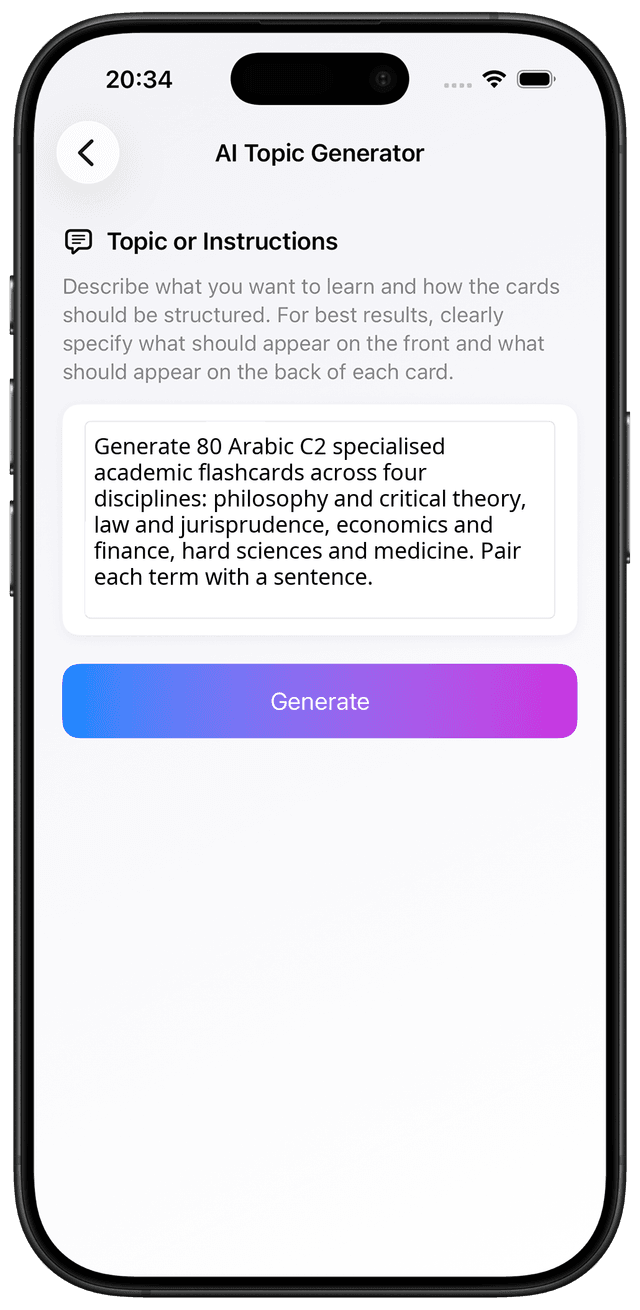
Generate 80 Arabic C2 specialised academic flashcards in four discipline groups. Group 1 - Philosophy and critical theory (20): ميتافيزيقا, ظاهراتيّة, العقلانيّة النقديّة, الأخلاق المعياريّة, الجدل الهيغلي, نقد ما بعد البنيويّة, تفكيك النص, الذاتيّة المعرفيّة, الاغتراب, الوعي الزائف. Group 2 - Law and jurisprudence (20): القرينة القانونيّة, الدفع الشكلي, الاجتهاد القضائي, المسؤوليّة التقصيريّة, العقد الباطل, القانون الوضعي, مبدأ الفصل بين السلطات, الحصانة القضائيّة, الإحالة على القضاء. Group 3 - Economics and finance (20): السياسة النقديّة, التضخّم الركودي, مرونة الطلب السعريّة, العجز الهيكلي, الناتج المحلّي الإجمالي, ميزان المدفوعات, التيسير الكمّي, تقلّبات الأسواق, الفقاعة الماليّة. Group 4 - Hard sciences and medicine (20): الجزيء, البروتين الناقل, الخلايا الجذعيّة, الجينوم البشري, المضادّات الحيويّة, التفاعل النووي, الجاذبيّة الكميّة, الذكاء الاصطناعي, التعلّم الآلي. Front: Arabic term with a sentence from real disciplinary writing. Back: English equivalent, domain label, and short usage note.
At C1 you started recognising the major rhetorical figures (طباق, موازنة, كناية). At C2 you handle the full classical system: استعارة (metaphor with its sub-types مكنيّة and تصريحيّة), التشبيه البليغ, الجناس by type (تامّ, ناقص, مُطرف), السجع by structure, الالتفات (rhetorical shift in person or tense), التورية, and حسن التعليل. These are not academic curiosities. Editorial Arabic, Friday sermons, political oratory, and serious literary fiction all use them, and a strong Arabic writer chooses among them deliberately.
Why this comes mid-list: The lexicon and the syntax of C2 sit on top of a rhetorical instinct. Without it, your Arabic stays correct but flat. With it, you write the way a strong Arabic essayist writes. This is also where the ALPT essay rubric distinguishes Distinguished from Superior.
The strategy: Each card pairs a rhetorical figure with a passage where the figure is at work and a brief structural note that names the type. The deck cycles through journalism, sermons, contemporary fiction, and classical poetry so you feel the figure in every register where you will encounter it.
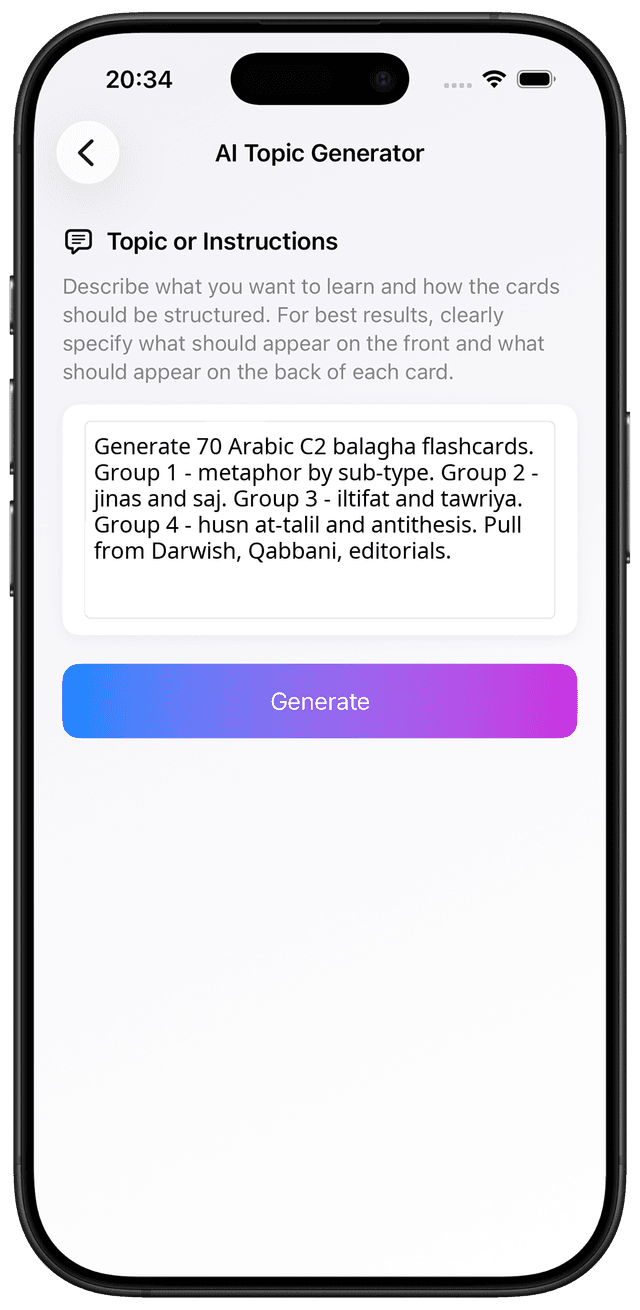
Generate 70 Arabic C2 advanced rhetorical and balagha flashcards in four groups. Group 1 - استعارة (metaphor) by sub-type (20): استعارة تصريحيّة, استعارة مكنيّة, تشبيه بليغ, التشخيص. Use real lines from Mahmoud Darwish, Nizar Qabbani, and contemporary essayists. Group 2 - الجناس and السجع (15): جناس تامّ, جناس ناقص, جناس مطرف, سجع متوازٍ, سجع مرصّع. Pull from Friday sermons, political oratory, and editorial leads. Group 3 - الالتفات and التورية (15): shift from first to third person mid-paragraph, shift from past to present, double-meaning puns. Pull from classical prose and modern columnists. Group 4 - حسن التعليل and المقابلة (20): aesthetic justification figures and antithetical pairs structured as full balanced clauses. Front: Arabic passage where the figure is at work. Back: English translation, rhetorical figure name, structural note explaining how the figure operates.
At C1 you handled passive recognition of major dialect lexical differences. At C2 you actively switch between MSA and educated cross-dialect Arabic without conscious effort, and you understand the dialectal Arabic of four large dialect areas (Egyptian, Levantine, Gulf, and Maghrebi) at the level of an extended interview. You also produce the مُهَذَّبة (refined) cross-dialect register that hosts and guests use on pan-Arab television. This register is what makes you sound Arab and educated rather than Arab and regional, or worse, foreign and bookish.
The goal: Active comprehension across the four major dialect areas, smooth switching into the cross-dialect refined register, and conscious use of dialect lexicon for tone in writing (dialogue in fiction, opinion columns that quote ordinary speech). The Maghrebi component matters in particular because almost no learner gets there before C2.
The strategy: Each card shows the same idea in four forms (MSA, Egyptian, Levantine, Gulf or Maghrebi) plus a register usage note. The deck cycles through everyday actions, emotional states, food and travel, and politically charged terms that carry different connotations in different dialect areas.
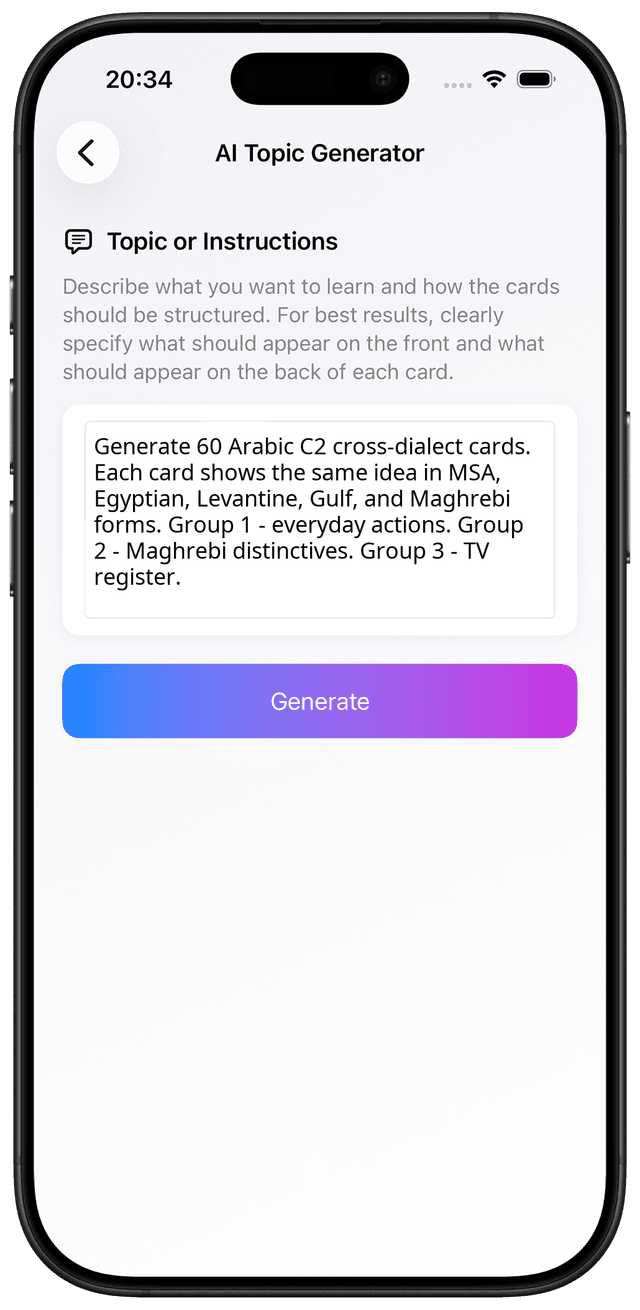
Generate 60 Arabic C2 cross-dialect cards. Each card shows the same idea in four forms with a register usage note. Group 1 - Everyday actions and states (20): want, look at, finish, get tired, hurry up, leave. Show MSA: يريد, ينظر إلى, ينتهي من, يتعب, يستعجل, يغادر. Egyptian: عايز, بصّ على, خلّص, تعِب, اِستعجل, مشي. Levantine (Shami): بدّو, تطلّع على, خلّص, تعب, اِستعجل, راح. Gulf: يبغي, يطالع, خلّص, تعب, يستعجل, راح. Group 2 - Maghrebi distinctives (15): includes Moroccan and Tunisian terms that diverge sharply from Mashriqi dialects (بزّاف, دابا, واخّا, عافاك, شكون). Group 3 - Refined cross-dialect TV register (15): how a pan-Arab interviewer switches mid-sentence to soften a sensitive question or set tone. Group 4 - Politically charged terms by region (10): الفتنة, الانتفاضة, الحراك, التطبيع, with the regional connotation difference noted. Front: situation plus MSA form. Back: Egyptian, Levantine, Gulf, Maghrebi equivalents with usage note.
C2 stylistic control is the work of choosing the precise word among three or four that an unspecialised speaker would treat as interchangeable. The difference between غضب, سَخَط, اِغتاظ, اِستشاط, and اِحتدم is small but real. So is the difference between شجاع, مِقدام, جسور, بطل, and باسل. Or between خطأ, سهو, زلّة, هَفوة, and خطل. At C2 you select consciously. An Arabic editor reading your prose feels the choice. The Arab Academies of Cairo, Damascus, and Baghdad publish style guides that make these distinctions explicit, and serious Arabic literary critics flag them constantly.
Why this is the C2 lever: At earlier levels vocabulary growth is breadth. At C2 it is depth inside the lexicon you already have. The same root family can carry four or five near-synonyms, each with a slightly different shade. The C2 milestone is producing the right one without hesitation. Your effective register precision multiplies once near-synonym choice becomes automatic.
The strategy: Each card centres on a near-synonym set (typically four to five items) with the precise distinction noted and a model sentence for each. Spaced review locks in the discrimination so that the right word surfaces first in writing and speech.
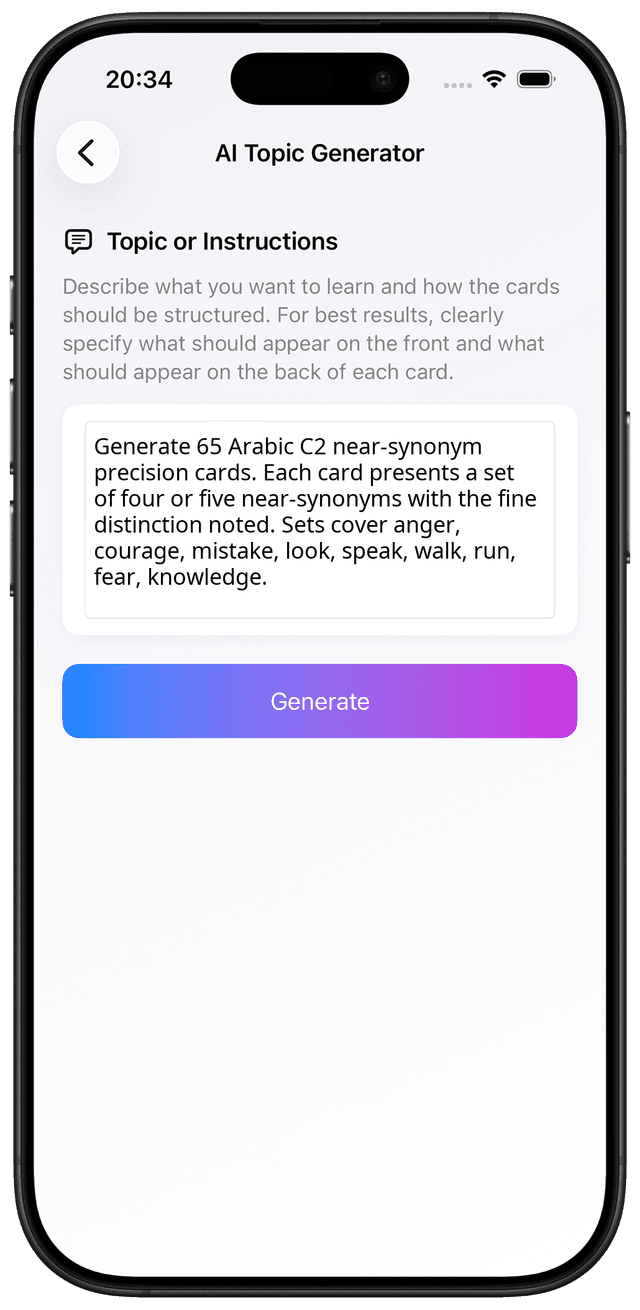
Generate 65 Arabic C2 near-synonym precision cards. Each card presents a near-synonym set of four to five items with the fine distinction noted. Sample sets: (1) Anger: غضب (general), سخط (sustained displeasure with reason), اغتاظ (boiling internal anger), استشاط (flaring up with rage), احتدم (anger at peak). (2) Courage: شجاع (general brave), مقدام (forward-rushing), جسور (audacious), بطل (heroic in deed), باسل (valiant in combat). (3) Mistake: خطأ (any error), سهو (forgetful slip), زلّة (small lapse), هفوة (minor stumble), خطل (foolish blunder). (4) Look: نظر (general look), حدّق (stared intently), رمق (glance from corner of eye), تأمّل (looked reflectively), تطلّع إلى (looked up toward). (5) Speak: قال, تكلّم, نطق, تفوّه بـ, صرّح بـ, أدلى بـ. Provide 13 such sets covering anger, courage, mistake, look, speak, walk, run, fear, joy, sadness, knowledge, deception, wisdom. Front: near-synonym set. Back: precise distinction for each plus one model sentence per item.
The final C2 phase covers the small set of high-impact decisions that turn a strong Arabic essay into a piece of writing an Arabic editor accepts as native. Where to put the topic of the sentence, when to use the nominal sentence (الجملة الاسميّة) for stability of state versus the verbal sentence (الجملة الفعليّة) for action and movement, when to use الحال versus التمييز to add detail, when to deploy التقديم والتأخير for emphasis. The Arabic Distinguished rating and the ALPT Distinguished rubric both probe this layer explicitly. So does any serious Arabic editor at Al-Hayat, Al-Quds Al-Arabi, or An-Nahar.
The C2 milestone: Completing this phase means your Arabic C2 toolkit spans literary فصحى, classical Arabic and Jahili lexicon, specialised academic register, advanced balagha, cross-dialect mastery, near-synonym precision, and full conscious stylistic control. That is the ACTFL Distinguished communicative range and the lexical density that genuinely native-feeling Arabic requires.
What comes next: Beyond C2 the work is no longer acquisition. It is reading, writing, and conversing in Arabic on a daily basis. MindCards keeps your decks in spaced rotation so the items you do not encounter naturally stay locked in. Your literary, classical, and specialised vocabularies stop drifting and stay live.
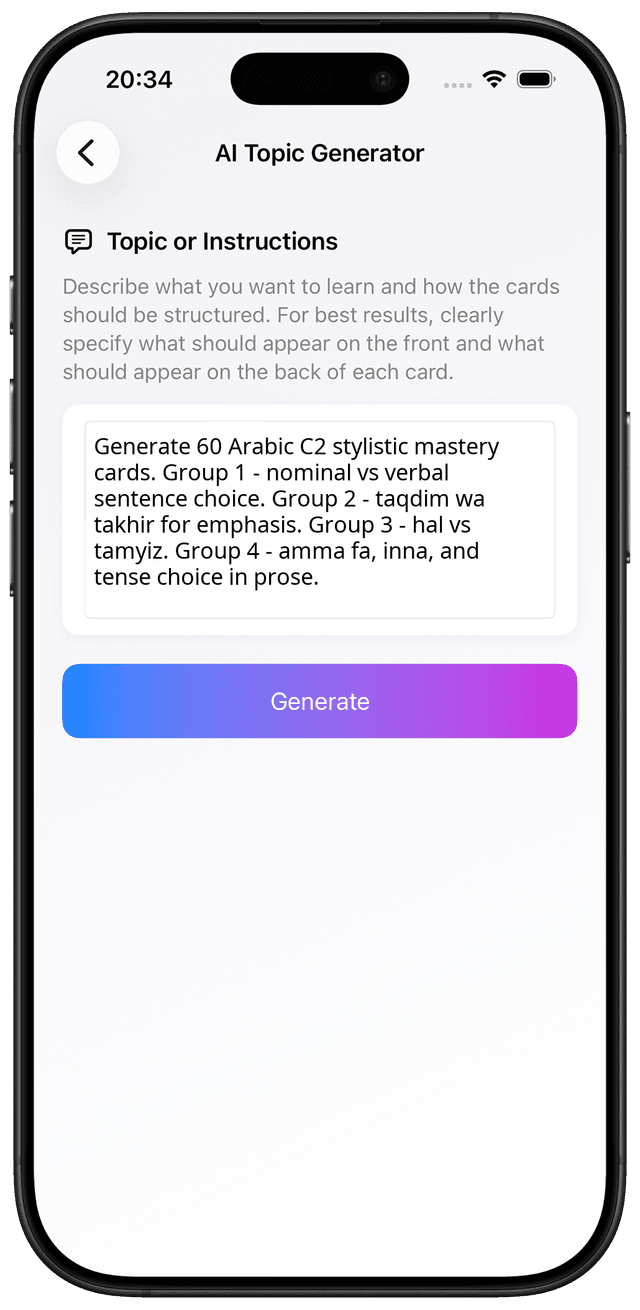
Generate 60 Arabic C2 stylistic mastery cards. Group 1 - Nominal vs verbal sentence choice (15): الجملة الاسميّة for state and continuity vs الجملة الفعليّة for action and movement. Provide minimal pairs: الحرب مستمرّة (state) vs تستمرّ الحرب (process). Group 2 - تقديم والتأخير for emphasis (15): putting خبر before مبتدأ, or مفعول before فعل, to throw weight onto the fronted element. Pull pairs from editorial Arabic. Group 3 - الحال vs التمييز usage (15): when to add a circumstantial accusative for state at the moment of the verb vs a specifier accusative for distinguishing quantity or kind. Group 4 - Discretionary stylistic markers (15): use of أمّا...فـ for thematic shift, use of إنّ for emphatic assertion vs none, choice of perfective in classical-flavoured prose for completed-aspect resonance. Front: Arabic sentence A. Back: Arabic alternative with reordered or restructured form, precise stylistic difference, and recommended context.
At C2 the vocabulary you are missing is less frequent and more context-dependent than at any earlier level. Spaced repetition is well suited to this work: the literary collocations, classical phrases, near-synonym pairs, and balagha figures you keep forgetting surface more often, and the items you have already locked in quietly drop back. Your review time goes where it actually moves the needle.
C2 builds directly on C1. Use the links below to review the prerequisite level or return to the full Arabic guide.
Copy any prompt from this guide into MindCards and your first C2 deck is ready in seconds. No account needed. The app is free on iOS.