
Spaced Repetition Explained
Why spacing your reviews leads to faster Arabic script recognition.
Al-Abjadiyah, the Arabic alphabet, is where reading Arabic starts. Its 28 letters are used across the Middle East, North Africa, and communities worldwide. Every Arabic word you will ever read is built from these letters.
The script can look intimidating because letters change shape when they connect inside a word. The shapes follow consistent, predictable rules, though. Once you internalize the base letter forms, the connected variations click into place.
Staring at an alphabet chart is not enough. You need active recall practice. MindCards turns each letter into a flashcard scheduled by spaced repetition, so you spend your time retrieving shapes from memory instead of passively re-reading them. Use the guided prompts below to build your study decks in seconds.
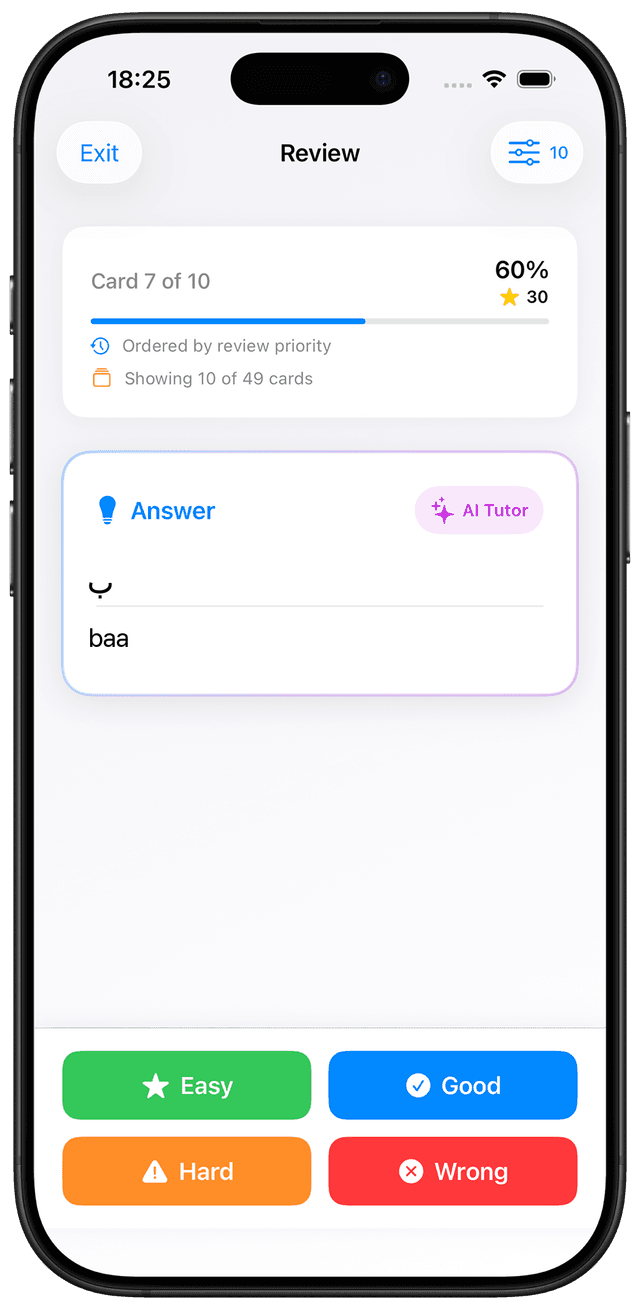
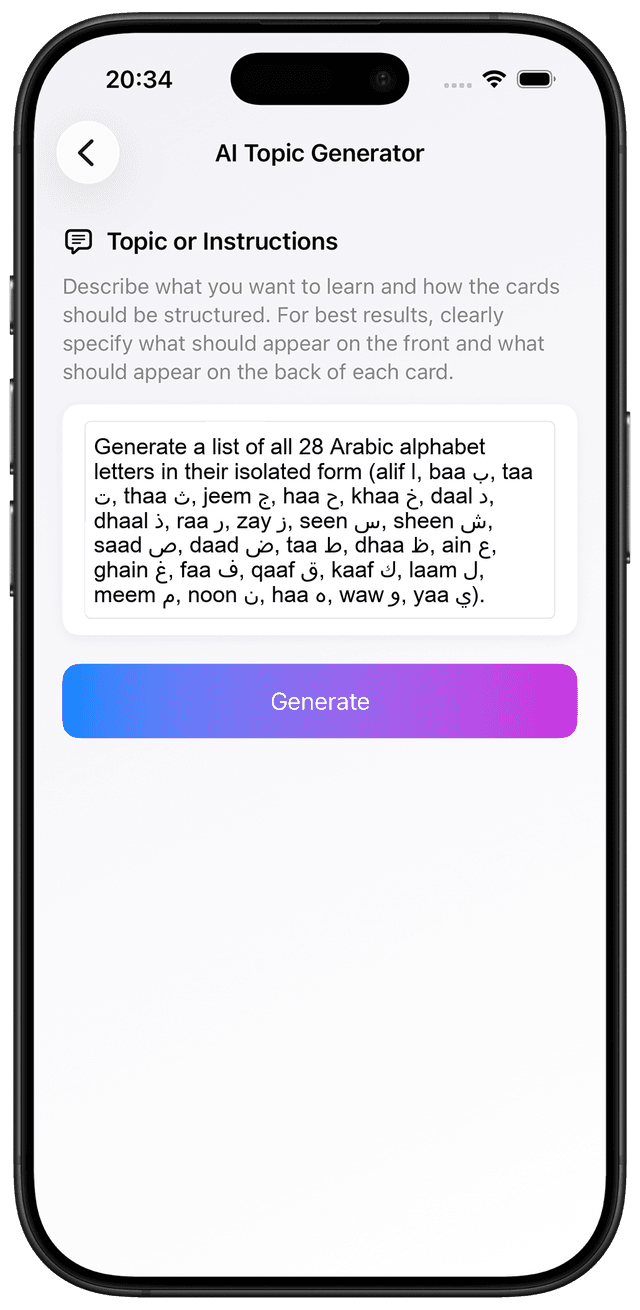
The Arabic alphabet contains 28 consonant letters. Unlike Latin scripts, Arabic is written right to left, and every letter has up to four distinct shapes depending on where it appears in a word. Before tackling those variations, start by learning each letter in its isolated (standalone) form.
Why start here? Isolated forms are the base shape every other position derives from. Once you can recognize all 28 in isolation, the connected forms become logical variations rather than entirely new symbols.
The Strategy: Copy the prompt below and paste it into the AI Topic Generator in MindCards. The deck places the Arabic letter on the front and its name plus pronunciation on the back, training direct visual recognition from the first session.
Generate a list of all 28 Arabic alphabet letters in their isolated form (alif ا, baa ب, taa ت, thaa ث, jeem ج, haa ح, khaa خ, daal د, dhaal ذ, raa ر, zay ز, seen س, sheen ش, saad ص, daad ض, taa ط, dhaa ظ, ain ع, ghain غ, faa ف, qaaf ق, kaaf ك, laam ل, meem م, noon ن, haa ه, waw و, yaa ي). The Arabic letter should be on the front while the letter name and pronunciation should be on the back. No English text on the front.
Arabic is a cursive script, so letters within a word connect to each other. Most letters have four forms: isolated, initial (start of a word), medial (middle), and final (end). Six letters (alif, daal, dhaal, raa, zay, waw) only connect to the right and therefore have just two forms.
Why this next? Real Arabic text is almost entirely connected. If you only know isolated forms, you will struggle to read even simple signs and labels. Recognizing positional shapes is the leap from "I know the alphabet" to "I can actually read."
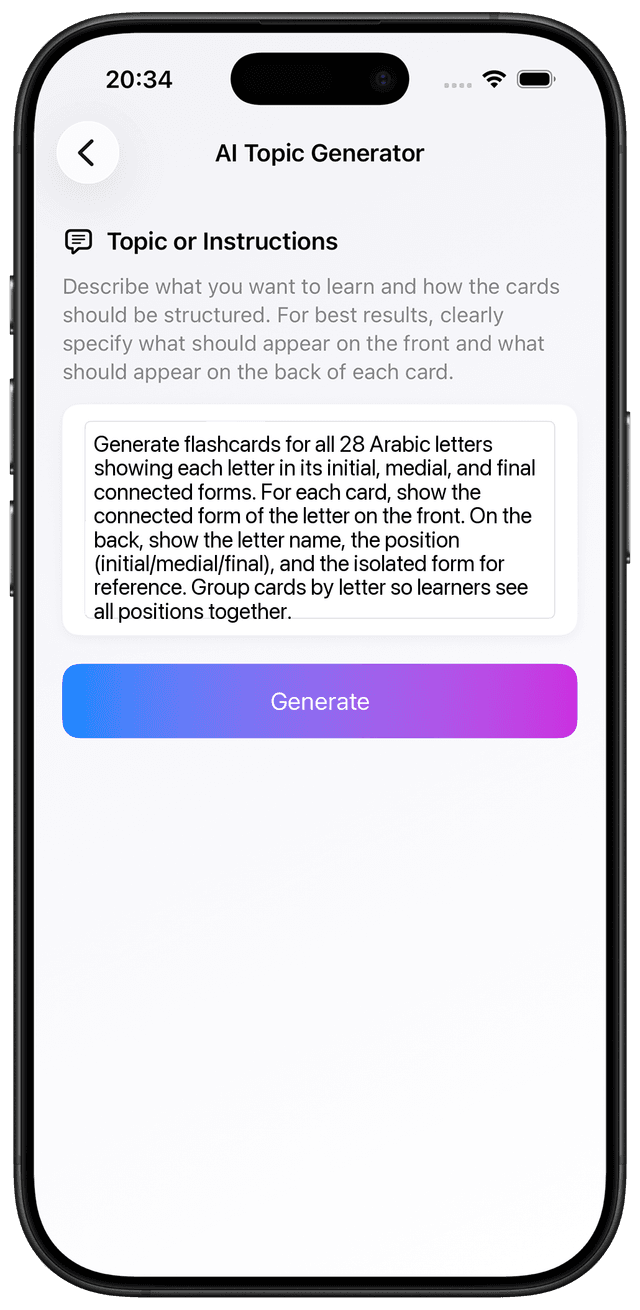
The Strategy: The prompt below generates cards that show a letter in one of its connected positions on the front, while the back reveals which letter it is and which position is shown. This trains you to recognize familiar letters in unfamiliar shapes.
Generate flashcards for all 28 Arabic letters showing each letter in its initial, medial, and final connected forms. For each card, show the connected form of the letter on the front. On the back, show the letter name, the position (initial/medial/final), and the isolated form for reference. Group cards by letter so learners see all positions together. Skip medial/final for non-connecting letters (alif, daal, dhaal, raa, zay, waw).
Written Arabic often omits short vowels, but beginners need them to pronounce words correctly. The diacritical marks (called harakat) sit above or below letters and indicate the short vowels and other pronunciation features you will not get from the consonant skeleton alone.
Fatha (َ ): A small diagonal stroke above a letter, producing an "a" sound (e.g., بَ = ba).
Kasra (ِ ): A small diagonal stroke below a letter, producing an "i" sound (e.g., بِ = bi).
Damma (ُ ): A small curl above a letter, producing a "u" sound (e.g., بُ = bu).
Sukun (ْ ): A small circle above a letter, indicating no vowel follows (e.g., بْ = b).
Shadda (ّ ): A small "w" shape above a letter, indicating the consonant is doubled.
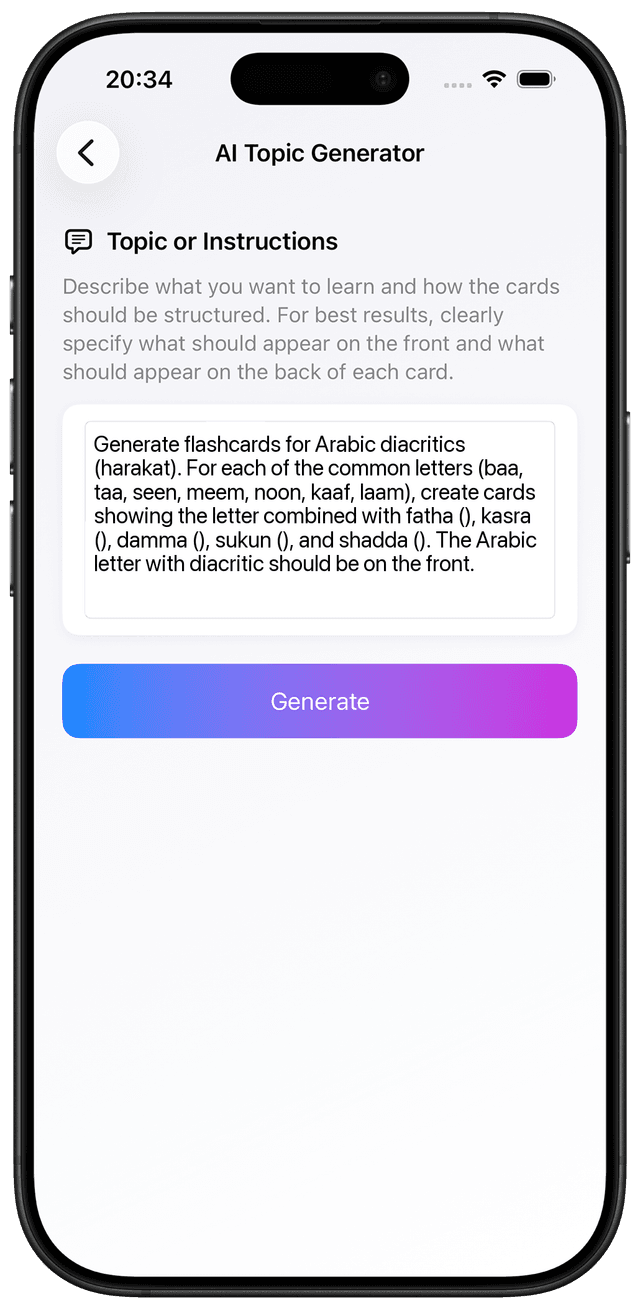
The Strategy: The prompt below generates cards combining letters with different diacritics. The front shows the letter-plus-diacritic combination and the back shows the pronunciation. This builds your ability to read vowelled text before moving on to unvowelled reading.
Generate flashcards for Arabic diacritics (harakat). For each of the common letters (baa, taa, seen, meem, noon, kaaf, laam), create cards showing the letter combined with fatha (َ), kasra (ِ), damma (ُ), sukun (ْ), and shadda (ّ). The Arabic letter with diacritic should be on the front. The back should show the pronunciation in English transliteration and the name of the diacritic mark. No English text on the front.
Active recall and spaced repetition move Arabic letters from short-term recognition into reading fluency that sticks. Here is how the research backs it up.
Now that you can recognize Arabic letters, start building real vocabulary with the A1 guide.
Learn the Arabic alphabet with flashcards, AI-powered deck generation, and spaced repetition. Free, no account required.