
Spaced repetition explained
Why reviewing at the right interval is key to locking in Arabic A2 vocabulary
You have the A1 foundation. At A2, the real work is verb conjugations across all persons, broken plurals that bear no resemblance to their singulars, and the fixed expressions native speakers use without thinking. These are the things that feel hard at first and then suddenly obvious.
This guide skips filler and focuses on the patterns that actually change how you speak: the past and present tense forms that let you describe your day, the plural rules that stop tripping you up mid-sentence, and the opinion phrases that let you say something more than a single word answer.
Seven phases, each with a ready-to-use prompt. Paste them into MindCards to generate custom decks that use spaced repetition to help the vocabulary stick.
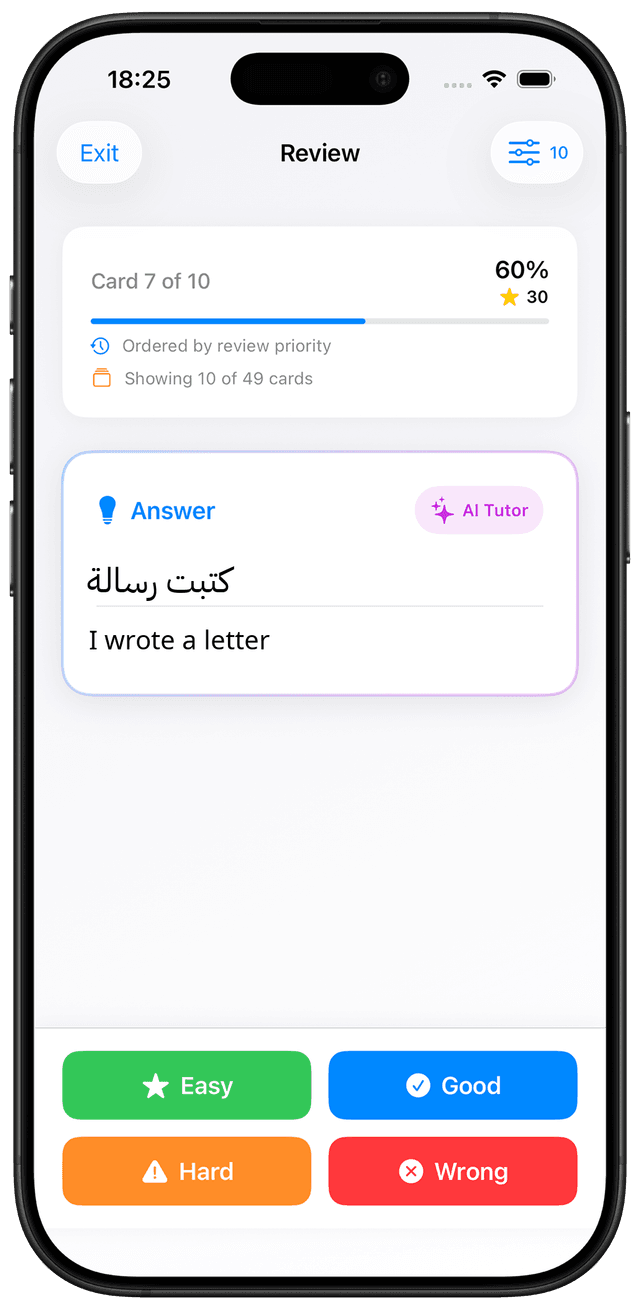
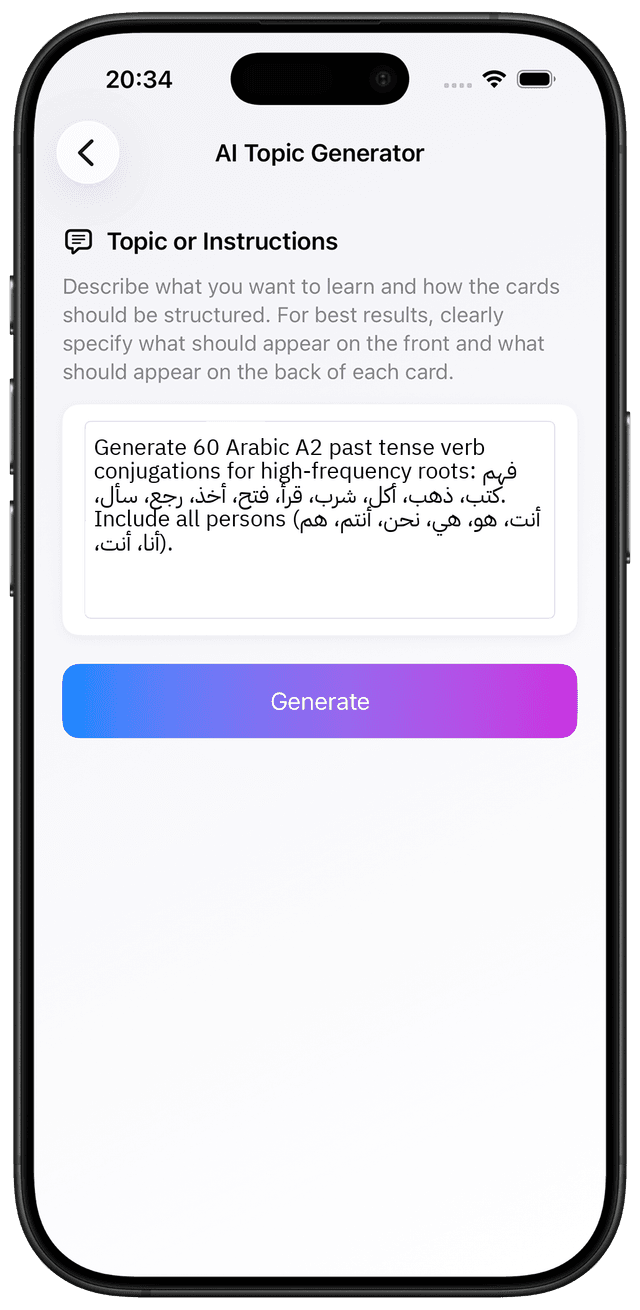
Arabic past tense verbs follow a consistent root-based pattern, but the endings change by person, gender, and number. Getting these conjugation tables into your head means you can describe any completed event in Modern Standard Arabic.
Why start here? Without the past tense, you cannot tell a story or answer basic questions about what you did. Arabic verb roots also carry most of the meaning, so the conjugation patterns you learn here recur constantly in related vocabulary.
The strategy: Drill one root verb in all its past-tense forms before moving to the next, so the pattern becomes automatic rather than something you have to look up.
Generate 60 Arabic A2 past tense verb conjugations for high-frequency roots: كتب، ذهب، أكل، شرب، قرأ، فتح، أخذ، رجع، سأل، فهم. Include all persons (أنا، أنتَ، أنتِ، هو، هي، نحن، أنتم، هم). Front: Arabic conjugated form. Back: English meaning + root + person label.
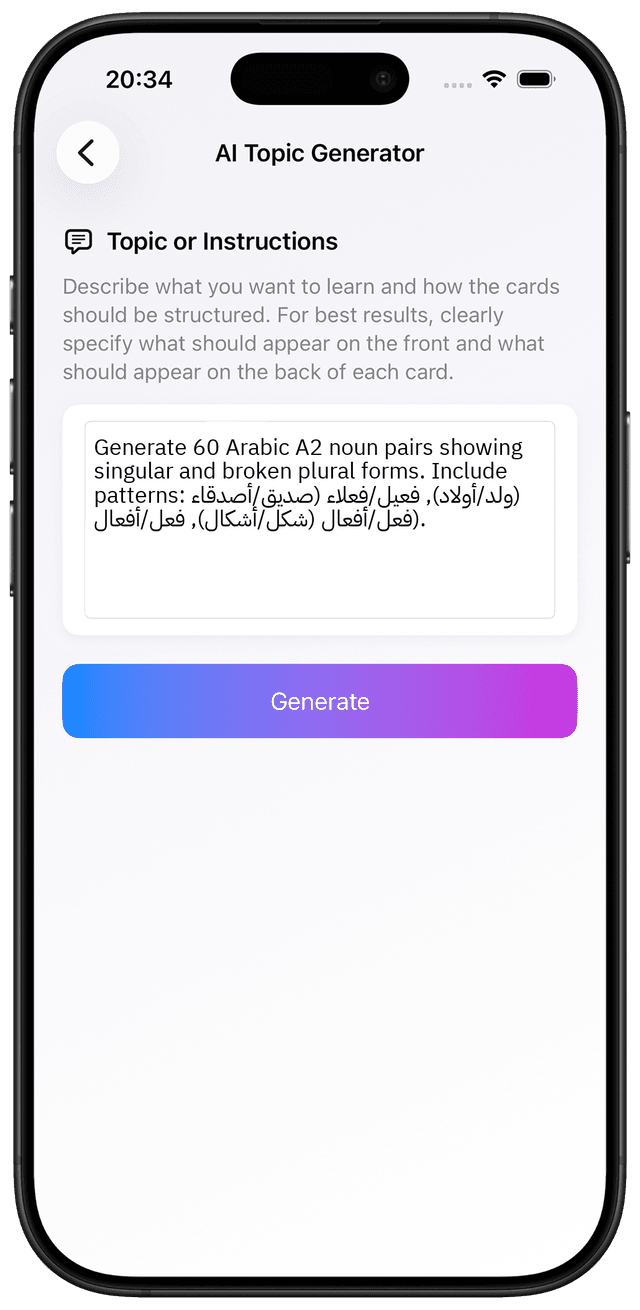
Arabic plurals do not simply add a suffix. Many common nouns use broken plurals, where the internal vowel pattern of the word changes entirely. كتاب becomes كُتُب, بيت becomes بيوت, ولد becomes أولاد. This is one of the areas that most distinguishes A2 Arabic from A1.
Why this trips people up: You cannot predict a broken plural from a singular without learning it. But there are recurring patterns, and once you recognize them, they stop feeling arbitrary.
The strategy: Learn singular and plural as a pair from the start. Never store a noun without its plural.
Generate 60 Arabic A2 noun pairs showing singular and broken plural forms. Include patterns: فَعْل/أفعال (شكل/أشكال), فَعَل/أفعال (ولد/أولاد), فَعِيل/فُعَلاء (صديق/أصدقاء), فِعَال/أفعلة (كتاب/كتب). Front: singular Arabic noun. Back: broken plural + English + pattern label.
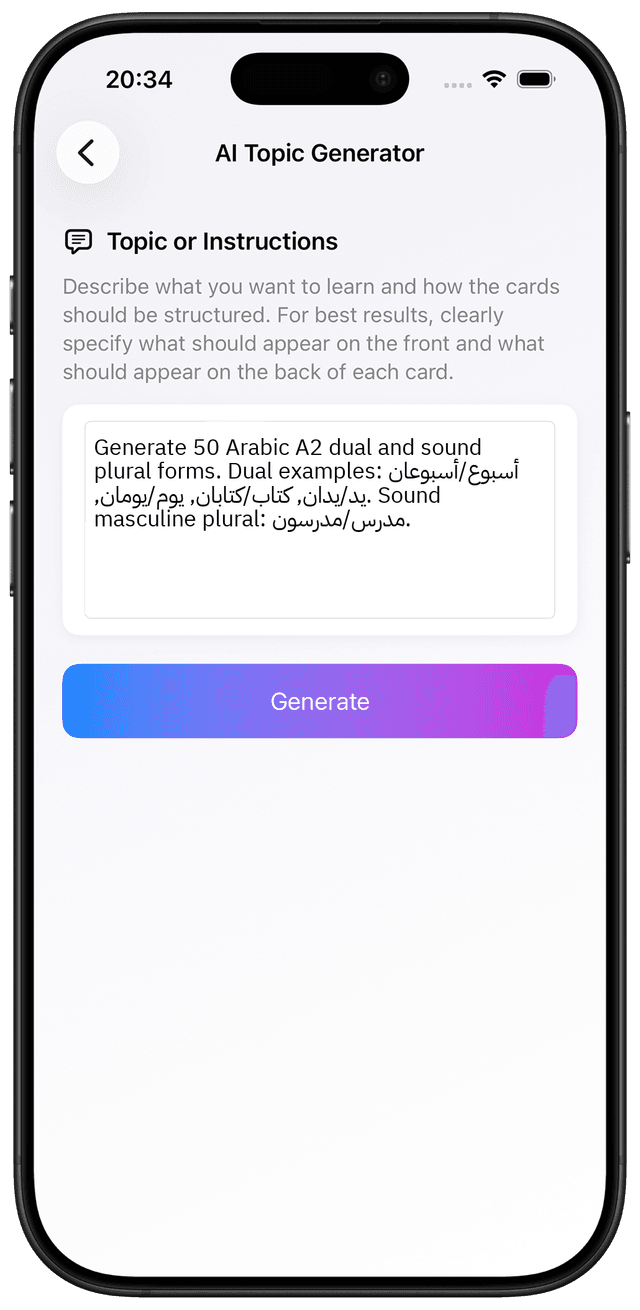
Arabic has a dedicated grammatical dual for exactly two of anything. A pair of books is not كتابان with a suffix tacked on by chance, it follows a precise grammatical rule. Sound masculine plurals add -ون or -ين, and sound feminine plurals add -ات. These are far more regular than broken plurals.
Why learn these now: Dual forms appear constantly in texts, news, and everyday speech when referring to pairs of objects, body parts, or time periods. Sound plurals cover a large class of nouns you will encounter at A2 and beyond.
The strategy: Practice dual and sound plural forms with phrases that naturally include pairs, like يدان (two hands) or يومان (two days), to make the -ان ending feel immediate.
Generate 50 Arabic A2 dual and sound plural forms. Dual examples: يد/يدان, كتاب/كتابان, يوم/يومان, أسبوع/أسبوعان. Sound masculine plural: مدرّس/مدرّسون. Sound feminine plural: طالبة/طالبات, سيارة/سيارات. Front: singular form. Back: dual or plural + English + form label.
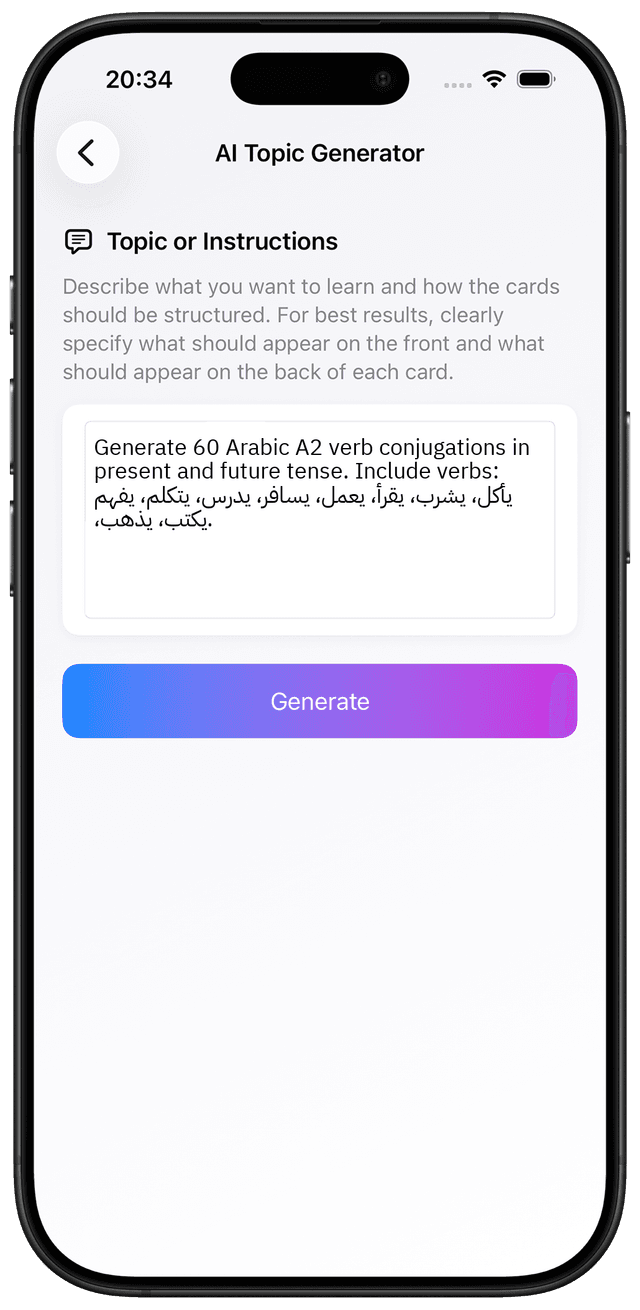
The Arabic present tense (المضارع) covers both ongoing and habitual actions, and the same form with the prefix سَـ or the word سوف indicates future events. This is a major shift from English, where present and future are separate verb forms.
Why this comes after past tense: Once you know the past tense pattern, the present conjugation prefixes (أ، تـ، يـ، نـ) feel logical in comparison. The shared roots across tenses make this the moment verb patterns really click.
The strategy: Create paired cards showing the same verb in past, present, and future forms so you see the root across all three tenses simultaneously.
Generate 60 Arabic A2 verb conjugations in present and future tense. Include verbs: يكتب، يذهب، يأكل، يشرب، يقرأ، يعمل، يسافر، يدرس، يتكلم، يفهم. Show present tense conjugations (أنا، أنتَ، هو، هي، نحن، هم) and future with سَـ prefix. Front: Arabic verb form. Back: English + tense label + person.
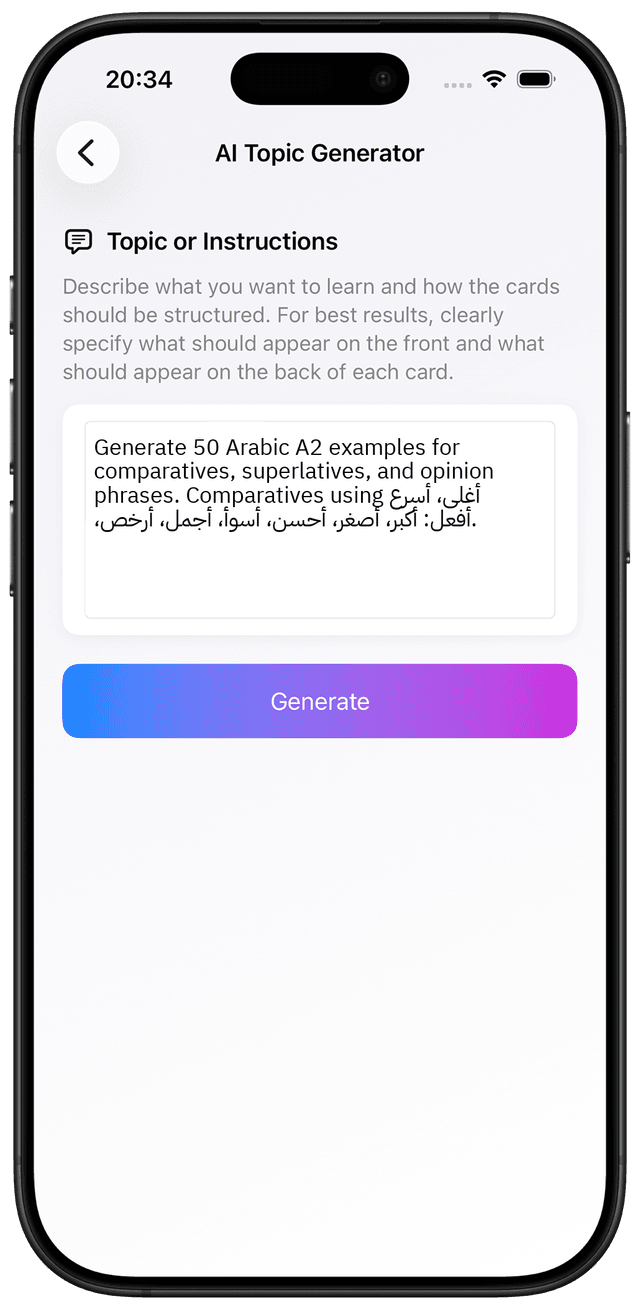
Arabic comparatives use the أَفْعَل pattern: كبير becomes أكبر (bigger), جميل becomes أجمل (more beautiful). Superlatives use the same form with a definite article. Opinion phrases like أعتقد أن، في رأيي، and يبدو لي are the building blocks of A2 conversation and writing tasks.
Why opinions matter at A2: You can describe objects and events, but expressing your take on them is what makes Arabic feel like real communication. A vocabulary set combining comparatives with opinion phrases turns isolated words into actual A2-level responses.
The strategy: Practice opinion phrases as complete sentence starters so you can slot any topic into them without pausing to construct the grammar from scratch.
Generate 50 Arabic A2 examples for comparatives, superlatives, and opinion phrases. Comparatives using أَفْعَل: أكبر، أصغر، أحسن، أسوأ، أجمل، أرخص، أغلى، أسرع. Opinion phrases: أعتقد أن، في رأيي، يبدو لي أن، أنا مقتنع بأن. Front: Arabic phrase. Back: English + pattern label.
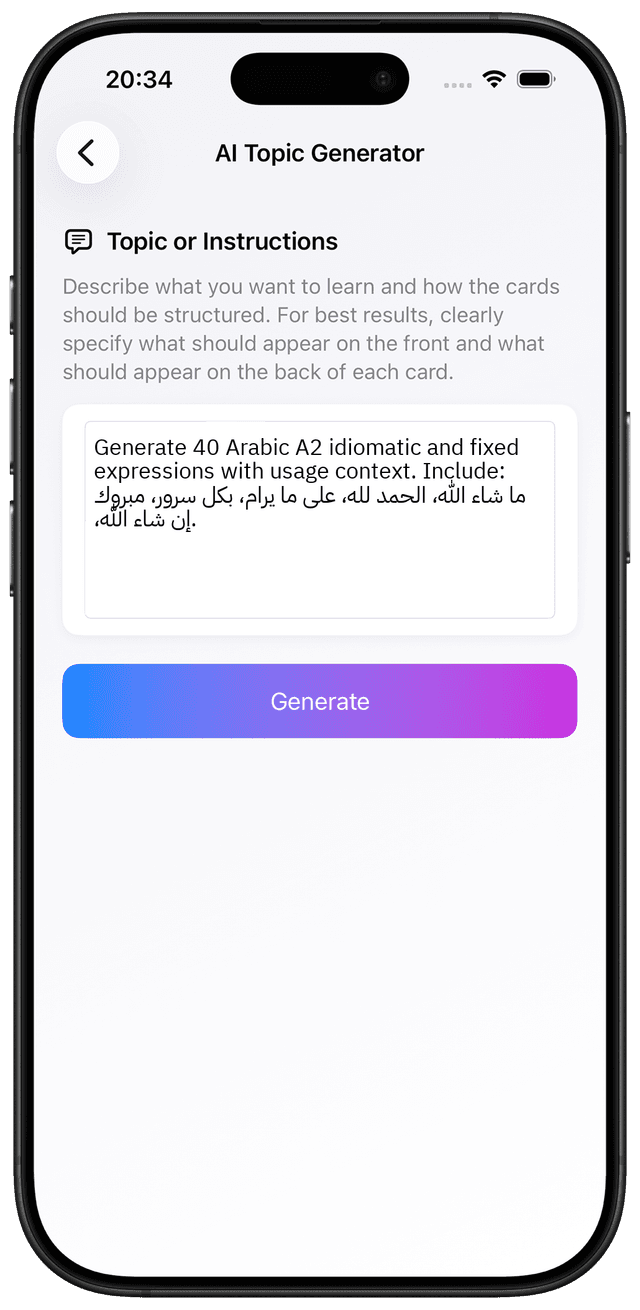
Arabic is full of fixed expressions that do not translate word for word but appear in nearly every conversation. Phrases like إن شاء الله (God willing, also used as 'maybe'), على ما يرام (going well), and ما شاء الله (expression of admiration) carry social weight that isolated vocabulary cannot capture.
Why idioms belong at A2: Native speakers use these expressions constantly. Knowing them signals genuine familiarity with Arabic-speaking culture beyond textbook sentences. They also tend to be short and highly memorable.
The strategy: Learn each expression with context: who says it, when, and what response it typically gets. These are social scripts, not just phrases.
Generate 40 Arabic A2 idiomatic and fixed expressions with usage context. Include: إن شاء الله، ما شاء الله، الحمد لله، على ما يرام، بكل سرور، مبروك، في أمان الله، يعطيك العافية، لا بأس، خلاص. Front: Arabic expression. Back: English meaning + typical usage context.
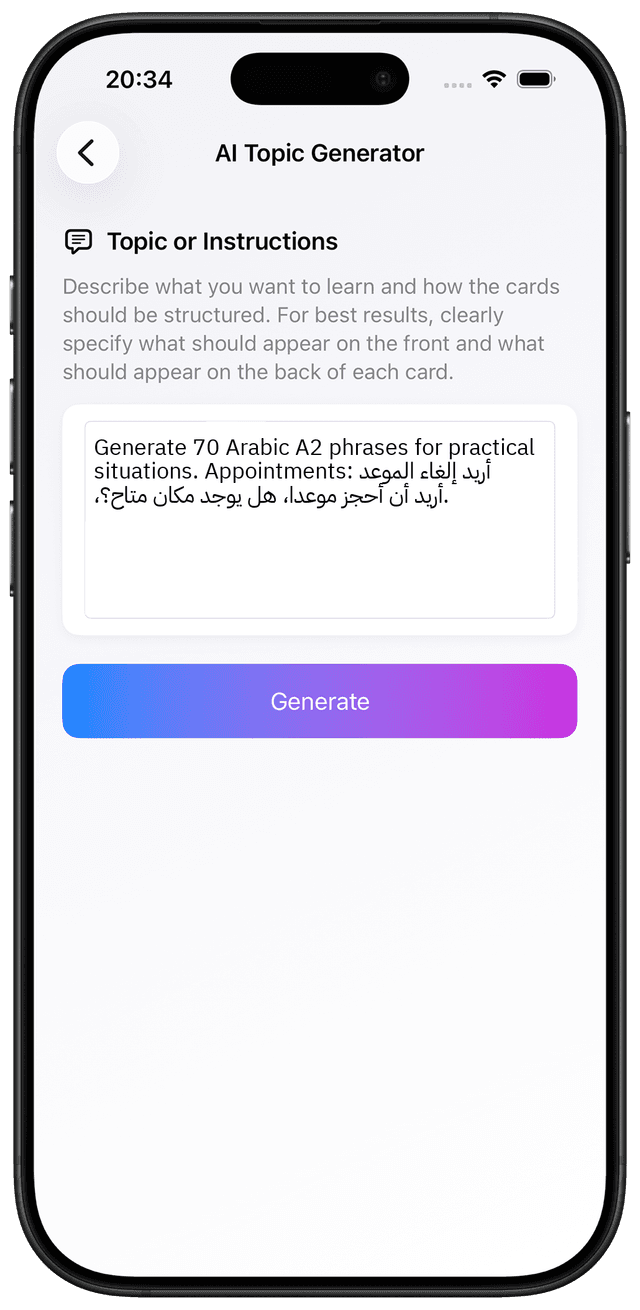
The final A2 phase covers vocabulary for real situations: booking and cancelling appointments, asking for help, explaining problems at a clinic or government office, and handling phone calls. This is the Arabic you need when something actually happens and you cannot just stay quiet.
The milestone: After this phase you have past and present tense conjugations, broken and sound plural forms, comparatives, opinion phrases, cultural expressions, and situational language for everyday encounters. That covers A2 Arabic.
Generate 70 Arabic A2 phrases for practical situations. Appointments: أريد أن أحجز موعداً، هل يوجد مكان متاح؟، أريد إلغاء الموعد. Requests: هل يمكنك مساعدتي؟، أحتاج إلى مساعدة. Problems: ضاع جواز سفري، لا أفهم، هل يمكنك التحدث ببطء؟. Phone: ألو، من يتكلم؟. Front: Arabic phrase. Back: English + situation label.
At A2, Arabic becomes a game of pattern recognition. Broken plurals, verb conjugations by person and gender, and the comparative form all follow internal rules. MindCards uses active recall to drill those patterns so you stop relying on memorized lists and start recognizing forms automatically. Spaced repetition ensures you review items right before you would otherwise forget them.
A2 vocabulary builds on the A1 foundation and sets you up for B1 conversational fluency. Use the links below to move between levels or return to the full Arabic guide.
Join learners building their Arabic fluency with AI-powered flashcards and spaced repetition. No account or signup required.