
Spaced repetition explained
Why reviewing at the right interval is what locks in Arabic B1 vocabulary long term
At B1, the structure of Arabic starts to feel like a system rather than a list of exceptions. You know the roots, you know the basic verb forms, and you can build sentences. What you do not have yet is the vocabulary for derived verb forms, mood distinctions, abstract noun construction, and formal register that make Arabic readable and writable at a real-world level.
This guide works through seven phases: derived verb forms (Forms II through X), subjunctive and jussive moods, the masdar system, formal written register, argumentation discourse, news media vocabulary, and idiomatic collocations. Each phase targets a specific gap rather than trying to cover everything at once.
Each phase has a ready-to-use prompt. Paste it into MindCards to generate a focused deck, then let spaced repetition handle the review schedule.
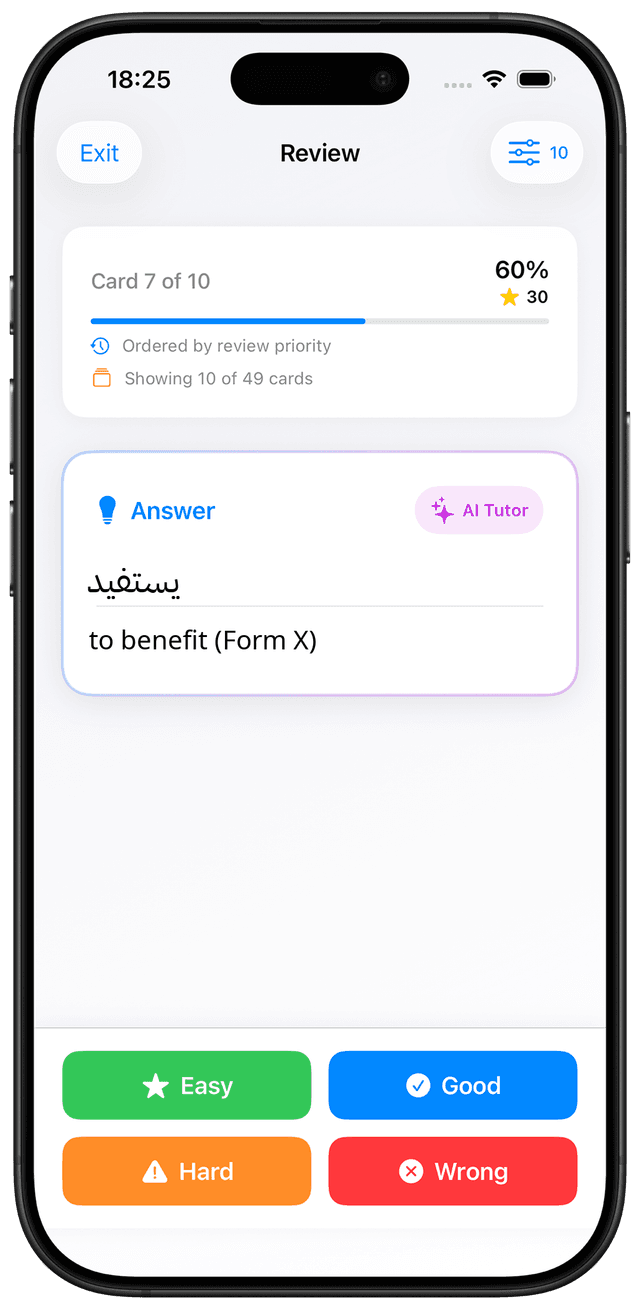
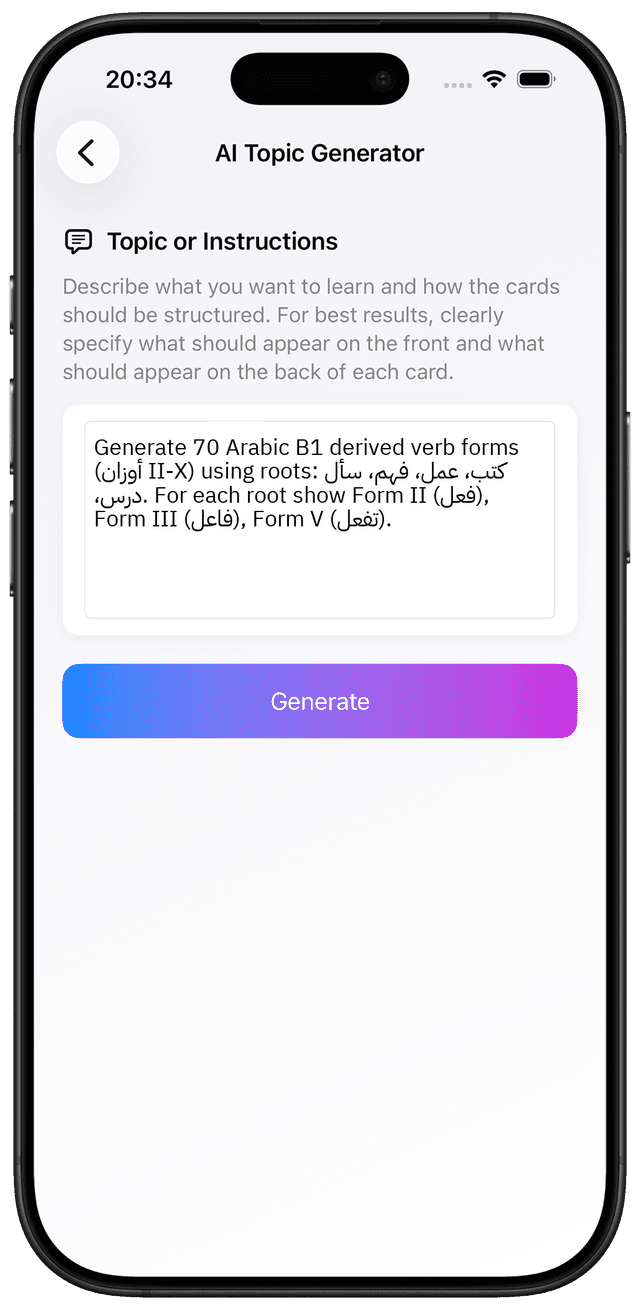
Arabic builds most of its vocabulary from three-letter roots through a system of verb forms (أوزان). At B1, you need to work fluently with Form II through Form X. Each form adds a predictable layer of meaning: Form II makes verbs causative or intensifying, Form III adds a social or reciprocal dimension, Form V and VI are reflexive versions of II and III.
Why this unlocks the language: Once you know the ten core forms, you stop learning words in isolation. درَسَ (to study) is Form I; دَرَّسَ (to teach) is Form II; تَدَرَّسَ (to be studied) is Form V. The same root, three different meanings from the pattern alone.
The strategy: Build one card set per form, using the same root across all forms so the meaning shifts become obvious rather than arbitrary.
Generate 70 Arabic B1 derived verb forms (أوزان II-X) using roots: درس، كتب، عمل، فهم، سأل. For each root show Form II (فَعَّلَ), Form III (فَاعَلَ), Form V (تَفَعَّلَ), Form VI (تَفَاعَلَ), Form VII (اِنْفَعَلَ), Form X (اِسْتَفْعَلَ). Front: Arabic conjugated verb. Back: English meaning + form number + root.
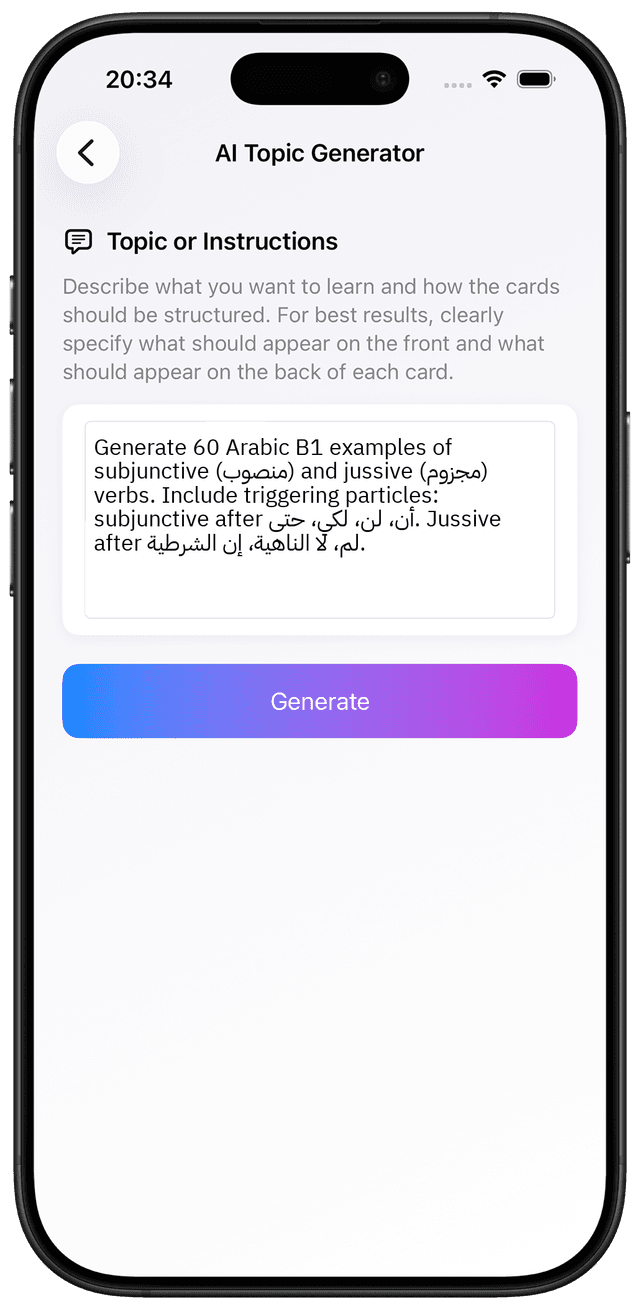
The Arabic present tense changes form depending on the grammatical context it appears in. After particles like أن، لن، لكي the verb takes the subjunctive (منصوب). After لم، لا الناهية، and conditional particles it takes the jussive (مجزوم). These are not optional variations, they are required in standard written and formal spoken Arabic.
Why B1 learners need this: You will hit a wall writing formal sentences if you keep using the plain present everywhere. Both forms look similar to the base verb but with short ending changes, so the drills here are about training your eye and ear to spot the required context.
The strategy: Create paired cards showing the same verb in three moods (indicative, subjunctive, jussive) with the governing particle that triggers each.
Generate 60 Arabic B1 examples of subjunctive (منصوب) and jussive (مجزوم) verbs. Include triggering particles: subjunctive after أن، لن، لكي، حتى. Jussive after لم، لا الناهية، إن الشرطية. Verbs: يكتب، يذهب، يعمل، يدرس، يفهم، يسافر، يتكلم. Front: full Arabic phrase with particle + verb. Back: English + mood label + particle name.
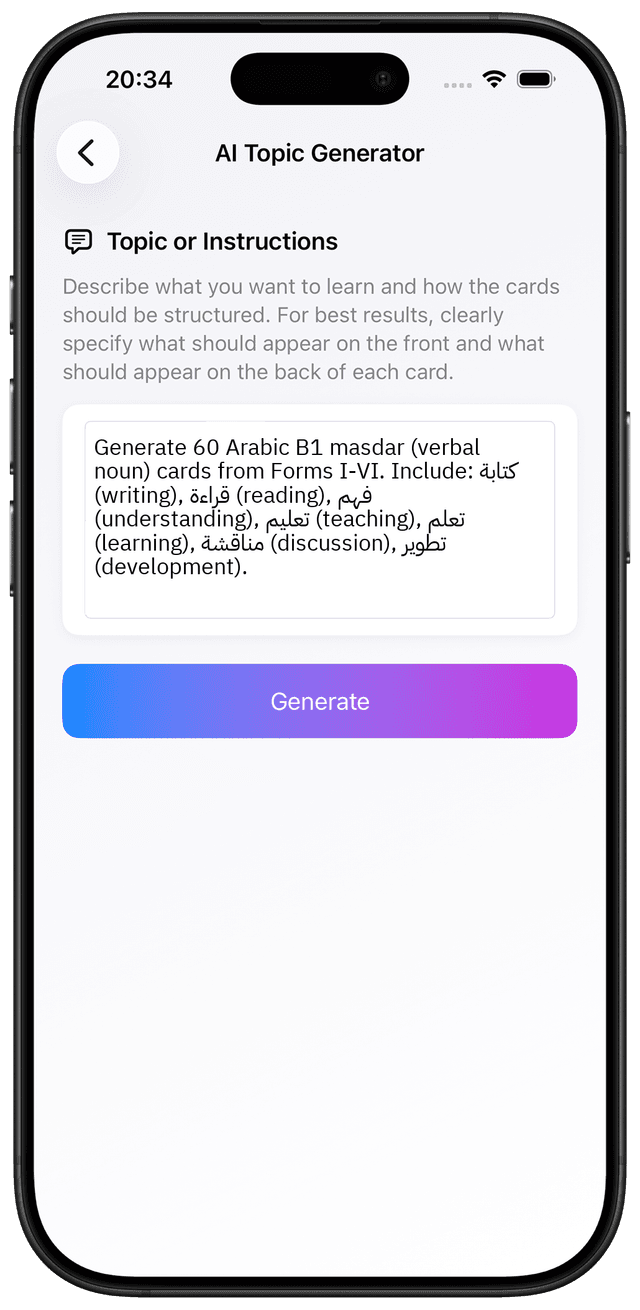
The masdar (المصدر) is the Arabic verbal noun. كَتَبَ (to write) produces كِتَابَة (writing). فَهِمَ (to understand) produces فَهْم (understanding). At B1, masdars appear constantly in formal sentences, news headlines, and academic language. They function as subjects, objects, and complements, and they are the building blocks of Arabic abstract vocabulary.
Why masdars matter now: You cannot read an Arabic newspaper or academic text without them. A single masdar can replace an entire subordinate clause, which is why formal Arabic uses them constantly.
The strategy: Learn each masdar paired with its verb and one sentence where the masdar functions as the grammatical subject or object.
Generate 60 Arabic B1 masdar (verbal noun) cards from Forms I-VI. Include: كتابة (writing), قراءة (reading), فهم (understanding), تعليم (teaching), تعلم (learning), مناقشة (discussion), تطوير (development), استفسار (inquiry). Front: Arabic masdar. Back: English + source verb + one example sentence.
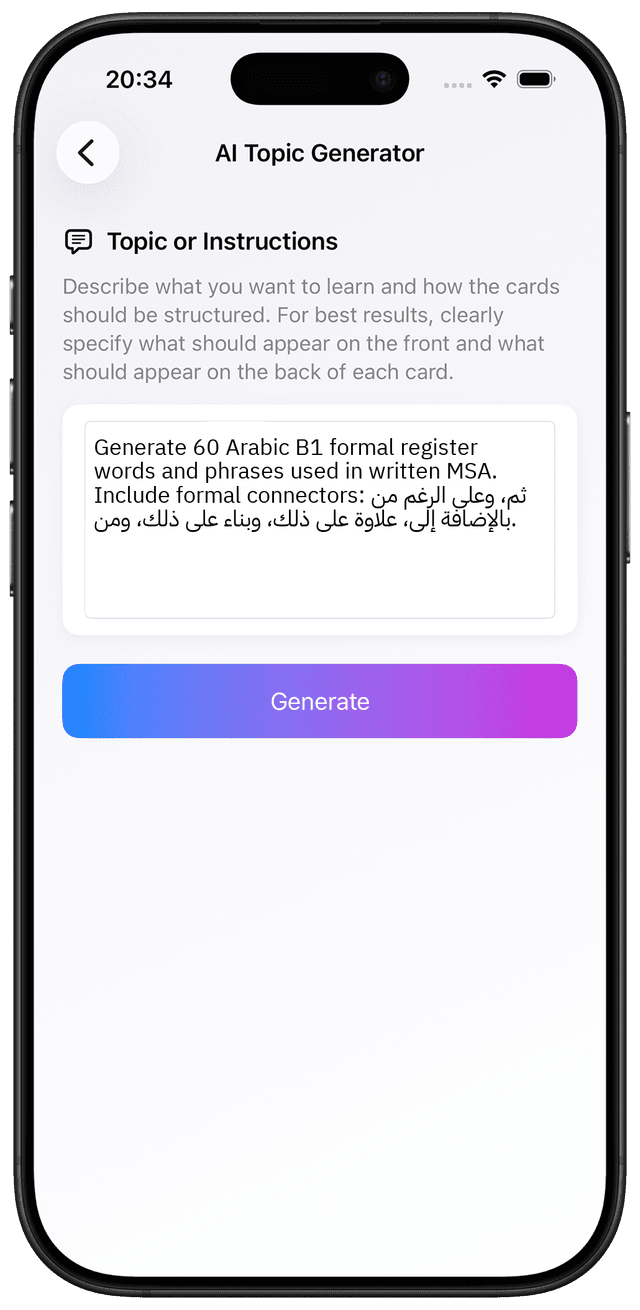
B1 Arabic means you can handle formal written contexts: job applications, official correspondence, news articles, and academic writing. This requires a specific layer of vocabulary that does not appear in everyday spoken Arabic but shows up constantly in anything written or formally delivered.
What changes at B1: Words like غير (non-), ذو/ذات (possessing), حيث (where/given that), and إذ (since/when) are cornerstones of formal prose. You will also need formal connectors that signal logical structure: بالإضافة إلى، علاوة على ذلك، وبناءً على ذلك.
The strategy: Focus on connectors and formal determiners as whole-phrase cards rather than individual words, because context is what makes them recognizable.
Generate 60 Arabic B1 formal register words and phrases used in written MSA. Include formal connectors: بالإضافة إلى، علاوة على ذلك، وبناءً على ذلك، ومن ثَمَّ، وعلى الرغم من. Formal determiners: حيث، إذ، ذو، غير. Formal verbs: يُشير إلى، يتضمّن، يُعدّ. Front: Arabic phrase. Back: English + register label (formal/written).
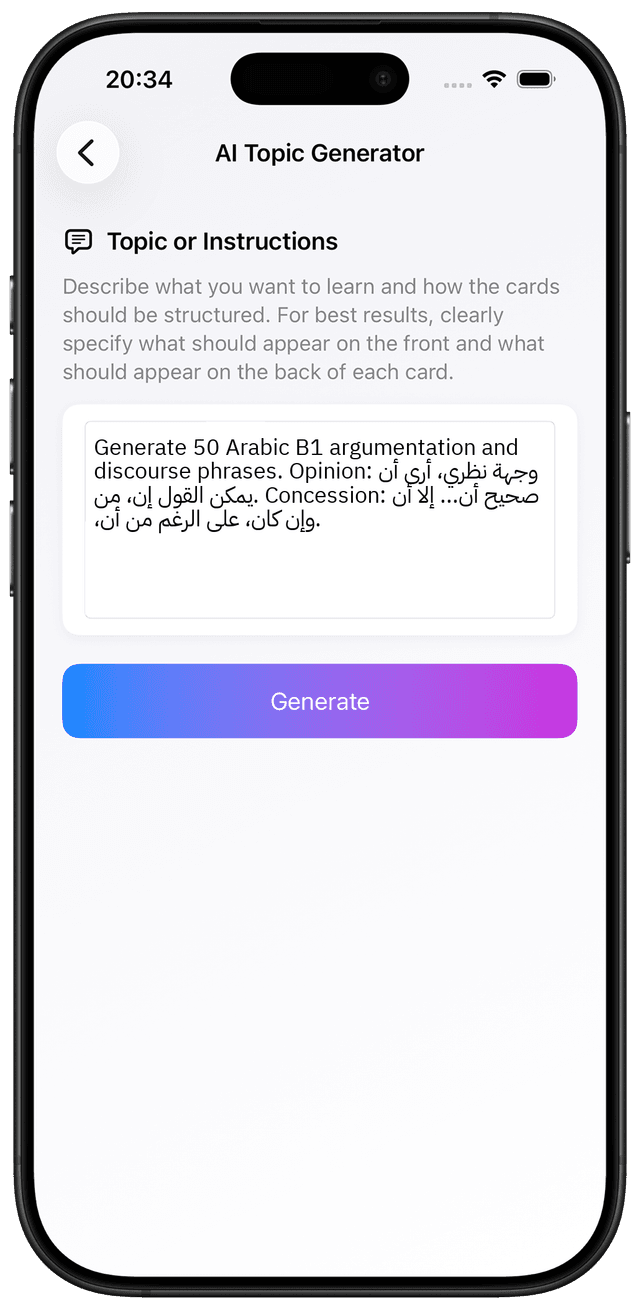
At B1, you should be able to give a reasoned opinion, acknowledge a counterargument, and reach a conclusion. This requires discourse-level vocabulary that goes beyond أعتقد أن. You need phrases for conceding a point, presenting evidence, and wrapping up an argument.
Why this is the gap between A2 and B1: A2 learners express individual opinions. B1 learners string those opinions into structured arguments. The vocabulary here gives you the connective tissue that holds a paragraph together in Arabic.
The strategy: Create sentence-level cards, not word-level cards. Practice complete discourse moves such as الرأي الأول... غير أن... وبالتالي... as units.
Generate 50 Arabic B1 argumentation and discourse phrases. Opinion: يُمكن القول إن، من وجهة نظري، أرى أن. Concession: وإن كان، على الرغم من أن، صحيح أن... إلا أن. Evidence: استناداً إلى، وفقاً لـ، تشير الإحصاءات إلى. Conclusion: وبالتالي، ومن ثَمَّ، خلاصة القول. Front: Arabic phrase. Back: English + discourse function label.
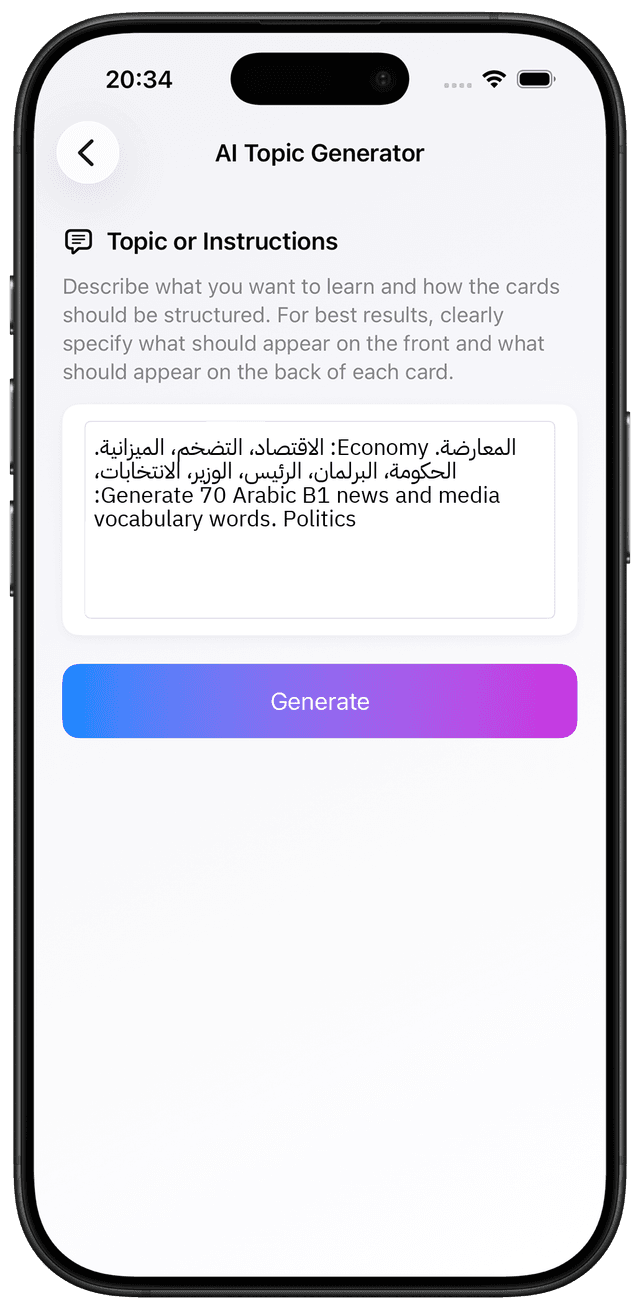
Reading Al Jazeera, BBC Arabic, or any major Arabic news outlet requires a specific vocabulary set. Headlines omit the verb entirely, passive voice is used constantly, and topics like governance, economy, and conflict come with their own standard terminology.
Why news vocabulary belongs at B1: If you can read and follow real Arabic news at a basic level, you have reached genuine B1 comprehension. Much of this vocabulary also appears outside news: political terms show up in history, economic terms in business correspondence.
The strategy: Build cards from actual headlines. A real headline is usually short enough for a single card and comes pre-packaged with authentic vocabulary in context.
Generate 70 Arabic B1 news and media vocabulary words. Politics: الحكومة، البرلمان، الرئيس، الوزير، الانتخابات، المعارضة. Economy: الاقتصاد، التضخم، الميزانية، الاستثمار، النمو. Conflict: النزاع، وقف إطلاق النار، الأزمة، الاتفاقية. Passive constructions: أُعلن، أُقرّ، صدر قرار. Front: Arabic term. Back: English + topic label.
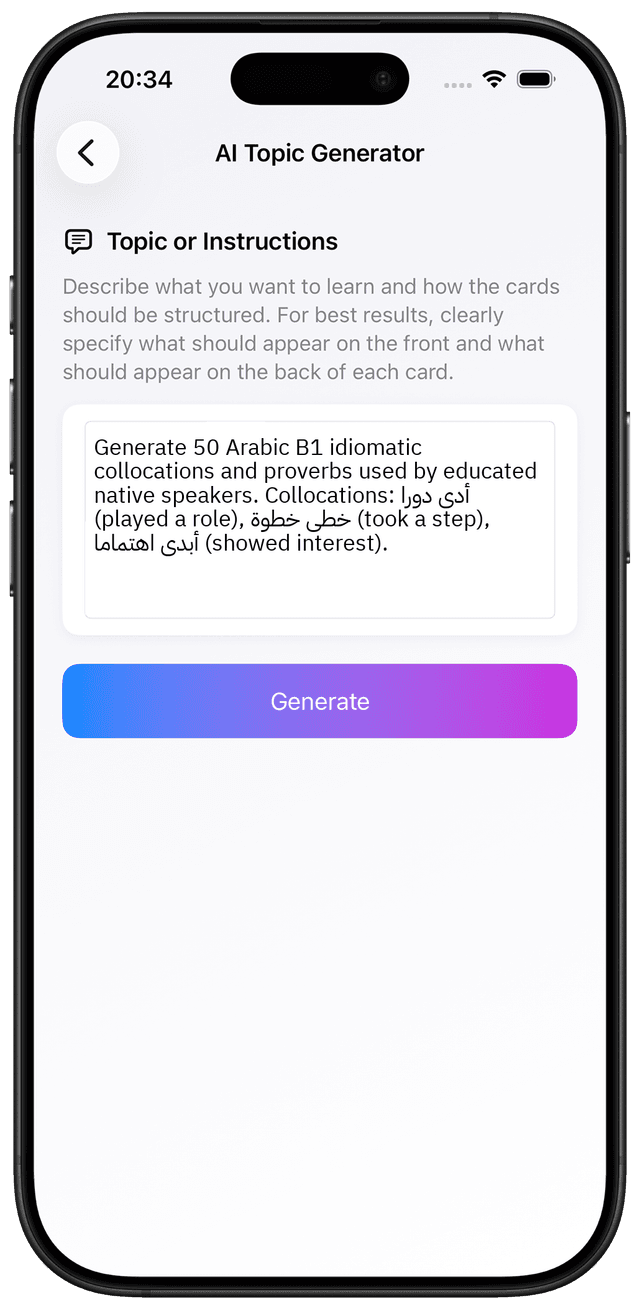
The final B1 phase is about sounding natural rather than grammatically correct. Native speakers use proverbs and idiomatic collocations constantly, and knowing when to shift from formal to informal register is what separates a competent B1 reader from someone who can actually talk.
The milestone: After this phase you have derived verb forms across the ten major patterns, both subjunctive and jussive moods, the masdar system for abstract vocabulary, formal register connectors, discourse-level argumentation phrases, news media vocabulary, and idiomatic collocations. That covers B1 Arabic.
Generate 50 Arabic B1 idiomatic collocations and proverbs used by educated native speakers. Collocations: أدى دوراً (played a role), خطى خطوة (took a step), أبدى اهتماماً (showed interest), أثار جدلاً (sparked controversy). Proverbs: العلم في الصغر كالنقش على الحجر، لكل مقام مقال. Front: Arabic collocation or proverb. Back: English + usage note.
At B1, Arabic is pattern recognition at scale. Derived verb forms, mood endings, and masdar constructions all follow internal rules, but there are a lot of them. MindCards uses active recall to drill those patterns individually so you stop second-guessing yourself and start reading automatically. Spaced repetition schedules each card for review right before you would otherwise forget it, which means you spend more time on the hard items and less time on what you already know.
B1 vocabulary builds on the A1 and A2 foundations and sets you up for B2 reading fluency and advanced conversation. Use the links below to move between levels or return to the full Arabic guide.
Join learners building B1 Arabic fluency with AI-powered flashcards and spaced repetition. No account or signup required.