
Spaced repetition explained
Why reviewing at the right interval locks in advanced Arabic B2 vocabulary long term
You have B1 Arabic. You can construct formal sentences, read a news article with effort, and handle derived verb forms. B2 is where that effort drops. Sentences that required active decoding start arriving whole. You stop translating word by word and start reading in Arabic.
B2 Arabic covers roughly 4,000 words in total. This guide focuses on the 1,000+ that actually make the difference: complex conditionals for real hypothetical reasoning, quadrilateral and literary verb forms, the elevated register used in literary journalism and opinion writing, academic prose vocabulary, advanced media and political Arabic, rhetorical and argumentation structures, and the collocations that native speakers use without thinking.
Each of the seven phases below includes a ready-to-use AI prompt. Copy it into the MindCards app to generate a focused flashcard deck. Spaced repetition then handles the review schedule, so you spend your time on the cards that actually need work.
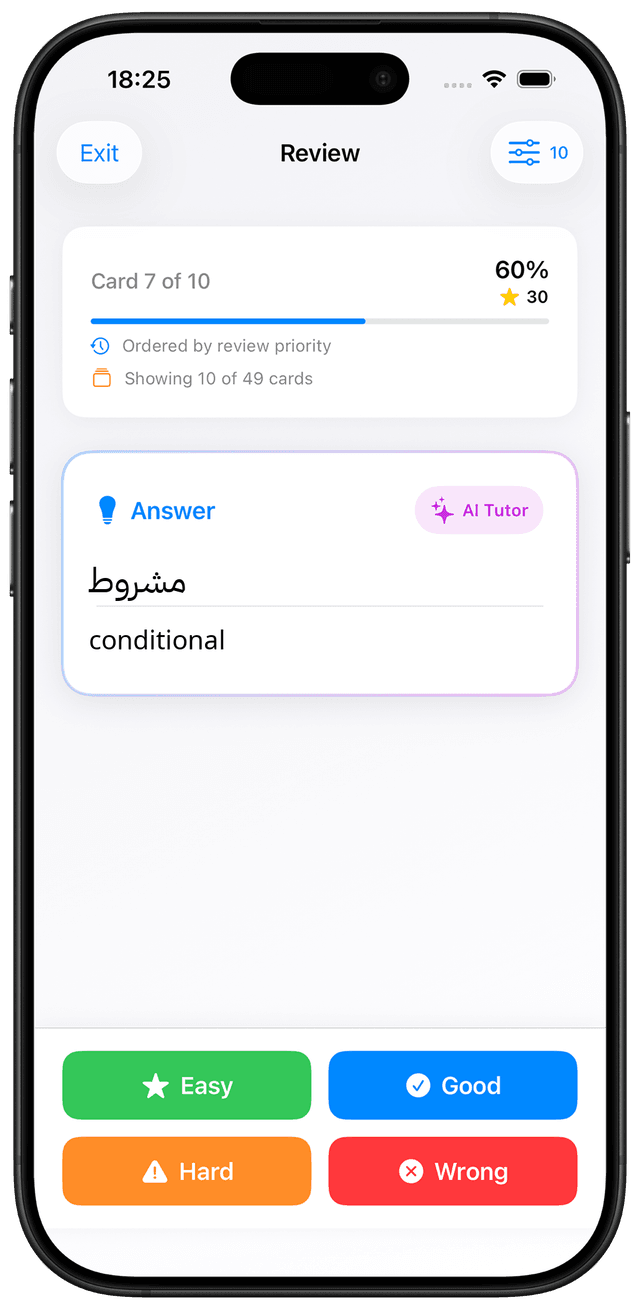
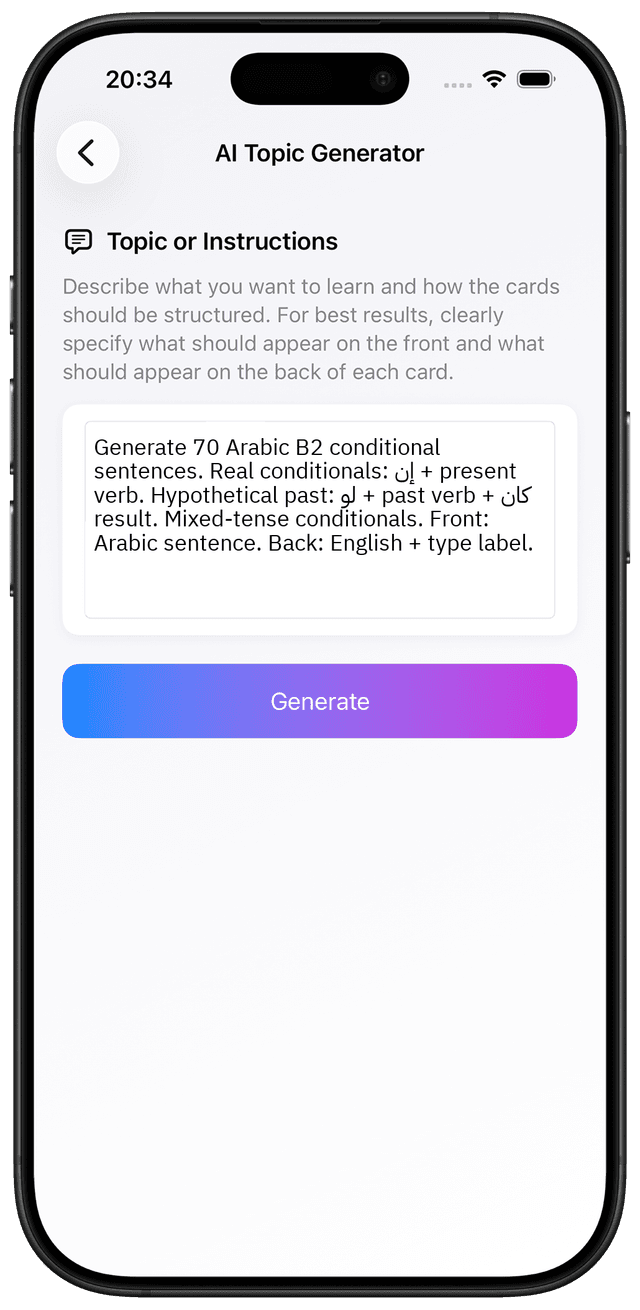
Arabic conditionals go well beyond the basic لو...كان structure you learned at B1. At B2 you need the full range: real conditions with إن + indicative, hypothetical past conditions with لو + past verb, and mixed-tense conditionals where the condition and result sit in different time frames. Real Arabic writing uses all three constantly, and knowing which structure fits which meaning is what separates B1 reading comprehension from B2.
Why start here? Conditionals show up in news analysis, opinion writing, formal speeches, and everyday argumentation. A gap in this area makes your writing sound stilted even when the vocabulary is right.
The strategy: Build one card set per conditional type, showing the governing structure alongside three real-world example sentences. Mix real, hypothetical, and mixed-tense conditions so the pattern becomes automatic.
Generate 70 Arabic B2 conditional sentences. Real conditionals (25): إن + present verb in condition, matching result. Hypothetical past (25): لو + past verb, كان + conditional result, covering both affirmative and negative. Mixed-tense conditionals (20): condition in one tense, result in another. Topics: politics, environment, everyday decisions. Front: full Arabic conditional sentence. Back: English + conditional type label.
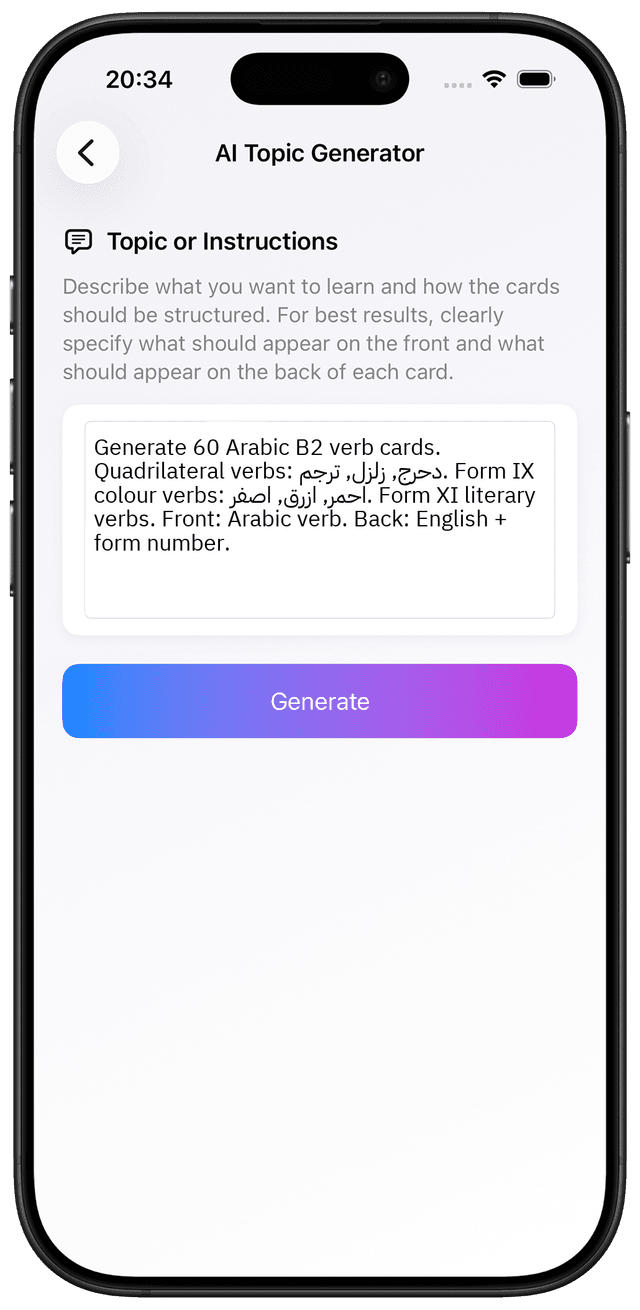
At B1 you worked through the ten trilateral verb forms. B2 adds two layers. First, the quadrilateral roots: four-letter roots like دحرج (to roll), زلزل (to shake), and ترجم (to translate) that behave differently from trilateral verbs. Second, rare or literary Forms IX and XI that appear in academic and classical texts but not in everyday speech.
Why B2 needs this: Technical, academic, and literary Arabic uses quadrilateral and Form IX/XI verbs regularly. You will hit them in newspaper opinion columns, academic abstracts, and any text that borrows from classical registers.
The strategy: Group cards by derivation type. For quadrilaterals, show Form I (فَعْلَلَ) and Form II (تَفَعْلَلَ) side by side so the reflexive relationship is visible immediately.
Generate 60 Arabic B2 advanced verb derivation cards. Group 1 (25 quadrilateral verbs): Form I فَعْلَلَ and Form II تَفَعْلَلَ pairs using: دحرج/تدحرج, زلزل/تزلزل, ترجم/تترجم, طمأن/اطمأن, وسوس/توسوس. Group 2 (20 Form IX verbs): colour and defect verbs: احمرّ, ازرقّ, اصفرّ, اسودّ, ابيضّ. Group 3 (15 Form XI literary verbs): احمارّ, ازرقّ extended forms. Front: Arabic verb + root. Back: English + form number + usage note.
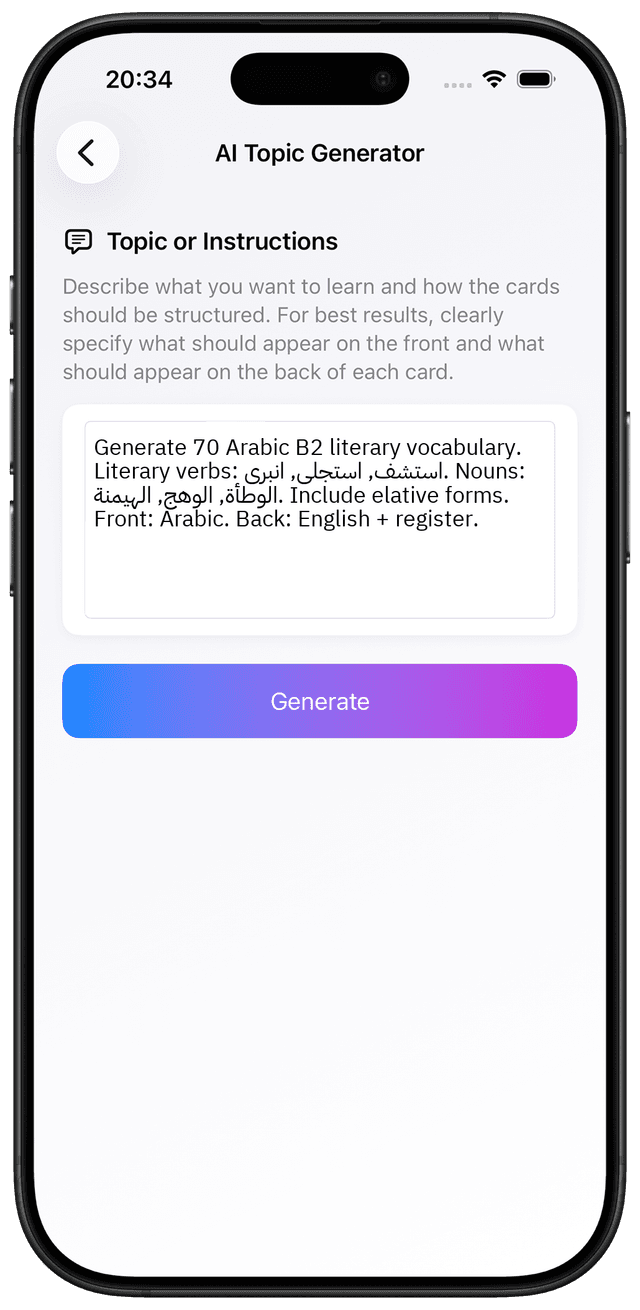
B2 Arabic means you can read opinion columns, literary journalism, and edited prose without reaching for a dictionary every paragraph. This requires a specific layer of vocabulary that sits between MSA and classical Arabic: the elevated register used in cultural magazines, literary criticism, and quality journalism. Words like استشفّ (to discern), استجلى (to clarify), انبرى (to set about), and ناءَ (to be weighed down) belong here.
Literary Arabic also uses constructions that formal MSA avoids. The resumptive pronoun in a relative clause, the accusative of specification (تمييز), and the elative form (أفعل التفضيل) in comparative and superlative contexts all appear regularly in edited prose and less often in bureaucratic writing.
Why this phase? Quality newspaper reading, Arabic literature, and any academic text in the humanities uses this register. Skipping it caps your comprehension below genuine B2.
The strategy: Build cards from real sentences drawn from literary journalism. Each card should show the word in a sentence that a quality newspaper would actually publish.
Generate 70 Arabic B2 literary and elevated-register vocabulary items. Group 1 (25 literary verbs): استشفّ, استجلى, انبرى, ناءَ بـ, أفضى إلى, أسهم في, انصبّ على, تجلّى في. Show each in an authentic literary journalism sentence. Group 2 (20 classical-origin nouns): الوطأة, الوهج, الصخب, الصمت, الهيمنة, الرؤية, الإرث, الشأن. Group 3 (25 constructions): elative forms (الأكثر تعقيداً vs أعقد), resumptive pronouns in relative clauses, accusative of specification examples. Front: Arabic word/phrase + example sentence. Back: English + register label.
Reading Arabic academic writing requires a vocabulary set that does not appear in everyday speech. Arabic university texts, research papers, and policy documents use a consistent stock of abstract nouns, technical verbs, and hedging phrases that marks the register immediately. Words like يُلاحَظ أن (it is observed that), تجدر الإشارة إلى (it is worth noting), وفقاً للبيانات (according to the data), and في ضوء ما سبق (in light of the above) are the connective tissue of Arabic academic prose.
Why this matters at B2: Arabic university students read this register constantly. If you want to use Arabic professionally or academically, or simply want to read academic commentary on current events, this vocabulary is unavoidable.
The strategy: Focus on whole phrases rather than individual words. Academic register is carried more by set-phrase patterns than by technical terminology. Build cards that show the phrase in a full sentence so you absorb the surrounding grammatical structure.
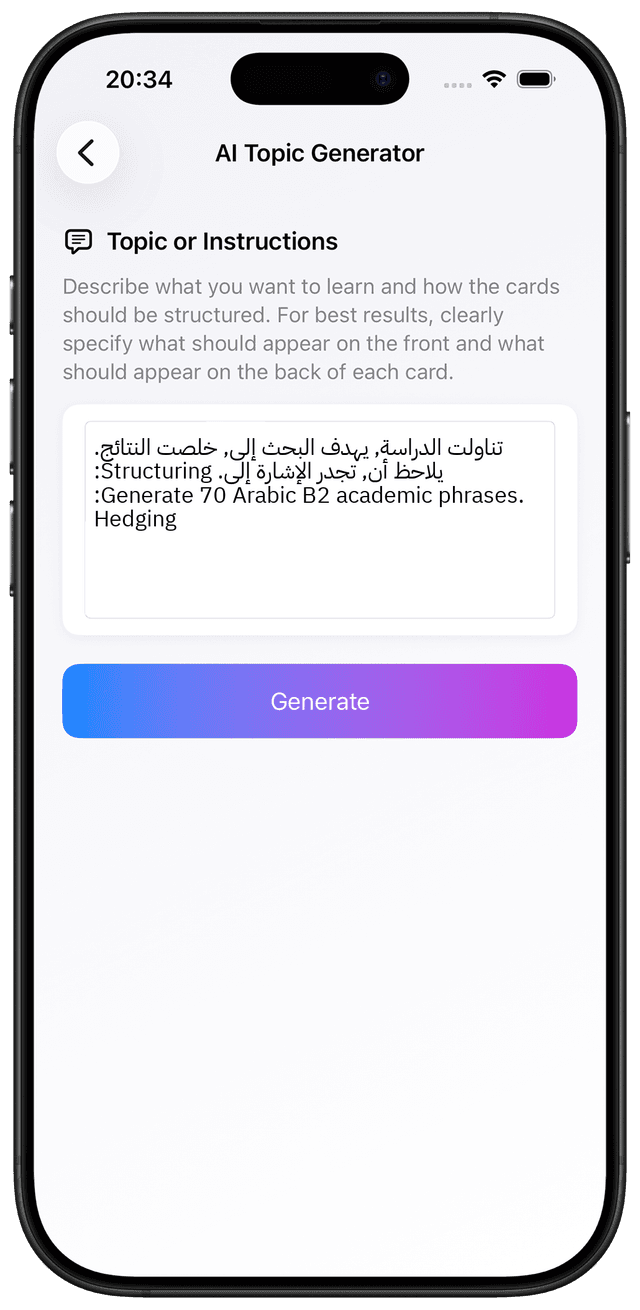
Generate 70 Arabic B2 academic and research language phrases. Group 1 (20 hedging and evidential phrases): يُلاحَظ أن, تجدر الإشارة إلى, وفقاً للبيانات, في ضوء ما سبق, يمكن القول بصفة عامة, من الجدير بالذكر. Group 2 (20 structuring phrases): تناولت الدراسة, يهدف البحث إلى, خلصت النتائج إلى, يتضح من التحليل أن, وتوصّل الباحثون إلى. Group 3 (15 academic nouns): المنهجية, الإطار النظري, الفرضية, التحليل الكمي, الاستنتاج. Group 4 (15 citation and reference phrases): كما يُشير فلان إلى, وقد أكّد الباحث, استناداً إلى. Front: Arabic phrase + full sentence. Back: English + academic function label.
B2 media Arabic goes beyond the basic political terminology from B1. At this level you can follow Al Jazeera's analytical segments, read editorial opinion without relying on context to guess vocabulary, and track a complex news story across multiple articles. This requires domain-specific vocabulary for geopolitics, international law, economic analysis, and diplomatic language.
Arabic political media also uses a specific set of nominal sentence patterns, passive constructions, and quotation formulas that differ from everyday speech. The pattern صدر بيان مشترك يقضي بـ (a joint statement was issued requiring...) or أفادت مصادر بأن (sources reported that) appear in every major Arabic news broadcast.
Why advanced media vocabulary at B2? Following Arabic news without stopping to look up vocabulary is a real and measurable milestone. This phase removes the ceiling that blocks it.
The strategy: Build cards from actual news-style sentences. Each card should look like a sentence you would find in an Al Jazeera or BBC Arabic report.
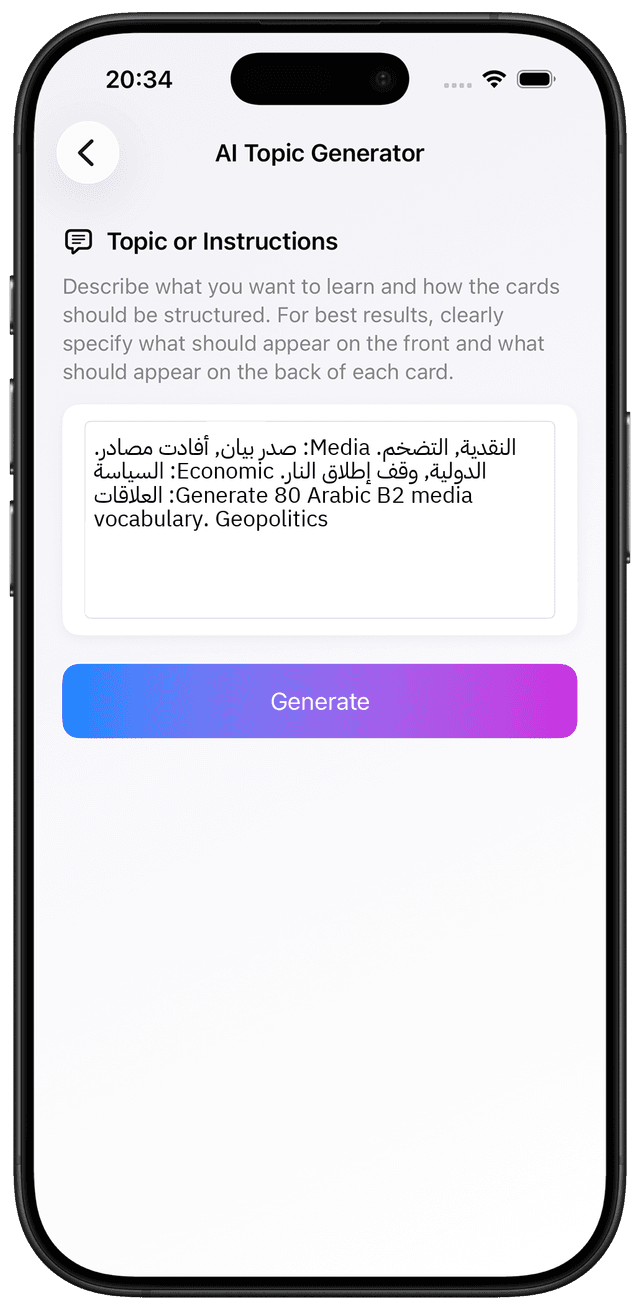
Generate 80 Arabic B2 advanced media and political vocabulary items. Group 1 - Geopolitics (25): العلاقات الدولية, السيادة الوطنية, التدخل الإنساني, المبادرة الدبلوماسية, وقف إطلاق النار, التسوية السلمية, الشرعية الدولية, مجلس الأمن الدولي, القانون الدولي الإنساني. Group 2 - Economic reporting (25): السياسة النقدية, معدل الفائدة, التضخم المتسارع, الاحتياطيات الأجنبية, الميزان التجاري, الاستثمار الأجنبي المباشر. Group 3 - Media formulas (15): صدر بيان, أفادت مصادر بأن, أكّد المسؤولون, ذكرت وكالة الأنباء. Group 4 - Opinion and analysis (15): في ظل المشهد الراهن, على صعيد العلاقات, يُرجَّح أن. Front: Arabic phrase + news sentence. Back: English + domain label.
Written Arabic at B2 uses rhetorical devices that have roots in the classical tradition: the balanced antithesis (الطباق), the rhetorical question (الاستفهام البلاغي), and the use of chiasmus or repetition for emphasis. These are not archaic. They appear in modern opinion writing, political speeches, and even advertising. Recognising them is part of reading comprehension; using them is part of B2 writing.
The argumentation vocabulary at B2 extends beyond the discourse connectors from B1. You need ways to introduce a concession that acknowledges a specific objection, to present evidence from a named source, and to close an argument with a synthesis that goes beyond وبالتالي. Phrases like وإن سلّمنا بصحة ذلك فإن (even if we accept the validity of this, then...) and حتى لو افترضنا جدلاً (even if we assumed for the sake of argument) belong to B2 written Arabic.
The goal: After this phase your written Arabic can construct a structured argument, concede specific objections, deploy evidence from named sources, and close with a synthesis. That is the core of B2 writing production.
The strategy: Each card pairs a rhetorical or argumentation phrase with a complete example so you learn the phrase in its natural grammatical habitat.
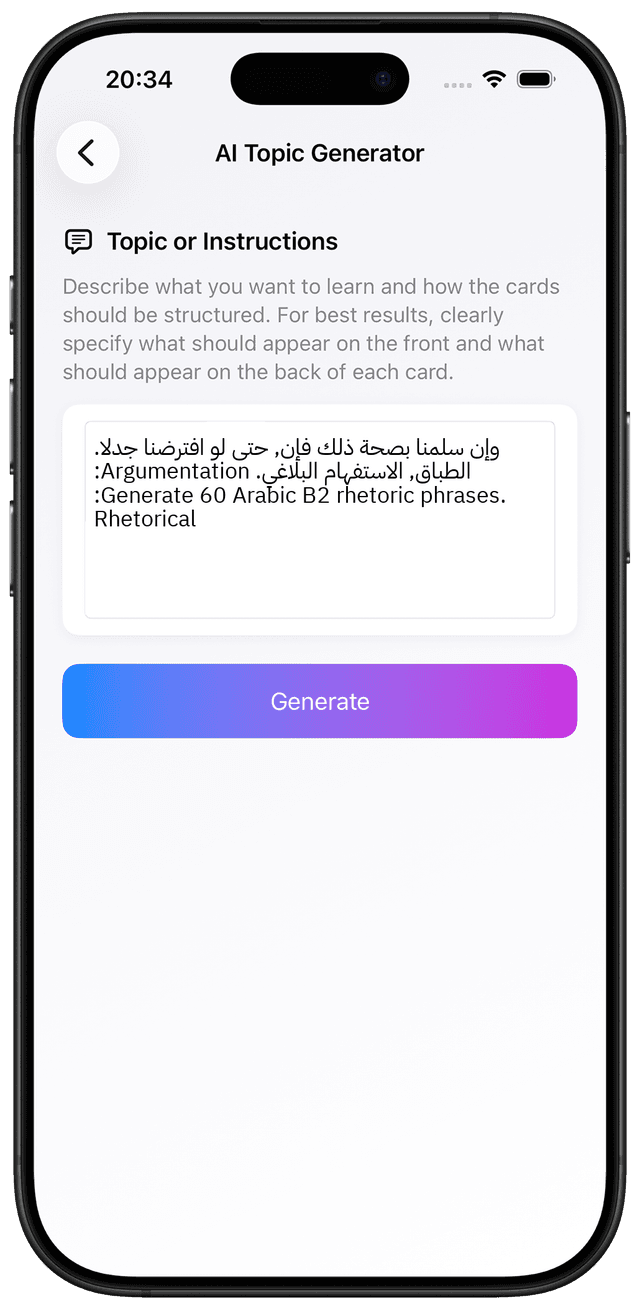
Generate 60 Arabic B2 rhetoric and argumentation phrases. Group 1 (15 rhetorical devices): examples of الطباق (antithesis), الاستفهام البلاغي (rhetorical question), التكرار (repetition for emphasis) in modern opinion writing. Group 2 (20 advanced argumentation): وإن سلّمنا بصحة ذلك فإن, حتى لو افترضنا جدلاً, ولئن كان كذلك, ومع ذلك تجدر الإشارة. Group 3 (15 evidence presentation): استناداً إلى ما أورده, وفق ما كشفت عنه الأرقام, في ضوء الدراسة الصادرة عن. Group 4 (10 synthesis and closing): وخلاصة القول, مما يعني في نهاية المطاف, وهكذا يتضح أن, وفي المحصلة. Front: Arabic phrase + full example. Back: English + rhetorical/argumentation function.
The difference between a grammatically correct B2 learner and someone who sounds natural in Arabic is largely collocational. Native-educated Arabic speakers do not say يعمل دوراً, they say يؤدي دوراً. They do not say فعل اتفاقاً, they say أبرم اتفاقاً. They do not say أعطى اهتماماً, they say أولى اهتماماً. These verb-noun pairings are fixed in the language and learning them is the final piece of B2 fluency.
Arabic proverbs and set expressions also operate at B2. Not the simple ones from A2, but the culturally specific proverbs that appear in editorial writing and formal speeches: الحليم يبتلع غيظه (the patient man swallows his anger), درهم وقاية خير من قنطار علاج (a gram of prevention is worth a ton of cure). These appear in Arabic media because they carry cultural resonance that an international learner needs to recognize.
The B2 milestone: With this phase complete, you have covered Arabic B2 across all the dimensions that matter: complex conditionals, advanced morphology, literary register, academic prose, media and political vocabulary, advanced argumentation, and natural collocational use. C1 takes those as a base and adds wider idiomatic range and finer stylistic control.
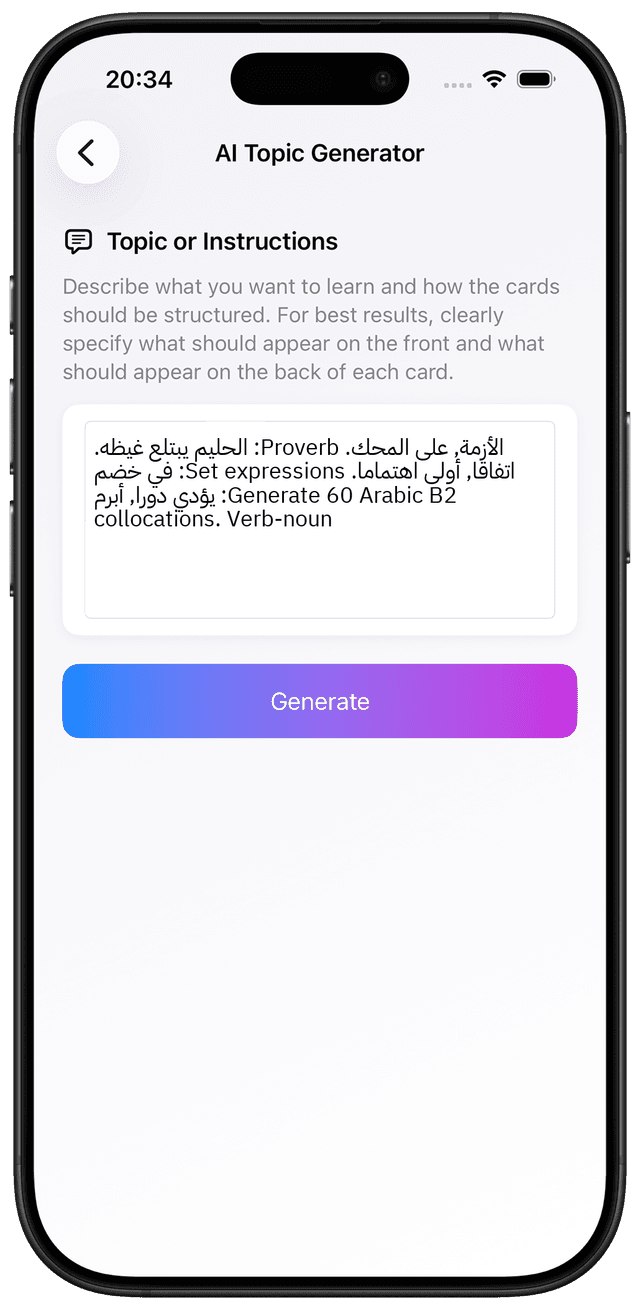
Generate 60 Arabic B2 advanced collocations and idiomatic expressions. Group 1 (25 fixed verb-noun collocations): يؤدي دوراً, أبرم اتفاقاً, أولى اهتماماً, خاض معركة, أطلق مبادرة, بسط نفوذه, أرسى قواعد, أثار جدلاً واسعاً, وضع حداً لـ, ألقى الضوء على. Group 2 (20 elevated set expressions from media/opinion): في خضم الأزمة, على المحك, في مهب الريح, على حافة الهاوية, في طليعة الأولويات. Group 3 (15 culturally resonant proverbs): الحليم يبتلع غيظه, درهم وقاية خير من قنطار علاج, من جدّ وجد, الصبر مفتاح الفرج, العقل زينة. Front: Arabic collocation/proverb + sentence. Back: English + usage note.
At B2, Arabic vocabulary is less predictable than at earlier levels. Literary register, academic prose, collocations, and rhetorical phrases do not follow patterns you can derive from grammar rules alone. Spaced repetition handles this well: cards you find difficult come back more often, cards you already know drop back. You spend your review time where it actually counts.
B2 builds on B1 and prepares you for C1. Use the links below to move between levels or return to the full Arabic guide.
Build your Arabic B2 vocabulary with AI-generated decks and spaced repetition that adapts to what you actually find difficult. Free to download. No account required. Start with the phase that covers your biggest gap.