
Spaced repetition explained
Why reviewing at the right interval is the key to locking in advanced Arabic C1 vocabulary long term
You have B2 Arabic. You can read a newspaper article, follow most news broadcasts with effort, and write a structured argument. C1 is where that effort drops. Editorial columns start reading at speaking pace. Academic abstracts make sense on the first pass. You stop translating in your head and start thinking in Arabic.
C1 Arabic covers roughly 6,000 to 8,000 words in active use. This guide focuses on the 1,500+ that actually move you up at this level. The seven phases work through complex syntax, academic register, advanced media discourse, idiomatic and rhetorical depth, diglossia awareness, root family derivation, and the conscious stylistic choices that mark a strong C1 writer.
Each of the seven phases below includes a ready-to-use AI prompt. Paste it into the MindCards app and it generates a custom flashcard deck in seconds. Spaced repetition then schedules each card just before you are likely to forget it, so the time you spend reviewing actually counts.
At B2 you handled relative clauses and the standard إنّ family. C1 Arabic asks something harder. You need to track meaning through three or four nested clauses, hold an embedded إنّ inside a relative clause inside a conditional, and write sentences that move from a topic through evidence to a conclusion without dropping the thread. Al-Hayat editorials, academic abstracts, and Supreme Court rulings all sit at this level.
Long Arabic sentences carry information through a chain of explicit connectors and resumptive pronouns. The shift from B2 reading to C1 reading is largely the shift from parsing one clause at a time to parsing whole sentence-paragraphs as a single thought. The same shift happens in writing. C1 writing produces these sentences naturally rather than chopping ideas into shorter pieces.
Why start here? Without syntactic control at this depth, advanced register vocabulary sits in isolation and you read C1 texts one word at a time. Syntax is the scaffolding that lets the rest of C1 vocabulary land in real context.
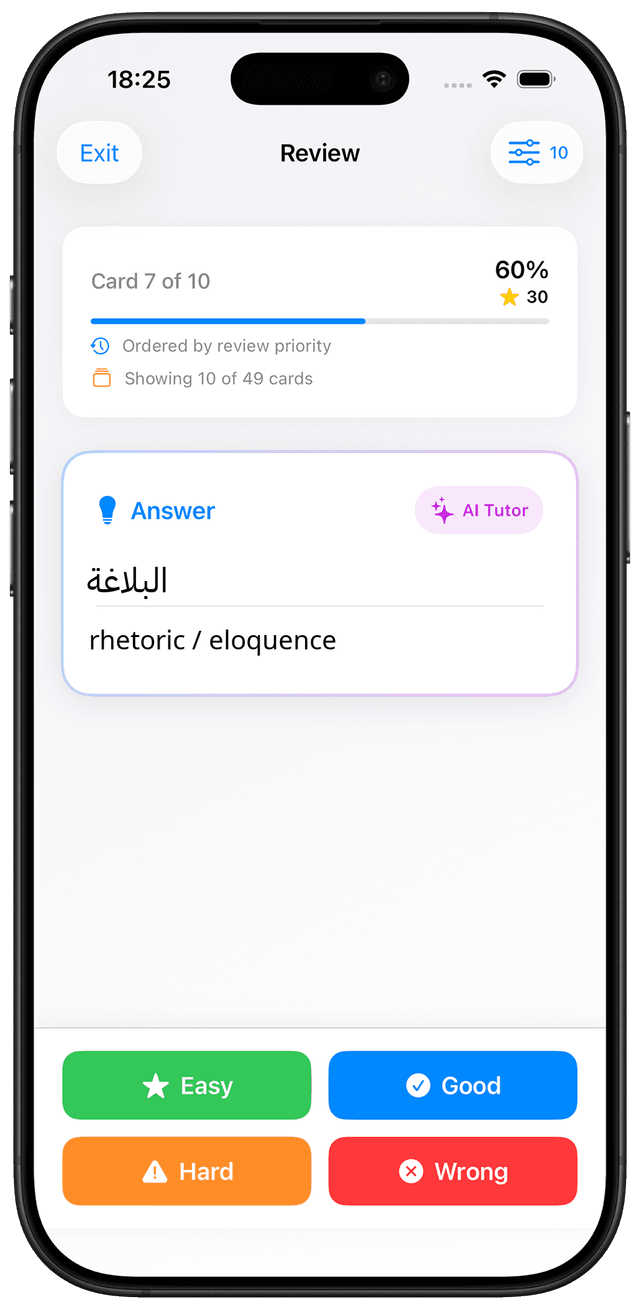
The strategy: Build cards from authentic sentences taken from Arabic editorial and academic prose. Each card shows a sentence with two or three layers of embedding and a short structural label so the pattern becomes visible.
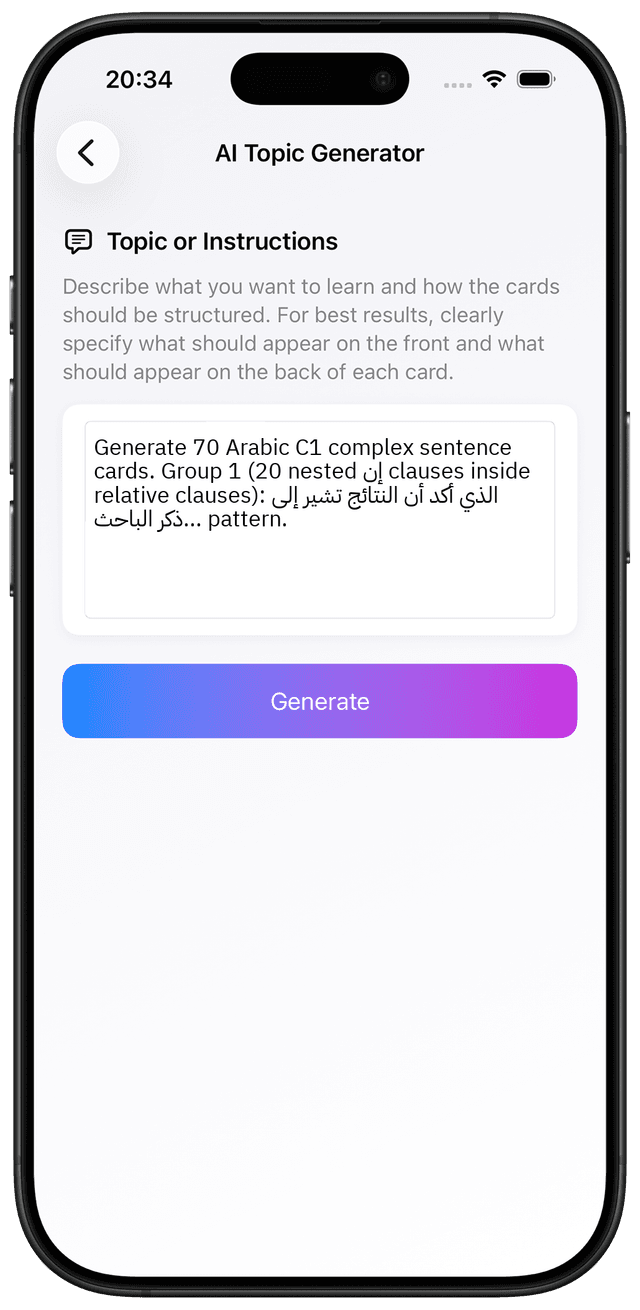
Generate 70 Arabic C1 complex sentence cards. Group 1 (20 nested إنّ clauses inside relative clauses): ذكر الباحث الذي أكّد أنّ النتائج تشير إلى... pattern. Group 2 (20 chained conditionals with embedded relative clauses): إذا تمّ تطبيق ما اقترحته الدراسة التي صدرت عن... pattern. Group 3 (15 long sentences with multiple resumptive pronouns): إنّ التحدّيات التي يواجهها القطاع والتي تعكس... pattern. Group 4 (15 sentences combining فإنّ apodosis with adverbial clauses): pulled from editorial Arabic. Front: full Arabic sentence. Back: English translation plus structural label naming each embedding type.
C1 academic Arabic goes well beyond the structuring phrases you met at B2. At this level you need the vocabulary of methodology, citation, theoretical positioning, and counterargument across the humanities and social sciences. Arabic doctoral writing, journal articles in علم الاجتماع or الاقتصاد السياسي, and conference papers all draw on a defined lexicon that you cannot guess from general MSA.
Arabic academic prose also uses specific syntactic moves. Nominalisation is heavy: ideas appear as nouns of action rather than verbs (مأسسة الحوار rather than تأسيس الحوار كمؤسسة). The passive voice carries scientific neutrality (يُلاحَظ، يُستنتَج، تتمّ مقارنته). Hedging phrases such as يمكن القول إنّ and يبدو أنّ المعطيات تشير إلى mark argumentative caution that direct English-style claims would miss.
Why this matters at C1: If you plan to study, research, or work professionally in Arabic, this register is unavoidable. It also appears in long-form journalism and policy commentary that draws on academic argument.
The strategy: Each card pairs an academic phrase with a complete sentence drawn from a real research style. Group by function (methodology, theoretical framing, counterargument, conclusion) so the rhetorical purpose stays visible.
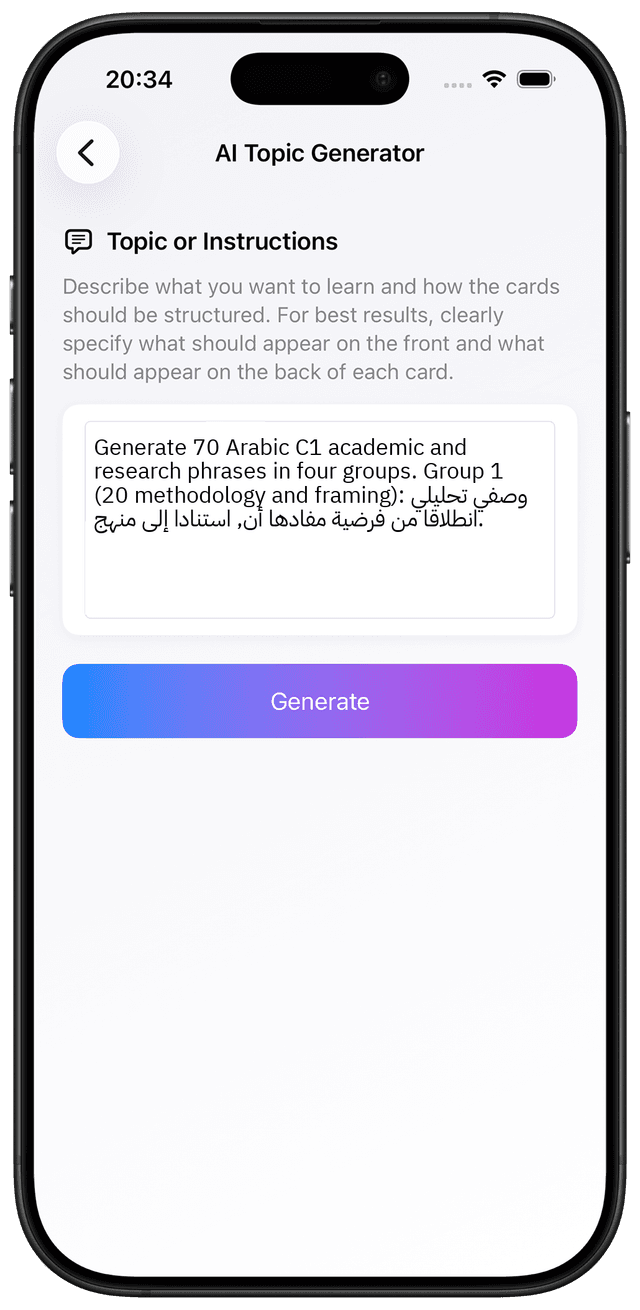
Generate 70 Arabic C1 academic and research phrases in four groups. Group 1 (20 methodology and framing): انطلاقاً من فرضية مفادها أنّ, استناداً إلى منهج وصفي تحليلي, يتبنّى البحث مقاربة متعدّدة التخصّصات, يستعين الباحث بأدوات. Group 2 (20 theoretical positioning): يندرج هذا التصوّر ضمن, ينسجم مع الإطار النظري لـ, يستلهم الباحث من أعمال, يتقاطع هذا الطرح مع. Group 3 (15 counterargument and hedging): على النقيض من ذلك يرى, خلافاً لما ذهب إليه, تجدر الإشارة مع ذلك إلى, يبدو أنّ المعطيات تشير إلى. Group 4 (15 conclusion and contribution): تكشف نتائج البحث عن, تسهم هذه الدراسة في, تفتح هذه النتائج آفاقاً جديدة لـ. Front: Arabic phrase with full sentence. Back: English plus academic function label.
B2 media Arabic let you follow a news report. C1 takes you into editorial analysis, geopolitical commentary, and the longer-form pieces that appear in Al-Sharq Al-Awsat opinion columns, Al Jazeera analytical segments, and the editorial sections of publications such as As-Safir Al-Arabi. Reading these comfortably needs both vocabulary and an ear for how Arabic media frames an argument.
Arabic political and editorial writing uses heavily stylised verb-noun collocations and a fixed set of analytical metaphors. The state acts (تتحرّك, تسعى, تُصعِّد). Negotiations stumble (تتعثّر, تصطدم, تواجه عقبات). Diplomatic moves are measured (محسوبة, مدروسة, ذات أبعاد متعدّدة). At C1 you stop translating these phrases word for word and start reading them as single semantic units, the way a native reader does.
Why media Arabic at C1? Editorial Arabic is the meeting point of formal MSA, classical-leaning rhetoric, and contemporary political vocabulary. Mastering it means you can follow Arabic public debate without leaning on translation.
The strategy: Each card pairs an editorial collocation or analytical phrase with a sentence drawn from the style of an actual opinion column. Group by domain so the political and economic vocabularies build alongside each other.
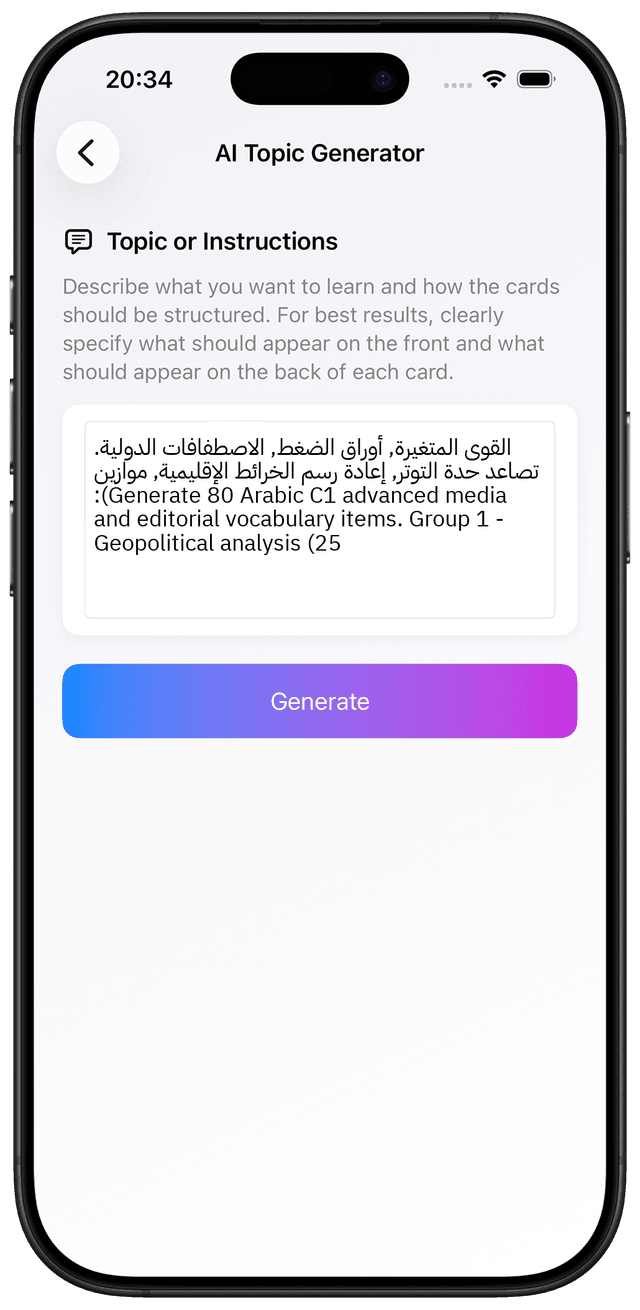
Generate 80 Arabic C1 advanced media and editorial vocabulary items. Group 1 - Geopolitical analysis (25): تصاعد حدّة التوتّر, إعادة رسم الخرائط الإقليمية, موازين القوى المتغيّرة, أوراق الضغط, الاصطفافات الدولية, المظلّة الأمنية, العمق الاستراتيجي, نقطة التماس. Group 2 - Diplomacy and negotiation (20): جسّ النبض الدبلوماسي, دبلوماسية المسار الثاني, إعادة الانخراط, تجميد المسار التفاوضي, الوساطة المكوكية. Group 3 - Economic editorial (20): التباطؤ الاقتصادي, الفوائد المركّبة, ضبط الأسواق, العجز التوأم, الفجوة بين الطبقات. Group 4 - Opinion framing (15): يطرح هذا المشهد تساؤلات حول, لا يمكن قراءة الحدث بمعزل عن, على هامش هذه التطوّرات. Front: Arabic phrase with editorial-style sentence. Back: English plus domain label.
Arabic rhetoric (البلاغة) is not an academic curiosity. The classical figures still shape modern writing. Antithesis (طباق), parallelism (الموازنة), metonymy (الكناية), and rhetorical question (الاستفهام البلاغي) appear in editorials, Friday sermons, political speeches, and even high-end advertising. Recognising them is comprehension. Using them is what a strong C1 writer does.
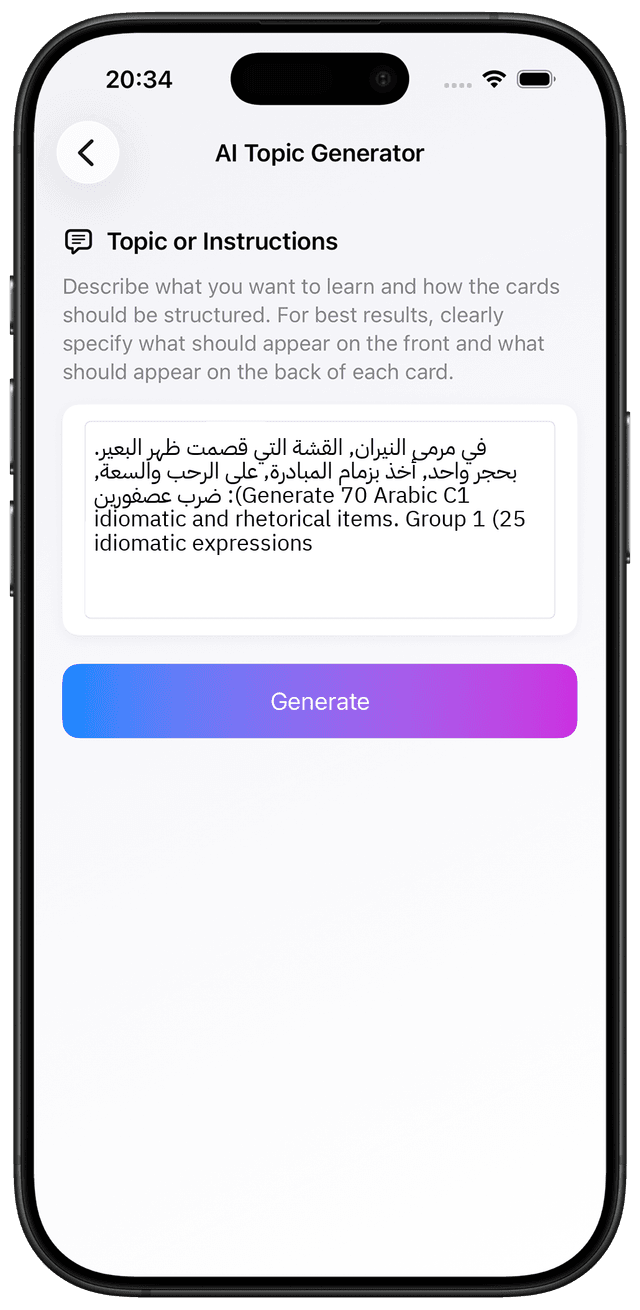
At the same level, C1 brings a wider idiomatic range. Expressions like ضرب عصفورين بحجر واحد (kill two birds with one stone), على الرحب والسعة (you are most welcome), في مرمى النيران (in the line of fire), and أخذ بزمام المبادرة (take the initiative) belong to educated Arabic across the region. They appear in journalism, fiction, and serious conversation. A learner who avoids them sounds careful but stiff; a C1 speaker uses them naturally and chooses among them for tone.
Why this phase? Arabic carries a distinctive idiomatic and rhetorical texture that does not map onto English directly. The C1 milestone is being able to read it with the same ease as plain MSA and use it without sounding forced.
The strategy: Each card pairs an idiom or rhetorical device with a complete example sentence and the rhetorical function. Group by usage context so you build the right register intuition.
Generate 70 Arabic C1 idiomatic and rhetorical items. Group 1 (25 idiomatic expressions): ضرب عصفورين بحجر واحد, أخذ بزمام المبادرة, على الرحب والسعة, في مرمى النيران, ألقى الكرة في ملعب الآخر, شعرة معاوية, القشّة التي قصمت ظهر البعير, بات على كفّ عفريت. Group 2 (15 examples of طباق and موازنة): pairs in modern editorial Arabic showing antithesis or balanced parallelism, with brief structural note. Group 3 (15 كناية metonymy examples): طويل النجاد, نقيّ الجيب, بيت الحكمة, etc. with their meaning unpacked. Group 4 (15 rhetorical questions from Arabic opinion writing): ومن ذا الذي يستطيع أن ينكر, أليس من حقّنا أن نتساءل. Front: Arabic expression with full sentence. Back: English meaning, literal gloss, and rhetorical type.
Diglossia is the central feature of advanced Arabic that most B2 courses sidestep. A C1 user knows when MSA is appropriate, when a dialect form is expected, and when educated speakers mix the two in a single utterance. TV talk shows, business meetings, university lectures, and even WhatsApp groups in the Arab world all use a calibrated mix. Reading it and producing it sit firmly at C1.
At C1 you do not need full active control of a dialect, but you do need passive recognition of the major lexical and grammatical differences in Egyptian, Levantine, and Gulf speech, plus an instinct for when MSA carries an authoritative tone and when it sounds artificially stiff. You also need the in-between register sometimes called الفصحى المعاصرة or the educated spoken Arabic that hosts on Al-Jazeera deploy when interviewing guests across the region.
Why this comes mid-list: Without diglossia awareness you write in a register that sounds correct on paper but artificial in any spoken or semi-formal context. C1 communication ability requires the right register for the right moment.
The strategy: Each card shows the same idea in three forms (MSA, educated cross-dialect, and one regional colloquial example) so the register choice becomes a habit, not an academic question.
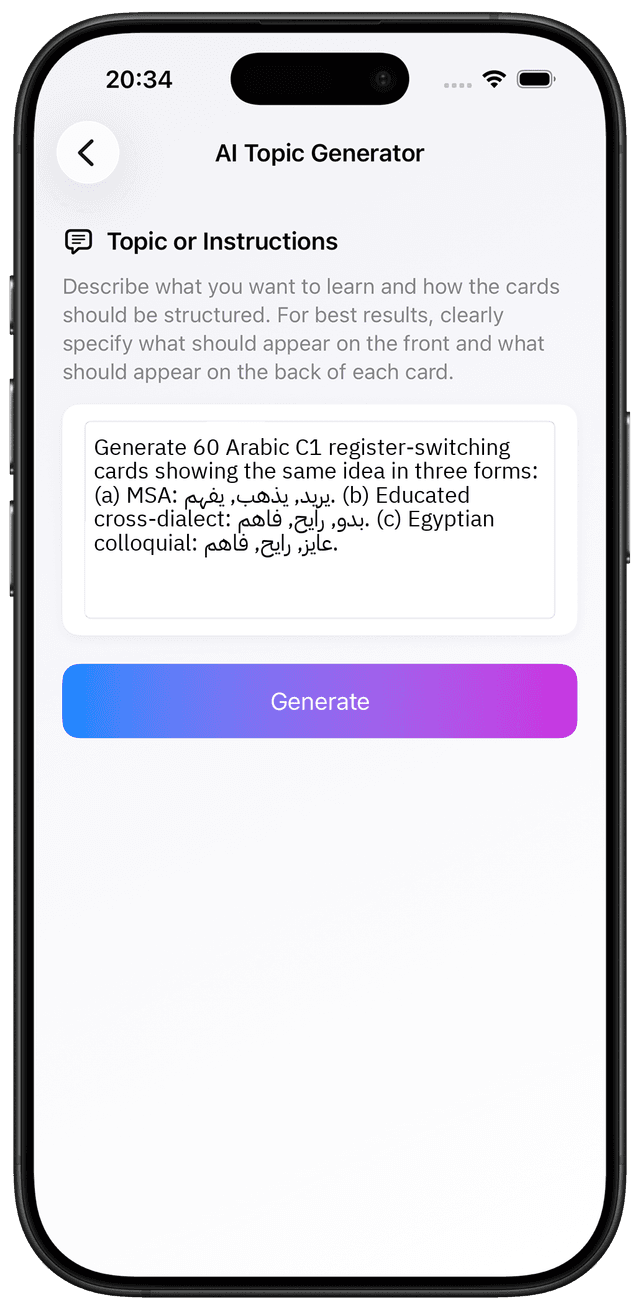
Generate 60 Arabic C1 register-switching cards. Each card shows the same idea in three forms. Group 1 (20 everyday actions and states): want, go, see, understand, be tired, feel like. Show in (a) MSA: يريد, يذهب, يرى, يفهم, متعب, يرغب. (b) Educated cross-dialect: بدّو, رايح, شايف, فاهم, تعبان, نِفسو. (c) Egyptian colloquial: عايز, رايح, شايف, فاهم, تعبان, نفسي. Group 2 (20 connector and discourse particles): إذن vs يعني vs طبعاً variants. Group 3 (20 phrases appropriate to TV talk show register): showing when MSA is required and when colloquial slips in for tone. Front: situation plus MSA form. Back: cross-dialect and colloquial equivalents plus register usage note.
Arabic morphology is what makes the language compact. A single root generates a verb in ten forms, several deverbal nouns, two participles, an instrumental noun, a place noun, and often a diminutive or intensive form. At C1 you stop learning words one by one and start learning roots as whole families. ك-ت-ب gives كَتَبَ, كاتِب, مكتوب, كتاب, كتابة, مكتبة, مَكتَب, مكتبيّ, اِكتَتَبَ, اِستَكتَبَ, and more, each with its own role.
C1 also pushes you into the less common derivations: nouns of intensity (فعّال, مِفعال), nouns of attribute on the pattern of فعيل with a specific semantic shade, and the rich set of verbal noun (مصدر) patterns that distinguish action from result. Educated Arabic plays with these constantly. A C1 reader recognises a new word's likely meaning from its root and pattern long before reaching for a dictionary.
Why this is the C1 lever: Vocabulary growth flips from memorising new words to deriving them. Your effective vocabulary triples once you treat the root system as a generative engine rather than a curiosity.
The strategy: Each card centres on a root and shows its full derivational family with usage examples. Spaced review then locks in the pattern recognition that lets you read unfamiliar formal Arabic without stopping.
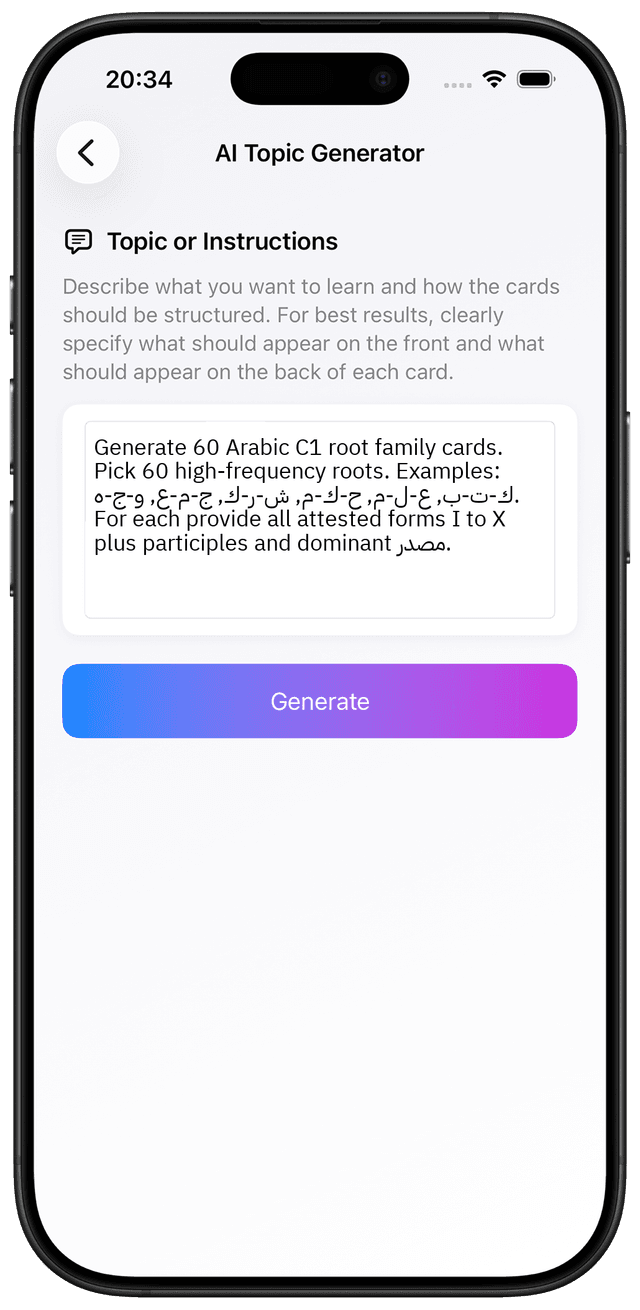
Generate 60 Arabic C1 root family cards. Pick 60 high-frequency roots used at C1. Examples: ك-ت-ب, ع-ل-م, ح-ك-م, ش-ر-ك, ج-م-ع, و-ج-ه, ر-ج-ع, د-ر-س, س-ل-م, ف-ت-ح, ق-ر-ر. For each root provide: (1) all attested forms I to X in the active and meaningful passive. (2) the agent participle, patient participle, and place noun. (3) the dominant مصدر (verbal noun) plus any secondary مصدر patterns that carry distinct meaning. (4) a sample C1 sentence per root that uses three derived forms from that root. Front: Arabic root. Back: full family table with example sentence and brief usage note.
The final C1 phase is about choice. You already have the vocabulary, the syntax, and the register awareness. What remains is the small set of decisions that shapes a piece of Arabic writing or speech: whether to use the active or passive, whether to nominalise or keep the verbal form, whether to place the subject before or after the verb, and which of three near-synonyms carries the precise weight you want. The TORFL-equivalent Arabic proficiency exams and the ACTFL Superior rating both test this directly.
Stylistic control also shows up in connective tissue. The difference between ولكنّ and بيد أنّ and غير أنّ is small but real. So is the choice between إذ and حيث and بما أنّ for the explanatory because. C1 means you make these choices without slowing down. C2 will extend the same control across literary register, classical Arabic borrowings, and the finest nuances. Build a strong C1 here and C2 follows.
The C1 milestone: Completing this phase means your Arabic spans complex syntax, academic register, advanced media language, idiomatic and rhetorical depth, diglossia awareness, derivational mastery, and conscious stylistic control. That is the full C1 communicative range.
Looking ahead: C2 layers in classical-leaning register, fine literary distinctions, and the sharper end of stylistic precision. The choices you train here are the foundation for that next step.
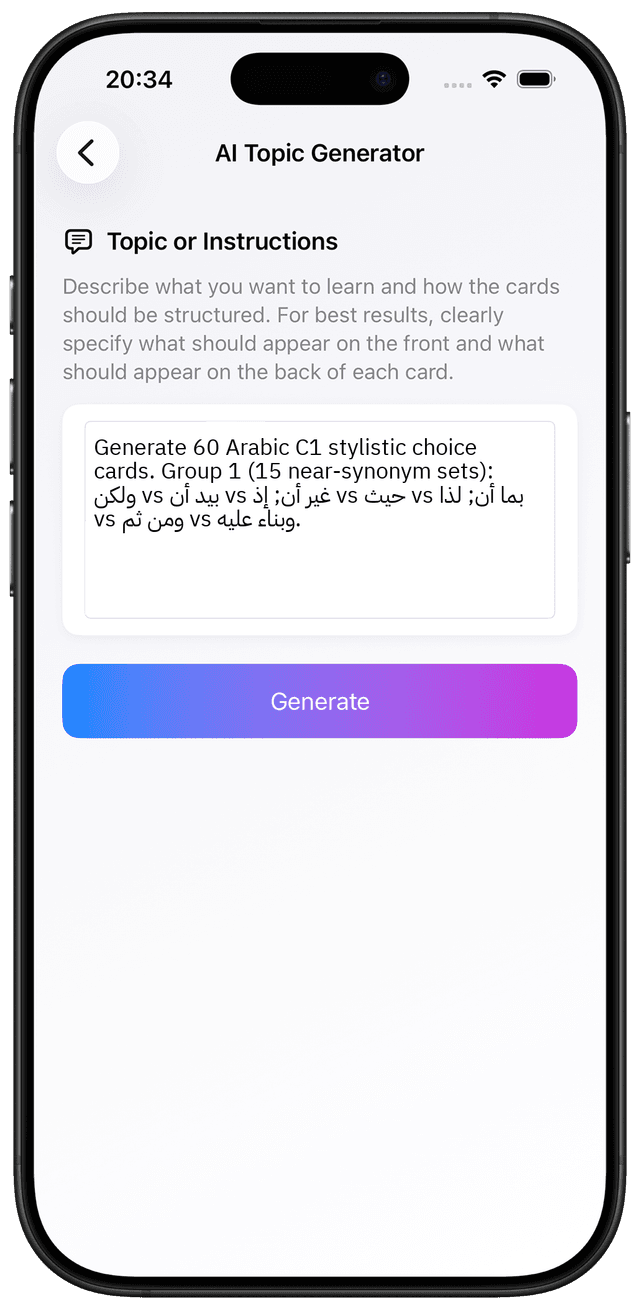
Generate 60 Arabic C1 stylistic choice cards. Group 1 (15 near-synonym sets): ولكنّ vs بيد أنّ vs غير أنّ; إذ vs حيث vs بما أنّ; لذا vs ومن ثمّ vs وبناءً عليه; فحسب vs لا غير vs ليس إلّا. Group 2 (15 active vs passive register choices): يرى الباحث vs يُرى أنّ; قرّرت اللجنة vs تقرّر; ينتقد المراقبون vs يُنتقد. Group 3 (15 verbal vs nominal style transformations): تأسيس مؤسسة الحوار vs مأسسة الحوار; زيادة الإنتاج vs تنمية الإنتاجية. Group 4 (15 word order choices VSO vs SVO): فهم الطلّاب الدرس vs الطلّاب فهموا الدرس with the tone difference. Front: Arabic sentence A. Back: Arabic alternatives plus precise stylistic difference and recommended context.
At C1 Arabic vocabulary becomes less predictable than at earlier levels. Idioms, rhetorical figures, derivational subtleties, and register variants do not follow patterns you can reduce to a simple rule. Spaced repetition handles this directly: cards you find difficult come back sooner, cards you already control drop back. You spend review time where it actually matters.
C1 builds on B2 and prepares you for near-native C2 fluency. Use the links below to move between levels or return to the full Arabic guide.
Build your Arabic C1 vocabulary with AI-generated decks and spaced repetition that adapts to what you actually find difficult. Free to download. No account required. Start with the phase that covers your biggest gap.