
Spaced repetition explained
Why reviewing at the right interval is the key to retaining mastery-level Spanish vocabulary
You have C1. You can handle register shifts, write academic essays, read literary texts without stopping every paragraph. C2 is where fluency stops feeling like performance. The mental effort of monitoring your Spanish drops away. You reach for idioms without thinking, you hear when a refrán fits, and you can write in a way that does not read as translated.
This guide targets the 1,000+ vocabulary items that close the remaining gap between advanced and native-like. Collocations come first, because wrong word combinations are the most visible signal of a non-native writer. Then literary register, rhetorical devices for written production, nuanced subjunctive uses that signal stylistic control, Spanish proverbs (refranes) in real-world context, fixed expressions for legal and academic work, and dialectal awareness across Castilian and major Latin American varieties.
Each of the seven phases below includes a ready-to-use AI prompt. Copy it into the MindCards app and it generates a custom flashcard deck in seconds. Spaced repetition schedules each card at the right interval, so you spend your review time on the items you are actually forgetting.
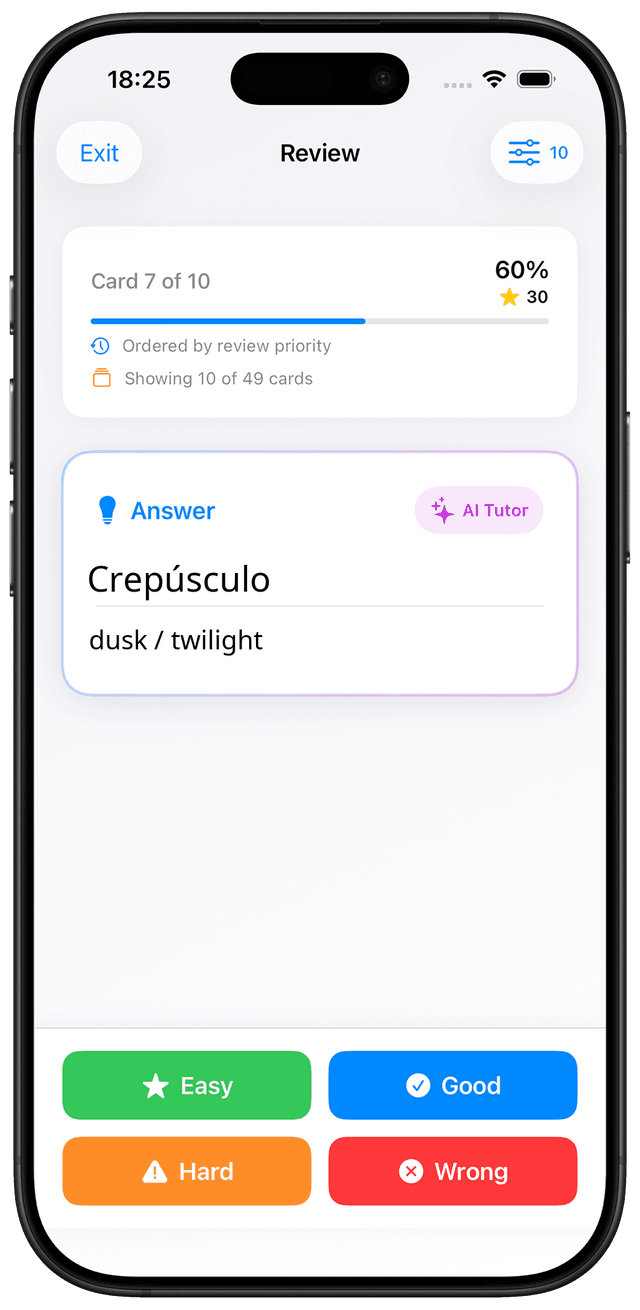
C2 is not about knowing more words. It is about knowing how native speakers combine them. At this level, the gap between you and a native speaker is largely collocational: they do not choose words one by one, they reach for chunks. "Dar a luz" instead of "tener un bebe." "Echarse a perder" instead of "arruinarse." These chunks are automatic for natives and deliberate for learners, and that deliberateness shows.
Why start here? Collocational fluency is the single most reliable marker of C2 competence. Examiners and native speakers notice wrong collocations before they notice grammar errors. This phase targets the 200 most frequent noun-verb, adjective-noun, and adverb-verb collocations in educated Castilian and Latin American usage.
The strategy: Each card presents the full collocation with a native-context sentence, a common learner error to avoid, and the English equivalent. You practice recognition and production together.
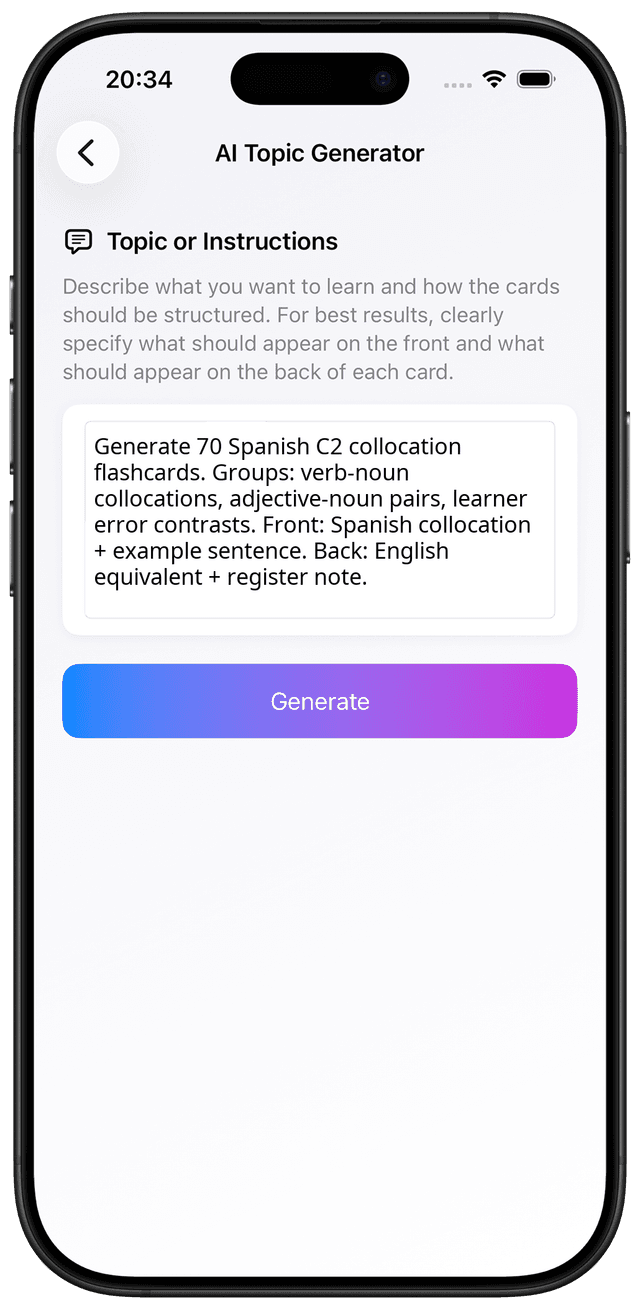
Generate 70 Spanish C2 collocation flashcards. Three groups: (1) Verb-noun collocations: contraer matrimonio, dictar sentencia, rendir homenaje, dar cabida a, prestar juramento, sentar precedente, plantear interrogantes, suscitar dudas. (2) Adjective-noun: argumento contundente, decisión irreversible, silencio sepulcral, mirada escrutadora, detalle nimio, giro inesperado. (3) Common learner errors to contrast: hacer/cometer un error, dar/hacer una conferencia, tener/llevar razón. Front: Spanish collocation + example sentence. Back: English equivalent + note on register or common error.
Reading Garcia Marquez, Borges, or Javier Marias without constant dictionary use requires a specific vocabulary set that sits at the boundary between formal and literary Spanish. This is not the vocabulary of newspapers or presentations. It is the vocabulary of interior monologue, lyrical description, and authorial commentary that you find in 20th and 21st century Spanish prose.
The goal: To give you enough literary register vocabulary that you can read a novel passage and understand the narrative choices the author is making, not just the plot. This matters both for DELE C2 reading comprehension tasks and for your own writing.
The strategy: The deck draws from actual passages in major Spanish literary works. Each card includes the source context, the literary function, and common contemporary uses of the same term outside literature.
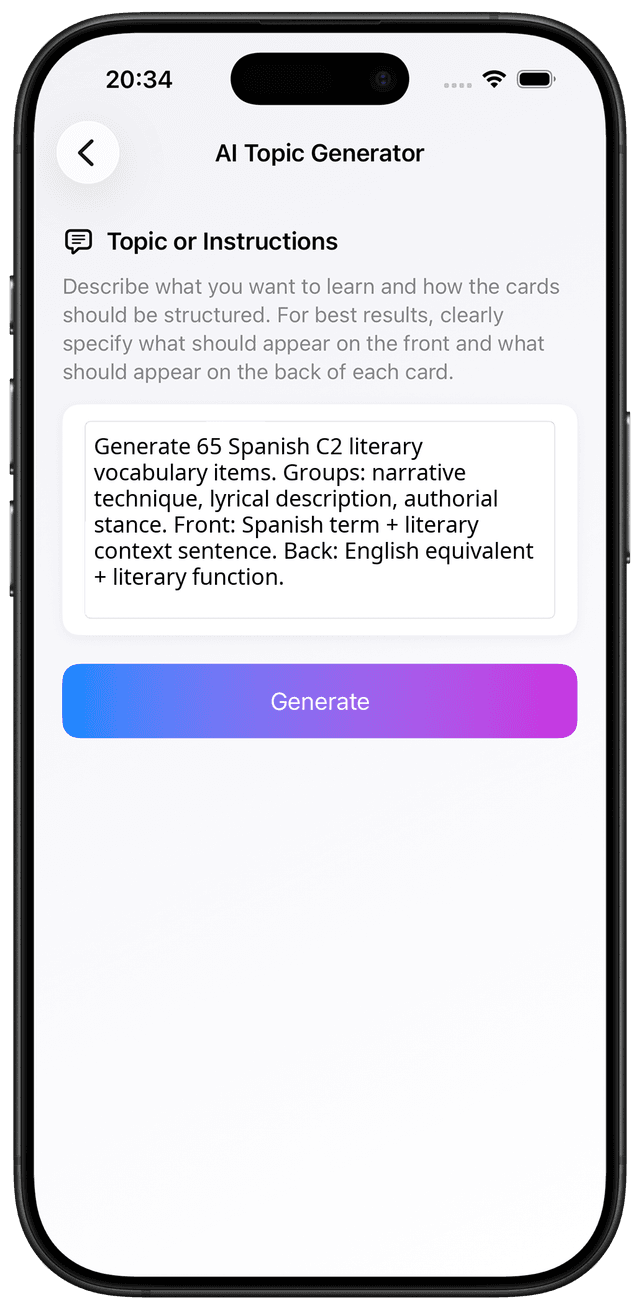
Generate 65 Spanish C2 literary vocabulary items from narrative prose and poetry. Three groups: (1) Narrative technique: analepsis, prolepsis, narrador poco fiable, corriente de conciencia, monólogo interior, distancia narrativa, tiempo diegético. (2) Lyrical and descriptive: crepúsculo, penumbra, evanescente, soslayo, tersura, añoranza, zozobra, quebranto. (3) Authorial stance: ironía dramática, ambigüedad deliberada, voz autorial, perspectivismo, digresión, meta-narrativa. Front: Spanish term + sentence from a literary context. Back: English equivalent + literary function label.
The DELE C2 written production tasks ask you to produce editorial-quality Spanish. That means using rhetorical devices deliberately: antithesis to sharpen a contrast, anaphora to build emphasis, a well-placed rhetorical question to shift the reader's stance. These are not decorations. In educated Spanish writing, they are expected tools.
Why this matters: Most C1 learners can avoid rhetorical devices and still write well. At C2, the absence of these structures is itself a marker of non-native writing. The assessors are reading for evidence of stylistic control, not just grammatical accuracy.
The strategy: Cards cover the 15 most common rhetorical figures in Spanish editorial and academic writing, each with a real example and a note on when they work versus when they overreach.
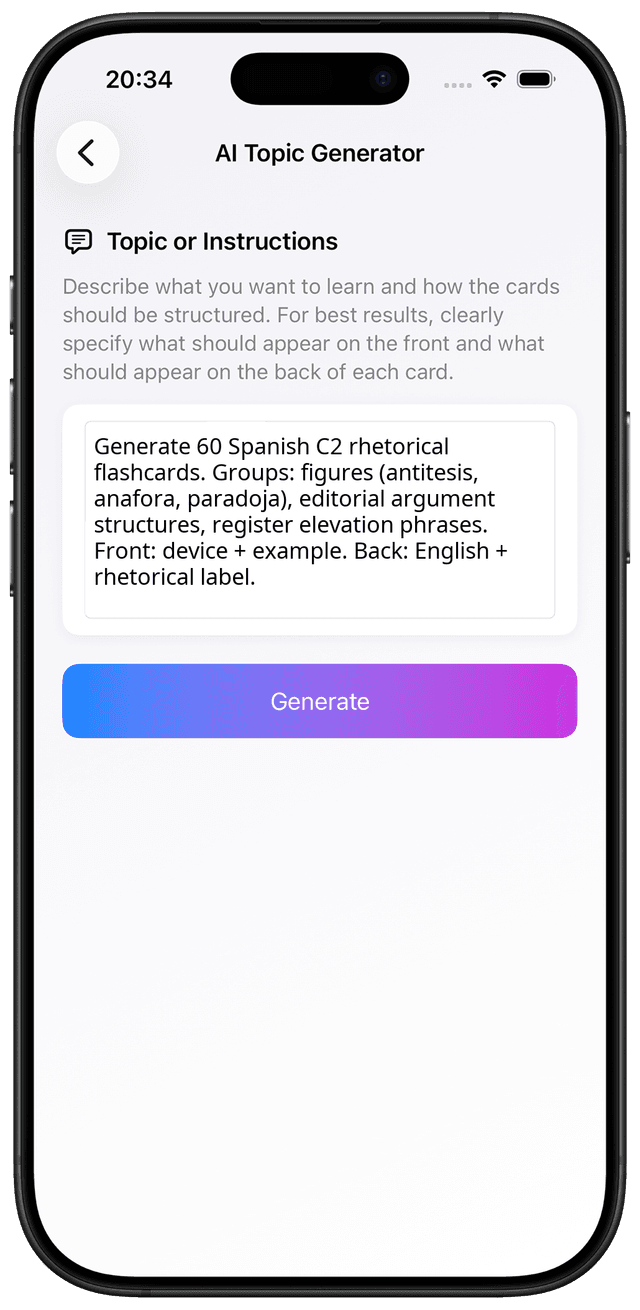
Generate 60 Spanish C2 rhetorical device and argumentation flashcards. Four groups: (1) Rhetorical figures: antítesis, anáfora, paradoja, eufemismo, litotes, perífrasis, hipérbole moderada, interrogación retórica, digresión controlada. (2) Editorial argument structures: si bien... no es menos cierto que, hay que admitir que... aunque, en el fondo late la pregunta de si, resulta paradójico que, lo que está en juego es. (3) Register elevation phrases: cabe preguntarse si, no es baladí señalar que, conviene tener presente que, a todas luces, de suyo. (4) Persuasion and concession at C2: incluso quienes discrepan reconocerán que, ningún análisis honesto puede ignorar. Front: device or phrase + example in editorial context. Back: English + rhetorical label.
C1 subjunctive is about following rules. C2 subjunctive is about breaking them knowingly. Native speakers use the indicative in contexts that technically call for the subjunctive to create a specific effect: more certainty, more directness, more irony. They also use the subjunctive where it is technically optional to signal deference, formality, or emotional distance. Getting these choices right is what makes your Spanish read as authored rather than produced.
The goal: To understand the subtle meanings created by mood alternation in complex subordinate clauses, polite requests, existential statements, and literary prose.
The strategy: The deck presents minimal pairs: the same sentence with subjunctive and indicative, followed by the meaning shift. You learn to feel the difference, not just apply the rule.
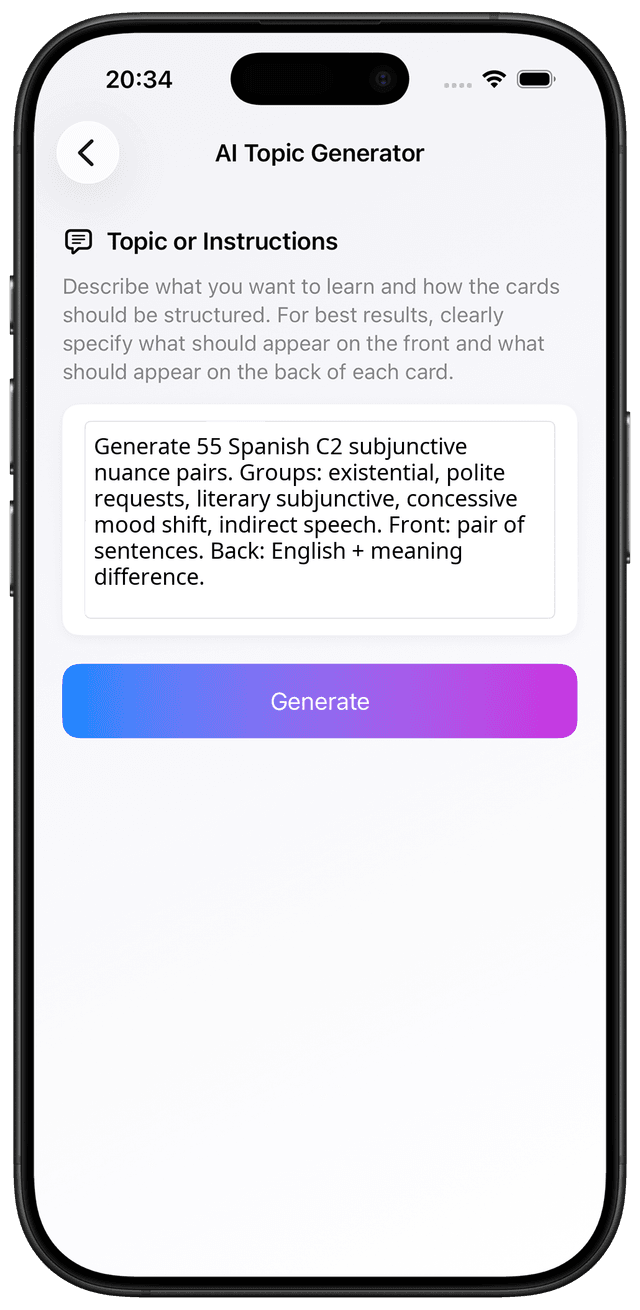
Generate 55 Spanish C2 subjunctive nuance flashcards as minimal pairs. Five groups: (1) Mood alternation in existential statements: no hay nada que hacer vs no hay nada que se pueda hacer. (2) Polite vs direct requests: quiero que vengas vs quisiera que vinieras. (3) Literary subjunctive of unreality: viviera donde viviera, dijera lo que dijera. (4) Concessive with mood shift: aunque sea tarde (still possible) vs aunque fuera tarde (it was too late). (5) Indirect speech mood: dijo que vendría vs dijo que venga ya. Front: pair of Spanish sentences. Back: English for both + note on the meaning or register difference.
Spanish proverbs (refranes) are not optional decoration at C2. Native speakers in Spain and Latin America use them in casual conversation, political debate, journalism, and literature. "Camarón que se duerme, se lo lleva la corriente." "A caballo regalado, no le mires el diente." Knowing what these mean, recognising them in context, and using one at the right moment is a concrete sign of near-native competence.
Why add this now? Refranes index cultural knowledge, not just linguistic knowledge. A C2 user understands that proverbs carry ironic weight in Spanish discourse and that misusing one is worse than not using it at all. This phase covers the 50 refranes with the highest frequency in contemporary usage, plus 30 fixed expressions specific to legal, journalistic, and everyday formal speech.
The strategy: Cards show the refrán, its literal meaning, its pragmatic use, and a model sentence showing how a native speaker would introduce it.
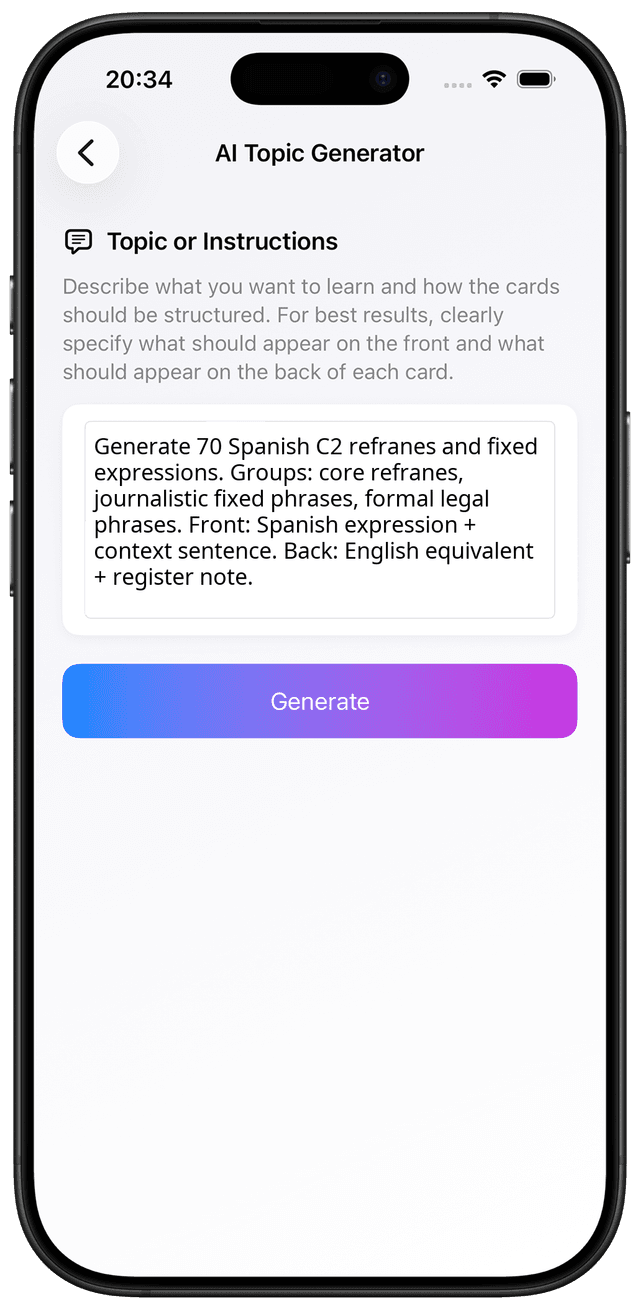
Generate 70 Spanish C2 refranes and fixed expression flashcards. Three groups: (1) Core refranes: a quien madruga Dios le ayuda, más vale tarde que nunca, ojos que no ven corazón que no siente, a mal tiempo buena cara, dime con quién andas y te diré quién eres, camarón que se duerme se lo lleva la corriente. (2) Journalistic and political fixed phrases: poner de manifiesto, saltar a la palestra, quedar en entredicho, dar marcha atrás, tirar de la manta, hacer la vista gorda. (3) Formal and legal fixed phrases: en virtud de lo dispuesto, de conformidad con, sin perjuicio de, a efectos legales, en el marco de la normativa vigente. Front: Spanish expression + context sentence. Back: English equivalent + usage note on register and frequency.
Spanish law, academia, and public administration have a fixed vocabulary that does not bend to informal usage. If you are working as a translator, a lawyer, a researcher, or a policy professional in a Spanish-speaking context, this vocabulary is not optional. "A tenor de lo establecido en el artículo." "El tribunal ha fallado a favor de." "Los resultados corroboran la hipótesis de partida." These phrases appear in real documents daily.
The goal: To build active command of the 150 most common fixed expressions in Spanish legal texts, academic papers, and administrative correspondence. The distinction between near-C2 and true C2 in professional contexts is often whether you can produce these phrases correctly rather than just recognize them.
The strategy: Phrases are grouped by document type: court judgments, academic abstracts, official letters, and regulatory texts. Each card shows the phrase in a realistic document extract.
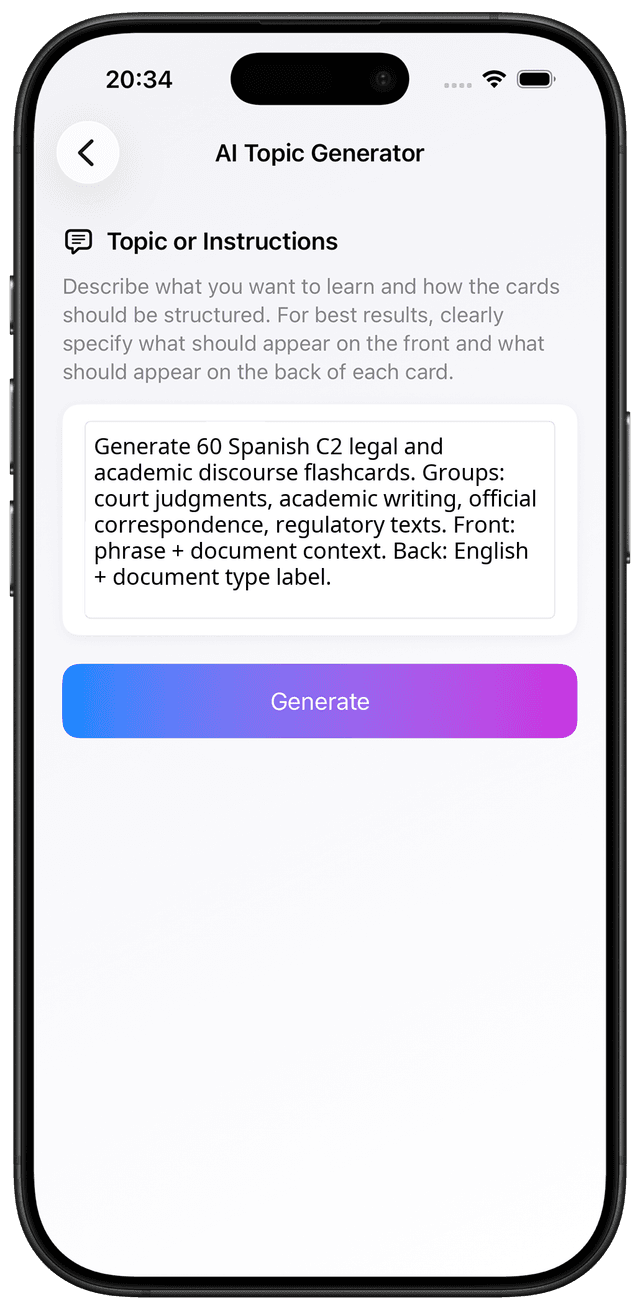
Generate 60 Spanish C2 legal and academic discourse flashcards. Four groups: (1) Legal judgments and procedure: el tribunal resuelve, en méritos de lo expuesto, fallo absolutorio, recurso de apelación, en aplicación del artículo, ha lugar a la demanda, desestimarla en todos sus extremos. (2) Academic writing: los hallazgos corroboran, la investigación pone de relieve, se desprende de los datos que, en consonancia con estudios previos, cabe concluir que. (3) Official correspondence: en respuesta a su escrito, me dirijo a usted en calidad de, quedo a su disposición, sin otro particular, en espera de sus noticias. (4) Regulatory and policy texts: en el marco normativo vigente, con sujeción a, sin menoscabo de los derechos, a los efectos previstos en. Front: phrase + document context. Back: English + document type label.
C2 mastery requires understanding that Spanish is not one language. A document written in Buenos Aires reads differently from one written in Madrid, which reads differently from one written in Mexico City. At this level you are expected to recognise these differences and produce text appropriate for your target audience. This is not about speaking with an accent. It is about lexical and pragmatic choices.
Why this matters: DELE C2 texts come from multiple regional varieties. If you are preparing for professional work in Spanish, you will encounter clients, colleagues, and documents from multiple Spanish-speaking countries. Knowing that "coger" means something different in Mexico than in Spain, or that "vos" is the second-person pronoun in Argentina, is basic professional competence.
The strategy: The deck covers the 80 most common lexical divergences between Castilian and major Latin American varieties, plus pragmatic differences in politeness, address forms, and professional communication norms.
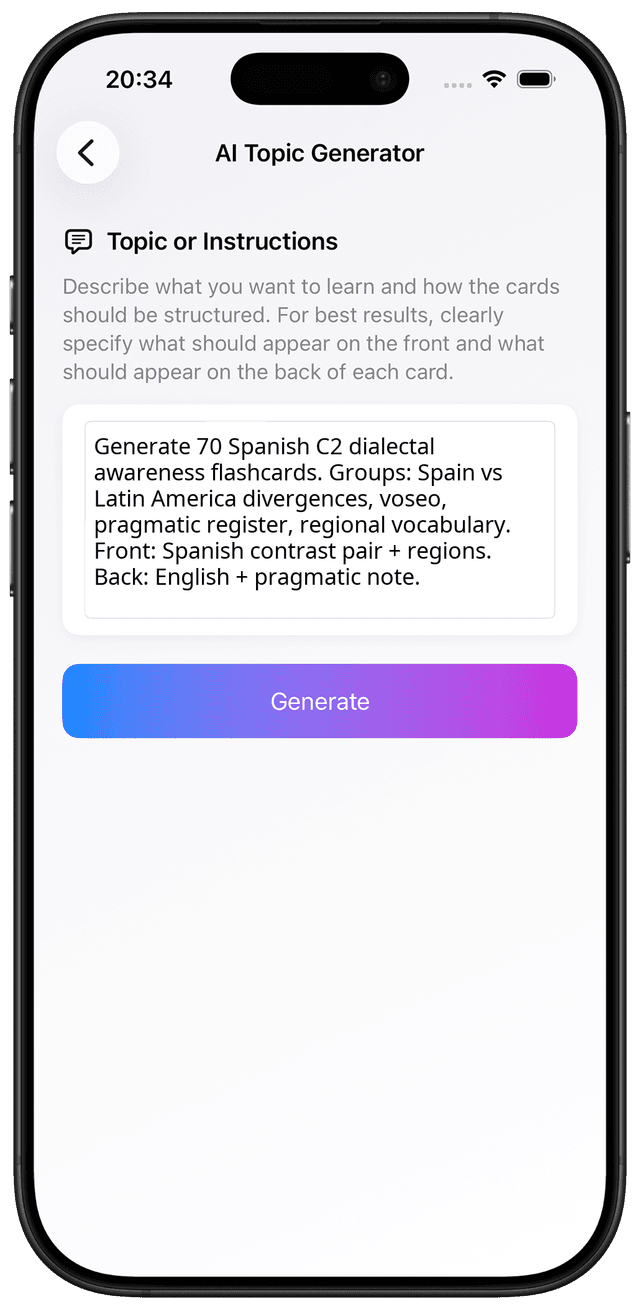
Generate 70 Spanish C2 dialectal awareness flashcards. Four groups: (1) Lexical divergences Spain vs Latin America: ordenador/computadora, coche/carro, piso/apartamento, zumo/jugo, patata/papa, coger (Spain neutral, offensive in Mexico). (2) Voseo and tuteo: vos tenés/tú tienes (Argentine vs Castilian), imperative forms: vení vs ven. (3) Pragmatic register differences: formal address usted vs vos in professional contexts by country. (4) Regional vocabulary: guagua (bus in Cuba, baby in Chile/Peru), coger (Spain), agarrar (Latin America), plata/dinero, chamba/trabajo. Front: Spanish contrast pair + region labels. Back: English equivalents + pragmatic usage note.
At C2 the vocabulary you are missing is less frequent and more context-dependent than at any earlier level. Spaced repetition is well suited to this: it surfaces the collocations and fixed phrases you keep forgetting more often and backs off the ones you know. You spend your review time where it actually matters.
C2 builds directly on C1. Use the links below to review the prerequisite level or return to the full Spanish guide.
Copy any prompt from this guide into MindCards and your first C2 deck is ready in seconds. No account needed. The app is free on iOS.