
Spaced Repetition Explained
Learn why spacing reviews is key to mastering Spanish A1 Vocabulary
The journey to fluency starts with a solid foundation. Spanish A1 vocabulary is not just a list of words; it is your survival kit. These core nouns, verbs, and phrases make up nearly 70% of daily conversation, forming the essential building blocks for everything you will ever say.
Crucially, A1 mastery is the bridge between "translating in your head" and actually speaking. While many beginners rely on phrasebooks, real progress happens when you internalize the high-frequency vocabulary that intermediate grammar requires. Without these essentials, you will find yourself stuck at the "tourist level" regardless of how much grammar you study or DELE-style beginner practice.
Many learners try to memorize long, dry lists of words - only to forget them by the next day. MindCards offers a smarter way to lock in the language. We use spaced repetition (SRS) to ensure you spend your time reviewing the words you struggle with, not just re-reading the ones you already know. Below, you will find our curated A1 guide and the AI prompts you can use to generate custom study decks in seconds.
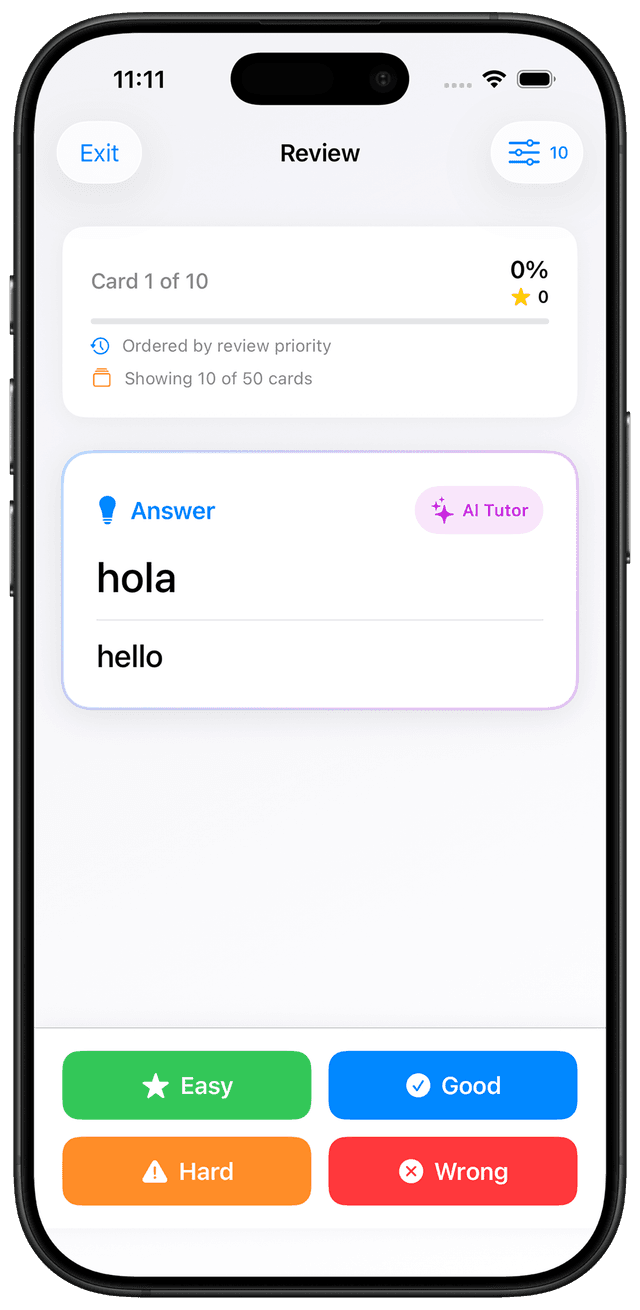
In Spanish, a handful of words do most of the heavy lifting. This phase focuses on the "super-verbs" (like Ser, Estar, and Tener) and the essential greetings that allow you to start any interaction with confidence.
Why start here? These words appear in almost every Spanish sentence. Mastering them early means you will recognize the "skeleton" of the language immediately.
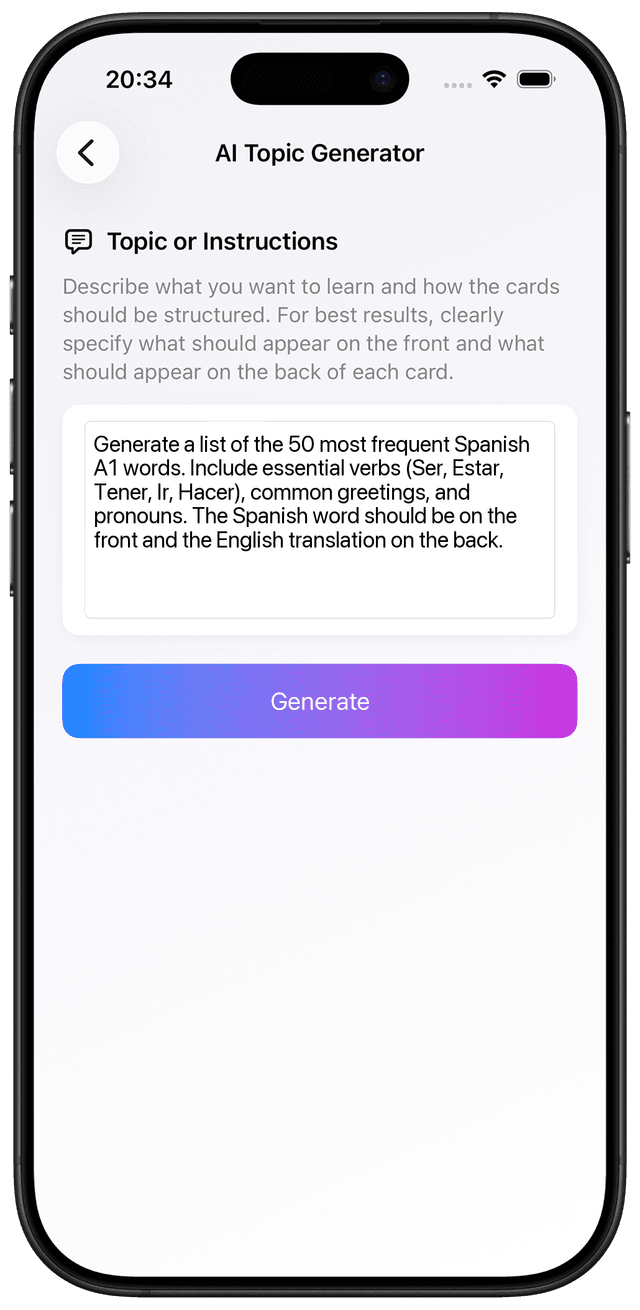
The Strategy: Click the prompt below to copy it, then paste it into the "AI Topic Generator" in the MindCards App. This will build a deck focusing on the most critical foundation words.
Generate a list of the 50 most frequent Spanish A1 words. Include essential verbs (Ser, Estar, Tener, Ir, Hacer), common greetings, and pronouns. The Spanish word should be on the front and the English translation on the back.
Once you have the verbs, you need things to talk about. This phase covers "survival nouns" - family, food, places, and time. Think practical items you see fast, like tortilla, paella, mercado, and estación. Crucially, this is where you practice noun gender (masculine vs. feminine).
Why learn this next? You cannot navigate a city or a menu without these. By learning the article (el/la) alongside the noun, you avoid the most common beginner mistakes later on.
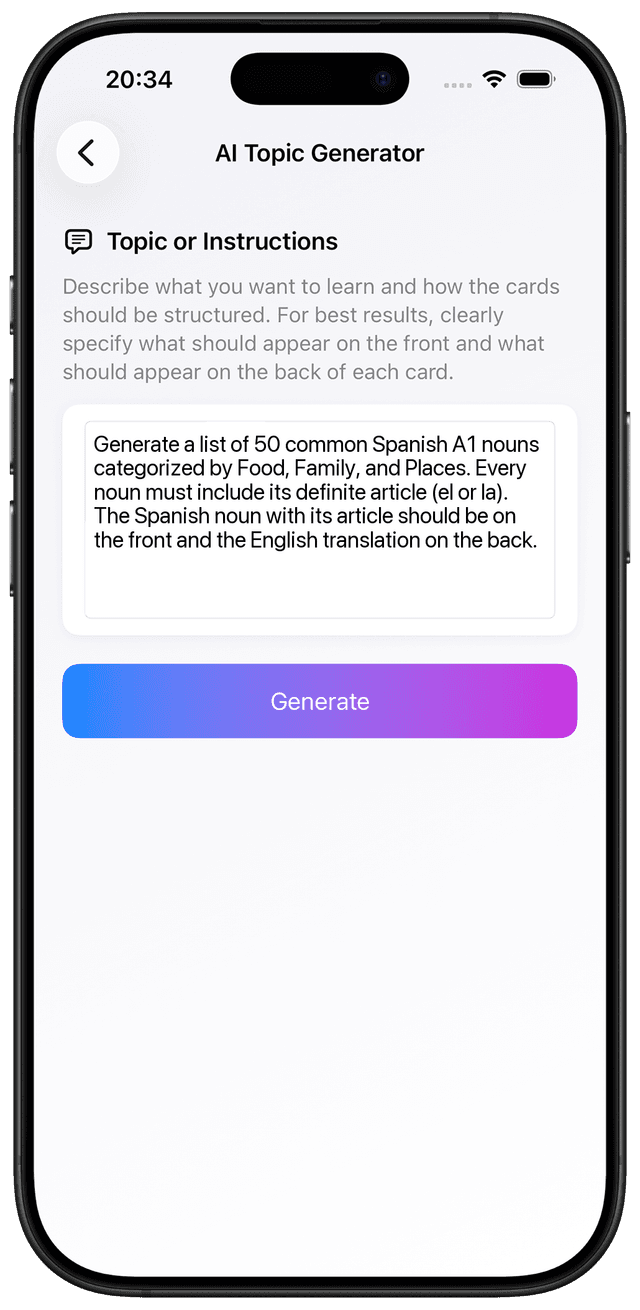
The Strategy: Use the prompt below to generate a deck of categorized nouns. MindCards will help you drill the gender of each word until it becomes second nature.
Generate a list of 50 common Spanish A1 nouns categorized by Food, Family, and Places. Include examples like tortilla, paella, mercado, and familia. Every noun must include its definite article (el or la). The Spanish noun with its article should be on the front and the English translation on the back.
This is where your Spanish starts to feel "real." By adding basic adjectives (colors, sizes, feelings) and connectors (and, but, because), you move from one-word answers to full, descriptive sentences.
Why learn this now? Adjectives allow you to express your needs and personality, while connectors are the "glue" that turns a list of words into a conversation.
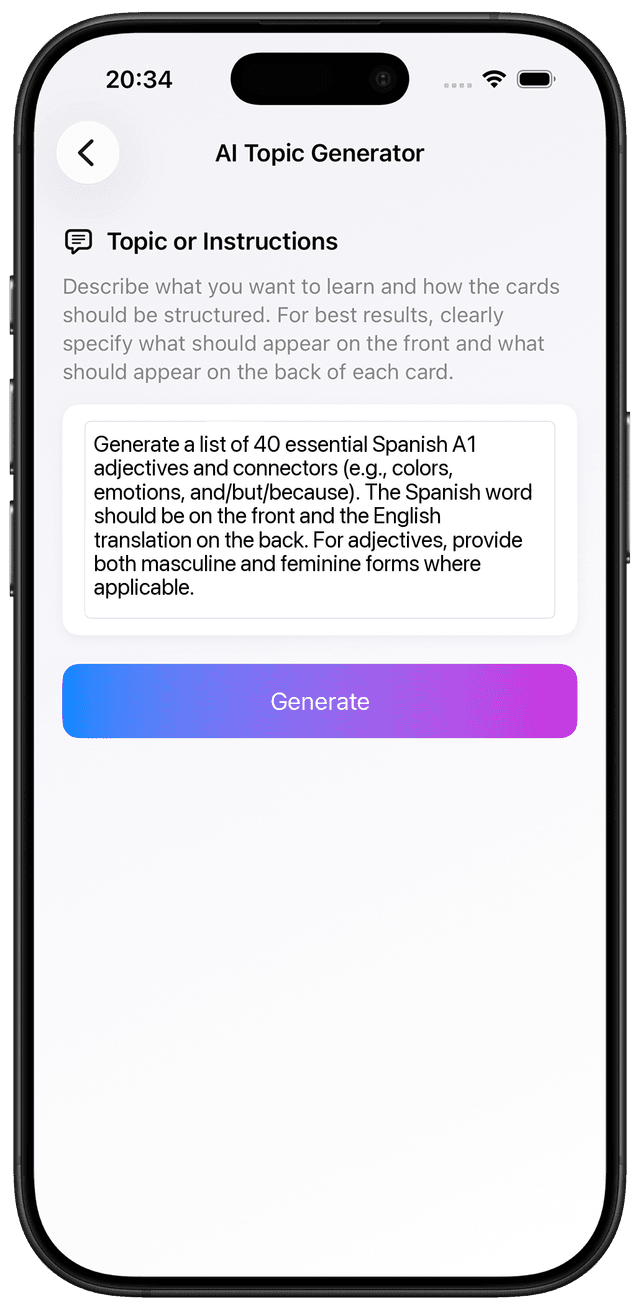
The Strategy: Copy this prompt to add flavor to your vocabulary. These words are essential for the phases ahead where we begin to describe your home, your job, and your world.
Generate a list of 40 essential Spanish A1 adjectives and connectors (e.g., colors, emotions, and/but/because). The Spanish word should be on the front and the English translation on the back. For adjectives, provide both masculine and feminine forms where applicable.
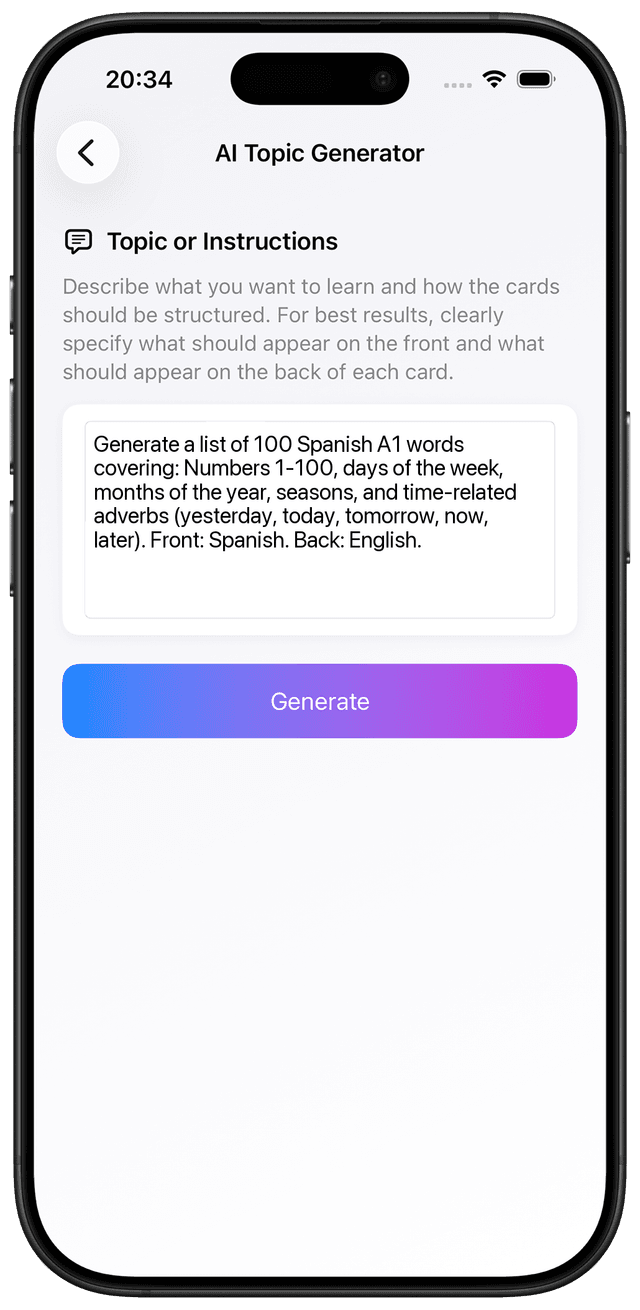
You cannot make plans if you cannot tell time. This phase moves beyond simple nouns and focuses on the numerical and temporal framework of the language - numbers, days, months, and seasons.
Why this is vital: This batch covers the "logic" of the calendar. It is how you book a hotel, set a meeting, or understand when a shop opens.
The Strategy: This prompt specifically asks for the chronological essentials.
Generate a list of 100 Spanish A1 words covering: Numbers 1-100, days of the week, months of the year, seasons, and time-related adverbs (yesterday, today, tomorrow, now, later). Front: Spanish. Back: English.
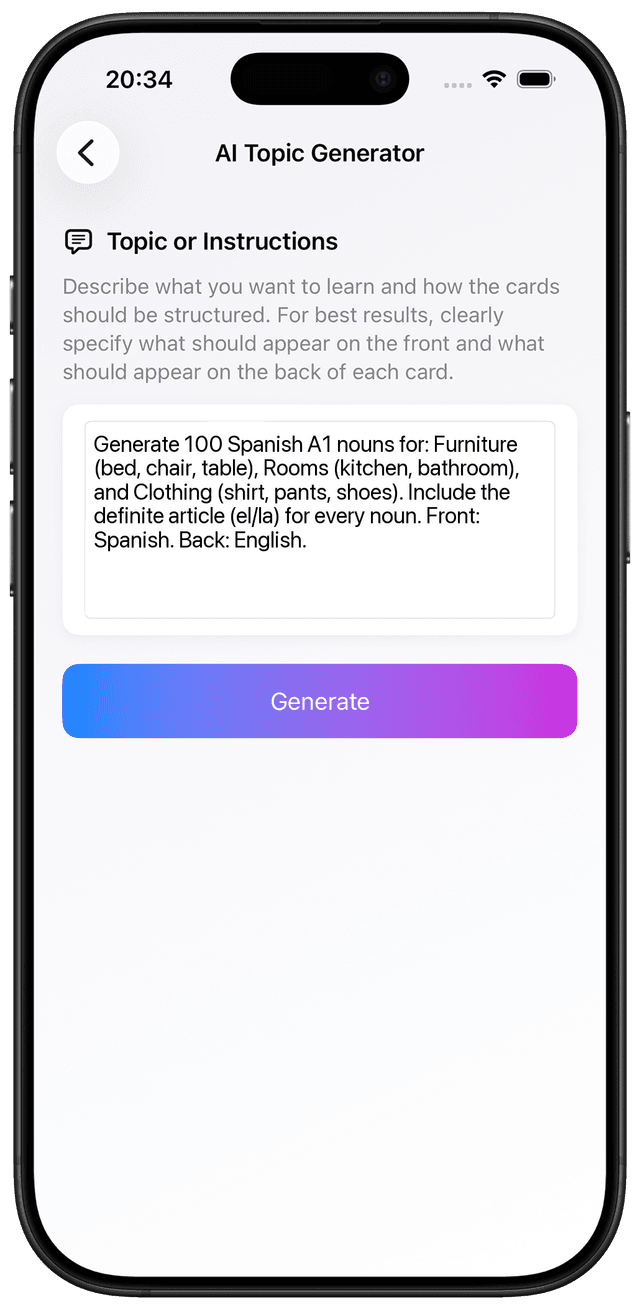
A1 fluency is about describing your immediate environment. This batch focuses on the items you interact with every day: the rooms in your house, your furniture, and the clothes you wear.
Why this comes next: Being able to describe your routine and your belongings is a core requirement for A1 speaking exams and daily comfort in a Spanish-speaking home.
Generate 100 Spanish A1 nouns for: Furniture (bed, chair, table), Rooms (kitchen, bathroom), and Clothing (shirt, pants, shoes). Include the definite article (el/la) for every noun. Front: Spanish. Back: English.
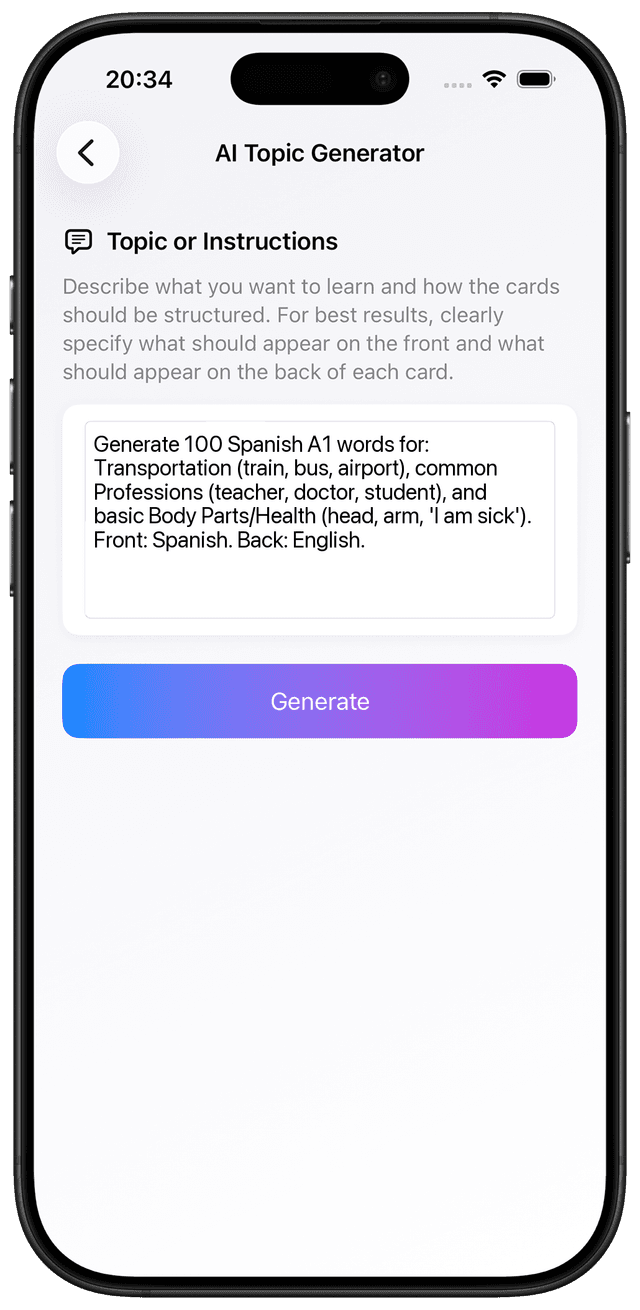
Now we expand your world. This phase covers how to get around, what people do for a living, and how to explain basic health needs - essential for real scenarios like buses, metro stations, and pharmacies.
The Goal: To give you the vocabulary to navigate a city, a doctor's office, or a job interview at a basic level.
Generate 100 Spanish A1 words for: Transportation (train, bus, airport), common Professions (teacher, doctor, student), and basic Body Parts/Health (head, arm, 'I am sick'). Front: Spanish. Back: English.
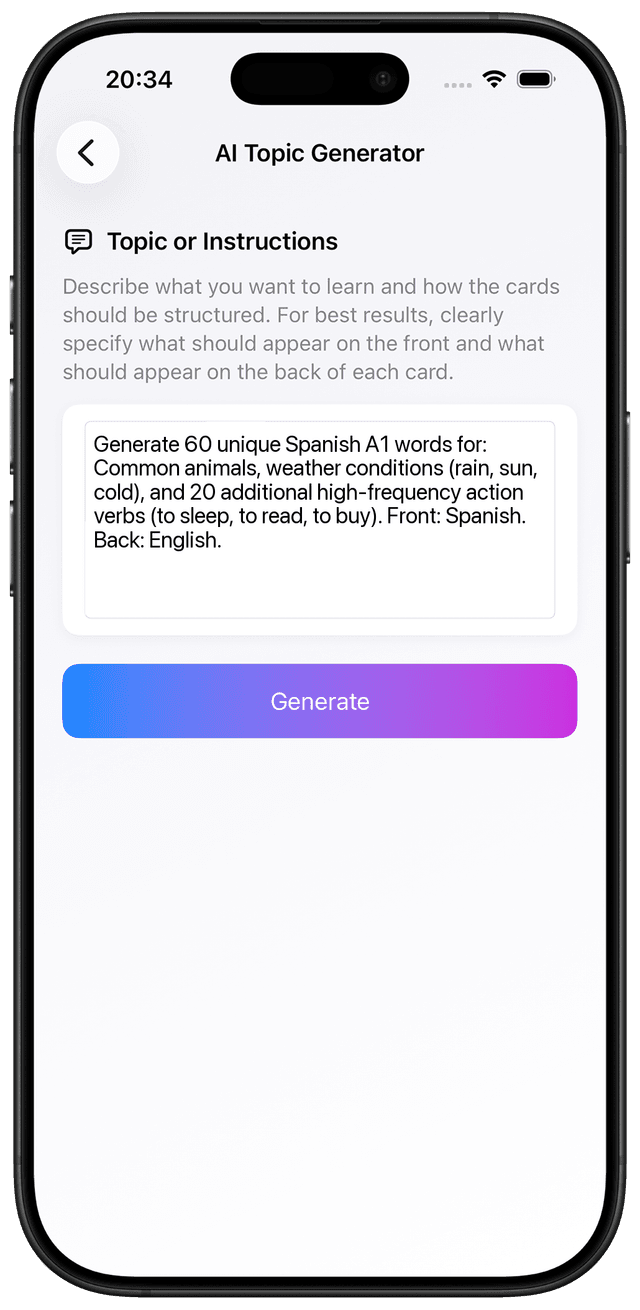
You are almost there. The final 60 words round out your vocabulary with common action verbs and the natural world around you (weather, animals, and geography).
The Milestone: Once these are in your MindCards deck, you have officially built a 500-word Spanish foundation.
Generate 60 unique Spanish A1 words for: Common animals, weather conditions (rain, sun, cold), and 20 additional high-frequency action verbs (to sleep, to read, to buy). Front: Spanish. Back: English.
MindCards uses scientifically-proven learning techniques to help you master Spanish A1 Vocabulary faster and remember it longer.
Once you have A1 locked in, A2 is where Spanish becomes conversational. Past tense, opinions, and social vocabulary are the next step.
Join hundreds of learners mastering Spanish with our free flashcard app. Start learning Spanish with flashcards, AI-powered generation, and smart spaced repetition. No account required!