
Spaced Repetition Explained
Why reviewing at the right interval is key to locking in Spanish A2 vocabulary
You have the A1 foundation. Now build something you can actually use. At A2, you gain the past tense, the ability to express opinions, and vocabulary for the situations you will actually face: shops, restaurants, transport, and making plans with people.
A2 covers roughly 1,000 words and structures, and not all carry the same weight. This guide focuses on the ones that appear again and again in everyday Spanish. Those are the words that turn broken sentences into actual conversation.
Each phase below comes with a ready-to-use AI prompt. Paste it into the MindCards app and it generates a custom flashcard deck in seconds. Spaced repetition then schedules each card just before you forget it, so you remember more with less review time.
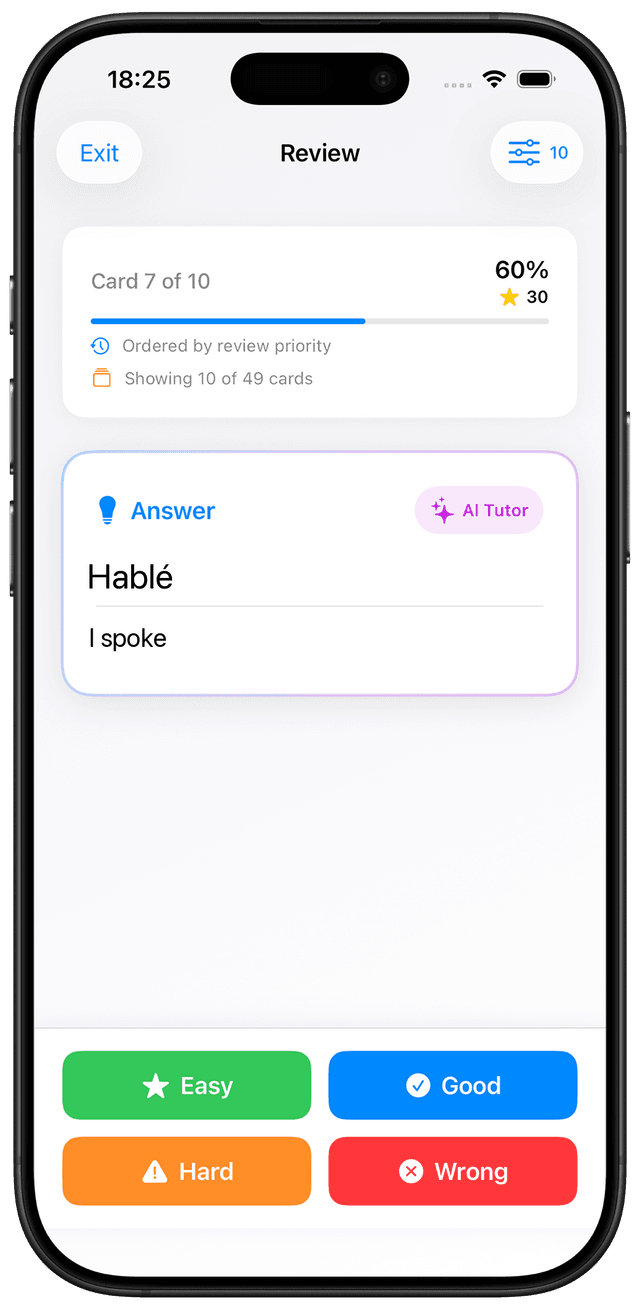
The single biggest jump from A1 to A2 is learning to talk about the past. The Pretérito Indefinido is how Spanish speakers describe completed actions: yesterday's dinner, last weekend's trip, a film you watched. Without it, you are stuck in the present.
Why start here? Past tense verbs unlock storytelling. Once you can say what happened, conversations stop being single exchanges and start becoming real dialogue.
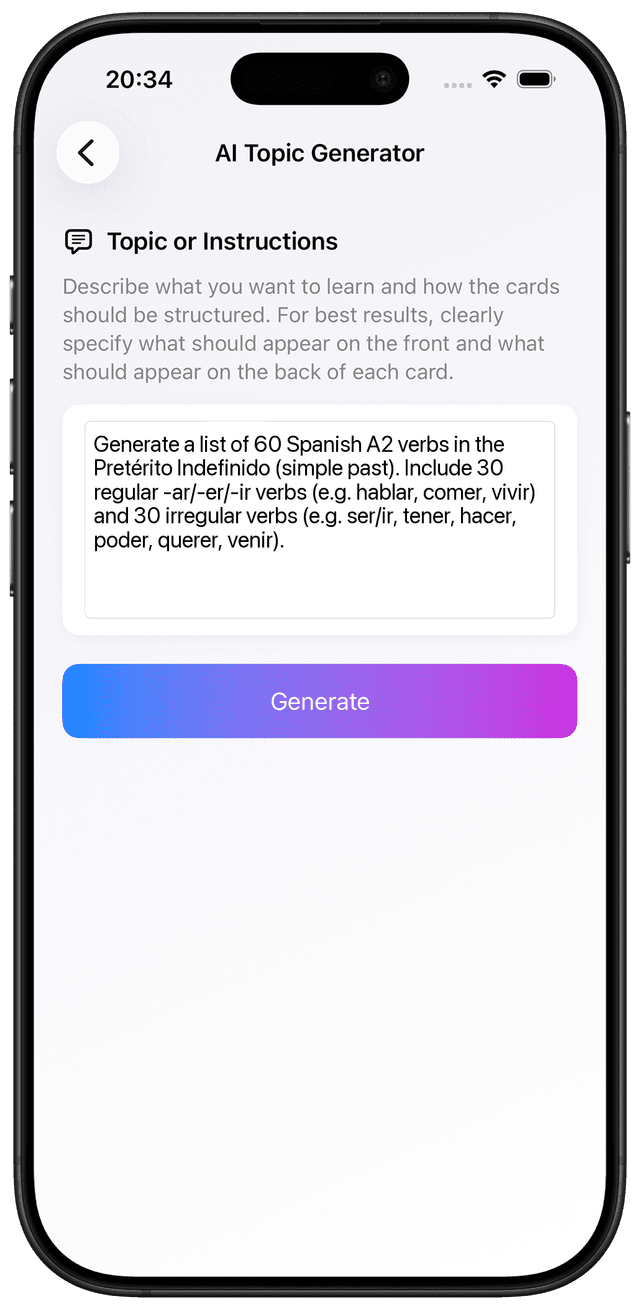
The Strategy: Click the prompt below to copy it, then paste it into the "AI Topic Generator" in the MindCards app. This deck focuses on high-frequency regular and irregular past tense verbs with example sentences on the back.
Generate a list of 60 Spanish A2 verbs in the Pretérito Indefinido (simple past). Include 30 regular -ar/-er/-ir verbs (e.g. hablar, comer, vivir) and 30 irregular verbs (e.g. ser/ir, tener, hacer, poder, querer, venir). Front: infinitive + yo-form past tense. Back: English meaning + a short example sentence in the past tense.
At A2 you are expected to express what you like, dislike, prefer, and think. The gustar structure has no direct English equivalent, and most learners avoid it for that exact reason. Drilling it early puts you ahead.
Why this matters: Opinion vocabulary powers everyday conversation. You will reach for these phrases constantly, whether recommending a restaurant or reacting to a film.
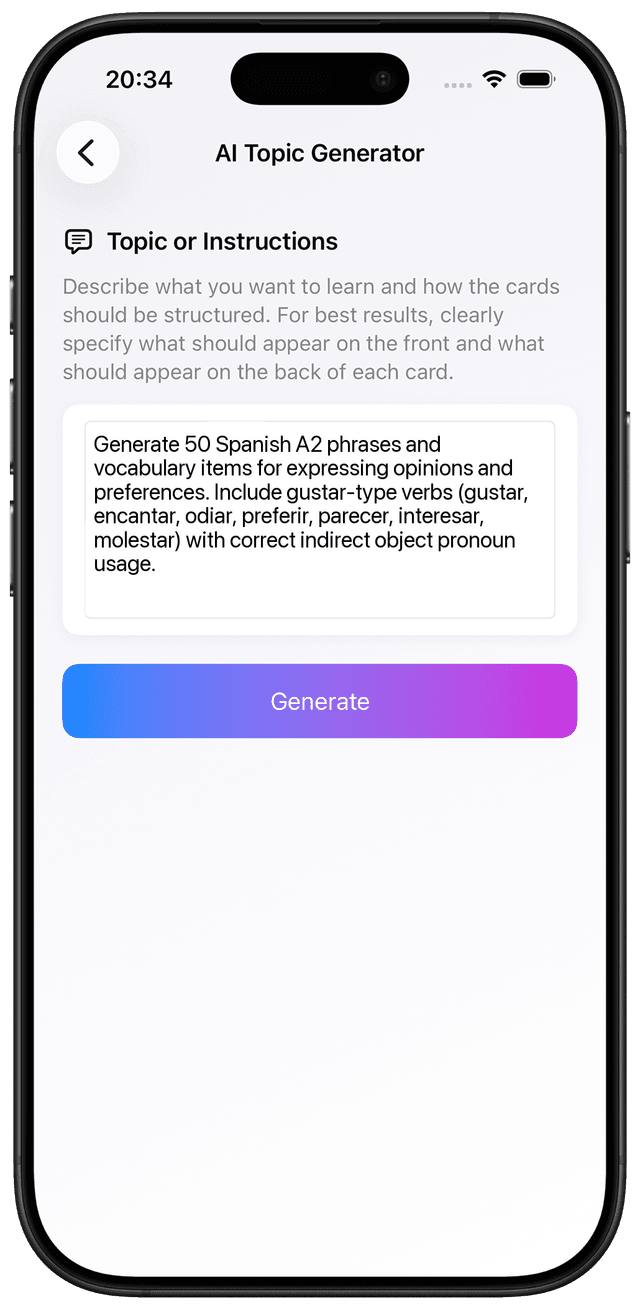
The Strategy: This prompt builds a deck around gustar-type verbs (encantar, odiar, preferir, parecer) alongside vocabulary for expressing agreement, disagreement, and uncertainty.
Generate 50 Spanish A2 phrases and vocabulary items for expressing opinions and preferences. Include gustar-type verbs (gustar, encantar, odiar, preferir, parecer, interesar, molestar) with correct indirect object pronoun usage. Also include agreement phrases (Estoy de acuerdo, Tienes razón) and disagreement phrases (No creo que..., En mi opinión...). Front: Spanish phrase. Back: English meaning + usage note.
How do you say something is better, cheaper, or the largest in the city? Comparatives and superlatives are short structures with a lot of practical value. They show up in menus, reviews, directions, and daily conversation.
Why add this now? After opinions (Phase 2), comparatives round out the ability to evaluate and recommend. Together they make your Spanish sound noticeably more natural.
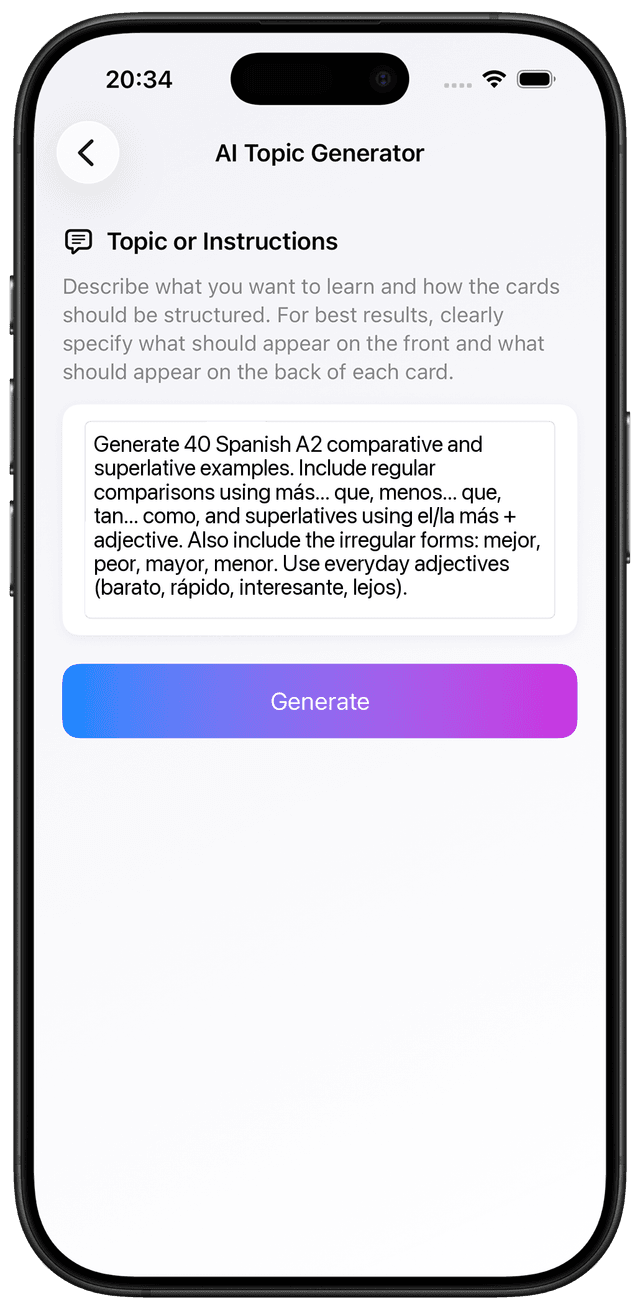
The Strategy: This deck covers the core comparison patterns (más... que, tan... como, menos... que) and the irregular forms (mejor, peor, mayor, menor) that come up regularly at A2 level.
Generate 40 Spanish A2 comparative and superlative examples. Include regular comparisons using más... que, menos... que, tan... como, and superlatives using el/la más + adjective. Also include the irregular forms: mejor, peor, mayor, menor. Use everyday adjectives (barato, rápido, interesante, lejos). Front: Spanish sentence. Back: English translation + pattern label.
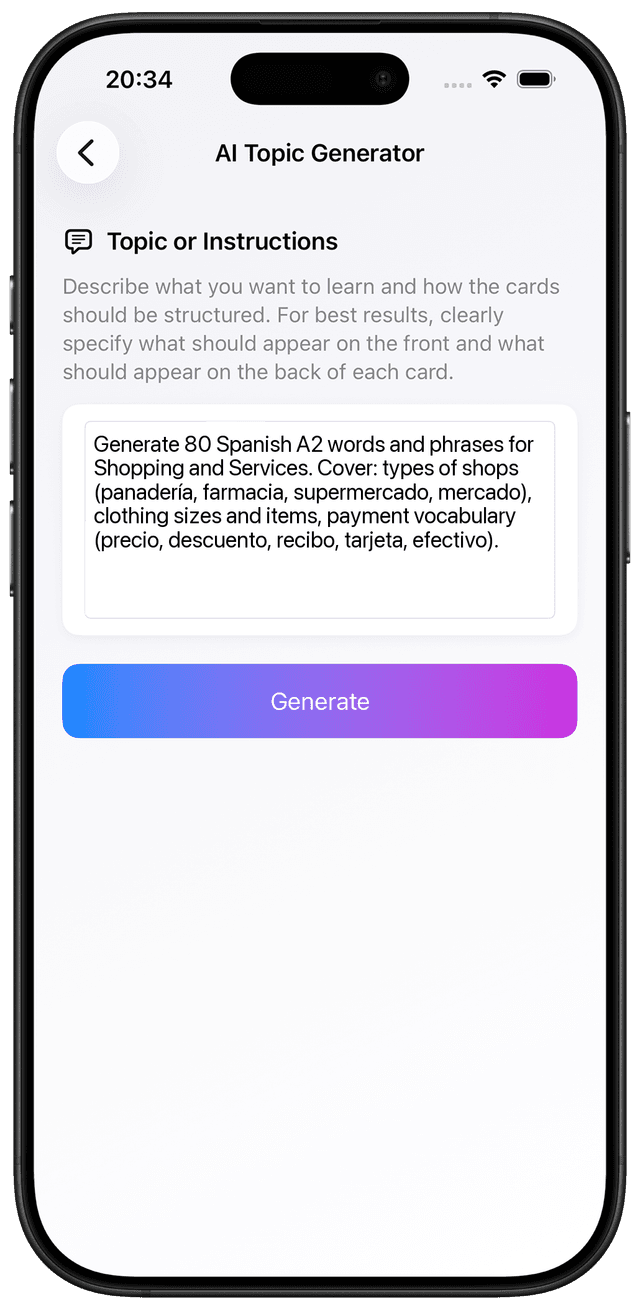
At A2, you should be able to handle real-world transactions: buying clothes, asking for the price, returning an item, visiting a pharmacy, or booking an appointment. This phase covers the practical vocabulary for all of those situations.
Why this is essential: Shopping and service vocabulary is tested directly in DELE A2 and is the kind of language you use from your first day in a Spanish-speaking country.
The Strategy: Copy this prompt to build a deck covering stores, products, payment vocabulary, and useful phrases for asking for help or a specific size.
Generate 80 Spanish A2 words and phrases for Shopping and Services. Cover: types of shops (panadería, farmacia, supermercado, mercado), clothing sizes and items, payment vocabulary (precio, descuento, recibo, tarjeta, efectivo), and service phrases (¿Cuánto cuesta?, ¿Tiene esto en azul?, Quisiera devolver esto). Front: Spanish. Back: English.
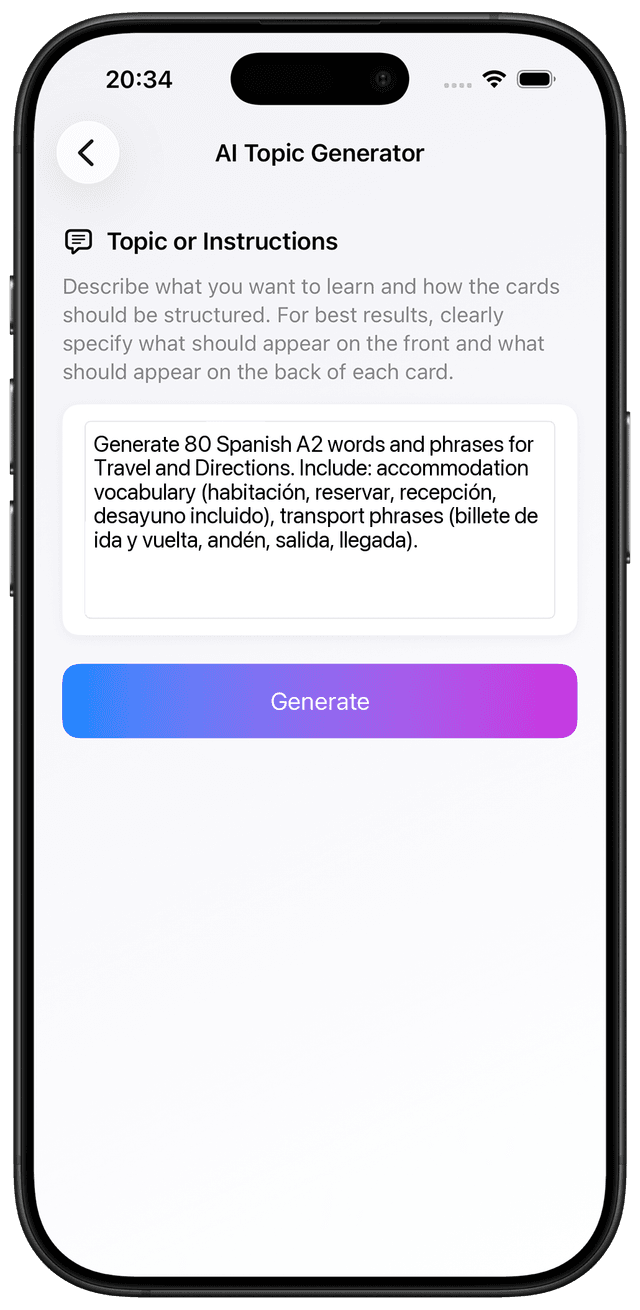
A2 travel vocabulary goes further than the A1 basics. You need to book accommodation, understand transport schedules, navigate a city, and sort out problems at the airport or train station, all in Spanish.
Why this comes next: Travel is one of the main reasons people learn Spanish. Build it early and you can handle real situations, from booking a room to sorting out a missed connection.
The Strategy: This deck combines key transport words with direction phrases and accommodation vocabulary into one practical batch.
Generate 80 Spanish A2 words and phrases for Travel and Directions. Include: accommodation vocabulary (habitación, reservar, recepción, desayuno incluido), transport phrases (billete de ida y vuelta, andén, salida, llegada), giving and understanding directions (Gira a la derecha, Sigue todo recto, Está a dos cuadras), and common travel problems (Mi equipaje se ha perdido, ¿Dónde está la parada de metro?). Front: Spanish. Back: English.
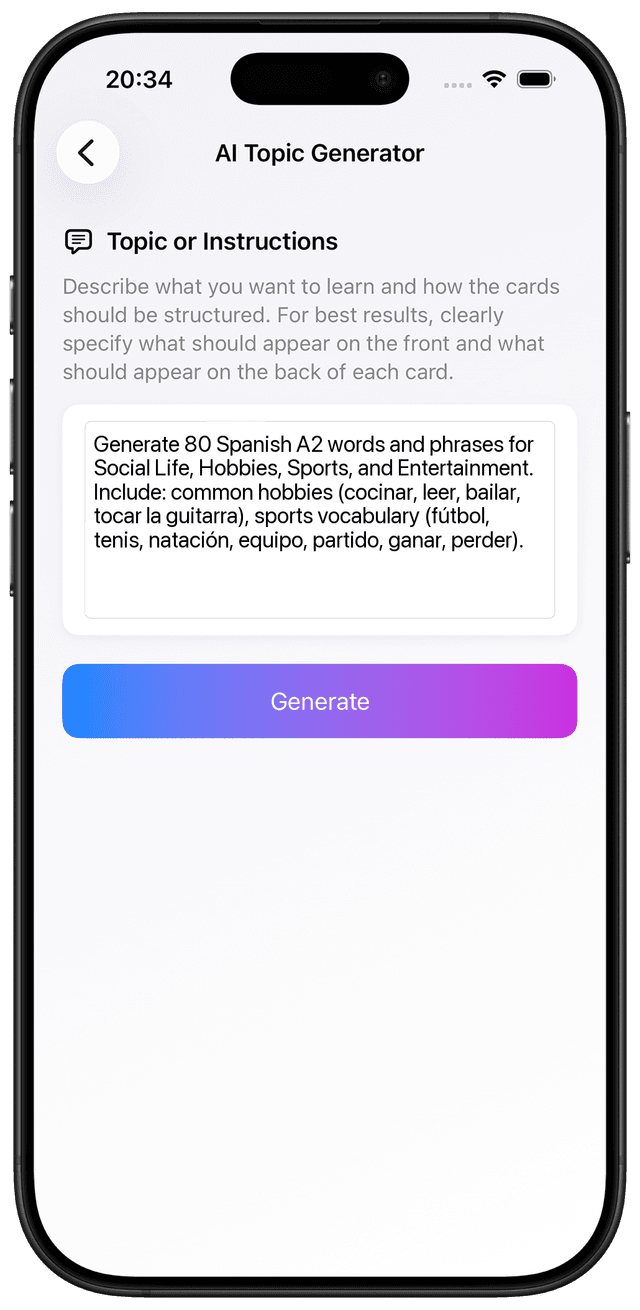
You can only talk about survival situations for so long. This phase covers what you actually want to talk about: free time, sport, and culture. Think películas, partidos de fútbol, música en vivo, and salir con amigos.
The Goal: To give you the vocabulary for real social conversations, the kind that actually builds friendships in a Spanish-speaking community.
Generate 80 Spanish A2 words and phrases for Social Life, Hobbies, Sports, and Entertainment. Include: common hobbies (cocinar, leer, bailar, tocar la guitarra), sports vocabulary (fútbol, tenis, natación, equipo, partido, ganar, perder), entertainment (concierto, película, exposición, entrada), and social phrases (¿Quedamos el sábado?, Me apetece mucho, ¿Has visto esta serie?). Front: Spanish. Back: English.
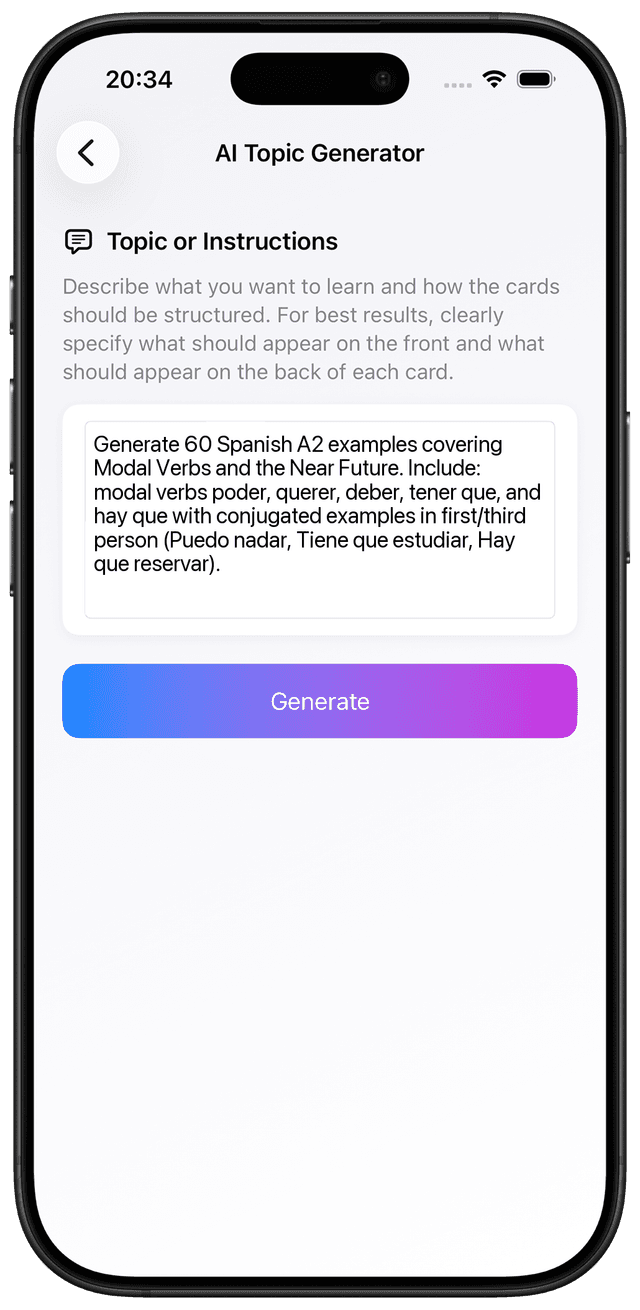
The final A2 phase moves from the past to future plans. Modal verbs (poder, querer, deber, tener que) let you express ability, desire, and obligation. The near future tense (ir + a + infinitive) is the most natural way to talk about what you are going to do, and Spanish speakers use it all the time.
The Milestone: With this deck, your A2 vocabulary toolkit is complete. You can now describe past events, express opinions, make comparisons, and handle real-world situations. That covers the full A2 communicative range.
Generate 60 Spanish A2 examples covering Modal Verbs and the Near Future. Include: modal verbs poder, querer, deber, tener que, and hay que with conjugated examples in first/third person (Puedo nadar, Tiene que estudiar, Hay que reservar). Include 20 near-future sentences using ir + a + infinitive (Voy a viajar a México el mes que viene). Front: Spanish sentence. Back: English translation + grammar note (modal or near future).
MindCards uses spaced repetition and active recall, two research-backed techniques, to help you retain A2 vocabulary faster and for longer.
A2 vocabulary sits between A1 foundations and B1 fluency. Use the links below to move between levels or return to the full Spanish guide.
Join hundreds of learners building their Spanish with spaced repetition and AI-powered vocabulary generation. No account needed. Download and start your first A2 deck.