
Spaced repetition explained
Why reviewing at the right interval is the key to locking in advanced Spanish vocabulary
You have B1. You can hold a conversation, navigate work situations, and read a news article with effort. B2 is where that effort drops significantly. Sentences that used to require active decoding start arriving whole. You stop translating and start thinking in Spanish.
B2 covers roughly 4,000 words in total. This guide focuses on the 1,000+ that actually move the needle: the past subjunctive for hypotheticals and formal speech, advanced connectors for argumentation, academic writing registers, social vocabulary for opinion tasks, collocations for natural speech, and media vocabulary for authentic comprehension.
Each of the seven phases below includes a ready-to-use AI prompt. Paste it into the MindCards app and it generates a custom flashcard deck in seconds. Spaced repetition then schedules each card at the right interval, so you retain more with less time reviewing.
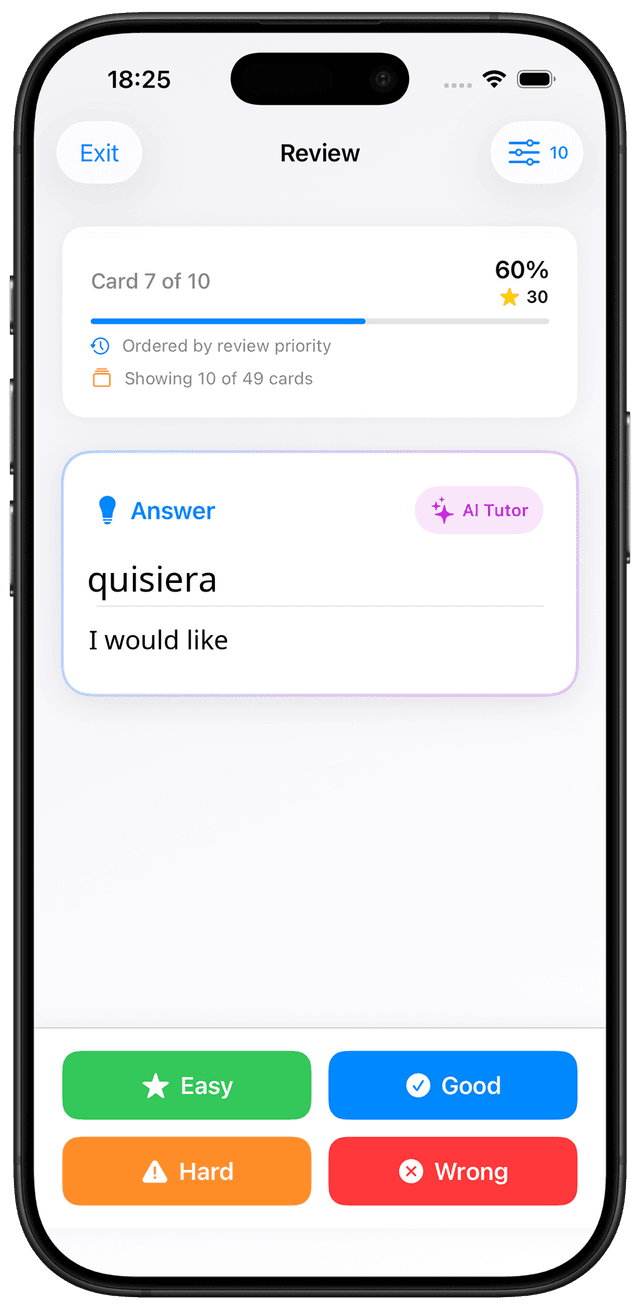
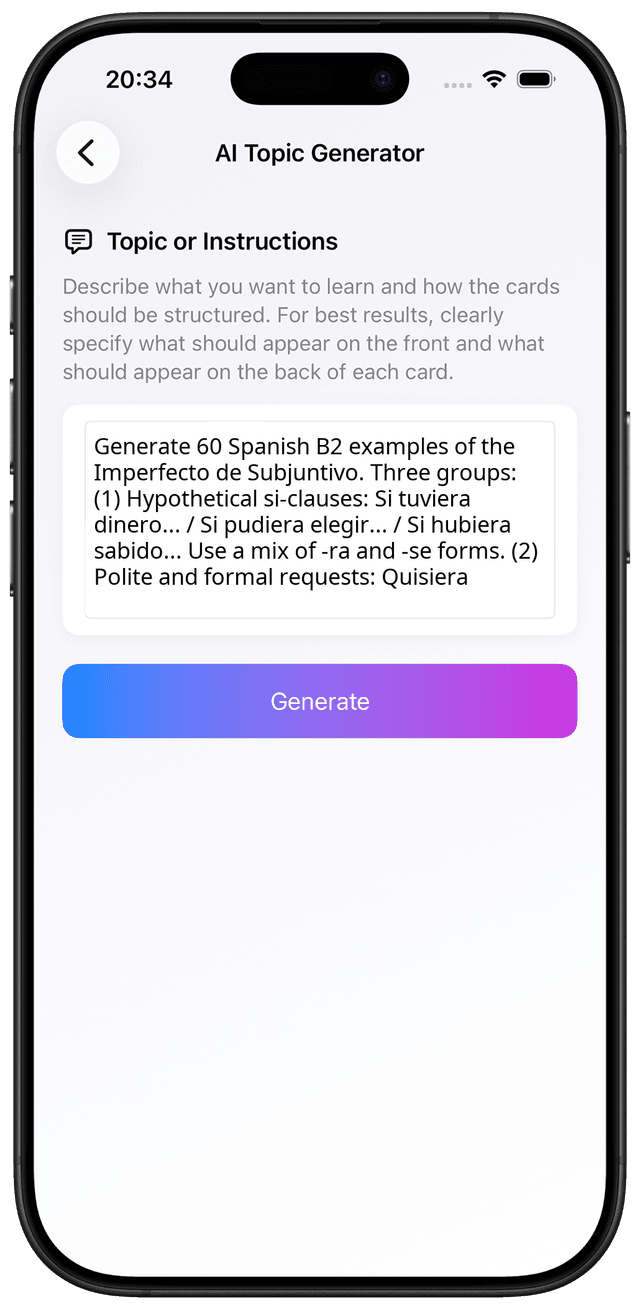
You know the present subjunctive from B1. At B2 the past subjunctive (hablara, comiera, viviera) opens up a new layer of the language: hypothetical conditions, formal reported speech, and polite requests with a distancing effect. It appears constantly in written Spanish and in formal spoken registers.
Why start here? The imperfecto de subjuntivo is the gateway to complex sentences in Spanish. Si pudiera viajar... (if I could travel), quisiera que... (I would like that...), and reported speech structures all depend on it. Once you have the pattern, sentences that seemed incomprehensible start making sense.
The strategy: Copy this prompt into the MindCards AI Topic Generator. The deck focuses on the three most common uses so you absorb the pattern through real examples rather than abstract conjugation drills.
Generate 60 Spanish B2 examples of the Imperfecto de Subjuntivo. Three groups: (1) Hypothetical si-clauses: Si tuviera dinero... / Si pudiera elegir... / Si hubiera sabido... Use a mix of -ra and -se forms. (2) Polite and formal requests: Quisiera reservar..., Me gustaría que usted..., Sería conveniente que... (3) Reported speech with past main verb: Dijo que viniera, Pidió que lo hicieran, Esperaba que llegara. Front: Spanish sentence. Back: English translation + usage label.
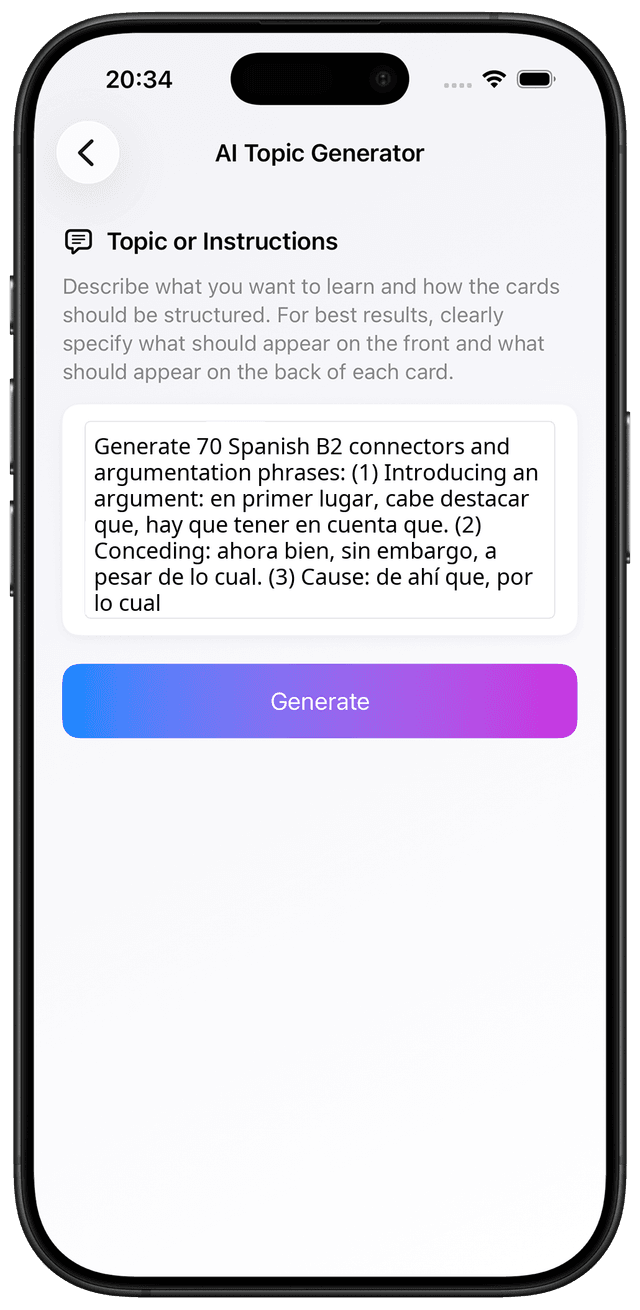
B2 writing and speaking tasks require you to build arguments, not just describe situations. That means knowing how to introduce a claim, concede a counter-argument, draw a conclusion, and signal your reasoning precisely. The connectors at this level go well beyond B1 basics.
Why this matters: DELE B2 essay and letter tasks are scored partly on cohesion. Examiners can tell immediately whether a candidate controls these structures or is improvising. This deck covers the connectors that appear in Spanish journalism, academic writing, and formal debate.
The strategy: Each card pairs the connector with an example sentence so you learn the word in context, not in isolation.
Generate 70 Spanish B2 connectors and argumentation phrases in five groups: (1) Introducing and developing an argument: en primer lugar, cabe destacar que, hay que tener en cuenta que, conviene subrayar que. (2) Conceding and contrasting: ahora bien, sin embargo, a pesar de lo cual, no obstante, aun así. (3) Cause and consequence: de ahí que (+ subjunctive), por lo cual, dado que, puesto que, en vista de que. (4) Examples and reformulation: a modo de ejemplo, esto es, en otras palabras, dicho de otro modo. (5) Conclusion: en definitiva, en resumen, a modo de conclusión, todo apunta a que. Front: connector + example sentence. Back: English equivalent + function label.
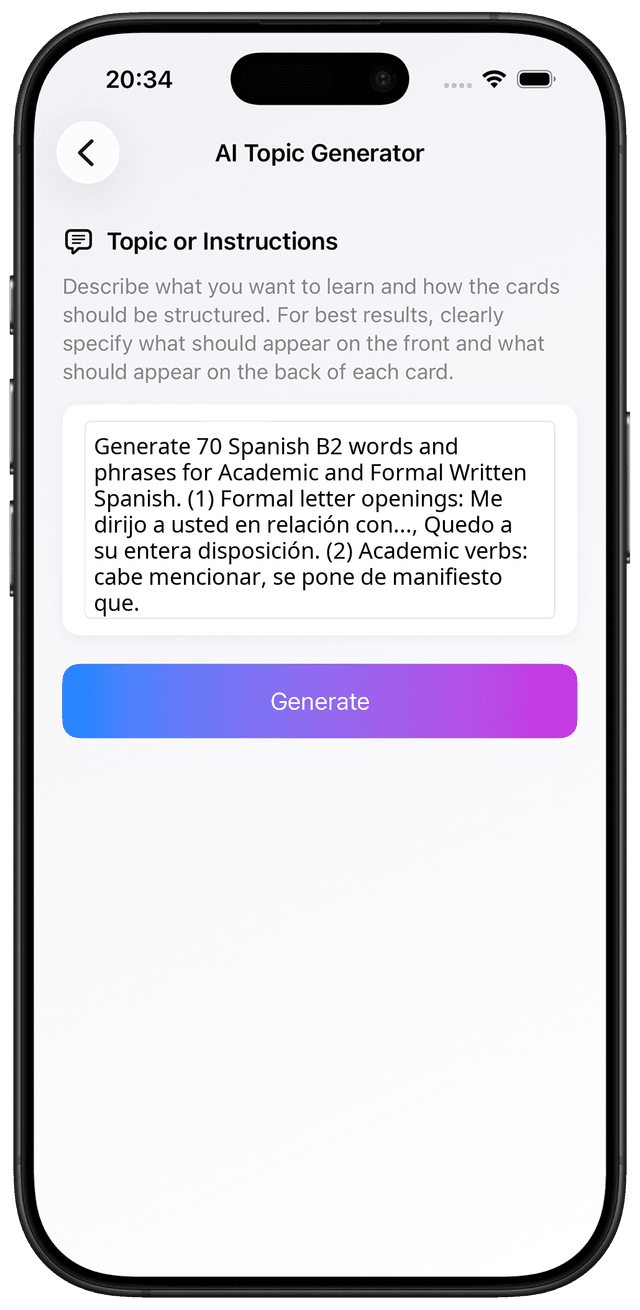
At B2 the written register matters. Formal emails, reports, essays, and letters follow conventions that differ sharply from spoken Spanish. Phrases you would never say aloud appear constantly in formal writing, and knowing which ones to use matters.
Why add this now? If you are preparing for DELE B2 or planning to work in a Spanish-speaking professional environment, formal writing is non-negotiable. This phase gives you the stock phrases that appear in formal correspondence, academic prose, and business documents.
The strategy: This deck covers formal opening and closing formulas, academic verbs (señalar, afirmar, cuestionar, analizar), and register-appropriate alternatives to colloquial phrasing.
Generate 70 Spanish B2 words and phrases for Academic and Formal Written Spanish. Four groups: (1) Formal letter openings and closings: Me dirijo a usted en relación con..., En respuesta a su carta de fecha..., Quedo a su entera disposición, En espera de sus noticias, Le saluda atentamente. (2) Academic verbs and phrases: cabe mencionar, cabe preguntarse si, se pone de manifiesto que, resulta evidente que, plantear una hipótesis. (3) Register-shift pairs: quiero decir -> deseo expresar, pero -> no obstante, creo -> considero, mucha gente -> un gran número de personas. (4) Hedging and qualification: al parecer, según fuentes fiables, en cierta medida, con ciertos matices. Front: Spanish phrase. Back: English + register label.
DELE B2 oral tasks require you to discuss social and cultural topics: the role of technology, environmental concerns, work-life balance, globalisation, education, and more. You need vocabulary that lets you state a position, acknowledge complexity, and defend a view under pressure.
Why this is essential: Many learners stall at B1 because they have the grammar but not the content vocabulary to say anything interesting. This phase covers the social and cultural vocabulary that appears in Spanish-language interviews, opinion columns, and debates.
The strategy: The deck covers topic vocabulary across four high-frequency B2 themes, plus opinion phrases that go beyond the B1 basics (en mi opinión, creo que).
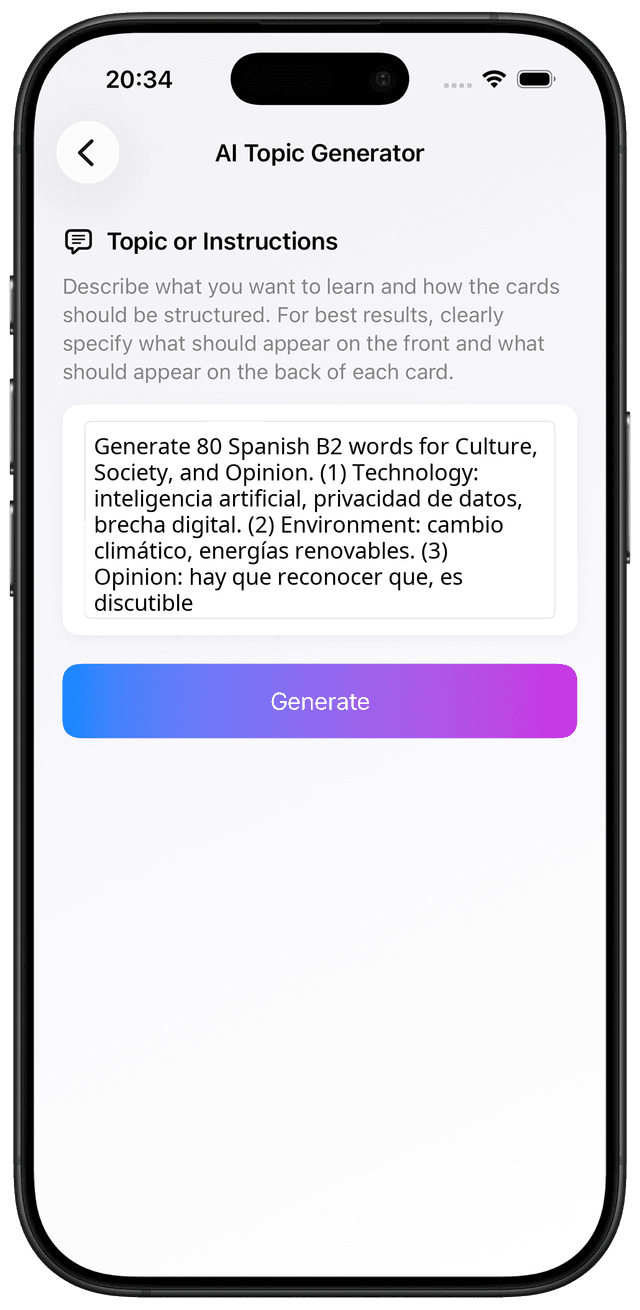
Generate 80 Spanish B2 words and phrases for Culture, Society, and Opinion. Four themes: (1) Technology and society: inteligencia artificial, privacidad de datos, redes sociales, dependencia tecnológica, brecha digital, desinformación. (2) Environment: cambio climático, huella de carbono, energías renovables, residuos, consumo responsable, sostenibilidad. (3) Education and work: conciliación laboral, brecha salarial, teletrabajo, formación continua, mercado laboral. (4) Opinion and nuance: desde mi punto de vista, hay que reconocer que, es discutible si, no cabe duda de que, me parece cuestionable que. Front: Spanish. Back: English + theme label.
Native speakers do not speak in textbook Spanish. They use set phrases, collocations (word pairings that feel natural), and idioms that no amount of grammar study prepares you for. At B2 your vocabulary needs to include these patterns or you will sound unnaturally formal even when you are trying to be casual.
The goal: To close the gap between textbook Spanish and the Spanish you actually hear in films, podcasts, and conversations. This phase builds collocations (tomar una decisión, prestar atención, cometer un error) and common idioms alongside their contexts.
The strategy: Each card shows the phrase in a sentence so you learn the collocation in use, not as an isolated pair. This is how native speakers actually store these patterns in memory.
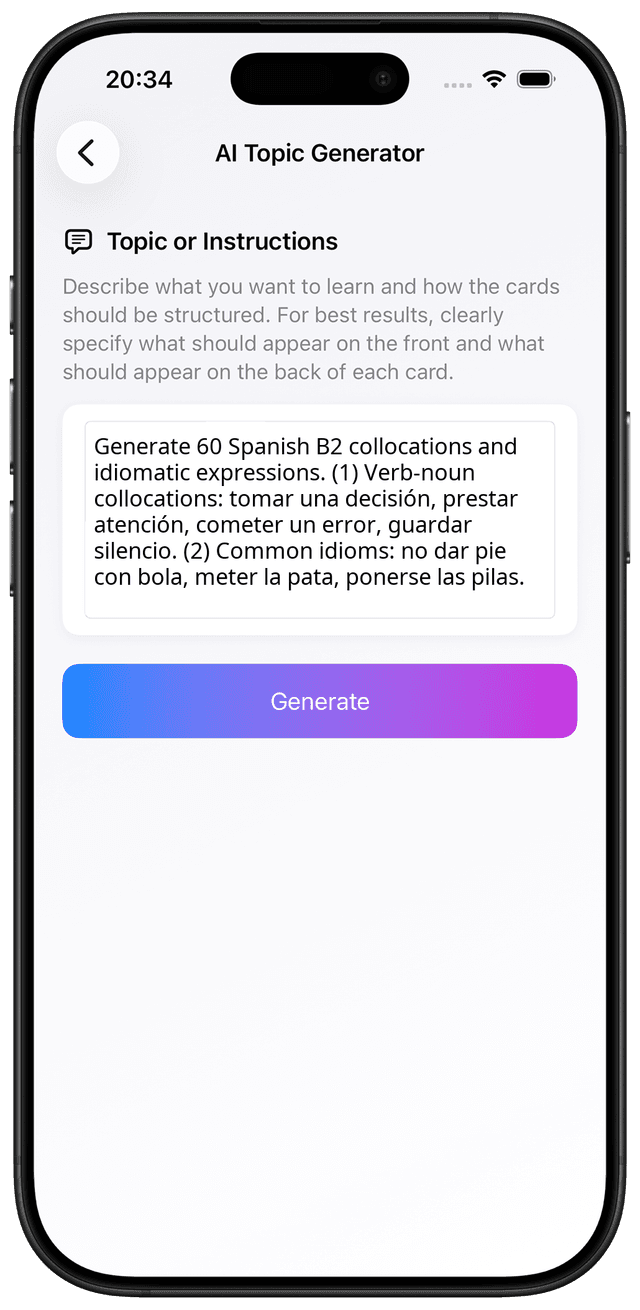
Generate 60 Spanish B2 collocations and idiomatic expressions in three groups: (1) High-frequency verb-noun collocations: tomar una decisión, prestar atención, cometer un error, guardar silencio, poner en práctica, tener en cuenta, llevar a cabo, dar lugar a. (2) Common idioms with meaning and example: no dar pie con bola, meter la pata, ponerse las pilas, tener manga ancha, hacer la vista gorda. (3) Register-aware phrases for spoken B2: o sea (spoken filler + formal equivalent), a ver (discourse opener), la verdad es que, eso depende de, en plan (informal). Front: Spanish phrase + example sentence. Back: English meaning + register note.
At B2 you should be able to follow a Spanish radio documentary, read an opinion piece in El Pais, and understand a podcast on a topic you care about without constant dictionary look-ups. The vocabulary gap that blocks this is usually not grammar, it is exposure to the specific lexical fields that appear in Spanish-language media.
The goal: To give you enough domain vocabulary in politics, economics, and culture that authentic media becomes accessible rather than exhausting. Once you hit this threshold, your Spanish grows faster because you can learn directly from native content.
The strategy: This deck covers vocabulary from three authentic media registers that B2 learners encounter most: political news, economic reporting, and cultural commentary.
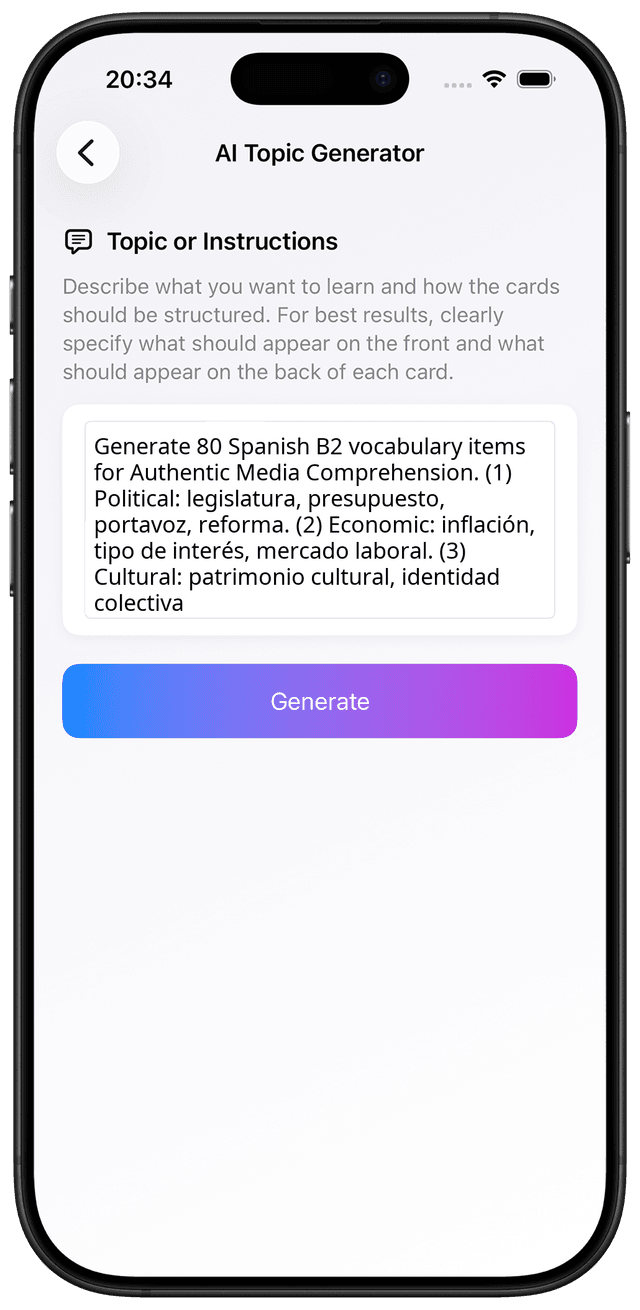
Generate 80 Spanish B2 vocabulary items for Authentic Media Comprehension. Three registers: (1) Political and institutional language: legislatura, escrutinio, presupuesto, debate parlamentario, portavoz, reforma, propuesta de ley, voto de confianza. (2) Economic reporting: inflación, tipo de interés, mercado laboral, desempleo, crecimiento del PIB, inversión extranjera, recesión, prima de riesgo. (3) Cultural and social commentary: patrimonio cultural, identidad colectiva, diversidad lingüística, tendencia, brecha generacional, fenómeno social. Front: Spanish term + example sentence from news context. Back: English equivalent.
At B2 you can handle most real-world situations in Spanish. The final phase covers the grammar structures that separate B2 from B1: the perfect subjunctive, passive voice with ser and estar, impersonal constructions, and complex relative clauses with subjunctive.
The milestone: With this deck, your B2 vocabulary and grammar set is complete. You now have the past subjunctive for hypotheticals, advanced connectors for argumentation, formal writing phrases for professional contexts, social vocabulary for opinion tasks, collocations for natural speech, and media vocabulary for authentic comprehension. That is the full B2 communicative range for DELE and real-world use.
Looking ahead: C1 builds on exactly these foundations, adding more idiomatic range and finer genre control. Every card you lock in at B2 makes C1 measurably easier.
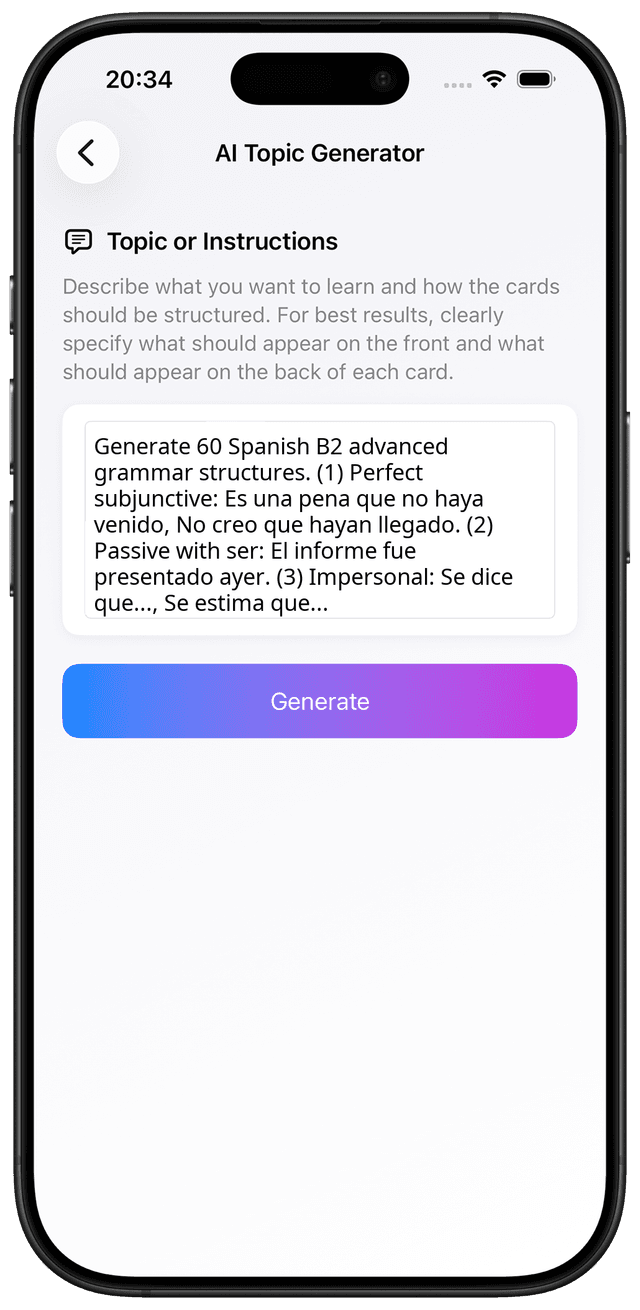
Generate 60 Spanish B2 advanced grammar structures as example sentences. Five groups: (1) Perfect subjunctive: Es una pena que no haya venido, Espero que lo hayas terminado, No creo que hayan llegado todavía. (2) Passive with ser: El informe fue presentado ayer, Los cambios serán aprobados por el comité. (3) Impersonal constructions: Se dice que..., Se ha comprobado que..., Se estima que... (4) Complex relative clauses with subjunctive: Busco a alguien que sepa programar, No hay nada que me preocupe, El primero que llegue recibirá el premio. (5) Indirect style with mood changes: Me dijo que viniera (vs. Me dijo que viene). Front: Spanish sentence. Back: English + structure label.
At B2 the vocabulary is less predictable than A1-B1 core words. Spaced repetition handles this well: cards you find difficult appear more often, cards you know well drop back. You spend time where it counts.
B2 builds on B1 and prepares you for C1. Use the links below to move between levels or return to the full Spanish guide.
Join hundreds of learners building advanced Spanish with spaced repetition and AI-powered vocabulary generation. No account needed. Download and start your first B2 deck today.