
Spaced repetition explained
Why reviewing at the right interval is the key to locking in advanced Spanish vocabulary
You have B2. You can read opinion pieces, write formal essays, and hold your own in professional conversations. C1 is where fluency becomes real. The effort of processing Spanish drops away, register switches become automatic, and the language starts to feel like a tool you own rather than a system you are navigating.
C1 covers roughly 5,000 words in total. This guide focuses on the 1,200+ that move the needle at this level. That means register mastery across formal, neutral, and colloquial Spanish; nuanced argumentation vocabulary for DELE oral and written tasks; literary and cultural references; idiomatic precision; and the advanced subjunctive uses that give your prose texture.
Each of the seven phases below includes a ready-to-use AI prompt. Copy it into the MindCards app and it generates a custom flashcard deck in seconds. Spaced repetition then schedules each card at the right interval, so you retain more with less review time.
At C1 you already have the grammar. What separates you from a near-native speaker is control over register. Spanish has sharp differences between the way educated adults speak in formal contexts, the neutral register of quality journalism, and the casual speech of everyday conversation. Switching between them correctly is what makes you sound fluent rather than just accurate.
Why start here? Register errors are the most visible sign of a learner at this level. Mixing formal verbs with colloquial connectors, or using textbook phrasing in casual conversation, signals non-native status immediately. This phase builds your awareness of the three registers and your active vocabulary in each.
The strategy: Each card presents a word or phrase with its register label. You learn the formal, neutral, and colloquial alternatives for the same concept, so you can choose correctly in any situation.
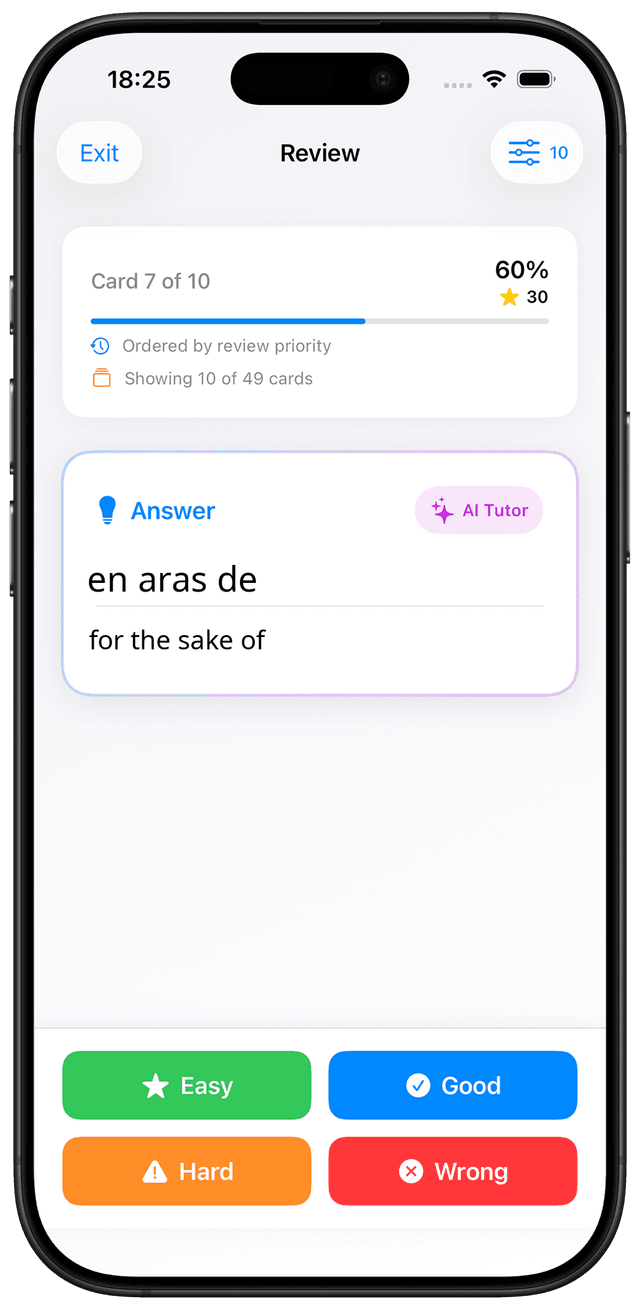
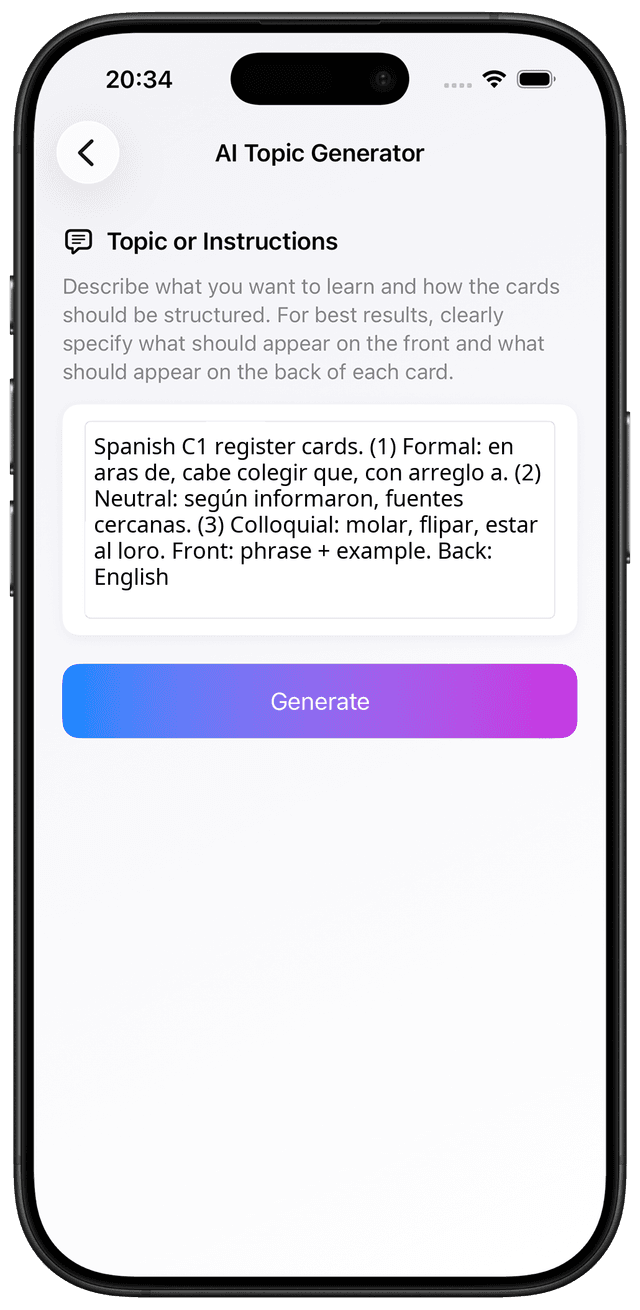
Generate 60 Spanish C1 register contrast flashcards in three groups: (1) Formal/written register: en aras de, cabe colegir que, con arreglo a, a tenor de lo expuesto, en lo que atañe a. (2) Neutral/journalistic: según informaron, en declaraciones a, fuentes cercanas afirman, se estima que. (3) Colloquial/spoken: molar, flipar, estar al loro, liarse, qué rollo, no hay manera. Front: word or phrase + example sentence in context. Back: English meaning + register label (formal/neutral/colloquial).
B2 argumentation gives you the basic connectors. At C1 the task is precision: knowing when to concede a point without losing ground, how to qualify a claim so it survives scrutiny, and how to refute a position without sounding blunt. DELE C1 oral and written tasks reward this kind of rhetorical sophistication.
Why this matters: C1 exam tasks in Spanish ask you to evaluate competing positions, present a balanced view, and defend your perspective under pressure. The vocabulary in this phase is what separates a B2 answer from a C1 one.
The strategy: Cards are grouped by rhetorical function so you build a toolkit you can apply across any topic, not just memorized phrases tied to one subject.
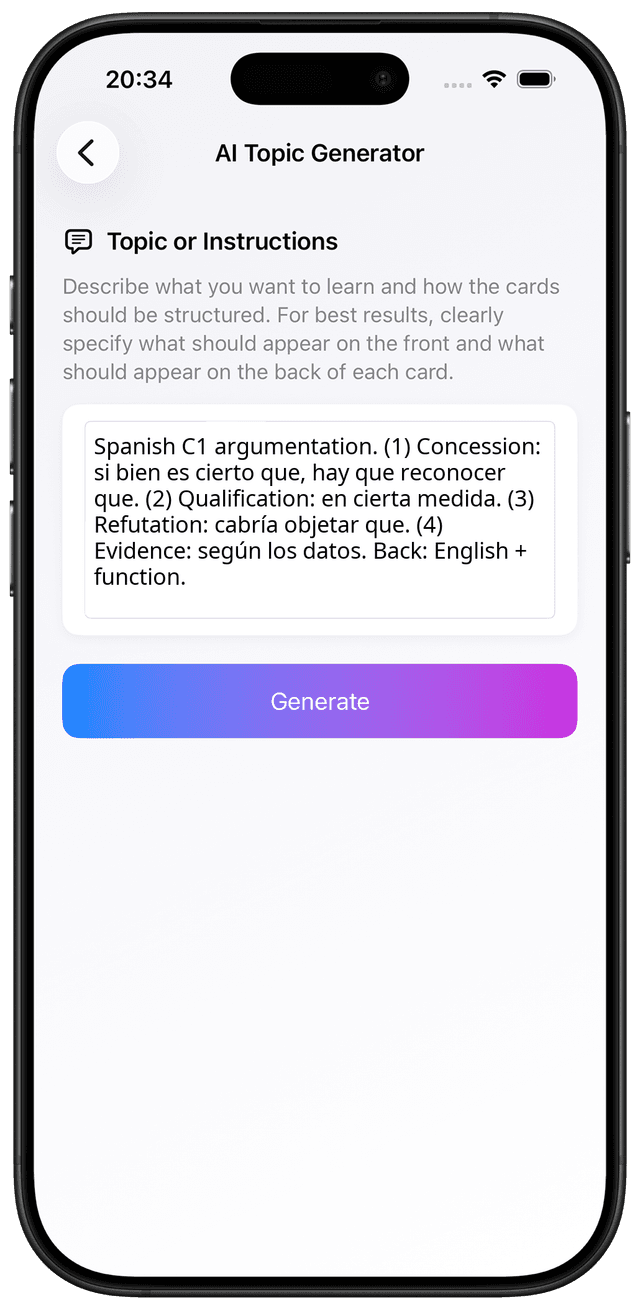
Generate 70 Spanish C1 argumentation phrases in four groups: (1) Concession with reservation: si bien es cierto que, hay que reconocer que... aunque, no se puede ignorar que... sin embargo, es innegable que... pero conviene matizar. (2) Qualification: en cierta medida, con reservas, no del todo, hasta cierto punto, dependiendo del contexto. (3) Refutation: no es del todo exacto que, esta afirmación resulta discutible, cabría objetar que, esta interpretación pasa por alto. (4) Evaluating evidence: según los datos disponibles, a la luz de los hechos, los estudios apuntan a que, la evidencia sugiere. Front: phrase + example sentence. Back: English + rhetorical function label.
C1 is the level required for university study and professional work in Spanish-speaking contexts. Whether you are writing a research paper, giving a business presentation, or drafting a formal report, the vocabulary and phrasing conventions of academic and professional Spanish differ sharply from conversational use.
Why add this now? If you are preparing for DELE C1, working with Spanish-speaking colleagues, or studying in a Spanish-language institution, this is non-negotiable vocabulary. The phrases here appear in board reports, academic papers, and official correspondence.
The strategy: This deck covers three professional registers: academic writing, business communication, and formal presentation language. Each card shows the phrase in a realistic context.
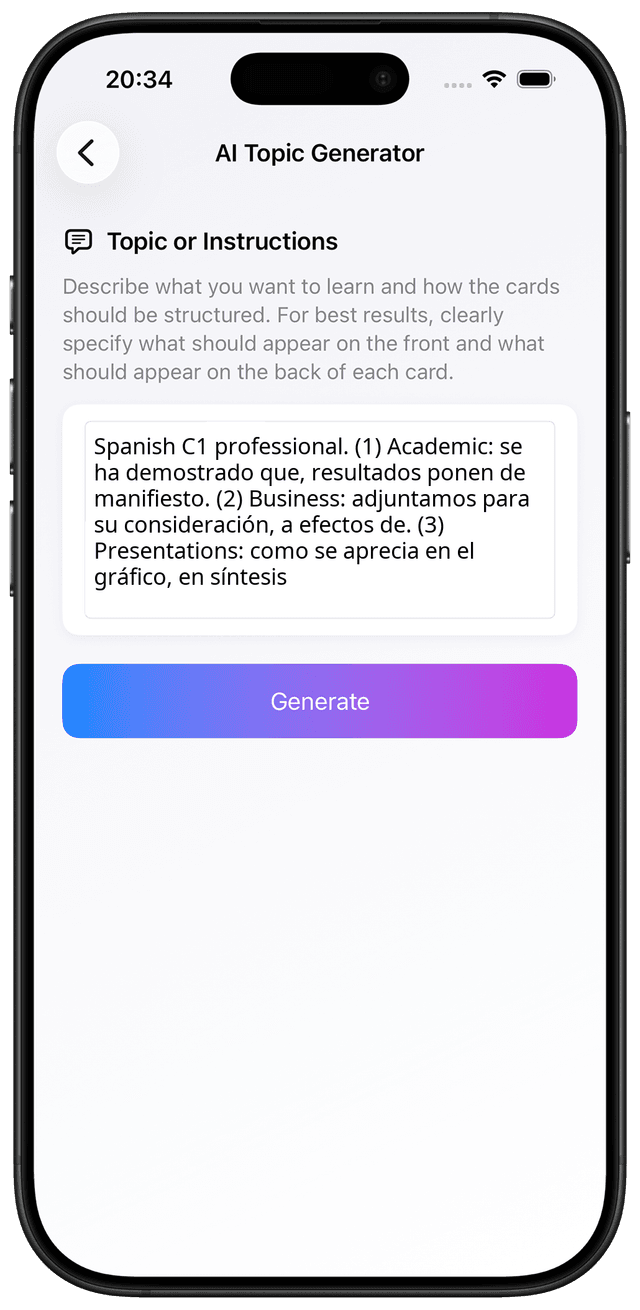
Generate 70 Spanish C1 professional and academic vocabulary items. Three groups: (1) Academic writing: se ha demostrado que, los resultados ponen de manifiesto, con base en los datos obtenidos, el presente estudio analiza, cabe señalar que, merece especial atención. (2) Business communication: adjuntamos para su consideración, en referencia a su consulta, le comunicamos que, a efectos de, con carácter inmediato, previa notificación. (3) Formal presentations: como se puede apreciar en el gráfico, los datos reflejan que, quisiera señalar a continuación, en síntesis, para concluir quisiera destacar. Front: Spanish phrase + professional context. Back: English equivalent + domain label.
Spanish literature, film, and cultural commentary use vocabulary you will not find in language textbooks. At C1, picking up a Cervantes excerpt or following a debate about Almodovar's latest film becomes manageable rather than exhausting. Native speakers pull from these references constantly; knowing them is part of what makes your Spanish feel natural rather than studied.
The goal: To give you enough literary and cultural vocabulary that you can read a novel excerpt, discuss a film, or engage with an art review without needing a dictionary for every second line.
The strategy: This deck covers three areas: literary vocabulary for prose and poetry, cultural and historical terms, and aesthetic vocabulary for discussing art, music, and film.
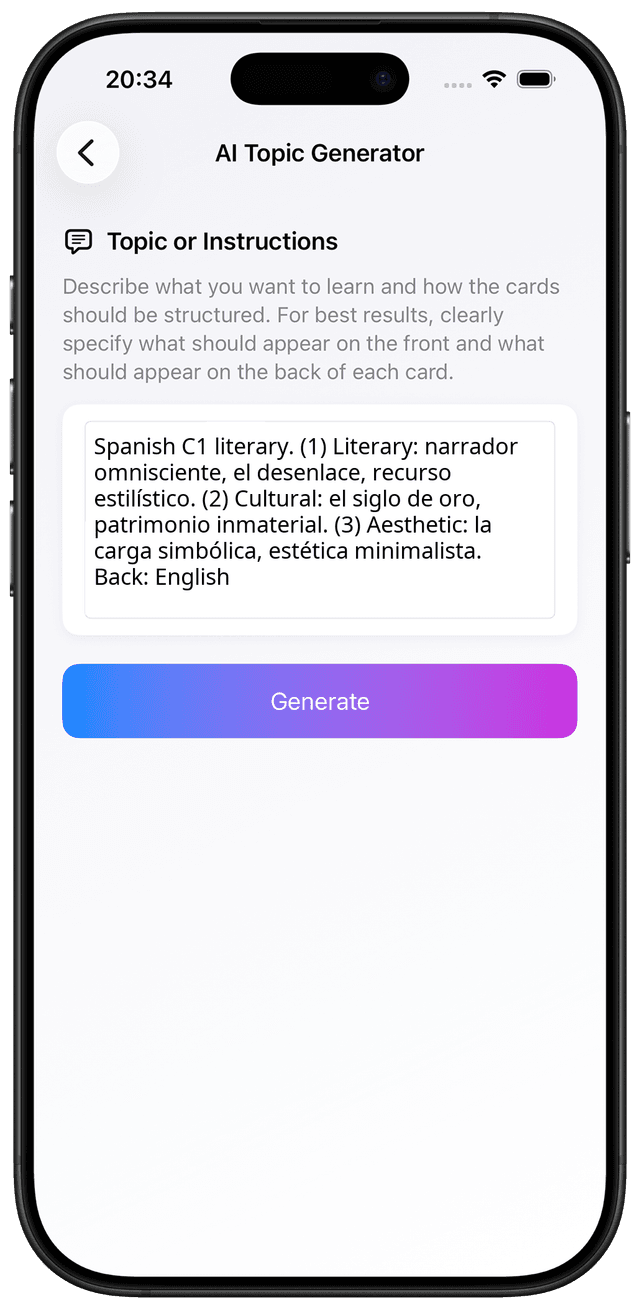
Generate 70 Spanish C1 literary and cultural vocabulary items. Three groups: (1) Literary language: narrador omnisciente, el desenlace, la trama, el protagonista, recurso estilístico, metáfora, alegoría, ironía narrativa, voz poética, el verso libre. (2) Cultural and historical: el siglo de oro, la transición democrática, el boom latinoamericano, el movimiento obrero, patrimonio inmaterial, identidad regional. (3) Aesthetic commentary: transmitir una sensación de, evocar el ambiente, la carga simbólica, la estética minimalista, la narrativa fragmentada, el ritmo de la composición. Front: Spanish term + example sentence from cultural context. Back: English equivalent + domain label.
Native speakers at C1-C2 level rely heavily on fixed expressions, verbal periphrases, and idiomatic collocations that give their speech texture and naturalness. Many of these are opaque to learners who have been taught from textbooks. Knowing them passively (understanding when you hear them) is useful; knowing them actively (using them correctly) is what gets you to C1.
The goal: To close the gap between textbook Spanish and the Spanish of educated native speakers. This phase covers verbal periphrases (ir a + infinitive at C1 level means more subtle things), fixed prepositional phrases, and the idiomatic expressions that appear across formal and informal registers alike.
The strategy: Each card shows the expression in context with a note on register and frequency. You learn which expressions are universally used and which are marked as formal, colloquial, or literary.
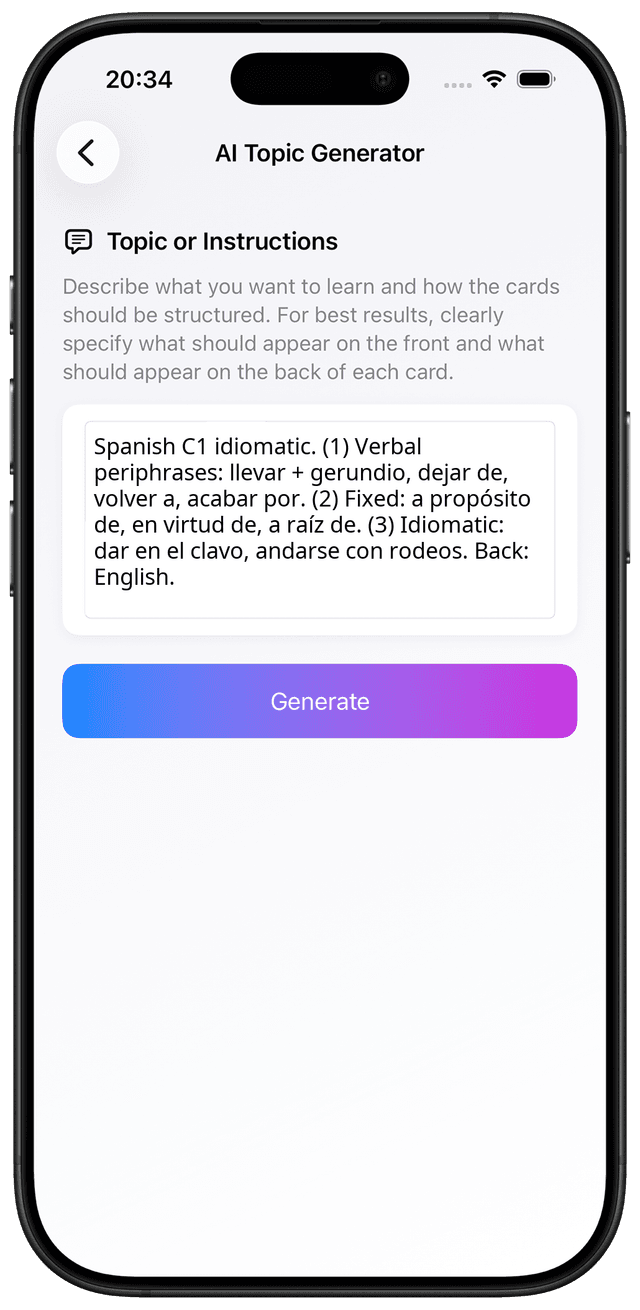
Generate 65 Spanish C1 idiomatic expressions and verbal periphrases. Three groups: (1) Verbal periphrases: llevar + gerundio (llevar estudiando tres horas), dejar de + infinitivo, volver a + infinitivo, acabar por + infinitivo, ponerse a + infinitivo, seguir + gerundio. (2) Fixed prepositional phrases: a propósito de, en virtud de, a raíz de, en torno a, con vistas a, a expensas de, en detrimento de. (3) Idiomatic expressions: dar en el clavo, andarse con rodeos, coger el toro por los cuernos, no tener pelos en la lengua, hacer de tripas corazón, saltar a la vista. Front: expression + example sentence. Back: English meaning + register note.
The subjunctive does not end at B2. At C1 you encounter the subjunctive in subordinate noun clauses with implicit subjects, in concessive and conditional structures you would not have seen at lower levels, in exclamatory and optative uses, and in the complex interplay of mood shifts in indirect speech. Mastering these patterns is what allows you to write sophisticated Spanish prose.
Why this matters: Many learners plateau between B2 and C1 precisely because their subjunctive use stays mechanical. At C1 the subjunctive is not just a rule to follow but a tool for expressing degrees of certainty, hypothetical distance, and emotional stance. This phase covers those uses.
The strategy: The deck focuses on five C1-specific uses of the subjunctive with real example sentences. This is not review; it is new territory that native speakers use naturally.
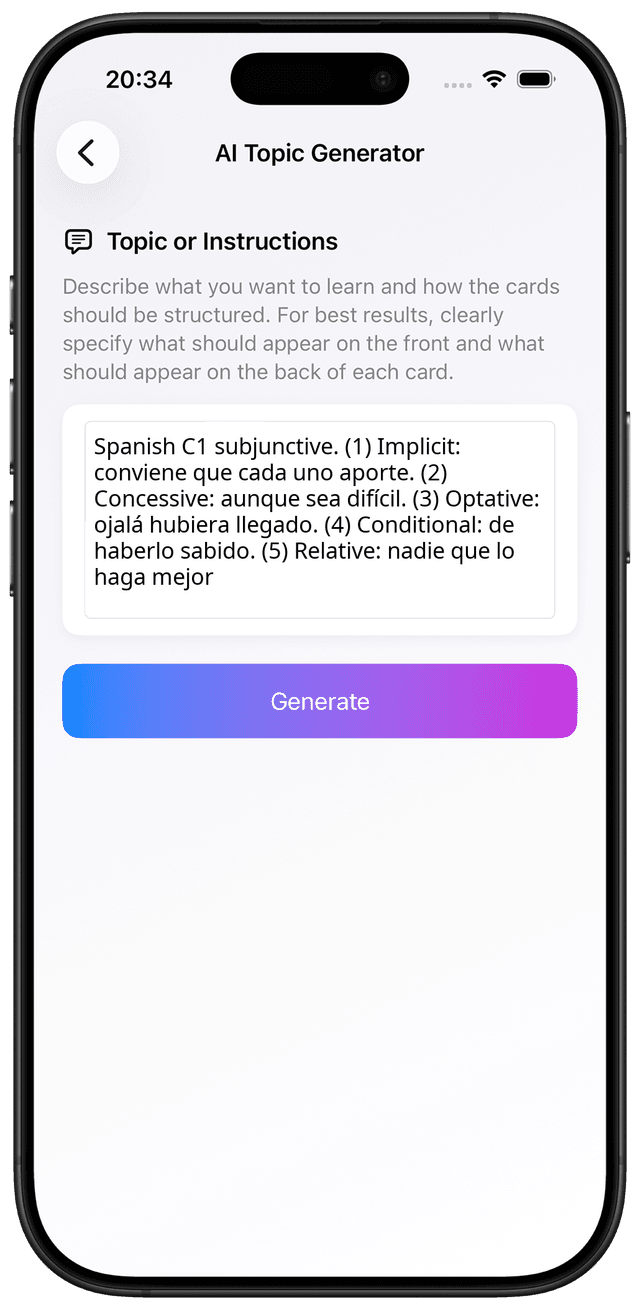
Generate 60 Spanish C1 advanced subjunctive examples. Five groups: (1) Implicit subject in noun clauses: conviene que cada uno aporte su parte, resulta imprescindible que se haga ya, parece mejor que lo revisemos. (2) Concessive clauses: aunque sea difícil, por más que lo intente, aun cuando no quisiera. (3) Optative and exclamatory: ojalá hubiera llegado antes, que te vaya bien, así fuera verdad. (4) Conditional variations: de haberlo sabido..., en caso de que llegue tarde..., a menos que surja un problema. (5) Subjunctive after relatives with negation or indefinite antecedent: no conozco a nadie que lo haga mejor, busca alguien que pueda ayudar. Front: Spanish sentence. Back: English + subjunctive use label.
By the end of this guide you have covered the full C1 range: 1,200+ words and structures across register mastery, argumentation, professional and academic Spanish, literary vocabulary, idiomatic expressions, and advanced subjunctive uses. If you have worked through all seven phases, you are ready for DELE C1.
The milestone: At C1 you can hold your own in complex conversations without reaching for words, catch register shifts in what you read, and produce writing that reads as educated rather than translated. That is the practical benchmark this guide works toward.
Looking ahead: C2 requires near-native precision: catching ambiguity, writing across genres, handling irony. The C1 vocabulary you have built here is the direct prerequisite. There is no shortcut past it.
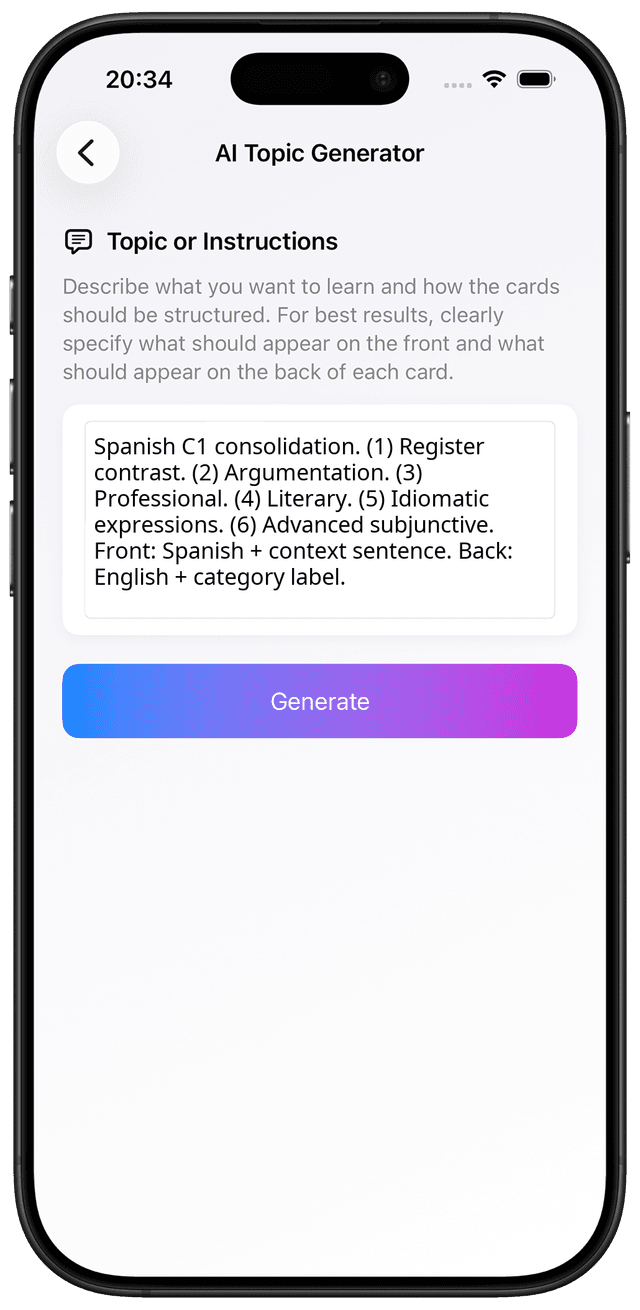
Generate 60 Spanish C1 consolidation flashcards covering the full C1 range. Six groups of 10: (1) Register contrast: formal vs colloquial version of same meaning. (2) Argumentation phrases: concession, qualification, refutation. (3) Professional phrases: academic writing, business, formal presentation. (4) Literary vocabulary: narrative, aesthetic, cultural. (5) Idiomatic expressions: verbal periphrases, fixed phrases. (6) Advanced subjunctive: one example per use type covered in this guide. Front: Spanish item + context sentence. Back: English + category label. Focus on items that appear across multiple real-world C1 tasks.
At C1 vocabulary is less predictable and more context-dependent than at lower levels. Spaced repetition handles this well: it surfaces the words you keep forgetting more often and backs off the ones you know. You spend review time where it matters.
C1 builds on B2 and prepares you for C2. Use the links below to move between levels or return to the full Spanish guide.
Copy any prompt from this guide into MindCards and your first C1 deck is ready in seconds. No account needed. The app is free on iOS.