
Spaced repetition explained
Why spacing reviews is the most efficient way to lock in N1 vocabulary long-term.
N1 is where Japanese stops having guardrails. No furigana, no simplified passages, no concessions to learners. The reading section uses literary prose and formal academic writing. The listening section includes fast speech with classical-influenced expressions. The vocabulary section tests words that most native speakers have only seen in books.
Getting from N2 to N1 is a different kind of climb. At N2 you built a vocabulary for newspapers and business Japanese. At N1 you need literary nouns, four-character idioms, classical grammar constructions, and rare kanji compounds that cannot be guessed from context or component characters.
This guide gives you seven focused phases to build the 2,000+ words the N1 exam actually tests. Use the prompts below to generate targeted decks in MindCards and let spaced repetition do the retention work.
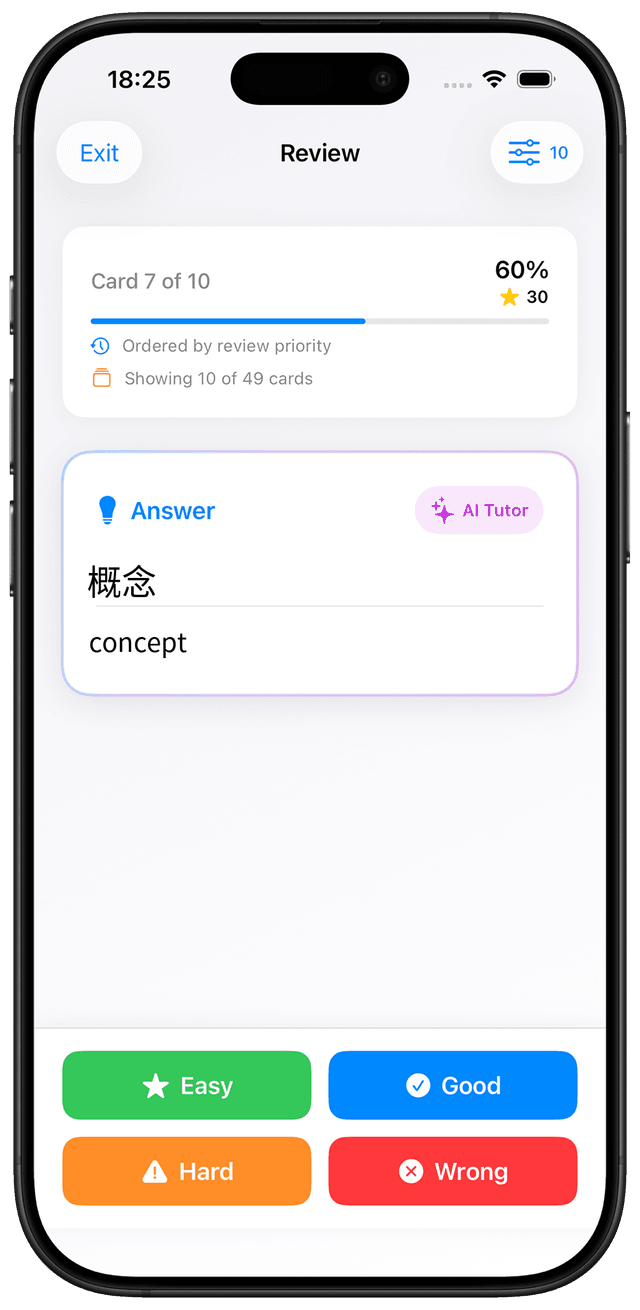
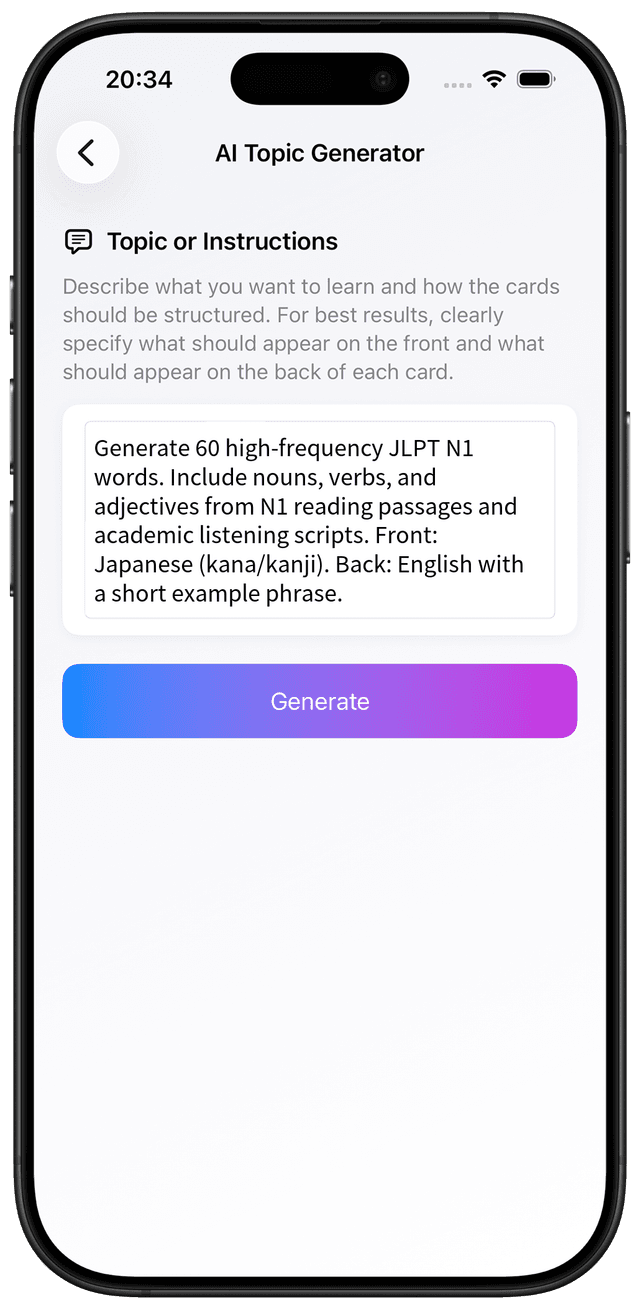
Start with the words that appear most often in N1-level reading passages, academic texts, and listening scripts. These are the nouns and verbs you need to recognize before anything else at this level.
Why start here? N1 vocabulary is not just more N2 words. The register shifts again, into literary, legal, and scholarly Japanese that you will not pick up from everyday conversation. This phase builds the base so every later phase clicks into place.
The strategy: Keep a dedicated N1 core deck separate from any N2 maintenance deck. The vocabulary at this level is dense enough that mixing levels creates confusion rather than reinforcement.
Generate 60 high-frequency JLPT N1 words. Include nouns, verbs, and adjectives from N1 reading passages and academic listening scripts. Front: Japanese (kana/kanji). Back: English with a short example phrase.
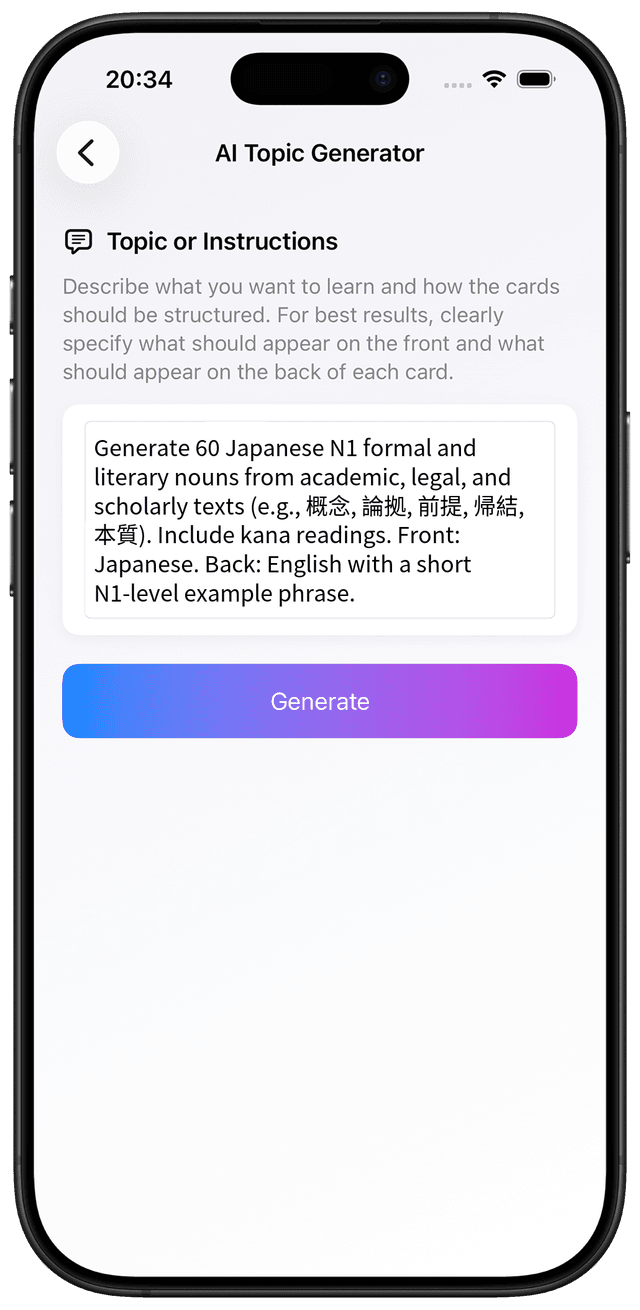
N1 reading sections pull from academic journals, legal documents, and literary prose. Words like 概念 (gainen, concept), 論拠 (ronkyo, grounds for argument), 前提 (zentei, premise), and 帰結 (kiketsu, conclusion/consequence) are the building blocks of formal Japanese argument.
Why this next? Formal nouns carry the logic in N1 reading passages. Recognizing them turns dense academic text from a wall of characters into an argument you can follow.
The strategy: Group nouns by function: words that introduce premises, words that signal conclusions, words that mark counterarguments. Functional grouping makes them stick faster than alphabetical or frequency-based ordering.
Generate 60 Japanese N1 formal and literary nouns from academic, legal, and scholarly texts (e.g., 概念, 論拠, 前提, 帰結, 本質). Include kana readings. Front: Japanese. Back: English with a short N1-level example phrase.
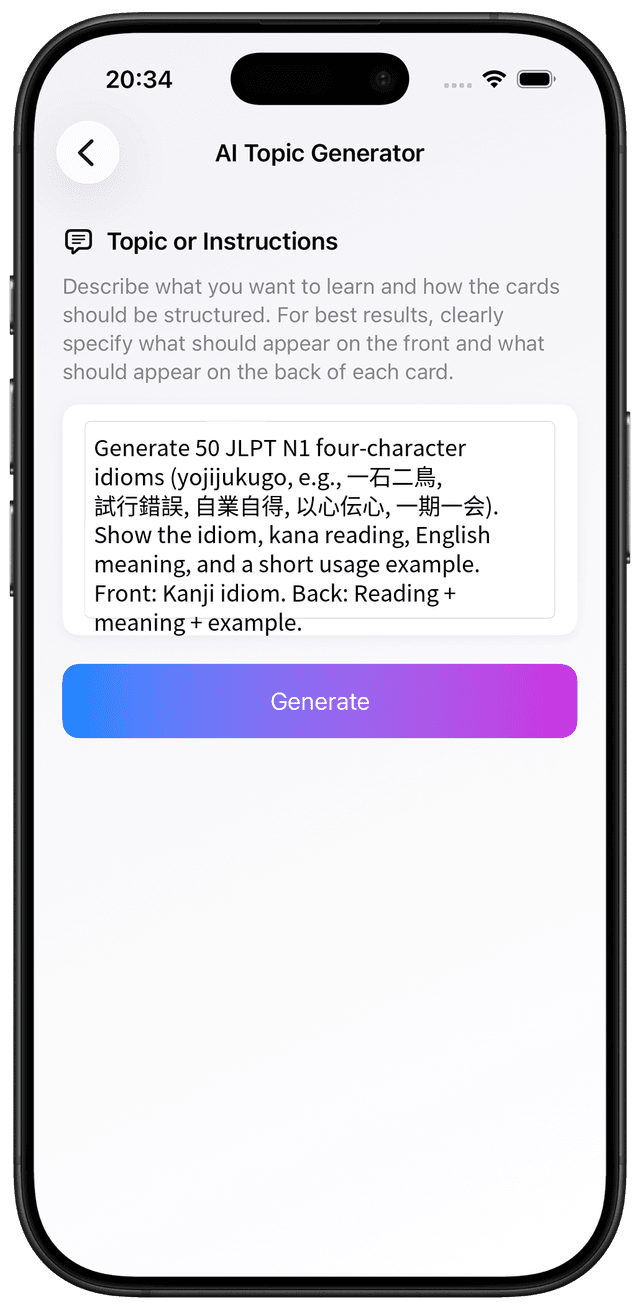
Four-character set phrases (yojijukugo) are a defining feature of N1. Expressions like 一石二鳥 (isseki nicho, kill two birds with one stone), 試行錯誤 (shiko sakugo, trial and error), and 自業自得 (jigo jitoku, you reap what you sow) appear regularly in N1 vocabulary sections and are tested both in isolation and inside longer passages.
Why dedicate a phase to yojijukugo? They are a distinct vocabulary category. Knowing individual kanji meanings does not reliably predict the compound meaning. You need to learn each idiom as its own unit.
The strategy: Study the meaning and a usage example on each card. For idioms you already know from N2 or everyday exposure, add a card with the kanji breakdown so the writing reinforces the meaning.
Generate 50 JLPT N1 four-character idioms (yojijukugo, e.g., 一石二鳥, 試行錯誤, 自業自得, 以心伝心, 一期一会). Show the idiom, kana reading, English meaning, and a short usage example. Front: Kanji idiom. Back: Reading + meaning + example.
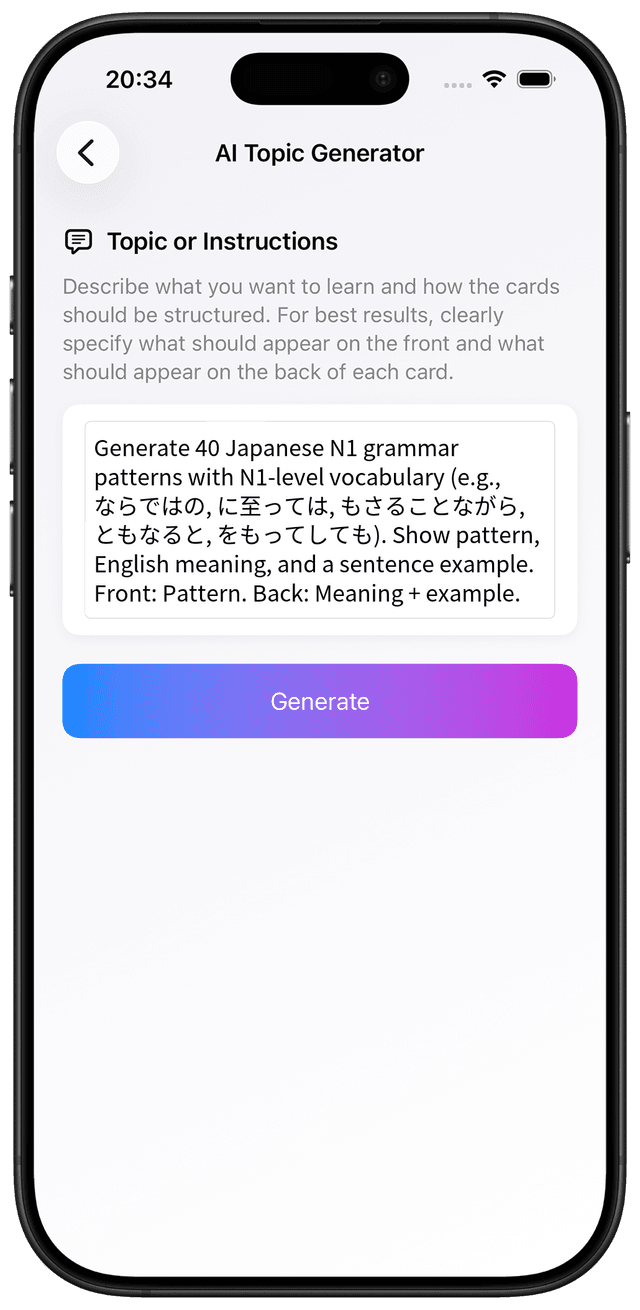
N1 reading includes texts with classical Japanese (kobun) influence: literary novels, newspaper editorials, and formal essays. Patterns like ならではの (unique to), に至っては (when it comes to), もさることながら (not to mention), and ともなると (when it reaches the point of) signal the structure of complex arguments.
Why classical-influenced patterns? These are not in everyday speech. They show up in N1 passages specifically because the reading section tests literary and formal Japanese. If you only know conversational patterns, the structure of these sentences will be opaque.
The strategy: Study each pattern with a before-and-after clause showing how it connects ideas. The connection is what the N1 reading questions actually test.
Generate 40 Japanese N1 grammar patterns with N1-level vocabulary (e.g., ならではの, に至っては, もさることながら, ともなると, をもってしても). Show pattern, English meaning, and a sentence example. Front: Pattern. Back: Meaning + example.
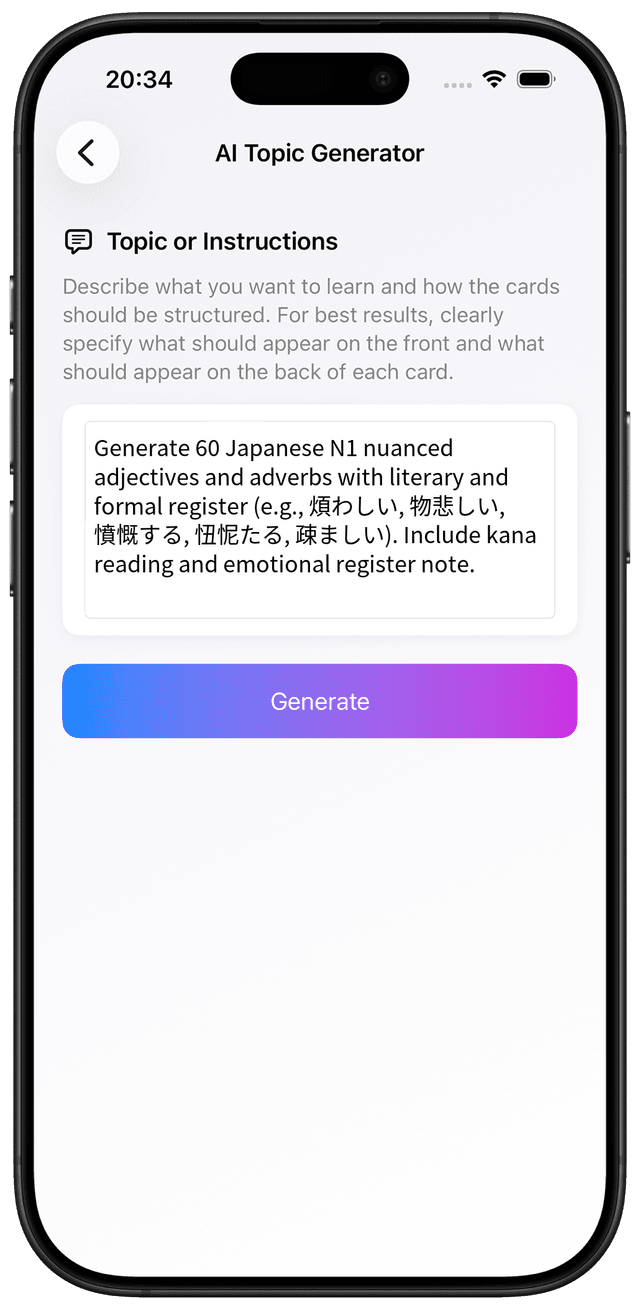
N1 passages use adjectives and adverbs that carry emotional, literary, or rhetorical weight. Words like 煩わしい (wazurawashii, troublesome/tiresome), 物悲しい (motoganashii, wistfully sad), 憤慨する (fungai suru, to be indignant), and いとも (ito mo, extremely, in a formal register) change the tone of a sentence in ways that affect reading comprehension questions.
Why adjectives separately? At N1, reading questions often ask about the author's emotional stance. That stance is carried by precise adjective and adverb choice. Knowing whether a word signals irritation, resignation, admiration, or indignation changes how you read a whole passage.
The strategy: For each word, note the emotional register alongside the dictionary meaning. An example sentence from a real literary or editorial context beats a generic placeholder.
Generate 60 Japanese N1 nuanced adjectives and adverbs with literary and formal register (e.g., 煩わしい, 物悲しい, 憤慨する, 忸怩たる, 疎ましい). Include kana reading and emotional register note. Front: Japanese word. Back: Reading + English + register note.
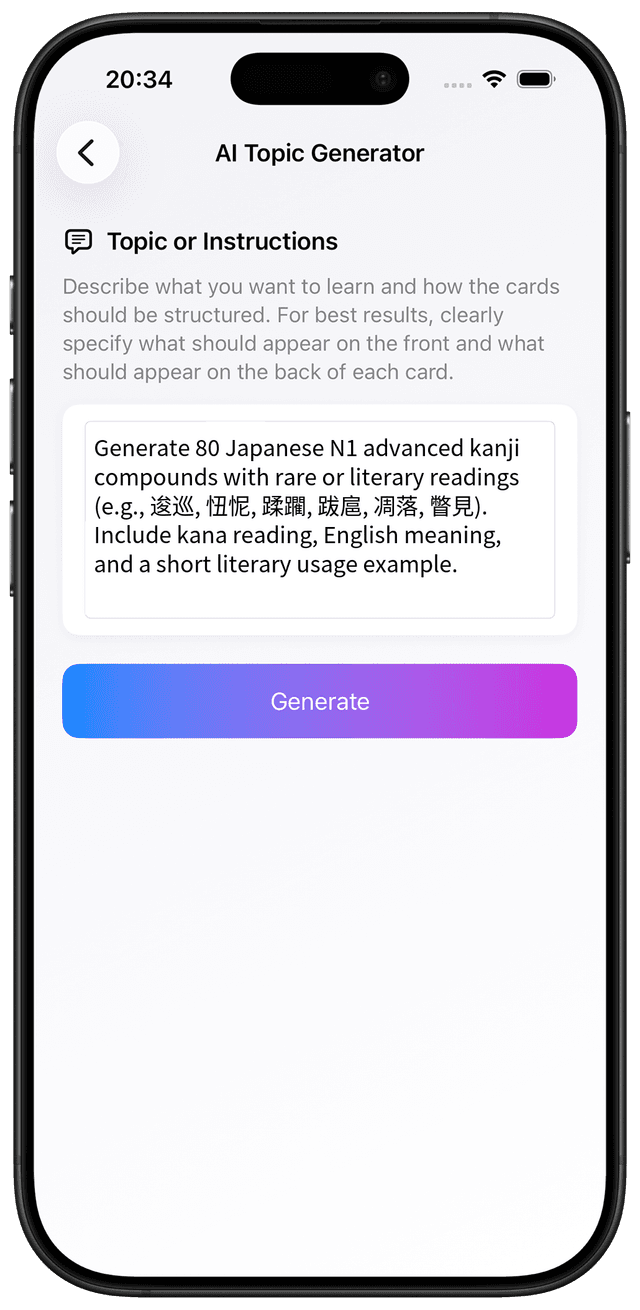
JLPT N1 expects around 2,000 kanji. The exam tests on-readings and kun-readings inside compound words, including less common readings that only appear in literary or formal contexts. Compounds like 逡巡 (shunjun, hesitation), 忸怩 (jikuji, shame), 蹂躙 (jurin, trampling/violation), and 跋扈 (bakko, running rampant) are unlikely to be guessable without deliberate study.
Why rare compounds specifically? N1 vocabulary sections test exactly these words because they separate prepared learners from those who simply absorbed vocabulary through media and conversation. You cannot pick these up passively.
The strategy: Use context sentences drawn from actual N1 practice tests or literary sources. The word 逡巡 is much stickier in a sentence than as an isolated pair of characters.
Generate 80 Japanese N1 advanced kanji compounds with rare or literary readings (e.g., 逡巡, 忸怩, 蹂躙, 跋扈, 凋落, 瞥見). Include kana reading, English meaning, and a short literary usage example. Front: Kanji word. Back: Reading + English + example.
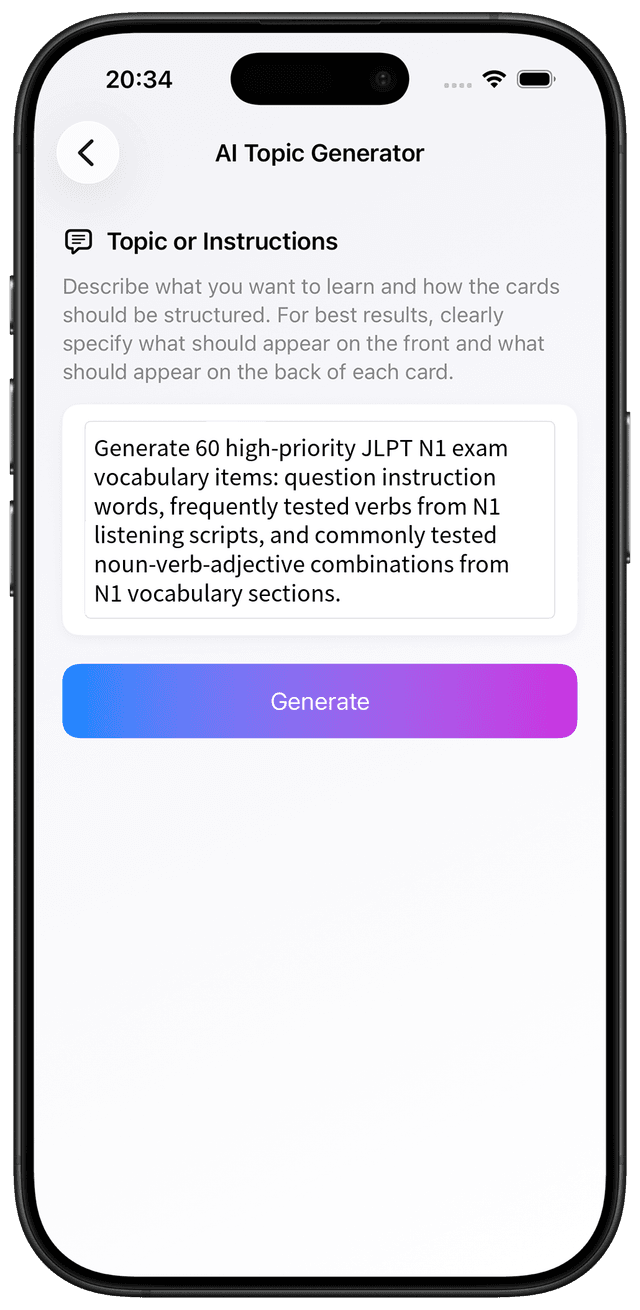
Close out your N1 preparation with the vocabulary patterns most tested across all N1 sections. This includes instruction vocabulary used in N1 exam questions, frequently tested noun-verb-adjective combinations from N1 listening scripts, and words that appear repeatedly in N1 vocabulary and reading sections.
Milestone: After this phase, your N1 vocabulary base covers the words needed across language knowledge, reading, and listening sections. The goal is not just recognition but automatic retrieval under time pressure in a real exam room.
Generate 60 high-priority JLPT N1 exam vocabulary items: question instruction words, frequently tested verbs from N1 listening scripts, and commonly tested noun-verb-adjective combinations from N1 vocabulary sections. Front: Japanese. Back: English.
MindCards uses active recall and spaced repetition so N1 vocabulary shifts from something you vaguely recognize to something you can retrieve when the exam clock is running.
N1 vocabulary builds on N2 foundations. Work through N2 first if you have not already, then return here when you are ready to push to the top.
Build advanced Japanese with smart flashcards, AI deck generation, and spaced repetition designed for real JLPT N1 progress.