
Spaced Repetition Explained
Learn why spacing reviews is key to retention
The journey to fluency starts here. Hiragana is not just an alphabet; it is the phonetic backbone of the Japanese language. Every single word you speak corresponds to one of these sounds.
Crucially, Hiragana is the barrier to entry for serious study. While beginner apps might use English letters (Romaji), most intermediate textbooks and courses simply assume you can read Hiragana. If you do not master these characters, you cannot access the best learning materials.
Many beginners try to memorize the chart by staring at it for hours. This is the hard way. MindCards offers a smarter way to start. We leverage spaced repetition flashcards to ensure you spend your time actually remembering characters, not just re-reading them. Below, you will find the guide on how to practice and the AI prompts you can use to build your own study decks in seconds.
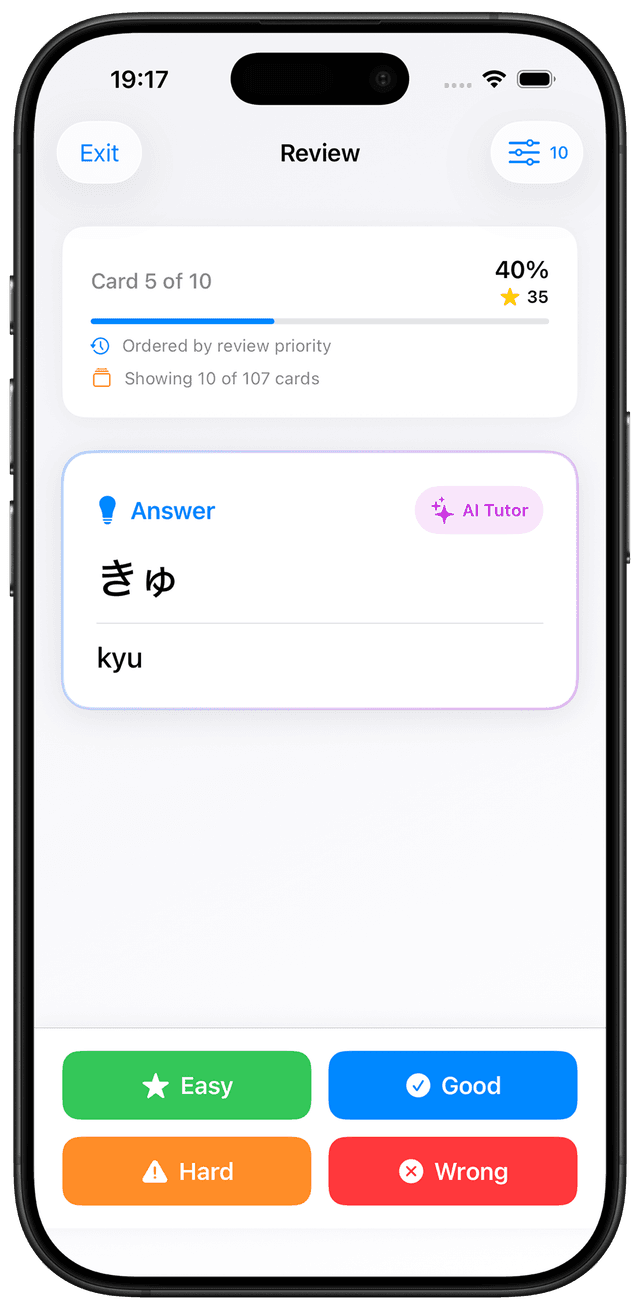
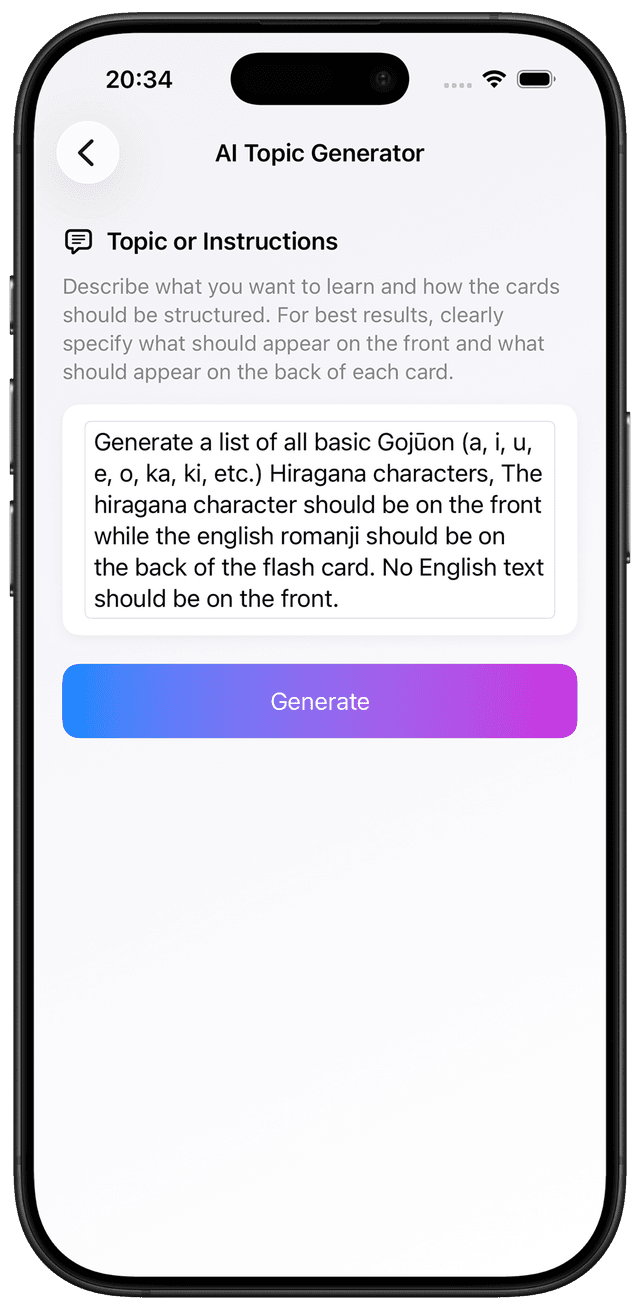
Before you tackle complex sentences, you need to master the building blocks. In Japanese, these are the Basic Gojūon (literally "50 sounds," though in modern Japanese there are only 46). These characters represent the primary vowels (a, i, u, e, o) and the consonant-vowel pairs (like ka, ki, ku, ke, ko).
Why start here? These 46 characters appear in almost every Japanese sentence.
The Strategy: Simply copy the prompt below (by clicking on it) and paste it into the "AI Topic Generator" in the MindCards App. Generate the deck and start reviewing!
Generate a list of all basic Gojūon (a, i, u, e, o, ka, ki, etc.) Hiragana characters, The hiragana character should be on the front while the english romanji should be on the back of the flash card. No English text should be on the front.
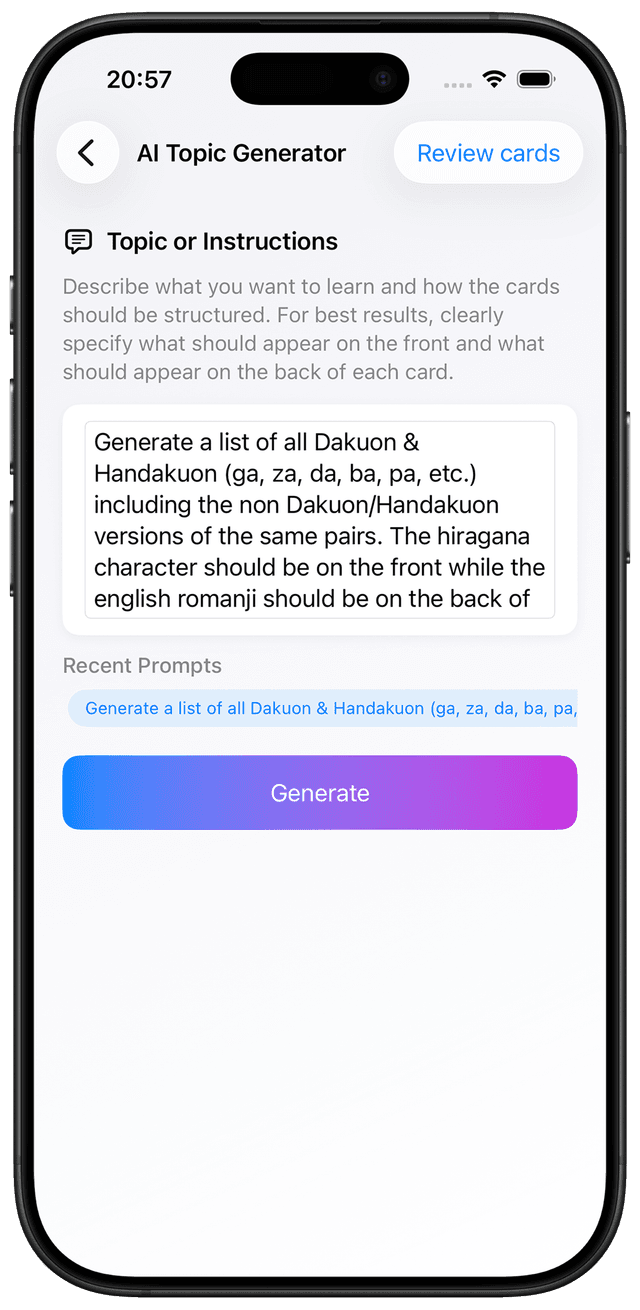
Once you know the basic shapes, you can instantly double your vocabulary by learning Dakuon and Handakuon.
You do not actually need to memorize new character shapes here. Instead, you just need to recognize two small marks added to the top-right of the basic characters you already know:
Dakuten ( ゙ ): These look like quote marks. They "voice" the sound (make it vibrate in your throat). Example: Ka (か) becomes Ga (が). Te (て) becomes De (で).
Handakuten ( ゚ ): This looks like a small circle. It adds a "pop" to the sound. Example: Ha (は) becomes Pa (ぱ)
Note: In this section, we will use specific prompts to generate cards that test your ability to distinguish between the unvoiced (Target: Ka) and voiced (Target: Ga) versions. Simply copy the prompt below (by clicking on it) and paste it into the "AI Topic Generator" in the MindCards App, generate the deck and start reviewing!
Generate a list of all Dakuon & Handakuon (ga, za, da, ba, pa, etc.) including the non Dakuon/Handakuon versions of the same pairs. The hiragana character should be on the front while the english romanji should be on the back of the flash card.
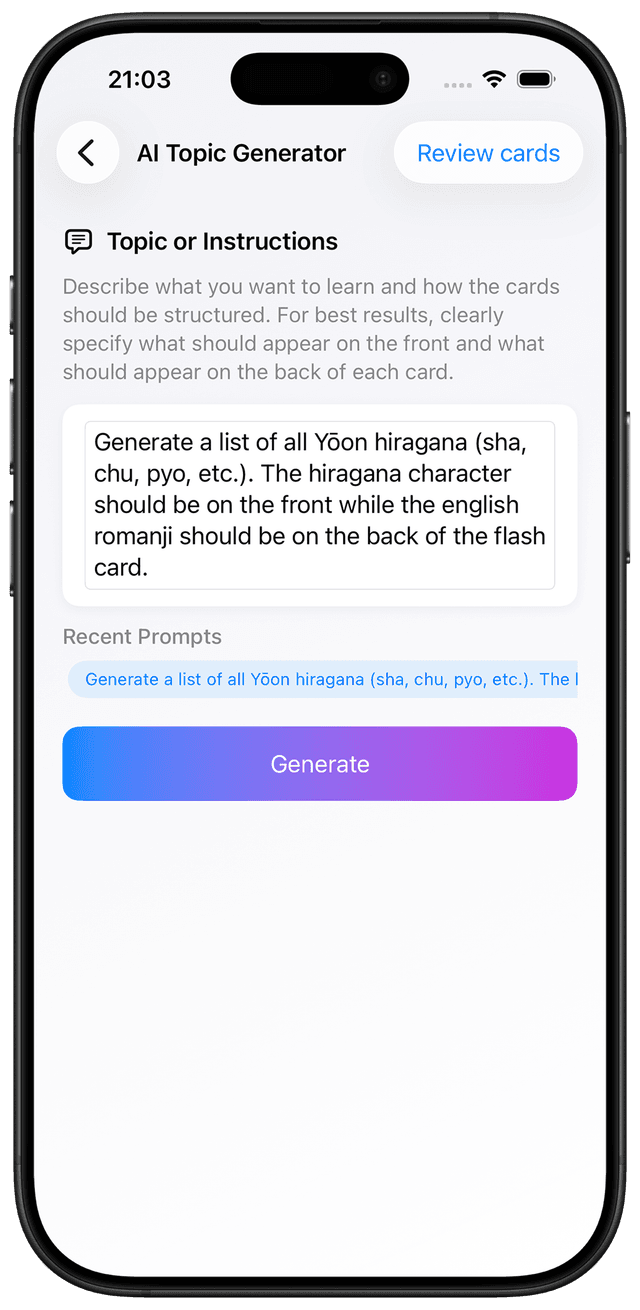
The final piece of the Hiragana puzzle is Yōon. These are "gliding" sounds created by combining a consonant with a small ya, yu, or yo
Example: Ki (き) + small ya (ゃ) = Kya (きゃ).
The Trick: Notice that it is not two beats ("Ki-ya"). It is one smooth, single beat ("Kya").
These sounds are crucial for natural Japanese speech. The prompts for this section will generate pairs like Sha, Chu, and Pyo to help you practice blending sounds smoothly.
To get started, simply copy the prompt below (by clicking on it) and paste it into the "AI Topic Generator" in the MindCards App, generate the deck and start reviewing!
Generate a list of all Yōon (sha, chu, pyo, etc.) including the non Yōon versions of the same pairs. The hiragana character should be on the front while the english romanji should be on the back of the flash card.
MindCards uses scientifically-proven learning techniques to help you master Hiragana faster and remember it longer.
The next step in your Japanese journey is Katakana, the alphabet for loan words.
Join hundreds of learners mastering Japanese with our free flashcard app. Start learning Japanese with flashcards, AI-powered generation, and smart spaced repetition. No account required!