
Spaced Repetition Explained
Learn why spacing reviews is key to retention
Katakana is the second essential alphabet of the Japanese language. While Hiragana is for native words, Katakana is used for loan words from English (like "Coffee" or "Computer"), foreign names, scientific terms, and for emphasis - like italics in English.
You will see it on menus, signs, and in manga sound effects. Mastering Katakana is key to navigating modern Japan.
Many beginners struggle because the characters are sharper and more angular than Hiragana. MindCards offers a smarter way to master them. We leverage spaced repetition flashcards to ensure you remember these sharp strokes forever. Below, you will find the guide on how to practice and the AI prompts you can use to build your own study decks in seconds.
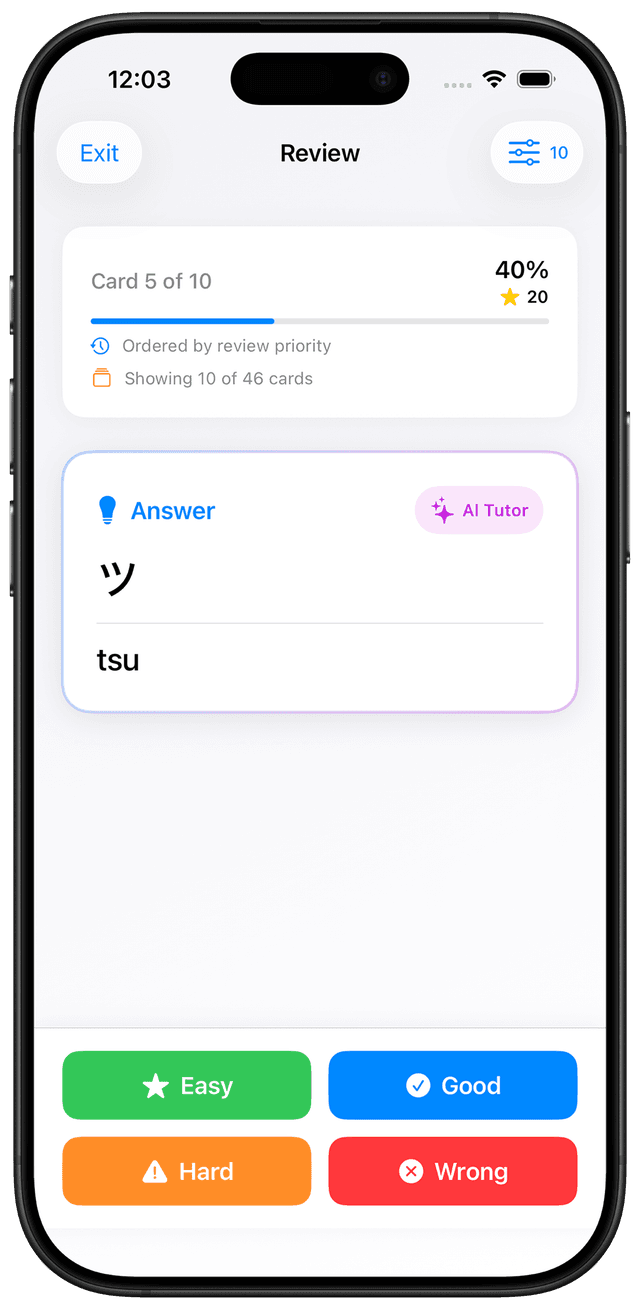
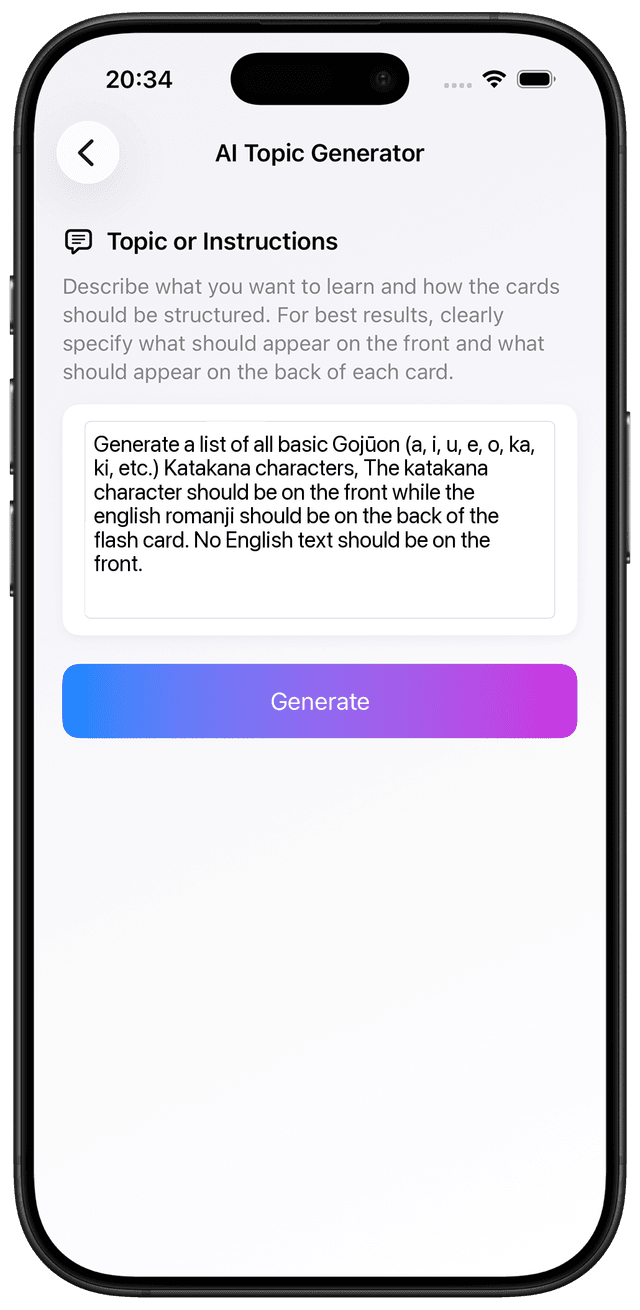
Just like Hiragana, Katakana starts with the Basic Gojūon ("50 sounds"). These share the exact same sounds as Hiragana (a, i, u, e, o, etc.), but differ in shape. Katakana characters are more angular and straight.
Why start here? You already know the sounds. You just need to map them to new symbols.
The Strategy: Simply copy the prompt below (by clicking on it) and paste it into the "AI Topic Generator" in the MindCards App. Generate the deck and start reviewing!
Generate a list of all basic Gojūon (a, i, u, e, o, ka, ki, etc.) Katakana characters, The katakana character should be on the front while the english romanji should be on the back of the flash card. No English text should be on the front.
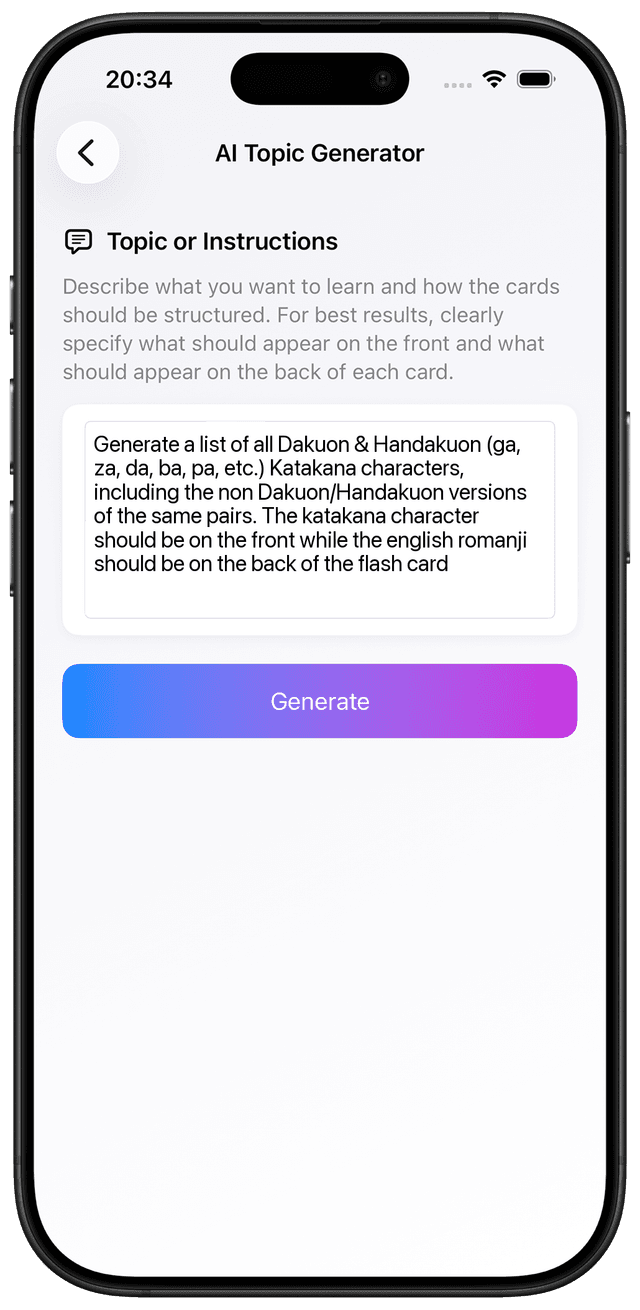
Good news: The rules for changing sounds in Katakana are exactly the same as Hiragana.
You use the same two small marks added to the top-right of the characters:
Dakuten ( ゙ ): Voices the sound. Example: Ka (カ) becomes Ga (ガ). Te (テ) becomes De (デ).
Handakuten ( ゚ ): Adds the "p" pop. Example: Ha (ハ) becomes Pa (パ)
Note: In this section, we will use specific prompts to generate cards that test your ability to distinguish these voiced sounds. Simply copy the prompt below (by clicking on it) and paste it into the "AI Topic Generator" in the MindCards App!
Generate a list of all Dakuon & Handakuon (ga, za, da, ba, pa, etc.) Katakana characters, including the non Dakuon/Handakuon versions of the same pairs. The katakana character should be on the front while the english romanji should be on the back of the flash card.
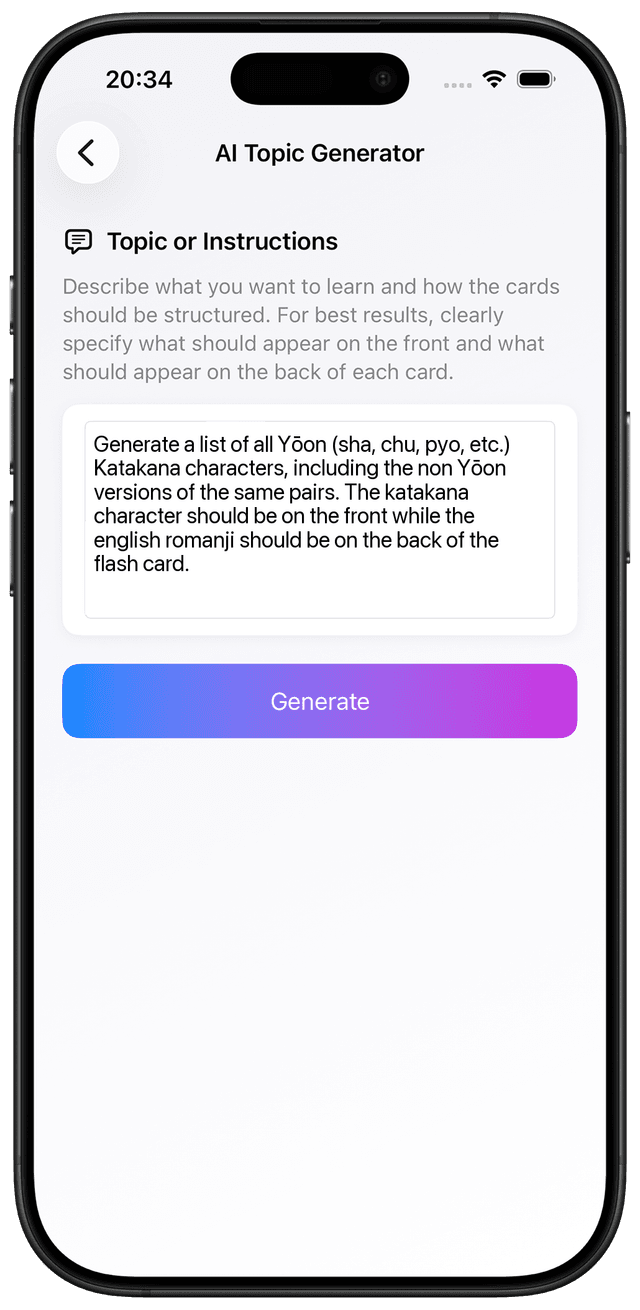
Finally, we have Yōon. These are the "gliding" sounds created by combining a consonant with a small ya (ャ), yu (ュ), or yo (ョ).
Example: Ki (キ) + small ya (ャ) = Kya (キャ).
The Trick: Just like Hiragana, it is one smooth beat.
(Note: Katakana actually has a few extra combinations to represent foreign sounds like "Wi" or "Che" which do not exist in traditional Japanese, but mastering the basics first is key.)
To get started, simply copy the prompt below (by clicking on it) and paste it into the "AI Topic Generator" in the MindCards App!
Generate a list of all Yōon (sha, chu, pyo, etc.) Katakana characters, including the non Yōon versions of the same pairs. The katakana character should be on the front while the english romanji should be on the back of the flash card.
MindCards uses scientifically-proven learning techniques to help you master Katakana faster and remember it longer.
If you haven't mastered the basics yet, we recommend starting with our Hiragana guide.
Join hundreds of learners mastering Japanese with our free flashcard app. Start learning Japanese with flashcards, AI-powered generation, and smart spaced repetition. No account required!