
Spaced repetition explained
Why spacing reviews is the most efficient way to lock in N3 vocabulary long-term.
N3 is where Japanese gets harder to fake. At N4 you can get by with memorized phrases and common words. At N3 the reading passages expect opinions, abstractions, and compound verb structures that expose gaps fast.
Most learners hit N3 vocabulary and realize their usual list-based approach stops working. The sheer variety of word types across abstract nouns, compound verbs, discourse markers, and nuanced adjectives calls for a more structured approach.
This guide gives you seven focused phases to work through the 650+ words that define N3 competency. Use the prompts below to generate targeted decks in MindCards, and let spaced repetition handle the long-term retention.
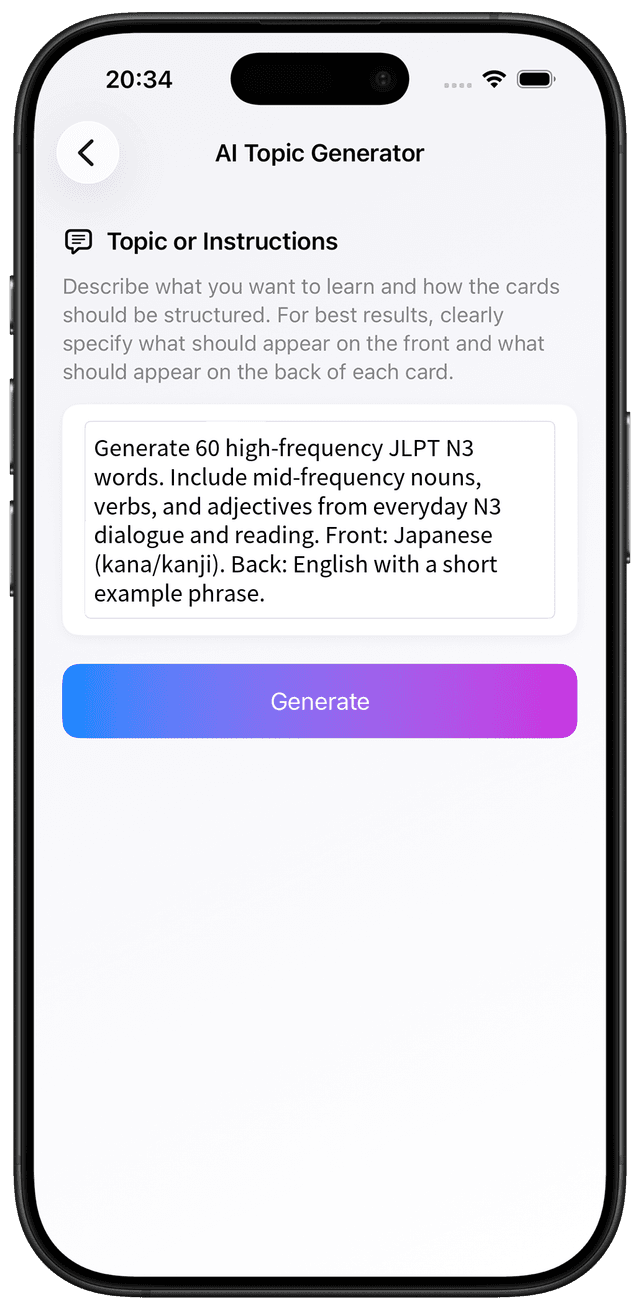
Start with the highest-frequency N3 words that appear throughout N3-level reading passages and listening tasks. These include mid-frequency nouns, verbs, and adjectives that bridge the gap from N4 to natural Japanese usage.
Why start here? Many learners pass N4 but stall at N3 because the vocabulary jumps in abstraction. This phase closes that gap so later phases feel manageable.
The strategy: Build a separate N3 core deck and review it alongside your N4 maintenance deck. Daily exposure to these words in short sessions builds the recognition speed the N3 exam demands.
Generate 60 high-frequency JLPT N3 words. Include mid-frequency nouns, verbs, and adjectives from everyday N3 dialogue and reading. Front: Japanese (kana/kanji). Back: English with a short example phrase.
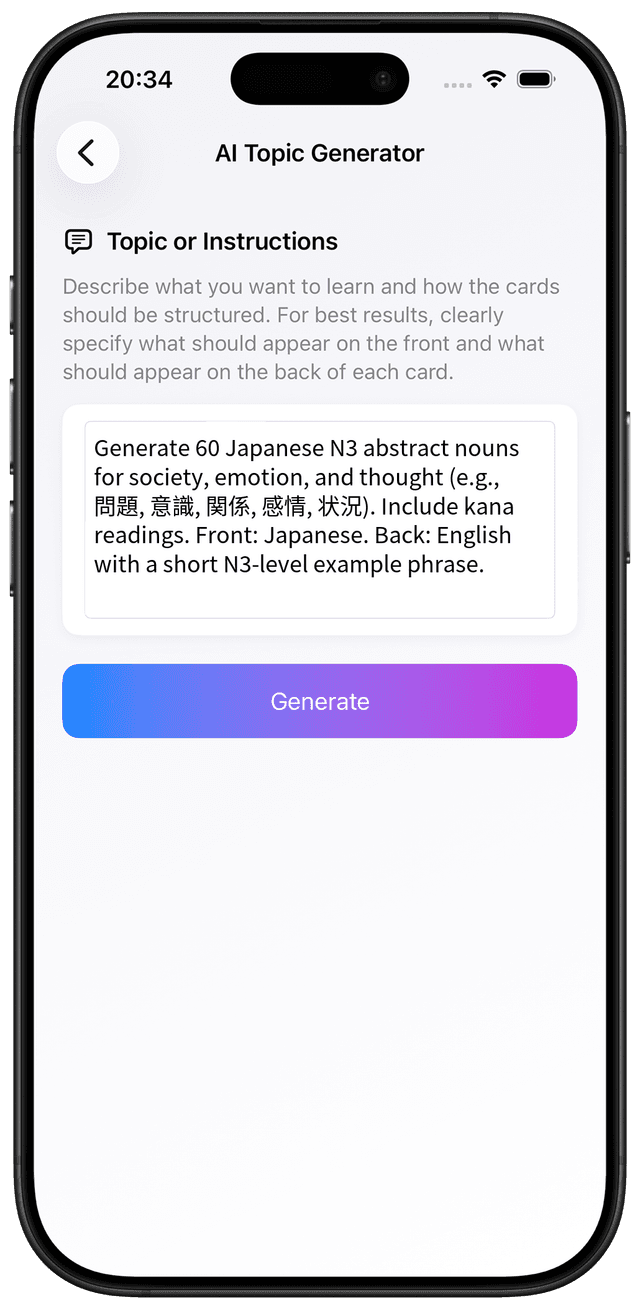
N3 reading passages regularly discuss opinions, feelings, social issues, and general ideas. You need abstract nouns like 問題 (mondai, problem), 意識 (ishiki, awareness), and 関係 (kankei, relationship) to follow these texts without guessing.
Why this next? Abstract vocabulary unlocks comprehension of editorial-style passages, personal essays, and magazine articles that form the backbone of N3 reading sections.
The strategy: Group cards by concept cluster (society words together, emotion words together). Words with shared contexts reinforce each other during spaced repetition review.
Generate 60 Japanese N3 abstract nouns for society, emotion, and thought (e.g., 問題, 意識, 関係, 感情, 状況). Include kana readings. Front: Japanese. Back: English with a short N3-level example phrase.
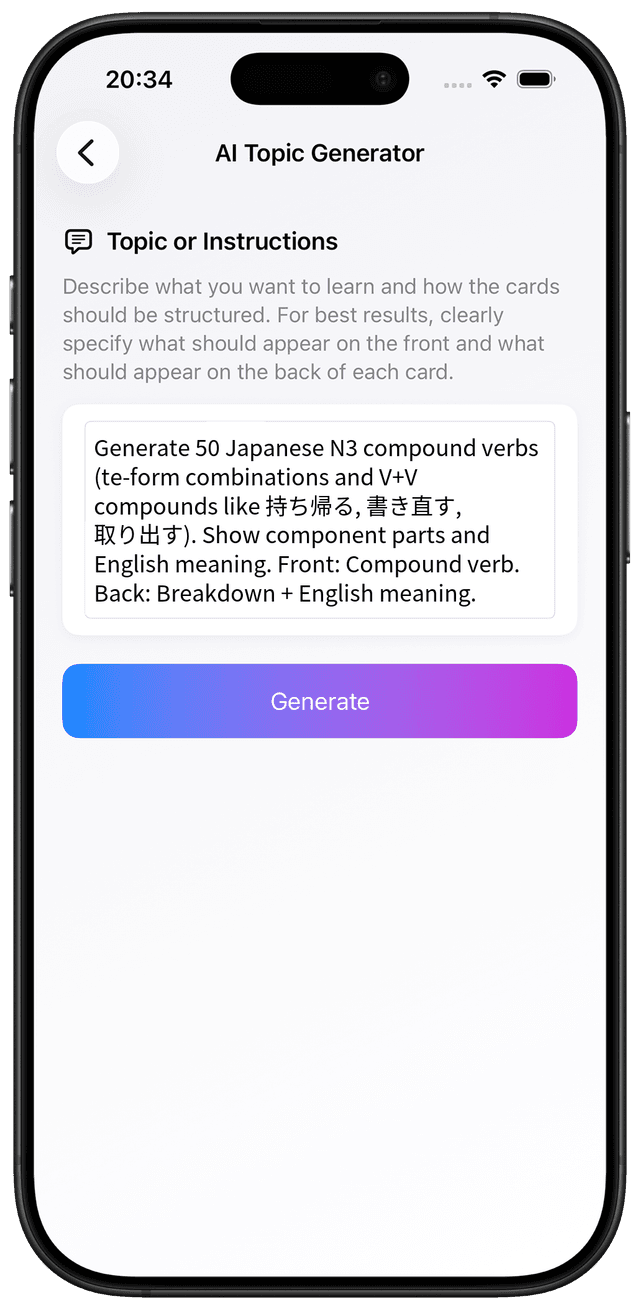
Japanese builds meaning by combining verbs. At N3, compound verbs like 持ち帰る (mochikaeru, bring back), 書き直す (kakinaosu, rewrite), and 取り出す (toridasu, take out) appear constantly. Treating each compound as its own vocabulary item is far faster than parsing them from scratch every time.
Why compound verbs matter: N3 listening and reading tasks use these combinations without breaking them down. If you do not recognize them on sight, processing slows enough to miss the meaning of the whole sentence.
The strategy: Front of card: compound verb in kanji. Back: component breakdown plus English meaning. Seeing the pieces once, then drilling the compound as a unit.
Generate 50 Japanese N3 compound verbs (te-form combinations and V+V compounds like 持ち帰る, 書き直す, 取り出す). Show component parts and English meaning. Front: Compound verb. Back: Breakdown + English meaning.
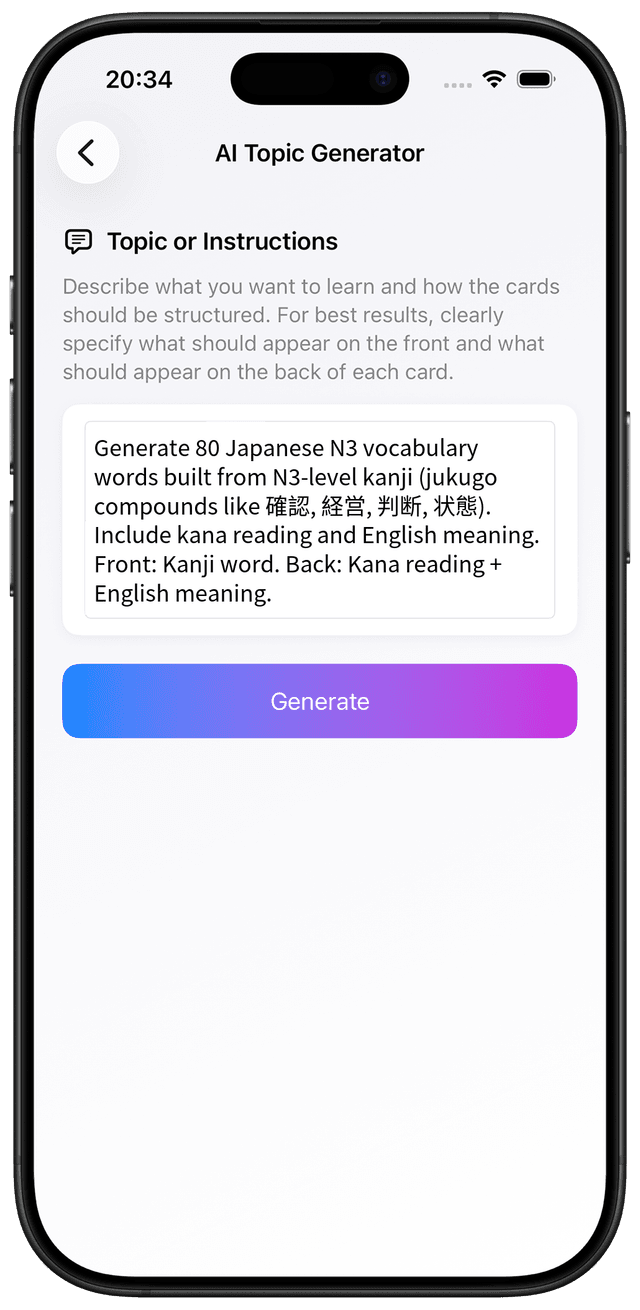
JLPT N3 expects around 650 kanji. The exam tests you on readings within words, not isolated characters. This phase targets vocabulary words built from N3-level kanji so you learn the characters in the contexts that actually appear in the test.
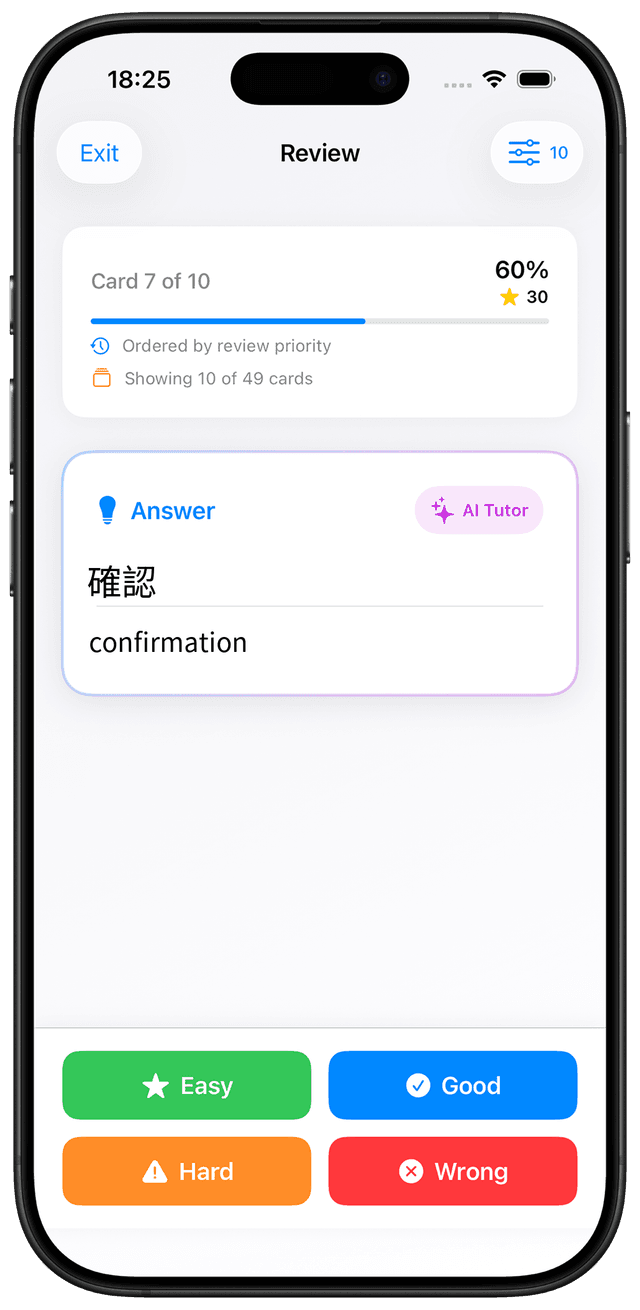
Why kanji in words, not in isolation? A kanji you only know alone will not help you read 確認 (kakunin, confirmation) or 経営 (keiei, management) under time pressure. Compound words are the unit that matters.
The strategy: Use two-character jukugo compounds as your study unit. The second kanji often signals the word category, which gives you an extra retrieval hook during the exam.
Generate 80 Japanese N3 vocabulary words built from N3-level kanji (jukugo compounds like 確認, 経営, 判断, 状態). Include kana reading and English meaning. Front: Kanji word. Back: Kana reading + English meaning.
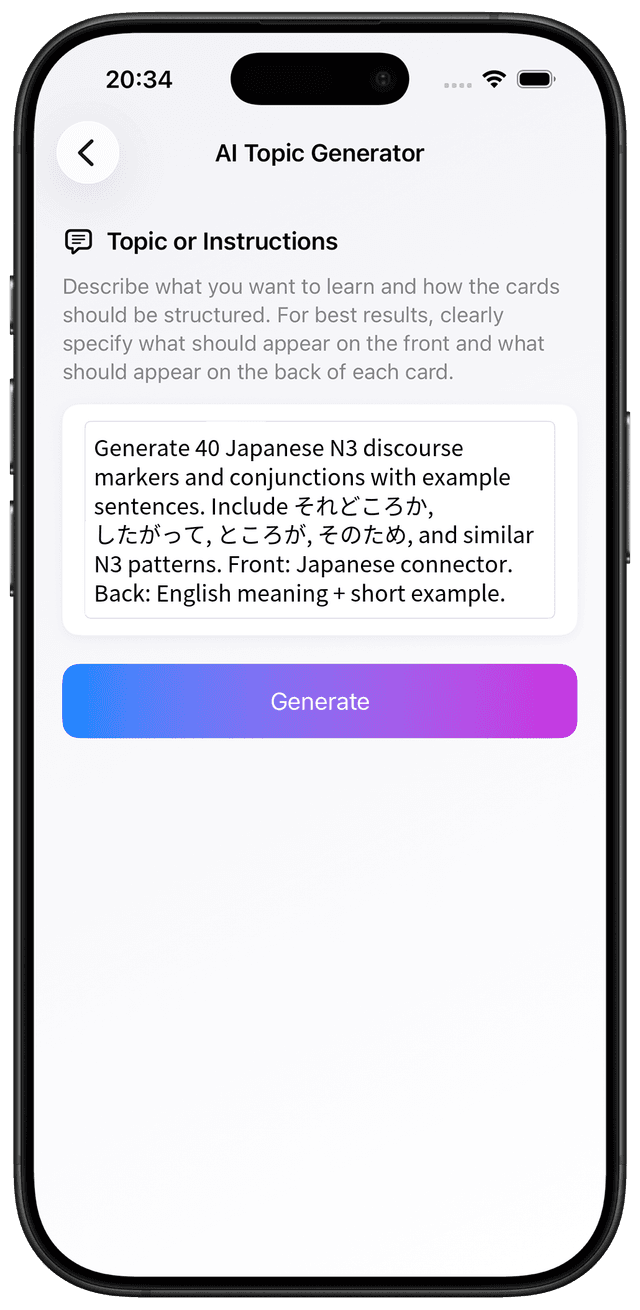
N3 reading passages use sophisticated connectors that shift argument direction, introduce contrast, or signal conclusion. Words like それどころか (on the contrary), したがって (therefore), and ところが (however) decide whether you follow the author's reasoning or lose the thread entirely.
Why now? Connectors appear in every multi-sentence paragraph at N3. Knowing them turns reading comprehension from guesswork into actual parsing.
The strategy: Study connectors with before-and-after sentence pairs so you learn the directional logic, not just an isolated English gloss.
Generate 40 Japanese N3 discourse markers and conjunctions with example sentences. Include それどころか, したがって, ところが, そのため, and similar N3 patterns. Front: Japanese connector. Back: English meaning + short example.
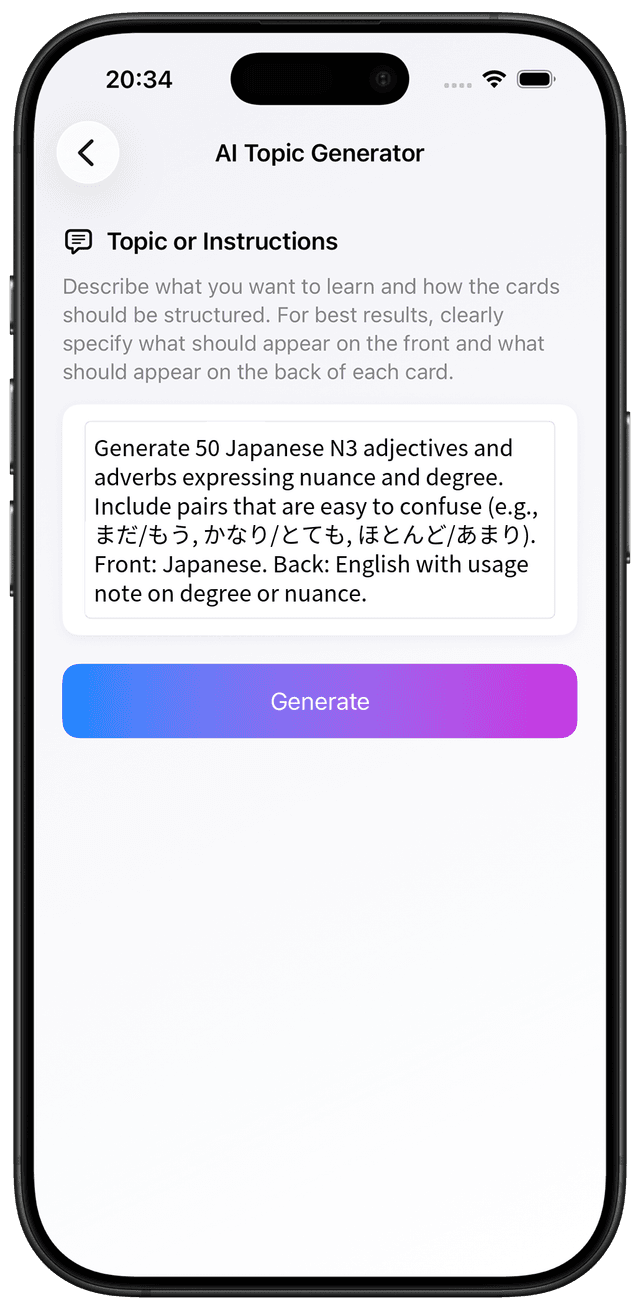
N3 adjectives and adverbs carry the fine distinctions that separate similar meanings. The difference between まだ and もう, or between かなり and とても, shows up in reading questions that ask about the author's tone or the degree of something.
Why this matters: Adjective and adverb errors are the most common source of wrong answers in N3 reading comprehension. They look minor but they change the meaning of a sentence completely.
The strategy: Pair similar-meaning adjectives on the same card to drill the distinction directly. For adverbs, include a degree scale note so you see how they compare.
Generate 50 Japanese N3 adjectives and adverbs expressing nuance and degree. Include pairs that are easy to confuse (e.g., まだ/もう, かなり/とても, ほとんど/あまり). Front: Japanese. Back: English with usage note on degree or nuance.
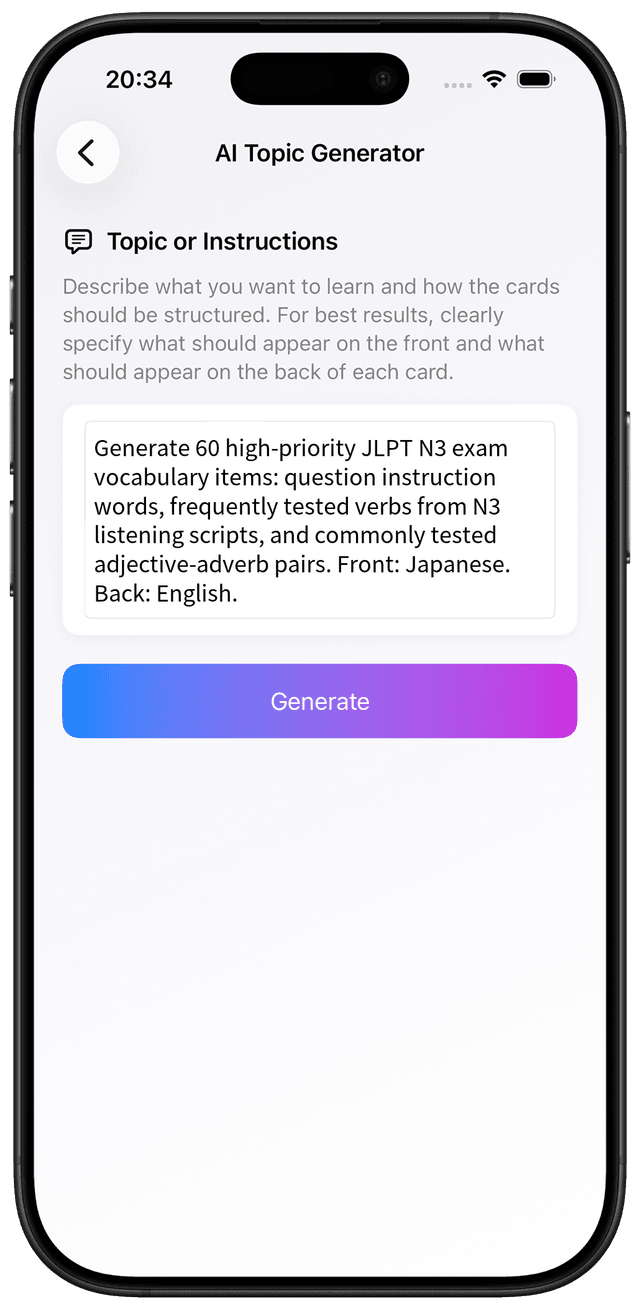
Round out your N3 preparation with the vocabulary patterns most tested in the language knowledge, reading, and listening sections. This includes instruction words used in exam questions, high-frequency verbs from N3 listening scripts, and vocabulary items that frequently appear in error-analysis questions.
Milestone: After this phase, your N3 vocabulary base covers the core words needed for all three JLPT N3 test sections. The goal is not just recognition but automatic retrieval under time pressure.
Generate 60 high-priority JLPT N3 exam vocabulary items: question instruction words, frequently tested verbs from N3 listening scripts, and commonly tested adjective-adverb pairs. Front: Japanese. Back: English.
MindCards combines active recall and spaced repetition to move N3 vocabulary from passive recognition to automatic retrieval under exam time pressure.
N3 vocabulary builds on N4 and N5 foundations. Work through the lower levels first if you have not already, then return here when you are ready to step up.
Build upper-intermediate Japanese with smart flashcards, AI deck generation, and spaced repetition designed for real JLPT N3 progress.