
Spaced repetition explained
Why spacing reviews is the most efficient way to lock in N4 vocabulary.
JLPT N4 is where Japanese stops feeling like memorized phrases and starts becoming a real communication skill. You know the N5 basics. Now it is time to build the 1,500-word vocabulary that lets you handle everyday situations, workplace conversations, and intermediate reading passages.
Most learners hit a wall after N5 because there is no clear path forward. This guide gives you seven focused phases covering complex verb forms, N4 kanji vocabulary, formal expressions, and the sentence connectors that make intermediate reading click.
MindCards uses spaced repetition and active recall to keep N4 vocabulary retrievable weeks after you first learn it. Use the prompts below to generate focused decks for each phase.
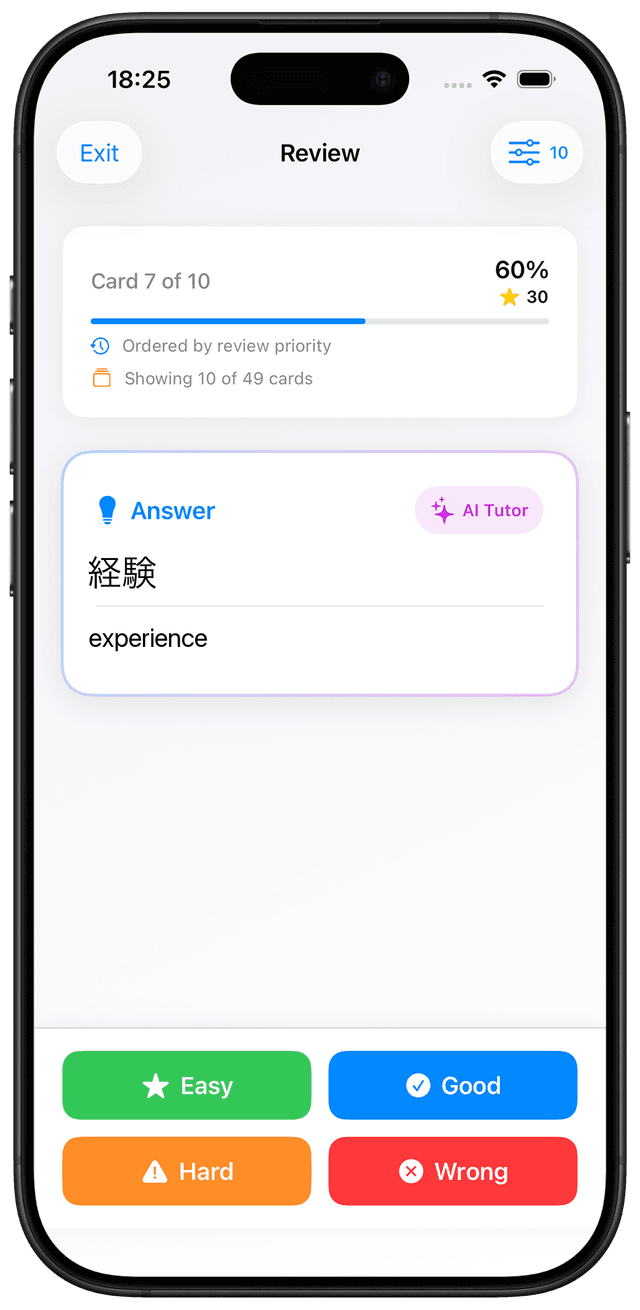
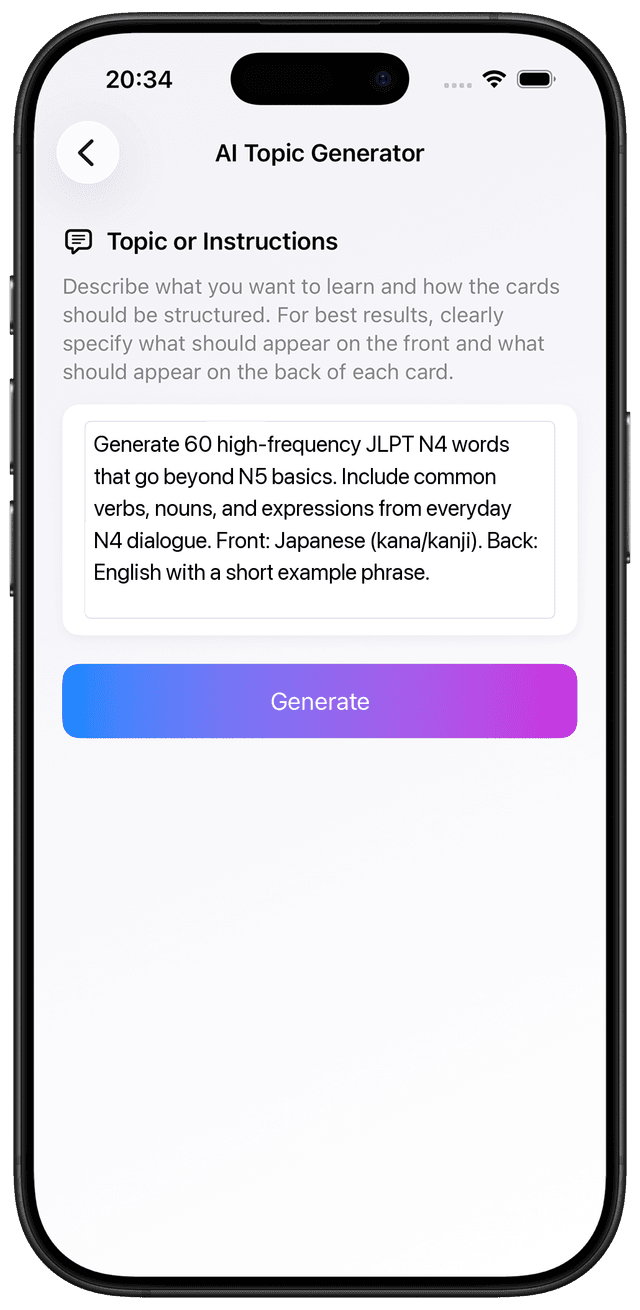
Start with the high-frequency N4 words that extend what you learned at N5. This includes new verbs, nouns, and expressions that appear constantly in intermediate dialogues and reading passages.
Why start here? Many N4 learners stall because they skip the vocabulary bridge between N5 and N4. This phase builds that bridge so later phases feel natural.
The Strategy: Add N4 words as a separate deck alongside your N5 review. Study both daily until N4 core words feel as automatic as N5 ones.
Generate 60 high-frequency JLPT N4 words that go beyond N5 basics. Include common verbs, nouns, and expressions from everyday N4 dialogue. Front: Japanese (kana/kanji). Back: English with a short example phrase.
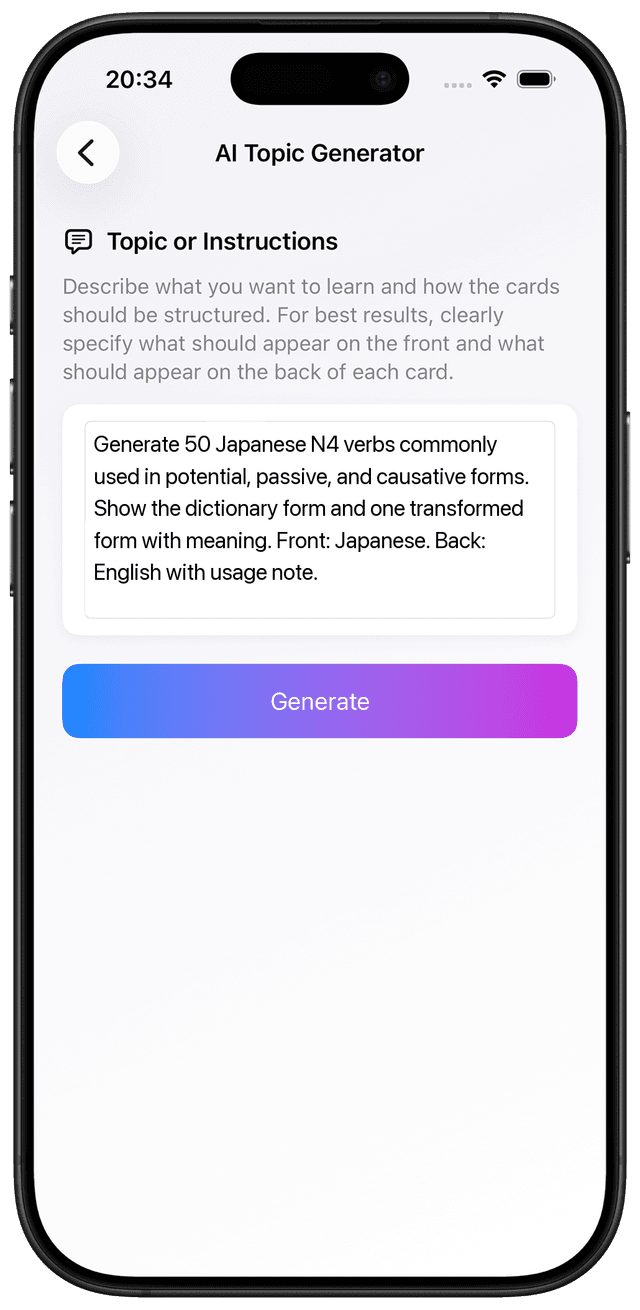
N4 grammar leans heavily on verb transformations. Knowing the base vocabulary for potential (can do), passive (is done), and causative (make someone do) forms is what separates N4 from N5 comprehension.
Why this next? Verb form vocabulary in context is more memorable than isolated grammar drills. Learning the words alongside how they shift in meaning speeds up both grammar and vocabulary.
The Strategy: Build cards with the plain form on the front and the transformed form plus meaning on the back.
Generate 50 Japanese N4 verbs commonly used in potential, passive, and causative forms. Show the dictionary form and one transformed form with meaning. Front: Japanese. Back: English with usage note.
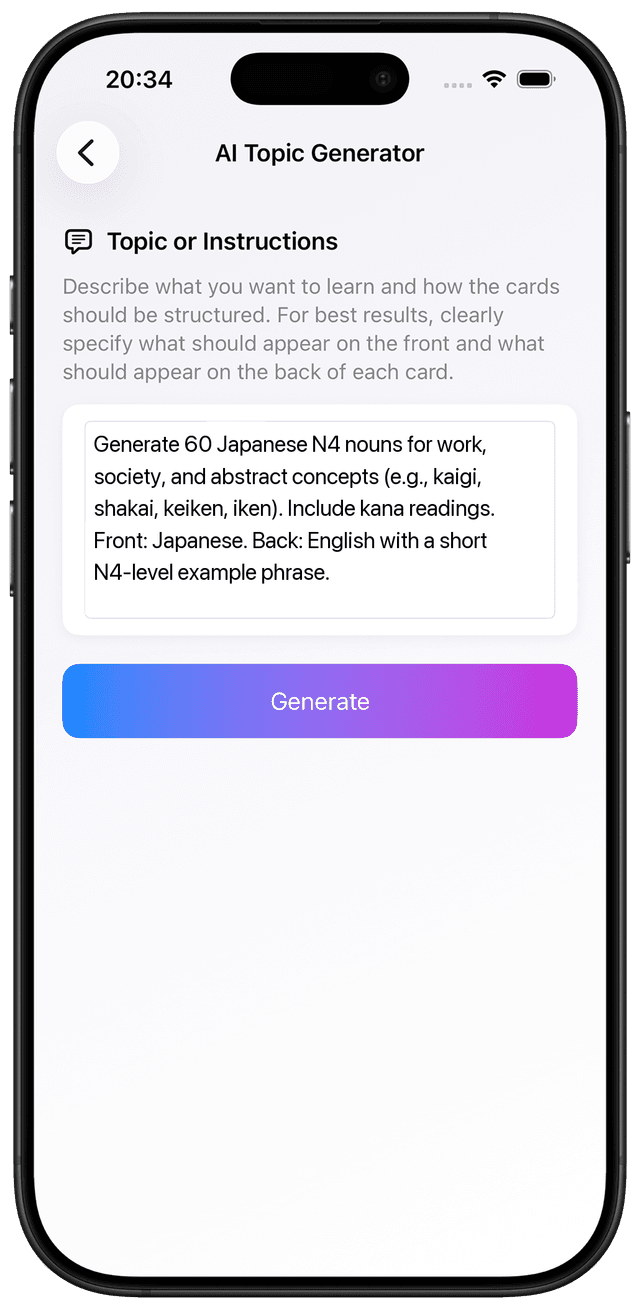
At N4, conversations move beyond family and daily routines into work, community, society, and abstract topics. These nouns carry more of the meaning load in N4 reading passages.
Why this matters: N4 listening tasks often involve workplace or community settings that N5 vocabulary does not cover.
The Strategy: Group nouns by domain (office, town, society). When words share a context, the surrounding words reinforce each other during review.
Generate 60 Japanese N4 nouns for work, society, and abstract concepts (e.g., 会議, 社会, 経験, 意見). Include kana readings. Front: Japanese. Back: English with a short N4-level example phrase.
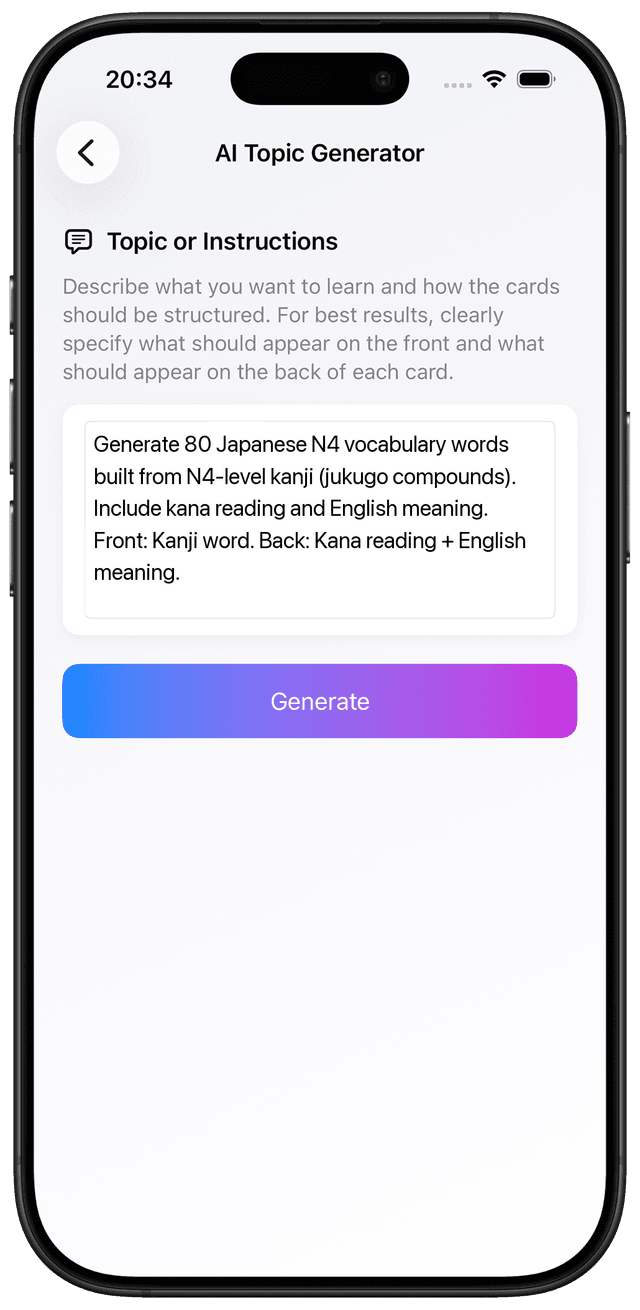
JLPT N4 expects knowledge of around 300 kanji. Rather than drilling kanji in isolation, this phase targets the most common N4 vocabulary words built from those kanji so you learn characters and meaning together.
Why kanji vocabulary, not kanji alone? Recognizing kanji inside real words is what matters on the N4 exam. Isolated stroke drills build little reading fluency.
The Strategy: Use kanji compound words (2-character jukugo) as your study units. Knowing the compound is more useful than knowing the individual kanji in isolation.
Generate 80 Japanese N4 vocabulary words built from N4-level kanji (jukugo compounds). Include kana reading and English meaning. Front: Kanji word. Back: Kana reading + English meaning.
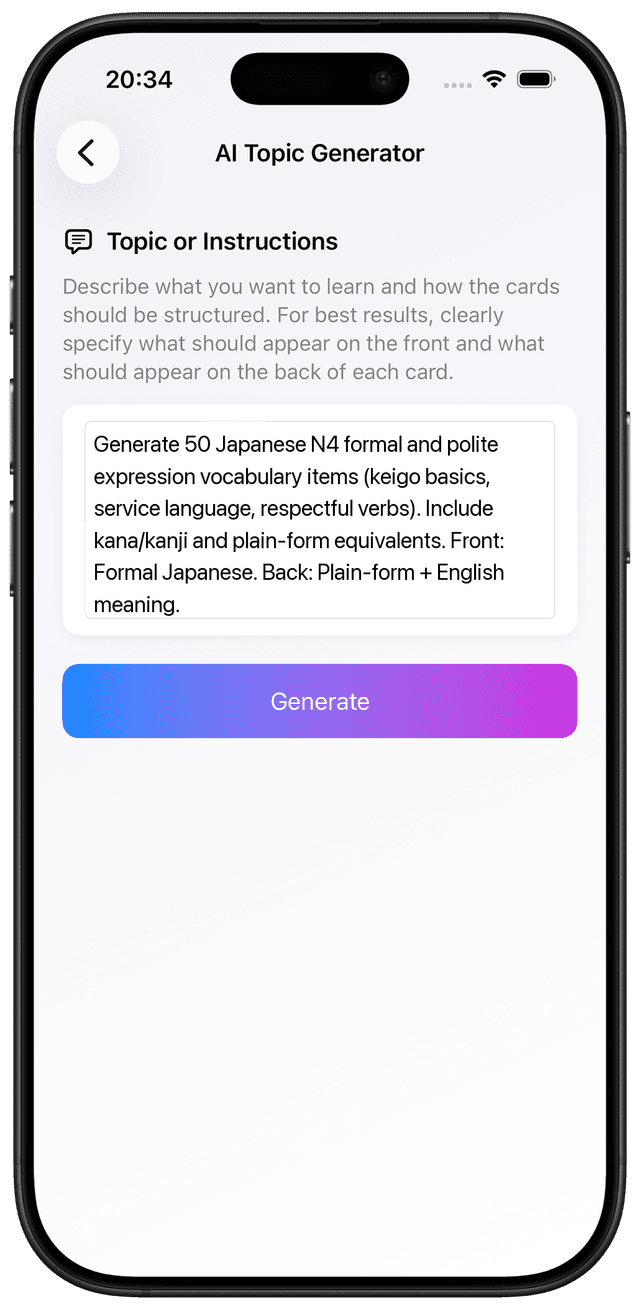
Japanese has distinct registers for formal and informal situations. N4 introduces the vocabulary of polite speech (keigo basics) used in shops, offices, and with people you respect. Getting these words wrong in real Japan can cause real awkwardness.
Goal: Recognize and use the most common formal vocabulary items that appear in N4 dialogues and reading tasks involving service, work, and social situations.
Generate 50 Japanese N4 formal and polite expression vocabulary items (keigo basics, service language, respectful verbs). Include kana/kanji and plain-form equivalents. Front: Formal Japanese. Back: Plain-form + English meaning.
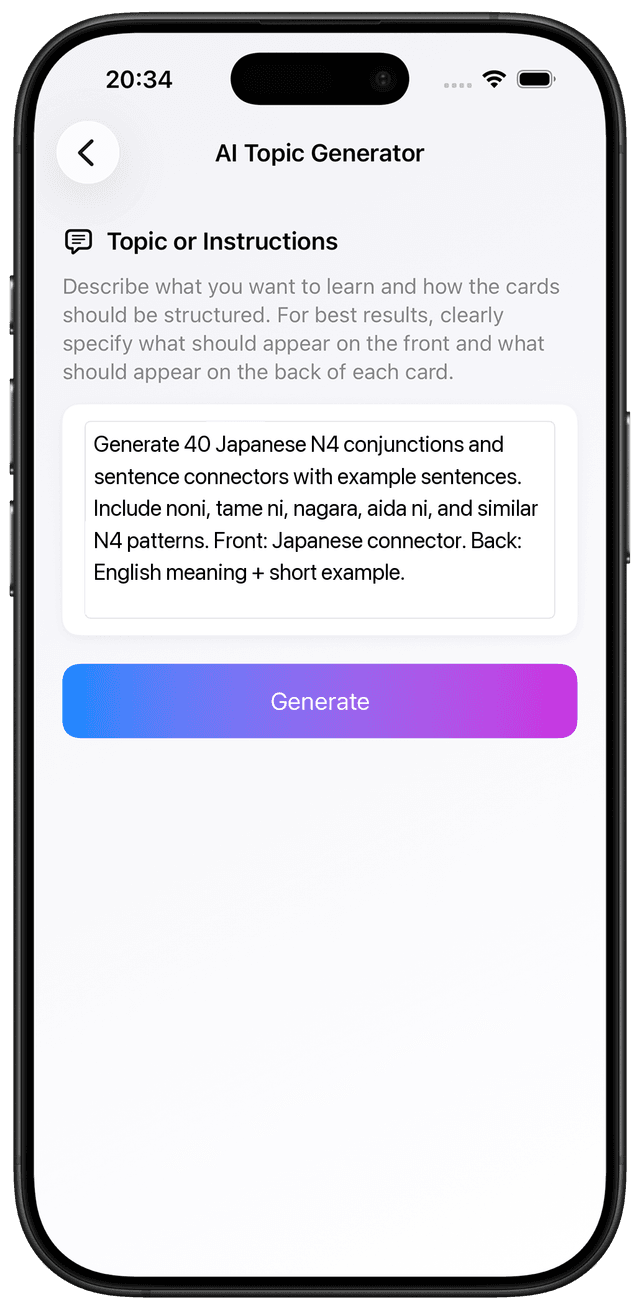
N4 reading passages use complex sentences joined by conjunctions and connectors. Knowing words like のに, ために, ながら, and あいだに is what lets you parse multi-clause sentences rather than guessing.
Why now? Connectors are not glamorous vocabulary, but they decide whether you understand long reading passages or get lost in them. N4 test sections include paragraphs where connector choice changes the whole meaning.
Generate 40 Japanese N4 conjunctions and sentence connectors with example sentences. Include のに, ために, ながら, あいだに, and similar N4 patterns. Front: Japanese connector. Back: English meaning + short example.
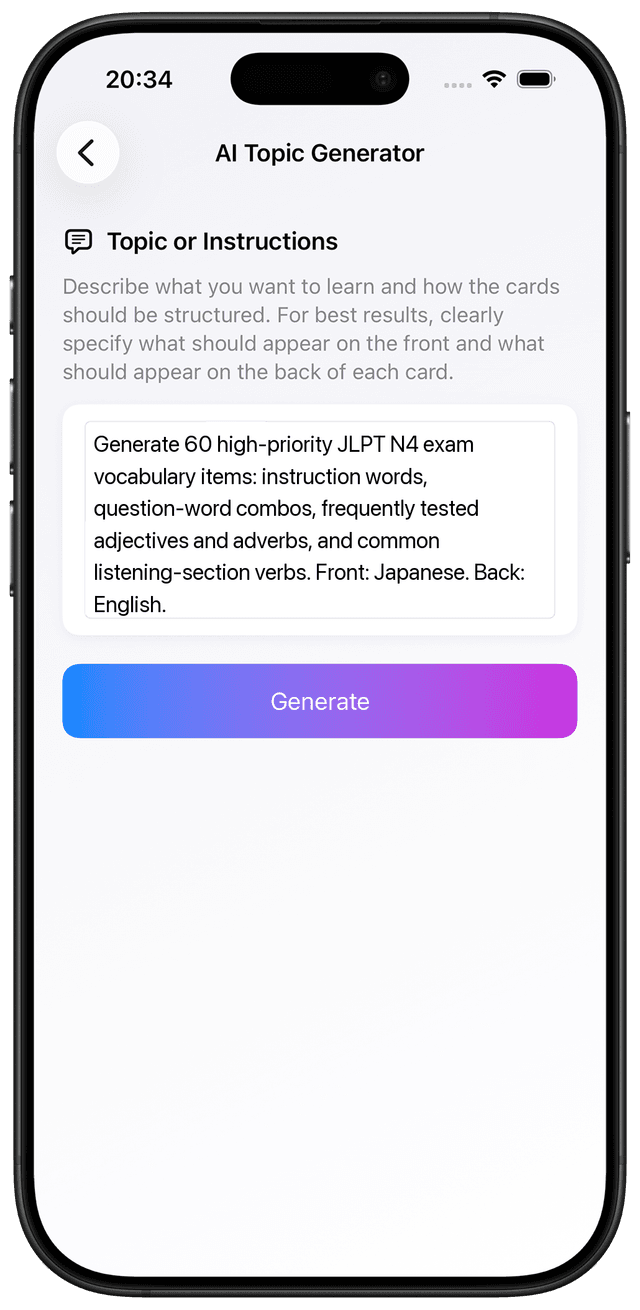
Finish with the N4 vocabulary most likely to appear on the JLPT: exam instruction words, question-word combinations, high-frequency adjective and adverb pairs, and verb forms commonly tested in listening comprehension.
Milestone: At this stage, your N4 vocabulary base covers the core words needed for the JLPT N4 language knowledge, reading, and listening sections.
Generate 60 high-priority JLPT N4 exam vocabulary items: instruction words, question-word combos, frequently tested adjectives and adverbs, and common listening-section verbs. Front: Japanese. Back: English.
MindCards combines active recall and spaced repetition to move N4 vocabulary from passive recognition to active use in reading and listening tasks.
N4 vocabulary works best when paired with N5 foundations and script practice. Once you have N4 covered, move up to N3.
Build intermediate Japanese with smart flashcards, AI deck generation, and spaced repetition designed for real JLPT N4 progress.