
Spaced repetition explained
Why spacing reviews is the most efficient way to lock in N2 vocabulary long-term.
N2 is the level where Japanese starts to look like the real thing. Newspapers, business emails, formal speeches. At N3 you learned to read with some guesswork. At N2 that stops working. The passages are longer, the vocabulary is formal, and there is no friendly furigana to save you.
Most learners who hit N2 after N3 are surprised by how much the vocabulary register shifts. Everyday conversation words do not carry you far. You need formal nouns from business and academic writing, transitive and intransitive verb pairs that appear in grammar questions, and newspaper-register language that makes up most of the reading section.
This guide gives you seven focused phases to build the 1,000+ words that define N2 competency. Use the prompts below to generate targeted decks in MindCards and let spaced repetition handle the long-term work.
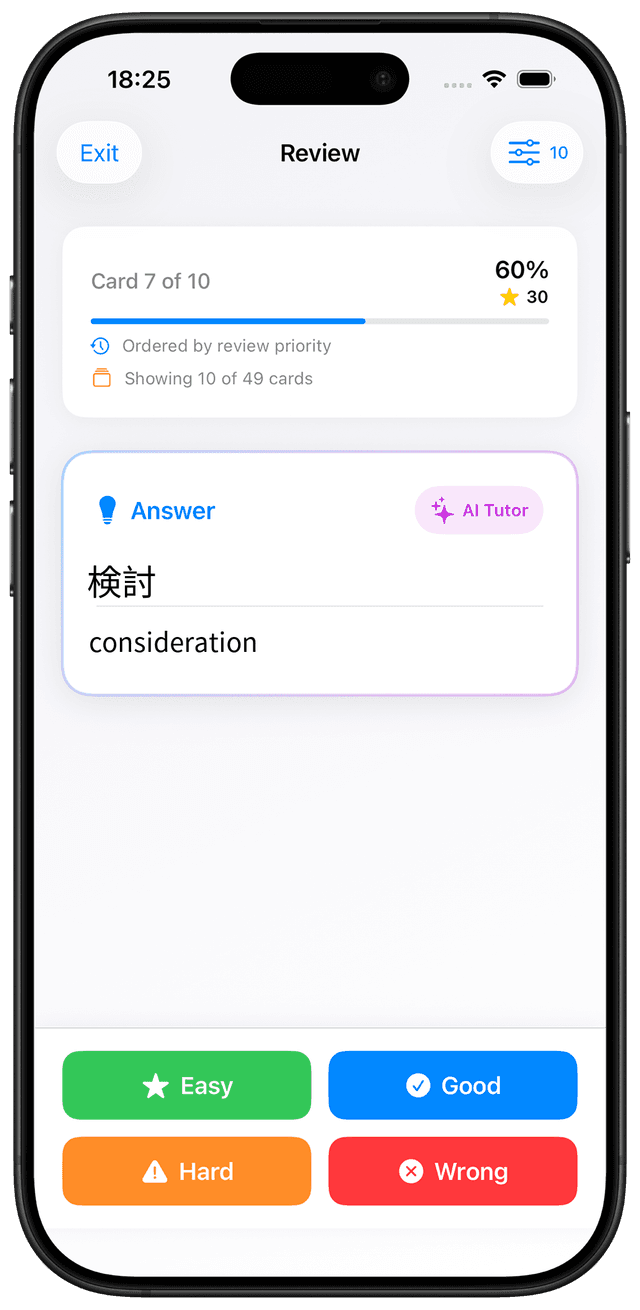
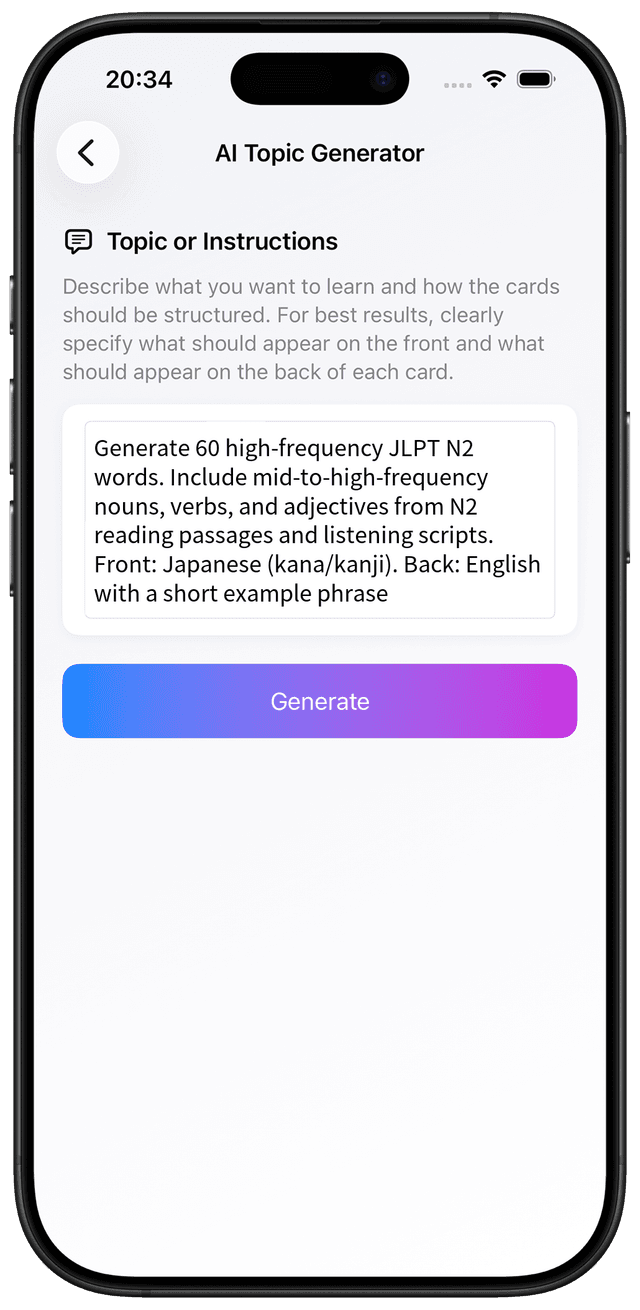
Start with the words that show up constantly in N2-level reading passages, listening scripts, and grammar exercises. These are mid-to-high-frequency nouns and verbs that you will encounter before anything else at this level.
Why start here? Many learners who pass N3 underestimate how much the vocabulary shifts at N2. The words get more formal, more abstract, and much less predictable from context alone. This phase builds the recognition base so every later phase feels manageable.
The strategy: Keep a dedicated N2 core deck separate from any N3 maintenance deck. Review both daily in short sessions. The overlap in difficulty will make N2 words feel natural faster.
Generate 60 high-frequency JLPT N2 words. Include mid-to-high-frequency nouns, verbs, and adjectives from N2 reading passages and listening scripts. Front: Japanese (kana/kanji). Back: English with a short example phrase.
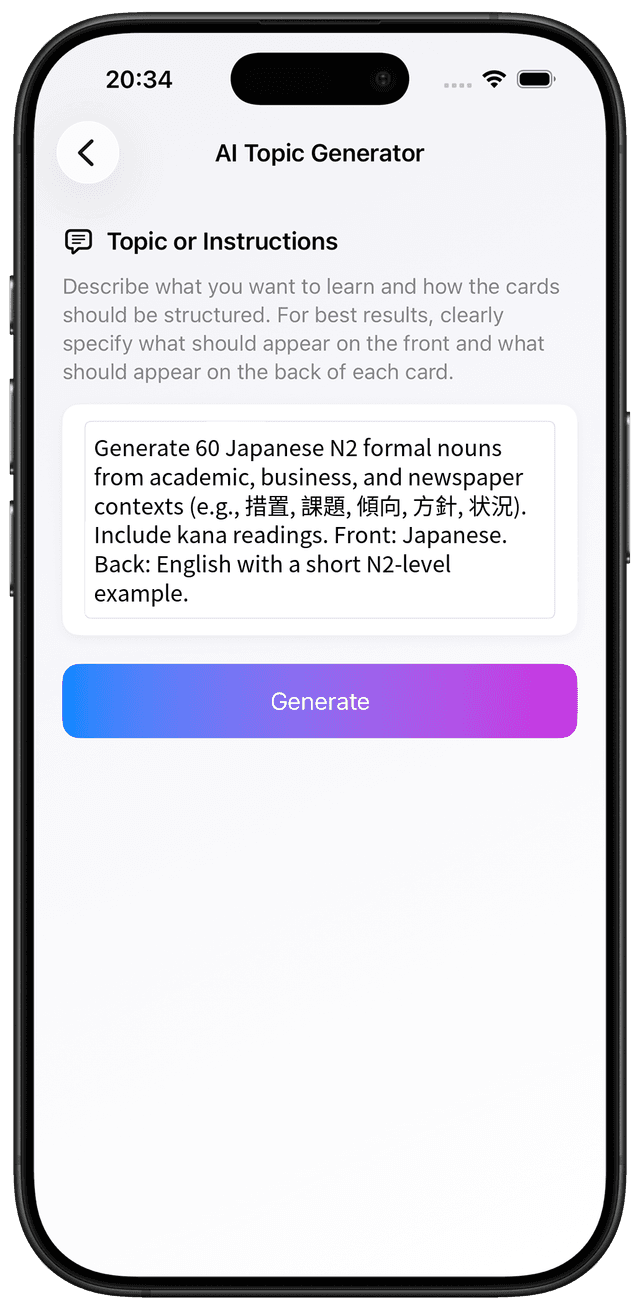
N2 reading passages pull heavily from newspaper editorials, business reports, and academic texts. You need formal nouns like 措置 (sochi, measure), 課題 (kadai, issue/task), 傾向 (keiko, tendency), and 方針 (hoshin, policy) to read these texts without stopping every few lines.
Why this next? Formal nouns carry the main arguments in N2 reading sections. Knowing them turns editorial passages from opaque blocks into parseable text.
The strategy: Group formal nouns by domain: business words together, academic words together, policy words together. Words that share a register reinforce each other during spaced repetition sessions.
Generate 60 Japanese N2 formal and written nouns from academic, business, and newspaper contexts (e.g., 措置, 課題, 傾向, 方針, 状況). Include kana readings. Front: Japanese. Back: English with a short N2-level example phrase.
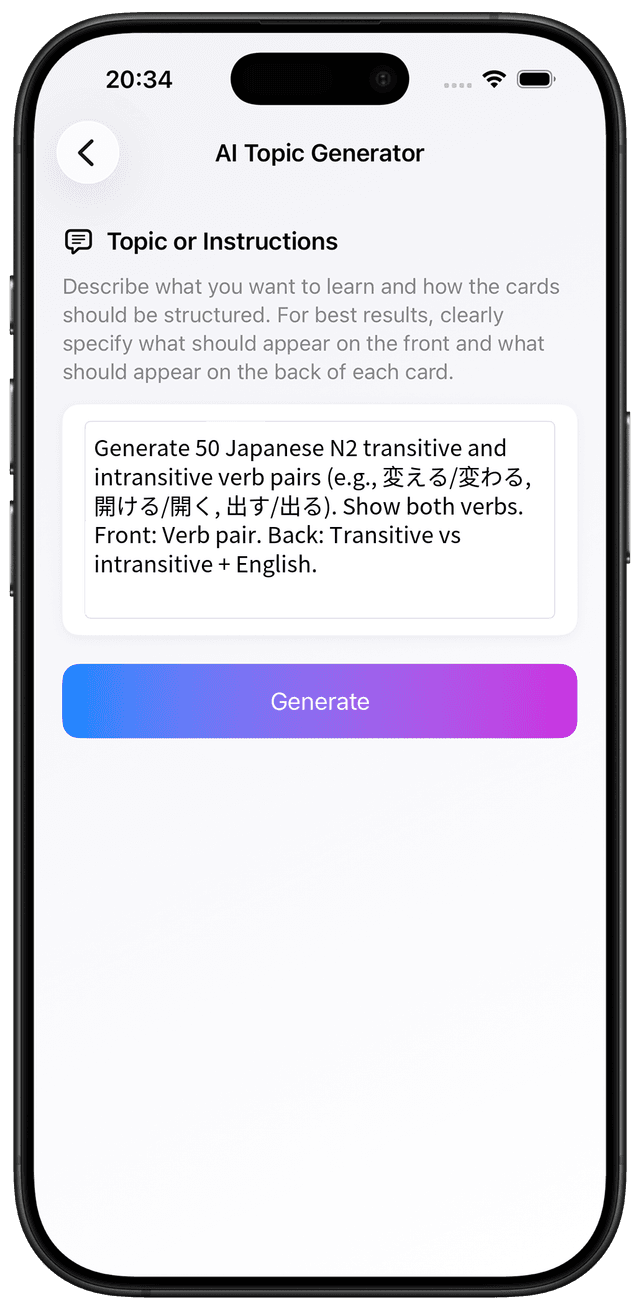
Japanese has paired verbs where one takes a direct object and the other does not. At N2, pairs like 変える (kaeru, to change something) vs 変わる (kawaru, to change on its own), or 開ける (akeru, to open) vs 開く (aku, to open by itself) appear in grammar and reading questions that specifically test whether you can tell them apart.
Why this matters: N2 grammar questions regularly use transitive/intransitive pairs as the point of contrast. Misreading which verb is which changes the meaning of a whole sentence and leads to wrong answers in reading comprehension.
The strategy: Always study the pair together on one card. Front: both verbs. Back: which is transitive, which is intransitive, plus one example sentence each.
Generate 50 Japanese N2 transitive and intransitive verb pairs (e.g., 変える/変わる, 開ける/開く, 出す/出る, 増やす/増える). Show both verbs with English meaning and mark which is transitive. Front: Verb pair. Back: Transitive vs intransitive + English.
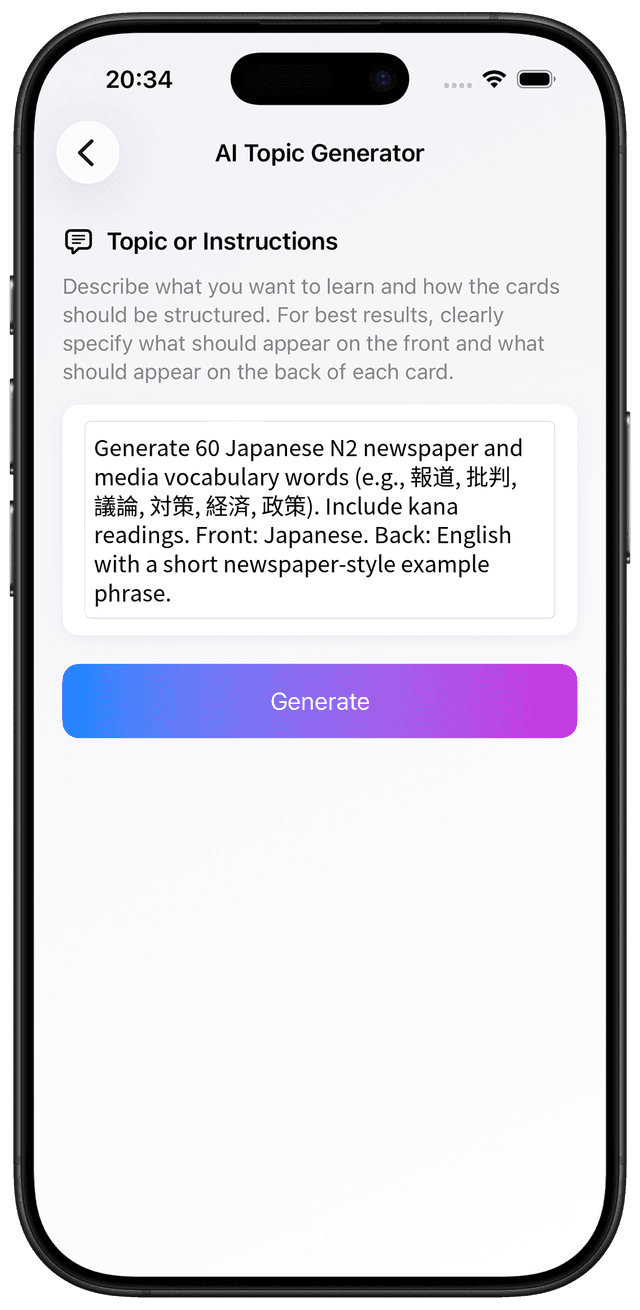
A big part of N2 reading uses authentic-style newspaper language. Words like 報道 (hodo, reporting), 批判 (hihan, criticism), 議論 (giron, debate), and 対策 (taisaku, countermeasure) come up in passages about current events, social issues, and public policy.
Why newspaper vocabulary specifically? The N2 reading section uses passages modeled on authentic media text. If you have only studied conversation-level Japanese, this register gap will cost you points.
The strategy: Read short NHK Web Easy articles alongside building this deck. The words you study in MindCards will start appearing in real text, which dramatically speeds up retention.
Generate 60 Japanese N2 newspaper and media vocabulary words (e.g., 報道, 批判, 議論, 対策, 経済, 政策). Include kana readings and English meanings. Front: Japanese. Back: English with a short newspaper-style example phrase.
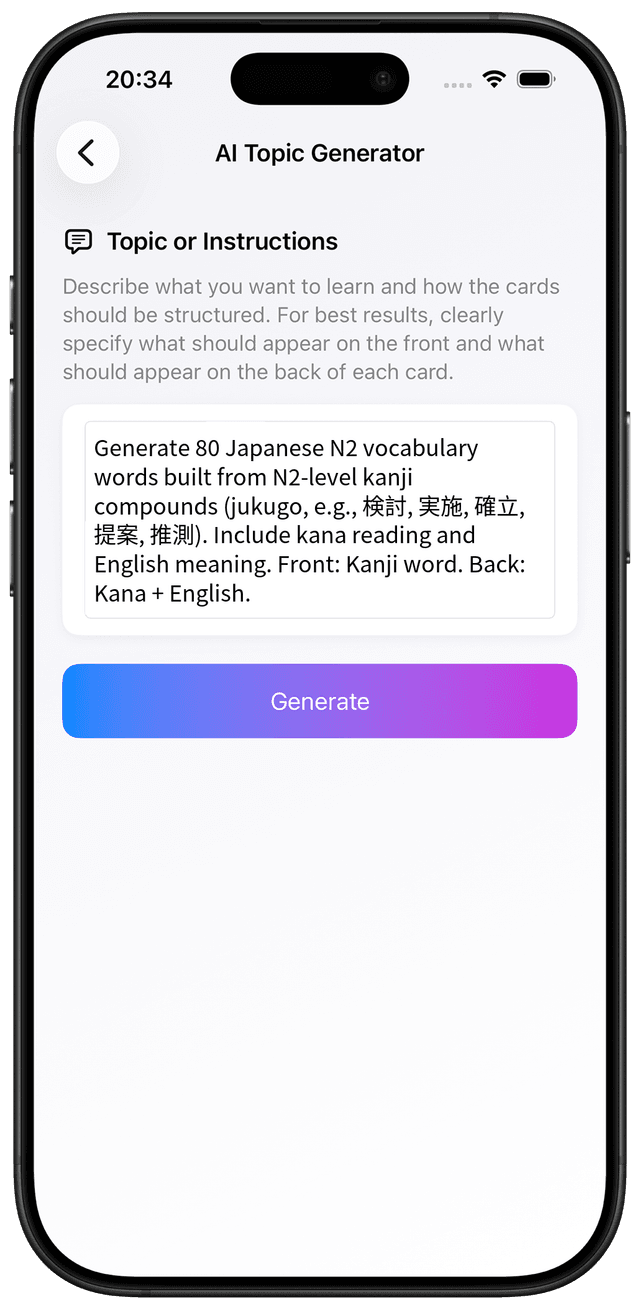
JLPT N2 expects around 1,000 kanji. The exam tests you on readings inside compound words, not characters in isolation. This phase targets the vocabulary items built from N2-level kanji that appear most often in N2 reading and language knowledge sections.
Why compounds over isolated kanji? A kanji you know in isolation will not automatically help you read 検討 (kento, examination/consideration) or 実施 (jisshi, implementation) under time pressure. The compound is the unit the exam actually tests.
The strategy: Use three-character and four-character compounds alongside two-character jukugo. Longer compounds are often built from predictable parts, and recognizing that pattern gives you a reading shortcut for unfamiliar words on exam day.
Generate 80 Japanese N2 vocabulary words built from N2-level kanji compounds (jukugo, e.g., 検討, 実施, 確立, 提案, 推測). Include kana reading and English meaning. Front: Kanji word. Back: Kana reading + English meaning.
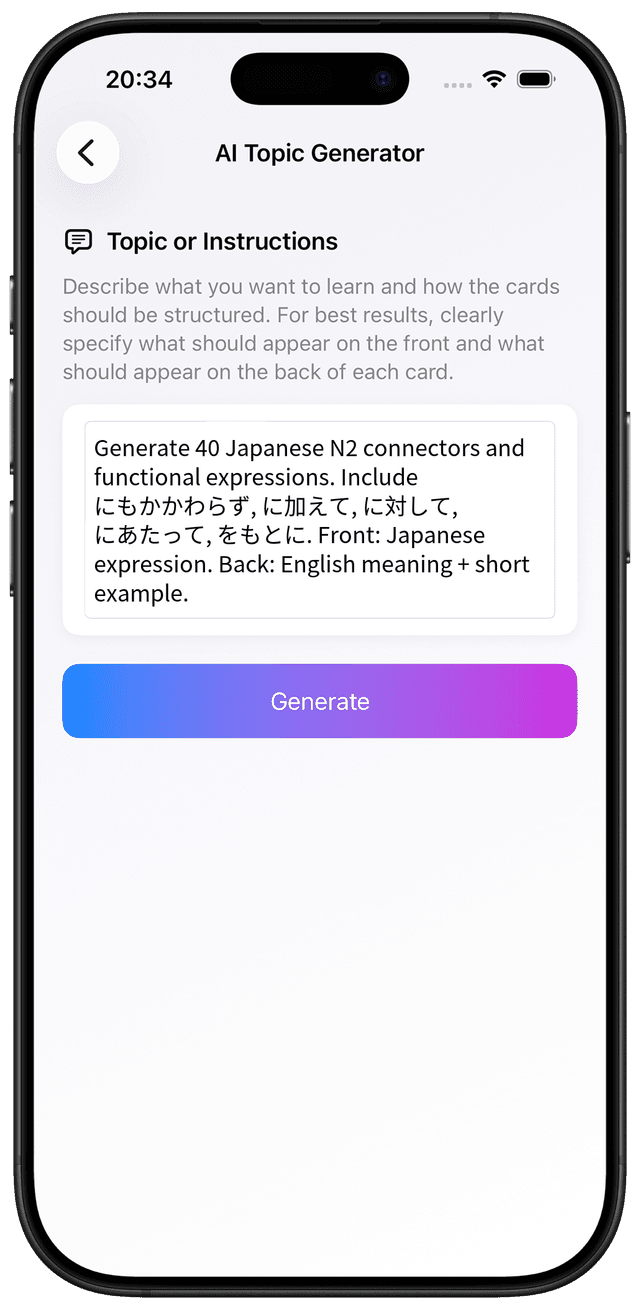
N2 reading passages use connectors that do more than link clauses. Expressions like にもかかわらず (despite), に加えて (in addition to), に対して (in contrast to), and にあたって (upon the occasion of) signal argument structure. If you do not know these, you cannot follow the author's reasoning.
Why now? N2 reading questions often ask about the author's position or the relationship between ideas. That relationship is signaled by these expressions. Knowing them turns comprehension questions from guesses into straightforward analysis.
The strategy: Study each connector with a before-and-after sentence pair. The pair teaches you the directional logic, not just an English gloss.
Generate 40 Japanese N2 advanced connectors and functional expressions with example sentences. Include にもかかわらず, に加えて, に対して, にあたって, をもとに, and similar N2 patterns. Front: Japanese expression. Back: English meaning + short example.
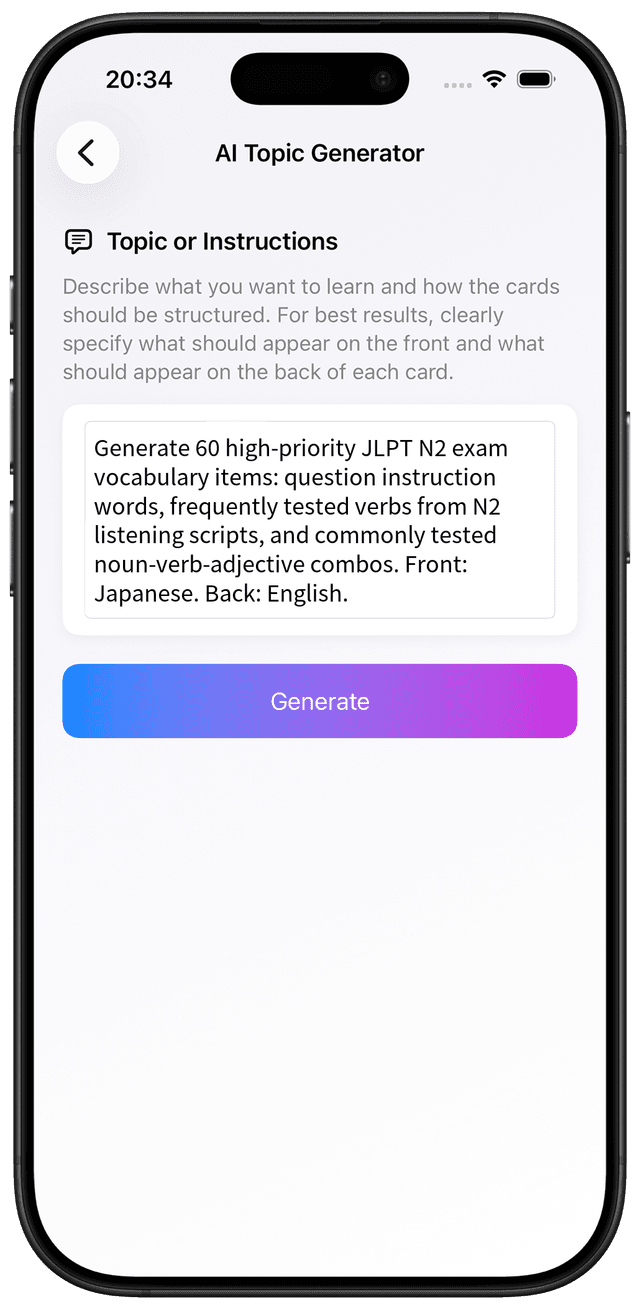
Close out your N2 preparation with the vocabulary patterns most tested across all three N2 sections. This includes instruction vocabulary used in exam questions, high-frequency verbs from N2 listening scripts, and words that show up repeatedly in N2 language knowledge (grammar and vocabulary) sections.
Milestone: After this phase, your N2 vocabulary base covers the core words needed for the language knowledge, reading, and listening sections. The goal here is not just recognition but automatic retrieval when you are working under exam time pressure.
Generate 60 high-priority JLPT N2 exam vocabulary items: question instruction words, frequently tested verbs from N2 listening scripts, and commonly tested noun-verb-adjective combinations. Front: Japanese. Back: English.
MindCards combines active recall and spaced repetition to move N2 vocabulary from passive recognition to automatic retrieval under exam time pressure.
N2 vocabulary builds on N3 foundations. Work through N3 first if you have not already, then return here when you are ready to step up.
Build advanced Japanese with smart flashcards, AI deck generation, and spaced repetition designed for real JLPT N2 progress.