
Spaced repetition explained
Why reviewing at the right interval is the key to retaining mastery-level German vocabulary
You have C1 German. You can switch registers, write a structured Erörterung, and read a literary novel without pausing every paragraph. C2 is where the effort drops away entirely. The mental work of monitoring your German fades, you reach for the right idiom without thinking, and you can produce written German that does not read as translated.
This guide covers the 1,000+ vocabulary items that close the remaining gap between advanced and near-native German. Idiomatic collocations come first, since wrong word pairings are the single most visible signal of a non-native writer. Then literary register, rhetorical devices for written production, fine-grained Konjunktiv and modal choices, German Sprichwörter in real context, fixed expressions for legal and academic work, and regional awareness across Germany, Austria, and Switzerland.
Each of the seven phases below includes a ready-to-use AI prompt. Paste it into MindCards and your first deck for that topic builds in seconds. Spaced repetition then schedules each card at the right interval, so your review time goes to the items you are actually forgetting and not the ones you have already locked in.
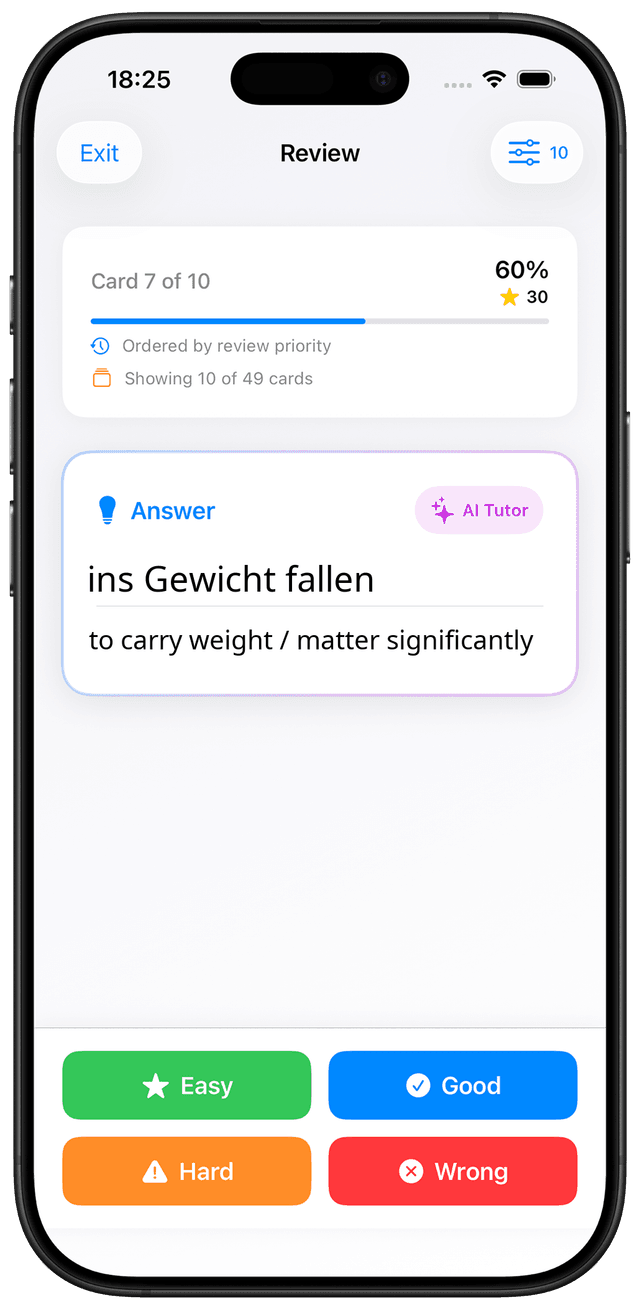
C2 German is not a longer word list. It is the habit of combining words the way educated native speakers do. The distance from C1 is mostly collocational: natives reach for whole chunks without thinking. Eine Entscheidung treffen, eine Frage aufwerfen, einen Beitrag leisten, Maßnahmen ergreifen, in Erscheinung treten, zur Sprache kommen, ins Gewicht fallen. Each chunk is automatic for a German speaker and deliberate for a learner, and that deliberateness is what the Goethe C2 examiners spot before anything else.
Why start here? Collocational fluency is the most reliable marker of C2 German. The Goethe-Zertifikat C2 schriftlicher Ausdruck and educated readers notice unusual word pairings before they notice grammar slips. This phase targets 200 of the most frequent verb-noun, adjective-noun, and Funktionsverbgefüge combinations from contemporary German press, academic essays, and educated speech.
The strategy: Each card pairs the full collocation with a native-context sentence and a common learner error to contrast. You build recognition and production together rather than separately.
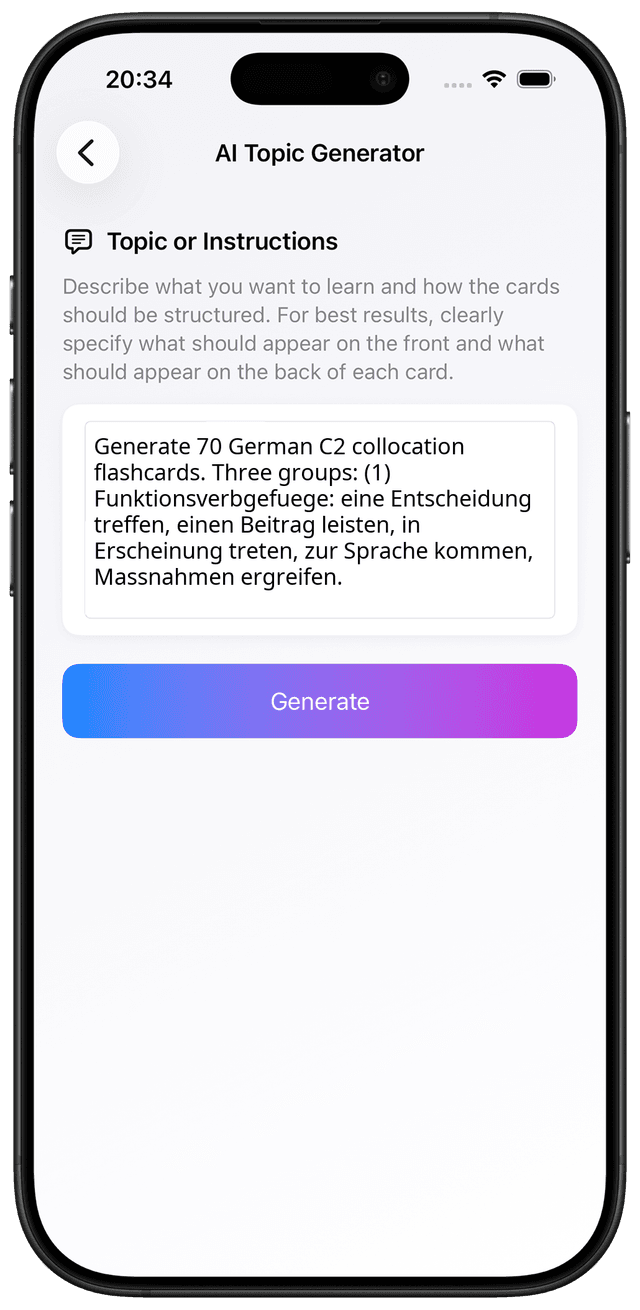
Generate 70 German C2 collocation flashcards. Three groups: (1) Funktionsverbgefüge: eine Entscheidung treffen, einen Beitrag leisten, in Erscheinung treten, zur Sprache kommen, Maßnahmen ergreifen, einen Antrag stellen, in Frage stellen, zur Verfügung stellen, in Betracht ziehen, einen Vergleich anstellen. (2) Verb-noun and adjective-noun chunks: ein Augenmerk richten auf, eine Lücke schließen, einen Schwerpunkt setzen, gravierende Folgen, weitreichende Konsequenzen, ein triftiger Grund, eine fundierte Analyse, ein heikles Thema. (3) Common learner errors to contrast: eine Frage stellen vs eine Frage machen, eine Entscheidung treffen vs eine Entscheidung machen, einen Fehler machen vs einen Fehler tun, sich Mühe geben vs Mühe machen. Front: German collocation + example sentence. Back: English equivalent + note on register or common error.
Reading Sebald, Jelinek, Kehlmann, Erpenbeck, or going back to Thomas Mann without leaning on a dictionary requires a vocabulary set that sits between formal and literary German. This is not the vocabulary of newspaper journalism or business writing. It is the vocabulary of inneres Erleben, lyrical description, and authorial reflection that fills serious German fiction. The same vocabulary turns up in literary criticism, essay collections, and feuilleton journalism in the Süddeutsche Zeitung and the FAZ.
The goal: To give you enough literary register vocabulary that you can read a novel passage and follow the narrative choices the author is making, not just the plot. This matters for the Goethe C2 Leseverstehen module and for your written production, where literary echoes are valued at this level in a way they are not at C1.
The strategy: The deck draws from passages in major German-language literary works. Each card includes a source context, the literary function, and how the same term reads in contemporary non-literary use.
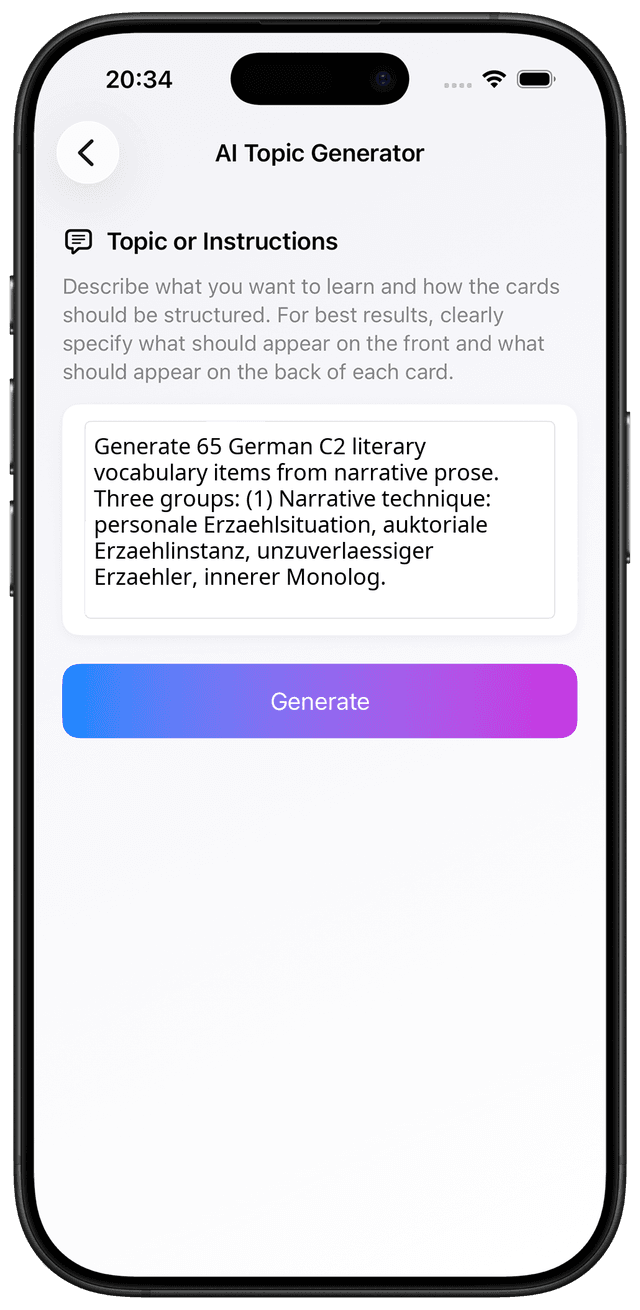
Generate 65 German C2 literary vocabulary items from narrative prose and poetry. Three groups: (1) Narrative technique: die personale Erzählsituation, die auktoriale Erzählinstanz, der unzuverlässige Erzähler, der Bewusstseinsstrom, der innere Monolog, die erlebte Rede, die Mise en abyme, die Leerstelle. (2) Lyrical and descriptive: die Dämmerung, das Zwielicht, vergänglich, verstohlen, die Schwermut, die Sehnsucht, die Beklemmung, das Innehalten, die Wehmut. (3) Authorial stance: die dramatische Ironie, die bewusste Ambivalenz, die auktoriale Distanz, der Perspektivenwechsel, die Digression, die Metafiktion. Front: German term + sentence from a literary context. Back: English equivalent + literary function label.
Goethe C2 schriftlicher Ausdruck asks you to produce essayistic German of the kind that runs in the Zeit feuilleton or in serious commentary in the FAZ. That means deploying rhetorical devices on purpose: Antithese to sharpen a contrast, Anapher to build rhythm across sentences, a well-placed rhetorische Frage to shift the reader's stance. In German argumentative prose these are not flourishes. They are expected tools, and their absence reads as a flat list of statements.
Why this matters: Most C1 writers can avoid rhetorical figures entirely and still produce a grammatically clean essay. At C2 that absence is itself the marker of non-native writing. German assessors are reading for evidence of stylistic control, not just accuracy.
The strategy: Cards cover the rhetorical figures and argument moves that recur in German editorial and academic writing. Each card carries a real example and a note on when the device strengthens the argument and when it tips into overreach.
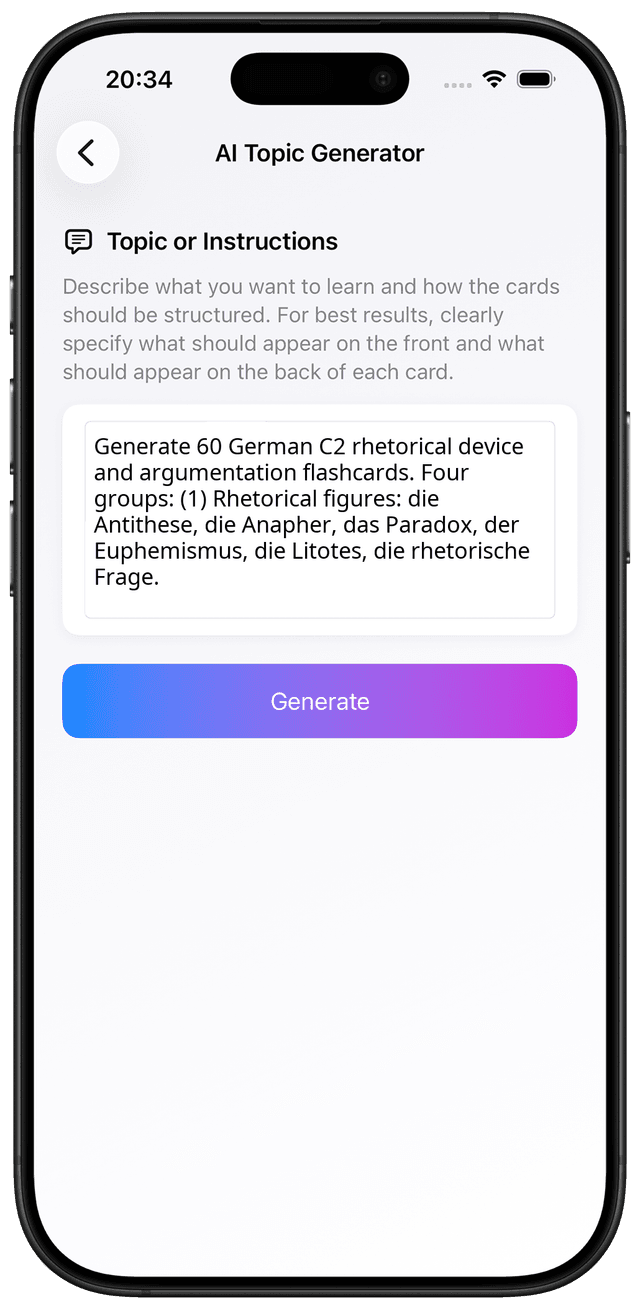
Generate 60 German C2 rhetorical device and argumentation flashcards. Four groups: (1) Rhetorical figures: die Antithese, die Anapher, das Paradox, der Euphemismus, die Litotes, die Periphrase, die rhetorische Frage, der Chiasmus, das Oxymoron, die Klimax. (2) Editorial argument structures: zwar... doch, es lässt sich nicht von der Hand weisen, dem ist entgegenzuhalten, hier zeigt sich die eigentliche Schwierigkeit, worum es im Kern geht ist, vor diesem Hintergrund stellt sich die Frage. (3) Register elevation phrases: es liegt auf der Hand, es bedarf keiner näheren Erörterung, in jeder Hinsicht, an sich, jenseits aller Beteuerungen. (4) Persuasion and concession at C2: selbst die größten Skeptiker werden zugeben müssen, keine ernsthafte Analyse kann ignorieren. Front: device or phrase + example in editorial context. Back: English + rhetorical label.
C1 Konjunktiv is about applying the rules: indirect speech, polite requests, irrealis. C2 Konjunktiv is about the choices native writers make inside those rules. Konjunktiv I vs Konjunktiv II in journalism, where one signals neutral reporting and the other signals authorial distance. Würde-paraphrases vs synthetic Konjunktiv II in literary prose, where the choice shifts register noticeably. Modal verbs in their epistemic uses (er dürfte angekommen sein, das mag stimmen, sie will das nicht gewusst haben), where the meaning is closer to evidential than to permission or ability.
The goal: To read these choices in German texts and make them yourself. At C2 you are expected to handle indirect speech in long news articles, modal evidentials in court reporting, and Konjunktiv shifts in literary prose without losing the thread.
The strategy: The deck presents minimal pairs and short passages. The same sentence shifts mood or modal verb and the meaning changes. You learn to feel the difference rather than just apply the rule.
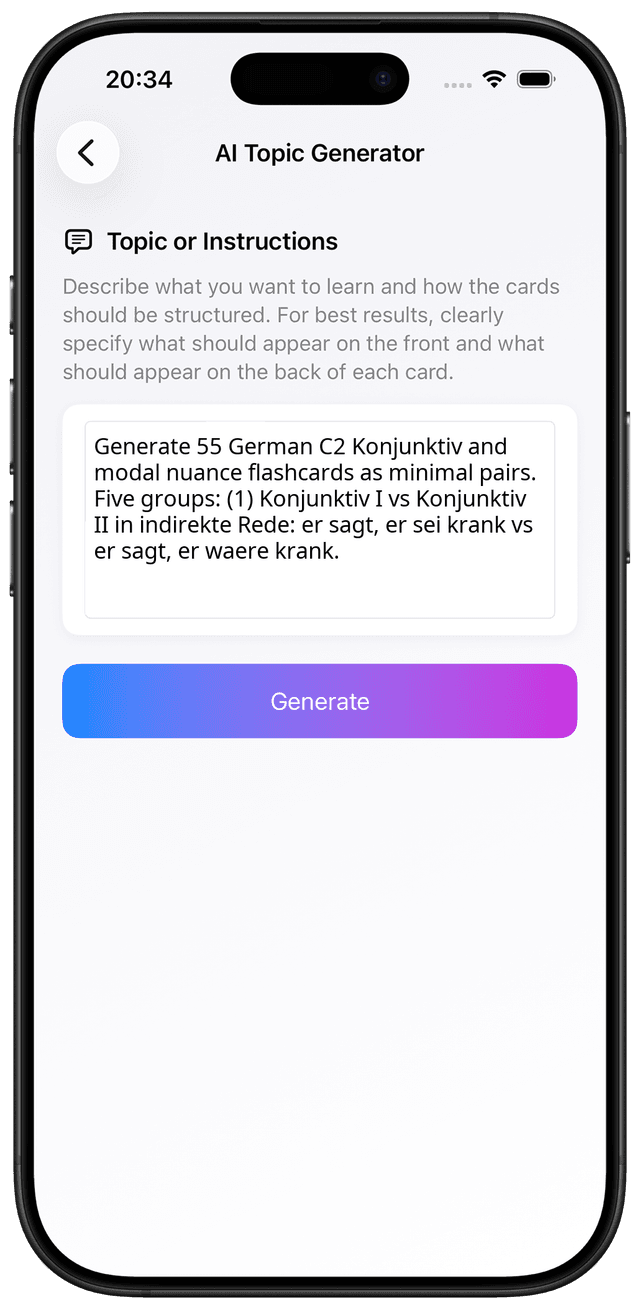
Generate 55 German C2 Konjunktiv and modal nuance flashcards as minimal pairs and short passages. Five groups: (1) Konjunktiv I vs Konjunktiv II in indirekte Rede: er sagt, er sei krank vs er sagt, er wäre krank (skepticism). (2) Würde-paraphrase vs synthetic Konjunktiv II: er würde kommen vs er käme (register). (3) Epistemic modal verbs: er dürfte angekommen sein, das mag stimmen, sie will davon nichts gewusst haben, er soll ein Vermögen besitzen. (4) Konjunktiv in concessive and conditional clauses: sei es, dass; käme es zu; wäre dem so. (5) Irrealis in literary register: hätte er gewusst, wäre er gekommen; ginge es nach mir. Front: pair of German sentences. Back: English for both + note on the meaning or register difference.
German Sprichwörter and Redewendungen are not optional decoration at C2. Native speakers reach for them in conversation, political debate, journalism, and literary prose. Was du heute kannst besorgen, das verschiebe nicht auf morgen. Wer A sagt, muss auch B sagen. Steter Tropfen höhlt den Stein. Knowing what these mean, recognising them in context, and placing one well in your own writing is a concrete signal of near-native competence in German.
Why add this now? Sprichwörter index cultural knowledge, not just linguistic knowledge. A C2 user understands that German proverbs carry ironic weight in discourse and that misusing one is worse than not using one at all. This phase covers the 50 Sprichwörter with the highest frequency in contemporary usage, plus 30 fixed expressions specific to journalistic, legal, and educated everyday speech.
The strategy: Cards show the Sprichwort, its literal meaning, its pragmatic use, and a model sentence showing how a German speaker would actually introduce it in conversation or in a piece of writing.
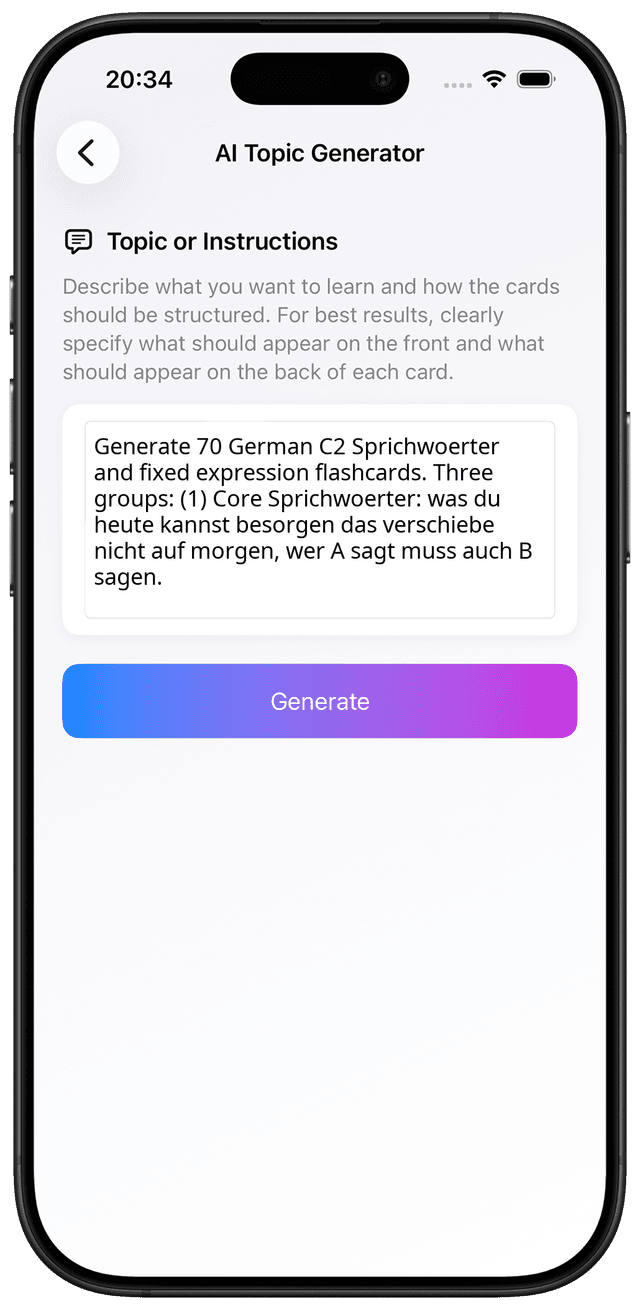
Generate 70 German C2 Sprichwörter and fixed expression flashcards. Three groups: (1) Core Sprichwörter: was du heute kannst besorgen das verschiebe nicht auf morgen, wer A sagt muss auch B sagen, steter Tropfen höhlt den Stein, der Apfel fällt nicht weit vom Stamm, viele Köche verderben den Brei, kleine Geschenke erhalten die Freundschaft, lügen haben kurze Beine, Reden ist Silber Schweigen ist Gold. (2) Journalistic and political fixed phrases: jemandem den Wind aus den Segeln nehmen, etwas in die Wege leiten, eine Bresche schlagen, ein Schlaglicht werfen auf, die Karten auf den Tisch legen, einen Schlussstrich ziehen, den Rubikon überschreiten. (3) Formal and legal fixed phrases: nach Maßgabe von, unter Berücksichtigung von, im Sinne des Gesetzes, vorbehaltlich, im Rahmen des geltenden Rechts. Front: German expression + context sentence. Back: English equivalent + usage note on register and frequency.
German law, scholarship, and public administration share a fixed vocabulary that does not flex into casual register. If you are translating, practising law, doing academic research, or working in policy in a German-speaking context, this vocabulary is not optional. Gemäß Paragraph. Das Gericht hat zugunsten von... entschieden. Die Ergebnisse stützen die Ausgangshypothese. These phrases turn up in real documents every day, and getting them wrong marks your text immediately as non-native to anyone reading it professionally.
The goal: To build active command of the 150 most common fixed expressions in German legal texts (Urteile, Beschlüsse), academic papers, and administrative correspondence. The line between near-C2 and true C2 in professional German contexts often runs through whether you can produce these phrases yourself rather than just recognise them.
The strategy: Phrases are grouped by document type: Gerichtsurteile, akademische Abstracts, behördliche Schreiben, and regulatory texts. Each card shows the phrase inside a realistic document extract.
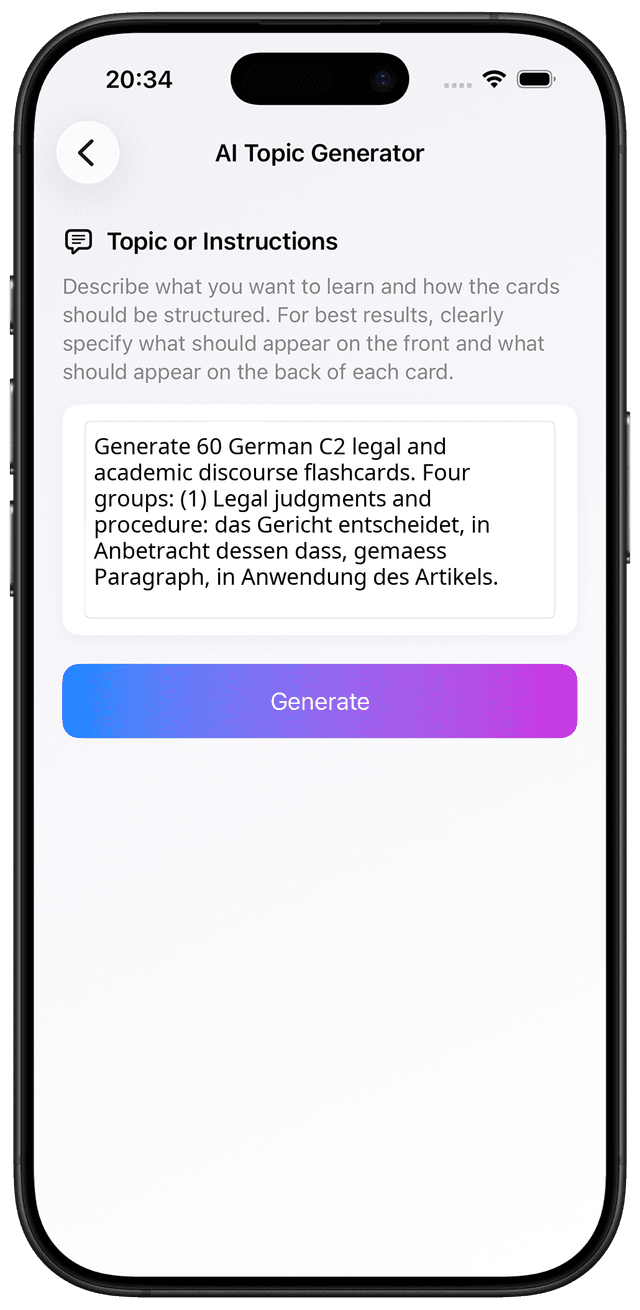
Generate 60 German C2 legal and academic discourse flashcards. Four groups: (1) Legal judgments and procedure: das Gericht entscheidet, in Anbetracht dessen dass, gemäß Paragraph, in Anwendung des Artikels, der Klage wird stattgegeben, die Klage wird abgewiesen, die Revision wird zurückgewiesen. (2) Academic writing: die Ergebnisse stützen, die Untersuchung zeigt deutlich, aus den Daten geht hervor, in Anlehnung an frühere Studien, daraus lässt sich schließen, diese Hypothese bedarf jedoch einer Einschränkung. (3) Official correspondence: in Bezug auf Ihr Schreiben, hiermit teile ich Ihnen mit, ich stehe Ihnen für Rückfragen zur Verfügung, in Erwartung Ihrer Antwort, mit vorzüglicher Hochachtung. (4) Regulatory and policy texts: im Rahmen der geltenden Rechtslage, vorbehaltlich, unbeschadet der Rechte, zu den in Paragraph genannten Zwecken. Front: phrase + document context. Back: English + document type label.
C2 mastery requires understanding that Standard German is not one variety. A text written in Vienna reads differently from one written in Hamburg, which reads differently from one written in Zurich. At this level you are expected to recognise these differences and tailor your own German to your audience. The lexical splits between Bundesdeutsch, österreichisches Deutsch, and Schweizerdeutsch (in its written Standard form) are real, and so are the pragmatic norms around grammatical politeness and address.
Why this matters: Goethe C2 listening and reading texts draw from across the German-speaking area. If you are working professionally in German, you will encounter clients, colleagues, and documents from Germany, Austria, and Switzerland. Knowing that Jänner is Januar in Austria, that Velo is Fahrrad in Switzerland, or that Rahm is Sahne in southern Germany and Switzerland is basic professional competence in the German-speaking labour market.
The strategy: The deck covers 80 of the most common lexical and pragmatic divergences across the three major Standard varieties, with usage notes on register, frequency, and which variety expects which form.
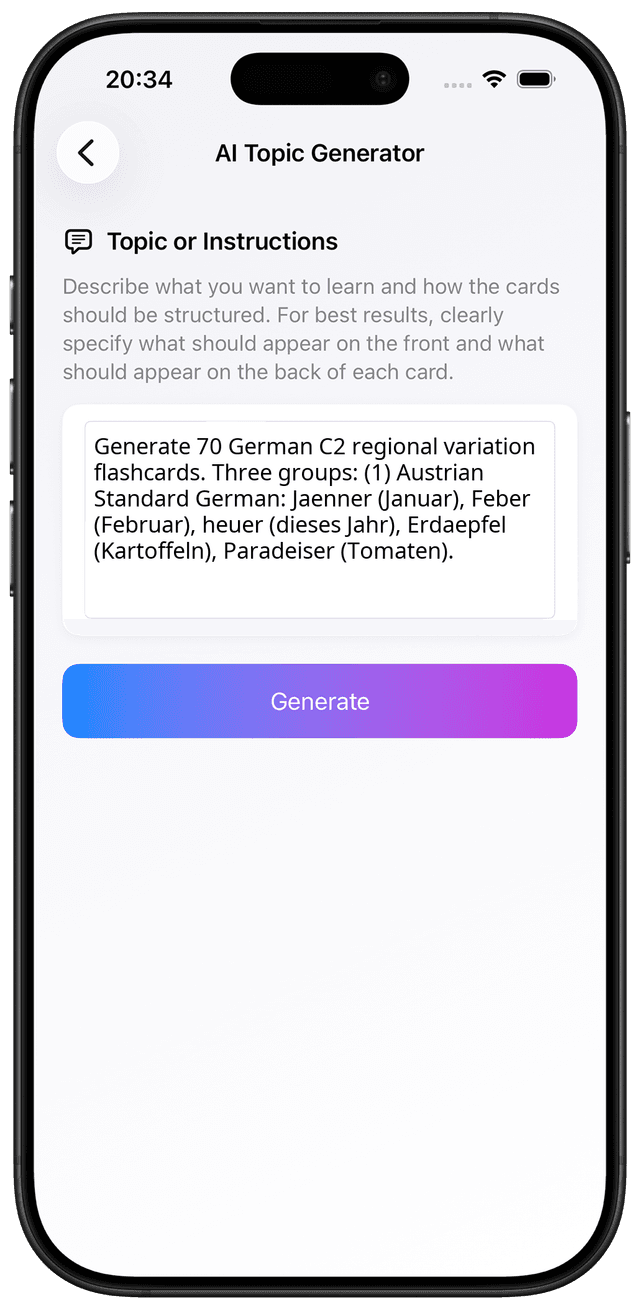
Generate 70 German C2 regional variation flashcards. Three groups: (1) Austrian Standard German: Jänner (Januar), Feber (Februar), heuer (dieses Jahr), Erdäpfel (Kartoffeln), Paradeiser (Tomaten), Topfen (Quark), Sackerl (Tüte), das Spital (das Krankenhaus), Matura (Abitur), Trafik (Tabakladen). (2) Swiss Standard German: Velo (Fahrrad), Tram (die, not das), Spital (Krankenhaus), Rahm (Sahne), Peperoni (Paprika), parkieren (parken), grillieren (grillen), das Tram, das Mail, das Sackmesser (Taschenmesser). (3) Federal German specifics and pragmatic norms: Brötchen vs Semmel vs Weckle vs Schrippe, Berliner vs Pfannkuchen vs Krapfen, the Sie vs du norms across business cultures in DE/AT/CH, regional differences in formal correspondence openings. Front: regional term + region label. Back: Standard equivalent + pragmatic usage note.
At C2 the vocabulary you are missing is less frequent and more context-dependent than at any earlier level. Spaced repetition is well suited to this work: the collocations, Sprichwörter, and fixed phrases you keep forgetting surface more often, and the ones you have already locked in quietly drop back. Your review time goes where it actually moves the needle.
C2 builds directly on C1. Use the links below to review the prerequisite level or return to the full German guide.
Copy any prompt from this guide into MindCards and your first C2 deck is ready in seconds. No account needed. The app is free on iOS.