
Spaced Repetition Explained
Why reviewing at the right interval is key to locking in German B1 vocabulary
You have the A2 foundation. Now build the German that lets you hold a real conversation. At B1, the language stops being about basic exchanges and starts being about genuine communication: expressing hypotheticals politely, using passive structures that feel natural in formal settings, and engaging with German in professional and public contexts.
B1 covers roughly 2,000 words in total. Not all of them come up equally often. This guide focuses on the vocabulary and structures that appear again and again, the ones that make your German sound noticeably more fluent rather than just grammatically serviceable.
Each of the seven phases below comes with a ready-to-use AI prompt. Paste it into the MindCards app and it builds a custom flashcard deck in seconds. Spaced repetition then schedules each card just before you are likely to forget it, so you retain more with less time spent reviewing.
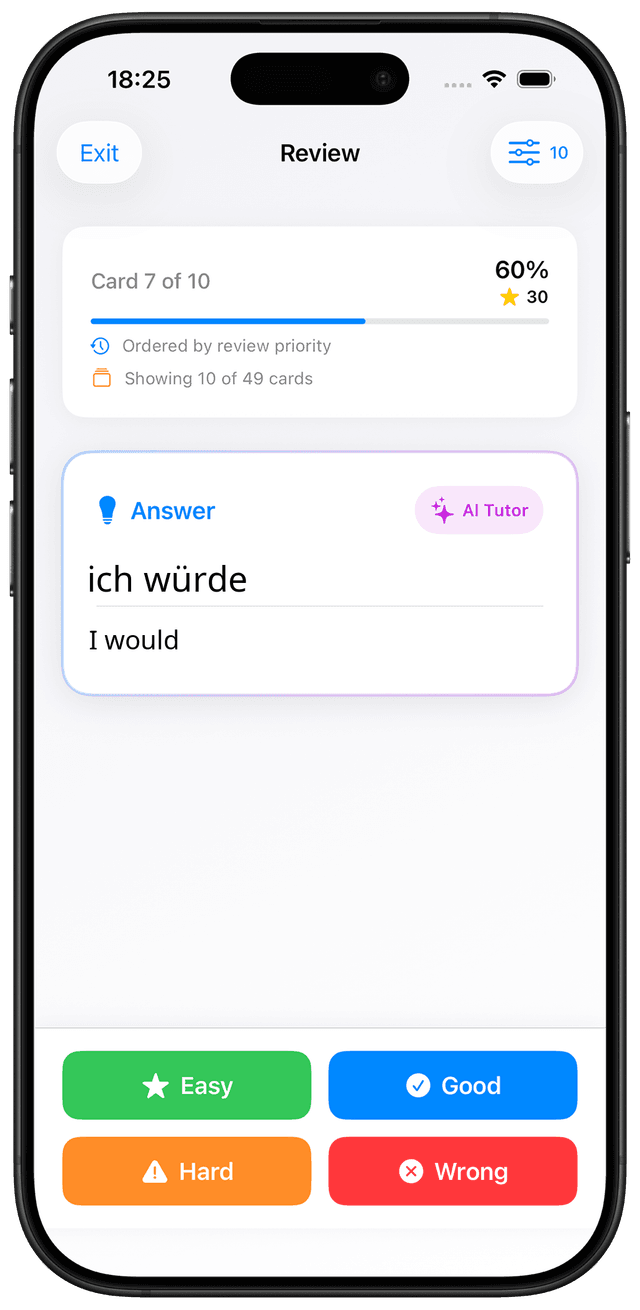
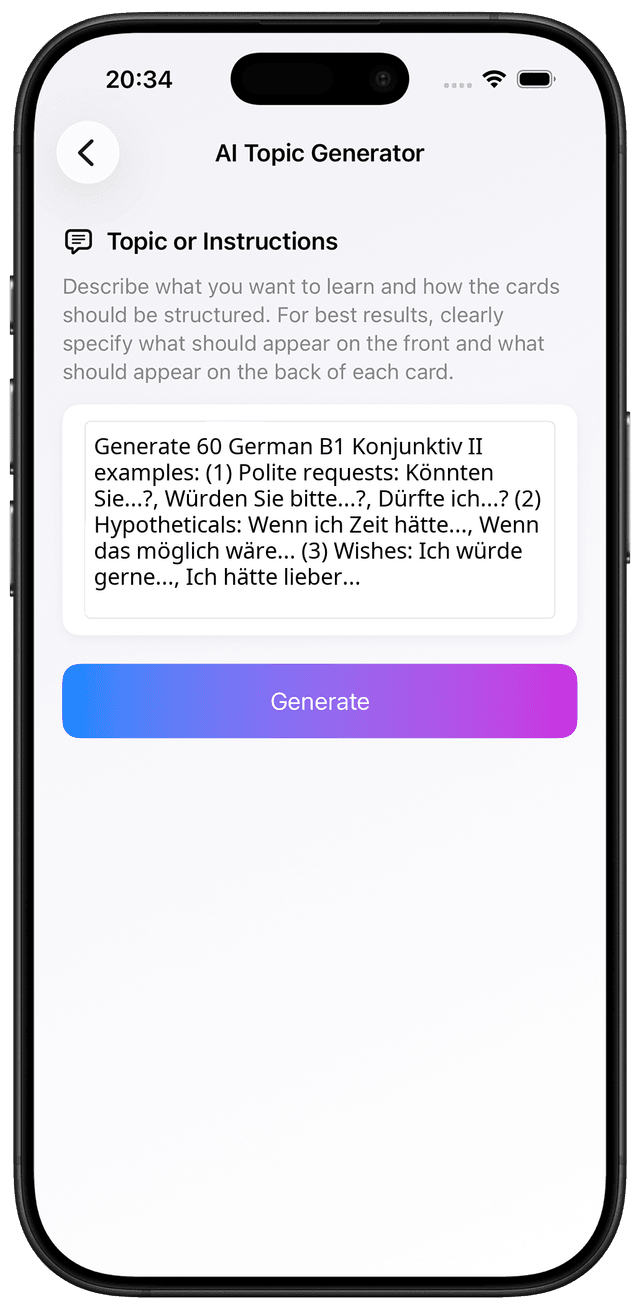
Konjunktiv II is the single most important grammar step between A2 and B1. German speakers use it for polite requests (Könnten Sie...?), hypothetical statements (Wenn ich Zeit hätte...), and wishes (Ich würde gerne...). Without it, your German sounds blunter than you intend.
Why start here? Konjunktiv II appears in nearly every formal or semi-formal exchange. Learning the high-frequency forms (wäre, hätte, könnte, würde) covers the vast majority of real-world use without needing every irregular conjugation at once.
The Strategy: This deck focuses on the modal verbs in Konjunktiv II and the würde + infinitive construction, the patterns that come up most often at B1 level.
Generate 60 German B1 examples of Konjunktiv II. Include three groups: (1) Polite requests: Könnten Sie...?, Würden Sie bitte...?, Dürfte ich...? (2) Hypotheticals with wenn: Wenn ich Zeit hätte..., Wenn das möglich wäre... (3) Wishes: Ich würde gerne..., Ich hätte lieber..., Es wäre schön, wenn... Front: German sentence. Back: English translation + Konjunktiv II pattern label.
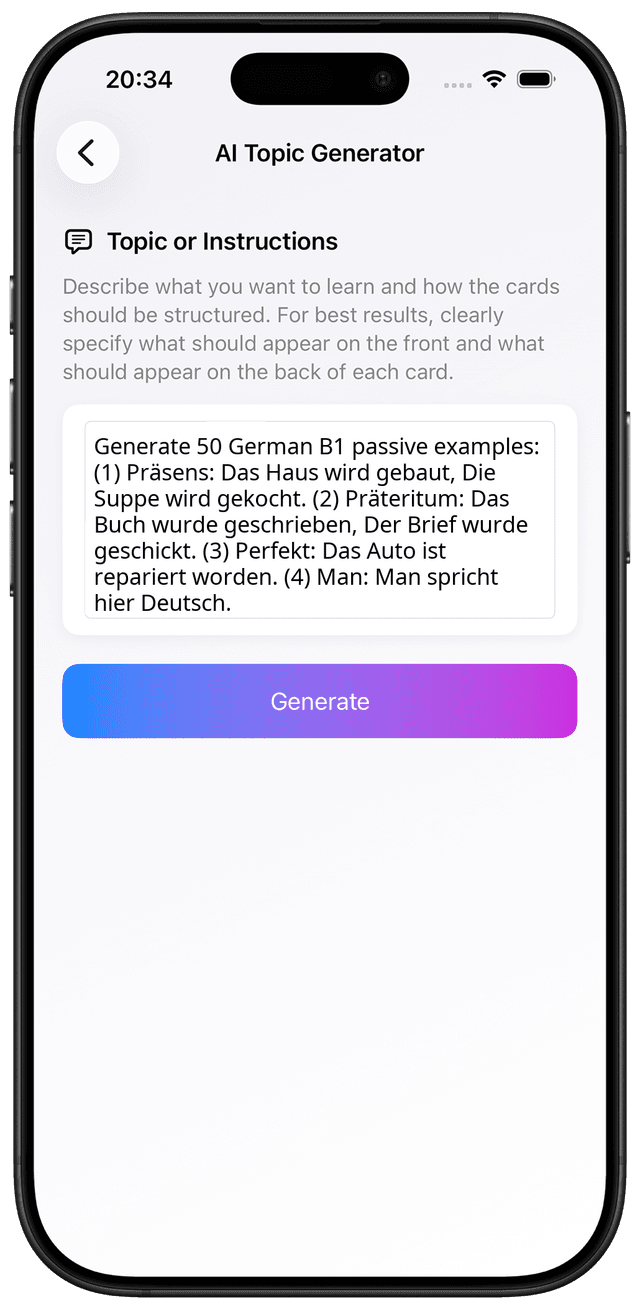
The passive voice is everywhere in German: news reports, instructions, formal writing, and academic texts all rely on it heavily. At B1, you need to recognise and produce Vorgangspassiv (werden + Partizip II) in the key tenses, along with the common passive substitute constructions used in spoken German.
Why this matters: German passive is more regular than it looks. Once you know werden + Partizip II, the pattern applies across tenses. Getting comfortable with it early makes reading German newspapers and instructions far more manageable.
The Strategy: This deck builds the passive in present, past (Präteritum), and Perfekt tenses, plus a selection of common man constructions used as passive substitutes.
Generate 50 German B1 passive voice examples. Include four groups: (1) Präsens passive: Das Haus wird gebaut, Die Suppe wird gekocht. (2) Präteritum passive: Das Buch wurde geschrieben, Der Brief wurde geschickt. (3) Perfekt passive: Das Auto ist repariert worden. (4) Man constructions as passive substitutes: Man spricht hier Deutsch, Man hat das Fenster geöffnet. Front: German sentence. Back: English translation + tense label.
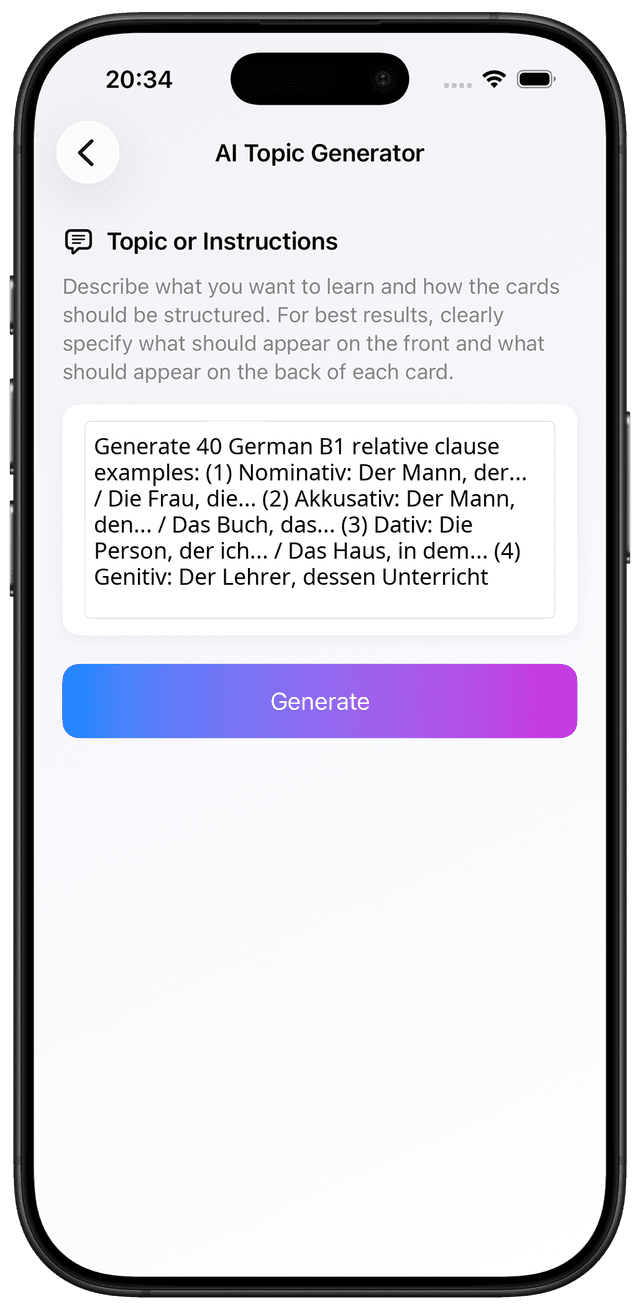
Relative clauses let you qualify and describe nouns without starting a new sentence. In German, relative pronouns change based on the gender and case of the noun they refer to. Getting this right is what gives your German the structure that native speakers expect at B1 and above.
Why add this now? Relative clauses are tested directly in Goethe B1. They also appear constantly in formal speech and writing. Building them early frees up mental bandwidth for more complex ideas later.
The Strategy: This deck drills the relative pronoun forms in Nominativ, Akkusativ, Dativ, and Genitiv with everyday nouns so the pattern becomes automatic.
Generate 40 German B1 relative clause examples covering all four cases. (1) Nominativ: Der Mann, der... / Die Frau, die... / Das Kind, das... (2) Akkusativ: Der Mann, den... / Das Buch, das... (3) Dativ: Die Person, der ich... / Das Haus, in dem... (4) Genitiv: Der Lehrer, dessen Unterricht... / Die Frau, deren Tochter... Front: complete German sentence with relative clause. Back: English translation + case label.
German builds new words by combining existing ones. Understanding how compound nouns, prefixes, and suffixes work gives you the ability to decode unfamiliar vocabulary on sight, which becomes increasingly valuable as texts grow more complex at B1 and B2.
Why this is essential: Knowing that -ung, -heit, -keit, and -schaft mark feminine abstract nouns cuts dictionary lookups in half. Recognising separable and inseparable prefixes (an-, auf-, be-, ver-, zer-) tells you a verb's basic meaning before you even know the full word.
The Strategy: This deck covers the most productive B1 word-formation patterns: compound nouns, common suffixes for noun gender prediction, and key verb prefixes.
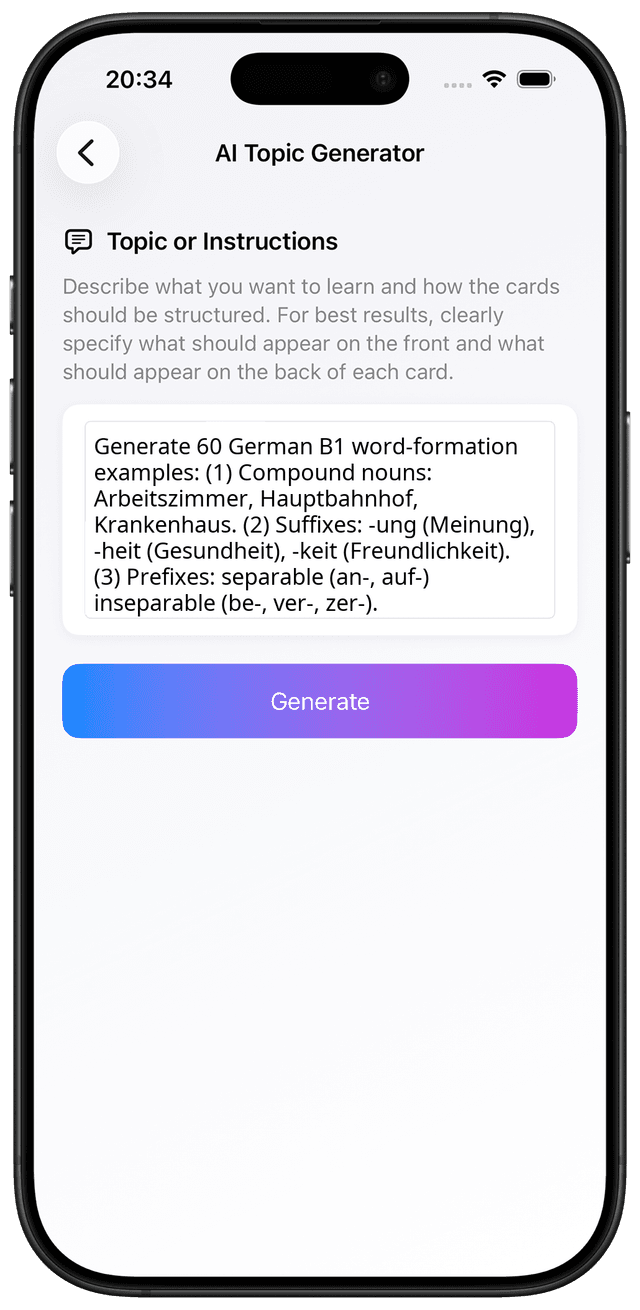
Generate 60 German B1 word-formation examples in three groups: (1) Compound nouns: Arbeitszimmer, Hauptbahnhof, Krankenhaus, Handschuh, Jahrestag — show root words + compound. (2) Noun suffixes: -ung (Meinung), -heit (Gesundheit), -keit (Freundlichkeit), -schaft (Gesellschaft) with gender and English. (3) Verb prefixes: separable (an-, auf-, aus-, ein-) and inseparable (be-, ver-, zer-, ge-) with example verbs and meanings. Front: German word. Back: English + formation pattern.
At B1, German becomes practical for professional life. Job interviews, workplace emails, meetings, and formal correspondence all require vocabulary that does not come up in everyday conversation. The Goethe B1 exam includes formal writing tasks, and professional contexts appear throughout the listening and reading sections.
Why this comes next: Professional vocabulary is one of the most common reasons adults learn German, and B1 is the minimum level required for many workplace and immigration purposes in German-speaking countries.
The Strategy: This deck covers job titles, workplace actions, meeting vocabulary, and formal correspondence phrases needed for Goethe B1 and real professional settings.
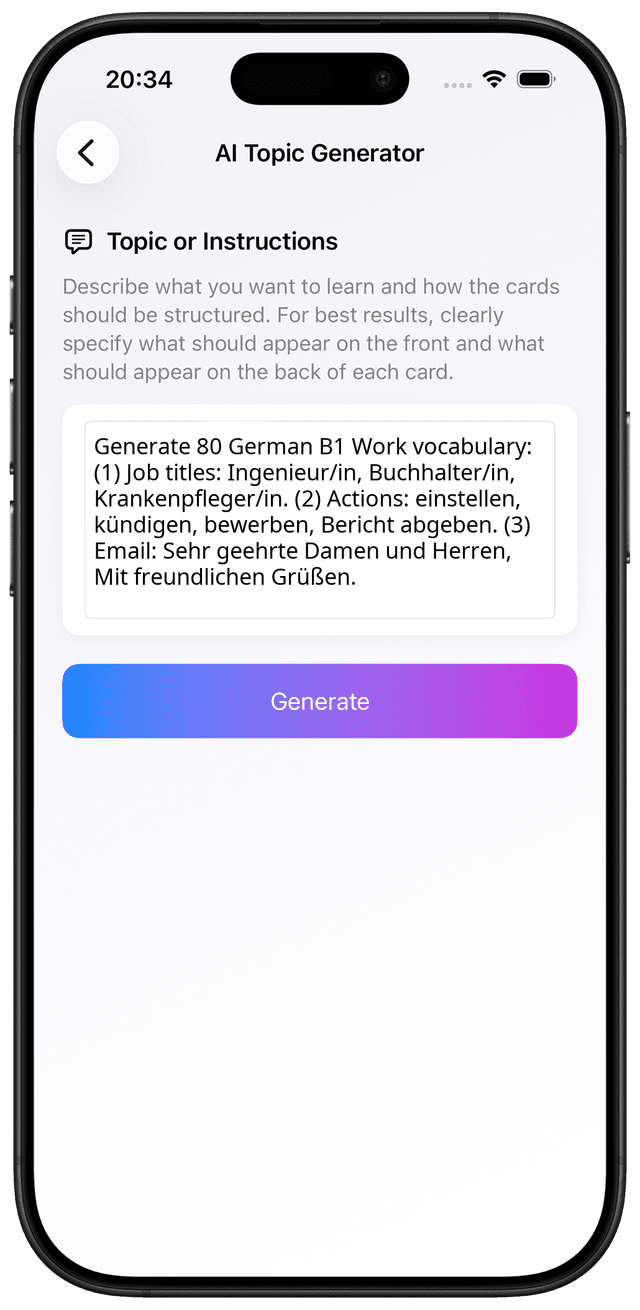
Generate 80 German B1 words and phrases for Work and Professional Contexts. Include: (1) Job titles: Ingenieur/in, Buchhalter/in, Krankenpfleger/in, Selbstständige/r, Auszubildende/r. (2) Workplace actions: einstellen, kündigen, bewerben, präsentieren, einen Bericht abgeben, Fristen einhalten. (3) Formal email phrases: Sehr geehrte Damen und Herren, Mit freundlichen Grüßen, Ich beziehe mich auf Ihre Anfrage. (4) Meeting vocabulary: Tagesordnung, das Wort ergreifen, zusammenfassen, vorschlagen. Front: German. Back: English.
B1 is the level where you start engaging with German in a broader social context: reading a newspaper, following a political debate, or discussing a news story. Society and media vocabulary is central to the Goethe B1 exam and to making sense of authentic German content.
The Goal: To give you the vocabulary for informed conversation about everyday public life, so you can follow German news, participate in discussions, and understand the cultural and political context of the language.
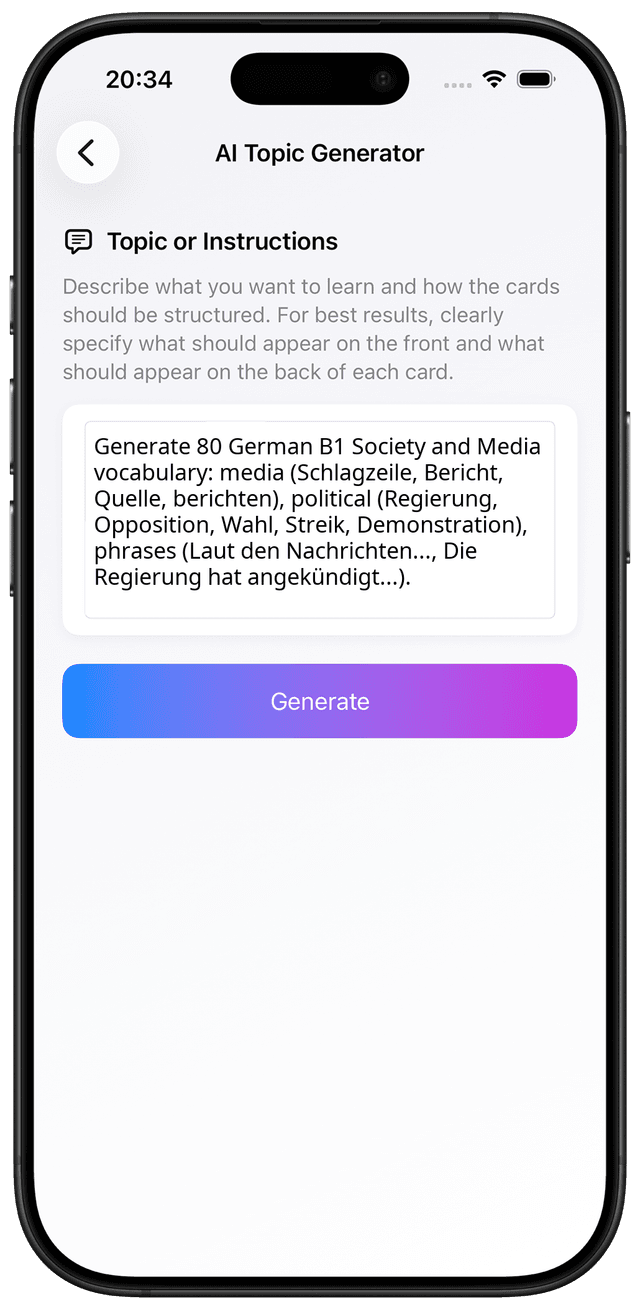
Generate 80 German B1 words and phrases for Society and Media. Include: media vocabulary (Schlagzeile, Bericht, Leitartikel, Quelle, berichten, veröffentlichen), social and political terms (Regierung, Opposition, Wahl, Streik, Demonstration, Gesetzesvorschlag), discussion phrases (Laut den neuesten Nachrichten..., Es wurde berichtet, dass..., Die Regierung hat angekündigt...), opinion markers (trotzdem, andererseits, im Gegensatz dazu). Front: German. Back: English.
Connectors are what turn a list of facts into a coherent argument. At B1, written and spoken tasks reward clear structure: adding information, contrasting ideas, expressing cause and effect, and conceding a point. German connectors also have grammatical consequences: subordinating conjunctions send the verb to the end, while coordinating conjunctions do not. Getting both right is part of the B1 skill set.
The Milestone: With this deck, your B1 vocabulary toolkit is complete. You have Konjunktiv II for politeness, passive for formal register, relative clauses for complex sentences, and vocabulary for professional life, society, and structured argument. That is the full B1 communicative range for Goethe B1 and real-world German.
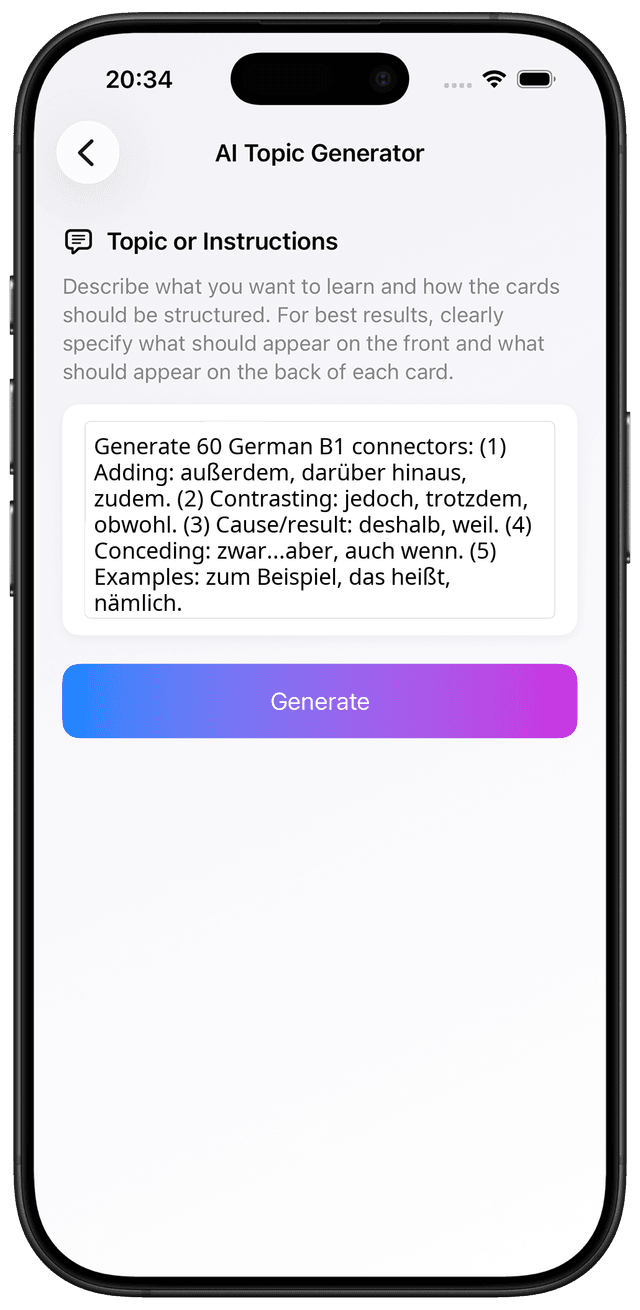
Generate 60 German B1 connectors and discourse markers in five groups: (1) Adding: außerdem, darüber hinaus, zudem, ebenfalls. (2) Contrasting: jedoch, trotzdem, obwohl (+ verb-final), während (contrast). (3) Cause/result: deshalb, deswegen, daher, weil (+ verb-final), da. (4) Conceding: zwar...aber, auch wenn, obwohl. (5) Examples and clarification: zum Beispiel, das heißt, nämlich, und zwar. Front: German connector + example sentence. Back: English + word-order note (verb-final or not).
MindCards uses spaced repetition and active recall, two research-backed techniques, to help you retain B1 vocabulary faster and for longer.
B1 vocabulary sits above A2 and prepares you for advanced B2 fluency. Use the links below to move between levels or return to the full German guide.
Join hundreds of learners building their German with spaced repetition and AI-powered vocabulary generation. No account needed. Download and start your first B1 deck.