
Spaced repetition explained
Why reviewing at the right interval is key to locking in German A2 vocabulary
You have the A1 foundation. Now build something you can actually use in conversation. At A2, the jump is the Perfekt, Germany's everyday past tense, plus the grammar structures that separate broken German from fluent German: modal verbs, separable verbs, and the Futur I for future plans.
A2 covers roughly 1,000 words and structures, and not all of them carry the same weight. This guide focuses on the ones that come up constantly: the verbs that take sein in the Perfekt, the modal constructions that express obligation and permission, the separable prefixes that confuse every learner who hasn't drilled them deliberately.
Each phase below includes a ready-to-use AI prompt. Paste it into the MindCards app and it generates a custom flashcard deck in seconds. Spaced repetition then schedules each card just before you are about to forget it, so you retain more with less study time.
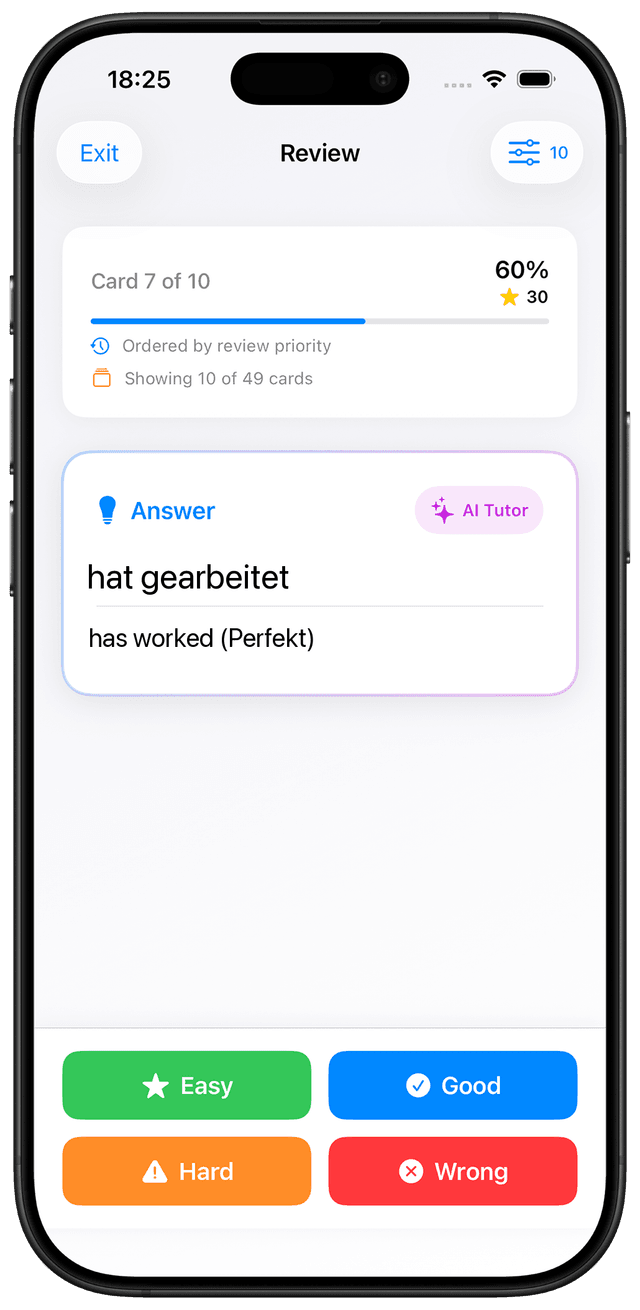
The Perfekt is how Germans talk about the past in everyday conversation. Unlike English, it uses a helper verb (haben or sein) plus a past participle at the end of the sentence, a structure that trips up most A1 learners the moment they try to tell a story.
Why start here? Every other A2 topic assumes you can talk about what happened. The Perfekt unlocks that and is the first thing Goethe A2 exams test in speaking tasks.
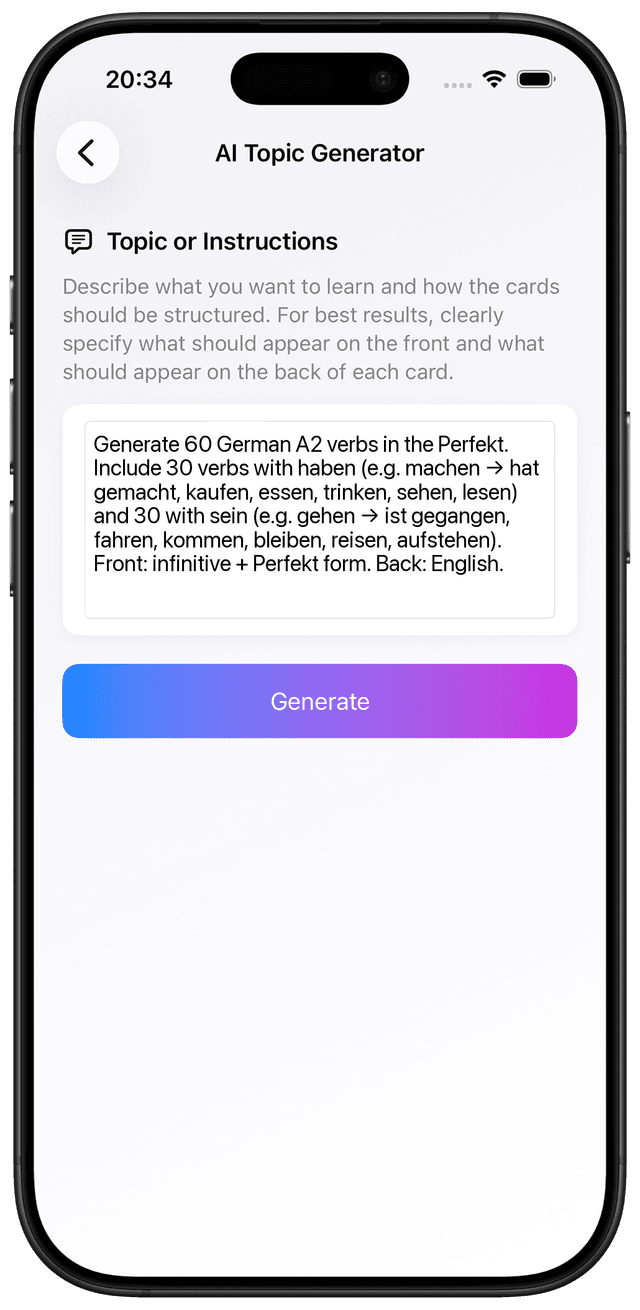
The strategy: This deck focuses on 60 high-frequency verbs with their correct auxiliary (haben or sein) and past participle. The back of each card shows a natural example sentence so you absorb the word order, not just the form.
Generate 60 German A2 verbs in the Perfekt. Include 30 verbs with haben (e.g. machen → hat gemacht, kaufen, essen, trinken, sehen, lesen) and 30 with sein (e.g. gehen → ist gegangen, fahren, kommen, bleiben, reisen, aufstehen). Front: infinitive + correct Perfekt form. Back: English + a short example sentence using ich or wir.
German has six modal verbs (können, müssen, dürfen, sollen, wollen, mögen) and each one carries a specific meaning English often can't map directly. The difference between dürfen (permission) and können (ability) matters in real conversations, especially in formal settings.
Why modals next? At A2, you need to express ability, obligation, permission, and desire. These are the verbs that carry those meanings. They are also the key to forming the past using the double infinitive (Ich habe gehen müssen).
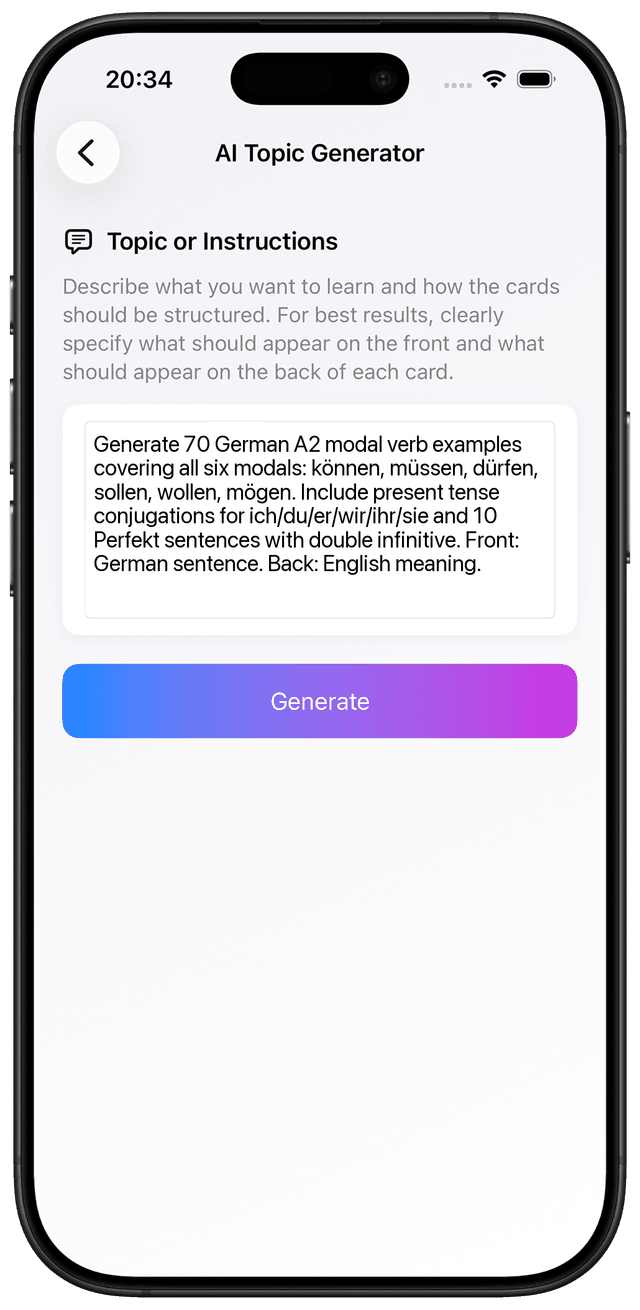
The strategy: This deck covers all six modals in present tense with all pronouns, plus their most common past forms using the Perfekt construction.
Generate 70 German A2 modal verb examples covering all six modals: können, müssen, dürfen, sollen, wollen, mögen. Include present tense conjugations for ich/du/er/wir/ihr/sie (all pronouns) and 10 Perfekt sentences with the double infinitive construction (e.g. Ich habe früh aufstehen müssen). Front: German sentence. Back: English meaning + modal label.
Separable verbs are one of the most distinctly German things in the language. A prefix breaks off and moves to the end of the sentence: anrufen becomes Ich rufe dich an. If you have ever noticed a German sentence that seemed to end with a random word you didn't recognise, it was probably a separable prefix.
Why now? These verbs appear constantly in everyday German and are tested at A2 level in listening and writing. Learning them with their correct split is faster than untangling the habit later.
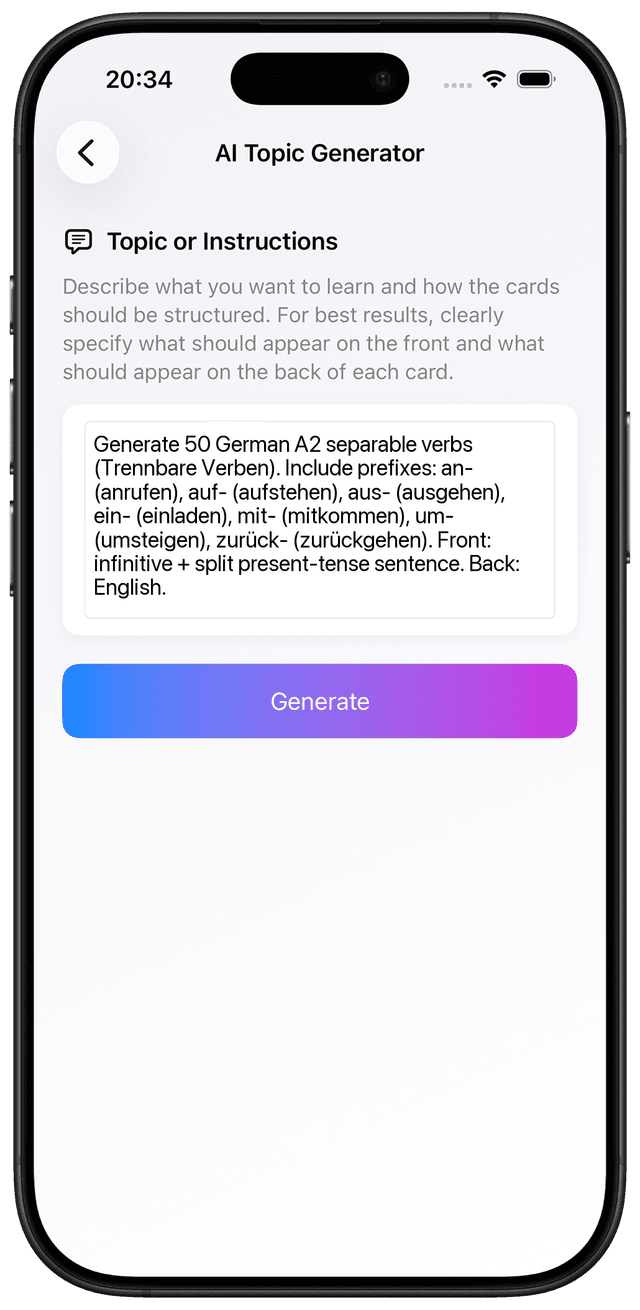
The strategy: This deck covers 50 high-frequency separable verbs with example sentences showing both the split form (present) and the rejoined Perfekt past participle.
Generate 50 German A2 separable verbs (Trennbare Verben). Include common prefixes: an- (anrufen, anfangen), auf- (aufstehen, aufmachen), aus- (ausgehen, ausziehen), ein- (einladen, einkaufen), mit- (mitkommen, mitnehmen), um- (umsteigen, umziehen), zurück- (zurückgehen, zurückkommen). Front: infinitive + split present-tense sentence (e.g. Ich stehe um 7 Uhr auf). Back: English + Perfekt past participle.
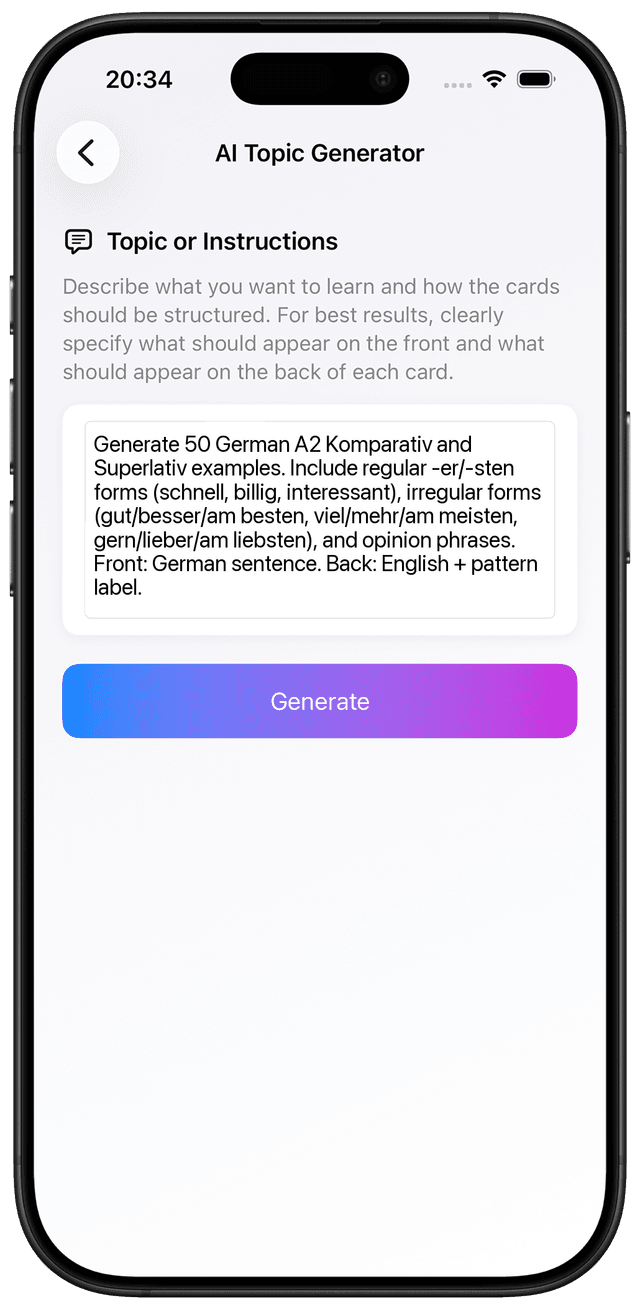
German comparatives work by adding -er to the adjective, but a group of common adjectives go irregular: gut becomes besser, viel becomes mehr, hoch becomes höher. The Superlativ adds -sten. You'll use these every time you describe something or recommend a place.
Why add opinions now? After past tense and modals, the next Goethe A2 task is expressing preferences and reactions. German phrases like Ich finde das... and Meiner Meinung nach... signal opinion in ways that native speakers recognise and respect.
The strategy: This deck combines the Komparativ and Superlativ patterns with opinion vocabulary so you can evaluate, compare, and recommend in one connected batch.
Generate 50 German A2 examples for Komparativ and Superlativ. Include: regular adjectives with -er/-sten (schnell, billig, interessant), irregular forms (gut/besser/am besten, viel/mehr/am meisten, hoch/höher/am höchsten, gern/lieber/am liebsten), and 20 opinion phrases (Ich finde das..., Meiner Meinung nach..., Ich halte das für..., Das gefällt mir...). Front: German sentence. Back: English + pattern label.
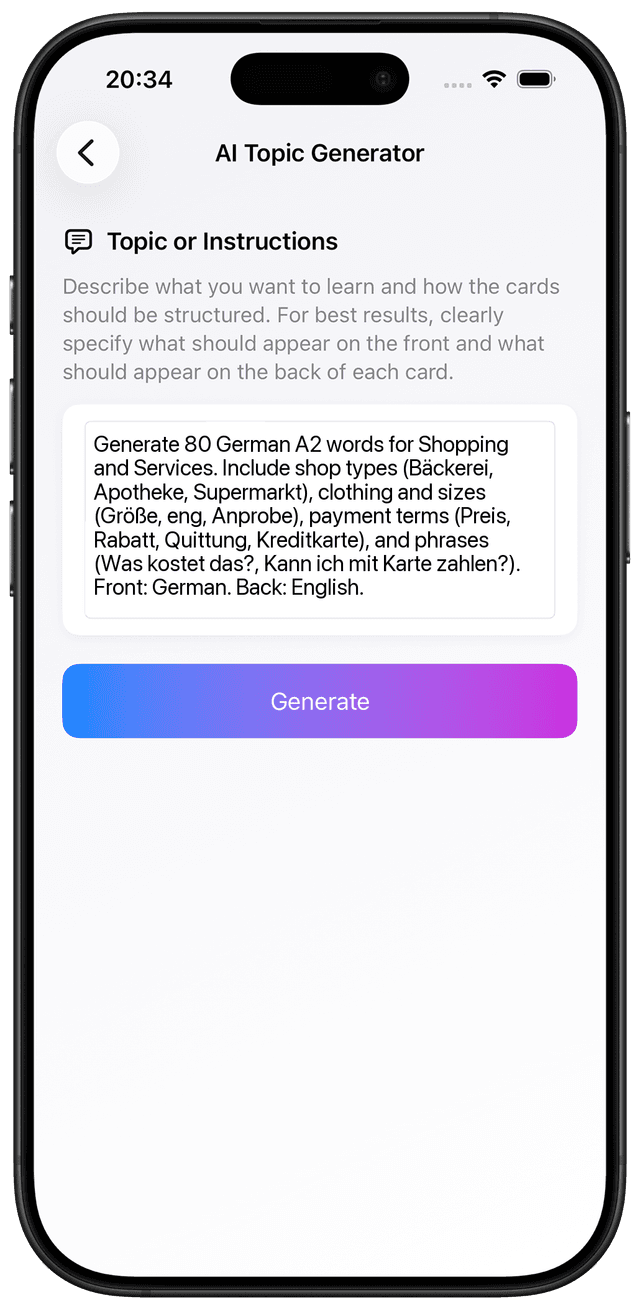
At A2, you should be able to handle a real shopping trip end to end: from asking whether something is available in your size to paying, getting a receipt, and returning an item. This phase also covers service language for pharmacies, banks, and post offices, which come up in every Goethe A2 exam scenario.
Why this is tested: Goethe A2 writing and speaking tasks frequently use shopping and service situations because they require practical transactional vocabulary without complex grammar.
The strategy: This deck mixes product vocabulary, money terms, and useful service phrases into one practical batch.
Generate 80 German A2 words and phrases for Shopping and Services. Cover: shop types (Bäckerei, Apotheke, Supermarkt, Post, Bank), clothing and sizes (Größe, eng, weit, Anprobe), payment terms (Preis, Rabatt, Quittung, Kreditkarte, bar bezahlen), and service phrases (Haben Sie das in Größe 40?, Was kostet das?, Ich möchte das zurückgeben, Kann ich mit Karte zahlen?). Front: German. Back: English.
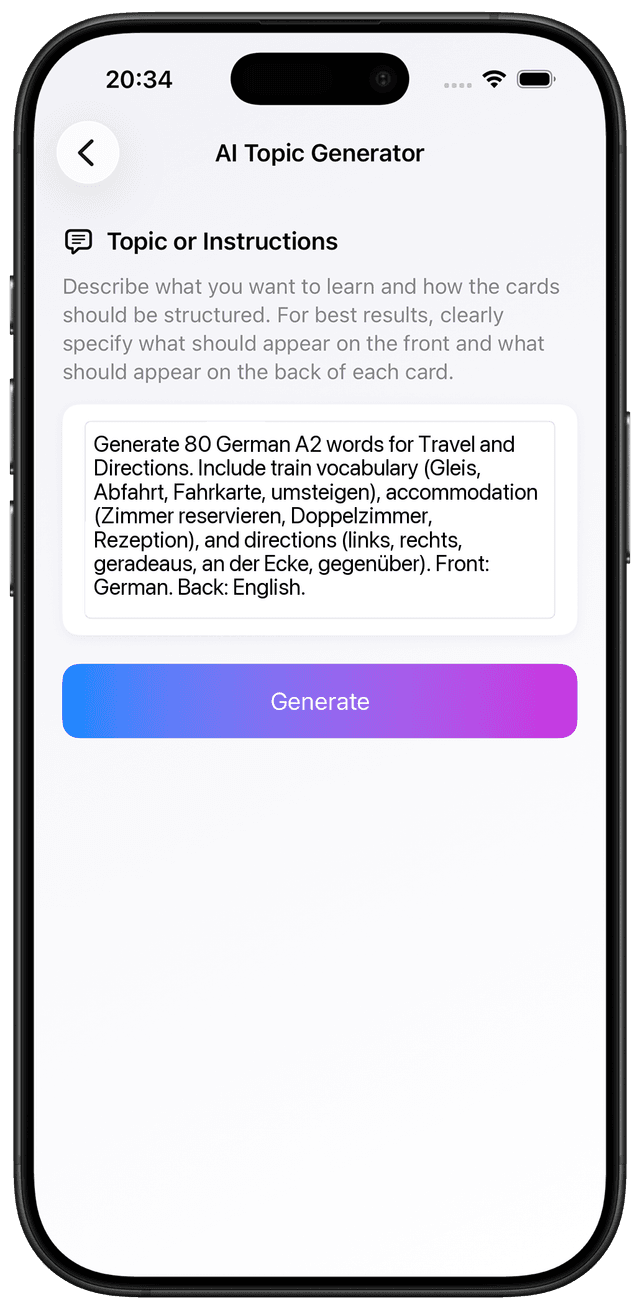
German-speaking countries have excellent rail networks, and navigating them requires specific vocabulary: Gleis, Abfahrt, Umsteigen, Fahrkarte. This phase also covers hotel check-in, giving and understanding directions, and sorting out common travel problems.
Why travel vocabulary matters: Travel is one of the four main topic areas in the Goethe A2 exam. The vocabulary here is also immediately practical for anyone visiting German-speaking countries.
The strategy: This deck covers transport, accommodation, and directional language in one batch so you can navigate without switching mentally between separate word lists.
Generate 80 German A2 words and phrases for Travel and Directions. Include: train vocabulary (Gleis, Abfahrt, Ankunft, Fahrkarte, Hin- und Rückfahrt, umsteigen, verspätet), accommodation (Zimmer reservieren, Doppelzimmer, Frühstück inklusive, Rezeption, auschecken), directions (links, rechts, geradeaus, an der Ecke, gegenüber, die erste Straße links), and travel problems (Der Zug hat Verspätung, Mein Gepäck fehlt, Wo ist die nächste U-Bahn?). Front: German. Back: English.
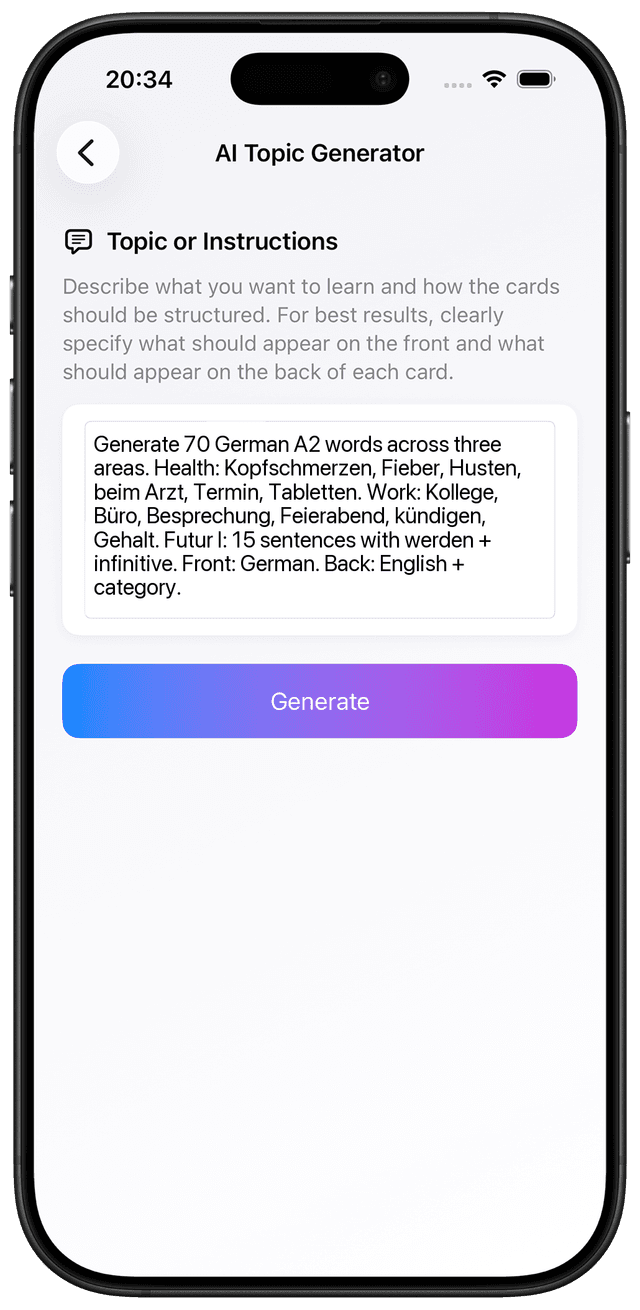
The final A2 phase covers three areas that often get skipped but appear in every exam: health vocabulary for describing symptoms and making appointments, work and daily routine language, and the Futur I (werden + infinitive) for talking about plans and predictions.
The milestone: With this deck, your A2 vocabulary is complete. You can now describe past events with the Perfekt, express ability and obligation with modals, handle shopping and travel, and talk about future plans using werden. That's the full A2 picture.
Generate 70 German A2 words and phrases across three areas. Health: symptoms and medical appointments (Kopfschmerzen, Fieber, Husten, beim Arzt, Termin machen, Rezept, Tabletten). Work: job and routine vocabulary (Kollege, Büro, Besprechung, Feierabend, kündigen, Gehalt). Futur I: 20 sentences using werden + infinitive for plans and predictions (Ich werde morgen früh aufstehen, Es wird regnen). Front: German. Back: English + category label (Health / Work / Future).
MindCards uses spaced repetition and active recall (two research-backed techniques) to help you retain A2 vocabulary faster and for longer. The Perfekt, separable verbs, and modal constructions all involve form+meaning pairs that benefit from this kind of retrieval practice.
A2 vocabulary sits between the A1 foundation and B1 fluency. Use the links below to move between levels or return to the full German guide.
Join hundreds of learners building their German with spaced repetition and AI-powered vocabulary generation. No account needed. Download and start your first A2 deck.