
Spaced repetition explained
Why reviewing at the right interval is key to locking in advanced German vocabulary
You have B1. You can hold a conversation, get through a work meeting, and read a news article with some effort. B2 is where that effort drops. German that required active translation starts arriving more directly. You start thinking in the language rather than through it.
B2 covers roughly 4,000 words in total. This guide focuses on the 1,000+ that actually shift your German forward: Konjunktiv I for indirect speech, extended participial constructions for reading dense texts, nominalisation for formal register, advanced conjunctions for argument structure, academic vocabulary for written tasks, and collocations that make your German sound genuinely natural rather than just grammatically acceptable.
Each of the seven phases below includes a ready-to-use AI prompt. Paste it into the MindCards app and it generates a custom flashcard deck in seconds. Spaced repetition then schedules each card just before you are likely to forget it, so you retain more with less time reviewing.
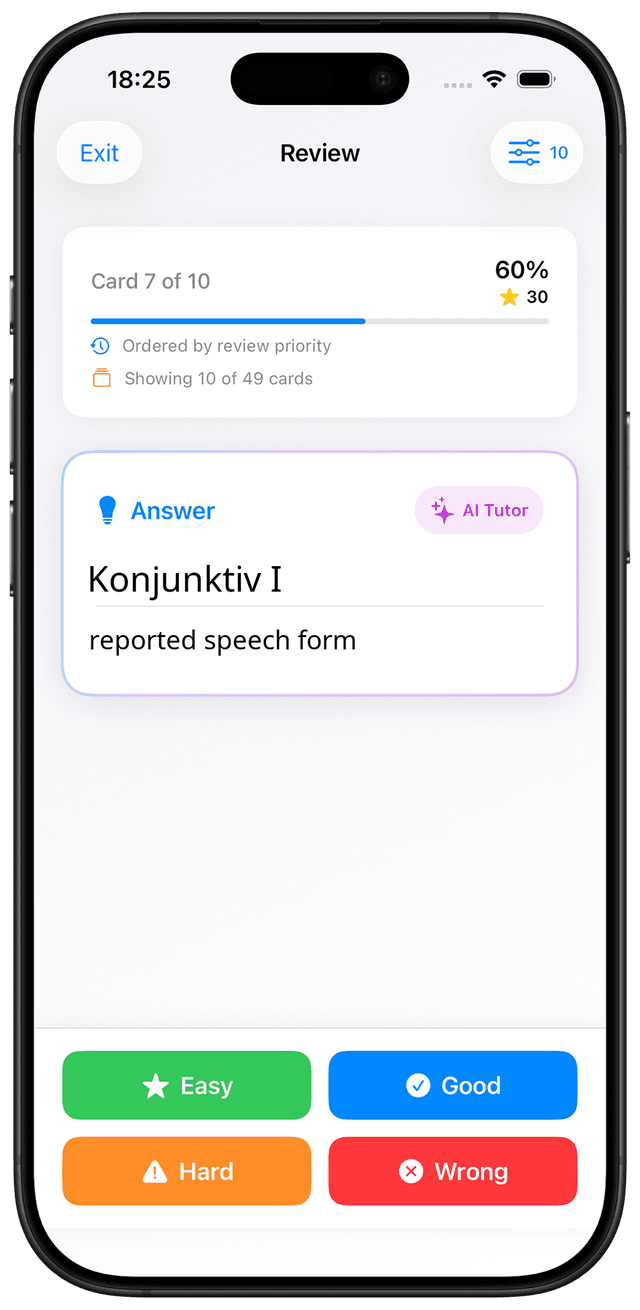
Konjunktiv I is the grammar form that separates B2 from B1. It is used almost exclusively in indirect speech: reporting what someone said without committing to its truth. German newspapers, radio broadcasts, and academic writing all use it constantly. If you read a German news article and cannot follow who is claiming what, Konjunktiv I is the gap.
Why start here? Konjunktiv I is the most distinctly German grammar feature at this level. English has no direct equivalent, so it needs deliberate study. Once you recognise the forms (er sage, sie habe, sie seien), your reading speed in German journalism improves noticeably.
The strategy: This deck focuses on the high-frequency Konjunktiv I forms in third-person singular and plural, which cover 90% of indirect speech in real texts.
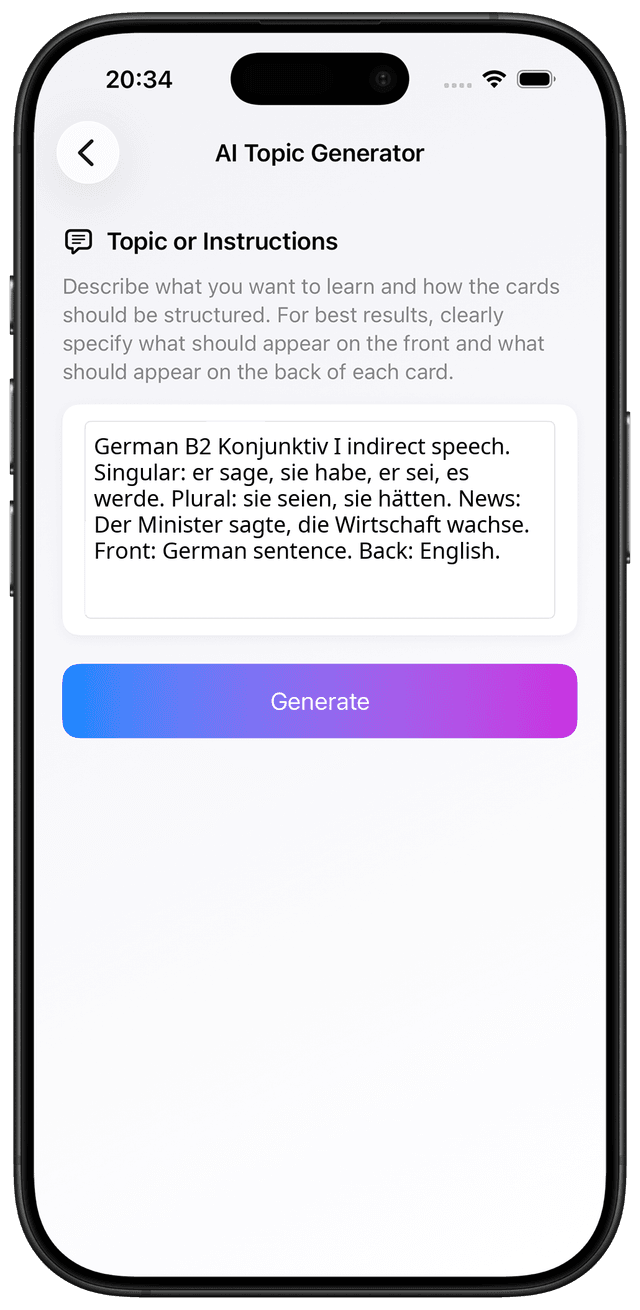
Generate 60 German B2 examples of Konjunktiv I in indirect speech. Three groups: (1) Third-person singular with common verbs: er sage, sie habe, er sei, es werde, sie könne, er müsse. (2) Third-person plural: sie seien, sie hätten, sie würden, sie könnten. (3) Complete reported speech sentences from a news context: Der Minister sagte, die Wirtschaft wachse. Die Sprecherin erklärte, das Projekt sei abgeschlossen. Front: German indirect speech sentence. Back: English translation + Konjunktiv I form label.
German academic and formal writing compresses information using extended participial phrases before nouns. Instead of a relative clause (die Maßnahme, die von der Regierung eingeführt wurde), formal German writes die von der Regierung eingeführte Maßnahme. These constructions appear constantly in newspaper writing, official documents, and academic prose.
Why this matters: Extended participial phrases are one of the main reasons formal German feels dense to intermediate learners. Once you know the pattern, text that seemed impenetrable becomes readable. They are also tested directly in the Goethe B2 reading and writing sections.
The strategy: This deck drills both Partizip I (ongoing action) and Partizip II (completed action) versions with real-world example phrases from news and academic contexts.
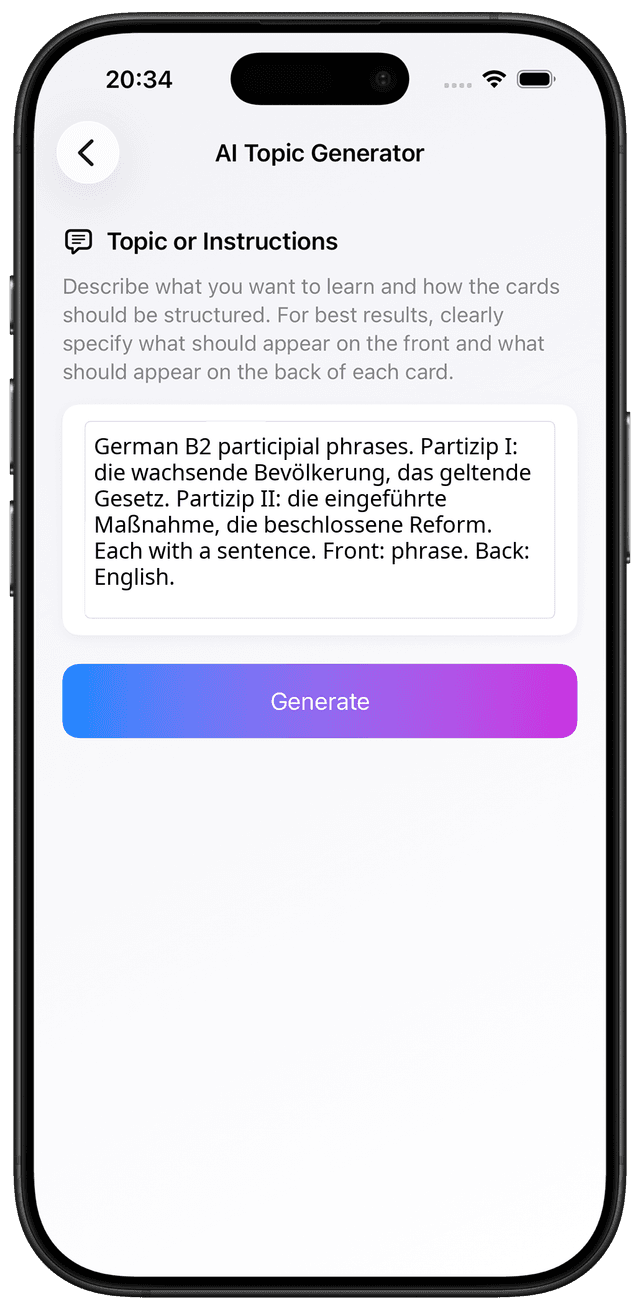
Generate 50 German B2 extended participial constructions. Two groups: (1) Partizip I (present/ongoing): die wachsende Bevölkerung, der zunehmende Druck, das geltende Gesetz, die steigende Nachfrage, each with an example sentence. (2) Partizip II (completed/passive): die eingeführte Maßnahme, das veröffentlichte Ergebnis, die beschlossene Reform, der abgeschlossene Vertrag, each with an example sentence. Front: extended participial phrase + sentence. Back: English translation + relative clause equivalent.
German formal writing heavily nominalises verbs and adjectives: entscheiden becomes die Entscheidung, diskutieren becomes die Diskussion, entwickeln becomes die Entwicklung. This pattern compresses argument structure and is what makes academic German sound different from spoken German. At B2 you need to both recognise and produce it.
Why add this now? Nominalisation is the single biggest stylistic gap between conversational and written German. B2 writing tasks in the Goethe exam are evaluated partly on register accuracy. Knowing the noun forms of high-frequency verbs lets you shift register deliberately rather than accidentally.
The strategy: This deck pairs high-frequency verbs with their noun forms, showing both in a sentence so you can see how the register shift works in practice.
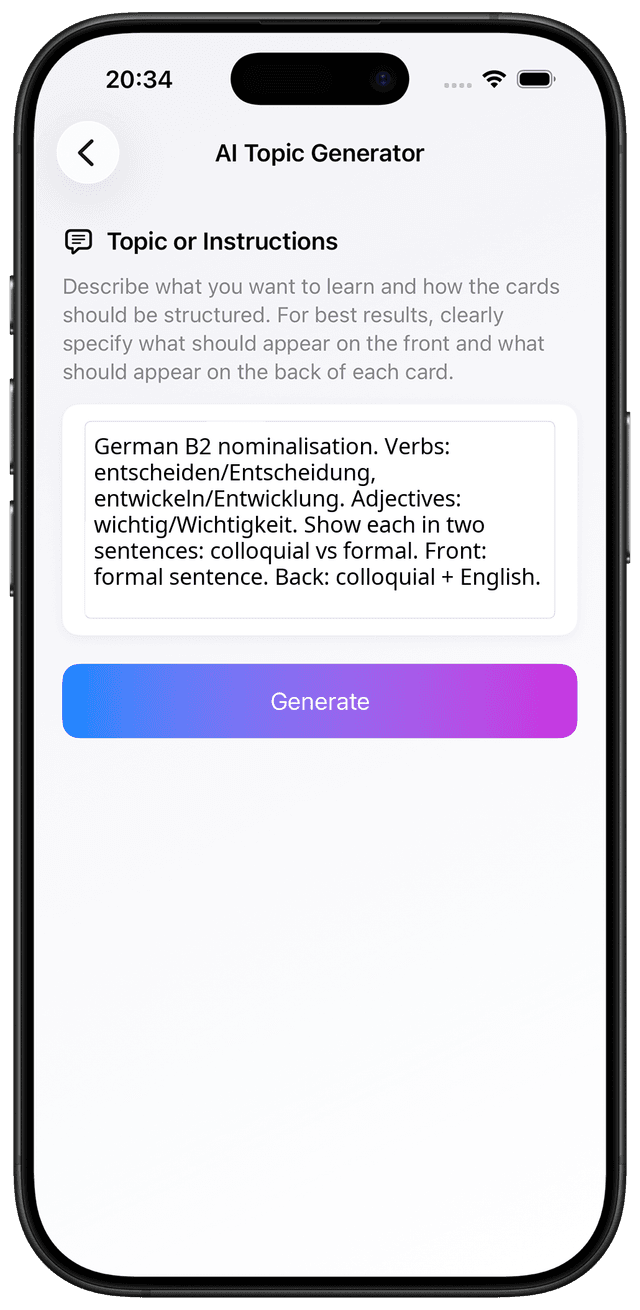
Generate 60 German B2 nominalisation pairs in three groups: (1) Verb to noun: entscheiden/die Entscheidung, entwickeln/die Entwicklung, verbessern/die Verbesserung, verlangen/die Verlängerung, darstellen/die Darstellung, begründen/die Begründung. (2) Adjective to noun: wichtig/die Wichtigkeit, abhängig/die Abhängigkeit, bereit/die Bereitschaft, möglich/die Möglichkeit. (3) Each pair in two sentences: one colloquial (verb/adjective) and one formal (nominalised) showing the same idea. Front: formal nominalised sentence. Back: colloquial version + English.
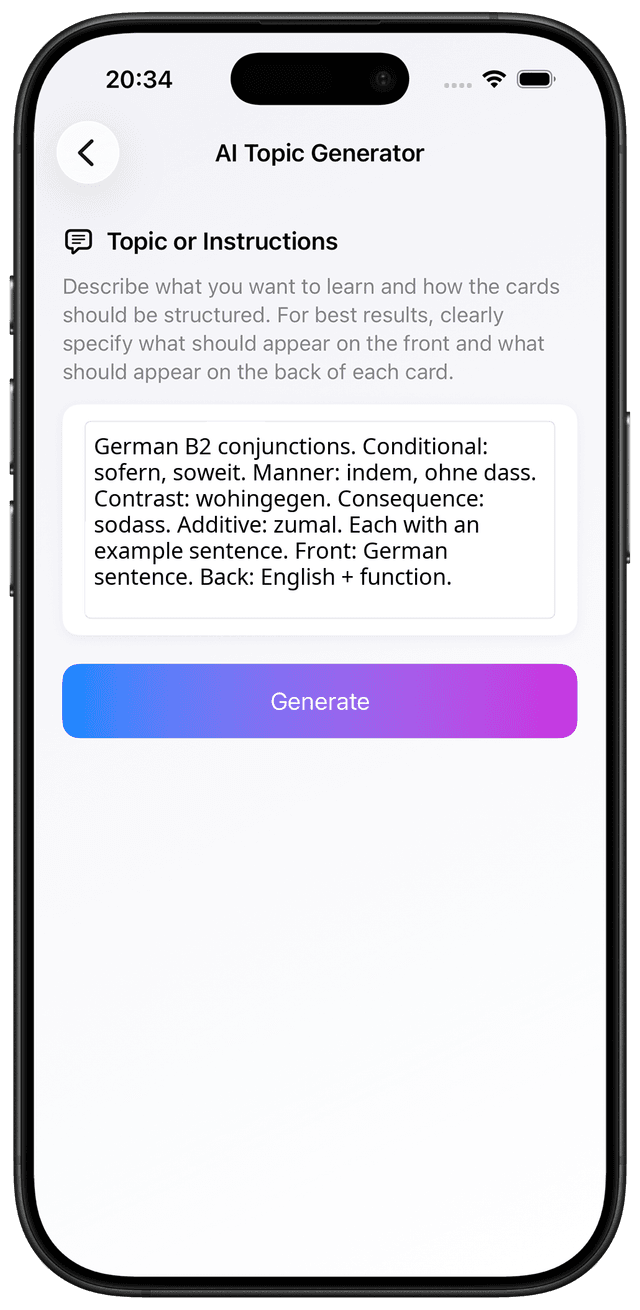
At B1 you learned the common subordinating conjunctions (weil, obwohl, wenn, dass). At B2 the range expands significantly: soweit, sofern, indem, wobei, wohingegen, zumal, geschweige denn, sodass. These are the conjunctions that appear in formal argument and that distinguish a B2 writer from a B1 writer.
Why this comes next: Complex subordinate clauses are a direct requirement of Goethe B2 writing tasks. They also appear in every news article, opinion piece, and business text you will read in German. Getting them right gives you control over nuance and argument structure.
The strategy: This deck covers B2-level conjunctions organised by their logical function: condition, manner, contrast, consequence, and addition.
Generate 60 German B2 subordinating conjunctions and complex sentence examples in five groups: (1) Conditional/restrictive: sofern, soweit, vorausgesetzt dass, es sei denn. (2) Manner/means: indem, dadurch dass, ohne dass. (3) Contrast: wohingegen, während (contrastive), anstatt dass. (4) Consequence: sodass, so...dass, derart...dass. (5) Additive/concessive: zumal, geschweige denn, wenngleich. Each entry: German example sentence + English translation + conjunction function label. Front: German sentence. Back: English + function.
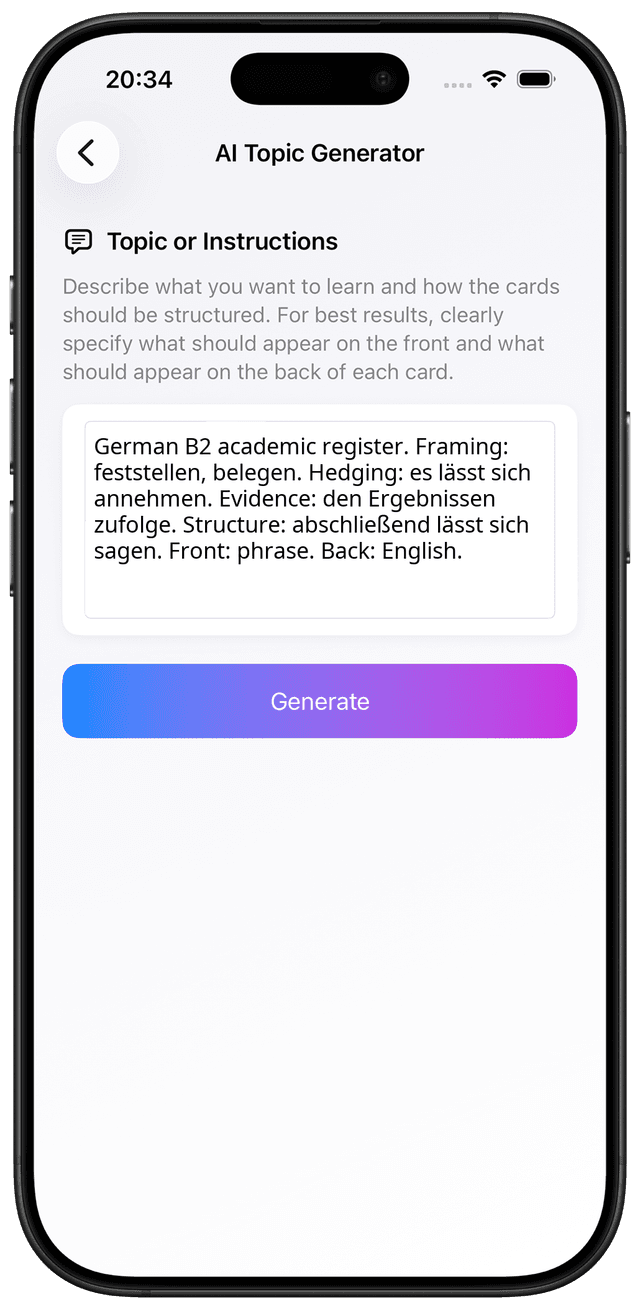
B2 German opens professional and academic doors. University study in German, professional work in Germany or Austria, and the TestDaF exam all require specific academic vocabulary: how to frame an argument, cite evidence, qualify a claim, and structure written analysis. This is vocabulary that does not appear in everyday conversation.
Why this is essential: The Goethe B2 and TestDaF exams include academic writing tasks where register matters as much as grammar. This phase gives you the phrases that signal academic competence: not just Ich meine, but Es lässt sich feststellen, dass... or Die vorliegende Untersuchung zeigt...
The strategy: This deck covers academic framing verbs, hedging phrases, evidence citation structures, and the formal vocabulary for structuring written argument at B2 level.
Generate 80 German B2 academic and professional vocabulary items in four groups: (1) Academic framing verbs: feststellen, belegen, untersuchen, analysieren, erläutern, aufzeigen, verdeutlichen, thematisieren. (2) Hedging and qualification: es lässt sich annehmen dass, unter Umständen, in gewissem Maße, es bleibt fraglich ob, der Befund deutet darauf hin dass. (3) Evidence and citation phrases: laut aktuellen Studien, wie die Forschung zeigt, den Ergebnissen zufolge, Daten belegen dass. (4) Argument structure: zunächst soll...erörtert werden, abschließend lässt sich sagen, dies führt zu der Frage ob, ein weiterer Aspekt betrifft. Front: German phrase + example sentence. Back: English.
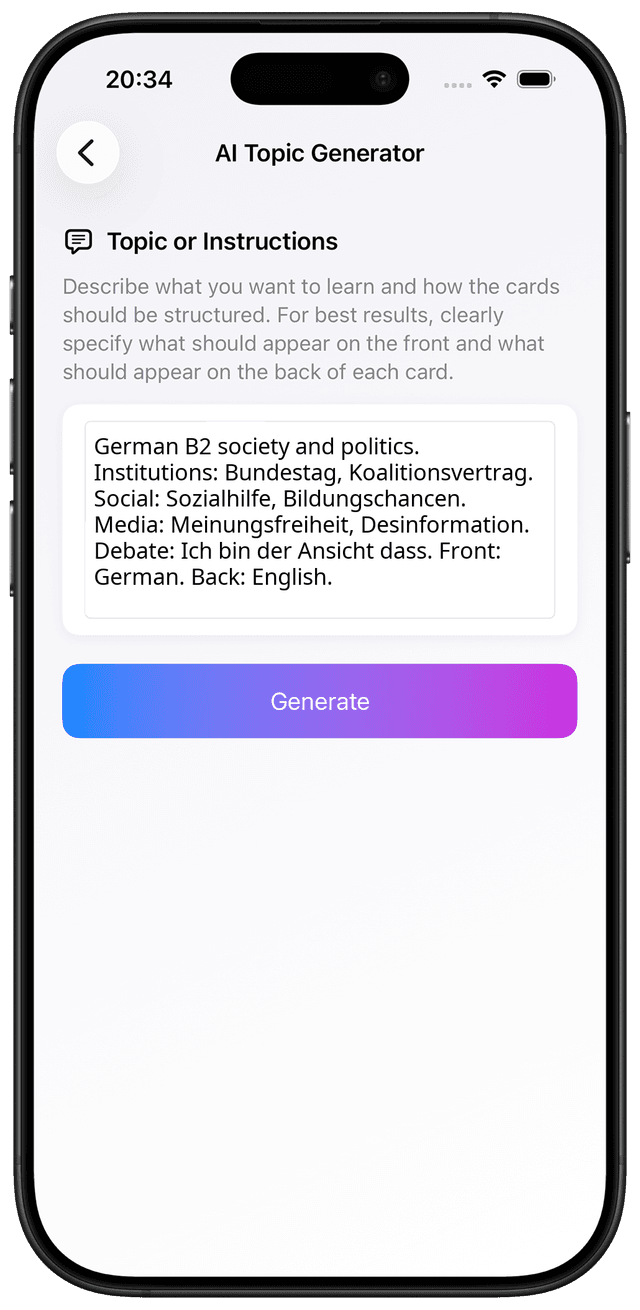
At B2 you can go beyond following the news to actually discussing it: arguing a position, pushing back on counter-arguments, and using the political and social vocabulary that German-speaking people use. Goethe B2 speaking tasks require you to handle topics like Sozialpolitik, Bildung, and Digitalisierung with enough precision that you can hold your own in a real exchange.
The goal: To build the content vocabulary that lets you have real opinions in German rather than just reporting what you heard. This phase covers the political, social, and media vocabulary that appears in Der Spiegel, Die Zeit, and Tagesschau at a level an educated German speaker would recognise.
Generate 80 German B2 society, politics, and media vocabulary items. Four areas: (1) Political institutions and processes: Bundestag, Bundesrat, Koalitionsvertrag, Gesetzgebungsverfahren, Volksbegehren, Wahlkreis, Fraktionszwang, Verfassungsgericht. (2) Social policy topics: Sozialhilfe, Rentensystem, Pflegeversicherung, Bildungschancen, Integration, sozialer Aufstieg, Ungleichheit. (3) Media and digital society: Meinungsfreiheit, Pressefreiheit, Desinformation, Filterblasen, Algorithmus, digitale Infrastruktur. (4) Opinion and debate phrases: Ich bin der Ansicht dass, dem muss man entgegnen dass, es wäre verfehlt zu behaupten, angesichts der Tatsache dass. Front: German. Back: English.
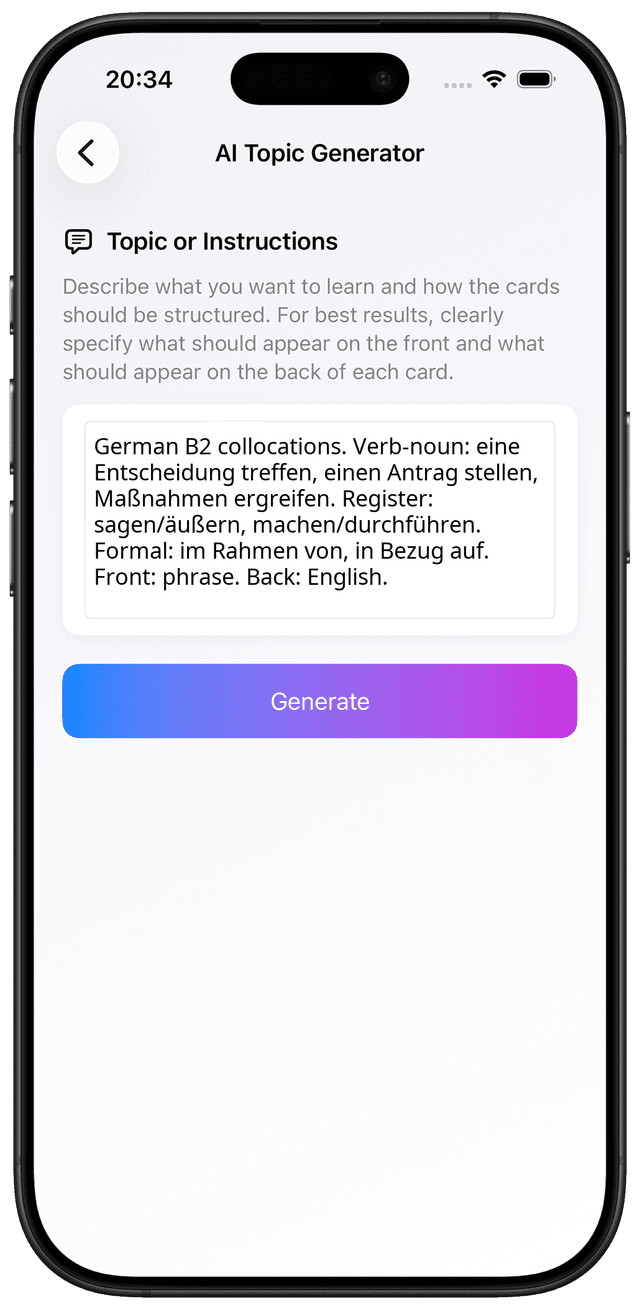
Native German speakers do not just know words. They know which words go together: eine Entscheidung treffen (not machen), einen Antrag stellen (not schreiben), ein Ziel verfolgen (not haben). Getting collocations right is what shifts your German from technically correct to genuinely natural. At B2, this is where visible improvement happens.
The milestone: With this deck, your B2 vocabulary toolkit is complete. You have Konjunktiv I for indirect speech, participial constructions for reading density, nominalisation for formal register, B2 conjunctions for argument complexity, academic vocabulary for formal writing, social and political content for opinion tasks, and collocations for natural sound. That covers the full B2 communicative range for Goethe B2, TestDaF, and genuine upper-intermediate German.
Looking ahead: C1 extends each of these areas further, adding finer stylistic control and a broader idiomatic range. Every card you lock in at B2 cuts C1 study time.
Generate 70 German B2 collocations and register-aware phrases in three groups: (1) High-frequency verb-noun collocations: eine Entscheidung treffen, einen Antrag stellen, ein Ziel verfolgen, Einfluss nehmen auf, zur Verfügung stellen, in Betracht ziehen, Rücksicht nehmen auf, eine Rolle spielen, Maßnahmen ergreifen. (2) Register pairs (colloquial vs. formal): sagen/äußern, machen/durchführen, bekommen/erhalten, fragen/anfragen, brauchen/benötigen. (3) Fixed academic phrases: im Rahmen von, in Bezug auf, hinsichtlich, mit Blick auf, unter Berücksichtigung von. Front: German phrase + example sentence. Back: English + register note.
At B2 the vocabulary is less predictable than A1-B1 core words. Spaced repetition handles this directly: cards you find difficult appear more often, cards you know well drop back. You spend time where it counts, not where you are already comfortable.
B2 builds on B1 and prepares you for C1. Use the links below to move between levels or return to the full German guide.
Join hundreds of learners building advanced German with spaced repetition and AI-powered vocabulary generation. No account needed. Download and start your first B2 deck today.