
Spaced repetition explained
Why reviewing at the right interval is the key to locking in advanced German vocabulary
You have B2. You can read a German newspaper, write a formal email, and hold your own in most conversations. C1 is where the effort drops again. German that required conscious processing starts arriving automatically. You stop translating and start thinking.
C1 covers roughly 6,000 to 8,000 words in active use. This guide focuses on the 1,500+ that actually move you forward at this level: register control for switching between colloquial and formal German, idioms that appear throughout journalism and professional speech, discourse markers for complex written argument, advanced nominal style for reading dense texts, academic writing conventions for university and exam contexts, domain-specific vocabulary for professional settings, and modal particles for genuine spoken fluency.
Each of the seven phases below includes a ready-to-use AI prompt. Paste it into the MindCards app and it generates a custom flashcard deck in seconds. Spaced repetition then schedules each card just before you are likely to forget it, so you retain more with less time reviewing.
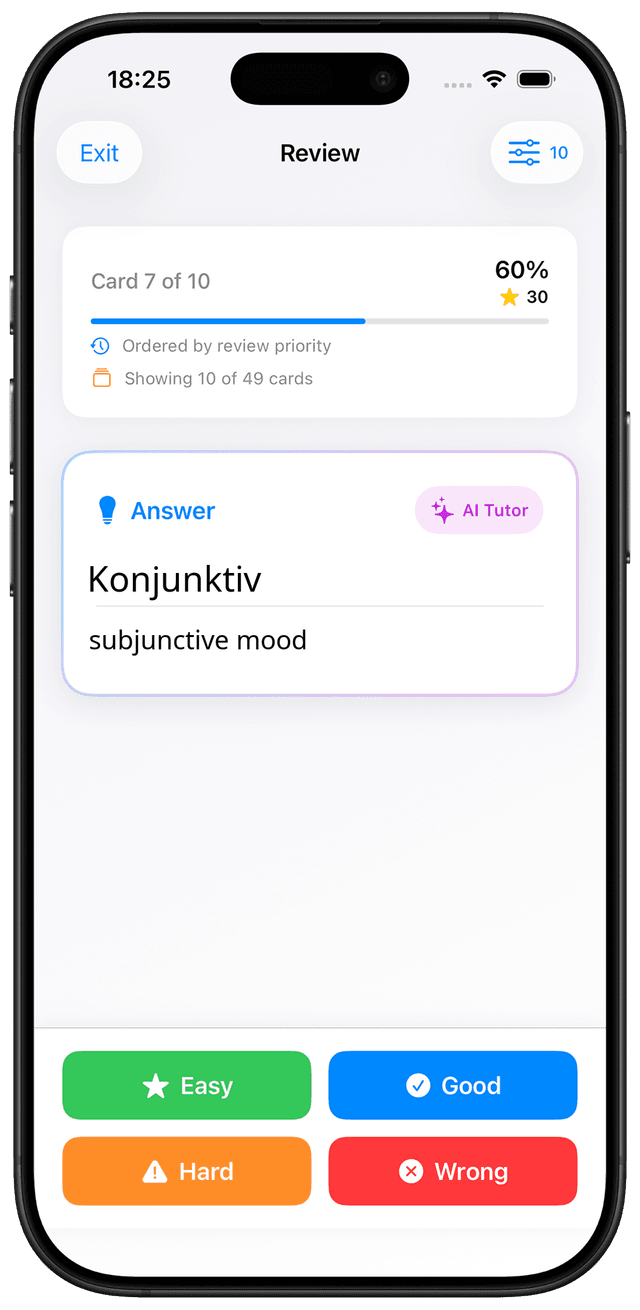
At C1, what separates you from B2 is not knowledge of more words but knowing when to use which ones. German has stark register divisions: the gap between colloquial spoken German and formal written German is wider than in English. Switching registers deliberately, from Umgangssprache to Hochsprache or academic register, is a core C1 skill.
Why start here? Register control is what makes C1 German sound native rather than just correct. A B2 speaker knows that abhauen and weggehen both mean to leave. A C1 speaker chooses between them depending on whether the context is a pub conversation or a formal letter.
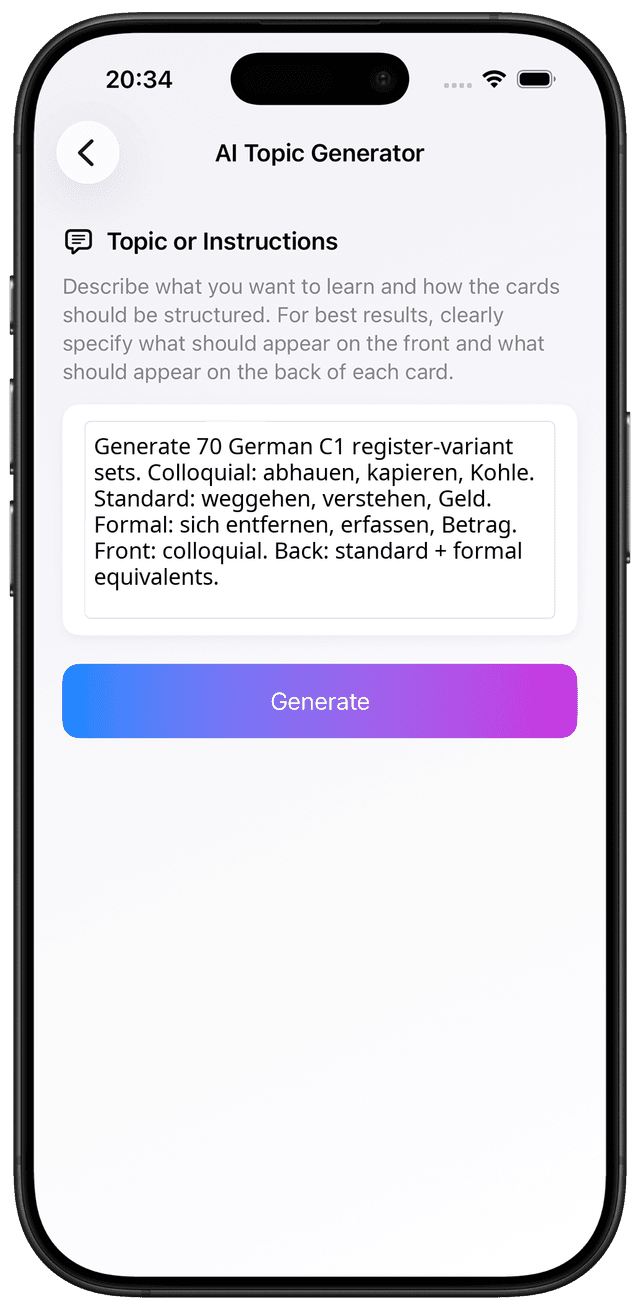
The strategy: This deck pairs colloquial, standard, and formal variants of the same idea so you build the habit of register-switching at the word level.
Generate 70 German C1 register-variant word sets. Three registers per set: (1) Umgangssprache (colloquial/spoken): abhauen, kapieren, Kohle (money), nix, echt, krass. (2) Standard/neutral: weggehen, verstehen, Geld, nichts, wirklich, extrem. (3) Formal/written: sich entfernen, erfassen, Betrag, keinerlei, tatsächlich, erheblich. Group by semantic category: movement, understanding, money, negation, emphasis. Front: German colloquial form. Back: standard + formal equivalents with register label.
German idioms are not optional at C1. They appear in journalism, business writing, political speech, and everyday conversation between educated speakers. Knowing that jemandem auf den Zahn fühlen means to probe someone, or that etwas auf die leichte Schulter nehmen means to underestimate something, is part of what fluency at this level looks like.
Why this matters: The Goethe C1 exam tests idiom comprehension in reading and listening sections. In professional settings, missing an idiomatic phrase can mean misunderstanding the tone or the actual content of what is being said.
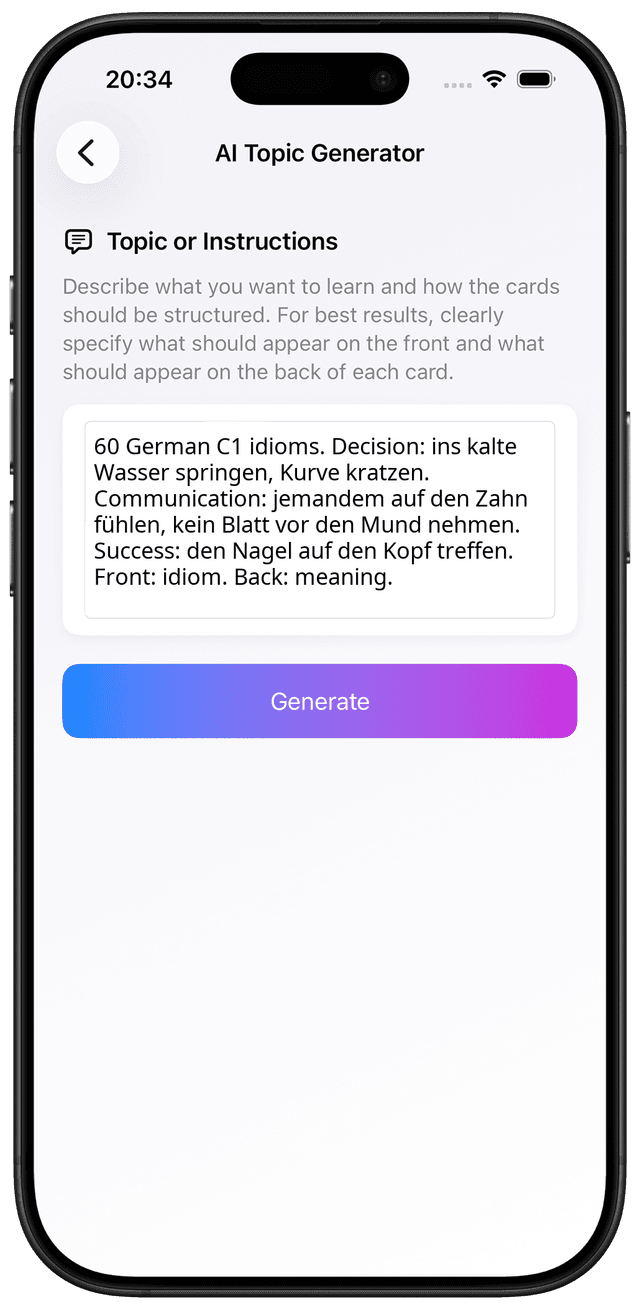
The strategy: This deck covers the 60 most frequently encountered idioms in German journalism and professional communication, grouped by theme.
Generate 60 German C1 idioms and fixed expressions in four thematic groups: (1) Decision and risk: etwas auf die leichte Schulter nehmen, ins kalte Wasser springen, die Kurve kratzen, den Stier bei den Hörnern packen. (2) Communication and truth: jemandem auf den Zahn fühlen, kein Blatt vor den Mund nehmen, hinter den Bergen wohnen, mit offenen Karten spielen. (3) Success and failure: auf keinen grünen Zweig kommen, den Nagel auf den Kopf treffen, ins Schwarze treffen, in die Hose gehen. (4) Time and urgency: auf Biegen oder Brechen, keine Zeit verlieren, in letzter Minute. Front: German idiom. Back: literal meaning + actual meaning + example sentence.
C1 written and spoken German is expected to handle complex argument structure: introducing a position, qualifying it, conceding counter-evidence, and landing a clear conclusion. B2 teaches the basic connectors. C1 requires the precise markers that signal logical relationships between clauses and paragraphs in formal prose.
Why add this now? The Goethe C1 writing tasks require structured essays and formal letters. Discourse markers are what give your writing the shape of an argument rather than a list of sentences. The same markers appear in German newspaper opinion pieces and academic papers.
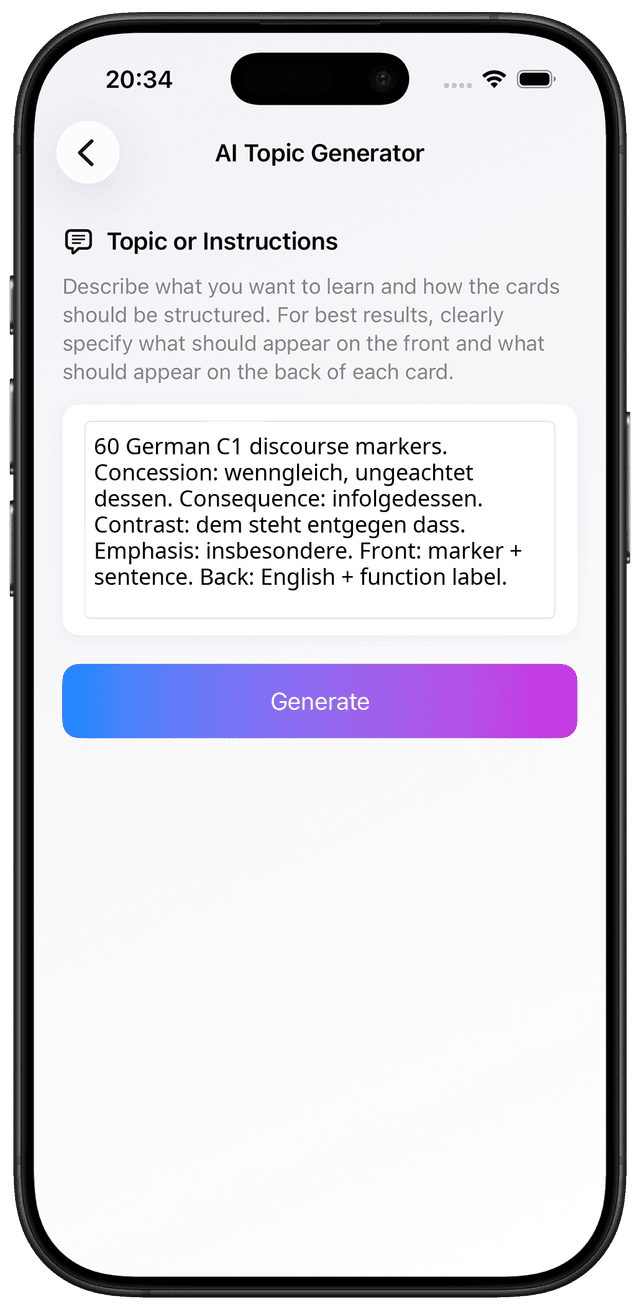
The strategy: This deck covers C1-level discourse markers organised by argumentative function, each shown in a complete sentence.
Generate 60 German C1 discourse markers for complex argumentation in six groups: (1) Concession with reservation: wenngleich, auch wenn man bedenkt dass, ungeachtet dessen, unbeschadet der Tatsache dass. (2) Logical consequence: daraus folgt dass, dementsprechend, infolgedessen, demzufolge. (3) Reformulation and clarification: mit anderen Worten, genauer gesagt, das bedeutet im Klartext. (4) Contrast and counter-argument: dem steht entgegen dass, im Gegensatz dazu, allerdings sei darauf hingewiesen. (5) Emphasis and focus: vor allem, insbesondere, nicht zuletzt. (6) Summary and conclusion: zusammenfassend lässt sich sagen, abschließend sei festgestellt. Front: German discourse marker + example sentence. Back: English + function label.
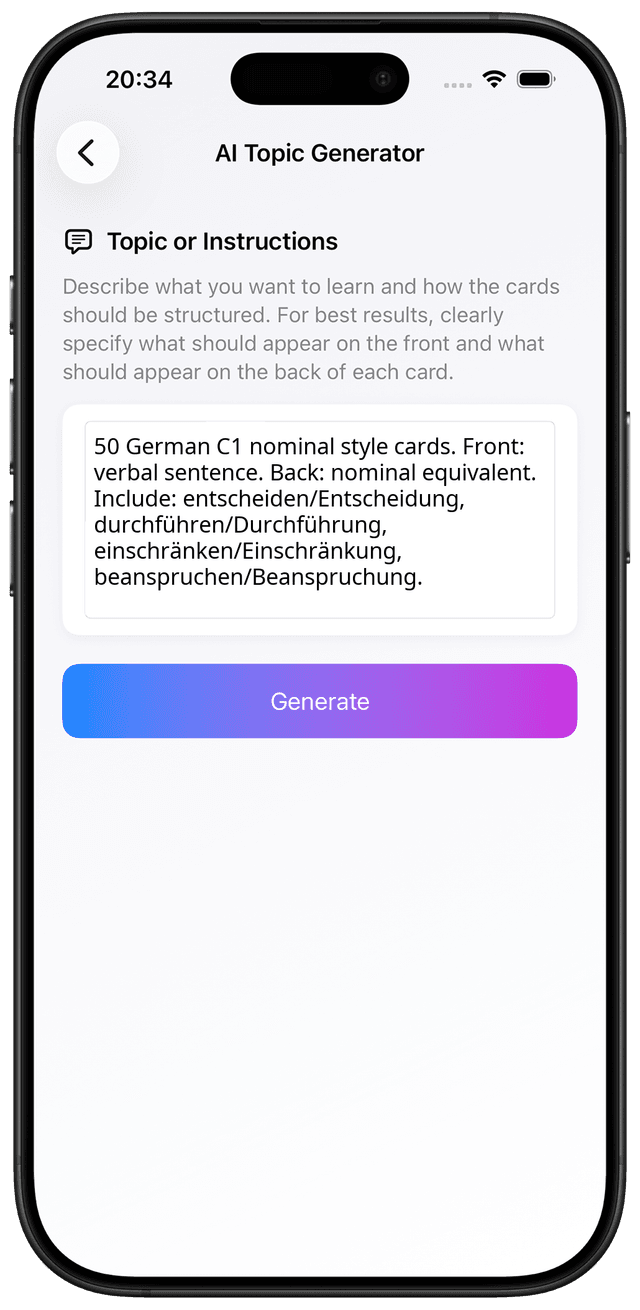
At C1, German formal writing relies heavily on a nominal style where ideas are expressed through nouns and noun phrases rather than verbs. Combined with extended participial constructions and heavily nested clauses, this creates the dense, compressed style of German academic and legal writing. Reading a German insurance policy, a university syllabus, or a government regulation requires familiarity with this style.
Why this is essential: Passive reading of dense German texts, and active production of formal written German, both depend on internalising this style. Without it, C1 texts feel difficult even when you know all the individual words.
The strategy: This deck drills the transformation from verbal to nominal constructions, and builds the reading-comprehension muscle for heavily nested clause structures.
Generate 50 German C1 nominal style transformations. Two parts: (1) Verbal to nominal: 20 pairs showing the same idea expressed verbally vs. nominally. Examples: Die Regierung hat entschieden (verbal) vs. Die Entscheidung der Regierung (nominal); Das Projekt wird durchgeführt vs. Die Durchführung des Projekts. Include verbs: durchführen, berücksichtigen, einschränken, beanspruchen, abwickeln. (2) Complex nested clauses: 30 sentence examples from legal and academic contexts with nested relative clauses and extended participial phrases. Front: verbal form or nested clause. Back: nominal equivalent or analytical breakdown.
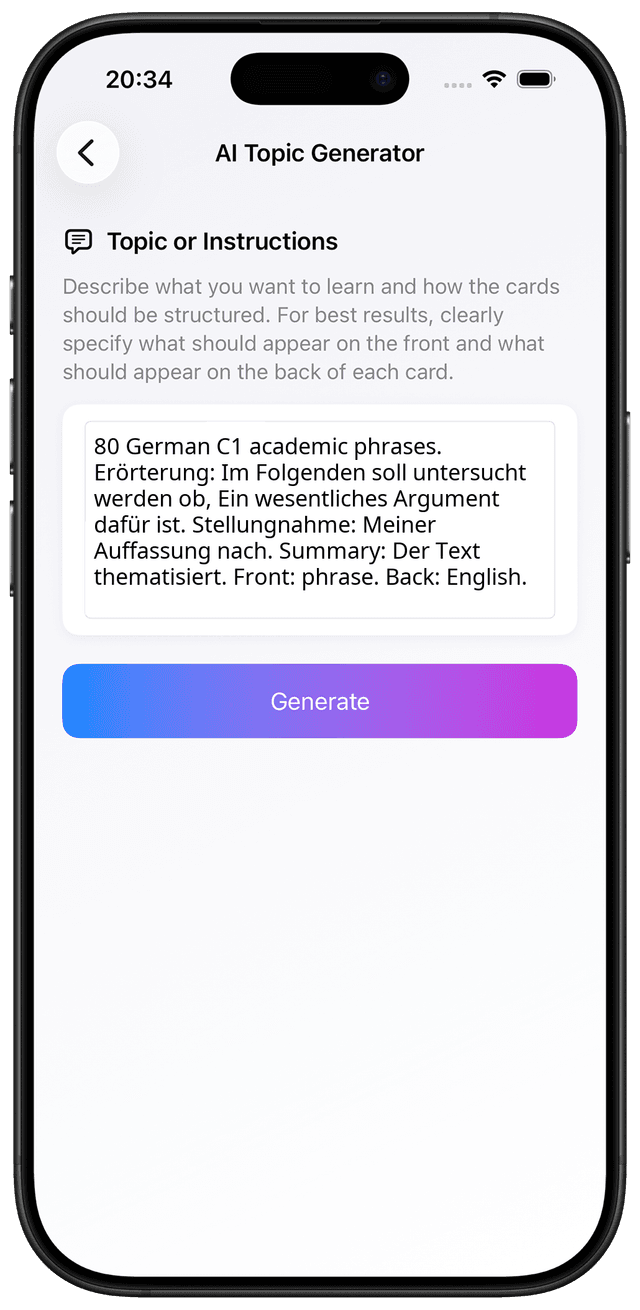
University study in German, the TestDaF exam, and professional communication at C1 all require command of specific text types: the Erörterung (argumentative essay), the Stellungnahme (position statement), the Zusammenfassung (summary), and formal correspondence. Each has structural and lexical conventions that differ from general writing.
Why this comes next: German university study and the Goethe C1 writing module both test academic text production. Knowing the structural phrases for each text type, and the vocabulary specific to argumentation and summary, directly affects your written score.
The strategy: This deck covers the lexical and structural conventions of the main C1 text types, with ready-to-use phrases for introduction, development, and conclusion.
Generate 80 German C1 academic writing phrases for four text types: (1) Erörterung (argumentative essay): introduction phrases (Im Folgenden soll untersucht werden, ob...), development (Ein wesentliches Argument dafür ist..., Dem lässt sich entgegenhalten, dass...), conclusion (Zusammenfassend lässt sich konstatieren, dass...). (2) Stellungnahme: Meiner Auffassung nach..., Ich vertrete die Position, dass..., Es erscheint mir fraglich, ob.... (3) Zusammenfassung: Der Text thematisiert..., Der Autor gelangt zu dem Schluss..., Als Kernaussage lässt sich festhalten. (4) Formal letters: Bezugnehmend auf..., Ich erlauben mir anzumerken..., Mit vorzüglicher Hochachtung. Front: German phrase. Back: English + text type label.
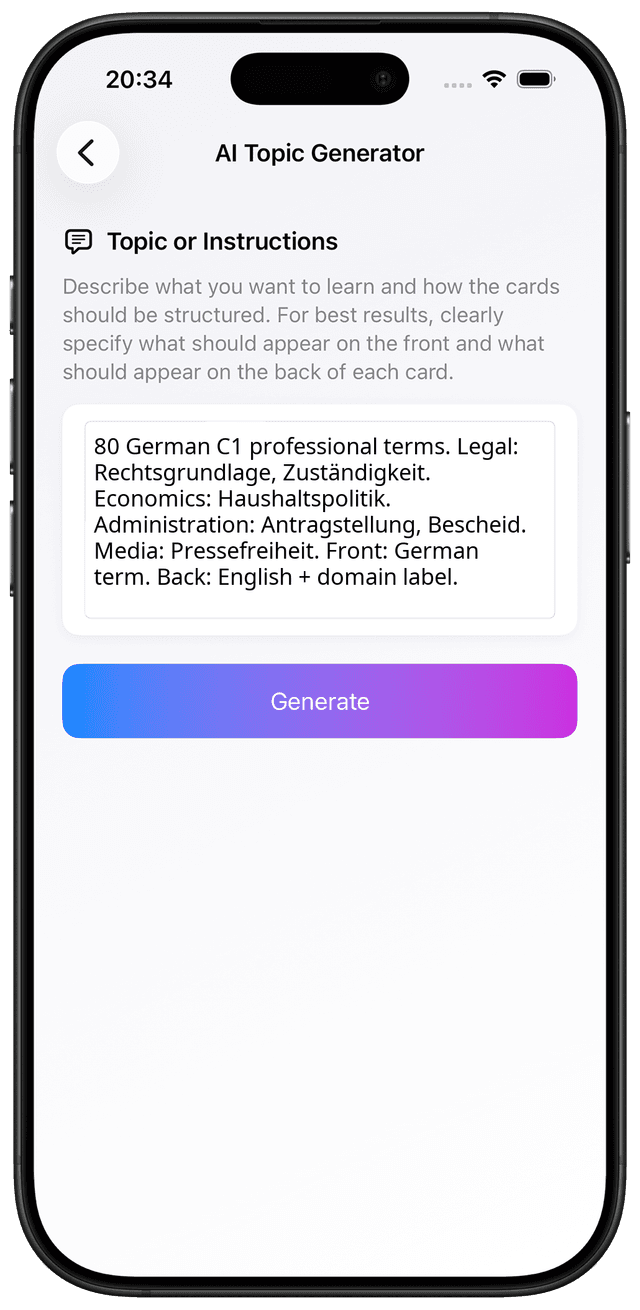
C1 German opens the door to professional and specialist communication. Legal German, business German, and the vocabulary of German public institutions all have their own terminology. Working in Germany or Austria at a professional level, reading authentic specialist texts, and navigating bureaucratic systems all require this domain-specific lexis.
The goal: To build the professional vocabulary that lets you operate in German-speaking work environments without relying on workarounds. This phase covers the domains most commonly tested in the Goethe C1 and DSH exams: law, economics, administration, and media.
Generate 80 German C1 professional vocabulary items across four domains: (1) Legal and administrative: Rechtsgrundlage, Zuständigkeit, Genehmigung, Widerspruch, Klage, Urteil, Erlass, Verordnung, Geschäftsordnung, rechtskräftig. (2) Economics and finance: Bruttoinlandsprodukt, Haushaltspolitik, Subvention, Schuldentilgung, Investitionsquote, Handelsdefizit, Kapitalanlage, Rendite. (3) Public administration: Bundesbehörde, Antragstellung, Bescheid, Widerspruchsfrist, amtlich, behördlich, Verwaltungsakt. (4) Media and communication: Berichterstattung, Pressefreiheit, Medienlandschaft, investigativer Journalismus, Meinungsbildung. Front: German term. Back: English + domain + example sentence.
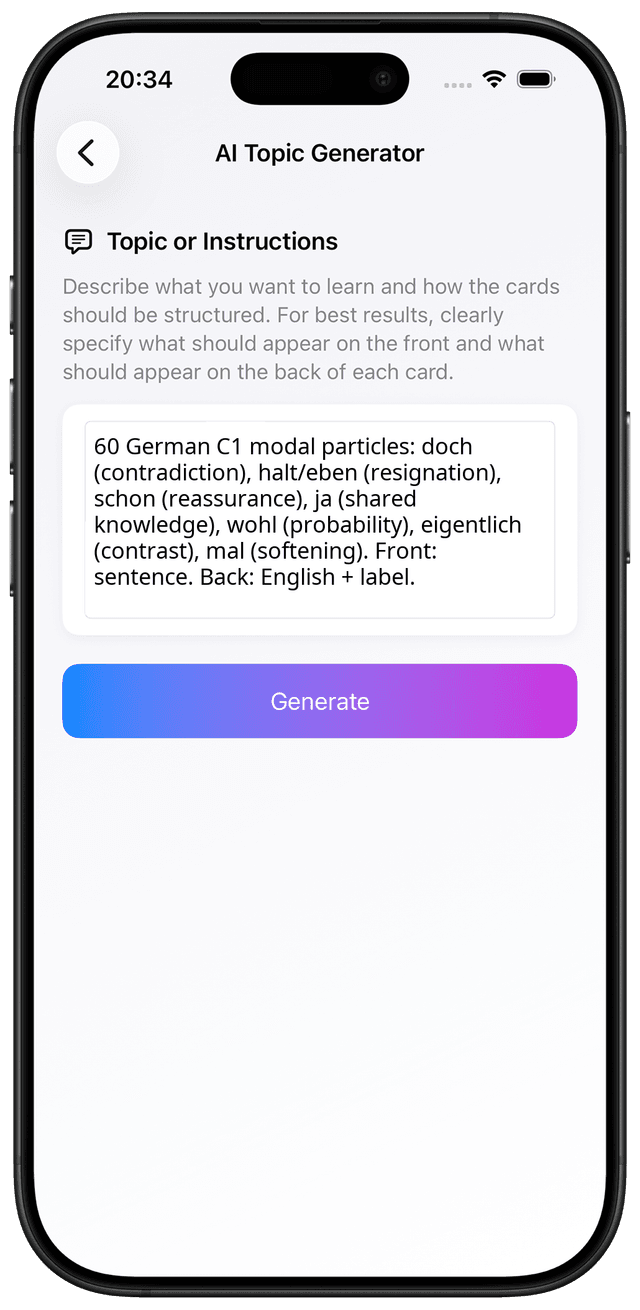
Modal particles are one of the most difficult aspects of German for non-native speakers. Words like doch, halt, eben, schon, ja, wohl, and eigentlich appear in almost every spoken sentence and fundamentally change the pragmatic meaning of an utterance. At C1 you are expected to understand and use them correctly. Getting particles right is what shifts your German from accurate to natural.
The milestone: Completing this phase means your C1 vocabulary toolkit covers register variation, idioms, discourse structure, nominal style, academic writing, professional vocabulary, and pragmatic nuance. That is the full C1 communicative range for Goethe C1, TestDaF, DSH, and professional German.
Looking ahead: C2 builds finer stylistic distinctions and a deeper idiomatic range. The modal particle control you build here is the foundation for C2 spoken authenticity.
Generate 60 German C1 modal particle examples. Seven particles, multiple contexts each: (1) doch: contradiction (Das stimmt doch nicht), encouragement (Komm doch mit), softening (Das ist doch klar). (2) halt/eben: resignation (Das ist halt so), explanation (Er ist eben müde). (3) schon: reassurance (Das wird schon klappen), concession (Schon, aber...). (4) ja: shared knowledge (Das weißt du ja), surprise (Du bist ja schon da). (5) wohl: probability (Er ist wohl krank). (6) eigentlich: mild contrast (Eigentlich wollte ich...). (7) mal: softening request (Kannst du mal helfen?). Front: German sentence with particle. Back: English + particle function label.
At C1 the vocabulary is more specialised and less predictable than at lower levels. Spaced repetition handles this directly: cards you find difficult appear more often, cards you know well drop back. You spend time where it counts. The same technique that builds A1 words builds C1 idioms and modal particles.
C1 builds on B2 and prepares you for near-native C2 fluency. Use the links below to move between levels or return to the full German guide.
Join hundreds of learners building advanced German with spaced repetition and AI-powered vocabulary generation. No account needed. Download and start your first C1 deck today.