
Spaced repetition explained
Why reviewing at the right interval is the key to retaining mastery-level French vocabulary
You have C1 French. You can manage register shifts, write a structured essay, read literary texts without stopping every paragraph. C2 is where fluency stops feeling like a performance. The mental effort of monitoring your French drops away. You reach for the right idiom without thinking, you hear when a proverbe fits the moment, and you can write in a way that does not read as translated.
This guide covers the 1,000+ vocabulary items that close the remaining gap between advanced and near-native. Collocations come first, because wrong combinations are the single most visible signal of a non-native writer. Then literary register, rhetorical devices for written production, nuanced subjunctive choices that signal stylistic control, French proverbes in real context, fixed expressions for legal and academic work, and francophone regional awareness across France, Belgium, Switzerland, Quebec, and West and Central Africa.
Each of the seven phases below includes a ready-to-use AI prompt. Paste it into MindCards and your first deck for that topic builds in seconds. Spaced repetition then schedules each card at the right interval, so your review time goes to the items you are actually forgetting.
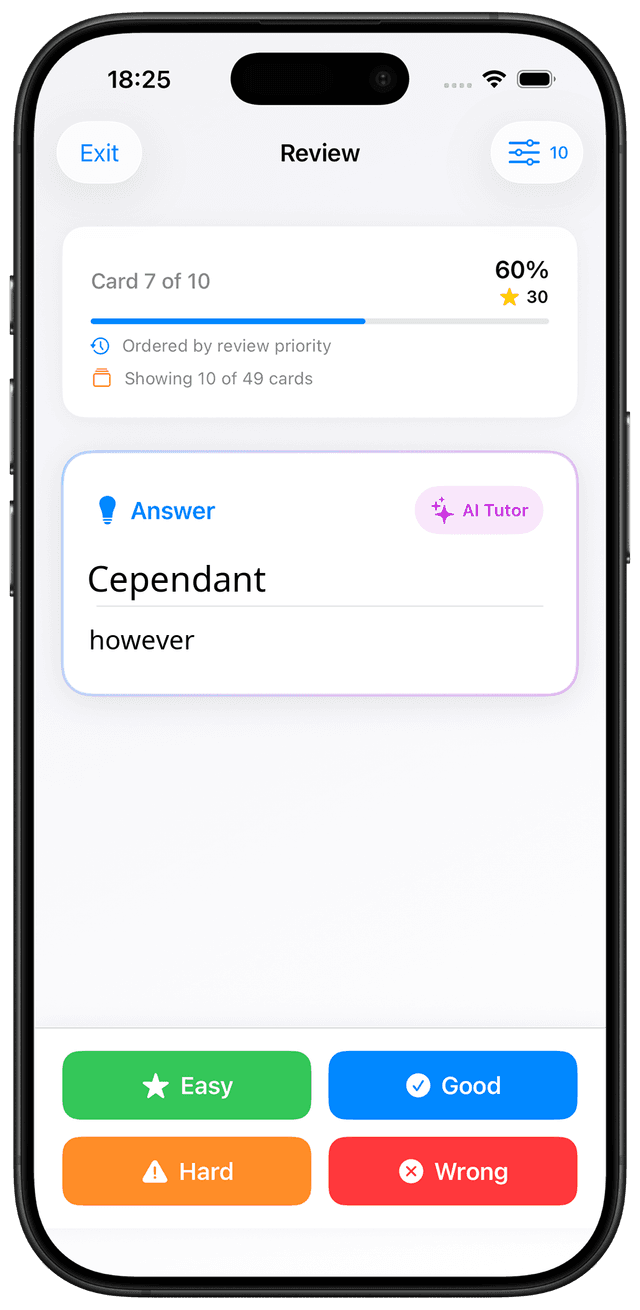
C2 French is not about adding more words to a list. It is about combining words the way French speakers actually do. At this level, the distance between you and a native speaker is mostly collocational. They do not pick verbs and nouns one by one. They pull whole chunks: prendre une décision, tirer la sonnette d'alarme, mener une enquête, faire le point sur, soulever une question, peser le pour et le contre. Each chunk is automatic for a native and deliberate for a learner, and that deliberateness is what shows.
Why start here? Collocational fluency is the single most reliable marker of C2 French. DALF C2 examiners and educated readers notice unusual collocations before they notice grammar slips. This phase targets the 200 most frequent verb-noun, adjective-noun, and adverb-verb combinations from contemporary French press, essays, and educated speech.
The strategy: Each card pairs the full collocation with a native-context sentence and the most common learner error to avoid. You build recognition and production together.
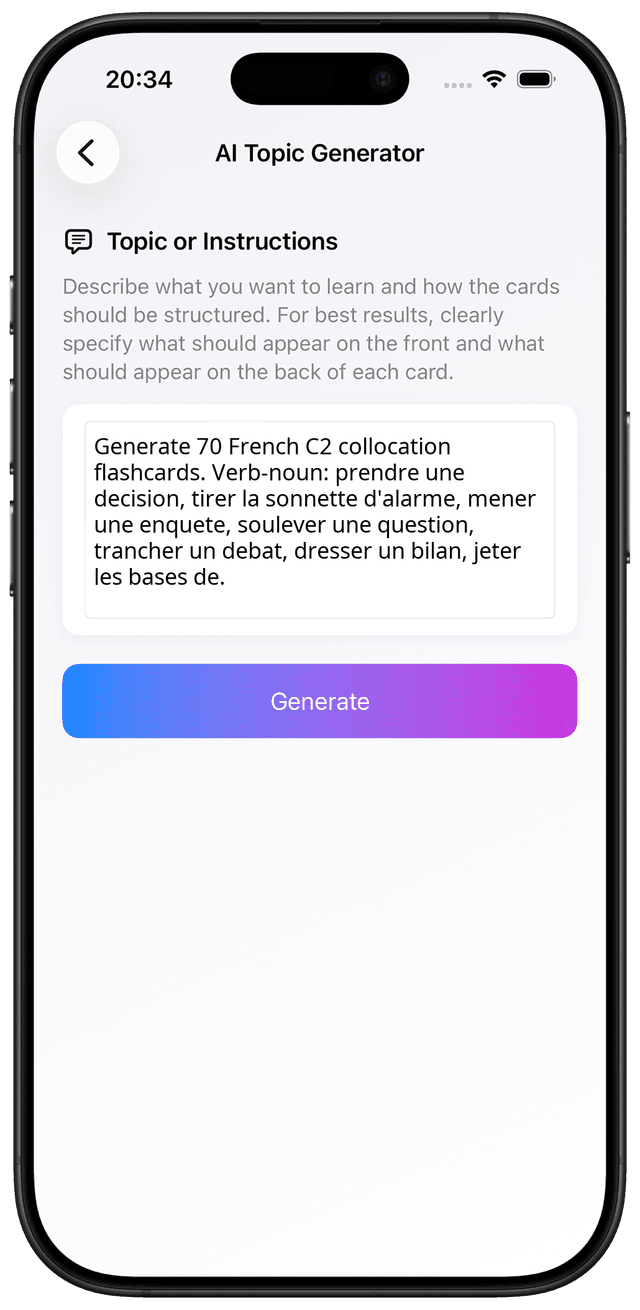
Generate 70 French C2 collocation flashcards. Three groups: (1) Verb-noun collocations: prendre une décision, tirer la sonnette d'alarme, mener une enquête, soulever une question, trancher un débat, dresser un bilan, jeter les bases de, ouvrir la voie à, mettre en lumière, faire le point sur. (2) Adjective-noun: argument massue, décision irrévocable, silence pesant, regard scrutateur, détail anodin, tournant décisif, enjeu majeur, situation délicate. (3) Common learner errors to contrast: faire/commettre une erreur, faire/donner une conférence, avoir/prendre raison, gagner/remporter un prix. Front: French collocation + example sentence. Back: English equivalent + note on register or common error.
Reading Modiano, Ernaux, Houellebecq, or Annie Ernaux without leaning on a dictionary requires a vocabulary set that sits between formal and literary French. This is not the vocabulary of journalism or business writing. It is the vocabulary of interior monologue, lyrical description, and authorial reflection that fills serious French fiction from Proust onward.
The goal: To give you enough literary register vocabulary that you can read a novel passage and follow the narrative choices the author is making, not just the plot. This matters for DALF C2 reading comprehension and for your own written production, where literary echoes are valued in the way they are not at C1.
The strategy: The deck draws from passages in major French literary works. Each card includes the source context, the literary function, and how the same term reads in contemporary non-literary use.
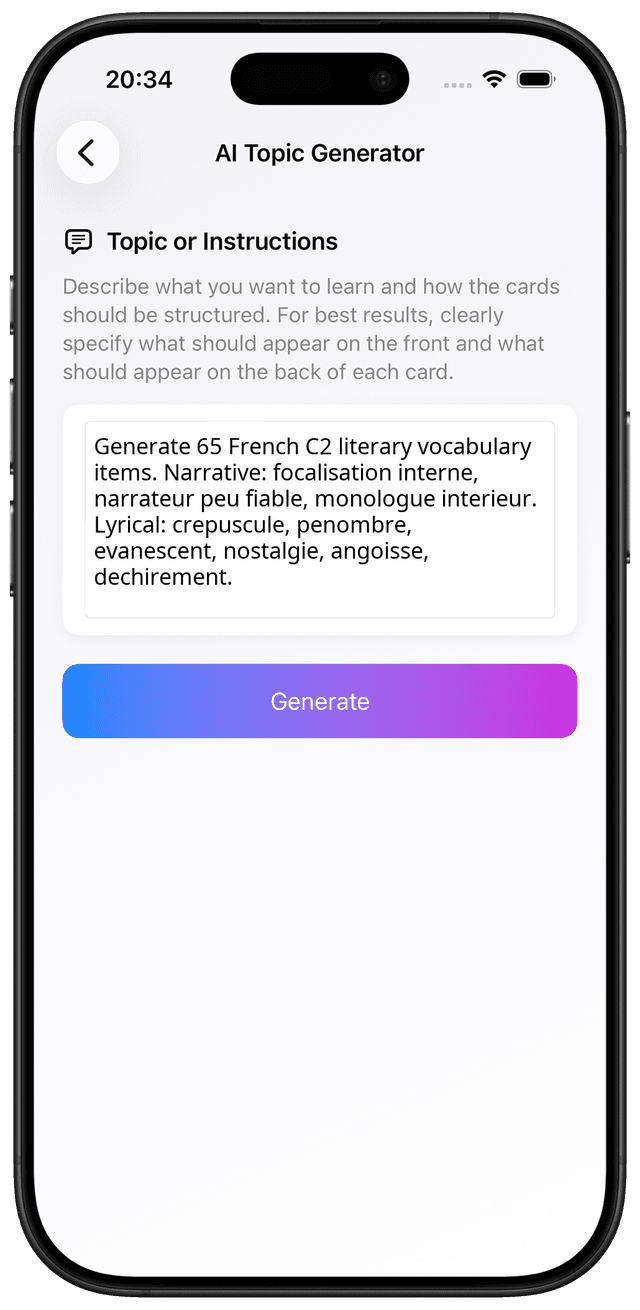
Generate 65 French C2 literary vocabulary items from narrative prose and poetry. Three groups: (1) Narrative technique: la focalisation interne, la focalisation zéro, le narrateur peu fiable, le flux de conscience, le monologue intérieur, la distance narrative, le temps diégétique, la mise en abyme. (2) Lyrical and descriptive: le crépuscule, la pénombre, évanescent, à la dérobée, la tendresse, la nostalgie, l'angoisse, le déchirement, l'épanchement. (3) Authorial stance: l'ironie dramatique, l'ambiguïté délibérée, la voix auctoriale, le perspectivisme, la digression, la métatextualité. Front: French term + sentence from a literary context. Back: English equivalent + literary function label.
DALF C2 written production asks you to produce editorial-quality French. That means deploying rhetorical devices on purpose: antithèse to sharpen a contrast, anaphore to build a rhythm, a well-placed question rhétorique to shift the reader's stance. In French opinion writing, these are not flourishes. They are expected tools, and their absence reads as flat prose.
Why this matters: Most C1 writers can avoid rhetorical figures and still produce a clean essay. At C2, that absence is itself the marker of non-native writing. French assessors are reading for evidence of stylistic control, not just grammatical accuracy.
The strategy: Cards cover the 15 most common rhetorical figures in French editorial and academic writing, each with a real example and a note on when the device strengthens an argument versus when it tips into overreach.
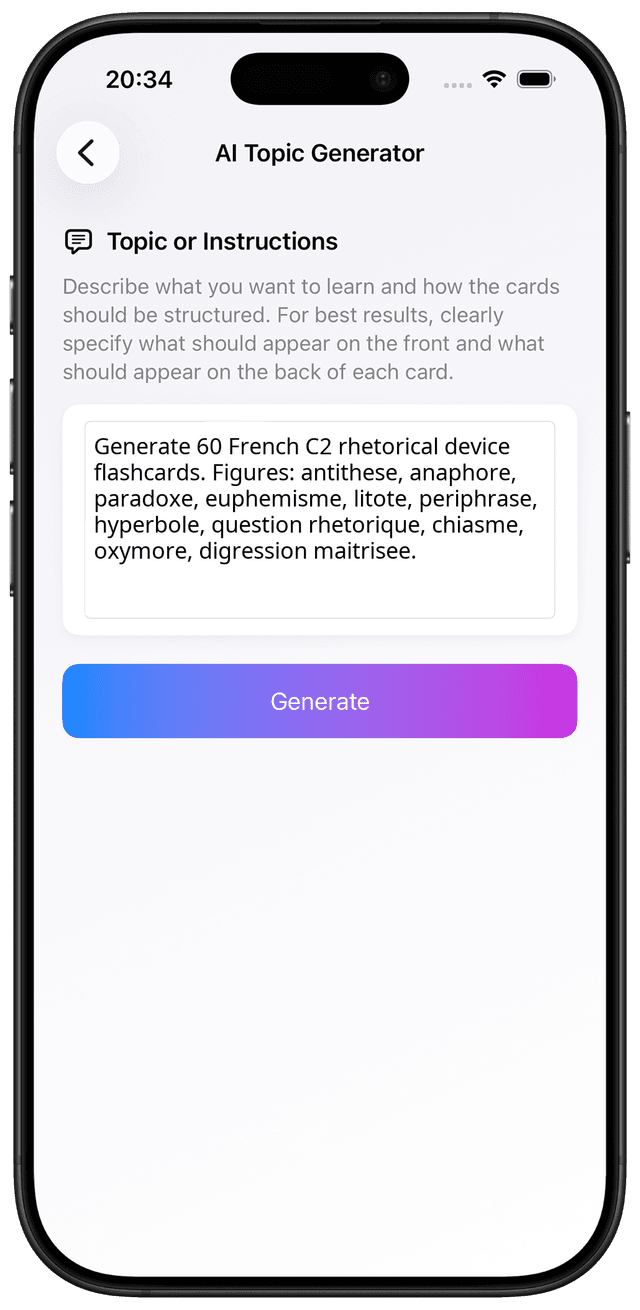
Generate 60 French C2 rhetorical device and argumentation flashcards. Four groups: (1) Rhetorical figures: l'antithèse, l'anaphore, le paradoxe, l'euphémisme, la litote, la périphrase, l'hyperbole modérée, la question rhétorique, la digression maîtrisée, le chiasme, l'oxymore. (2) Editorial argument structures: s'il est vrai que... il n'en demeure pas moins que, on aurait tort de croire que, force est de reconnaître que, là réside toute la difficulté, ce qui est en jeu, c'est. (3) Register elevation phrases: il convient de s'interroger sur, il n'est pas anodin de noter que, à tous égards, en soi, par-delà les apparences. (4) Persuasion and concession at C2: même les plus sceptiques admettront que, aucune analyse honnête ne saurait ignorer. Front: device or phrase + example in editorial context. Back: English + rhetorical label.
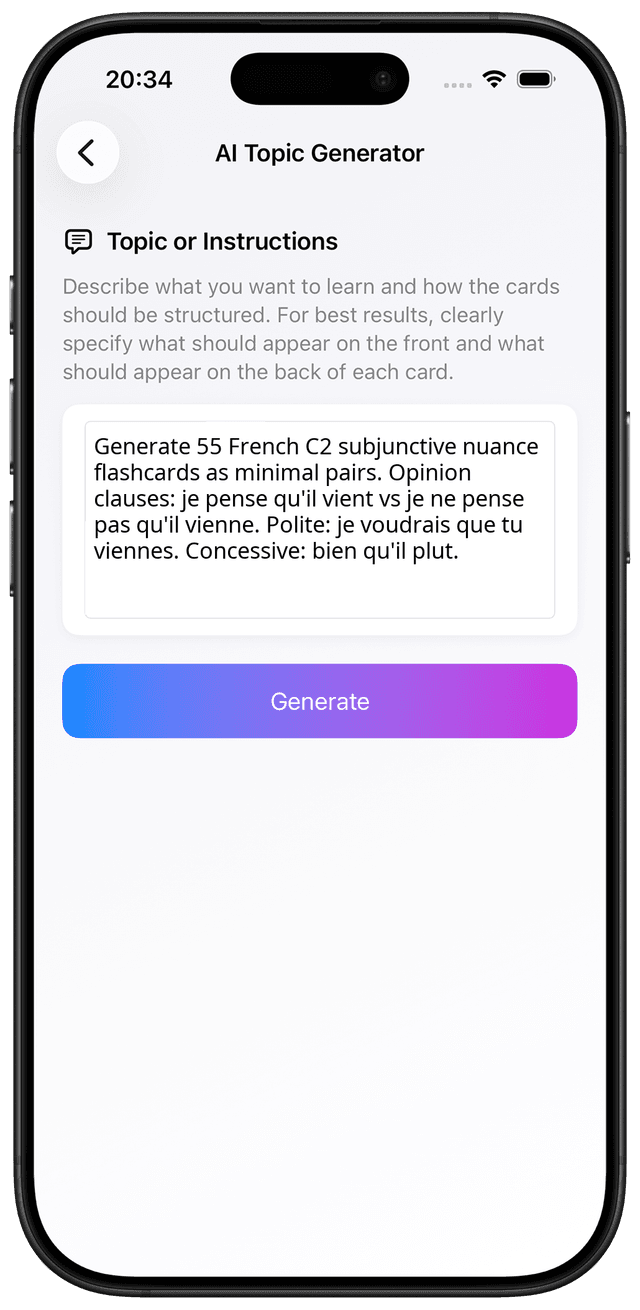
C1 subjunctive is about following the rules. C2 subjunctive is about bending them on purpose. Native speakers slip into the indicative where strict grammar calls for the subjunctive to assert more certainty, more directness, or a touch of irony. They also reach for the subjunctive where it is technically optional to mark deference, formality, or emotional distance. Reading those choices and making your own is what makes your French sound written rather than translated.
The goal: To understand the meanings created by mood alternation in complex subordinate clauses, polite requests, existential statements, and literary prose where the subjunctive carries weight beyond the rule.
The strategy: The deck presents minimal pairs: the same sentence with subjunctive and indicative, followed by the meaning shift. You learn to feel the difference, not just apply the rule.
Generate 55 French C2 subjunctive nuance flashcards as minimal pairs. Five groups: (1) Indicative vs subjunctive in opinion clauses: je pense qu'il vient vs je ne pense pas qu'il vienne, peut-être qu'il viendra vs peut-être vienne-t-il. (2) Polite vs direct requests: je veux que tu viennes vs je voudrais que tu viennes. (3) Literary subjunctive of indefiniteness: quoi qu'il en soit, où qu'il aille, qui que ce soit. (4) Imperfect subjunctive in literary register: bien qu'il fût tard, encore que cela parût étrange. (5) Concessive shift: bien qu'il pleuve (still possible) vs bien qu'il plût (literary register). Front: pair of French sentences. Back: English for both + note on the meaning or register difference.
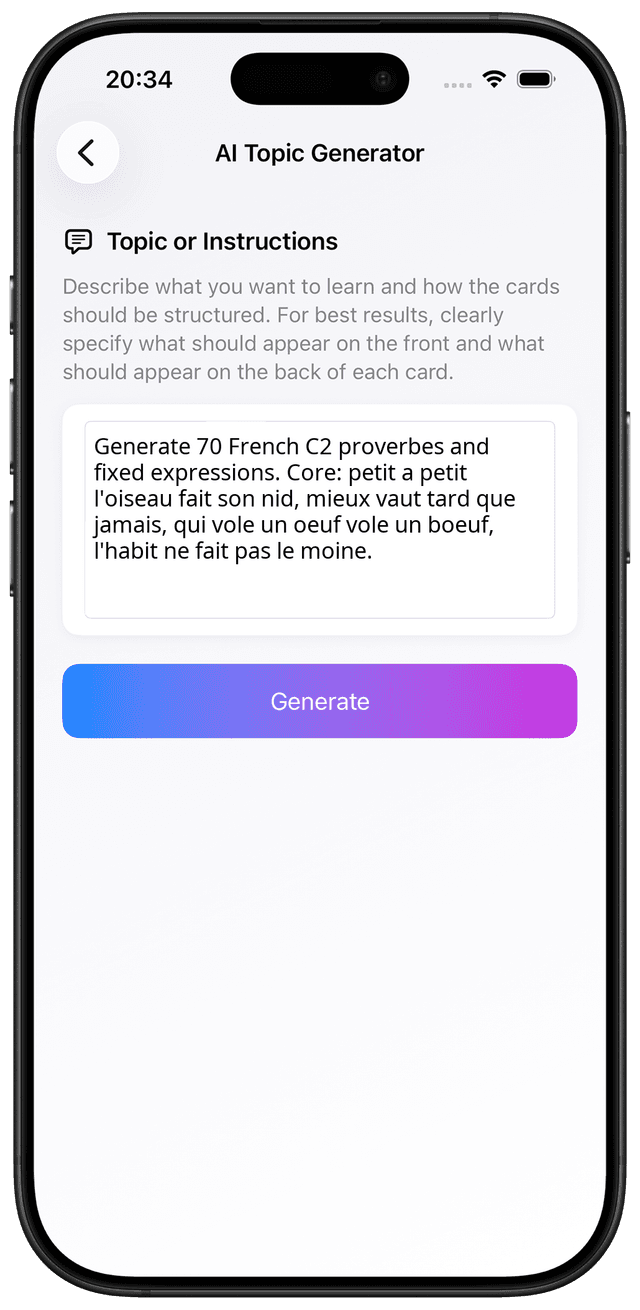
French proverbes are not optional decoration at C2. Native speakers in France, Belgium, Switzerland, and francophone Africa reach for them in conversation, political debate, journalism, and literature. Petit à petit, l'oiseau fait son nid. À chaque jour suffit sa peine. Qui vole un oeuf vole un boeuf. Knowing what these mean, recognising them in context, and slipping one in at the right moment is a concrete sign of near-native competence.
Why add this now? Proverbes index cultural knowledge, not just linguistic knowledge. A C2 user understands that French proverbs carry ironic weight in discourse and that using one wrongly is worse than not using one at all. This phase covers the 50 proverbes with the highest frequency in contemporary usage, plus 30 fixed expressions specific to journalistic, legal, and everyday formal speech.
The strategy: Cards show the proverbe, its literal meaning, its pragmatic use, and a model sentence showing how a native speaker would actually introduce it in conversation or in writing.
Generate 70 French C2 proverbes and fixed expression flashcards. Three groups: (1) Core proverbes: petit à petit l'oiseau fait son nid, mieux vaut tard que jamais, loin des yeux loin du coeur, à chaque jour suffit sa peine, dis-moi qui tu fréquentes je te dirai qui tu es, qui ne tente rien n'a rien, qui vole un oeuf vole un boeuf, l'habit ne fait pas le moine. (2) Journalistic and political fixed phrases: mettre sur la table, monter au créneau, jeter un pavé dans la mare, faire volte-face, faire la sourde oreille, vendre la mèche, mettre les pieds dans le plat. (3) Formal and legal fixed phrases: en vertu de ce qui précède, conformément aux dispositions de, sans préjudice de, aux fins de, dans le cadre de la législation en vigueur. Front: French expression + context sentence. Back: English equivalent + usage note on register and frequency.
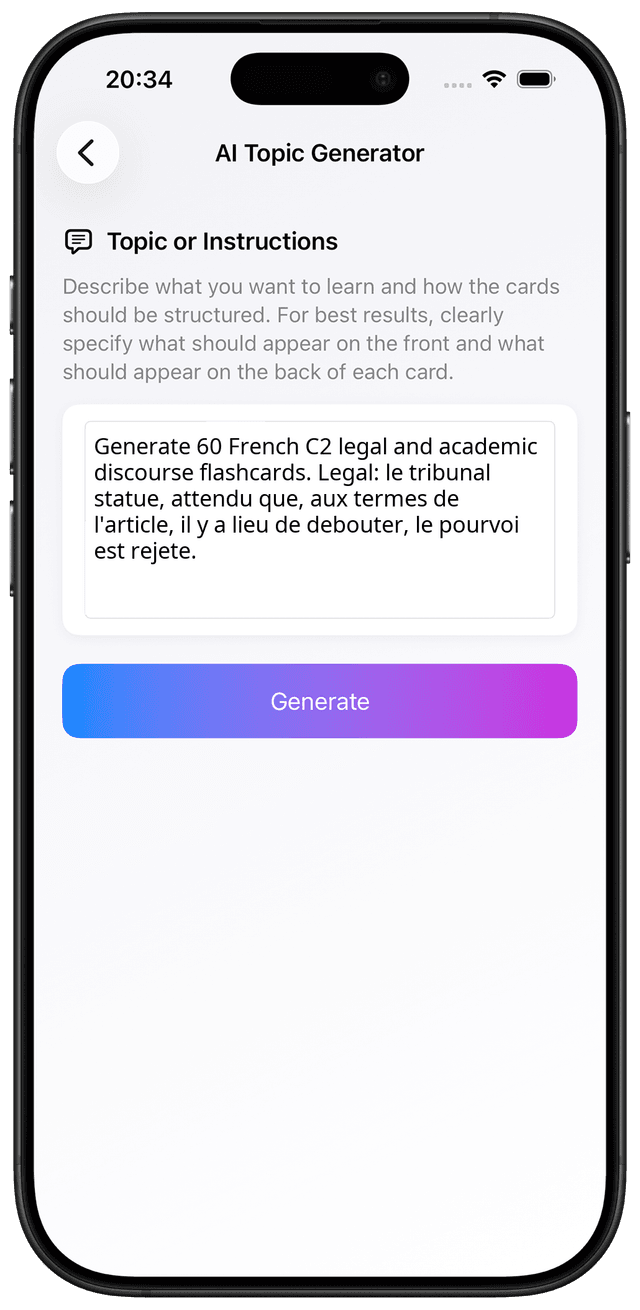
French law, academia, and public administration share a fixed vocabulary that does not flex into casual register. If you are translating, practising law, researching, or working in policy in a francophone context, this vocabulary is not optional. Aux termes de l'article. Le tribunal a statué en faveur de. Les résultats corroborent l'hypothèse de départ. These phrases turn up in real documents every day, and getting them wrong marks your text immediately as non-native.
The goal: To build active command of the 150 most common fixed expressions in French legal texts, academic papers, and administrative correspondence. The line between near-C2 and true C2 in professional contexts often runs through whether you can produce these phrases correctly rather than just recognise them.
The strategy: Phrases are grouped by document type: court judgments, academic abstracts, official letters, and regulatory texts. Each card shows the phrase inside a realistic document extract.
Generate 60 French C2 legal and academic discourse flashcards. Four groups: (1) Legal judgments and procedure: le tribunal statue, attendu que, aux termes de l'article, par voie de conséquence, il y a lieu de débouter, la cour fait droit à la demande, le pourvoi est rejeté. (2) Academic writing: les résultats corroborent, l'étude met en évidence, il ressort des données que, conformément aux travaux antérieurs, on peut conclure que, cette hypothèse appelle néanmoins certaines réserves. (3) Official correspondence: en réponse à votre courrier, j'ai l'honneur de vous informer, je me tiens à votre entière disposition, dans l'attente de votre réponse, veuillez agréer mes salutations distinguées. (4) Regulatory and policy texts: dans le cadre réglementaire en vigueur, sous réserve de, sans préjudice des droits, aux fins prévues à. Front: phrase + document context. Back: English + document type label.
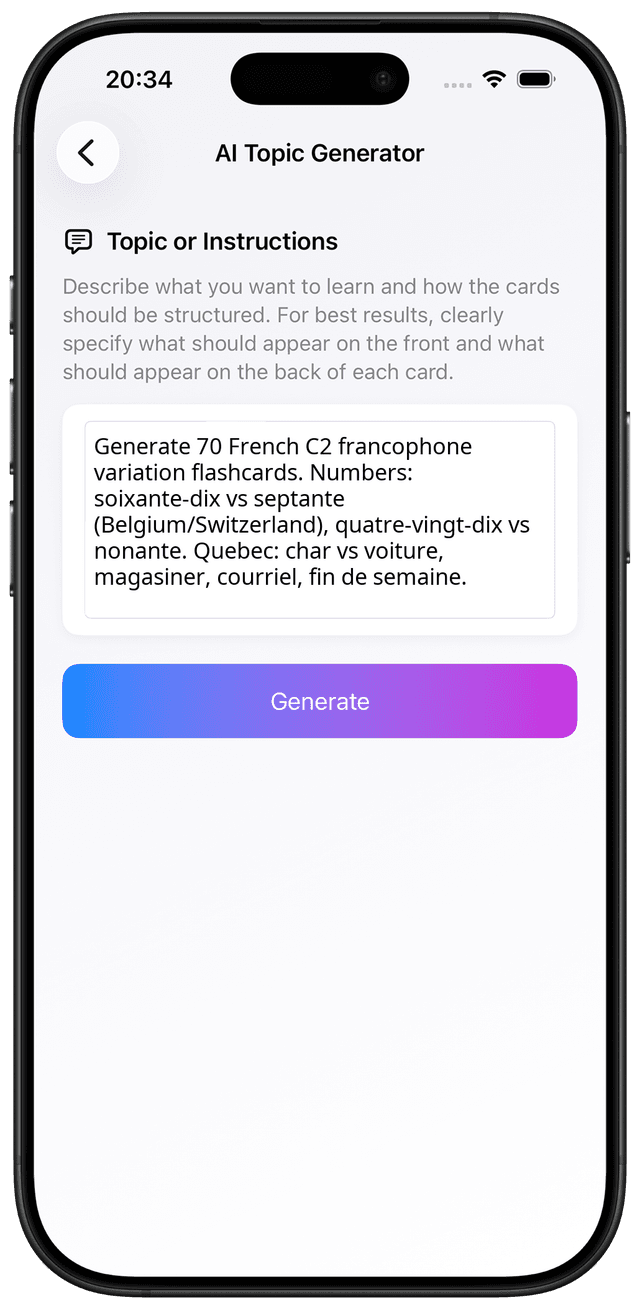
C2 mastery requires understanding that French is not one variety. A text written in Brussels reads differently from one written in Paris, which reads differently from one written in Montreal or Dakar. At this level you are expected to recognise these differences and tailor your own French to your audience. This is not about accent or pronunciation. It is about word choice and pragmatic norms.
Why this matters: DALF C2 listening and reading texts draw from across the francophone world. If you are working professionally in French, you will encounter clients, colleagues, and documents from France, Belgium, Switzerland, Quebec, and West and Central Africa. Knowing that septante means 70 in Belgium and Switzerland but soixante-dix in France, or that a courriel in Quebec is a mail in everyday French French, is basic professional competence.
The strategy: The deck covers the 80 most common lexical and pragmatic divergences across major francophone varieties, with usage notes on register, frequency, and which variety expects which form.
Generate 70 French C2 francophone variation flashcards. Four groups: (1) Numbers and basic divergences: soixante-dix vs septante (Belgium/Switzerland), quatre-vingt-dix vs nonante, déjeuner/dîner/souper across France and Quebec. (2) Quebec French: char vs voiture, magasiner vs faire les courses, courriel vs e-mail/mail, blonde/chum vs petite amie/petit ami, fin de semaine vs week-end. (3) Belgian and Swiss French: une fricadelle, un kot (student room), une essuie (towel) in Belgium, un cornet (bag), une panosse (mop) in Switzerland. (4) West and Central African French: un taxi-brousse, une maquis (open-air restaurant in Ivory Coast), un cadeau (tip/extra), pragmatic norms around tu/vous in different francophone professional cultures. Front: French contrast pair + region labels. Back: English equivalents + pragmatic usage note.
At C2, the vocabulary you are missing is less frequent and more context-dependent than at any earlier level. Spaced repetition is well suited to this work: it surfaces the collocations, proverbes, and fixed phrases you keep forgetting more often and quietly drops the ones you have already locked in. Your review time goes where it actually moves the needle.
C2 builds directly on C1. Use the links below to review the prerequisite level or return to the full French guide.
Copy any prompt from this guide into MindCards and your first C2 deck is ready in seconds. No account needed. The app is free on iOS.