
Spaced repetition explained
Why reviewing at the right interval locks in French A2 vocabulary
You have the A1 foundation. Now build something you can actually use in a real conversation. At A2, the big jump is the Passé Composé (France's everyday past tense), along with the grammar structures that separate halting French from natural French: the Imparfait for descriptions, reflexive verbs for daily routines, and the Futur Simple for making plans.
A2 covers roughly 1,000 words and structures, and they are not all equal. This guide focuses on the ones that come up most often: the verbs that take être in the Passé Composé, the reflexive constructions that appear in every health and daily-life topic, and the opinion phrases that make your French sound considered rather than robotic.
Each phase includes a ready-to-use AI prompt. Copy it into MindCards and you get a focused deck built around real French grammar and vocabulary. The app's spaced repetition algorithm then decides when each card reappears, spacing reviews so you consolidate A2 French faster than traditional word lists allow.
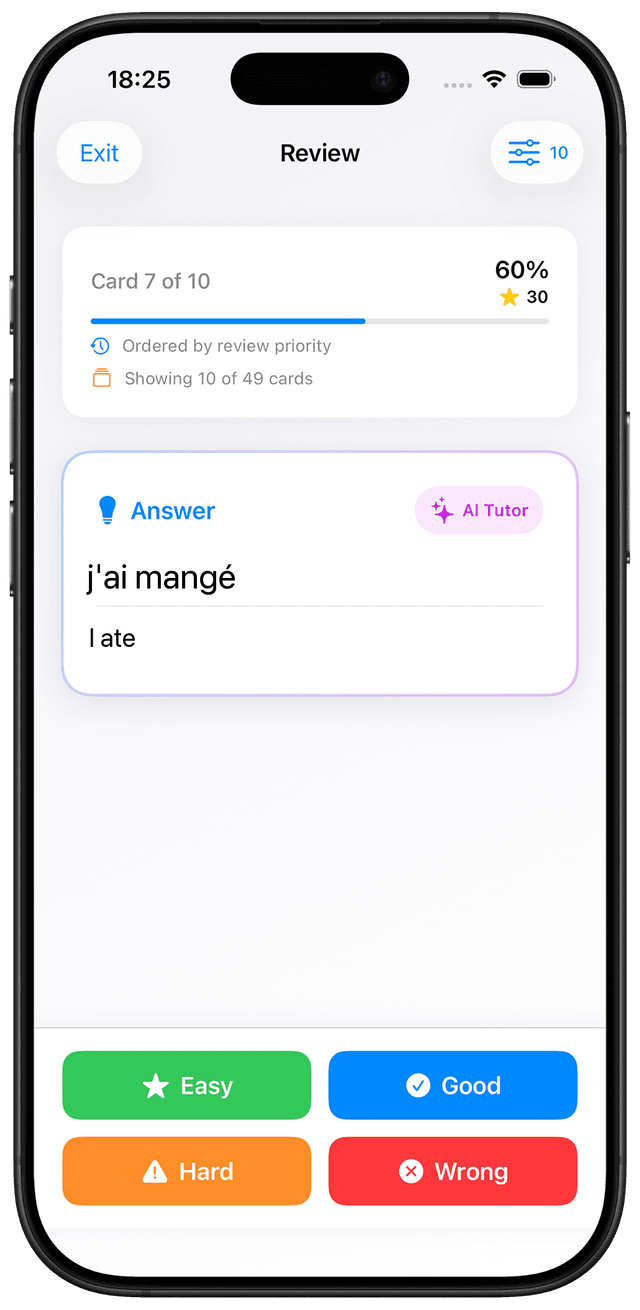
The Passé Composé is how French speakers talk about past events and completed actions in everyday conversation. Like German's Perfekt, it uses a helper verb (avoir or être) plus a past participle. But in French the choice between avoir and être affects the participle's agreement, a detail that trips up most A1 learners the moment they try to tell a story.
The verbs that use être are mostly movement and state-change verbs: aller (to go), venir (to come), partir (to leave), arriver (to arrive), rester (to stay), tomber (to fall), naître (to be born), and mourir (to die), among others. The DR & MRS VANDERTRAMP mnemonic covers the main group. When être is the auxiliary, the past participle agrees in gender and number with the subject: il est allé, elle est allée, ils sont allés.
Why start here? Every other A2 topic assumes you can describe something that already happened. The Passé Composé unlocks that, and it is the first structure tested in DELF A2 speaking and writing tasks.
The strategy: This deck focuses on 60 high-frequency verbs with their correct auxiliary (avoir or être) and past participle, plus a natural example sentence on the back so you absorb the word order, not just the isolated form.
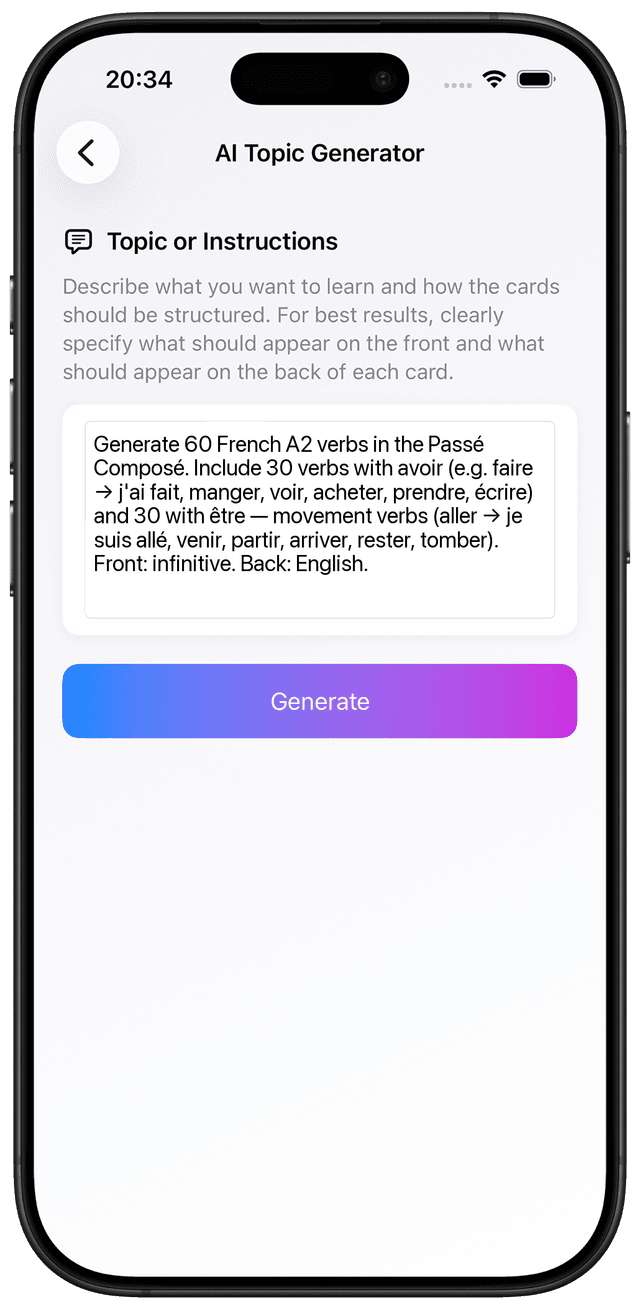
Generate 60 French A2 verbs in the Passé Composé. Include 30 verbs with avoir (e.g. faire → j'ai fait, manger, voir, acheter, prendre, écrire) and 30 with être — mainly movement and state-change verbs using the DR & MRS VANDERTRAMP group (aller → je suis allé, venir, partir, arriver, rester, tomber, naître, mourir). Include agreement note for être verbs. Front: infinitive + correct Passé Composé form. Back: English + a short example sentence using je or nous.
While the Passé Composé marks completed events, the Imparfait describes ongoing states, background details, and repeated habits in the past. The contrast between the two is one of the trickiest things in French for English speakers, because English does not separate them as clearly.
A quick test: if you would say 'I was doing' or 'I used to do' in English, that is Imparfait. If you would say 'I did' (a single completed event), use the Passé Composé. The classic textbook sentence is Il lisait quand le téléphone a sonné, meaning he was reading (Imparfait, ongoing) when the phone rang (Passé Composé, sudden event).
Why the Imparfait next? At A2, you need both tenses to tell a proper story: Passé Composé for what happened, Imparfait for what things were like. DELF A2 writing tasks almost always require this combination.
The strategy: This deck covers the Imparfait conjugations for core verbs, common time markers (autrefois, tous les jours, quand j'étais), and contrast sentences showing when to choose Imparfait over Passé Composé.
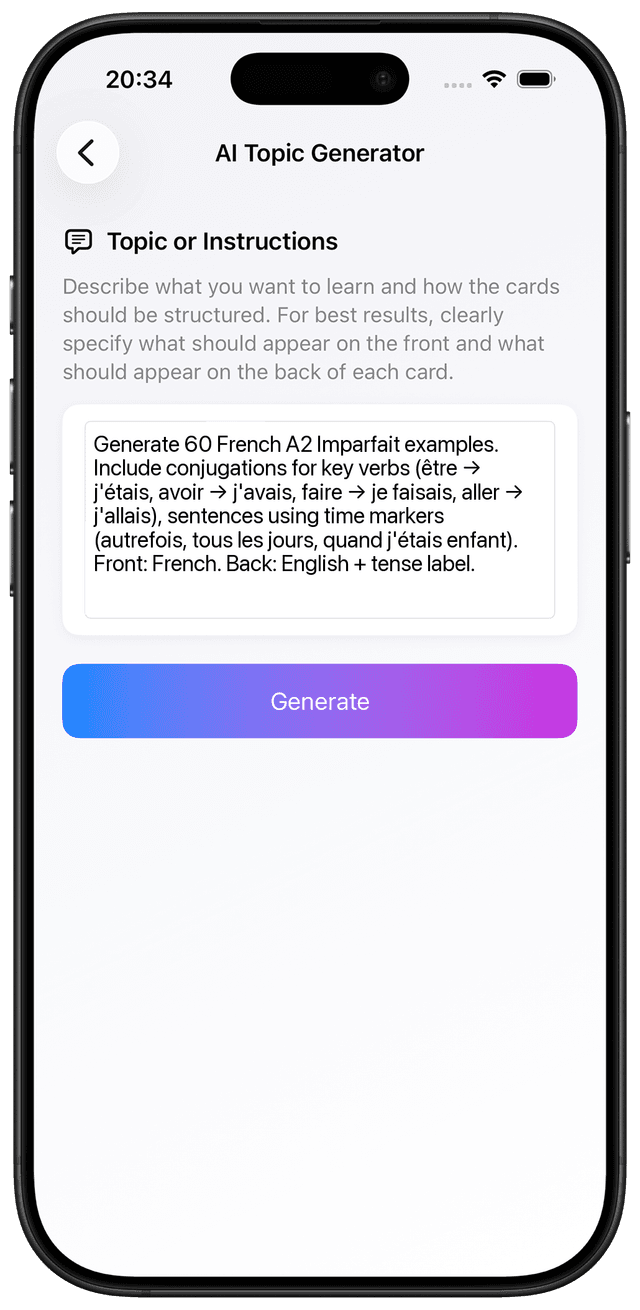
Generate 60 French A2 Imparfait examples. Include: conjugations for key irregular verbs (être → j'étais, avoir → j'avais, faire → je faisais, aller → j'allais, pouvoir → je pouvais), 20 sentences using time markers (autrefois, tous les jours, souvent, quand j'étais enfant, d'habitude), and 10 contrast pairs showing Passé Composé vs Imparfait in context (e.g. Il lisait quand le téléphone a sonné). Front: French sentence. Back: English + tense label (PC or Imp) with a usage note.
French uses reflexive verbs far more than English does. Se lever, se coucher, se souvenir, and s'appeler all require a reflexive pronoun that changes with the subject. They also use être in the Passé Composé, and the participle must agree with the subject when there is no direct object after the verb.
The agreement rule surprises many learners: Elle s'est levée has an extra 'e' because the subject is feminine and there is no following direct object, but Elle s'est lavé les mains has no agreement because les mains is the direct object after the verb. The deck includes notes so you see this pattern in action rather than reading about it abstractly.
Why reflexive verbs matter: Daily routine language, descriptions of feeling, and introductions all rely on this structure. They come up in nearly every DELF A2 topic, from daily life to health.
The strategy: This deck covers 50 high-frequency reflexive verbs in the present tense with all pronouns, plus their Passé Composé forms with agreement rules shown explicitly.
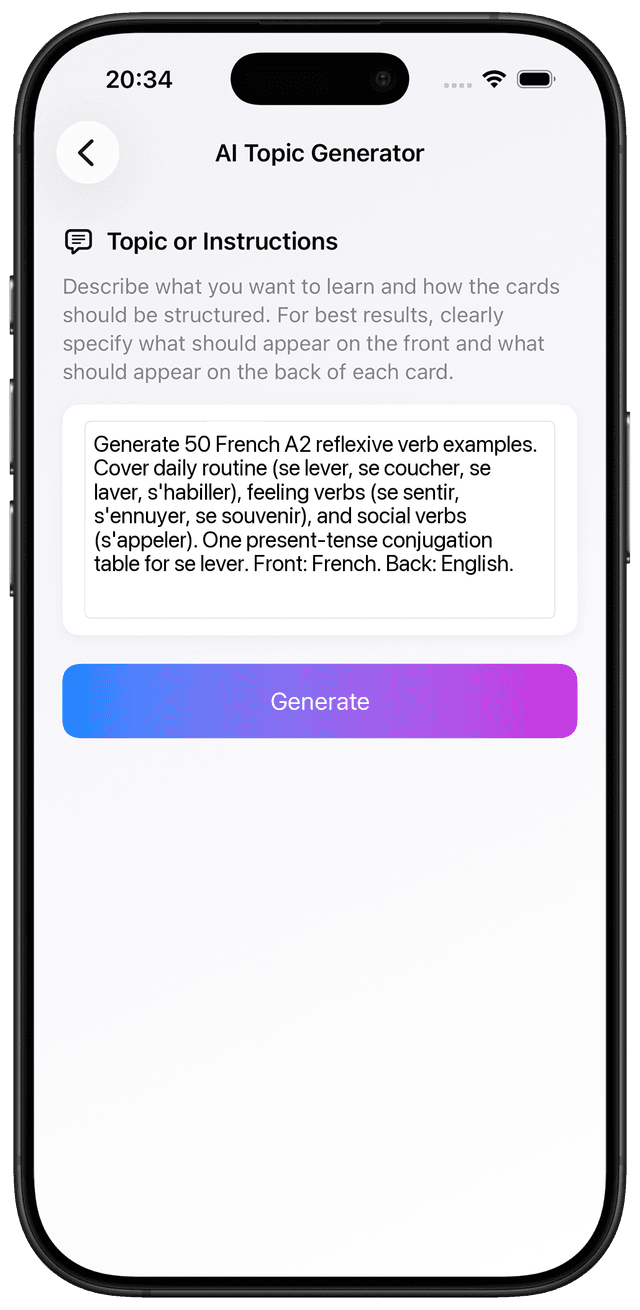
Generate 50 French A2 reflexive verb examples (verbes pronominaux). Cover daily routine verbs (se lever, se coucher, se laver, se brosser, s'habiller, se reposer), feeling and state verbs (se sentir, s'ennuyer, se souvenir, se tromper), and social verbs (s'appeler, se retrouver, se parler). Include full conjugation table in present tense for se lever and se coucher, then one example sentence each for the rest. Add 10 Passé Composé sentences with être and agreement notes. Front: French. Back: English + reflexive pronoun rule.
French comparatives add plus, moins, or aussi before the adjective, and French has a small group of irregular forms: bon becomes meilleur, bien becomes mieux, mauvais becomes pire. The Superlatif uses le/la/les plus or le/la/les moins. You use these every time you describe a preference, make a recommendation, or compare options.
One thing to watch: the adjective still agrees in gender and number in comparative constructions. Ce film est plus intéressant que l'autre works for a masculine noun, but Cette histoire est plus intéressante que l'autre needs the feminine form. The irregular forms (meilleur, mieux, pire) also agree: c'est la meilleure solution, not le meilleur.
Why add opinions now? After past tenses and reflexive verbs, the next DELF A2 task is expressing views and reactions. French phrases like Je trouve que..., À mon avis..., and Je préfère... signal opinion in ways native speakers recognise immediately.
The strategy: This deck combines comparative and superlative patterns with opinion vocabulary so you can evaluate, contrast, and recommend in one connected batch.
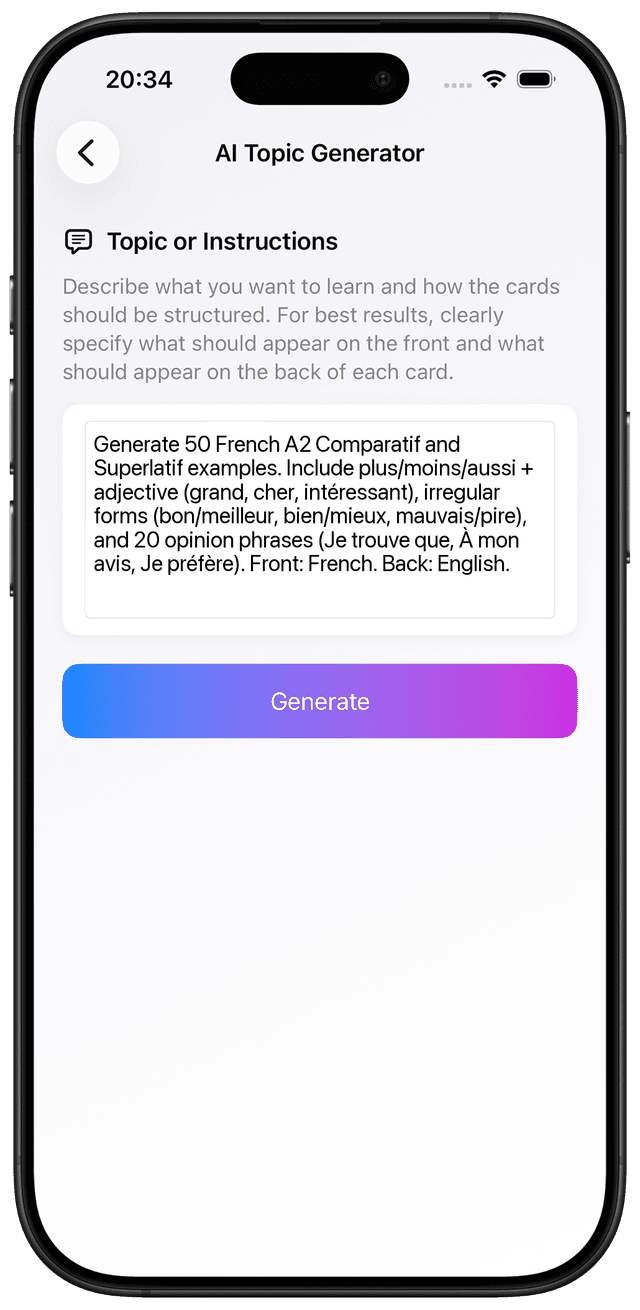
Generate 50 French A2 examples for Comparatif and Superlatif. Include: regular patterns with plus/moins/aussi + adjective (grand, cher, intéressant), irregular forms (bon/meilleur/le meilleur, bien/mieux/le mieux, mauvais/pire/le pire), 20 opinion phrases (Je trouve que, À mon avis, Je pense que, Je préfère, Je suis d'accord, Je ne suis pas d'accord, Ce que j'aime, c'est). Front: French sentence. Back: English + pattern label (Comparatif / Superlatif / Opinion).
French shopping has its own vocabulary layer that A1 never covers. Knowing your taille (clothing size) from your pointure (shoe size), understanding that soldes is a regulated sale period (not a general discount), and asking confidently in a fromagerie or pharmacie all require vocabulary that goes beyond tourist basics. This phase covers it in full.
One thing worth noting about French shopping culture: using the conditional rather than the indicative sounds much more polite. Je voudrais (I would like) is almost always more appropriate than Je veux (I want) in a shop or café. Using the wrong register can genuinely confuse staff or mark you as a tourist who hasn't thought about the language.
Why this is tested: DELF A2 writing and speaking tasks frequently use shopping and service situations because they require practical transactional vocabulary without needing complex grammar structures.
The strategy: This deck mixes product vocabulary, money terms, and useful service phrases so you can handle real-world French transactions confidently.
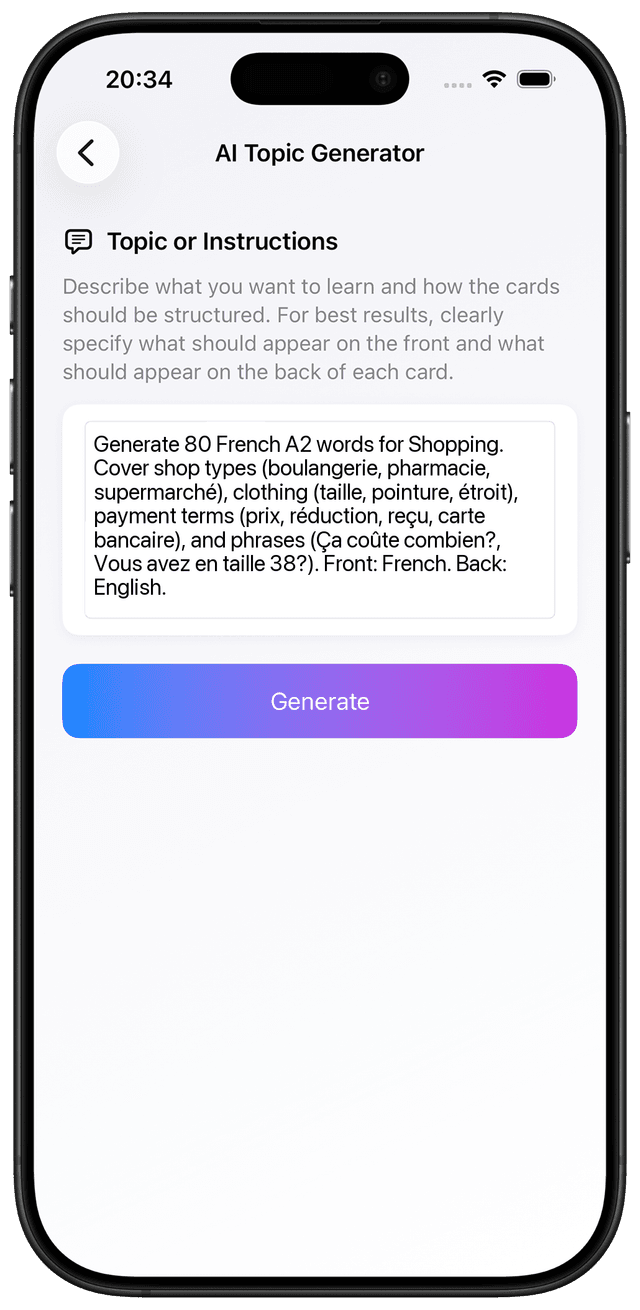
Generate 80 French A2 words and phrases for Shopping and Services. Cover: shop types (boulangerie, pharmacie, supermarché, poste, banque, librairie), clothing and sizes (taille, pointure, étroit, large, cabine d'essayage), payment terms (prix, réduction, soldes, reçu, carte bancaire, payer en espèces), and service phrases (Vous avez ça en taille 38?, Ça coûte combien?, Je voudrais rembourser ça, Est-ce que je peux payer par carte?). Front: French. Back: English.
France has an extensive rail network, and navigating it requires specific vocabulary: quai, départ, correspondance, billet. This phase also covers hotel check-in, giving and following directions, and handling common travel problems in French-speaking countries.
Directions are worth drilling separately from transport. French uses à gauche (left) and à droite (right), but also en face de (opposite), au bout de la rue (at the end of the street), and au feu rouge (at the traffic lights). These appear in DELF A2 listening tasks where someone asks a passerby for directions in a simulated street scenario.
Why travel vocabulary matters: Travel is one of the main topic areas in the DELF A2 exam. The vocabulary here is also immediately practical for anyone spending time in France, Belgium, or any other French-speaking country.
The strategy: This deck combines train, accommodation, and directional vocabulary in one study session. Grouping them means you can follow a French rail journey from buying the ticket to finding the hotel without reaching for a separate word list each time.
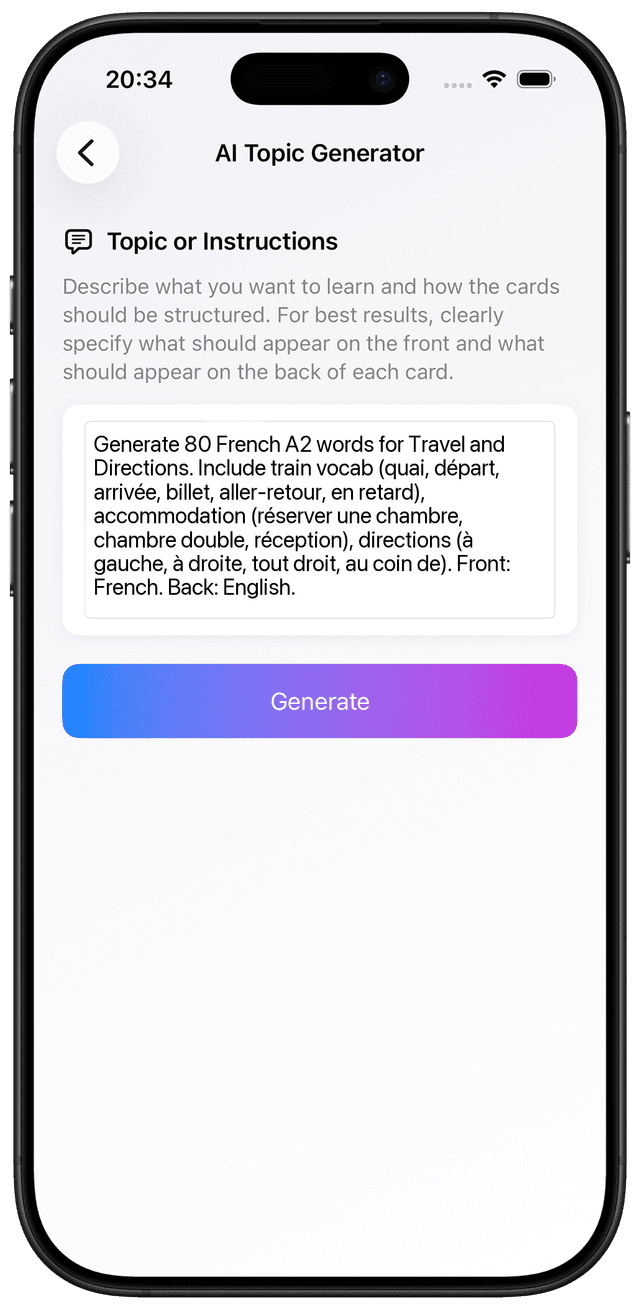
Generate 80 French A2 words and phrases for Travel and Directions. Include: train vocabulary (quai, départ, arrivée, billet, aller-retour, changer de train, en retard), accommodation (réserver une chambre, chambre double, petit-déjeuner inclus, réception, faire le check-out), directions (à gauche, à droite, tout droit, au coin de, en face de, la première rue à gauche), and travel problems (Le train a du retard, Ma valise est perdue, Où est la station de métro la plus proche?). Front: French. Back: English.
The final A2 phase covers three areas that often get skipped but appear in every exam: health vocabulary for describing symptoms and making appointments, work and daily routine language, and the Futur Simple for plans and predictions. French also uses aller + infinitive (Futur Proche) for immediate intentions, and this deck covers both.
The difference between the two future forms comes up more than learners expect. Je vais partir demain (Futur Proche) sounds immediate and conversational, the way English uses 'I'm going to leave.' Je partirai demain (Futur Simple) is slightly more formal and can imply a scheduled or certain event. At A2 level, knowing both and being able to distinguish them puts you ahead of most self-taught learners.
The milestone: With this deck, your A2 French vocabulary is complete. You can now describe past events with the Passé Composé and Imparfait, express reflexive routines, handle shopping and travel, and talk about future plans using both the Futur Proche and Futur Simple. That is the full A2 picture.
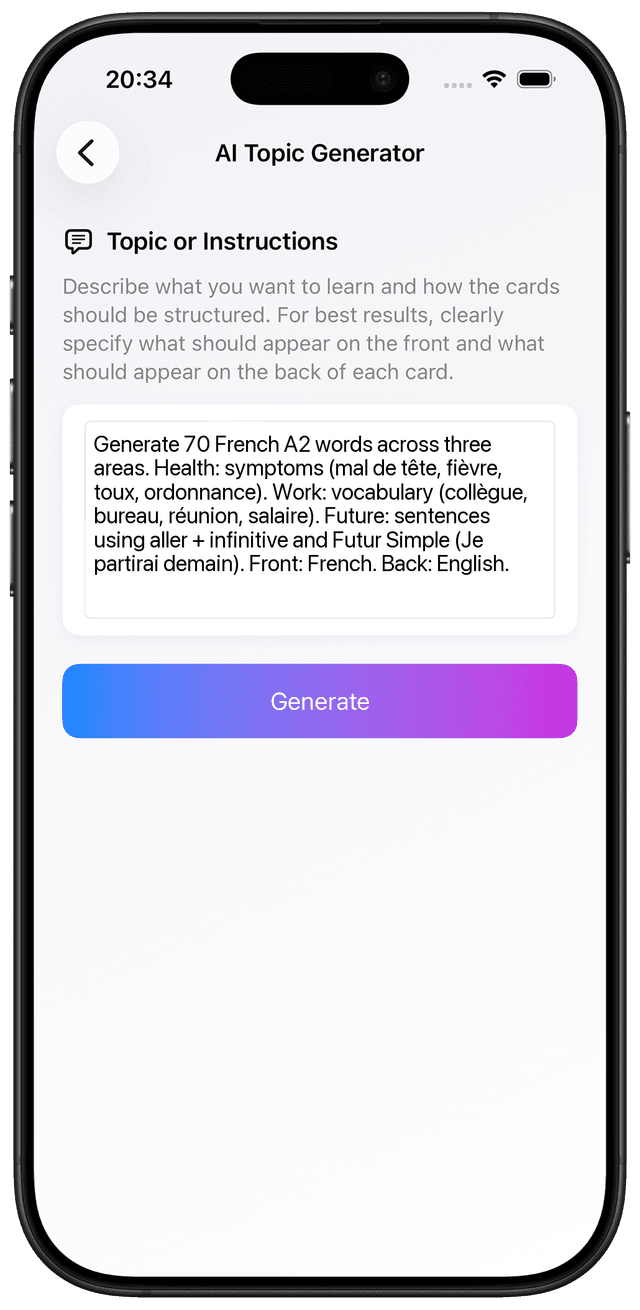
Generate 70 French A2 words and phrases across three areas. Health: symptoms and medical appointments (mal de tête, fièvre, toux, chez le médecin, prendre rendez-vous, ordonnance, comprimés, allergique). Work: job and routine vocabulary (collègue, bureau, réunion, fin de journée, démissionner, salaire, temps plein, temps partiel). Future: 20 sentences comparing aller + infinitive (Futur Proche: Je vais partir demain) with Futur Simple (Je partirai demain) for plans and predictions. Front: French. Back: English + category label (Health / Work / Future).
MindCards uses spaced repetition and active recall, both research-backed, to help you retain A2 vocabulary faster and for longer. The Passé Composé, reflexive verbs, and Imparfait all involve form-plus-meaning pairs that benefit from retrieval practice.
A2 vocabulary sits between the A1 foundation and B1 fluency. Use the links below to move between levels or return to the full French guide.
Build your French A2 vocabulary with AI-generated decks and spaced repetition that adapts to what you actually struggle with. Free to download. No account required. Start with any phase that interests you most.