
Spaced repetition explained
Why reviewing at the right interval locks in French B1 grammar and vocabulary
You have A2 French. You can book a hotel, navigate a train station, and describe your daily routine. B1 is where you stop translating from English in your head and start thinking in French. The gap between A2 and B1 is real, but it is mostly about three things: the subjunctive, the conditional, and the vocabulary you need for opinion, argument, and social topics.
This guide covers all of it in seven phases. Each phase targets a specific B1 gap, from the subjonctif forms that trip up most intermediate learners to the register differences that distinguish natural French from technically-correct-but-flat French. The phases follow the order that DELF B1 preparation tends to reward most.
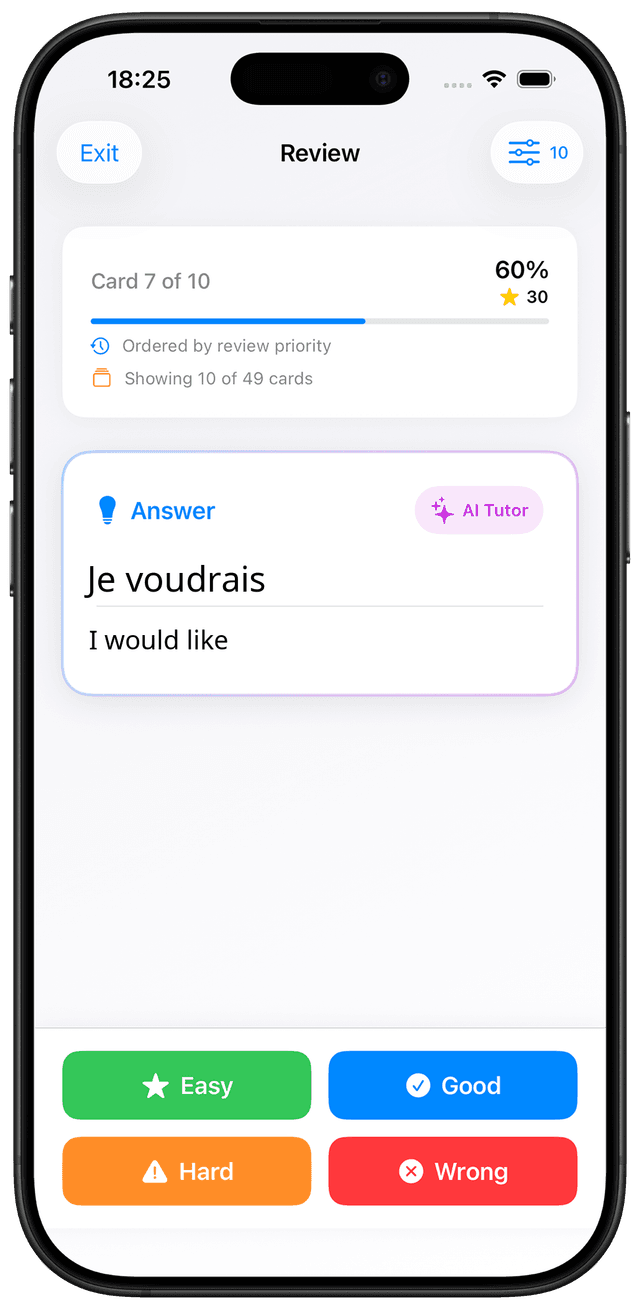
Each phase includes a ready-to-use AI prompt. Copy it into MindCards and you get a focused deck for that exact topic. The app's spaced repetition algorithm spaces your reviews so vocabulary consolidates faster than it would through re-reading or cramming.
The subjunctive is one of the biggest hurdles between A2 and B1 French. English speakers rarely notice it because English barely uses it, but French uses it constantly after expressions of emotion, doubt, desire, and necessity. When someone says il faut que tu partes or je veux qu'il vienne, that last verb is in the subjunctive, not the indicative.
Formation is more regular than its reputation suggests. Most verbs form the present subjunctive from the ils/elles form of the present tense minus the -ent ending, then add: -e, -es, -e, -ions, -iez, -ent. The main exceptions you need to memorize are être (sois, soit, soient), avoir (aie, ait, aient), aller (aille), faire (fasse), and pouvoir (puisse). Learning the trigger expressions is just as important as the verb forms themselves.
Why start here? The subjunctive appears in spoken French constantly. DELF B1 writing and speaking tasks regularly test whether you can produce it accurately under time pressure.
The strategy: This deck pairs subjunctive trigger phrases with correctly conjugated verbs, so you absorb the pattern as a whole rather than as a grammar rule you look up.
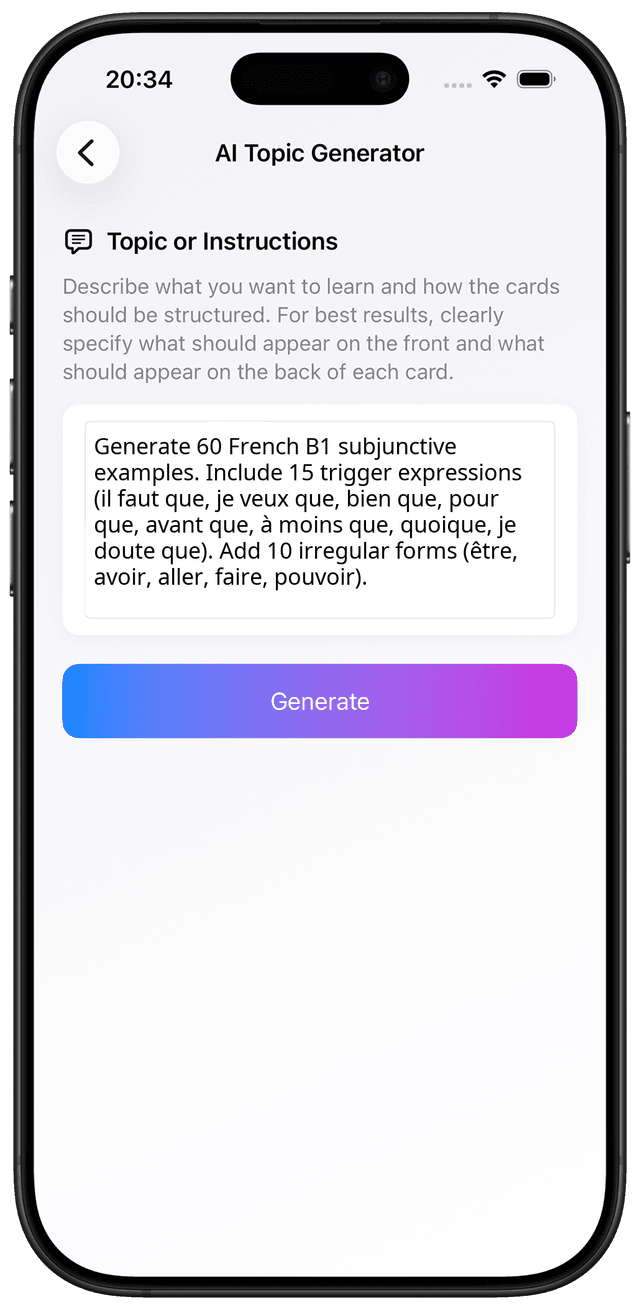
Generate 60 French B1 subjunctive examples. Include 15 trigger expressions (il faut que, je veux que, bien que, pour que, avant que, à moins que, quoique, je doute que, je regrette que, je suis content que). Add 10 irregular subjunctive forms (être, avoir, aller, faire, pouvoir, savoir, vouloir). Front: trigger phrase + infinitive. Back: full subjunctive sentence + English.
The conditional is mainly how French expresses polite requests and hypothetical situations. Je voudrais un café sounds polished; Je veux un café sounds blunt. French speakers notice the difference, and DELF examiners mark it. The si clause structures that appear in B1 exams both use the conditional, so this is not a peripheral grammar point.
Formation is reliable once you know the future stem: take the infinitive (or the irregular future stem for the common verbs), then add the imperfect endings: -ais, -ais, -ait, -ions, -iez, -aient. The si clause structures you need are the present/conditional pair (Si j'avais le temps, je viendrais) and the pluperfect/past conditional pair for past hypotheticals (Si j'avais su, je serais venu). Both appear in DELF B1 tasks.
Why the conditional second? Once you have the subjunctive, the conditional unlocks a different register: polite requests, hypotheticals, and indirect speech. These cover a huge portion of real B1 conversational French.
The strategy: This deck covers the conditional of 40 high-frequency verbs plus the two main si clause structures with natural example sentences showing the contrast between polite and blunt registers.
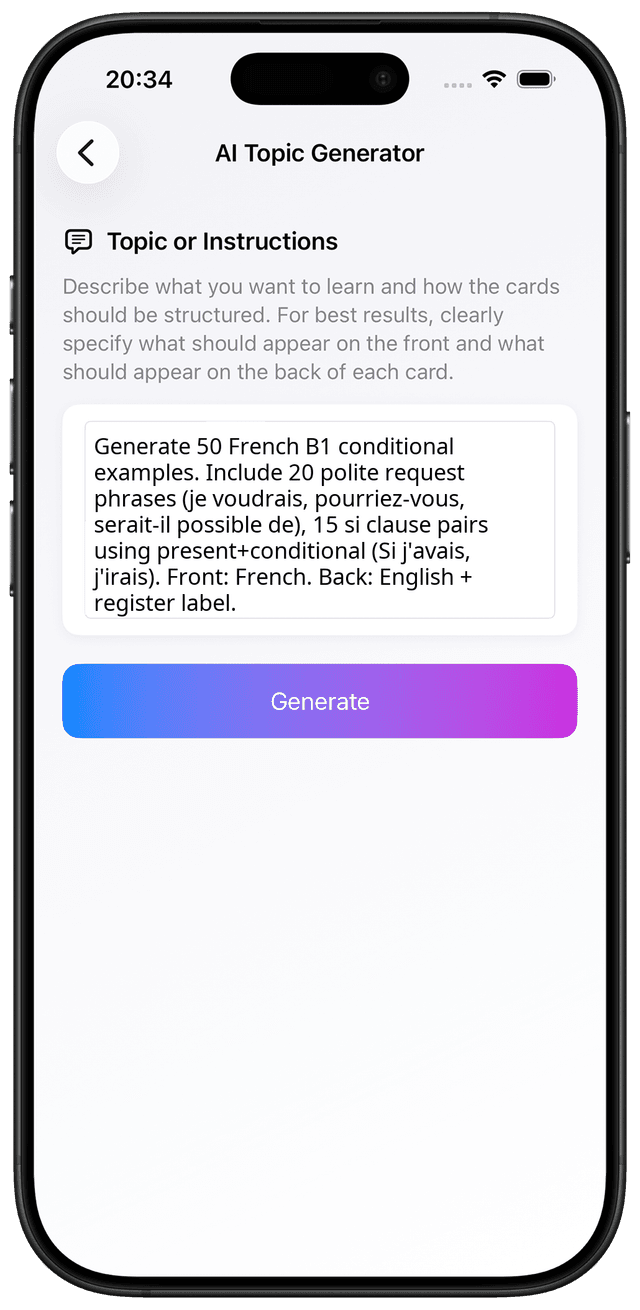
Generate 50 French B1 conditional examples. Include 20 polite request phrases (je voudrais, pourriez-vous, serait-il possible de), 15 si clause pairs using present+conditional (Si j'avais, j'irais), and 15 si clause pairs using pluperfect+past conditional (Si j'avais su, je serais venu). Front: French. Back: English + register label (Polite / Hypothetical / Reported).
At B1 you are expected to argue a point, not just state one. French has a distinct set of phrases for conceding a point, introducing a counter-argument, and drawing a conclusion. Phrases like certes, cependant, en revanche, d'un côté... de l'autre côté, and c'est pourquoi are what separate B1 French from A2 French on paper.
The DELF B1 writing section asks you to produce a structured response, often a short essay or a letter with an argument. Knowing how to open with a thesis, develop with two or three points, concede a counterargument, and close is exactly what the marking rubric rewards. These connectors also come up in B1 listening when a speaker signals a shift in argument.
Why opinion language now? After the subjunctive and conditional, opinion and debate phrases are the vocabulary layer that most affects your writing and speaking score at B1. They make your French sound structured rather than stream-of-consciousness.
The strategy: This deck covers 50 connectors and opinion phrases grouped by function: introducing a point, conceding, contrasting, exemplifying, and concluding.
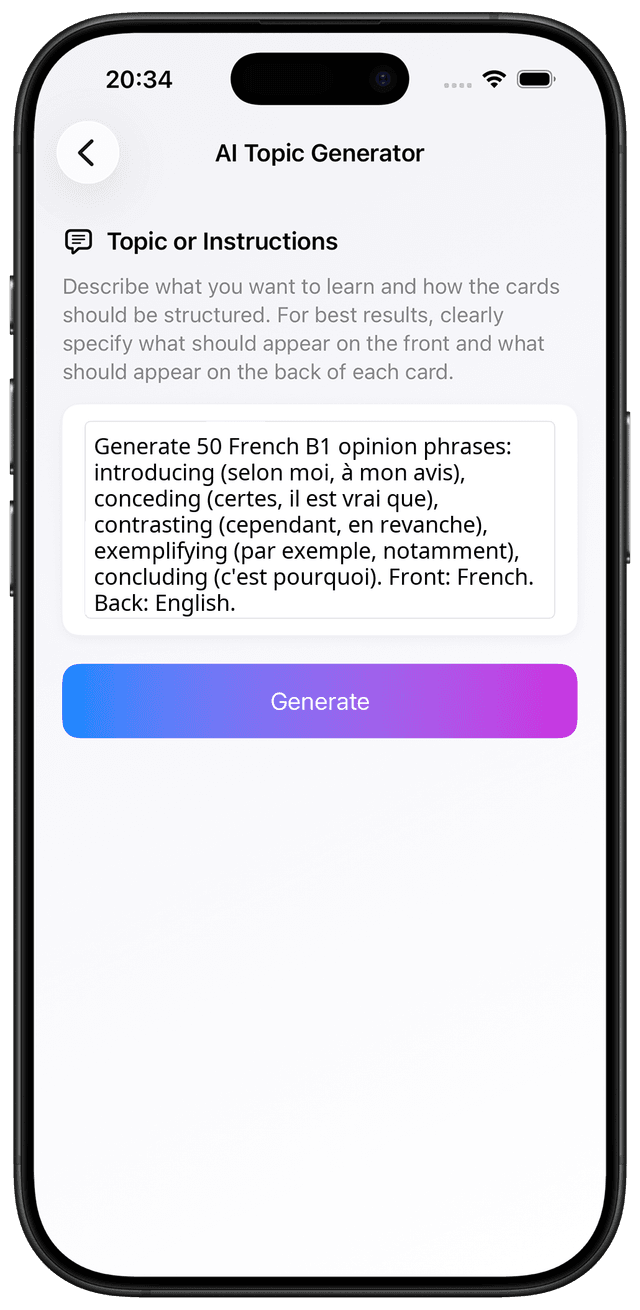
Generate 50 French B1 opinion and debate phrases. Group by function: 10 introducing (selon moi, à mon avis, il me semble que, je suis convaincu que), 10 conceding (certes, il est vrai que, j'admets que), 10 contrasting (cependant, en revanche, pourtant, néanmoins), 10 exemplifying (par exemple, notamment, c'est le cas de), 10 concluding (c'est pourquoi, ainsi, en conclusion). Front: French phrase. Back: English + function label.
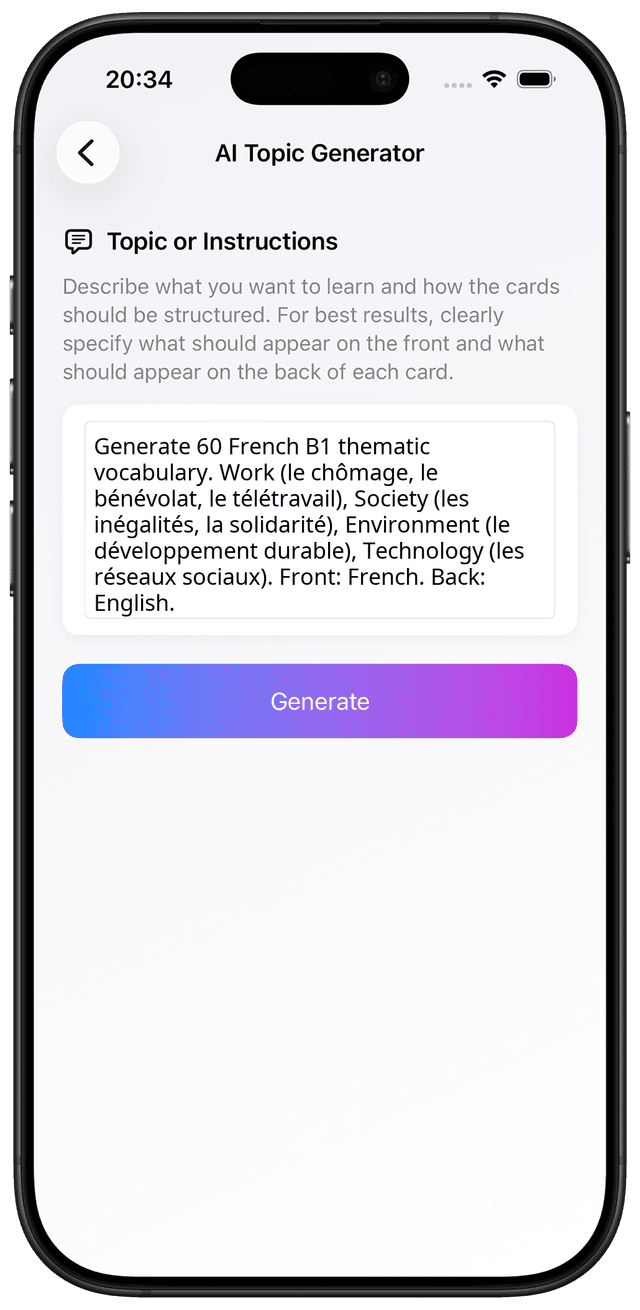
B1 topics in DELF go well beyond personal life. You are expected to read and discuss newspaper-style texts on work, society, environment, and technology. French has specific vocabulary for each of these areas that does not overlap much with everyday A2 words. Le chômage (unemployment), la mondialisation (globalisation), le bénévolat (volunteering), and les inégalités (inequalities) are the kinds of words that appear in B1 reading comprehension tasks.
French media vocabulary is worth studying separately because news language uses structures you won't encounter in conversation: the passive with se voir + infinitive, nominalisations (la hausse de rather than augmenter), and impersonal constructions. This deck introduces them through sentence-level examples rather than isolated word lists, so the context sticks.
Why this now? DELF B1 reading passages are almost always on social topics. Building this vocabulary before the exam means you are not decoding unfamiliar words mid-text under time pressure.
The strategy: This deck groups 70 words and phrases by theme: work and employment, society and equality, environment, and technology. Each entry includes an example sentence from the type of context you encounter in B1 reading tasks.
Generate 70 French B1 thematic vocabulary items. Cover: Work (le chômage, le bénévolat, les syndicats, le télétravail, la formation, l'entreprise), Society (les inégalités, la solidarité, l'intégration, la laïcité, le bénéficiaire), Environment (le développement durable, le réchauffement climatique, les énergies renouvelables, le tri sélectif), Technology (les réseaux sociaux, le numérique, l'intelligence artificielle). Front: French. Back: English + theme label.
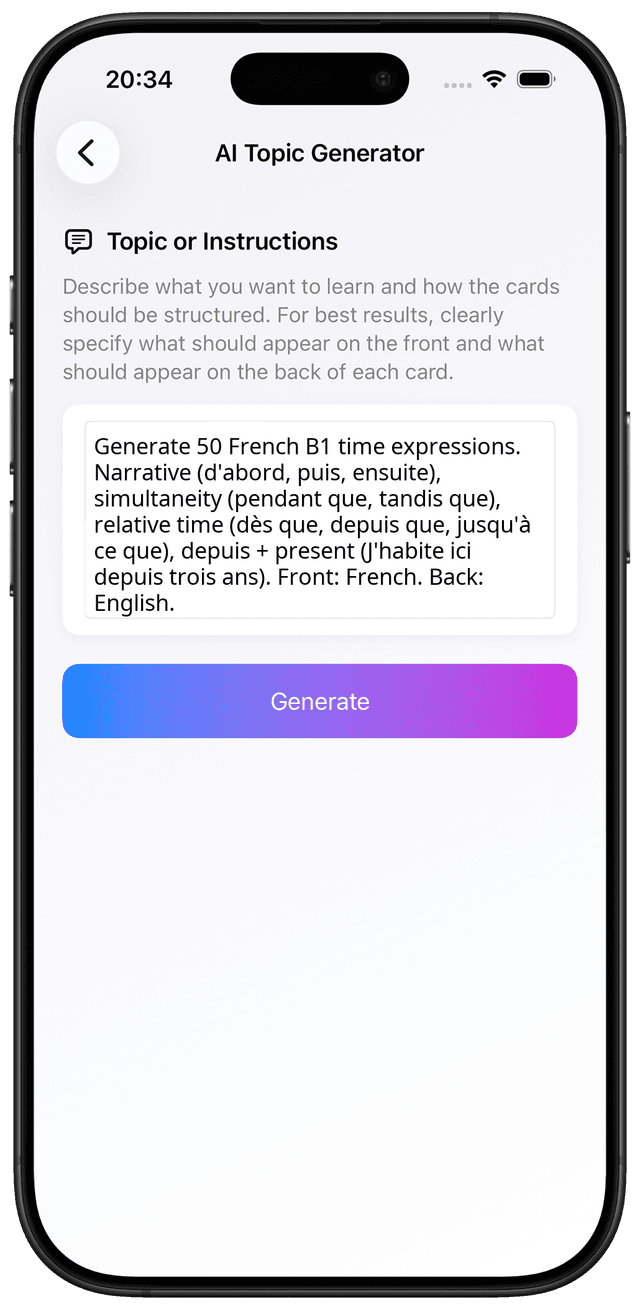
At B1, French narrative moves beyond hier and demain. You need to express sequence within a story (d'abord, ensuite, puis, finalement), describe simultaneous events (pendant que, au moment où, tandis que), and reference relative time (depuis que, jusqu'à ce que, dès que). These expressions are what make a narrative feel structured rather than choppy.
One structure that frequently confuses learners at this level: depuis + present tense for an ongoing action that started in the past. J'habite ici depuis trois ans does not use a past tense in French, which is the opposite of English. Similarly, depuis + imperfect for an action that was ongoing when something else happened. These are the kind of distinctions tested in B1 gap-fill tasks.
Why sequence expressions now? DELF B1 speaking tasks often ask you to describe a sequence of events. These connectors and time expressions are what examiners listen for when they assess your fluency and coherence.
The strategy: This deck covers 50 time expressions and sequence markers with example sentences showing each in its grammatically correct context, including the depuis + present tense pattern and the tandis que / pendant que distinction.
Generate 50 French B1 time expressions and sequence markers. Include: narrative sequence (d'abord, puis, ensuite, enfin, finalement), simultaneity (pendant que, tandis que, au moment où, en même temps que), relative time (dès que, depuis que, jusqu'à ce que, avant que, après que), depuis + present tense examples showing ongoing past actions (J'habite ici depuis trois ans). Front: French. Back: English + usage note.
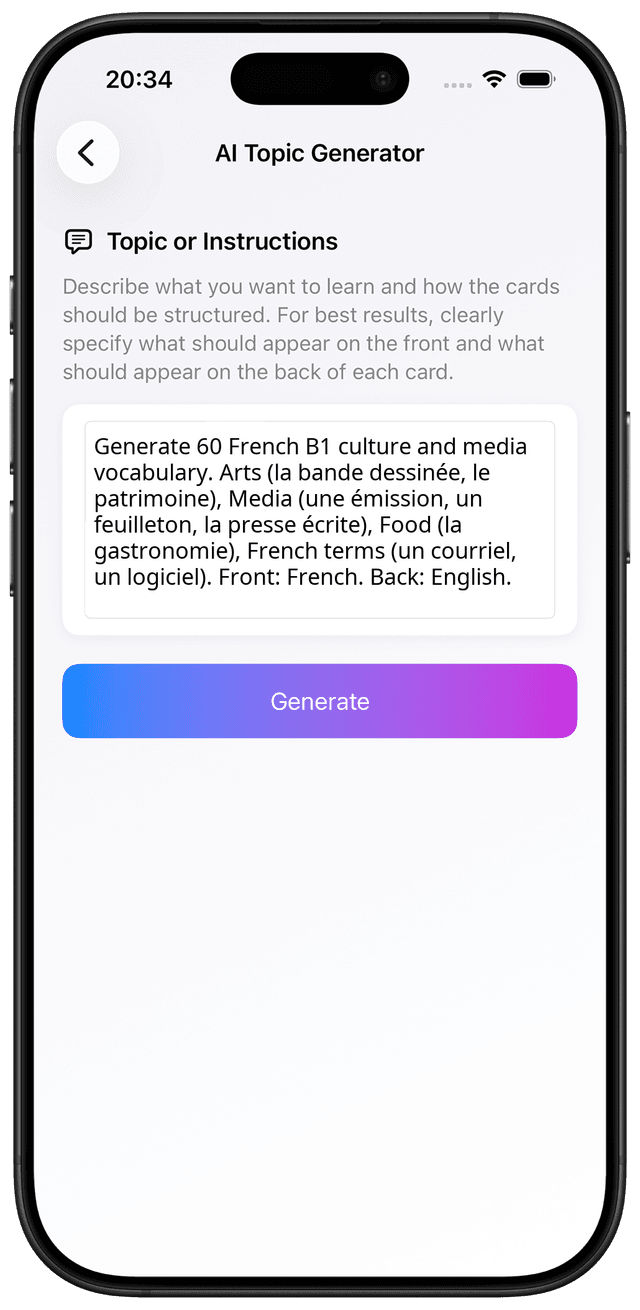
French culture has its own lexical layer: la bande dessinée (graphic novel/comic), le patrimoine (cultural heritage), les grands travaux (major public works projects), and la gastronomie are not just cultural curiosities but vocabulary that appears in B1 reading texts and listening tasks set in France. Media vocabulary also matters: French distinguishes between une émission (broadcast programme), un feuilleton (soap opera), un documentaire, and une série.
France's relationship with its language is also worth understanding because it affects the vocabulary you will encounter. The Académie française's preference for French neologisms over English borrowings means you are more likely to see un courriel than un email in formal French texts, and un logiciel rather than a software. B1 learners who know these French-preferred terms do better in reading comprehension.
Why culture and media vocabulary? DELF B1 listening tasks often use authentic French radio or television extracts. This vocabulary helps you follow the context even when individual words are unfamiliar.
The strategy: This deck covers 60 culture, media, and lifestyle words grouped by area, with notes on register differences where French and English diverge in how they name the same thing.
Generate 60 French B1 culture and media vocabulary items. Cover: Arts and culture (la bande dessinée, le patrimoine, l'exposition, la mise en scène, le réalisateur), Media (une émission, un feuilleton, un documentaire, les médias, la presse écrite, le journal télévisé), Food and lifestyle (la gastronomie, un terroir, les produits du terroir, un marché bio), French-specific terms (un courriel, un logiciel, un ordinateur portable). Front: French. Back: English + context note.
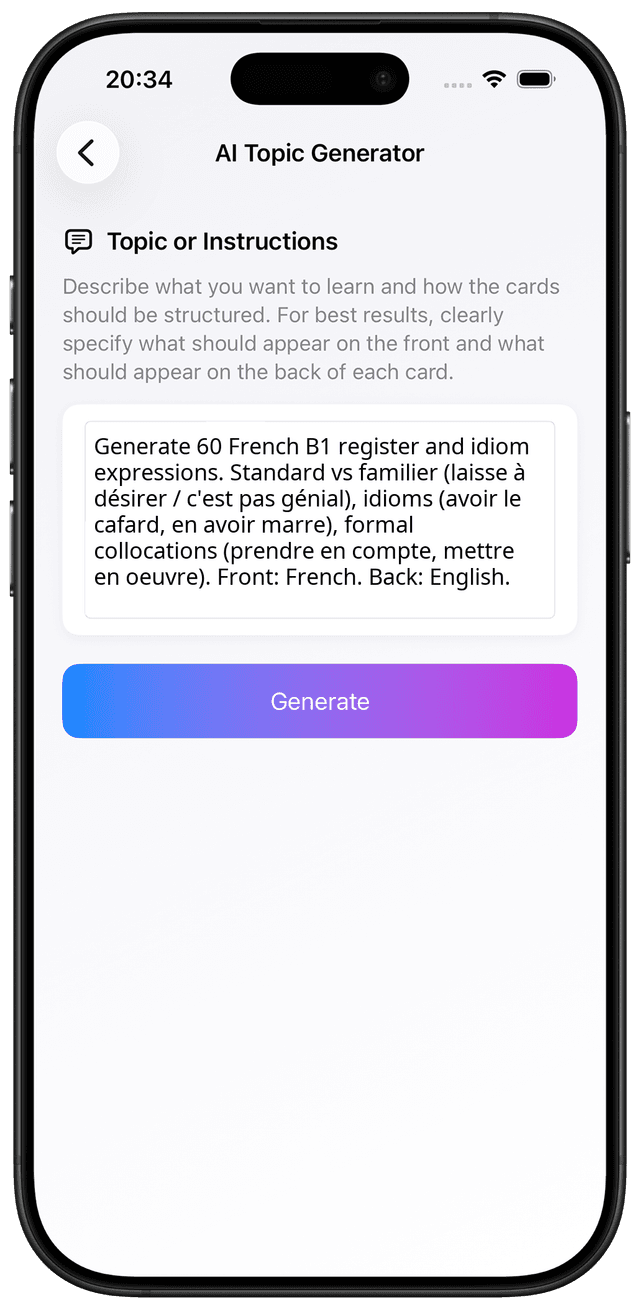
The final B1 phase covers what makes French sound natural versus correct-but-flat. French has three main registers: soutenu (formal written), standard (educated everyday speech), and familier (informal spoken). At B1, you need to recognize all three and produce standard French reliably. Knowing that quelque chose n'est pas génial is informal while quelque chose laisse à désirer is standard is exactly the register awareness DELF B1 tests.
French idioms and fixed expressions are also heavily tested at B1 because they appear in listening and reading extracts from real sources. Expressions like avoir le cafard (to feel down), se mettre au courant (to get up to speed), and en avoir marre (to be fed up) come up in informal contexts; phrases like prendre en compte, mettre en oeuvre, and faire part de appear in formal texts. Knowing both registers lets you handle the full range of B1 input.
The B1 milestone: With this phase complete, your B1 vocabulary is genuinely solid. You can follow a French news broadcast, write a structured opinion essay, hold a conversation on social topics, and handle DELF B1 tasks without constantly reaching for a dictionary. That is a real threshold.
Generate 60 French B1 expressions covering register and idiom. Include: 20 standard-vs-familier pairs (quelque chose laisse à désirer / c'est pas génial), 20 common idioms (avoir le cafard, se mettre au courant, en avoir marre, prendre son temps, faire la grasse matinée, avoir du mal à, s'en sortir), 20 formal collocations used in B1 writing (prendre en compte, mettre en oeuvre, faire part de, tenir compte de). Front: French. Back: English + register label.
B1 grammar structures like the subjunctive and conditional involve form-plus-context pairs that benefit from retrieval practice far more than from reading grammar explanations. MindCards uses spaced repetition and active recall to help you produce these forms accurately under time pressure.
B1 vocabulary sits between the A2 foundation and B2 fluency. Use the links below to move between levels or return to the full French guide.
Build your French B1 vocabulary with AI-generated decks and spaced repetition that adapts to what you actually struggle with. Free to download. No account required. Start with the phase that covers your biggest gap right now.